Realities and Challenges of Support for Children with Special Needs in Nursery
Schools
Kaori Ishiguro*† and Shin-ichi Yoshioka‡
*Graduate School of Medical Sciences, Tottori University, Yonago 683-8503, Japan, †Matsue Co-medical College, Matsue 690-0265, Japan and ‡Department of Nursing Care Environment and Mental Health, School of Health Science, Tottori University Faculty of Medi-cine, Yonago 683-8503, Japan
ABSTRACT
Background Nursery schools and kindergartens have been struggling to cope with increasing numbers of chil-dren with special needs. Hence, we conducted a study on what nursery school teachers (NSTs) will require regarding learning and societal resources for supporting such children in the future.
Methods A questionnaire survey was conducted for 2,476 NSTs employed in 154 nursery schools in Shimane and Kochi Prefectures. The questionnaires were sent by post to officials at each nursery school. The completed questionnaires were collected by the school officials and returned by post. In addition to statistical processing of the survey results, the content of the free description re-sponses was analyzed using the KJ method.
Results Responses were obtained from 1,509 NSTs at 118 nursery schools. Of the respondents, 90.7% had experienced difficulties coping with children with spe-cial needs, and 83.9% were in charge of caring for such children. Such children were enrolled in every childcare facility participating in the survey. The NSTs primarily needed to learn about specific coping methods, the ill-ness, and skills for supporting parents; concerning the societal resources, they needed the addition of assistant NSTs, the implementation of age-five check-up, and the recruitment of mentors. The free description responses were categorized into the following five categories: de-mand for child care administration, cooperation with professional staff, support for parents, developmental health checkups, and on-site needs for nursery childcare. One of the specific demands was to develop human re-sources capable of providing parents with appropriate advice.
Conclusion The results have shown that all NSTs are required to deal with children with special needs. Future challenges for providing support for such children are: Corresponding author: Shin-ichi Yoshioka, MD, PhD
[email protected] Received 2015 December 2 Accepted 2015 December 24
Abbreviations: ESSENCE, early symptomatic syndromes eliciting neurodevelopmental clinical examination; NDD, neurodevelopmen-tal disorder; NST, nursery school teacher; PT, parent training; SST, social skills training
ⅰ) to raise awareness of such children; ⅱ) to eliminate regional disparities; ⅲ) to provide professional training for NSTs specializing in developmental disorders; ⅳ) to train and re-educate assistant NSTs and ⅴ) to enhance infant screening.
Key words children with special needs, developmental disorder, nursery school, nursery school teacher
Various neurodevelopmental disorders (NDDs), which are discussed in the Japanese edition (2014) of “the American Psychiatric Association’s Diagnostic and Statistical Manual of Mental Disorders, Fifth Edition,”1 include intellectual disability, communication disorder, autism spectrum disorder, attention-deficit/hyperactivity disorder, specific learning disorder, and motor disorder including tics. Moreover, the fact that there are cases with NDD wherein individual children suffer from a combination of multiple symptoms of the disorders makes it difficult to diagnose and support such children. Gillberg2 has coined the term “Early Symptomatic Syndromes Eliciting Neurodevelopmental Clinical Ex-amination” (ESSENCE) to refer to children whose de-velopments subtly deviate from what may be considered normal despite having received no clear diagnosis. This term could describe the ones who could be categorized into a group of “children with special needs” (ki ni naru ko, literally “concerned children”) in Japan. It is critical to provide appropriate support according to the symp-toms being presented. In general, in this study, “children with special needs” refers not only to the children whose conditions include mildly delayed intellectual or physical development and maltreatment but also to the children who NSTs considered to be “children with special needs who appear outwardly ordinary” and “children who are left out of a group of children.” In particular, the NSTs should be able to perceive that developmental disorder(s) might underlie problem behavior in a child they are dealing with once they have “noticed” something differ-ent about that child at an earlier stage.
In recent years, it has been noted that there are chil-dren who require early detection and intervention even at the nursery school and kindergarten level.3 Shimono
et al.,4 Nakashima et al.,5 and Kurokawa6 have reported that children with special needs are enrolled in around 70% of nursery schools. Fukuyama et al.7 pointed out that while 40% of the NSTs were aware of and provided support to children with special needs, a considerable number of behaviors and characteristics associated with the developmental disorders remained.
In this study, in light of the present situation of lo-cal support systems, we clarify the societal and learning resources that NSTs need in the future. While discussing how administrative bodies and professionals in fields such as medicine, welfare, psychology, and education should play their roles and render cooperation support for those involved, including the parents, we examined possible future challenges to enhance support for chil-dren and childcare.
SUBJECTS AND METHODS Subjects
The study involved 2,476 NSTs employed at a total of 154 randomly selected nursery schools in Shimane Pre-fecture (n = 79) and Kochi Prefecture (n = 75). The study was conducted from August 2013 to the end of Septem-ber 2013.
Methods
A survey was conducted using an anonymous self-ad-ministered questionnaire. The questionnaires were sent by post to officials at each nursery school along with instructions and return envelopes with a request to dis-tribute the questionnaires to NSTs in their schools. The completed questionnaires were collected by the school officials and returned by post.
Questionnaire contents
The questionnaire was intended to find the attributes of NST respondents; their ideas about children with special needs (where to find information, degree of interest, childcare difficulties, workshop participation, the cur-rent situation of support systems, required learning and societal resources, etc.); and the opinions and requests they wished to address to government and institutional officials (free description).
Questionnaire analysis
For analysis, simple tabulation and cross tabulation were conducted using SPSS version 19 (IBM, Armonk, NY). For statistical testing, the chi-squared (χ2) test was used with a significance level of 5%. Free descriptions con-cerning NSTs’ opinions and requests were classified and categorized using the KJ method for analysis.8
Ethical considerations
Regarding ethical considerations, the study was imple-mented with approval given by the Tottori University School of Medicine Ethics Committee (dated July 22, 2013, approval number 2240) after obtaining prior ap-provals from the respective chairs of the Shimane Pre-fecture Childcare Council and Kochi PrePre-fecture Nursery School Administrative Council. In addition, the ques-tionnaire was accompanied by an explanation document that described the intention, purpose, and ethical consid-erations of the survey. Participation in the study was vol-untary and the choices of the respondents as to whether to cooperate or not was respected. The questionnaire responses were anonymous to ensure the privacy of the participant.
RESULTS
Responses were obtained from a total of 1,509 NSTs (collection rate of 60.9%) of 118 nursery schools (collec-tion rate of 76.6%, from 68 schools in Shimane Prefec-ture and 50 schools in Kochi PrefecPrefec-ture). After exclud-ing incomplete and unclear responses, responses from 1,233 subjects were evaluated for analysis (an effective response rate of 81.7%). For an analysis of free descrip-tions about required learning and societal recourses, responses including some missing data were evaluated. Subject attributes (Table 1)
The majority of the NSTs were in their twenties, and those with ten to twenties years of the experiences out-number other years in the years of experience categories. Two-year colleges accounted for approximately 80% of the institutions where the respondents obtained their accreditation. Moreover, 57.2% of the subjects had op-portunities to take courses in developmental disorders as part of their professional education.
Current situation of the support system (Table 2, 3) The proportion of NSTs who had experienced difficul-ties was 90.7%, and 83.9% of them had been in charge of children with special needs and 48.8% were currently experiencing difficulties caring for children with special needs. The proportion of nursery schools employing NSTs experiencing childcare difficulties was 100%, with 99.2% of all the schools employing teachers with some experience of being in charge of children with special needs, and 95.8% of the schools employing teachers cur-rently in charge of such children.
The proportion of the NSTs who had sought advice about children with special needs in their classes was 79.2%. The first person that these teachers sought advice from was a colleague (72.4%) had sought advice from a
Table 1. Subject Attributes (n = 1,233 )
Item Response n
Occupation Nursery school teacher (homeroom) 978 (79.3)
Nursery school teacher (free) 89 (7.2)
Supervisor 93 (7.6) Principal 73 (5.9) Age 20–29 407 (33.0) 30–39 329 (26.7) 40–49 238 (19.3) 50–59 231 (18.7) 60 and above 28 (2.3)
Years of Experience Less than 5 280 (22.7)
6 to 10 269 (21.8)
11 to 20 379 (30.8)
21 and more 305 (24.7)
Accreditation as nursery school teacher Vocational school 122 (9.9)
Junior college 966 (78.3)
University 65 (5.3)
Nursery school teacher test 80 (6.5)
Opportunity to learn about developmental disorders as a part of professional training
Yes 705 (57.2)
No 528 (42.8)
% in parentheses.
Table 2. Proportion of nursery schools and of nursery school teachers who have felt a sense of difficulty in a child care setting
Item Response No. of nursery school teachers No. of nursery schools
Sense of difficulty in providing child care
Have felt it in the past 1118 (90.7) 118 (100)
Felt it as a homeroom teacher 1034 (83.9) 117 (99.2)
Feeling it presently 602 (48.8) 113 (95.8)
% in parentheses.
school nurse or physician.
School nurses were present in 63.9% of the nursery schools, and while 65.9% of the respondents indicated that they would consult with their school nurses in the event they became concerned about a child’s behavior in the nursery.
Over 60% of the total number of subjects responded that cooperation with school physicians was easy to ob-tain. The professional expertise of school physicians was broken down into pediatrics (61.9%) and internal medi-cine (39.1%).
As for the frequency with which case study meet-ings were held in nursery schools regarding children with special needs, 28.5% of the schools met “regularly,” 47.8% met “when necessary,” and 4.1% met “annually.”
As for the frequency of cooperation with develop-mental support and counseling centers or related insti-tutions established by prefectures or municipals, 4.2%
cooperated monthly, 23.6% cooperated several times a year, 48.1% cooperated only when there was a relevant case.
The proportion of the NSTs who consulted with de-velopment counselors was 55.2%, and the occupations of the circuit development counselors who regularly visited nursery schools were as follows: public health nurses (68.5%), psychotherapists (14.7%), experienced NSTs (7.3%).
Learning required by NSTs (Fig. 1)
Each of “specific coping methods,” “knowledge of disor-ders,” “skills of supporting parents,” and “ways of com-municating with parents” were required by over 96% of the respondents.
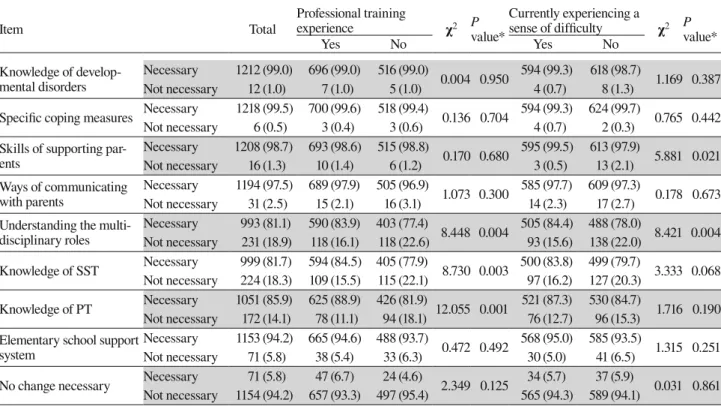
With regard to how the extent of professional educa-tion courses affects a sense of requirement of learning (Table 4), for each of the learning items, the subject
Table 3. Support systems for children with developmental special needs (n = 1,233)
Item Response n
Experience seeking advice about a child with special needs in class. Yes 976 (79.2)
No 257 (20.8)
From whom did you first seek advice about children with special needs? (Multiple Responses) Colleague 893 (72.4) Supervisor 296 (24.0) Administrator 240 (19.5) School nurse 21 (1.7) School physician 21 (1.7) Parents 6 (0.5) Other 28 (2.3)
Relationship with school nurse regarding children with special needs
Present 788 (63.9)
Would/do consult 519 (65.9)
Would not/do not consult 269 (34.1)
Not present 445 (36.1)
Cooperation with school physician as a system for supporting children with special needs
Very easy to access 273 (22.1)
Somewhat easy to access 520 (42.2) Somewhat difficult to access 261 (21.2)
Difficult to access 179 (14.5)
Medical specialty of school physician
Pediatrics 763 (61.9) Internal medicine 482 (39.1) Otorhinolaryngology 28 (2.3) Ophthalmology 19 (1.5) Psychosomatic medicine 16 (1.3) Other 85 (6.9)
Frequency of holding case review meetings about children with special needs
Regularly 351 (28.5)
Occasionally as necessary 589 (47.8)
About once a year 51 (4.1)
Not at all 242 (19.6)
Cooperation with developmental counselling support centers and related agencies
Almost every month 52 (4.2)
Several times a year 291 (23.6)
When there is a relevant case 593 (48.1)
Not at all 297 (24.1)
Involvement of developmental counselors Yes 681 (55.2)
No 552 (44.8)
Occupation of developmental counselor who regularly visits the nursery school
Public health nurse 845 (68.5)
Psychotherapist 181 (14.7)
Speech therapist 106 (8.6)
Experienced nursery school teacher 90 (7.3) University teaching staff 63 (5.1)
Other 252 (20.4)
% in parentheses.
group who had taken the relevant professional educa-tional experience had a keener sense of the necessity of understanding the role of interdisciplinary involvement, social skills training (SST), and parent training (PT) (P < 0.01 in each item) as compared with the subject group without such training. The group with currently expe-riencing a sense of difficulty felt more strongly that the understanding of the role of interdisciplinary involve-ment (P < 0.01) and the skills of supporting parents (P <
0.05) were required learning items.
Societal resources required by NSTs (Fig. 2)
Some of the most required resources were “increasing the number of assistant NSTs,” “implementation of age-five check-up,” and “recruitment of the mentors.”
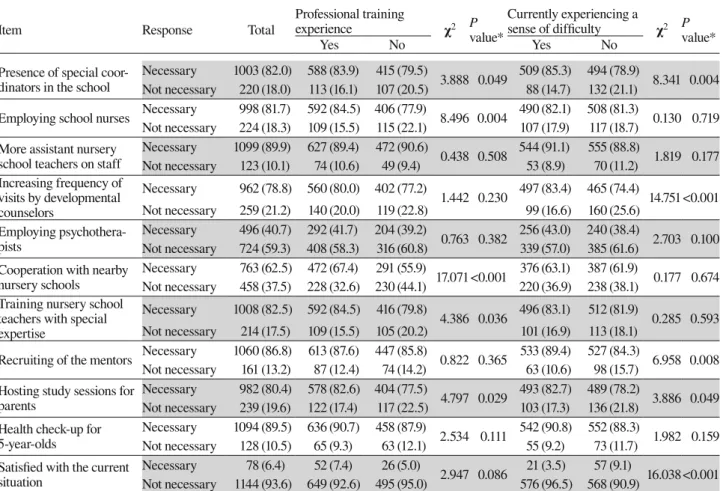
With regard to how the extent of professional educa-tion courses affect a sense of requirement of the societal resources (Table 5), the subject group who had taken
Table 4. Learning items and professional training required, relevance to current sense of difficulty Item Total Professional training experience χ2 P value* Currently experiencing a sense of difficulty χ2 P value* Yes No Yes No Knowledge of develop-mental disorders Necessary 1212 (99.0) 696 (99.0) 516 (99.0) 0.004 0.950 594 (99.3) 618 (98.7) 1.169 0.387 Not necessary 12 (1.0) 7 (1.0) 5 (1.0) 4 (0.7) 8 (1.3)
Specific coping measures Necessary 1218 (99.5) 700 (99.6) 518 (99.4) 0.136 0.704 594 (99.3) 624 (99.7) 0.765 0.442 Not necessary 6 (0.5) 3 (0.4) 3 (0.6) 4 (0.7) 2 (0.3)
Skills of supporting par-ents Necessary 1208 (98.7) 693 (98.6) 515 (98.8) 0.170 0.680 595 (99.5) 613 (97.9) 5.881 0.021 Not necessary 16 (1.3) 10 (1.4) 6 (1.2) 3 (0.5) 13 (2.1) Ways of communicating with parents Necessary 1194 (97.5) 689 (97.9) 505 (96.9) 1.073 0.300 585 (97.7) 609 (97.3) 0.178 0.673 Not necessary 31 (2.5) 15 (2.1) 16 (3.1) 14 (2.3) 17 (2.7)
Understanding the multi-disciplinary roles Necessary 993 (81.1) 590 (83.9) 403 (77.4) 8.448 0.004 505 (84.4) 488 (78.0) 8.421 0.004 Not necessary 231 (18.9) 118 (16.1) 118 (22.6) 93 (15.6) 138 (22.0) Knowledge of SST Necessary 999 (81.7) 594 (84.5) 405 (77.9) 8.730 0.003 500 (83.8) 499 (79.7) 3.333 0.068 Not necessary 224 (18.3) 109 (15.5) 115 (22.1) 97 (16.2) 127 (20.3) Knowledge of PT Necessary 1051 (85.9) 625 (88.9) 426 (81.9) 12.055 0.001 521 (87.3) 530 (84.7) 1.716 0.190 Not necessary 172 (14.1) 78 (11.1) 94 (18.1) 76 (12.7) 96 (15.3)
Elementary school support system
Necessary 1153 (94.2) 665 (94.6) 488 (93.7)
0.472 0.492 568 (95.0) 585 (93.5) 1.315 0.251 Not necessary 71 (5.8) 38 (5.4) 33 (6.3) 30 (5.0) 41 (6.5)
No change necessary Necessary 71 (5.8) 47 (6.7) 24 (4.6) 2.349 0.125 34 (5.7) 37 (5.9) 0.031 0.861 Not necessary 1154 (94.2) 657 (93.3) 497 (95.4) 565 (94.3) 589 (94.1)
% in parentheses. *χ2 test and Fisher’s exact probability test. PT, parent training; SST, social skills training.
Fig. 1. Learning items necessary for nursery school teachers to support children with special needs and their parents. Multiple answers permitted in the question.
5.8 80.5 81.0 85.2 93.5 96.8 98.0 98.3 98.8 93.6 18.7 18.2 13.9 5.8 2.5 1.3 1.0 0.5 0 20 40 60 80 100 現状で十分 多職種の役割理解 SST PT 小学校での支援体制 保護者への伝え方 保護者対応のスキル 疾患の知識 具体的対応策
Specific coping measures Knowledge of developmental disorders Skills of suppor8ng parents Ways of communica8ng with parents Elementary school support system Knowledge of parent training Knowledge of social skills training Understanding mul8disciplinary roles No change necessary
Table 5. Social resources and professional training required, relevance to current sense of difficulty
Item Response Total
Professional training experience χ2 P value* Currently experiencing a sense of difficulty χ2 P value* Yes No Yes No
Presence of special coor-dinators in the school
Necessary 1003 (82.0) 588 (83.9) 415 (79.5)
3.888 0.049 509 (85.3) 494 (78.9) 8.341 0.004 Not necessary 220 (18.0) 113 (16.1) 107 (20.5) 88 (14.7) 132 (21.1)
Employing school nurses Necessary 998 (81.7) 592 (84.5) 406 (77.9) 8.496 0.004 490 (82.1) 508 (81.3) 0.130 0.719 Not necessary 224 (18.3) 109 (15.5) 115 (22.1) 107 (17.9) 117 (18.7)
More assistant nursery school teachers on staff
Necessary 1099 (89.9) 627 (89.4) 472 (90.6) 0.438 0.508 544 (91.1) 555 (88.8) 1.819 0.177 Not necessary 123 (10.1) 74 (10.6) 49 (9.4) 53 (8.9) 70 (11.2) Increasing frequency of visits by developmental counselors Necessary 962 (78.8) 560 (80.0) 402 (77.2) 1.442 0.230 497 (83.4) 465 (74.4) 14.751<0.001 Not necessary 259 (21.2) 140 (20.0) 119 (22.8) 99 (16.6) 160 (25.6) Employing psychothera-pists Necessary 496 (40.7) 292 (41.7) 204 (39.2) 0.763 0.382 256 (43.0) 240 (38.4) 2.703 0.100 Not necessary 724 (59.3) 408 (58.3) 316 (60.8) 339 (57.0) 385 (61.6)
Cooperation with nearby nursery schools
Necessary 763 (62.5) 472 (67.4) 291 (55.9)
17.071<0.001 376 (63.1) 387 (61.9) 0.177 0.674 Not necessary 458 (37.5) 228 (32.6) 230 (44.1) 220 (36.9) 238 (38.1)
Training nursery school teachers with special expertise
Necessary 1008 (82.5) 592 (84.5) 416 (79.8)
4.386 0.036 496 (83.1) 512 (81.9) 0.285 0.593 Not necessary 214 (17.5) 109 (15.5) 105 (20.2) 101 (16.9) 113 (18.1)
Recruiting of the mentors Necessary 1060 (86.8) 613 (87.6) 447 (85.8) 0.822 0.365 533 (89.4) 527 (84.3) 6.958 0.008 Not necessary 161 (13.2) 87 (12.4) 74 (14.2) 63 (10.6) 98 (15.7)
Hosting study sessions for parents
Necessary 982 (80.4) 578 (82.6) 404 (77.5)
4.797 0.029 493 (82.7) 489 (78.2) 3.886 0.049 Not necessary 239 (19.6) 122 (17.4) 117 (22.5) 103 (17.3) 136 (21.8)
Health check-up for 5-year-olds
Necessary 1094 (89.5) 636 (90.7) 458 (87.9)
2.534 0.111 542 (90.8) 552 (88.3) 1.982 0.159 Not necessary 128 (10.5) 65 (9.3) 63 (12.1) 55 (9.2) 73 (11.7)
Satisfied with the current situation Necessary 78 (6.4) 52 (7.4) 26 (5.0) 2.947 0.086 21 (3.5) 57 (9.1) 16.038<0.001 Not necessary 1144 (93.6) 649 (92.6) 495 (95.0) 576 (96.5) 568 (90.9) % in parentheses. *χ2 test. 6.3 40.2 61.9 78.0 79.6 80.9 81.3 81.8 86.0 88.7 89.1 92.8 58.7 37.1 21.0 19.4 18.2 17.8 17.4 13.1 10.4 10.0 0 20 40 60 80 100 現状で満足 心理士採用 近隣保育所との連携 巡回発達相談の回数増加 保護者向け勉強会の開催 園内看護師の採用 調整役の存在 専門保育士の人材育成 助言者の確保 5歳児健診の実施 加配保育士の増員 (%) More assistant nursery school teachers on staff
Health check-‐up for 5-‐year-‐olds RecruiEng of the mentors Training nursery school teachers with special experEse Presence of special coordinators in the school Employing school nurses HosEng study sessions for parents Increasing frequency of visits by developmental counselors CooperaEon with nearby nursery schools Employing psychologists SaEsfied with currently situaEon
Fig. 2. Social resources necessary for nursery school teachers to support children with special needs and their parents. Multiple answers permitted in the question.
the relevant professional educational experience had a keener desire for cooperation with nearby nursery schools (P < 0.001) as compared with the subject group without such training. They also felt a greater necessity of the employment of school nurses (P < 0.01). Further-more, the group with relevant professional educational experience was also somewhat more affirmative with having special support coordinator personnel in nursery schools, training of a professional NST specializing in developmental disorders, and convening the study ses-sion for the parents (P < 0.05).
As shown in Table 5, the group with currently expe-riencing a sense of difficulty felt the strongest desire to
increase the number of visits by the itinerant counselors (P < 0.001) as well as a stronger desire for the presence of coordinating personnel and the recruitment of the mentors (P < 0.01), with many also indicating the desire to host parent-oriented study sessions (P < 0.05). While over 80% of both groups favored the training of profes-sional NSTs specializing in the developmental disorders. Opinions and requests to administrative bodies and institutions (Table 6)
The collected free description responses using the KJ method into 26 subcategories, were then grouped into the following five categories: i) requests for the childcare
Table 6. Classification of nursery school teachers’ opinions and requests to administrative and institutional officials
Requests for childcare administrative bodies (n = 90) Response
Desire to increase the total capacity of nursery school teaching staff and implement a smaller homeroom system 29 (32.2) Augmenting staff in specialized departments and improving classroom environments to facilitate cooperation 21 (23.3) Increasing operating funds and insufficient subsidies (not enough for paying assistant nursery school teachers) 16 (17.9) Childcare system that can easily provide assistant nursery school teachers (institutionalized by the national
govern-ment) and new childcare systems 12 (13.3)
Expansion of Rehabilitation Centers (Counseling sites are too far, which causes delayed response) 5 (5.6) Concerns about the acceptance of children with disabilities under a new system that would involve "certification of
childcare needs" 4 (4.4)
Desire to be led to appropriate treatment agencies by administrative guidance 2 (2.2) Maintaining the current system to provide assistant nursery school teachers 1 (1.1) Cooperation with professional staff (n = 77)
Increasing the number of psychotherapists and counselors who can provide accurate, personalized advice 24 (31.2)
Implementing systematic skill training 19 (24.7)
Desire to increase the number of visits by developmental counselors to ensure their grasp of the on-site situation 11 (14.3) Desire for opportunities to learn (e.g., through case studies) together with specialized staff such as developmental
counselors and public health nurses 11 (14.3)
Desire for close cooperation with rehabilitation centers and specific opinions by attending physicians 5 (6.5)
Training nursery school teachers with medical expertise 4 (5.2)
Regular visits to nursery schools by childcare instructors 3 (3.8)
Desired changes for developmental health check-up (n = 34)
Desire to conduct health check-up for 5-year olds (few opportunities for children to see specialists until they reach
school-age) 13 (38.2)
Desire to perform a close examination to detect disabilities at the health check-up for 3-year-olds (overlooked in many
cases) 9 (26.5)
Need to review how the health check-up for 5-year-olds should be (improve the quality of the staff, etc.) 4 (11.8) Requests to physicians: improve the institutions (e.g., assistant teacher staff) based on their diagnosis 4 (11.8) Clarify the real situation of the follow-up after the health check-up for 5-year-olds; Passing on the information to those
involved after school enrolment 3 (8.8)
Desire to mitigate parents’ distress caused by knowing the result of 1.5 year health check-up 1 (2.9) Desired changes for supporting parents (n = 16)
Providing opportunities to interact with parents to maintain positive relationships with them 14 (87.5) Improving the role of nursery school teachers to support the independence of children requiring rehabilitation 2 (12.5) On-site childcare needs (n = 8)
Appreciating the importance of working as a team among nursery school teachers 5 (62.5)
Expanding freedom for principal’s assistants 2 (25.0)
Needing a full-time assistant nursery school teacher to do a job using the physicians’ diagnosis (to secure safety) 1 (12.5) % in parentheses.
administration; ii) cooperation with the professional staff; iii) check-up for developmental health; iv) ways of supporting parents and v) on-site childcare needs. Requests for the childcare administration was expressed by most respondents, with many expressing requests related to staffing, such as increasing the total capacity of the NSTs and reducing the number of children per homeroom, and other requests such as improving the classroom environment and augmenting staff in the spe-cialized departments. The next most popular request was cooperation with professional staff, with many express-ing expertise-related requests, such as increasexpress-ing the number of psychotherapists and counselors and imple-menting a systematic skills training. In the third place, with regard to check-up for developmental health, the implementation of age-five check-up was most desired. As for ways of supporting parents, there was a request for opportunities to interact with parents to maintain a positive relationship with them. As for the on-site child-care needs, there was a desire for fostering positive rela-tionships with the fellow teachers as a team.
DISCUSSION
Since it was found that children with special needs, whom the teachers felt difficult to cope with, were en-rolled in all the target schools, it became evident that all NSTs were required to cope with children with special needs (Table 2).
The number of NSTs who consulted with their col-leagues was 72.4% (Table 3). In addition, from their school discussions and case review meetings, it was in-ferred that they would implement a policy to cooperate with specialized agencies. These results were thought to suggest that approximately 80% of the respondents de-sired to attempt solutions through such regular coopera-tion. The proportion of respondents who consulted with school nurses was 65.9%. In nursery school with nurses on staff, Tsuda et al.9 reported that approximately 50% of the staff consulted with their nurses. While it is de-sirable that nurses be assigned as nursery school staff members, it is required that they be more involved in consultation as a part of child care support, along with health and safety management of children with special needs.
For NSTs, school physicians are the most accessible medical professionals. The proportion of subjects who responded that they found it relatively easy to liaise with school physicians on a daily basis was 64.3%. While the principal task of school physicians is normally to visit schools on several occasions throughout the year, it is desirable that physicians be actively involved in provid-ing support for children with special needs. Takada et
al.10 also indicated the necessity of having dedicated physicians able to offer counsel to each nursery school regarding developmental issues. If school physicians view themselves as members of the nursery school staff and observe children on a continuous basis through regular school visits, then they would notice any abnor-malities and share their observation with parents and other NSTs. This we believe will help build a system that better facilitates consultations regarding subsequent approaches.
Among the choices of learning required by NSTs, the following items were seen to be needed from the perspective of NSTs (Fig. 1).
As a quality of the experts from whom NSTs would like to seek advice regarding children with special needs, “offering suggestions about specific meth-ods” was desired, as was noted by Hidaka et al.11 and Kuboyama et al.12 In addition, to understand specific coping methods, it is important to gain accurate and basic knowledge about the disorders that a child might have. If NSTs are able to grasp the mechanisms that give rise to behaviors that should not be considered as those of spoiled or selfish children but as symptomatic of an underlying disorder, then a better understanding of children with special needs will be obtained. For this reason, holding workshops with physicians and other medical and psychological professionals will be impor-tant.
NSTs also felt that supporting parents was as im-portant as dealing with children with special needs. As reported by Inoue et al.,13 it was found that many NSTs sensed the importance of ways of listening to and speaking with parents, and desired to learn them. It is important for NSTs to not only inform the current state of the children with special needs to their parents who are not mentally prepared for that fact but also display an attitude and demeanor that is sympathetic toward the parents who may be shocked and bewildered with such information.
It became evident that the foremost social resource demanded by NSTs was increasing the number of as-sistant NSTs (Fig. 2). It is necessary to have asas-sistant NSTs to alleviate the physical and psychological burden on teachers. This suggestion seems to be backed by re-ports that state the staffing shortages might be related to the increase in the number of children with tendencies toward developmental disorders and the prevalence of burnout among NSTs.14
The second highest score of responses was to call for the implementation of five check-up. The age-five check-up is an optimal time to ensure the observa-tions made by NSTs and to promote awareness among
parents. It has been reported that a majority of NSTs lack professional expertise regarding developmental and behavioral disorders,15 suggesting the possibility that the recognition could be delayed. However, there are also reports stating that, while cognitive delays in children with developmental disorders begin to be discernible at around the age of two years old, with careful observa-tion, most cases can be diagnosed by the age of five.16 Gillberg2 reports that even when major symptoms of ESSENCE begin to appear, there are many cases where diagnoses are not sufficiently certain before the age of five, and that the drafting of intervention plans and follow-up diagnoses are important. In addition, it is also reported that since factors such as an environment and parents’ level of education influence social attitudes and hyperactivity of the children, it is important to have medical check-ups between the ages of five and six.17
The conventional way of examination overlooked half of the cases of mild developmental disorders. By conducting check-ups at the ages of three and five and combining these with detailed observation records, indi-vidual interviews, and questionnaire surveys performed by NSTs, the ratio of overlooking high-functioning pervasive developmental disorders can be broadly re-duced. Furthermore, the age-five check-up can serve as a screening for developmental disorders to be found, and the period around age five is known as the preparatory period for school enrollment, and thus, it is positioned at an ideal time, neither too early nor too late, to detect a type of the disorder.18 In addition, by knowing the re-sults of the age-five check-up, understanding what is go-ing on with a child will be easier if problems arise after enrollment in a school, suggesting that it would be easier to provide them with support from the teachers.19
Even when NSTs become concerned about behavior-al or emotionbehavior-al aspects of children’s development, they did not feel the desire to convey such concerns directly to the parents and often experienced difficulties when dealing with them. Partnering with experts would allow for not only the strengthening of the relationship be-tween NSTs and parents but also making the children’s lives better. In anticipation of what would await for time to come, it is important to perform health check-ups at the proper time and to continue supporting children with special needs and their parents.
The desire for the recruitment of mentors was third. Specifically, NSTs sought experts to advise them on matters including disorder-related knowledge, and skills of supporting and communicating to parents, and they desired to be able to obtain multi-disciplinary advice in a timely and regular manner.
However, as reported by Miyake,20 there are very
few mentors with specialized knowledge of develop-mental disorders of young children, and it is challenging to secure and train mentors who can play an active part in the field.
We investigated whether there was any associa-tion between either experience taking a professional educational course on developmental disorders or ongo-ing feelongo-ings of difficulty in dealongo-ing with children with special needs and learning items and societal resources required by NSTs.
The result showed that both those who had under-gone the professional education and those experiencing ongoing feelings of difficulty significantly felt the need for understanding the multi-disciplinary approach. In terms of cooperation, some desire to know what types of occupations exist and the specific duties of those likely to be involved, such as public health nurses, psycho-therapists, and speech therapists. The investigation also found that those who had pursued professional educa-tion strongly felt the importance of PT and SST and felt more strongly about the necessity of knowledge of the disorders. Those experiencing the ongoing difficulties strongly felt the need for skills of responding parents.
With regard to the relevance of the required societal resources, those who had pursued professional educa-tion felt strongly about cooperating with nearby nursery schools and employing school nurses, and many of them felt the need to hold study sessions for parents, to train NSTs with relevant expertise, and to ensure the presence of the special support coordinator. And, those experienc-ing ongoexperienc-ing difficulties had a strong feelexperienc-ing about the necessity of personnel able to provide advice when dif-ficulties arose, thus expecting to increase the number of visits by development counselors, recruiting mentors, or ensuring the presence of a special support coordinator in nursery schools.
Asked to provide their frank opinion on the child-care administrative bodies and institutions, the respon-dents provided responses that were divided into five categories, as shown in Table 6. Regarding cooperation with professional staff, the proportion of responses “to increase the number of psychologists and counselors capable of offering accurate and individualized advice” was 31.2%. These respondents expressed their desire to enlist cooperation and participation from professionals.
The term “cooperation” in providing support here is defined as: i) mutual sharing of information among experts; ii) evaluation and analysis from a multidisci-plinary perspective; iii) determination of a direction of the support and iv) leveraging of societal resources to provide the support, of which it is significant that ii) and iii) are firmly conducted by professionals.
In our survey, 68.5% of visiting developmental counselors was public health nurses; this is the highest ratio, followed by psychotherapists (14.7%). The survey revealed that psychotherapists capable of providing ad-vice on regular and timely basis are required more than psychotherapists working in nursery schools full-time. Similarly, Hidaka et al.11 reported that clinical psycho-therapists are the experts from whom advice was most eagerly sought, presumably because there was likely a need for a counseling form of support that could rec-ognize NSTs’ sense of difficulty. The presence of psy-chotherapists in a support role for children with special needs and their parents is expected to be effective in making social adaptation possible, assisting them with forming a sense of attachment.
The kind of support for children with special needs, which NSTs can provide by making the most use of their expertise, is to quickly identify children who experi-ence difficulties in kindergarten because of their unique characteristics in a group living and to make careful observations for compiling the childcare record so that they can enlist proper assistance and cooperation from professionals.
Many expressed their desire to “augment staff in specialized departments” and “improve an environment that would facilitate regular cooperation.” With this point, it is expected that seeking advice and planning cooperation from a multidisciplinary standpoint (involv-ing, e.g., physicians, public health nurses, psychologists, speech therapists, occupational therapists, elementary school teachers, and administrative staff) would give a direction for both short- and long-term support and lead to the effective utilization of social resources.
Mori et al.21 reported that kindergartens and nursery schools do not fully understand the role of professionals who conduct periodic counseling visits. Furuichi22 has examined how to work together with visiting counselors and has indicated the need for improving mutual com-munication and understanding. In addition, Sano et al.23 suggested that there are regional differences to coopera-tion and that there is an urgent need to expand institu-tions in keeping with local childcare needs.
With regard to “a systematic skill training,” Ha-raguchi et al.,24 consistent with the results of our own study, pointed out that while NSTs do not lack desire for further training, implementation of the training in most nursery schools is actually inadequate and consideration should be given to training methods with a high degree of effectiveness and efficiency.
More than half of the free descriptions showed a desire to increase the number of assistant NSTs and sug-gested that more inclusive childcare can be realized if
the NST shortage could be resolved.
The Comprehensive Support system for Children and Childcare was launched in April, 2015. Accord-ingly, it would be desirable in the future to construct a more comprehensive system of childcare for children with special needs.
Concerning challenges related to childcare for children with special needs and measures for handling these, the results of this study suggest the following. i) Improving awareness of children with special devel-opmental needs: most, if not all, of the nursery schools enroll children with special needs, and if NSTs are cur-rently coping with the difficulty, they should first gain a firm understanding of normal development and acquire knowledge about developmental disorders. We recom-mend that they should spend ample time for hands-on childcare training in training courses for NSTs. In addition, we would also wish that parents have more learning opportunities to gain knowledge about devel-opmental disorders. ii) Eliminating regional differences: there should be no shortage of societal resources, such as inadequate personnel, who should cooperate among themselves, caused by local circumstances. Continuous cooperation is also necessary, and to achieve it, human resources should be developed and cooperation systems, including administrative bodies, should be constructed. It is also important to gain an accurate and timely un-derstanding of local childcare needs. iii) Training of NSTs specializing in developmental disorders: training professional NSTs by, for example, cooperating with developmental support centers in order for them to play a central role is necessary. For instance, this role would be a position similar to specialist nurses at visiting nurse stations. Such staff would play a leadership role in, for example, case review meetings held in nursery schools. iv) Training and reeducating assistant NSTs: in the context of a nationwide shortage of NSTs, it will be im-portant to offer rewards to accredited NSTs and employ them after arranging for their re-training as well as to guarantee their employment on a multi-year basis rather than a single-year basis if possible. v) Enhancing infant health check-up: since it is possible that children with special needs or with clear physical or cognitive devel-opmental disorders included among those who have yet to undergo health check-ups, it is important that follow-up and dialogue with those involved, including parents, should be performed. In parenting counseling sessions conducted at the same time for five-year-olds, an effort should be made to deepen parents’ understanding and cope with their anxieties about childcare.
In conclusion, despite increasing social concerns about children with special developmental needs, it was
found that coping difficulties remained in childcare settings. However, early detection and early response can alleviate difficulties in childcare to some degree. To understand such children, it is important to improve the quality of NSTs, build their empirical knowledge base, and cooperate with professionals across various occupations. Furthermore, it is desired that NSTs, psy-chologists, and other experts be involved in providing parental support from an early stage.
Acknowledgments: We benefitted greatly from the cooperation of the chairman of the Shimane Prefectural Childcare Council and the Kochi Prefectural Nursery School Council Chairman, for which we would like to acknowledge our grateful thanks. Ad-ditionally, we would like to express our thanks for the responses provided by the principals and NSTs in the two prefectures.
11 Hidaka K, Hashimoto S, Akiyama C. Development and appli-cation of “ Checklist of children special needs eduappli-cation” in nursery daycare and kindergarten. Bulletin of Tokyo Gakugei University. Section1, Science of Education. 2008;59:503-12. Japanese.
12 Kuboyama S, Saito Y, Nishimaki K, Toushima S, Fujii S, Takigawa K. Survey on awareness of and response to “children of concern” and “parents of concern” by preschool teach-ers and child-care providteach-ers: Considerations in providing organizational support to preschools and child-care centers. Bulletin of the National Institute of Special Needs Education. 2009;36:55-75. Japanese with English abstract.
13 Inoue K, Ishikawa H, Aizawa N. Problems and Counseling needs Nursery Teachers Have. Journal of Human Life Sci-ence. 2007;29:61-9. Japanese.
14 Kiso Y. The Relationship between the Number of Children with Suspected Developmental Disorders and Burnout in Nursery School Teachers: A Cross-Sectional Postal Survey. Research on Early Childhood Care and Education in Japan. 2013;51:199-210. Japanese with English abstract.
15 Lian WB,Ying SH, Tean SC, Lin DC, Lian YC, Yun HL. Pre-school teachers’ knowledge, attitudes and practices on child-hood developmental and behavioural disorders in Singapore. J Paediatr Child Health. 2008;44:187-94. PMID: 17927728. 16 Cheng ER, Palta M, Kotelchuck M, Poehlmann J, Witt WP.
Cognitive delay and behavior problems prior to school age. Pediatrics. 2014;134:e749-e57. PMID: 25113290.
17 Perren S, Stadelmann S, von Wyl A, von Klitzing K. Path-ways of behavioural and emotional symptoms in kindergarten children: What is the role of pro-social behaviour? Eur Child Adolesc Psychiatry. 2007;16:209-14. PMID: 17149542. 18 Koeda T. [The Significance of Medical Check-Ups for
5-year-olds. What We Already Know about Children’s Development from Pediatric Clinical Pyxis]. Igarashi T, editor. Nakayama Shoten; 2010. p. 94-97. Japanese.
19 Shimoizumi H. [Cooperation and Awareness of Developmen-tal Disorders in Medical Check-Ups for 5-year-olds]. Current Information of Maternal & Child Health. 2011;63:38-44. Japa-nese.
20 Miyake M. Needs of support for nursing preschooler who need special consideration. Journal of the Faculty of Human Cultures and Science of Fukuyama University. 2010;10:131-38. Japanese with English abstract.
21 Mori M, Hayashi E. Present Conditions and Problems in Itinerant Consultation Services for Kindergarten Teachers and Nursery School Teachers Taking Care of Handicapped Children: Focusing on Professionals’ Support Practice at Kindergartens and Nursery Schools. The Bulletin of Saitama Prefectural University. 2012;14:27-34. Japanese.
22 Furuichi M. [Child Care Consultation Requirements for Chil-dren in Need of Special Assistance]. Aichi University of Edu-cation Kindergarten. 2005;34:55-64. Japanese.
23 Sano Y, Kawaike T, Kawana H, Amemiya Y, Yoneyama M, Asahi Y. Basic Study of a Regional Model for a Support Network for Infants with Disabilities and their Parents (I). Bulletin of Faculty of Human and Social Services, Yamanashi Prefectural University. 2011;6: 33-45. Japanese with English abstract.
24 Haraguchi H, Noro F, Kamiyama T. Current Issues of Spe-cial for Young Children with SpeSpe-cial Educational Needs in Nursery School: Comparison of the Support by the Existence of Diagnosis of Disabilities. J J Disa Sci. 2013;37:103-14. Japa-nese with English abstract.
The authors declare no conflict of interest. REFERENCES
1 Desk Reference to the Diagnostic Criteria from DSM-5® American Psychiatric Association , Tokyo: Igaku Shoin; 2014. p. 17-41. Japanese.
2 Gillberg C. The ESSENCE in child psychiatry: Early Symp-tomatic Syndromes Eliciting Neurodevelopmental Clinical Examinations. Res Dev Disabil. 2010;31:1543-51. PMID: 20634041.
3 Sasamori H, Gokami T, Kuboyama S, Kobayashi M, Hirose Y, Sawada M, et al. Current situation and problems for early detection and early support for children with developmental disability. Bulletin of the National Institute of Special Needs Education. 2010;37:3-15. Japanese with English abstract. 4 Shimono M, Inatomi M. The “disturbed” Child in a Nursery:
Characteristic Actions, Accordance with Child Caretaker, Child-parent Relationship. Bulletin of the Faculty of Educa-tion, Kochi University. 2007;67:11-20. Japanese with English abstract.
5 Nakashima M, Takeo A, Yano A. The Situation of Children with Developmental Disorders and Children of Concern on Attend Nursery School. Journal of the School of Education, Sugiyama Jogakuen University. 2012;5:69-80. Japanese. 6 Kurokawa K. The Problem on the Support for Infants with
Special Needs in Day Nursery. Journal of The Development Research, Minamikyushu University. 2012;2:57-68. Japanese. 7 Fukuyama K, Miyagi M, Uehara M, Maeda K, Sakugawa H,
Sunagawa K, et al. The early detection and early support of the developmental disease in childcare workers. The Okinawa Journal of Child Health. 2012;39:49-52. Japanese.
8 Kawakita J. [The KJ method: Teasing Narrative from Chaos]. 12th ed. Tokyo: Chu-kou-shinsyo; 2004. Japanese.
9 Tsuda A, Kimura R. Factors disturbing the early detection and intervention of developmental disorders in nursery school children –Awareness and support of childcare givers on chil-dren with special care needs–. Journal of the Tsuruma Health Science Society, Kanazawa University. 2014;38:25-33. Japa-nese with English abstract.
10 Takada S, Ishioka Y. [Medical treatment for children with de-velopmental disorders and cooperation with nursery schools, kindergartens, and schools]. Japanese Journal of Pediatric Medicine.2010;42-3:491-5. Japanese.