The 7th International Conference of Asian Concrete Federation
“SUSTAINABLE CONCRETE FOR NOW AND THE FUTURE”
30 Oct – 02 Nov, 2016, Hanoi, Vietnam www.acf2016.vn
STUDY ON PREVENTION FOR SALT DAMAGESUSING CA2 AND EXPANSIVE MATERIAL APPLYING DIFFERENT CEMENT TYPE
Takafumi Ito
1, Shinya Ito, Minoru Morioka
2andTakeshi Iyoda
31
Graduate Student, School of Eng, Shibaura Institute of Technology, Tokyo, Japan
2
Denka Co., Ltd., Niigata, Japan
3
Professor,Shibaura Institute of Technology, Tokyo, Japan
ABSTRACT: Salt damage is one of the serious causes of deterioration in reinforced concretestructures. In this research, we focused on the calcium aluminate materials (CA2 and CA aggregate) which is for salt damage prevention.Calcium aluminate materials react with calcium hydroxide from cement hydration and make hydrocalumite. Thus, the free chloride ion is reduced. Finally, concrete using calcium aluminate materials have high resistance for salt damage. The results of the test, LPC concrete using CA aggregate has low resistance for chloride ion than OPC concrete using that. So, we checked the hydration products using CA aggregate on X-ray Diffraction (XRD).As a result, CA aggregate has reacted in concrete both OPC and LPC.The cause of the difference in the result of the OPC and the LPC is difference of the size of the area of the aggregate interface.
1 INTRODUCTION
There are various types of deterioration of reinforced concrete structures.In particular, we have to care for salt damage in Japan. Salt damage causes cracks due to the expansion pressure of the rebar, leading to such as falling cover concrete.
In this research, we focused on calcium aluminate materials. Calcium aluminate materials generate hydrocalumite while reacting with calcium hydroxide at hydration.This hydrocalumite immobilize chloride ion as Friedel’s salt. Thus, the soluble chloride ion is reduce. Finally, concrete using calcium aluminate materials have high resistance for salt damage.
In this research, we made and tested concrete using two types of calcium aluminatematerials and
expansive additive. Expansive additiveis used for the purpose ofsuppressing shrinkage. We are
considering that these materials are used at harbor structure in the future. Using these concrete,we
checked the resistance for chloride ion byimmersedtest in salt water. And, we also confirmed
compressive strength and resistance for carbonation.
Figure 1. Calcium aluminate material
2 EXPERIMENTAL OUTLINE
2.1 Using material and specimen specifications
Figure 1 shows the two types of calcium aluminate materials. One is CaO ・ 2Al
2O
3(CA2) which is powder,the other is CaO ・ Al
2O
3(CA)which is coarse aggregate.These reaction are shown in formula (1), (2).
Ca 𝑂𝐻
2+ 𝐶𝑎𝑂 ∙ 2𝐴𝑙
2𝑂
3+ 19𝐻
2𝑂 → 2(3𝐶𝑎𝑂 ∙ 2𝐴𝑙
2𝑂
3∙ 𝐶𝑎 𝑂𝐻
2∙ 2𝐻
2𝑂)(1)
3Ca 𝑂𝐻
2+ 𝐶𝑎𝑂 ∙ 𝐴𝑙
2𝑂
3+ 10𝐻
2𝑂 → 3𝐶𝑎𝑂 ∙ 𝐴𝑙
2𝑂
3∙ 𝐶𝑎 𝑂𝐻
2∙ 12𝐻
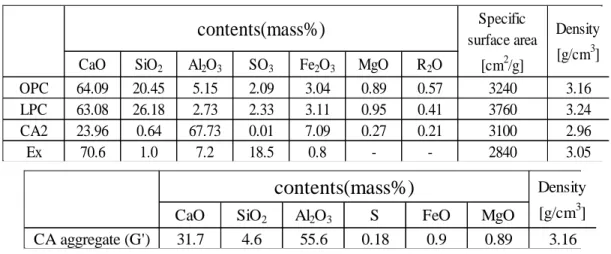
2𝑂 (2) Table 1 shows the chemical composition of the binder and CA aggregate. Calcium aluminatematerials are mainly composed of Al
2O
3. The expansive additive containsmuch SO
3.
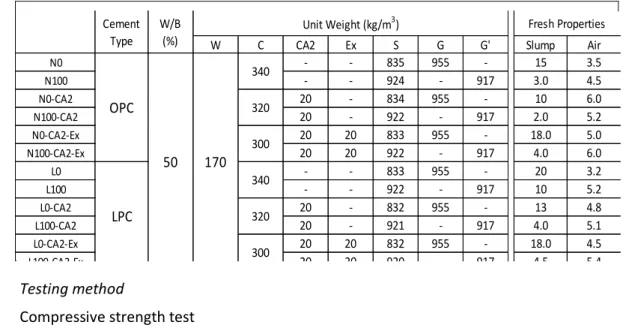
Table 2 shows the mix proportion of concrete and fresh properties. Water-Binder ratio (W/B) and unit water content (W) are constant in all of concrete, and using cements are ordinary Portland cement (OPC) and low heat Portland cement (LPC). In this research,CA2 and theexpansive additivewere replaced with thecement. Curing method is in water for 28 days.From the results of the fresh properties, slump of concrete using CA aggregate is lower than normal concrete. This trend was confirmed by both OPC and LPC. This is because, CA aggregate has high water absorption and reacts rapidly.
Table 1. Chemical composition of the binder and CA aggregate
Table 2. Mix proportion of concrete and fresh review
calcium aluminate material
CA aggregate (CaO・Al
2O
3) CA2 (CaO・2Al
2O
3)
CaO SiO
2Al
2O
3SO
3Fe
2O
3MgO R
2O
OPC 64.09 20.45 5.15 2.09 3.04 0.89 0.57 3240 3.16
LPC 63.08 26.18 2.73 2.33 3.11 0.95 0.41 3760 3.24
CA2 23.96 0.64 67.73 0.01 7.09 0.27 0.21 3100 2.96
Ex 70.6 1.0 7.2 18.5 0.8 - - 2840 3.05
contents(mass%) Specific
surface area [cm
2/g]
Density [g/cm
3]
CaO SiO
2Al
2O
3S FeO MgO
CA aggregate (G') 31.7 4.6 55.6 0.18 0.9 0.89 3.16
contents(mass%) Density
[g/cm
3]
2.2 Testing method
2.2.1 Compressive strength test
After 28 days of water curing, we had a compressive test of concrete reference to JIS A 1108-2006. The specimen size is φ100×200 (mm).
2.2.2 Salt water immersion test
Figure 2 shows the method of salt waterimmersion test. After 28 days of water curing, the specimen (100×100×400mm) was coated with epoxy resin except one side surface. Then, the specimen was immersed in NaCl 10% solution. The specimen was split in the age of 1, 2, 4, 8weeks, and was sprayed0.1Nsilver nitrate solution on the split surface. After that, the part which was colored in whitewas measured as the penetration depth ofchloride ion. Penetration depth is an averageof seven point’s measurement.
2.2.3 Accelerated carbonation test
Calcium aluminatematerials consume calcium hydroxide at hydration, so the concrete addition of calcium aluminate materials may be lowered alkaline. So, we checked the resistance for carbonation.
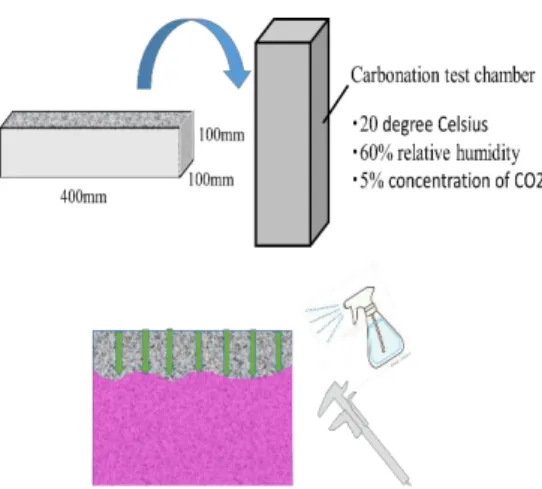
Figure 3 shows the method of accelerated carbonation test. After 28 days of water curing, the specimen (100×100×400mm) was coated with aluminum tape except one side surface. Then, the specimen was put in the carbonation testing chamber. It was kept at temperature was 20 degree Celsius, Relative humidity was 60% and concentration of carbon dioxide was 5%. The specimen was split in the age of 1, 2, 4, 8weeks, and sprayed 1% phenolphthalein solution on the split surface. After that, the part which was not colored in purple was measured as carbonation depth. Depth is an average ofseven point’s measurement.
W C CA2 Ex S G G' Slump Air
N0 - - 835 955 - 15 3.5
N100 - - 924 - 917 3.0 4.5
N0-CA2 20 - 834 955 - 10 6.0
N100-CA2 20 - 922 - 917 2.0 5.2
N0-CA2-Ex 20 20 833 955 - 18.0 5.0
N100-CA2-Ex 20 20 922 - 917 4.0 6.0
L0 - - 833 955 - 20 3.2
L100 - - 922 - 917 10 5.2
L0-CA2 20 - 832 955 - 13 4.8
L100-CA2 20 - 921 - 917 4.0 5.1
L0-CA2-Ex 20 20 832 955 - 18.0 4.5
L100-CA2-Ex 20 20 920 - 917 4.5 5.4
Fresh Properties
OPC
50 170 340 Cement
Type W/B
(%)
Unit Weight (kg/m
3)
320 300
LPC
340
320
300
Figure 2. Salt water immersion test method Figure 3. Accelerated carbonation test method
3 RESULTS AND DISCCUSIONS 3.1 Compressive strength test
Figure 4,5 show the result of compressive strength in water 28 days.Figure 4shows result of OPC concrete, and Figure 5 is LPC. Compressivestrength of concrete addition of CA2 are not decreased both OPC and LPC. In the case of adding CA aggregate, strength in OPC is not decreased, the strength in the LPC is reduced. On the other hand, in the case ofadding expansive additive,strength was lower than other concrete both in OPC and LPC. In this research, CA
2and the expansive additive was replaced with cement as binder ratio is constant.
Therefore, decreasing in strength is affected that the decreasing of total cement content.
Figure 4. Compressive strength at28 days (OPC) Figure 5. Compressive strength at28 days (LPC)
3.2 Salt water immersion test
Figure 6 shows the penetration depth of chloride ion during 8 weeks at OPC concretes.The resistance to chloride ion is increased by addition of calcium aluminate material. In the case of adding expansive additive,the concrete can keep the ability for chloride ion.
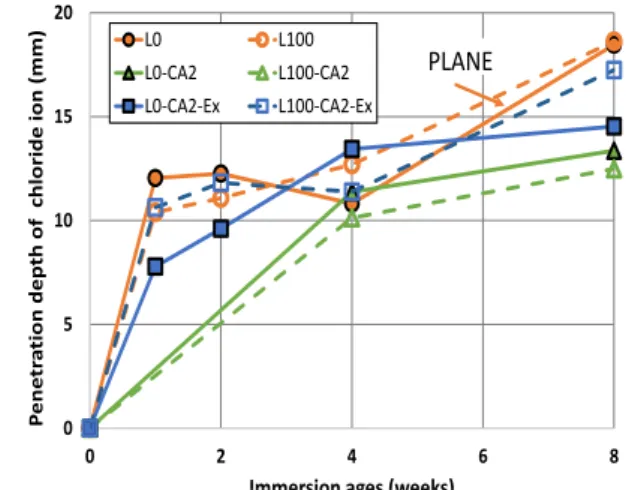
Figure 7 shows the penetration depth of chloride ion during 8 weeks at LPC concretes.
Theconcrete addition of CA2 has high resistance for chloride ion.However,the effect of the improvement is small by addition of CA aggregate. In the case of adding expansive additive, the concrete can keep the ability for chloride ion as well as OPC.
0 10 20 30 40 50
N0 N100 N0-CA2 N100-CA2 N0-CA2-Ex N100-CA2-Ex Compressive strength (N/mm2)
0 10 20 30 40
L0 L100 L0-CA2 L100-CA2 L0-CA2-Ex L100-CA2-Ex Compressive strength (N/mm2)
Figure 6. Penetration depth of chloride ion (OPC) Figure 7. Penetration depth of chloride ion (LPC)
3.3 Accelerated carbonation test
Figure8,9 show the carbonation depthduring 8 weeks.In the case ofadding CA aggregate,the resistance forcarbonationisreduced.This is because consuming Ca (OH)
2by the reaction of CA aggregate. In addition,the concretes addition of CA2 and expansive additive are also not good for carbonation. This is because decreasing of Ca(OH)
2by decreasing of total cement content and consumption by the addition of calcium aluminate materials.
Figure 8. Carbonation depth (OPC) Figure 9. Carbonation depth (LPC)
4 CHEMICAL ANALYSES
From these test results, we find that the concrete with addition of CA aggregate is different between LPC and OPC at resistance for chloride ion.So, we have examined the differences in the reactivity of CA aggregate between LPC and OPC.
To check the difference in OPC and LPC, we remove CA aggregate from specimen of salt water immersion test. CA aggregate was removed from area which chloride ion was penetrating.
After removing the CA aggregate, it was all crushed. And we checked the hydration products by X-Ray diffraction (XRD).Figure 10 show the results of XRD test.There is the peak of Friedel’s salt close of 11° both OPC and LPC. Therefore, CA aggregate is reacted in concrete both OPC and LPC.
0 5 10 15 20
0 2 4 6 8
Penetration depth of chloride ion (mm)
Immersion ages (weeks)
N0 N100
N0-CA2 N100-CA2 N0-CA2-Ex N100-CA2-Ex
PLANE
0 5 10 15 20
0 2 4 6 8
Penetration depth of chloride ion (mm)
Immersion ages (weeks)
L0 L100
L0-CA2 L100-CA2 L0-CA2-Ex L100-CA2-Ex