のか?
誌名
誌名 Bulletin of Fisheries Research Agency. Supplement = 水産総合研究セン ター研究報告. 別冊
ISSN
ISSN 13469894
著者 著者
高見, 秀輝 深澤, 博達 河村, 知彦 巻/号
巻/号 5号別冊
掲載ページ
掲載ページ p. 97-117 発行年月
発行年月 2006年3月
農林水産省 農林水産技術会議事務局筑波産学連携支援センター
Tsukuba Business-Academia Cooperation Support Center, Agriculture, Forestry and Fisheries Research Council Secretariat
The Ezo abalone, Haliotis discus hannai, is the only one species which distributes in north- east Japan and the most harvested one among the six commercially fished abalone species and subspecies in Japan. The annual catch ofH. dis- cus hannaiwas maximum about 3,200t in 1969, but then declined to current levels of less than 1,000t. The reseeding of hatchery-reared juve-
nile abalone into wild populations to enhance the stock was started in late 1970's forH. discus hannai, and now over 15 million juveniles are produced and released annually. Despite this, the abalone resources had not increased for many years mainly due to the low natural re- cruitment. In these several years, natural re- cruitment has markedly increased in some
Delayed metamorphosis by larval abalone in the field
Hideki TAKAMI*1, Hirotatsu FUKAZAWA*2 and Tomohiko KAWAMURA*2
Abstract Delayed metamorphosis has been thought to be an important factor affecting recruitment in marine benthic invertebrates with lecithotrophic larval stages including abalone. The effects of delayed metamorphosis on larval competence, and post-larval sur- vival and growth of Ezo abaloneHaliotis discus hannaiwere examined, and age determi- nation method for larval and newly metamorphosed post-larval H. discus hannai was developed by the laboratory experiments. In addition, we determined the age of field caught larvae and post-larvae, and actual larval period ofH. discus hannaiin the natural habitat was estimated.
Larval Haliotis discus hannai required about 4 days before becoming competent to metamorphose, and metamorphosis was successfully achieved up to 19 days after fertili- zation. The survival and growth rates of post-larvae that metamorphosed after a 19-day larval period, however, were significantly lower than those within less than 15-day larval period. Competent veliger larvae had a radula and regularly added rows of radular teeth with age in the absence of metamorphosis. The number of radular teeth rows increased linearly with age, but rows of radular teeth were added more slowly at lower tempera- tures. The effect of temperature on the development rate of the radula was quantified by the regression and the temperature coefficient,Q10. From these results, an age determina- tion method of veliger larvae and newly metamorphosed post-larvae(within a day of metamorphosis)was established; using the number of radular teeth rows.
The age of veliger larvae and newly metamorphosed post-larvae captured in the field was determined by the age determination method. Nine percent of veliger larvae were es- timated to be 4-6 days old. The remaining 91%of larvae were classified as younger than 4 days old. All newly metamorphosed post-larvae were estimated to be 4-6 days old.
Key words: abalone, age dilermination, delayed metamorphosis,Haliotis, recruitment
2005年11月30日受理 (Received: November 30, 2005)
*1Coastal Fisheries and Aquaculture Division, Tohoku National Fisheries Research Institute, Fisheries Research Agency(Shiogama, Miyagi 985-0001, Japan)
*2Depertment of Living Marine Biological Resources, Ocean Research Institute, The University of Tokyo(Na kano, Tokyo 164-8693, Ja pan)
areas in Iwate and Miyagi reflecting on the in- creasing catch. Although understandings of the annual variation and its mechanism are impor- tant for the management of the abalone re- sources, their early life ecology and factors that affect the recruitment process in the field are poorly understood.
Abalone have a planktonic larval stage for dispersal. Larvae are able to delay metamor- phosis in the absence of an appropriate environ- mental stimulus, while the capacity to metamorphose is maintained (Roberts and Lapworth, 2001). Examining the period of de- layed metamorphosis in the field is important for considering about the extent to which re- production of released hatchery-reared abalone has impacted on the genetic structure of wild populations because delayed metamorphosis has been suggested to increase the rate of mix- ing of geographically separated populations
(e.g. Thorson, 1950; Pechenik, 1990).
In particular for species with a lecithotrophic
(non-feeding)larvae including abalone, a delay of metamorphosis involves the risk of depletion of nutrients and larval senescence, and these have negative effects on post-metamorphic per- formance(Lucas et al., 1979; Nielsen, 1981;
McEdwardet al., 1988; Woollacott et al., 1989;
Pechenik and Cerulli, 1991; Pechenik et al., 1993; Maldonado and Young, 1999). For in- stance, New Zealand abalone Haliotis iris lar- vae become competent 7 days after fertilization and can survive for a month or more at 17℃ without metamorphosis under laboratory con- ditions(Roberts and Lapworth, 2001). Survival and growth of post-larvae were not influenced by the delay of metamorphosis within 22 days after fertilization, but post-larvae that meta- morphosed after a 26-30 day larval period showed significantly lower growth and survival rates than those that metamorphosed earlier
(Roberts and Lapworth, 2001). This previous findings suggest abalone larvae have a poten- tial for longer and wider dispersal for up to sev- eral weeks. However, the effects of delayed metamorphosis on the post-larval fitness ofH.
discus hannai are not examined, and the
frequency and period of delayed metamorphosis in all abalone species in the field is unknown.
One of the approaches to estimate the dura- tion of the larval period or extended larval pe- riod in the field is to examine morphological criteria that relate to larval age and therefore indicate evidence for delayed metamorphosis.
Several planktotrophic larvae of some echino- derms(Emlet, 1986; Highsmith and Emlet,
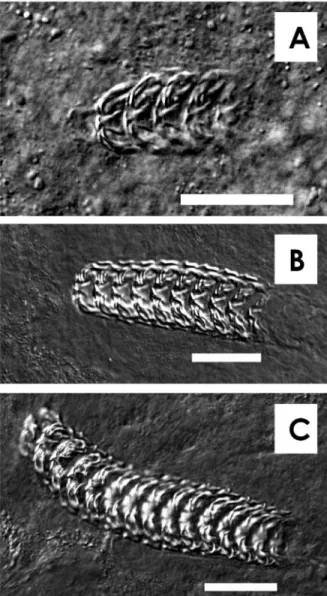
Fig. 1. Photographs of larval radula ofHaliotis dis- cus hannaiby a differential interference contrast mi- croscope. Scale bar=30μm.(A)Radula with 5 rows of teeth of veliger larvae after 5 days from fertiliza- tion at 20℃.(B)Radula with 10 rows of teeth of veliger larvae after 6 days from fertilization at 20
℃.(C)Radula with 15 rows of teeth of veliger larvae after 8 days from fertilization at 20℃.
1986; Miller and Emlet, 1999), gastropods
(Pechenik, 1986), and a mussel(Bayne, 1965)
change their body size or morphology after the acquisition of competence to metamorphose. If swimming larvae are found with these changes, this is used as evidence that these larvae have delayed metamorphosis. Abalone larvae show no increase in larval shell size and no obvious changes in external morphology after the acquisition of competence(Seki and Kan-no, 1977). However, larval abalone commence for- mation of the radula(the feeding organ of gas- tropods)by the acquisition of competence, and then gradually increase the number of rows of radular teeth in the absence of metamorphosis
(Barlow and Truman, 1992; Roberts et al., 1999;
Moss, 1999; Searcy-Bernal, 1999; Fig. 1). There- fore, if the relationship between larval age and the number of rows of radular teeth is deter- mined, the age of field caught abalone larvae can be determined by counting the number of teeth rows.
In this article, we reviewed our recent studies on delayed metamorphosis ofH. discus hannai
(Takamiet al., 2002, 2005). We examined to de- termine if delayed metamorphosis decreases their ability to metamorphose, or their post- metamorphic survival and growth under a laboratory condition(Exp. I). To establish an age determination method for larval and newly metamorphosed post-larval H. discus hannai, we investigated the relationship between age and number of rows of radular teeth by labora- tory experiments under environmentally realis- tic temperatures(Exp. II). The age of larvae and newly metamorphosed post-larvae from field samples were determined using the age de- termination method established in Exp. II and we considered the extent to which H. discus hannailarvae delay their metamorphosis in the field(Exp. III).
Materials and Methods
1. Exp. I: Effects of delayed metamorphosis on post-larval performance
1.1 Obtaining abalone larvae
Larval abalone were hatched at the Yamagata Sea Farming Association
(Yamagata, Japan) and reared with the method of Uki and Kikuchi(1984). Four days after fertilization at 20℃, the veliger larvae were transported to the Tohoku National Fish- eries Research Institute (TNFRI; Miyagi, Japan)within 4 h.
1.2 Rearing experiments
Competent larvae(4 days old at 20℃)were placed into polystyrene 6 well tissue culture plates(Corning 25810-6, New York, USA)at densities of 40-60 individuals per well and main- tained at 20℃ in 5 mL of 0.45μm-filtered seawater(FSW)containing 150μg/mL each of penicillin G sodium and Streptomycin sulfate BP. Larvae were then induced to metamorphose at 5, 10, 15, and 19 days after fertilization by changing to the FSW containing 1μMγ amino-butyric acid(GABA)and the same anti- biotics described above. Plates were wrapped in clear cellophane film and incubated without water change at 20℃for 2, 2, 3, and 4 days for 15, 19, 10, and 5 days old larvae, respectively;
the induction of metamorphosis was stopped when the mean peristomal(adult)shell forma- tion rate exceeded more than 50%in each larval period. A second group of larvae from the same batch were maintained at 20℃without the ad- dition of GABA to observe spontaneous attach- ment and metamorphosis. Individuals that had spontaneously metamorphosed were removed when first observed.
Larval settlement was quantified for each larval age by inspecting the floor and walls of the assay chamber with inverted and dissecting microscopes. We calculated the percentage of live animals showing:(a)"shell formation"
(velum shed, peristomal shell visible);(b)
"metamorphosis"(velum shed, with or without peristomal shell formation);(c)"attachment"
(metamorphosed or attached by the foot). The percentage of individuals showing shell forma- tion, metamorphosis and attachment were measured(6 replicates in each larval period)
daily. Spontaneous attachment and
metamorphosis were observed(12 replicates)
every other day using the larvae that were not induced to metamorphose by GABA.
After the induction of metamorphosis, non- metamorphosed larvae were removed, and seawater was replaced with 5 mL of FSW per replicate containing the same antibiotic cock- tail described above. Metamorphosed individu- als were fed on a benthic diatomCylindrotheca closterium. This diatom species is a suitable food for post-larval growth ofH. discus hannai from just after metamorphosis(Kawamura and Takami, 1995). The added food was always present in excess. Post-larvae were also reared in a starved treatment under which individuals were not provided with any food. All experi- ments were run with 6 replicates(initial den- sity was 30-50 individuals per replicate). The water was changed at 2-day-intervals. Individu- als were reared for 15-23 days after metamor- phosis.
Post-larval survival was monitored daily.
The dead post-larvae were removed at every ob- servations. Here, we defined dead animals as those with no heart beat during 10 seconds of observation(Takami et al., 2000). The shell length of 10 live individuals selected randomly from each replicate was measured on the day of metamorphosis and at 6 days after metamor- phosis using a monitor and video camera sys- tem with an image analyzer, connected to an inverted optical microscope.
2. Exp. II: Development of Age determination method
2.1 Obtaining oocytes
Larval H. discus hannai were produced by five different females (Batch I-V) in the TNFRI. Female abalone used in Batch I and IV, which had been cultured from eggs in aquaria, were obtained from Hirota Fisheries Coopera- tive, Iwate prefecture, Japan in June 2001 and April 2002, respectively. Wild female abalone were collected in October 2003(used in Batches II and III)and October 2004(Batch V)at the study site where the post-larvae were sampled in the field study(Exp. III). All animals were transported to TNFRI and kept in 518 liter plastic tanks until spawning induction.
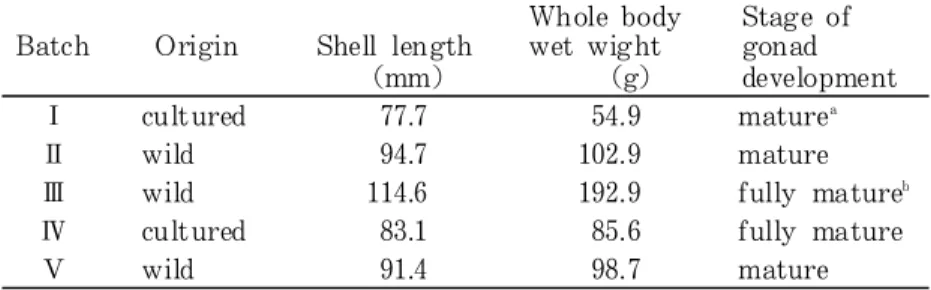
Female characteristics such as the origin, the size, and the stage of gonad development de- fined by Kikuchi and Uki(1974)varied among the five females(Table 1). Females were in- duced to spawn by using a combination of the desiccation and the UV irradiation methods
(Uki and Kikuchi, 1984)at 20℃on 14 June 2004
(Batch I and II), 2 July 2004(Batch III), 30 August 2004(Batch IV), and 23 May 2005
(Batch V). Eggs from individual females were fertilized by pooled sperm from 2-4 males in 15 L plastic containers. Different males were used for production of each batch, but the origin of these males was not recorded.
2.2 Rearing experiments
Fertilized oocytes of Batches I-V were incu-
Table 1.Female characteristics of abaloneHaliotis discus hannaiused for the experiments
Batch Origin Shell length
(mm)
Whole body wet wight
(g)
Stage of gonad development
Ⅰ cultured 77.7 54.9 maturea
Ⅱ wild 94.7 102.9 mature
Ⅲ wild 114.6 192.9 fully matureb
Ⅳ cultured 83.1 85.6 fully mature
Ⅴ wild 91.4 98.7 mature
aMature : individuals have developing gonad and some individuals react to spawning induction.
bFully mature : gonad maturation is complete and spawning induction occurs at reliably high rate
bated at 20.0±0.3℃(set point±range)during the experimental period. At 20 h after fertiliza- tion, hatched larvae were siphoned from the plastic containers into 500 mL glass jars with 400mL of FSW at a density of<1 larva mL-1. After the completion of larval shell formation, swimming larvae were gently sieved onto a 100 μm nylon mesh and transferred each day to new jars with 400mL of FSW to avoid contami- nation of the cultures. Veliger larvae(3-9 days after fertilization)were used for radula obser- vations. Veligers from each batch were ran- domly selected every day and preserved in 5%
(v/v) seawater formalin for the radular measure-ment.
To test the effect of rearing temperature on the development rate of the larval radula, a part of the oocytes from Batch III and V were divided into two other temperature treatments just after fertilization and were incubated at 17.0±0.3 and 22.0±0.4℃. The range of the ex- perimental temperatures is environmentally relevant during the reproductive season of H.
discus hannai in their natural habitat(from September to October)in Miyagi Prefecture coastal waters. The temperature of 20℃ at which eggs were fertilized was elevated or dropped gradually to each experimental tem-
perature within four hours after fertilization to avoid any effects of temperature shock, and these temperature changes did not affect larval activity. Larvae at each temperature treatment were reared and sampled as described above.
To compare the radular development of meta- morphosed post-larvae with that of veliger lar- vae, a subsample of 4-day-old veligers from Batch IV and V were transferred to a 50mL polystyrene dish with a piece(ca. 1 cm2)of crustose coralline alga(CCA)Lithophyllum yessoense, which strongly induces larval meta- morphosis of abalone(Takamiet al., 1997), and they were incubated at 20℃. More than 10 metamorphosed post-larvae, which had shed the velum(swimming organ)and some speci- mens which had begun peristomal shell(adult shell)formation, were randomly selected and removed from the CCA pieces every day for over 4(Batch IV)or 3(Batch V)days follow- ing the induction of metamorphosis. The shell length was measured after the method used in Exp. II, and then the post-larvae were preserved in 5% seawater formalin for the radular meas- urement. The larval shell length of 4 and 7 or 8 day old veligers(n=7-11)from Batch IV and V were also measured.
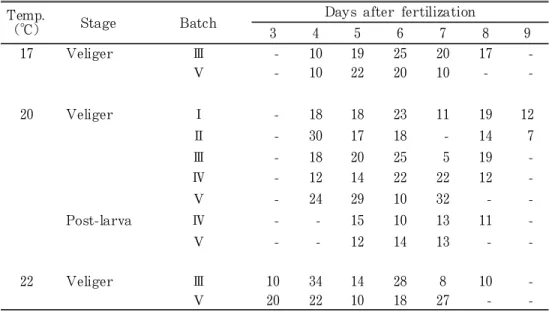
Table 2.Number of radulae measured in the laboratory experiments Temp.
(℃) Stage Batch Days after fertilization
3 4 5 6 7 8 9
17 Veliger Ⅲ - 10 19 25 20 17 -
Ⅴ - 10 22 20 10 - -
20 Veliger Ⅰ - 18 18 23 11 19 12
Ⅱ - 30 17 18 - 14 7
Ⅲ - 18 20 25 5 19 -
Ⅳ - 12 14 22 22 12 -
Ⅴ - 24 29 10 32 - -
Post-larva Ⅳ - - 15 10 13 11 -
Ⅴ - - 12 14 13 - -
22 Veliger Ⅲ 10 34 14 28 8 10 -
Ⅴ 20 22 10 18 27 - - - : not determined
2.3 Radula measurement
Radular measurement was conducted using the method of Tong and Moss(1992). The lar- val or post-larval shells of fixed samples were decalcified in 2 N of hydrochloric acid for sev- eral minutes. The remaining tissues were cleared in 2 N of potassium hydroxide for sev- eral minutes, and then squashed on a micro- scope slide glass with a coverslip. The number of rows composed of fully formed rachidian, lateral, and marginal teeth on the radula was counted using a light microscope with a Nomarski interference contrast system. One to three additional rows composed of developing teeth were not included in the counts. The sam- ple size of radula measurement in the labora- tory experiments is presented in Table 2.
3. Exp. III: Age determination of field caught lar- vae and post-larvae
Plankton sampling was conducted at 1-7 day intervals from late August to early October in 2003 and 2004 at the mouth of Kesennuma Bay, Miyagi Prefecture, Japan(141o36'E, 38o49'N). Plankton samples were taken with an XX13 Kitahara quantitative plankton net following the method of Sasaki and Shepherd(1995). At each sampling time, hauls of the net were made from 10m depth to the surface, giving a volume of water sampled of 0.4m3 on each haul. Col- lected organisms were preserved in 5%
seawater formalin for laboratory sorting.
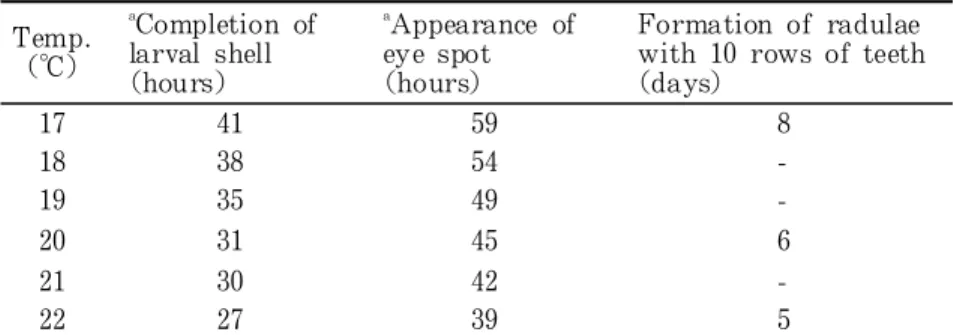
Completion of the larval shell and appearance of the eye spot of the field caught larvae were determined before the radula observation. The timing and order of these developmental fea- tures have been well documented at different rearing temperatures by Seki and Kan-no
(1977, Table 3). These developmental features were also used for morphological criteria to de- termine the age of field caught larvae.
The sampling of newly metamorphosed post- larvae, which had not acquired a peristomal shell and most of which were appear to be a day within metamorphosis, was conducted from late September to early October in 2003 and 2004 at the Myojinsaki, Miyagi prefecture, Japan(141o34'E, 38o48'N), which is 3 km dis- tance from the sampling site of larvae. In 2003, after large numbers of larvae were observed in the plankton sampling on 25 September, newly metamorphosed post-larval abalone were col- lected by post-larval collectors consisting of 102 scallop shells(approx. 11cm in shell length each)covered with CCA on their surfaces.
Twenty collectors were set on the bottom of the study site at depths of 5-12 m between 26 and 29 September 2003. The bottom at this site is com- posed of boulders with irregular shapes, mostly with a greater diameter of 20-50cm resting on the bedrock. The surfaces of these boulders and bedrock were covered with CCA. On 2 October 2003(3 days after the recovery of the collec- tors)newly metamorphosed abalone in the study site were also sampled by collecting 127
Table 3.Elapsed hours or days from fertilization to the occurrence of each developmental event in larval abalone Haliotis descus hannai at different rearing temperatures
Temp.
(℃)
aCompletion of larval shell
(hours)
aAppearance of eye spot
(hours)
Formation of radulae with 10 rows of teeth
(days)
17 41 59 8
18 38 54 -
19 35 49 -
20 31 45 6
21 30 42 -
22 27 39 5
aValues were obtained by digitizing the figure 2 in Seki and Kan-no(1977). - : not determined
boulders from the site of the post-larval collec- tors at which the largest settlement was ob- served. In 2004, we could not conduct the collector sampling because of constantly rough conditions at the study site, and newly meta- morphosed abalone were only sampled by col- lecting 113 boulders on 17 September and 159 boulders on 8 October at the same sampling site as used in 2003.
The collectors and boulders were soaked in a 10%(v/v)solution of ethanol in seawater for a minimum of 5 min, and then brushed with a soft brush, just after retrieval on the boat. Of the organisms collected from the surfaces, post- larval abalone were sampled and these shell length was measured using a dissecting micro- scope in the laboratory. They were then pre- served in 5%seawater formalin for the radula measurement.
Seawater temperatures were recorded every 10 minutes between August and October in 2003 and 2004 with a battery-powered sensor(Alec Electronics, MDS-Mk V)deployed at 7 m depth at the site where post-larvae were collected.
4. Data analysis
The data from Exp. I were compared by analysis of variance(ANOVA)with Tukey- Kramer multiple comparison tests. If the as- sumption of homoscedasticity was rejected by Levene's test or the assumption of normality rejected by the Shapiro-Wilk W test, data were analyzed with the Steel-Dwass non-parametric multiple comparison test following Kruskal- Wallis non-parametric ANOVA. The relation- ship between age(days after fertilization)and the number of rows of teeth of larvae in Exp. II was evaluated using a least squares linear re- gression. Differences in the slope and intercept of regression lines among batches in each tem- perature treatments were tested using analysis of covariance (ANCOVA) by age as the covariate. The regression lines of radular devel- opment with age were also compared between veliger larvae and post-larvae with different batches(IV and V)using two-way ANCOVA
(growth stage and batch as independent vari- able, age as covariate). The differences of the mean larval shell length between 4 and 7(Batch V)or 4 and 8(Batch IV)days after fertiliza- tion were tested by student's t-test. At 5 days after fertilization, the mean numbers of rows among veliger larvae, post-larvae with peristomal shell, and post-larvae without peristomal shell were compared using two-way ANOVA with Tukey-Kramer multiple com- parison test. We also tested the homoscedasticity assumption of residuals and assessed the assumption of normality as de- scribed above. The results of these statistical tests were noted only when the assumptions were violated.
The sensitivity of the development rate of the radula to changes in temperature was described by the Q10 coefficient, which gives the relative change in physiological rate over a specified 10
℃ change in temperature(Schmidt-Nielsen, 1991). The slopes of the regression lines of pooled batches for each temperature treatment were used to calculate the Q10 values for the temperature ranges 17-20 and 20-22℃using the following equation.
Q10=(R2/R1)10/(t2-t1)
where R1 and R2 are the development rates of radula at temperatures t1 and t2 in ℃, respec- tively. To estimate larval age by the number of teeth rows, a linear equation for x=(y−a)/b
(x: age of larvae, y: number of rows)at the field temperature was estimated. The intercept
(a)was obtained by interpolating between the intercepts of regression lines at different tem- peratures based on the laboratory experiments.
The development rate of the radula(b)was cal- culated by rearranging the equation forQ10and solving for the development rate R2(=b). For example, when the field temperature t2 is 19.3
℃, the development rate of a field caught larva R2 is obtained by solving the following equa- tion.
2.46=(R2/2.35)10/(19.3-17)
where 2.46 is the Q10 value between 17 and 20
℃, and 2.35 is the development rate of the radula(slope of pooled regression line)at 17
℃(see Results 2.1 and Table 4). The intercept ais obtained by interpolation between -9.00 at 17℃ and -9.66 at 20℃(Table 4). Thus the lin- ear equation at 19.3℃isx=(y+9.51)/2.89. The age of a field caught larva(x)could be calcu- lated by substituting the number of rows for y.
Results
1. Exp. I: Effects of delayed metamorphosis on post-larval performance
1.1 Relationship between duration of larval pe- riod and metamorphic competence
Attachment and metamorphosis increased with time in all experimental treatments. More rapid attachment, metamorphosis, and shell growth were observed in older larvae. The per- centage of metamorphosed individuals 2 days
after the addition of GABA increased with the length of larval swimming period(Fig. 2); the significant results were limited to 15 d(96%)
and 19 d(99%)>10 d(51%)>5 d(19%)(Steel- Dwass multiple comparison test, p<0.05). The percentage of post-larvae that attached and metamorphosed spontaneously increased rap- idly after 17 days from fertilization(Kruskal- Wallis test, p<0.05)and reached 96±3.0%
metamorphosis at 24 days post-fertilization
(Fig. 3). No dead un-metamorphosed larvae were observed in any experimental treatment.
1.2 Effect of delayed metamorphosis on post- larval survival
Survival rates of fed post-larvae depended on larval swimming period. For larvae that swam for <15 days, more than 80% of post-larvae survived for 20 days after metamorphosis(Day 20). There were no significant differences be- tween individuals from 5, 10, and 15-day-old larvae in survival rates on Day 20(Steel-Dwass multiple comparison test, p>0.05). In contrast, Table 4. Parameters of the linear regression(y=a+bx)fitted to the number of
rows of radular teeth(y)in response to age(xin days following fertilization)and Q10values among the different batches and rearing temperatures
Temp.
(℃) Stage Batch a b Q10 n r2 F
17 Veliger Ⅲ -8.70 2.31 91 0.94 1477
Ⅴ -9.49 2.43 62 0.81 256
Pooled -9.00 2.35 153 0.91 1461
20 Veliger Ⅰ -9.78 3.12 101 0.94 1586
Ⅱ -9.56 3.04
2.46 86 0.94 1265
Ⅲ -9.67 3.06 87 0.93 1167
Ⅳ -9.17 3.02 82 0.91 801
Ⅴ -10.07 3.18 95 0.92 1020
Pooled -9.66 3.08 451 0.93 6205
22 Veliger Ⅲ -8.01 3.25 1.41 104 0.95 1959
Ⅴ -8.01 3.33 97 0.94 1657
Pooled -8.00 3.30 201 0.95 3602
20 Post-larva Ⅳ -7.96 3.20 49 0.96 1012
Ⅴ -10.59 3.66 39 0.91 382
The regressions were highly significant fore all batches in all tempereture treat- ments(p<0.0001).Q10was determined for each temperature interval using slopes
(b)of pooled regression lines.
for individuals from 19-day-old larvae, survival was markedly reduced after Day 6, with 57± 2.9% of post-larvae surviving during the 15- day-observation-period(Fig. 4). In the starved treatment, survival again decreased more rap- idly in older larvae, with the exception that survival rate of post-larvae from 5-day-old lar- vae decreased more rapidly than that of indi- viduals from 10-day-old larvae(Fig. 4).
1.3 Effect of delayed metamorphosis on post- larval growth
Post-larval growth rates(during 6 days from the end of metamorphosis induction)did not differ significantly for larval swimming Fig. 2.The effect of GABA on attachment, metamor-
phosis, and shell growth with respect to 4 different larval periods(5 d, 10d, 15d post-fertilization)in Haliotis discus hannai. The percentage of responders in each of 12 replicates was determined at each larval period, and the mean percentage(±SE)was plotted against days after addition of GABA.
Fig. 3. The percentage of spontaneous attachment and metamorphosis inHaliotis discus hannai. Sym- bols indicate the mean percentage(±SE)of respond- ers in 6 replicates.
Fig. 4. Effect of delayed metamorphosis on post- larval survival rate in fed and starved post-larval Haliotis discus hannai. Each curve traces the sur- vival of larvae of a particular age. Data are mean percentage(±SE)of survivors in 6 replicates.
periods <15 days in fed treatments(Tukey- Kramer multiple comparison test, p>0.05). However, growth rate of post-larvae from 19- day-old larvae was significantly lower than that of larvae <15 days old(Tukey-Kramer multiple comparison test, p<0.05)(Fig. 5). In the starved treatments, post-larvae from all larval periods showed shell growth. The growth rate of individuals from 19-day-old lar- vae was significantly lower than those of other post-larvae(Tukey-Kramer multiple compari- son test, p<0.05)(Fig. 5).
2. Exp. II: Development of Age determination method
2.1 Relationship between radular development and age
The number of rows of radular teeth in- creased linearly with age in all batches in each temperature treatment(Fig. 6). No radulae could be found from <2 day old larvae by the microscope observation in all temperatures. In 22℃, 33.3%larvae(n=10)had radulae with 1-3 rows of teeth but no individual had a radula in other temperatures at 3 days after fertilization.
All larvae had radulae from 5, 5, and 4 days after fertilization in 17, 20, and 22 ℃tempera- tures, respectively. Each row of radula was composed of one rachidian tooth, two pairs of lateral teeth and one pair of marginal teeth, al- though the lateral and marginal teeth were not differentiated clearly(Fig. 1).
Residuals of regression lines between number of rows and age in some treatments were not normally distributed (Shapiro-Wilkes test, p<0.01). The Levene's test showed that the Fig. 5. Effects of delayed metamorphosis on post-
larval growth rate in fed and starved post-larval Haliotis discus hannai. Each bar represents the mean shell growth rate(±SE)in 6 replicates. The mean shell growth rate of each replicate was calculated using the shell length of 10 randomly selected live in- dividuals both just after metamorphosed and 6 days after metamorphosis. Letters on the top of each col- umn indicate the results of ANOVA with Tukey- Kramer multiple comparison tests, columns with different letters represent means that are statisti- cally different(p<0.05).
Fig. 6. Relationships of the number of rows of radular teeth and age(days after fertilization)at 17, 20, 22℃for larvalHaliotis discus hannai(mean
±SD). Larvae were obtained by fertilizing the eggs from two(17 and 22 ℃; Batches III and V)or five
(20℃; Batches I-V)different females. Sample sizes of each point are presented in Table 2.
residuals among different batches in each tem- perature had homogenous variances(p>0.05). ANCOVA is robust to violation of the normal- ity assumption when the assumption of homoscedasticity is met. Hence, ANCOVA analyses were performed on non-transformed data. The regression lines were parallel(17℃:
F1,149=0.75, p=0.39, 20℃: F4,441=0.45, p=0.78, 22
℃: F1,201=0.28, p=0.60), and intercepts were not
significantly different (17 ℃: F1,150 =0.29, p=0.59, 20℃: F4,445=1.41, p=0.23, 22℃: F1,202
=3.61, p=0.06)among different batches when larvae reared at the same temperature(Fig. 6, Table 4).
The comparison of regression lines among different temperatures by ANCOVA could not be performed because residuals violated both normality and homoscedasticity. These as- sumptions could not be met for the trans- formed data. Therefore, the results of temperature response should be interpreted with caution. The slopes of regression lines in the lower temperature treatments have clearly smaller slopes(Fig. 6); pooled regression liens showed that the rows of radular teeth were added more slowly at lower temperatures; 2.35, 3.08, and 3.30 rows day-1 were added at 17, 20, and 22℃, respectively(Table 4).
2.2 Growth and radular development of newly metamorphosed post-larvae
One day after the metamorphosis induction
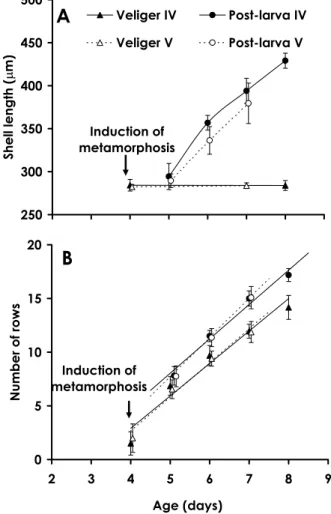
(incubation with CCA pieces), about 80% of larvae had metamorphosed into post-larvae and 55.6%of post-larvae had acquired a peristomal shell. Two days after the metamorphosis induc- tion, most post-larvae showed peristomal shell growth. In batch IV, post-larvae grew to 429.0
±8.8μm(mean±SD, n=12)in shell length from 284.2 ±6.8μm shell length(n=7)of the larval shell(4 day old veligers)during 4 days of incubation(growth rate: 36.20μm/day)
(Fig. 7A). The mean larval shell length(283.9
±5.8μm, n=11)of 8 day old veligers, which were not induced to metamorphose, was not significantly different from that of 4 day old veligers(Student's t test, p>0.93, Fig. 7A). In
Batch V, post-larvae showed comparable growth in shell length with those of Batch IV
(growth rate: 32.37μm/day)(Fig. 7A). The mean larval shell length(283.8±3.2μm, n=7) of 7 day old veligers was not significantly dif- ferent from that of 4 day old veligers(Stu- dent's t test, p>0.39, Fig. 7A).
The number of rows of post-larval radula was larger than that of veliger larval radula
(two-way ANCOVA, F1,261=261.95, p<0.0001, Fig. 7B). There was no significant difference in radular development between two batches
(two-way ANCOVA, F1,261=0.20, p=0.65, Fig.
Fig. 7.Growth of shell length(A)and increase in the number of rows of radular teeth(B)with age(days after fertilization)at 20℃for larval and post-larval Haliotis discus hannai(mean±SD)obtained from different females(Batches IV and V). Post-larvae were induced to metamorphose by the addition of a piece of crustose coralline alga Lithophyllum yessoenseat 4 days after fertilization. Sample sizes at each point are presented in the Table 2.
0 5 10 15 20
2 3 4 5 6 7 8 9
Number of rows
Induction of metamorphosis 250
300 350 400 450 500
2 3 4 5 6 7 8 9
Shell length (Pm)
Veliger IV Post-larva IV Veliger V Post-larva V
Induction of metamorphosis
A
B
Age (days)
7B). Interaction between growth stage and batch was not significantly deferent(F1,260
=0.10, p=0.75).
Although there was no significant difference in number of rows between batches(two-way ANOVA,F1,65=0.07, p=0.79), significant differ- ence was observed among growth stages
(veliger larvae, post-larvae without peristomal shell, and post-larvae with peristomal shell)in 5-day-old individuals(two-way ANOVA, F2,65
=22.22, p<0.0001, Fig. 8). There was no sig- nificant interaction between batch and stage
(two-way ANOVA, F2,65=1.24, p=0.30). The number of rows were not significantly different between veliger and post-larvae without peristomal shell, but were significantly differ- ent between veliger and post-larvae with peristomal shell(Tukey-Kramer multiple com- parison test, p<0.05, Fig. 8).
3. Exp. III: Age determination of field caught lar- vae and post-larvae
3.1 Age determination of field caught larvae H. discus hannaiis the only abalone species found in the study area, and its veliger larva is distinguishable from other larval gastropods, though its egg and trochophore larva are un- identifiable based on their morphologies.
Eighty eight veliger larvae with complete larval shell were identified in the field samplings con- ducted during September and October in 2003 and 2004. Veliger larvae showed discrete peaks of occurrence(on 8, 16, and 25 September in 2003, and 1 September and 5 October in 2004)
Fig. 8. Number of rows of radular teeth in veliger larva, post-larva without peristomal shell, and post- larva with peristomal shell ofHaliotis discus hannai between different females(Batches IV and V). All individuals were 5 days after fertilization and both post-larvae were one day from induction of meta- morphosis by a piece of crustose coralline alga Lithophyllum yessoense. Each bar represents the mean number of rows(+SD)with the number of in- dividuals measured indicated above each bar. Alpha- betical letters on the top of each bar indicate the results of two-way ANOVA with Tukey-Kramer multiple comparison tests; bars with the different letter represent means that are significantly differ-
ent(p<0.05) Fig. 9. Compositions of the number of rows of radular teeth on newly metamorphosedHaliotis dis- cus hannaisampled in the field on 29 September 2003
(A, the mean temperature: 18.8 ℃), 17 September 2004(B, 20.1℃), and 08 October(C, 19.1℃). Deter- mined ages(days)using the equation given in Table 6 are given above each bar.
0 10 20 30 40 50
4 5 6 7 8 9 10
Number of rows
29. Sept. 2003 n=12
0 10 20 30 40 50
4 5 6 7 8 9 10
17. Sept. 2004 n=7
0 10 20 30 40 50
4 5 6 7 8 9 10
08. Oct. 2004 n=5 4d
5d
6d
5d 5d
5d 5d
6d
5d 6d
6d 6d
Number of rows
%
A
B
C
but few larvae were collected even a couple of days after these peaks(Table 5). Forty three out of the 88 veligers did not have the eye spot, and only 8 larvae had formed a radula(Table 5). Based on the seawater temperature range experienced by the sampled larvae(18-21℃), about 2 days from fertilization are needed for the appearance of the eye spot(Table 3, Seki and Kan-no, 1977)and 4 days for the formation of the radula(Fig. 6). Thus at least 48% of the captured larvae were considered to be younger than 2 days old as they did not have the eye spot, and 90% of larvae were considered to be younger than 4 days old as they had not formed a radula.
The number of rows of radular teeth of the 8
larvae that had formed a radula ranged from 3 to 10. The age of larvae with radula was deter- mined to range from 4 to 6 days old(Table 5).
3.2 Age determination of newly metamorphosed post-larvae
In 2003, 12 newly metamorphosed post- larvae, which had not acquired a peristomal shell, were collected on the collectors during 26- 29 September. They were thought to be within a day of metamorphosis and thus the majority of radula formation would have occurred dur- ing the larval period(Fig. 8). The number of rows of the radular teeth of the post-larvae ranged from 4 to 7(Fig. 9A). The mean field temperature during 25-29 September was 18.8 Table 5.Age determination by developmental stages and number of rows of radular teeth of the field caught lar- val abalone Haliotis discus hannai
Ssmpling date Field temp.a n of larvae m- 3
(℃)
Developmental stage:
n of larvae
n of rows Estimated larval age
(d)
2003 20.Aug. 18.0±0.3 0.63 ESc: 1 2-3
01.Sept. 19.0±0.2 0.64 LSb: 5 1
08.Sept. 19.3±0.3 4.06 LS : 4 1
ES: 7 2-3
FRd: 2 3, 4 4, 4
09.Sept. 19.3±0.2 2.22 LS : 2 1
ES : 11 2-3
FR : 3 4, 4, 6 4, 4, 5
16.Sept. 18.9±0.6 3.96 LS : 18 1
ES : 1 2-3
17.Sept. 19.1±0.3 0.42 ES : 1 2-3
25.Sept. 18.5±0.1 4.64 LS : 12 1
ES : 1 2-3
2004 01.Sept. 20.6±0.4 3.13 LS : 2 1
FR : 3 5, 7, 10 4, 5, 6
06.Sept. 20.1±0.3 0.63 LS : 1 1
09.Sept. 20.1±0.5 0.63 ES : 1 2-3
01.Oct. 20.1±0.1 0.63 LS : 1 1
05.Oct. 19.3±0.2 5.0 ES : 10 2-3
14.Oct. 18.6±0.1 1.25 LS : 1 2-3
aThe mean±SD temperature for 2-5 days(depending on the developmental stage of captive larvae)before sam- pling date.
bLS: Larvae with complete larval shell, but without the eye spot and radula.
cES: Larvae with complete larval shell and eye spot, but without the radula.
dFR: Larvae that had formed the radula in addition to complete larval shell and eye spot.
No larva was captured on 22, 25 August, 03, 12 September, 01 October in 2003, and 23, 27, 30 August, 13, 17, 21, 24, 27 September, 08, 12, 25 October in 2004.
℃. Consequently their ages were determined to be 4-6 days old. These post-larvae were proba- bly from the same cohort of the larvae which was sampled in high numbers on 25 September 2003(Table 5). On 2 October 2003(3 days after the recovery of the collectors), 11 post-larvae were sampled by the boulder sampling, all of which had acquired a peristomal shell. No newly metamorphosed post-larvae without the peristomal shell were sampled at this time. The mean shell length of the post-larvae was 351.3±42.8μm(n=11), which was considered to be at a few days after the metamorphosis.
In 2004, a total of 12 newly metamorphosed post-larvae were collected by the boulder sam- pling conducted on 17 September(n=7, the mean field temperature was 20.1℃)and 8 Oc- tober(n=5, the mean field temperature was 19.1 ℃). The numbers of rows of these indi- viduals ranged from 6 to 10(Figs. 9B, C). Ages of newly metamorphosed post-larvae were de- termined as 5-6 days old.
Discussion
1. The effects of delayed metamorphosis on post-larval performance
Delaying the metamorphosis of marine inver- tebrates, which have lecithotrophic larval stage, has detrimental influence on post- meta- morphic performance. The results of Exp. I show such negative effects in H. discus hannai.
Longer larval period reduced post-larval survi- vorship and growth rate. Similarly, delaying metamorphosis altered post-larval survival and growth rates for Haliotis iris(Roberts and Lapworth, 2001), whereas Haliotis rufescens larvae were compromised by much shorter de- lays in metamorphosis(Searcy-Bernal, 1999).
Larval sensitivity to GABA as a cue for metamorphosis increased as larvae aged(Fig.
2). Such increased sensitivity with larval period to GABA has been demonstrated for larvae of H. rufescens (Barlow, 1990; Searcy-Bernal, 1999). GABA triggers larval attachment and metamorphosis by binding to molecular
receptors of veliger larvae(Morseet al., 1979b). It is possible that increased sensitivity to GABA with larval period was caused by further development of receptors after the acquisition of metamorphic competence (Degnan and Morse, 1995).
Larvae that delay metamorphosis in the ab- sence of metamorphosis cues, may experience nutritional stress during the delay period be- cause of limited energy content of stored nutri- ents(Maldonado and Young, 1999). When metamorphosis of lecithotrophic larvae is de- layed, individuals will either metamorphose spontaneously or die without metamorphosis
(Woollacott et al., 1989; Pechenik, 1990;
Pechenik and Cerulli, 1991; Maldonado and Young, 1999; Roberts and Lapworth, 2001). In the present study, not one dead individual was observed as a larva, and most larvae metamor- phosed into post-larvae without GABA(Fig.
3). Such spontaneous metamorphosis is possi- bly triggered when energy reserves of the lecithotrophic larva drop below some threshold level(Maldonado and Young, 1999). Interest- ingly, larvae began to metamorphose spontane- ously after Day 17(Fig. 3), which is close to the critical larval period(>15days)affecting post- larval survival and growth(Figs. 4, 5). Dura- tion of larval period without metamorphosis cues could be partly controlled by the amount of nutritional reserves.
It is also possible that spontaneous metamor- phosis reflects greatly increased sensitivity to ambient stimuli present at an extremely low level (Coon et al., 1990). Bacterial films, changes in water quality, and/or presence of individuals that had already metamorphosed into post-larvae could induce attachment and metamorphosis of aged swimming larvae(e.g.
Pechenik, 1990). In this study, although we used FSW containing penicillin and strepto- mycin for rearing of larvae, it is possible that bacteria resistant to these antibiotics could have induced 'spontaneous' metamorphosis. It may be also consider that the antibiotics used probably do not remain active for weeks, so bacteria could enter assay chambers during
removal of metamorphosed animals after Day 15, and grow once antibiotic activity was suffi- ciently reduced. The ability of abalone larvae to delay metamorphosis could be enhanced if ef- fective antibiotics and extremely clean rearing conditions are used. Roberts and Lapworth
(2001)reported that most larvalH. irisdied by 38 days after fertilization without metamor- phosis(at 17℃)when denied of a metamorpho- sis cue. The culturing methods of swimming larvae that Roberts and Lapworth used were very close to those of our study except for rear- ing temperature(present study: 20℃ ). This implies that either:(1)both larval H. discus hannaiand H. irisdo not metamorphose spon- taneously but the level of sensitivity to ambient stimuli differs between species or(2)H. discus hannai truly spontaneously metamorphose without ambient stimuli but H. iris generally do not.
Influences of delayed metamorphosis on juve- nile performance were reported even for planktotrophic(feeding)larvae of polychaetes that were fed sufficiently throughout larval pe- riod(Qian et al., 1990; Qian and Pechenik, 1998). This suggests that nutritional stress is an insufficient explanation for the influence of extended larval life on post-metamorphic per- formance(Pechenik et al., 1993; Qian and Pechenik, 1998; Roberts and Lapworth, 2001). It has been hypothesized that extreme delays in metamorphosis may affect post-larval fitness by compromising the larva's preparations for post-larval feeding and growth(Roberts and Lapworth, 2001).
LarvalH. discus hannairequire about 4 days before becoming competent to metamorphose
(Seki and Kan-no, 1977). Results of Exp. I showed that metamorphosis was successfully achieved up to 19 days after fertilization at 20
℃and there was no significant effect of delayed metamorphosis of less than 15 day larval period on post-metamorphic survival and growth.
These results suggest a relatively longer larval period for abalone than that previously sug- gested(e.g. Ino, 1952)and this implies a poten- tially wide larval dispersion in the natural
environment.
2. Validity of the aging method by the number of rows of radular teeth
Rows of radular teeth of larval H. discus hannaiwere added at a constant rate as larvae aged(Exp. II, Fig. 6), and based on this rela- tionship, we developed a method to determine the age of field caught larvae and newly meta- morphosed post-larvae. An assumption of this aging method was that larval quality such as the amount of energy reserves did not affect the development rate of radula. Fukazawa et al .(2005)reported that eggs from a female with higher maturity contain higher protein and lipid content, and larvae from such eggs show greater survivorship. We used five female broodstock in different conditions such as size and degree of maturity(Table 1), which have been considered to affect quality of eggs and larvae to obtain the experimental larvae, but there were no significant differences in radular development among larvae from these females
(Fig. 6). Kawamuraet al.(2001)observed that 6-7-day-old larval H. disucus hannai reared at 20℃had radulae with 11-13 rows using a scan- ning electron microscope(SEM). Robertset al.
(1999)also used a SEM and reported that lar- val radulae from 8-day-old H. irisreared at 16
℃ contained 9-10 rows. These results were closely consistent to those of this study using the light microscope with a Nomarski interfer- ence contrast system, and this may support the assumption that the development rate of the larval radula was unlikely affected by the fe- male characteristics. Further, development rate may not vary widely between abalone species.
Temperature had significant effects on the radular development, but under all tempera- ture treatments, which cover the environmen- tally relevant range: 17-22℃, the larval radula developed at a constant rate, and thus we could compare the rates among the different rearing temperatures. In addition, although number of females used were limited, response to the tem- perature changes in the development rate of
radula was not significantly different between two(17 and 22℃)or five batches(20℃). If the thermal history of field caught larvae is known, we can estimate the larval age using the rate at the mean field temperature, based on theQ10values, and interpolated intercepts.
The sensitivity of the development rates was different between lower(17-20℃)and higher
(20-22℃ )temperatures. The Q10 value was larger at lower temperatures but smaller at higher temperatures(Table 4). In general, an unstressed animal in its normal temperature range should have a Q10 of around 2(Cossins and Bowler, 1987), as it is observed across a wide range of organisms that metabolic reac- tions are slowed by approximately half when ambient temperature falls by 10℃. AQ10of less than 2 indicates insensitivity of acclimation to temperature change. The maximum tempera- ture in the habitat ofH. discus hannaiwas usu- ally around 22-23℃. Thus, a decline in the Q10
value for temperatures more than 20℃may be interpreted as a stress response.
Metamorphosed post-larvae had larger num- ber of rows than the same age of veliger larvae
(Fig. 7B)as demonstrated by Barlow and Truman(1992)for H. rufescens. It was previ- ously reported that the number of rows of radular teeth increased rapidly during the first several days after settlement(〜<500μm shell length)in post-larval H. iris(Roberts et al., 1999)andH. discus hannai(Kawamuraet al.,
2001). Kawamura et al.(2001)suggested that abalone may need to develop the radula imme- diately after settlement to establish an effective feeding organ, since post-larval abalone begin feeding within a day of metamorphosis. The rapid increase in the number of rows of teeth in early post-larvae probably indicates the active formation of new rows of teeth before they start shedding worn teeth at the anterior end during feeding(Kawamuraet al., 2001). Thus, after the post-larvae start grazing, the increase in the number of rows of radular teeth may de- pend on the degree of hardness of the surface on which post-larvae graze using their radula.
The growth of post-larvae influenced by
variable environment conditions may also af- fect the development rate of the radula
(Roberts et al, 1999; Kawamura et al.,2001). Thus one might expect the reliability of the aging method using the number of rows of radular teeth would decrease when it is applied to older post-larvae. This method is only appli- cable to newly metamorphosed post-larvae, which had not acquired a peristomal shell(Fig.
8).
This study support previous research that the larval shell length does not increase with age prior to metamorphosis(Sasaki, 1985;
Sasaki and Shepherd, 1995, Fig. 7A)and there- fore larval shell length is not a useful character for aging larvae. Other characters used to age larvae are based on presence or absence and are only useful in the very early stages of develop- ment. Consequently, the aging method devel- oped in this study could fill in a capability gap of aging larvae from three days onwards.
3. Possibility of the delayed metamorphosis in the field
All of the captured veliger larvae were deter- mined to be younger than 7 days old and 90%
of them were determined to be younger than 4- 5 days old(Exp. III, Table 5). The larvae were sampled by vertical tows of a plankton net.
Larval abalone show a clear positive phototaxis during the trochophore stage, but are nega- tively phototactic in the veliger stage(Yano and Ogawa, 1977). Therefore, there is a possi- bility that our larval samplings do not capture a considerable number of older larvae that occur near the bottom. The age of the newly metamorphosed post-larvae, however, which had not acquired the peristomal shell in- dicating that they are within a day of meta- morphosis, were determined to be 4-6 days old
(Fig. 9). Furthermore, the same cohort of lar- vae that were sampled on a large scale on 25 September 2003(Table 5)was sampled as newly metamorphosed post-larvae on 29 September by the collectors, but no newly metamorphosed in- dividuals were sampled on 2 October(3 days
after the recovery of collectors)on the boul- ders.
Since H. discus hannai become competent within 4 days after fertilization(Seki and Kan- no, 1977), all the post-larvae sampled in this study were thought to have metamorphosed within a few days after the acquisition of com- petence. The results of Exp. I showed that lar- vae could delay metamorphosis until 15 days after fertilization with normal post- metamorphic fitness if sufficient food was available for post-larvae(Figs. 4, 5). This ex- tended larval period implies that H. discus hannailarvae can potentially disperse for up to two weeks before successful metamorphosis.
The larvae and post-larvae that were sampled, were in the area where they could successfully settle shortly after becoming competent. When larvae are carried offshore, it can be assumed that they would need to delay metamorphosis, and that if they are subsequently returned to settlement areas, they would be close to the bottom as larvae and few in number. This may explain why such abalone were not detected in this study.
Two different models on the larval transport are hypothesized for the abalone. The first as- sumes that larvae that enter the water column will be transported passively by water currents and disperse widely or be concentrated in eddies
(Foster et al., 1982; Tegner and Butler, 1985;
Tanaka et al., 1986; Shepherd et al., 1992;
Sasaki and Shpherd, 1995). The second postu- lates that larval dispersion is very limited and larvae are retained on the natal reef(Prince et al., 1987, 1988; McShane et al., 1988; Guzman del Pro'o et al., 2000). If the dispersal depends on the duration of the larval period, shorter larval duration suggested in this study implies the later hypothesis, larval dispersion is local- ized. A study of population genetics on H. dis- cus hannai also suggests that all natural populations collected from sampling sites, 2 to 10 km apart from each other, was experience extensive inbreeding and this imply limited dis- persion of larvae(Hara and Kikuchi, 1992). The localized recruitment of larvae allows the
descendants of released hatchery-reared aba- lone to inhabit within or around the released areas.
Initial survival and growth of young post- larvae can be supported by the residual yolk reserves in addition to particulate feeding.
During this period, the primary nutrition source for post-larvae is gradually transferred from the yolk supply to particulate food
(Takamiet al., 2000; Robertset al., 2001). Post larvalH. discus discus show massive mortality at a size of〜 0.5mm shell length under a lack of adequate food source in hatcheries(Ohashi, 1993). In the natural habitat, a number of dead or dyingH. discus hannaiwith a shell length of 0.4-0.5 mm have often been observed, probably due to starvation(Sasaki and Shepherd, 2001). The food availability and residual yolk reserves at abalone metamorphosis are thought to be critical factors for survival and growth of newly metamorphosed post-larvae. The amount of yolk reserves available for post-larvae de- clines as their larval period becomes longer, and residual yolk has an important effect on the survival and growth of post-larvae as initial en- ergy source(Roberts and Lapworth, 2001; Exp.
I). Therefore, a short larval period in the field infers that larvae which settle on substrata with larger amounts of residual yolk have a grater potential to adapt to variable food avail- ability.
At the sampling site of the present study, adult and juvenile abalone are constantly ob- served at relatively high densities every year compared with other sites in Miyagi Prefecture
(A. Oshino, unpublished data). The sampling site could be suitable habitat for recruitment of post-larval abalone because of the high grazing pressure on CCA by adult and juvenile abalone which has been shown to play important roles in preventing CCA surface from being covered with competitively superior algae, in keeping the surface adequate for larval metamorphosis, and in providing suitable food sources for post- larvae(e.g. Kawamura, 1996; Kawamuraet al., 2002). The incidence of delayed metamorphosis is probably closely related to the availability of
suitable habitat for post-metamorphic indi- viduals(reviewed by Pechenik, 1990). There- fore, delayed metamorphosis may be common only when larvae recruit into relatively unsuit- able habitats for settlement and post-larval survival. The fact that the results of our study indicate that larval abalone did not delay meta- morphosis may be because the study site is a suitable habitat for larval recruitment. Further study is needed on a wide spatially scale to bet- ter understand the larval ecology and recruit- ment process ofH. discus hannai.
Acknowledgements
We wish to thank Hiroyuki Kawakami of Yamagata Sea Farming Association for provid- ing the larval abalone used in Exp. I. We would like to also thank Ryo Sasaki, Akio Oshino, Teruo Tsukada, Keisaku Kusaka, and Hiroshi Ito of Kesennuma Miyagi Prefectural Fisheries Experimental Station for assistance in the field.
References
Barlow L., 1990: Electrophysiological and be- havioral responses of larvae of the red aba- lone(Haliotis rufescens)to settlement- inducing substances. Bull. Mar. Sci., 46, 537-554.
Barlow L.A. and Truman J.W., 1992: Patterns of serotonin and SCP immunoreactivity during metamorphosis of the nervous sys- tem of the red abalone, Haliotis rufescens.
J. Neurobiol.,23, 829-844.
Bayne B.L., 1965: Growth and the delay of metamorphosis of the larvae of Mytilus edulis(L.).Ophelia,2, 1-47.
Coon S.L., Fitt, W.K., and Bonar, D.B., 1990:
Competence and delay of metamorphosis in the Pacific oyster Crassostrea gigas. Mar.
Biol.,106, 379-387.
Cossins A.R. and Bowler K., 1987: Temperature Biology of Animals, Chapman and Hall, London.
Degnan D.M. and Morse D.E., 1995:
Developmental and morphogenetic gene regulation in Haliotis rufescens larvae at metamorphosis.Am. Zool.,35, 391-398.
Emlet R.B., 1986: Larval production, dispersal, and growth in a fjord: a case study on lar- vae of the sand dollar Dendraster excentricus. Mar. Ecol. Prog. Ser., 31, 245- 254.
Forster G.R., Potts, G.W., and Swinfen, R., 1982: Changes in the ormer populations of Guernsey and Jersey. J. Mar. Biol. Assoc.
UK,62, 717-727.
Fukazawa H., Takami H., Kawamura T., and Watanabe Y., 2005: The effect of egg qual- ity on larval period and post-larval sur- vival of an abaloneHaliotis discus hannai.
J. Shellfish Res.,24, 1141-1147
Guzma'n-del Pro'o S.A., Salinas F., Zaytesev O., Belmar-Pe'rez J., and Carrilo-Laguna, J., 2000: Potential dispersion of reproductive products and larval stages of abalone
(Haliotisspp.)as a function of the hydro- dynamics of Bahia Tortugas, Mexico. J.
Shellfish Res.,19, 869-881.
Hara M. and Kikuchi S., 1992: Genetic variabil- ity and population structure in the aba- lone,Haliotis discus hannai. Bull. Tohoku Reg. Fish. Res. Lab., 54, 107-114(in Japa- nese, with English abstract).
Highsmith R.C., and Emlet R.B., 1986: Delayed metamorphosis: effects on growth and sur- vival of juvenile sand dollars(Echinoidea:
Clypeasteroida). Bull. Mar. Sci., 39, 347- 361.
Ino T., 1952: Biological studies on the propaga- tion of the Japanese abalone (genus Haliotis). Bull. Tokai Reg. Fish. Res. Lab., 5, 29-102(in Japanese, with English ab- stract).
Kawamura T., 1996: The role of benthic dia- toms in the early life stages of the Japa- nese abalone(Haliotis discus hannai). In:
Y. Watanabe, Y. Yamashita & Y. Oozeki
(eds.). Survival Strategies in Early Life Stages of Marine Resources. A. A.
Balkema, Rotterdam, pp. 355-367.
Kawamura T. and Takami,H., 1995: Analysis of
feeding and growth rate of newly meta- morphosed abaloneHaliotis discus hannai fed on four species of benthic diatom.Fish- eries Sci.,61, 357-358.
Kawamura T., Takami H., Roberts R.D., and Yamashita Y., 2001: Radula development in abalone Haliotis discus hannai from larva to adult in relation to feeding transi- tions. FisheriesSci., 67, 596-605.
Kawamura T., Takami H., and Saido T., 2002:
Early life ecology of abalone Haliotis dis- cus hannaiin relation to their recruitment fluctuations.Fisheries Sci.,68, supp. 1, 230- 234.
Kikuchi S. and Uki N., 1974: Technical study on artificial spawning of abalone, genus Haliotis I. Relation between water tem- perature and advancing sexual maturity of Haliotis discus hannai. Bull. Tohoku Reg.
Fish. Res. Lab., 33, 69-78(in Japanese, with English abstract).
Lucas M.I., Walker G., Holland D.L., and Crisp D.J., 1979: An energy budget for the free- swimming and metamorphosing larvae of Balanus balanoides (Crustacea:
Cirripedia).Mar. Biol.,55, 221-229.
Maldonado M. and Young C.M., 1999: Effects of the duration of larval life on postlarval stages of the demosponge Sigmadocia caerulea. J. Exp. Mar. Biol. Ecol.,232, 9-21.
McEdward L.R., Carson S.F., and Chia F.S., 1988: Energetic content of eggs, larvae, and juveniles of Florometra serratissima and the implications for the evolution of crinoid life histories. Int. J. Inv. Reprod.
Dev.,13, 9-22.
McShane P.E., Black K.P., and Smith M.G., 1988: Recruitment processes in Haliotis rubra (Mollusca: Gastropoda) and re- gional hydrodynamics in southeastern Australia imply localized dispersal of lar- vae.J. Exp. Mar. Biol. Ecol.,124, 175-203.
Miller B.A. and Emlet R.B., 1999: Development of newly metamorphosed juvenile sea ur- chins (Strongylocentrotus franciscanus and S. purpuratus): morphology, the ef- fects of temperature and larval food ration,
and a method for determining age. J. Exp.
Mar. Biol. Ecol.,235, 67-90.
Morse D.E., Hooker N., Duncan H., and Jensen, L., 1979b: Gamma-aminobutyric acid, a neurotransmitter, induces planktonic aba- lone larvae to settle and begin metamor- phosis. Science,204, 407-410.
Moss G.E., 1999: Factors affecting settlement and early post-settlement survival of the New Zealand abaloneHaliotis australis. N.
Z. J. Mar. Freshwater Res.,33, 271-278.
Nielsen C., 1981: On morphology and reproduc- tion of Hippodiplosia insculpta and Fenestrulina malusii (Bryozoa, Cheilostomata). Ophelia, 20, 91-125.
Ohashi S., 1993: Yolk absorption of plantigrade juvenile abalone Nordotis discus discus.
Bull. Nagasaki Pref. Inst. Fish., 19, 23-25
(in Japanese, with English abstract). Pechenik J.A., 1986: Field evidence for delayed
metamorphosis of larval gastropods:
Crepidula plana Say, C. fornicata(L.), and Bittium alternatum(Say). J. Exp. Mar.
Biol. Ecol.,97, 313-319.
Pechenik J.A., 1990: Delayed metamorphosis by larvae of benthic marine invertebrates:
Does it occur? Is there a price to pay?
Ophelia,32, 63-94.
Pechenik J.A. and Cerulli T.R., 1991: Influence of delayed metamorphosis on survival, growth, and reproduction of the marine polychaete Capitella sp. I. J. Exp. Mar.
Biol. Ecol.,151, 17-27.
Pechenik J.A., Rittschof D., and Schmidt A.R., 1993: Influence of delayed metamorphosis on survival and growth of juvenile barna- cles Balanus amphitrite. Mar. Biol., 115, 287-294.
Prince J.D., Sellers T.L., Ford W.B., and Talbot S.R., 1987: Experimental evidence for lim- ited dispersal of haliotid larvae(genus Haliotis; Mollusca: Gastropoda). J. Exp.
Mar. Biol. Ecol., 106, 243-263.
Prince J.D., Sellers T.L., Ford W.B., and Talbot S.R., 1988: Confirmation of a relationship between the localized abundance of breed- ing stock and recruitment for Haliotis
rubra Leach(Mollusca: Gastropoda). J.
Exp. Mar. Biol. Ecol.,122, 91-104.
Qian P.-Y., McEdward L.R., and Chia F.-S., 1990: Effects of delayed settlement on sur- vival , growth, and reproduction in the spionid polychaete,Polydora ligni. Invert.
Reprod. Dev.,18, 147-152.
Qian P.-Y. and Pechenik J.A., 1998: Effects of larval starvation and delayed metamorpho- sis on juvenile survival and growth of the tube-dwelling polychaete Hydroides elegans(Haswell).J. Exp. Mar. Biol. Ecol., 227, 169-185.
Roberts R.D. and Lapworth C., 2001: Effect of delayed metamorphosis on larval compe- tence, and post-larval survival and growth, in the abaloneHaliotis irisGmelin.J. Exp.
Mar. Biol. Ecol., 258, 1-13.
Roberts R.D., Kawamura T., and Takami H., 1999: Morphological changes in the radula of abalone(Haliotis iris)during postlarval development.J. Shellfish Res., 18, 637-644.
Roberts R.D., Lapworth C., and Barker R., 2001: Effect of starvation on the growth and survival of post-larval abalone
(Haliotis iris). Aquaculture,200, 323-338.
Sasaki R., 1985: Larval identification and occur- rence of ezo abalone,Haliotis discus hannai , in the adjacent waters of Kesennuma Bay, Miyagi Prefecutre, Japan.Suisan Zoshoku, 32, 214-219(in Japanese).
Sasaki R. and Shepherd S.A., 1995: Larval dis- persal and recruitment of Haliotis discus hannai and Tegulaspp. on Miyagi coasts, Japan.Mar. Freshwater Res.,46, 519-529.
Sasaki R. and Shepherd S.A., 2001: Ecology and post-settlement survival of the ezo abalone Haliotis discus hannai, on Miyagi coasts, Japan.J. Shellfish Res., 20, 619-626.
Schmidt-Nielsen K., 1990: Animal Physiology:
Adaptation and Environment, 4th ed. Cam- bridge University Press, Cambridge, UK.
Searcy-Bernal R., 1999: Settlement and post- larval ecology of the red abalone Haliotis rufescens in culture systems. PhD Thesis.
University of California, Davis and San Diego State University.
Seki T. and Kan-no H., 1977: Synchronized con- trol of early life in the abalone, Haliotis discus hannaiIno, Haliotidae, Gastropoda.
Bull. Tohoku Reg. Fish. Res. Lab.,38, 143- 153(in Japanese, with English abstract). Shepherd S.A., Lowe D., and Partington, D.,
1992: Studies on southern Australian aba- lone(genus Haliotis)XIII. Larval disper- sal and recruitment.J. Exp. Mar. Biol. Ecol .,164, 247-260.
Takami H., Kawamura T., and Yamashita Y., 1997: Contribution of diatoms as food sources for post-larval abalone Haliotis discus hannaion a crustose coralline alga.
Moll. Res.,18, 143-151.
Takami H., Kawamura T., and Yamashita Y., 2000: Starvation tolerance of newly meta- morphosed abaloneHaliotis discus hannai.
Fisheries Sci.,66, 1180-1182.
Takami H., Kawamura T., and Yamashita Y., 2002: Effects of delayed metamorphosis on larval competence, and post-larval survival and growth of abalone Haliotis discus hannai. Aquaculture, 213, 311-322.
Takami H., Oshino A., Sasaki R., Fukazawa H., and Kawamura T., 2006: Age determina- tion and estimation of larval period in field caught abalone(Haliotis discus hannaiIno 1953)larvae and newly metamorphosed post-larvae by counts of radular teeth rows.J. Exp. Mar. Biol. Ecol., 328, 289-301 Tanaka K., Tanaka T., Ishida O., and Ohba T., 1986: On the distribution of swimming and deposited larvae of nursery ground of aba- lone at the southern coast of Chiba Prefec- ture.Bull. Jap. Soc. Sci. Fish.,52, 1525-1532
(in Japanese, with English abstract). Tegner M.J. and Butler R.A., 1985: Drift-tube
study of the dispersal potential of green abalone(Haliotis fulgens)larvae in the southern California Bight: implications for recovery of depleted populations. Mar.
Ecol. Prog. Ser.,26, 73-84.
Thorson G., 1950: Reproductive and larval ecol- ogy of marine bottom invertebrates.Biol.
Rev., 25, 1-45.
Tong L.J. and Moss G.A., 1992: The New
Zealand culture system for abalone, in
"Abalone of the World: Biology, Fisheries and Culture"(ed. by Shepherd S.A., Tegner M.J., and Guzma'n-del Pro'o S.A.), Fishing News Books, Oxford, Blackwell, pp. 583- 591.
Uki N. and Kikuchi S., 1984: Regulation of maturation and spawning of an abalone Haliotis(Gastropoda), by external envi- ronmental factors. Aquaculture, 39, 247- 261.
Woollacott R.M., Pechenik J.A., and Imbalzano K.M., 1989: Effects of duration of larval swimming period on early colony develop- ment in Bugula stolonifera (Bryozoa:
Cheilostomata).Mar. Biol.,102, 57-63.
Yano I. and Ogawa Y., 1977: Effects of light, temperature and hydrostatic pressure on vertical distribution of abalone larvae, Haliotis gigantea. Bull. Tohoku Reg. Fish.
Res. Lab.,91, 19-27(in Japanese, with Eng- lish abstract).