World Automation Congress © 2010 TSI Press.
DISCUSSION OF EVALUATION METHODS FOR MULTIOBJECTIVE INTERACTIVE GENETIC ALGORITM
TOMOYUKI HIROYASU†1,YUSUKE KOBAYASHI†2, YASUNARI SASAKI†3, MISATO TANAKA†2, MITSUNORI MIKI†3,
MASATO YOSHIMI†3,HISATAKE YOKOUCHI†1
†1 Department of Life and Medical Science, Doshisha University, 1-3 ../Tatara Miyakodani Kyotanabe, Kyoto, Japan
[email protected], [email protected]
†2 Graduate School of Engineering, Doshisha University [email protected], [email protected]
†3 Department of Science and Engineering, Doshisha University
[email protected], [email protected], [email protected]
ABSTRACT— The Interactive genetic algorithm is an optimization method that can deal with human preferences and firsthand knowledge. Conventional iGAs have only one objective. In this paper, we discuss iGAs with several subjective objects, which are called multiobjective interactive genetic algorithms. To develop effective multiobjective iGAs, we discuss how to evaluate candidate solutions. We introduce an interface where the user can evaluate candidates according to information of dominance and nondominance explicitly. This interface should reduce user evaluation fatigue.
Some mechanisms for evaluating the candidates correctly are also described. The effectiveness of these methods is also discussed based on subjective experiments.
Key Words: Interactive Genetic Algorithm, Evaluation Methods, Multiobjective Optimization, Decision Making
1. INTRODUCTION
The interactive Genetic Algorithm (iGA) is a method for optimizing systems based on subjective human evaluation [1]. In iGAs, solution candidates are provided to users and these candidates are evaluated by the users based on their preferences. The optimal solution can then be derived.
Most conventional iGAs treat only one subjective object. However, when people judge displayed individuals according to their preferences, they may use two or more factors, e.g., “Loveliness” and
“Freshness,” as standards of judgment [2]. To deal with the several subjective factors explicitly, we use multiobjective interactive genetic algorithms (MOIGAs). In this paper, we propose MOIGA that optimizes several subjective factors. In addition, we discuss the problems in the evaluation method, and propose an evaluation method involving mapping to reduce user fatigue.We built systems for subjective experiments to compare and examine the proposed evaluation method in comparison with the previous method.
2. MULTIOBJECTIVE INTERACTIVE GENETIC ALGORITHM 2.1 Interactive Genetic Algorithm
The interactive genetic algorithm (iGA) [1] is an optimization method based on subjective evaluation of users and the genetic operations of GA [3]. In iGA, subjective preference replaces the fitness function for the evaluation operation of GA. Therefore, iGA has been applied as a method of sensitivity analysis to many problems that are difficult to formulate, such as the design of clothes and music composition[4]. It has also been confirmed that iGA is especially effective for users inexperienced with the target problem. In addition, user’s evaluation fatigue has been discussed, such as in the design of lighting [5].
2.2 Multiobjective Genetic Algorithm
A multiobjective optimization problem is a problem that obtains the optimal solution with two or more objects. This problem is formulized as follows (1). This problem minimizes (maximization) in k objective functions f(x) handling n design variables under m constraints g(x).
(1)
However, multiobjective optimization problems cannot yield an optimal solution as there are tradeoff relations among the various objects. Therefore, multiobjective optimization performs the search using the set of Pareto optimal solutions. The Pareto optimal solutions are not inferior to other solutions in the feasible area, and obtaining them is the purpose of multiobjective optimization. The solution that is not inferior to other solutions in each generation is known as the nondominated solution.
The algorithm to obtain this Pareto optimal solution set by GA that can search for multiple points is called a multiobjective genetic algorithm (MOGA). It is important for multiobjective GAs to evaluate nondominated solutions appropriately and leave them for the next generation. Therefore, the use of two populations is recommended, i.e., the search population to which is applied genetic operations, such as crossover and mutation, and the archive population that saves nondominated solutions. NSGA-II (Elitist Nondominated Sorting Genetic Algorithm) developed by Deb et al. [6], and SPEA2 (Strength Pareto Evolutionary Algorithm) developed by Zitzler et al. [7], are commonly used multiobjective GAs.
2.3 Multiobjective Interactive Genetic Algorithm
The multiobjective interactive Genetic Algorithm (MOIGA) is an algorithm that applies multiobjective GA to iGA. There is increasing research interest regarding MOIGA, which use objective functions that are qualitative and quantitative objects. In these studies, qualitative evaluation, i.e., subjective evaluation of characteristics such as “desirability,” etc., and quantitative evaluation using an objective function are performed by users. For example, Brintrup has optimized the room arrangement design problem [8] using quantitative evaluation of the area of each room and qualitative evaluation of people’s favorite grade.
Moreover, Takagi optimized the design problem of a chair [9] using the quantitative evaluation of modeled comfort and the qualitative evaluation of subjects’ evaluation. In addition to these problems, many other MOIGA studies have been reported, including the design of jet aircraft [10], design of groundwater ways [11], and elevator scheduling [12].
3. MULTIOBJECTIVE INTERACTIVE GENETIC ALGORITHM CONSIDERING MULTIQUALITATIVE OBJECTS
3.1 Multiobjective Interactive Genetic Algorithm considering Multiqualitative objects
This paper discusses MOIGA that optimizes several qualitative evaluations instead of the qualitative object and the quantitative object simultaneously. In this algorithm, the user does not evaluate the quantitative object, but evaluates several qualitative objects that have tradeoff relations. It is thought that a solution set with diversity suited to the user’s subjective preferences can be derived.
3.2 Suggestion Evaluation Method
Assigning an evaluation value to each individual shown in iGA or the previous MOIGA places a large burden on the user. In the MOIGA treating several qualitative objects proposed in this paper, the
requirement to assign several evaluation values to each object increases the user burden in comparison with the previous iGA or MOIGA.
Evaluation interfaces using radio buttons, sliders, and linguistic evaluations have been discussed for use with iGA or the previous MOIGA [13]. In the conventional researches, interfaces discussions were performed only in the problems which have one object but several qualitative objects. As it is necessary to assign several evaluation values to each object to evaluate to several qualitative objects, this is thought to increase the burden on the user for evaluation. Therefore, this paper proposes an evaluation method for evaluating two qualitative evaluations simultaneously. The proposed evaluation method, which maps an individual to the objective function space, is an interface that eases the user evaluation burden. The proposed user interface is called mapping interface and shown in Fig.1.
In Fig. 1, the individual set as the object of evaluation in this method is arranged on the left-hand side, and the objective function space centering on the qualitative object is arranged on the right-hand side. The user is able to evaluate individuals, which are the targets of evaluation, by dragging and mapping into objective function space. By using this interface, user can evaluate several objects at once. In addition the proposed method targets two objective optimization problem. When three or more objective evaluation values are treated, objective evaluation values are integrated or are reduced to two objectives.
4. SUBJECTIVE EXPERIMENT
4.1 Experiment Regarding Evaluation Methods 4.1.1 Overview of Experiment
To examine the proposed method, we compared four evaluation methods, i.e., mapping in objective values space, drag&drop for each object, slider, and radio button. The archive population of the last generation at the time of the experiment was used for comparison and a questionnaire was used to evaluate each interface.
To compare the proposed method, the general multiobjective GA method NSGA-II was applied into iGA.
4.1.2 Scheme of Experiment
In the experiment, the 5th generation was considered the end.The archive population stored in the 5th generation was the final solution. The subjects operated the four interfaces. There is no overlap of each subject to make counterbalance. The archive population behind the last generation of each system was shown to the subject after the end of the experiment, and the subjects completed the questionnaire to compare the interfaces. The subjects in this experiment were Japanese college students, graduate students, and university personnel (age range, 21–27 years old; 17 men, 7 women).
4.2 System Overview
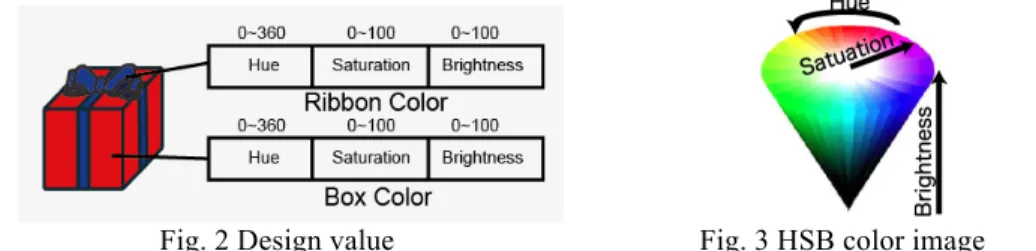
To examine the validity of the proposed method, the system was built using the gift packaging design problem.The color of the gift box and the color of the ribbon were expressed using the HSB color system as design variables. The design variables are shown in Fig. 2 and the HSB color system is shown in Fig. 3.
The HSB color system is a mode of expression of color similar to human sense, and includes three elements regarding color: hue, saturation, and brightness.It is possible to express hue with the hue circle arranged at equal intervals on the circumference, and it is expressed with real numerical value of 0–360. Brightness and saturation are expressed by real numerical values of 0–100.
Fig. 2 Design value Fig. 3 HSB color image
Moreover, in this paper, as qualitative objects used for optimization, clear tradeoff relations set up two objects of "men-oriented present" and "women-oriented present", and considered it as the two-objective maximization problem.
4.3 Overview of Evaluation Method
We examined shown as follows the four evaluation methods.
• Mapping: Evaluation by mapping the individuals to the objective function space.
• Drag&Drop per object: Evaluation by dragging and dropping each object.
• Slider: Evaluation of each object using a slider.
• Radio button: Evaluation of each object using a radio button.
The subjects evaluated the individuals in detail with the objective values from 0 to 100 with Mapping, Drag&Drop per object, and Slider. The Radio button accepts a coarse evaluation from 1 to 5.The interface of the system used in this experiment is shown in Figs. 4–7.
Fig. 4 Mapping Fig. 5 Mapping per object
Fig. 6 Slider Fig. 7 Radio button
In the proposed interface shown in Fig. 4, individuals are displayed on the left of the screen, and the objective function space, which has two axes of qualitative objects, is shown at the right of the screen. The user performs evaluates individuals by mapping them to the space. In Fig. 5, individuals are displayed on the left of screen, and the area for each object is displayed on the right of the screen. The subjects can evaluate the individuals by dragging and dropping. In Figs. 6 and 7, the Slider or Radio button is placed under each individual and used for evaluation.
4.4 Result of Experience
4.4.1. Discussion of Questionnaire Result
From the results of the questionnaire shown in Fig. 8, we compared the system from the viewpoint of "ease of attaching evaluation (ease)," "degree of fatigue (fatigue)," "degree of satisfaction (satisfaction)," and
"diversity of objective function space and design value space (diversity).”
Fig. 8 Questionnaire results
Figure 8 shows that mapping had the best scores in all items, while Drag&Drop per object was poorer than the others. Although there were no significant differences between Slider and Radio button, significant differences were seen between all other evaluation methods (P<0.05). The results of sign test for comparing the systems are shown in Table I.
Next, the advantages and disadvantages of each evaluation method were considered. As shown in Table I, the results of the Mapping evaluation method were better than those if the other evaluation methods with regard to all the items.Next, although the evaluation method using Drag&Drop per object had less fatigue than the Slider method, the degree of fatigue was larger than the Radio button method. Drag&Drop per object was inferior to the other methods in all other items.The Slider method showed the largest degree of
was poorer than the Radio button method. Although the Radio button method was better with regard to all items than the Drag&Drop method, diversity was poorer than the Slider method.
Based on the above results, in MOIGA considering several qualitative objects, Mapping is the best evaluation method.
Table I. Results of sign test
Ease Fatigue Satisfaction Diversity
Mapping (+) vs. Drag&Drop per object (-) (+) (+) (+) (+)
Mapping (+) vs. Slider (-) (+) (+) (+) (+)
Mapping (+) vs. Radio button (-) (+) (+) (+) (+)
Drag&Drop per object (+) vs. Slider (-) (-) (+) (-)
Drag&Drop per object (+) vs. Radio button (-) (-) (-) (-) (-)
Slider (+) vs. Radio button (-) (-) (-) (+) (-)
4.4.2. Discussion of Archive Satisfaction and Diversity
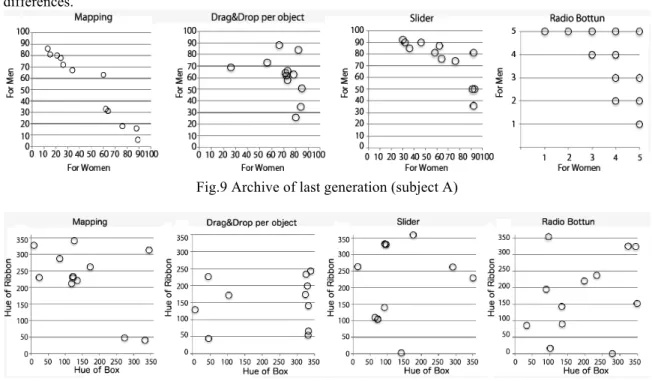
Figure 8 shows that the Mapping and Slider methods had greater satisfaction scores, and conversely that the Drag&Drop and Radio button methods had poorer satisfaction scores. The differences may occur from the particle size of the evaluation. The graph of the evaluation value of the individual group saved in the archive population after the last generation of subject A in each evaluation method is shown in Fig. 9. The value of Hue in the design variable space in this case is shown in Fig. 10. As design variables other than the value of Hue were not different between individuals or between interfaces, the value of Hue causes the differences.
Fig.9 Archive of last generation (subject A)
Fig. 10 Hue of individual in last generation archive (subject A)
As shown in Fig. 9, the solution with a low evaluation value is also saved into the archive population by the Radio button.In the Radio button method, as coarse evaluation from 1 to 5 was used, many cases had the same evaluation value. Good solutions which have the same evaluation value are compared. The differences caused because they have not been saved in the same archive population. Thus, the degree of subject satisfaction was reduced even when diversity in design variable space is maintained. The Drag&Drop method allowed checking of whether there was a point in the objective function space or design variable space that was crowded with solutions. Therefore, the drop in diversity in the design variable space and objective function space was thought to be related to the degree of satisfaction of solutions. In the Slider method, dominated solutions are saved in the objective function space in the archive population, and the diversity in the design variable space was also poor compared with the Mapping and
Radio button methods. In the Mapping method, the Pareto solutions that maintained breadth in the objective function space were checked. Diversity was maintained in the design variable space. This was considered to be because the diversity in the design variable space also appeared in the diversity in the objective function space. As the same tendency was seen in 20 of 24 test subjects (83%), these tendencies are thought to be common among subjects. From these experiments, it was suggested that evaluation method influences the users degree of satisfaction.
5 CONCLUSION
The conventional interactive Genetic Algorithm (iGA) only treats one subjective object. This paper introduced multiobjective iGA (MOIGA), which deals with several types of subjective object simultaneously. To develop the effective MOIGA, we considered the evaluation part of MOIGA. We introduced the evaluation interface where the Pareto front is treated explicitly. The proposed interface may reduce user burden in evaluating candidate solutions. An experiment was performed to compare the proposed method, Slider interface, and Radio button interface. The results of the experiment indicated that the proposed method is more suitable for MOIGA than the other interfaces.
REFERENCES References are as follows:
1. H. Takagi, “Interactive Evolutionary Computation: Fusion of the Capabilities of EC Optimization and Human Evaluation ", Proceedings of the IEEE, vol.89, no.9, 2001, pp.1275-1296.
2. M Zeleny, “Multiple criteria decision making ", McGrw-Hill Book Company, 1982.
3. D.E. Goldberg, "Genetic Algorithms in search optimization and machine learning”, Addison- Wesly, 1989.
4. K. Aoki, H. Takagi, “Interactive GA-based design support system for lighting design in 3-D computer graphics. The transactions of the Institute of Electronics”, Information and Communication Engineers 81(7), 1998, pp.1601–1608
5. H. Takagi, K. Aoki, and Fujimura.N, ”Interactive GA-based Design Support System for Lighting Design in Computer Graphics”, Proceedings of Int ’l Conf. on Soft Computing, 1996, pp. 533- 536.
6. K. Deb, A. Pratap, S. Agarwal, T. Meyarivan, “A fast and elitist multiobjective genetic algorithm:
NSGA-II ", IEEE Trans. on Evolutionary Computation, 6 (2), 2002, pp. 182-197.
7. E. Zitzler and L. Thiele,"SPEA2: Improving the Performance of the Strength Pareto Evolutionary Algorithm”, Technical Report 103, Computer Engineering and Communication Networks Lab (TIK), Swiss Federal Institute of Technology (ETH) Zurich, 2001.
8. A. Brintrup, H. Takagi, Ashutosh Tiwari, Jeremy J. Ramsden, “Evaluation of sequential, multi- objective, and parallel interactive genetic algorithms for multi-objective optimization problems ", Journal of Biological Physics and Chemistry 6, 2006, pp 586-598.
9. A.Brintrup, J. Ramsden, H. Takagi, A. Tiwari, “Ergonomic Chair Design by Fusing Qualitative and Quantitative Criteria Using Interactive Genetic Algorithms", IEEE Transactions on Evolutionary Computation, vol.12, no.3, 2008, pp.343-354.
10. B. Michael, M. Dimitri, “Supersonic Business Jet Design and Requirements Exploration Using Multiobjective Interactive Genetic Algorithms", SAE Tech Pap Ser (Soc Automot Eng), SAE, 01, 2005, pp. 1327-1342.
11. K. Joshua, R. Patrick, “A framework for Visually Interactive Decision-making and Design using Evolutionary Multi-objective Optimization (VIDEO)", Environ Model Softw, Vol.22, No.12, 2007, pp.1691-1704.
12. T. Tyni, J. Ylinen, “Evolutionary bi-objective optimisation in the elevator car routing problem.”
European Journal of Operational Research, Volume 169, Issue 3, 16 March 2006, 2006, pp.960- 977.
13. A. Brintrup, H. Takagi, “The Effect of User Interaction Mechanisms in Multi-objective IGA ", Genetic and Evolutionary Computation Conference (GECCO2007), London, U.K 2007, pp.2629- 2632.