1. Introduction
2. Complementation in Kumam 2.1. Types of V-Comps 2.2. “Paratactic” construction
2.3. Distribution of complement types
2.4. Complement types and their semantic characteristics
Complementation and Evidential Strategy in Kumam
HIEDA, Osamu
Kumam, a Western Nilotic language, has two types of complement clauses.
Complement clauses are divided into N-comps and V-comps. N-comps modify the preceding NP as an adjunct, while V-comps constitute an argument in sentences. It is not N-comps but V-comps that are involved in evidentiality.
V-comps are morpho-syntactically classified into five subclasses: “paratactic”
indicative, hypotactic indicative, “paratactic” subjunctive, hypotactic subjunc- tive, and infinitive. Main verbs determine which type of complements should be selected. Complement clauses in “paratactic” constructions are not pre- ceded by a complementizer, while those in hypotactic constructions are always preceded by a complementizer. The “paratactic” construction has syntacti- cally and semantically different characteristics from the hypotactic one. When perception verbs are used in “paratactic” constructions, they express Direct Perception. When cognition verbs are used in “paratactic” constructions, they express that the knowledge about an event described by the complement clause is inherent in the speaker’s mind. When manipulation verbs are used in
“paratactic” constructions, they express that the manipulation is accomplished without fail. These semantic characteristics come from evidentiality, which is related to complementation. In other words, there is a relationship between complementation types and evidentiality. This article is the first attempt to explain this relationship from a logical point of view. In “paratactic” construc- tions, both the main and complement clauses must have positive truth values in order for the whole sentence to have a positive truth value. This is the reason why “paratactic” constructions have those syntactic and semantic characteris- tics. This logical consideration explains the relationship between complemen- tation and evidentiality.
Keywords: complementation, evidentiality, “paratactic”, truth value, Kumam, Western Nilotic
1) This article is based on the data that were collected during fieldwork in 2012–2014, which was supported by JSPS KAKENHI Grant Number 24320073. The author is appreciative of the helpful advices from two referees. Inspired by the comments of the referees, I rewrote this article. The author is also grateful to Prof. Aikhenvald for her advice that originally inspired this research.
2.4.1. Perception verbs 2.4.2. Cognition verbs 2.4.3. Manipulation verbs 2.4.4. Causation verbs 2.4.5. Phasal verbs
2.5. “Paratactic” complements and first-person effect 2.6. Complementation and negation
2.7. Complementation and its pragmatic structure 3. Truth value and complement types
4. Concluding remarks
1. Introduction
This paper is a first attempt to demonstrate the relationship between complementation and evidential strategy in Kumam, which belongs to the southern Lwo group of Western Nilotic.2) The author has previously pointed out that a relationship between complementa- tion and evidentiality is observed in Acooli.3) Cross-linguistically, some prior researches have pointed out the relationship between complementation and evidentiality in a few languages.4) However, these studies did not clarify why complementation has something to do with evidentiality. In this paper, the author will discuss why complementation has a function for expressing characteristics of information sources, namely, evidentiality.5)
Languages have a variety of phonological, syntactic, or lexical devices for expressing characteristics of information sources. For example, Japanese has various lexical items for expressing these characteristics. In addition to the lexical items, Japanese has some morpho-syntactic devices for expressing characteristics of information sources.
(1) Taro-ga niwatori-o nusun-da-soo-da.
Taro-NOM chicken-ACC steal-PAST-HEARSAY-PAR ‘Taro stole a chicken, they say.’
2) Kumam is spoken in the central part of Uganda. The number of speakers is given as 112,629 in Ethnologue (Gordon 2005). Western Nilotic is a branch of the Nilotic languages, which form a large group among the members of the Nilo-Saharan phylum (Greenberg 1966). Kumam is not a well-studied language. We have only one dictionary and one grammar that are published by the author (Hieda 2011, Hieda 2013).
3) See Hieda (2010). Acooli is a genetically and structurally close-related language to Kumam.
4) Aikhenvald (2004) demonstrates cross-linguistically how evidentiality is expressed by a variety of linguistic devices. Some papers in Aikhenvald and Storch (2013) demonstrate evidentiality especially in perception and cognition cross-linguistically, including a Western Nilotic lan- guage. Miller and Gilley (2007) discuss evidentiality in Shilluk, a Western Nilotic language.
Aikhenvald (2006) points out that there is relationship between complementation and evidenti- ality (Aikhenvald 2006: 202). Fleck (2006) also discusses the relationship in Matses (Fleck 2006:
226–235).
5) Please see Aikhenvald (2004) for the definition of evidentiality.
(2) watashi-wa inu-ga naku-no-o kii-ta.
1SG-TOP dog-NOM bark-NOMINALIZER-ACC hear-PAST ‘I heard a dog barking.’
(3) watashi-wa inu-ga nai-ta-to kii-ta.
1SG-TOP dog-NOM bark-PAST-COMP hear-PAST ‘I heard that a dog barked.’
The modal particle –soo ‘they say’ in (1) expresses that the speaker has received hearsay information from somebody. The modal particle is one of the lexical items that express characteristics of information sources.6) In (2), the main verb kii-ta ‘heard’ is preceded by the noun phrase inu-ga naku-no ‘a dog’s barking’ consisting of the verb phrase inu-ga naku ‘a dog barks’ and the nominalizer –no. When perception verbs are preceded by a noun phrase as an object, they express direct perception. In (3), the main verb kii-ta ‘heard’ is preceded by the complement clause inu-ga nai-ta-to ‘that a dog barked’ consisting of the verb phrase inu-ga naku ‘a dog barks’ and the complementizer –to.7) When perception verbs are preceded by a complement clause as an object, they express indirect perception. Japanese makes use of syntactically different clause types for distinguishing between characteristics of informa- tion sources.
This article aims to explain why complementation functions to distinguish between characteristics of information sources. Before discussing the reason in its entirety, the author will draw a short sketch of complementation in Kumam.
2. Complementation in Kumam
Kumam has two types of complements: N-complement (N-comp) and V-complement (V-comp). N-comps do not constitute an argument in sentences but modify the preceding NP as an adjunct, while V-comps function as an object that the main verb requires. We will discuss only V-comps in this article because N-comps are not involved in distinguishing between characteristics of information sources.
V-complement clauses are sometimes preceded by the complementizer bé ‘COMP’ and sometimes not. In (4), the V-complement clause bé ó!kélo =neko gwáŋ ‘that Okelo killed Ogwang’
constitutes an object as one of the arguments that the transitive verb ŋeeno ‘to know’ requires.
(4) a=ŋé!ó !bé ó!kélo =neko gwáŋ.
1SG=PERF:know COMP Okelo 3S/P=PERF:kill Ogwang ‘I knew that Okelo killed Ogwang.’
6) We have a long tradition of research on modality in the Japanese language.
7) The verb naku- ‘to bark’ is morphologically alternated to nai- before the past particle ta- ‘PAST.’
2.1. Types of V-comps
Kumam has two main types of V-complement constructions. One is a construction in which the complement clauses are preceded by a complementizer as shown in (4), and the other is a construction in which the complement clauses are not preceded by a complementizer. Noonan (1992) refers to the former as hypotactic and the latter as “paratactic” in the grammar of Lango.8)
However, the term “paratactic” is not appropriate for naming the construction in which the complement clauses are not preceded by a complementizer. Although comple- ment clauses in “paratactic” constructions are not accompanied by a complementizer, they are embedded within the main clause. As shown in (5), the complement clause okélo kwál
gwen ‘(that) Okelo steals the chickens’ is embedded in the main clause a=n!n ‘I saw,’ though the complement clause is not accompanied by a complementizer. Though they are syntacti- cally dependent on the main clauses, complement clauses without a complementizer are logically separated from the main clause, as discussed later. For the time being, we will call the complement construction without a complementizer as “paratactic” because we have no other term than the one offered by Noonan (1992). We will call the complement construc- tion with a complementizer as hypotactic, adopting Noonan’s terminology.
Because they are V-comps, “paratactic” complement clauses constitute one of the argu- ments that the main verb requires in sentences. In (5), the “paratactic” complement clause okélo kwál gwen ‘(that) Okelo steals the chickens’ constitutes an object as one of the arguments that the transitive verb nn ‘to see’ requires.9)
(5) as=n!nv [ okélo kwál gwen ]o.
1SG=PERF:see Okelo 3SG:IMPERF:steal chickens ‘I saw Okelo stealing the chickens.’
In addition to the two main types discussed above, V-comps are subdivided into three types according to whether the complement clauses are inflected in indicative or subjunc- tive mood, or consist of an infinitive form of verbs. Overall, V-comps are classified into five morpho-syntactic types: hypotactic indicative, “paratactic” indicative, hypotactic subjunc- tive, “paratactic” subjunctive, and infinitive complement type.10) The infinitive complement clauses are never preceded by a complementizer.
8) See Noonan (1992: 191–210) and Noonan (2007).
9) “Paratactic” complement clauses function as an object that the main verb requires. However, a subject within a “paratactic” complement clause is not regarded as an object that the main verb requires. For example,
(1) a=n!n [!g =!kwál gwen]o. 1SG=PERF:see 3PL 3PL=IMPERF:steal chickens I saw them stealing the chickens.
The subject clitic = ‘3PL’ is added to a verb only when the third-person plural independent pro- noun g ‘3PL’ as the subject is followed by the verb. Therefore, the independent pronoun has a grammatical relation as a subject for the verb in the “paratactic” complement clause.
10) The classification of complement clauses in Kumam is discussed in detail by Hieda (2010).
Hypotactic indicative
Hypotactic indicative complement clauses are always preceded by the complementizer bé ‘COMP’ and consist of a predicate inflected in indicative mood. In (6), the complement clause bé ó!kélo =kwal sén!té ‘that Okelo stole the money’ consists of the verb kwal ‘to steal’
inflected in indicative mood.
(6) a=ŋé!ó !bé ó!kélo =kwal sén!té.
1SG=PERF:know COMP Okelo 3S/P=PERF:steal money ‘I knew that Okelo stole the money.’
“Paratactic” indicative
“Paratactic” indicative complement clauses are not preceded by a complementizer but consist of a predicate inflected in indicative mood. In (7), the complement clause okélo kwál gwen
‘(that) Okelo steals the chickens’ consists of the verb kwal ‘to steal’ inflected in indicative mood.
(7) a=n!n okélo kwál gwen.
1SG=PERF:see Okelo 3SG:IMPERF:steal chickens ‘I saw Okelo stealing the chickens.’
Hypotactic subjunctive
Hypotactic subjunctive complement clauses are preceded by the complementizer bé
‘COMP’ and consist of a predicate inflected in subjunctive mood. In (8), the complement clause bé !c kwal gwén ‘that the man should steal the chickens’ consists of the verb kwal ‘to steal’ inflected in subjunctive mood.
(8) a=mt !bé !c kwal gwén.
1SG=IMPERF:want COMP man 3SG:steal:SUB chickens ‘I wish that the man should steal the chickens.’
“Paratactic” subjunctive
“Paratactic” subjunctive complement clauses are not preceded by a complementizer but consist of a predicate inflected in subjunctive mood. In (9), the complement clause c
kwal gwén ‘(that) the man should steal the chickens’ is an object and one of the arguments that the main verb mt ‘to want’ requires. The verb kwal ‘to steal’ in the complement clause is inflected in subjunctive mood.
(9) a=mt c kwal gwén.
1SG=IMPERF:want man 3SG:steal:SUB chickens ‘I want the man to steal the chickens.’
Infinitive
Infinitive complement clauses consist of an infinitive form of verbs. An infinitive com- plement clause constitutes an object and one of the arguments that the main verb requires.
In (10), the complement clause kwal gwen ‘to steal the chickens’ consists of the infinitive form of the verb kwal ‘to steal.’ The complement clause constitutes an object that the main verb waac ‘to tell’ requires.
(10) a=wá!c !né-ó!kélo kwal gwen.
1SG=PERF:tell to-Okelo steal:INF chickens ‘I told Okelo to steal the chickens.’
2.2. “Paratactic” construction
“Paratactic” constructions consist of a main and complement clause that are linked without any connecting morpheme. First, we must attest that the “paratactic” construction constitutes one sentence phonologically and syntactically.
Sentences with “paratactic” constructions have an intonation pattern that represents one sentence. As vowel and tonal sandhi rules, whose application is interrupted by a sen- tence boundary are applied between the main and complement clauses in “paratactic” con- structions, no sentence boundary can be found between them. Any NP can be topicalized from a complement clause in a “paratactic” construction. Since topicalization is applied to any NP in a subordinate clause, the complement clause in a “paratactic” construction is regarded as constituting a subordinate clause embedded within the matrix clause.11) For example, the sentence in (11) contains the “paratactic” complement clause dák-!ná tédó
!cám ‘(that) my wife cooks the food.’ The object NP cám ‘food’ in the complement clause is topi- calized and occupies the sentence-initial position for a topic in (12). Of course, all NPs in a hypotactic complement clause may be topicalized. Thus, “paratactic” complement clauses are evidently embedded in the matrix clause in the same manner as hypotactic complement clauses are.
(11) a=n!n !dák-!ná tédó !cám.
1SG=PERF:see woman-1SG 3SG:IMPERF:cook food ‘I saw my wife cooking the food.’
11) Topicalization can also be applied to any NPs in a hypotactic complement clause.
(1) a=w! !bé dák-!ná =tedo cám.
1SG=PERF:hear COMP woman-1SG 3SG:IMPERF:cook food ‘I heard that my wife cooked the food.’
(2) cám, a=w! !bé dák-ná =tedo.
food 1SG=PERF:see COMP woman-1SG 3SG:IMPERF:cook ‘The food, I heard that my wife cooked.’
The object NP cám ‘food’ in the hypotactic complement clause is topicalized and occupies the sentence-initial position as a topic in (2).
(12) cám, a=n!n !dák-ná tédó.
food 1SG=PERF:see woman-1SG 3SG:IMPERF:cook ‘The food, I saw my wife cooking.’
2.3. Distribution of complement types
Main verbs determine which type of complements should be selected. Perception verbs such as nn ‘to see,’ bl ‘to taste,’ and w ‘to feel’ are followed only by a “paratactic”
indicative complement. Perception verbs such as w ‘to hear’ and d ‘to find’ are followed by a “paratactic” or hypotactic indicative complement. Cognition verbs such as ŋeeno ‘to know’ and taam ‘to think’ are basically followed by a hypotactic indicative or subjunctive complement. Only the cognition verb ŋeeno ‘to know’ may also be followed by a “paratactic”
indicative complement in some contexts. Though they show relatively complicated dis- tribution of complement types, manipulation verbs are mainly followed by a “paratactic”
or hypotactic subjunctive complement, or an infinitive complement. Manipulation verbs such as dn ‘to force,’ kwan ‘to ask for,’ and waac ‘to tell’ may be followed by an infinitive complement. Some manipulation verbs like dn ‘to force’ and sp ‘to persuade’ may also be followed by a “paratactic” indicative complement. Kumam clearly distinguishes causa- tion from manipulation. Causation verbs such as mn ‘to give’ are followed by a “paratactic”
indicative or infinitive complement. Phasal verbs such as gn ‘to begin’ and tyeko ‘to finish’
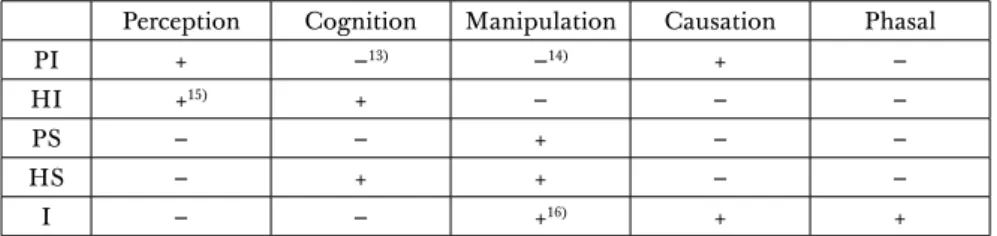
are followed only by an infinitive complement. The classification into perception, cogni- tion, manipulation, causation, and phasal verbs is not theoretically founded but useful for illustrating the distribution of complement types. We can summarize the basic distribution of complement types with the reservation that we ignore slight discrepancies.12)
Table 1: Distribution of complement types
Perception Cognition Manipulation Causation Phasal
PI + –13) –14) + –
HI +15) + – – –
PS – – + – –
HS – + + – –
I – – +16) + +
(PI: “paratactic” indicative, HI: hypotactic indicative, PS: “paratactic” subjunctive, HS:
hypotactic subjunctive, I: infinitive)
12) The detailed distribution of complement types is discussed by Hieda (2013). Hieda (2013) details additional perception, cognition, manipulation, causation, and phasal verbs.
13) The cognition verb ‘to know’ may be followed by a “paratactic” complement in some contexts.
14) Some manipulation verbs like ‘to force’ and ‘to persuade’ may be followed by a “paratactic”
complement.
15) Perception verbs like ‘to see,’ ‘to taste,’ and ‘to feel’ cannot be followed by a hypotactic complement.
16) The manipulation verb ‘to want’ may not be followed by an infinitive complement.
2.4. Complement types and their semantic characteristics 2.4.1. Perception verbs
When perception verbs are followed by a “paratactic” indicative complement, they express Direct Perception. They express that the speaker perceives an event described by the complement clause directly with his or her own sensory organs. When perception verbs are followed by a hypotactic indicative complement, they express Indirect Perception. They express that the speaker receives information about an event described by the complement clause, from another person.
Sentences (13) to (16) contain perception verbs followed by “paratactic” complements.
These verbs express Direct Perception. For example, the sentence in (13) is interpreted to mean that the speaker heard the dog barking with the speaker’s own ears.
“Paratactic” indicative
(13) a=w! ogwók gwéó.
1SG=PERF:hear dog 3SG:IMPERF:bark ‘I heard the dog barking.’
(14) a=b!l erŋi ww.
1SG=PERF:taste tea sweet ‘I tasted the tea and it tasted sweet.’
(15) a=w! d p lyêt tin.
1SG=PERF:feel PAST earth hot today ‘I felt it was hot today.’
(16) a=n!n c kwál gwen.
1SG=PERF:see man 3SG:IMPERF:steal chickens ‘I saw the man stealing the chickens.’
The sentences in (17) and (18) contain perception verbs followed by a hypotactic complement. These verbs express Indirect Perception. For example, the sentence in (17) is interpreted to mean that the speaker heard from somebody that the dog barked.
Hypotactic indicative
(17) a=w! !bé ó!gwók =gweo.
1SG=PERF:hear COMP dog 3S/P=PERF:bark ‘I heard (from somebody) that the dog barked.’
(18) a=!d !bé é!kéko =gore
1SG=PERF:find COMP door 3S/P=PERF:open:NEUT ‘I noticed that the door was opened.’
Some perception verbs like ‘to see,’ ‘to taste,’ and ‘to feel’ can be followed only by a
“paratactic” indicative complement. They express only Direct Perception according to the physical properties of sensory organs. Others may be followed by a “paratactic” or hypo-
tactic indicative complement. When they are followed by a “paratactic” indicative comple- ment, they express Direct Perception. When they are followed by a hypotactic indicative complement, they express Indirect Perception.
For example, perception verbs such as w ‘to hear’ may be used in a “paratactic” or hypotactic construction. Since the perception verb w ‘to hear’ in a “paratactic” construc- tion expresses Direct Perception, it cannot be accompanied by a prepositional phrase such as -bt NP ‘from NP’ that denotes the source of information. Therefore, the sentence in (19) is not grammatical. When the verb w ‘to hear’ is used in a hypotactic construction, it expresses Indirect Perception. The sentence in (20) is grammatical, even though it contains a prepositional phrase such as -bt NP ‘from NP’ that denotes the source of information.
(19) *a=w! -bt-okélo ogwók gwéó.
1SG=PERF:hear from-Okelo dog 3SG:IMPERF:bark ‘*I heard from Okelo the dog barking.’
(20) a=w! -bt-okélo bé ó!gwók =gweo.
1SG=PERF:hear from-Okelo COMP dog 3S/P=PERF:bark ‘I heard from Okelo that the dog barked.’
The second sentence in (21) is not acceptable semantically, even though each sentence is well-formed syntactically. Since the first sentence contains a “paratactic” construction, it is interpreted to mean that the speaker heard the dog barking with his or her own ears. There- fore, the speaker cannot deny in the second sentence the fact that he heard the dog barking.
(21) a=w! ogwók gwéó oró.
1SG=PERF:hear dog 3SG:IMPERF:bark yesterday
#do áŋ !lká á=w!!-. a=bú!tó -br.
but 1SG NEG 1SG=PERF:hear-3SG 1SG=PERF:sleep in-good ‘I heard the dog barking yesterday. #But I did not hear it. I slept well.’
(#: semantically unacceptable)
The second sentence in (22) is acceptable semantically. Since the first sentence contains a hypotactic construction, it is interpreted to mean that the speaker received hearsay infor- mation about the dog barking. He can deny in the second sentence the fact that he heard the dog barking.
(22) a=w! !bé ó!gwók =gweo oró.
1SG=PERF:hear COMP dog 3S/P=PERF:bark yesterday do áŋ !lká á=!w!!-. a=bú!tó -br.
but 1SG NEG 1SG=PERF:hear-3SG 1SG=PERF:sleep in-good ‘I heard that the dog barked yesterday. But I did not hear it. I slept well.’
In summary, when perception verbs are followed by a complement clause, Kumam speakers make use of complementation types for distinguishing between characteristics of information sources. By using a “paratactic” construction, speakers confirm that they per- ceive the event described by the complement clause with their own sensory organs.
2.4.2. Cognition verbs
Cognition verbs are mainly followed by a hypotactic indicative or subjunctive comple- ment clause. However, the particular verb ŋeeno ‘to know’ may also be followed by a “paratac- tic” indicative complement. When a speaker uses the verb in a “paratactic” construction, it expresses that an idea or knowledge about the event described by the complement clause is inherent in his mind. When it is followed by a hypotactic indicative complement, the verb expresses that the speaker receives an idea or knowledge about the event described by the complement clause from somebody else. The sentence in (23) contains a “paratactic”
construction. It can be interpreted to mean that the speaker witnesses the event described by the complement clause. Otherwise, it can be interpreted to mean that an idea or knowl- edge about the event is stored in the speaker’s mind, namely that the speaker believes that Okelo steals chickens habitually. The sentence in (24) contains a hypotactic construction and is interpreted to mean that the speaker received the idea or knowledge described by the complement clause from somebody else.
“Paratactic” indicative
(23) a=ŋéó okélo =kwal gwen.
1SG=IMPERF:know Okelo 3S/P=PERF:steal chickens ‘I know that Okelo stole the chickens (by witnessing).’
Hypotactic indicative
(24) a=ŋéó !bé ó!kélo =kwal gwen.
1SG=IMPERF:know COMP Okelo 3S/P=PERF:steal chickens
‘I have received the knowledge that Okelo stole the chickens (from somebody).’
The cognition verb ŋeeno ‘to know’ in a “paratactic” construction is usually conjugated with first person singular in imperfect aspect as discussed in Section 2.5. It is frequently grammaticalized into an adverbial that has a lexical meaning ‘surely, certainly’ as shown in (25). As a result, the complement clause c kwál gwen ‘the man steals the chickens’ becomes a main clause.
(25) a=ŋéó c kwál gwen.
1SG=IMPERF:know man 3SG:IMPERF:steal chickens ‘Certainly, the man steals the chickens.’
When the verb ŋeeno ‘to know’ is used in a hypotactic construction, it is interpreted as an inceptive verb. Therefore, it may be inflected in imperfect or perfect aspect. It expresses
that a speaker obtains an idea or knowledge about an event from somebody else at a speci- fied time. An event can be captured in time if it has a starting point. When the verb is used in a “paratactic” construction, it is interpreted as a stative verb. It expresses that an idea or knowledge about an event is stored in the speaker’s mind. An event is not captured in time if it does not have a starting point. Therefore, the verb in a “paratactic” construction cannot be inflected in perfect aspect.17)
In (26), because the first clause contains a hypotactic construction, the verb ŋeeno ‘to know’
expresses inceptive meaning. The clause is interpreted to mean that the speaker received hearsay information that Okelo stole the money. There is a possibility that the information might be false. Thus, the speaker can deny the information in the following clause.
(26) a=ŋé!ó !bé ó!kélo =kwal sén!té, do lká =!kwá!l.
1SG=PERF:know COMP Okelo 3S/P=PERF:steal money but NEG 3SG=PERF:steal ‘I got the news that Okelo stole the money, but he did not steal it.’
In summary, most cognition verbs cannot be followed by a “paratactic” indicative complement clause. They do not include evidential overtones in Kumam. Only the verb ŋeeno ‘to know’ has evidential overtones in some contexts where it is used in a “paratactic”
construction.
Hypotactic subjunctive
(27) a=tá!m !bé ó!kél kwal gwén.
1SG=PERF:think COMP Okelo 3SG:steal:SUB chickens ‘I thought that Okelo should steal the chickens.’
Cognition verbs may be followed by a hypotactic subjunctive complement clause.
When cognition verbs are followed by a subjunctive complement clause, they express the speaker’s opinion or judgment that an event described by the complement clause should be done or not, as shown in (27). Speakers do not need to distinguish between characteristics of information sources because the cognition verbs express their opinion or judgment. Evi- dentiality is not specified when cognition verbs are followed by a subjunctive complement clause.
2.4.3. Manipulation verbs
Manipulation verbs are mainly followed by a “paratactic” or hypotactic subjunctive, or an infinitive complement. When manipulation verbs like mt ‘to want’ are used in a
“paratactic construction, they express “strong” manipulation.18) The sentence in (28) with a “paratactic” construction presupposes that the speaker’s manipulation will be fulfilled without fail. When the manipulation verb mt ‘to want’ is used in a hypotactic construc-
17) Stative verbs cannot be inflected in perfect aspect in Kumam.
18) The “desirative” verb mt ‘to want’ belongs to the category of manipulation verbs in Kumam.
However, it may not be followed by an infinitive complement.
tion, it expresses “weak” manipulation. The sentence in (29) with a hypotactic construction is interpreted to mean that the speaker’s manipulation might or might not be fulfilled. This sentence is acceptable semantically, regardless of whether the child might study.
“Paratactic” subjunctive
(28) d a=mt atn som-í.
PAST 1SG=IMPERF:want child 3SG:read-SUB ‘I wanted the child to study. (He studied without fail.)’
Hypotactic subjunctive
(29) d a=mt !bé á!tn som-í.
PAST 1SG=IMPERF:want COMP child 3SG:read-SUB ‘I wanted the child to study. (He might or might not study.)’
These two types of complementation seemingly reflect the “strength” of manipulation.
Actually, however, they distinguish between characteristics of information sources, namely, evidentiality. When manipulation verbs are used in “paratactic” constructions, they pre- suppose that the speaker knows that his manipulation will achieve the desired result. He guarantees it with his information. When manipulation verbs are used in hypotactic con- structions, they do not presuppose that the speaker’s manipulation will achieve the desired result. The speaker does not know if his manipulation will achieve the desired result; hence he cannot guarantee it with his information. As a result, manipulation in a “paratactic”
construction sounds strong, while manipulation in a hypotactic construction sounds weak.
Complementation distinguishes between characteristics of information sources, not the
“strength” of manipulation.
The sentence in (30) sounds strange semantically as a whole, though each clause is syntactically well-formed.19) The first clause contains a “paratactic” subjunctive complement clause. When manipulation verbs are used in “paratactic” construction, they express that the speaker knows that his manipulation will achieve the desired result. Since the speaker knows that his manipulation will achieve the desired result, it is a meaningless repetition for him to confirm this in the second clause.
(30) ?d a=mt atn som-i =!kó soomo.
PAST 1SG=IMPERF:want child 3SG:read-SUB 3SG=PERF:and do read:INF ‘I wanted the child to study (he studied without fail.) and he studied.’
When manipulation verbs are followed by an infinitive complement, the event described by the complement clause will not necessarily be accomplished. The sentence in (31) is acceptable even if the event described by the complement clause is not accomplished.
19) Kumam has a particular coordinate construction where coordinants are linked by the verb =kó
‘and to do.’
(31) a=wá!c !né-ó!kélo kwal gwen.
1SG=PERF:tell to-Okelo steal:INF chickens ‘I told Okelo to steal the chickens.’
In summary, when manipulation verbs are followed by a complement clause, Kumam speakers make use of complementation types for distinguishing between characteristics of information sources, not the “strength” of manipulation.
2.4.4. Causation verbs
Causation verbs such as mn ‘to give, make’ are followed by a “paratactic” indicative complement in addition to an infinitive complement. When the causation verb mn ‘to give, make’ is followed by a “paratactic” indicative complement, it expresses that an event described by the complement clause is necessarily realized. In (32), the causation is realized at the time specified in the main clause. When causation verbs are followed by an infinitive complement, they express that the event described by the complement clause is not neces- sarily realized. The sentence in (33) is interpreted to mean that the speaker’s father tried to make the speaker become a teacher but that he might or might not have become a teacher.
“Paratactic” indicative
(32) papá =m a=bédó pwó.
my father 3S/P=PERF:give 1SG=IMPERF:become teacher ‘My father made me become a teacher. (I became a teacher.)’
Infinitive
(33) papá =m-á béedo pwó.
my father 3S/P=PERF:give-1SG become:INF teacher
‘My father made me become a teacher. (I might or might not have become a teacher.)’
The sentence in (34) is acceptable semantically, while the sentence in (35) is not acceptable.
The second clause in (34) contains a “paratactic” construction. Causation verbs in “paratac- tic” constructions express that the event described by the complement clause is realized.
The sentence in (34) is interpreted to mean that the subject missed the examination and as a result he felt sad. In (35), the causation verb is followed by an infinitive complement clause in the second clause. When causation verbs are followed by an infinitive complement, they express that the causation is not necessarily realized. The sentence in (35) is interpreted to mean that the subject missed the examination but that he might or might not feel sad. It sounds strange for Kumam speakers that a person does not mind missing an examination.
(34) =k! pe, =m!!- =!w -rac.20) 3SG=PERF:miss examination 3SG=PERF:give-3SG 3SG=IMPERF:feel in-bad ‘He missed the examination; thus, it made him feel sad.’
(35) #=k! pe, =m!!- w -rac.
3SG=PERF:miss examination 3SG=PERF:give-3SG feel:INF in-bad ‘He missed the examination; thus, it made him feel sad.’
In summary, Kumam distinguishes causation from manipulation. When causation verbs are used in complementation, they express whether an event will be realized or not, regardless of a speaker’s wish. When they know that an event will be realized, speakers use a “paratactic” construction. When they do not know if an event will be realized, speakers use an infinitive complement.
2.4.5. Phasal verbs
Phasal verbs are followed only by an infinitive complement clause. Phasal verbs might have nothing to do with evidentiality.
(36) a=tyé!kó soomo tab.
1SG=PERF:finish read:INF book ‘I finished reading the book.’
2.5. “Paratactic” complements and first-person effect
Agreement between “paratactic” constructions and person is observed. Main verbs in
“paratactic” constructions are basically limited to first-person forms, including first-person plural.21) For example, when perception verbs are used in “paratactic” constructions, they express Direct Perception. If main verbs are conjugated with first-person, then the subject in the main clauses is equal to the speaker of utterance. Consequently, the speaker is mak- ing claims that he or she perceives an event described by the complement clause with his or her own sensory organs. The sentence in (37) is grammatical because the speaker guaran- tees that he or she saw the event described by the complement clause with his or her own eyes. The sentence in (38) is not grammatical. Since the speaker did not see the event with his or her own eyes, the speaker cannot guarantee that the event actually occurred.
(37) a=n!n okélo kwál gwen.
1SG=PERF:see Okelo 3SG:IMPERF:steal chickens ‘I saw Okelo stealing the chickens.’
(38) *=nn okélo kwál gwen.
3S/P=PERF:see Okelo 3SG:IMPERF:steal chickens ‘He saw Okelo stealing the chickens.’
20) The verb mn ‘to give’ is a ditransitive verb. In (36), the ditransitive verb takes three argu- ments: the third person singular subject = ‘3SG,’ the third person singular object - ‘3SG,’ and the complement clause =w -rac ‘(that) he feels sad.’ In (37), the ditransitive verb takes three arguments; the third person singular subject, the third person singular object, and the infinitive complement clause w -rac ‘to feel sad.’
21) Aikhenvald (2004) discussed first person-effect in detail except for embedding sentences.
In order to quote clauses with “paratactic” constructions from someone else’s speech, these clauses may be embedded in a quoting clause such as “someone said” on condition that they have the same subject as the quoting clause. When perception verbs are used in “paratactic” constructions, the subject in the quoting clause guarantees that he or she perceived an event described by the complement clause with his or her sensory organs. For example, the sentence in (39) is grammatical, because the subject of the perception verb nn ‘to see’ is coreferential with the subject in the upper matrix clause c =wac ‘the man said.’ The subject of the upper matrix clause guarantees that he or she saw the event described by the “paratactic” complement with his or her eyes. Upper matrix clauses are sometimes omitted in daily speech, as shown in (39).
(39) (c =wac bé ) =!n!n okélo kwál gwen.
(man 3S/P=PERF:say COMP) 3SG=PERF:see Okelo 3SG:IMPERF:steal chickens ‘(The man said that) he saw Okelo stealing the chickens.’
Cognition, manipulation, and causation verbs in “paratactic” constructions are also basically conjugated only with first person for the same reason. The sentence in (40) is grammatical because the cognition verb ŋeeno ‘to know’ in the “paratactic” construction is conjugated with first person, while the sentence in (41) is ungrammatical because the cog- nition verb ŋeeno ‘to know’ in the “paratactic” construction is conjugated with third person.
(40) a=ŋéó okélo =kwal gwen.
1SG=IMPERF:know Okelo 3S/P=PERF:steal chickens ‘I know Okelo stole the chickens.’
(41) *c ŋéó okélo =kwal gwen.
man 3S/P=IMPERF:know Okelo 3S/P=PERF:steal chickens ‘The man knows Okelo stole the chickens.’
2.6. Complementation and negation
The negative particle lká ‘NEG’ may be moved from a complement clause with which it is associated and raised to a position within a matrix clause. When the negative particle lká
‘NEG’ is moved to a matrix clause from a complement clause, the scope of negation extends to the whole sentence. For example, the sentence in (43) has two interpretations that the matrix clause is negated or that the complement clause is negated. In the latter case, the sentence in (43) is semantically equivalent to the sentence in (42).
(42) a=tám !bé ó!kélo lká =tedo cám.
1SG=IMPERF:think COMP Okelo NEG 3S/P=PERF:cook food ‘I think that Okelo did not cook food.’
(43) lká á=!tám !bé ó!kélo =tedo cám.
NEG 1SG=IMPERF:think COMP Okelo 3S/P=PERF:cook food ‘I do not think that Okelo cooked food.’
Negative raising is found only in hypotactic constructions where a matrix clause consists of a limited set of verbs such as taam ‘to think.’ In “paratactic” constructions, the negative particle lká ‘NEG’ is always followed by a main verb but the scope of negation is limited to the matrix clause. The sentence in (44) has only one interpretation that the subject in the matrix clause did not see the event described by the complement. The event described by the complement clause is not negated. The truth value of a “paratactic” com- plement clause is determined separately from a main clause, as we will discuss in Section 3.
“Paratactic” constructions presuppose that the complement clause has a positive truth value.
Therefore, the scope of negation is limited to the main clause in a “paratactic” construction.
(44) lká á=!n!n okélo kwál gwen.
NEG 1SG=PERF:see Okelo 3SG:IMPERF:steal chickens ‘I did not see Okelo stealing the chickens.’
2.7. Complementation and its pragmatic structure
Kumam has a particular lexical device for expressing contrastive focus. Intensive reflexive pronouns are used to bring the preceding NPs into focus in sentences. In (45), the intensive reflexive pronoun ikom- ‘himself, herself’ brings the preceding NP búm ‘forest’ into focus in contrast with possible competitors. Intensive reflexive pronouns are not coreferen- tial with the preceding NP but to the subject in sentences.
(45) c =neko eŋú né-dák i-búm ikom-.
mani 3S/P=PERF:kill lion for-woman in-forest himselfi ‘The man killed the lion for the woman in the forest.’
A hypotactic complement clause is independent from a main clause with regard to controlling an intensive reflexive pronoun. An intensive reflexive pronoun in a hypotactic complement clause is coreferential with the subject of the complement clause not to the subject of the main clause. For example, the intensive reflexive pronoun ikom- ‘himself, herself’ is conjugated with third person singular agreeing with the subject of the hypotactic complement clause okélo ‘Okelo’ as shown in (46).
(46) a=tá!m !bé ó!kélo =wl né-á!tn riŋo íkom-.
1SG=PERF:think COMP Okeloi 3S/P=PERF:buy for-child meat himselfi ‘I thought that Okelo bought meat for the child.’
A “paratactic” complement clause is not independent from a main clause with regard to controlling an intensive reflexive pronoun that serves as the contrastive focus marker. If an intensive reflexive pronoun in a “paratactic” complement is controlled by the subject of the complement clause, the sentence is not grammatical as shown in (47). In a “paratactic”
construction, an intensive reflexive pronoun should be coreferential with the subject of the main clause not to the subject of the complement clause. The sentence in (48) is grammati- cal, because the intensive reflexive pronoun ikom-á ‘myself’ is coreferential with the subject of the main clause, not to the subject of the complement clause okélo ‘Okelo’.
(47) *a=n!n okélo kwál gwen ikom-.
1SG=PERF:see Okeloi 3SG:IMPERF:steal chickens himselfi ‘I saw Okelo stealing the chickens.’
(48) a=n!n okélo kwál gwen ikom-á.
1SGi=PERF:see Okelo 3SG:IMPERF:steal chickens myselfi ‘I saw Okelo stealing the chickens.’
The domain of focus is limited to main clauses in hypotactic construction, while it extends to whole sentences in “paratactic” constructions. This problem is left to research in the future.
3. Truth value and complement types
Why do “paratactic” constructions have the syntactic and semantic characteristics dis- cussed in the preceding section? We will discuss this problem with regard to truth value.
Sentences with “paratactic” constructions are semantically acceptable if both the main and complement clauses have positive truth values. For example, the sentence in (49) is semantically acceptable when the subject of the main clause heard the sound of the dog barking and the dog barked. The sentence in (50) is not acceptable semantically as a whole.
Since the first clause with the “paratactic” construction presupposes that the complement clause has a positive truth value, it cannot be followed by the second clause that denies the event described by the complement clause.
(49) a=w! ogwók !gwéó oró.
1SG=PERF:hear dog 3SG:IMPERF:bark yesterday ‘I heard the dog barking yesterday.’
(50) #a=w! ogwók !gwéó oró, do lká =gweo.
1SG:PERF:hear dog 3SG:IMPERF:bark yesterday but NEG 3S/P=PERF:bark ‘#I heard the dog barking yesterday, but it did not bark.’
The sentence in (49) (=the first clause in (50)) contains a perception verb followed by a
“paratactic” complement clause. As discussed in Section 2.4.1, perception verbs in “paratac-
tic” constructions express Direct Perception. If the dog barked and the speaker heard the sound with his or her ears, then this gives rise to an appropriate interpretation of the sentence because both the main and complement clauses have positive truth values. Truth values in “paratactic” constructions are determined in the main and complement clause independently.
On the other hand, truth values in hypotactic constructions are determined in the entire sentence. If the main clause has a positive truth value, the whole sentence has a positive truth value, whether the complement clause has a positive value or not. For example, the sentence in (51) fulfills the truth value only if the main clause has a positive truth value.
That is, the sentence in (51) is semantically acceptable if the speaker heard the news about the dog, whether it barked or not. The sentence in (52) is acceptable semantically as a whole, though the second clause denies the event described by the preceding complement clause.
If a speaker hears news about a dog, whether it barks or not, for instance, this provides a semantically appropriate interpretation for the whole sentence in a hypotactic construc- tion. Thus, perception verbs in hypotactic constructions express Indirect Perception.
(51) a=w! !bé ó!gwók =gweo oró.
1SG=PERF:hear COMP dog 3SG:IMPERF:bark yesterday ‘I heard that the dog barked yesterday.’
(52) a=w! !bé ó!gwók =gweo oró, do lká =gweo.
1SG:PERF:hear COMP dog 3SG:IMPERF:bark yesterday but NEG 3S/P=PERF:bark ‘I heard the dog barking yesterday, but it did not bark.’
As discussed in Section 2.4.3., when a manipulation verb is used in a “paratactic” con- struction, the manipulation is always fulfilled. Both the main and complement clauses must have positive truth values in order for the whole sentence with a “paratactic” construction to be semantically acceptable. The sentence in (53) contains a manipulation verb followed by a
“paratactic” complement clause. This provides an appropriate interpretation on the assump- tion that the speaker wants the child to study and that his manipulation will achieve the desired result. On the other hand, the truth value in a hypotactic construction is determined in the entire sentence. If the main clause has a positive truth value, the whole sentence is semantically acceptable. The sentence in (54) is semantically acceptable if the speaker wants the child to study even though his manipulation will not achieve the desired result.
(53) a=mt atn som-í.
1SG=IMPERF:want child 3SG:read-SUB
‘I want the child to study. (He will study without fail.)’
(54) a=mt !bé á!tn som-í.
1SG=IMPERF:want COMP child 3SG:read-SUB ‘I want the child to study.’
The sentence in (55) is not acceptable semantically as a whole. The first clause con- tains a manipulation verb followed by a “paratactic” complement clause. The “paratactic”
construction presupposes that both the main and the complement clause have positive truth values. The first clause is interpreted as semantically acceptable on the assumption that the speaker wanted the child to study and that his manipulation achieved the desired result. Therefore, the first clause cannot be followed by a second one that denies the event described by the complement clause. On the other hand, the first clause in (56) contains a manipulation verb followed by a hypotactic complement clause. A hypotactic construction provides an appropriate interpretation only if the main clause has a positive truth value.
The first clause is interpreted as semantically acceptable only if the speaker wants the child to read the book. Therefore, the first clause can be followed by a second one that denies the event described by the complement clause.
(55) #d a=mt atn som tab, do lká =somo.
PAST 1SG=IMPERF:want child 3SG:read:SUB book, but NEG 3S/P=PERF:read ‘I wanted the child to read the book, but he did not read it.’
(56) d a=mt !bé á!tn som tab, do lká =somo.
PAST 1SG=IMPERF:want COMP child 3SG:read:SUB book, but NEG 3S/P=PERF:read ‘I wanted the child to read the book, but he did not read it.’
4. Concluding remarks
Typologists suggest that there is an iconic relationship between syntax and semantics such that the closer linguistic elements are linked semantically, the closer they are con- nected syntactically.22) According to their definition, elements in “paratactic” constructions are connected syntactically closer than those in hypotactic constructions because there is no connecting device between elements in “paratactic” constructions. If an evidential reading calls for a semantically close meaning, then the relationship between complementation and evidentiality provides another type of evidence for this typological observation, because elements in “paratactic” constructions that are linked without any connecting device call for an evidential reading. However, this typological observation provides no fundamental explanation as to why “paratactic” constructions have the syntactic and semantic character- istics discussed in Section 2.
This article is the first attempt to explain the relationship between complementation and evidentiality. Both the main and complement clauses in “paratactic” constructions must have positive truth values in order for the whole sentence to have a satisfactory truth value.
On the other hand, only the main clause in hypotactic constructions must have a positive truth value in order for the whole sentence to have a satisfactory truth value. This logical consideration explains nicely the relationship between complementation and evidentiality.
22) Cf. Givón (2001).
Abbreviations ACC: Accusative
COMP: Complementizer IMPERF: Imperfect INF: Infinitive
NEG: Negative particle NEUT: Neuter
NOM: Nominative PAR: Particle PAST: Past particle PERF: Perfect REL: Relative Marker SUB: Subjunctive TOP: Topic Marker 1SG: First-person singular 3SG: Third-person singular
3S/P: Third-person singular or plural
References
Aikhenvald, Alexandra Y. (2004) Evidentiality. Oxford: Oxford University Press.
―. (2006) “Complement clause types and complementation strategies in Tariana,” in Dixon &
Aikhenvald (eds.) Complementation, A Cross-Linguistic Typology. pp. 178–203, Oxford: Oxford Uni- versity Press.
Aikhenvald, Alexandra Y. & Anne Storch. (eds.) (2013) Perception and Cognition in Languages and Cultures.
Leiden: Brill.
Dixon, R. M. W. & Alexandra Y. Aikhenvald. (eds.) (2006) Complementation, A Cross-Linguistic Typology.
Oxford: Oxford University Press.
Fleck, David W. (2006) “Complement clause type and complementation strategies in Matses,” in Dixon &
Aikhenvald (eds.) Complementation, A Cross-Linguistic Typology. pp. 224–244, Oxford: Oxford University Press.
Givón, Talmy. (2001) Syntax, an Introduction. Amsterdam: John Benjamins.
Gordon, Raymond G. (2005) Ethnologue. Languages of the World, 15th edition. Dallas: SIL.
Greenberg, Joseph. (1966) The languages of Africa. Bloomington: Indiana University Press.
Hieda, Osamu. (2010) “Complementation in Kumam,” in Hieda, O. (ed.) Descriptive Studies of Nilotic Morphosyntax. pp. 93–123. Tokyo: Research Institute for Languages and Cultures of Asia and Africa.
―. (2011) Kumam Vocabulary with Grammatical Notes. Tokyo: Research Institute for Languages and Cultures of Asia and Africa.
―. (2012) “Complementation and evidential strategy in Acooli,” in Hieda, O. (ed.) Challenges in Nilotic Linguistics and More, Phonology, Morphology and Syntax. pp. 73–95, Tokyo: Research Institute for Languages and Cultures of Asia and Africa.
―. (2013) A Grammar of Kumam: The interaction between syntax and pragmatics. Tokyo: Research Institute for Languages and Cultures of Asia and Africa.
Miller, C. & L. Gilley. (2007) “Evidentiality and mirativity in Shilluk,” in Payne, Doris L. & Mechthild, Reh (eds.) Advances in Nilo-Saharan Linguistics, Proceedings of the 8th nilo-saharan linguistics colloquium, Hamburg, August 22–25, 2001. pp. 191–206, Cologne: Köppe.
Noonan, Michael. (1992) A Grammar of Lango. Berlin & New York: Mouton de Gruyter.
―. (2007) “Complementation,” in Shopen, T. (ed.) Language Typology and Syntactic Description, 2nd edition. pp. 52–150, Cambridge: Cambridge University Press.
reception 25 November 2014