El as t o- pl as t i c def or m
at i on anal ys es of t he
i nt er ac t i on of c ol ony s t r uc t ur es i n t he
m
i c r os t r uc t ur e of pear l i t e s t eel s
その他のタイトル
(パーライト鋼の微視組織におけるコロニー間の相
互作用に関する弾塑性変形解析)
著者
LI D
YAN
A BI N
TI RO
SLAN
学位名
博士(工学)
学位授与機関
北見工業大学
学位授与番号
10106甲第156号
研究科・専攻名
生産基盤工学専攻
学位授与年月日
2017- 03- 17
博
士
論
文
Doctoral Thesis
(パ 鋼 微 視 組 織 け コ ロ 間 相 互 作 用 関 弾 塑 性 変 形 解 析)
Elasto-plastic deformation analyses of the interaction of
colony structures in the microstructure of pearlite steels
2017
3
2017
March
要旨
パ 鋼 強度 靱性 優 ,橋梁 ケ ワ 構
造材料 広く利用さ い .そ 優 性質 パ 鋼 微視組織
来 .パ 鋼 微視組織 ,高強度 あ 脆い ン
強度 あ 延性を持 ェ 交互 積層 構造 あ . ン
層 配向方向 領域をコロ 言い,パ 鋼 微視組織 多
数 コロ 構成さ い .パ 鋼 強度 積層構造 影響さ ,
延性 コロ 構造 影響さ こ 実験 知 . わ ,
サ クロン寸法 ェ 高い応力を担う一方,コロ 中 ン
塑性変形 い こ 観察さ . ,こ う こ 生
体的 十分 解明さ い い.本研究 ,積層構造を
持 コロ 弾塑性変形 詳細を検討 .
パ 鋼 弾塑性変形 古 的 弾塑性論 基 い 限要素法を用
い 解析 .こ 研究 , 体 ン ェ 積層
, ン 層内 生 ひ 応力 集中 抑制さ , ン
塑性変形 安定 こ 分 . ェ 層 寸法 サ クロ
構造 ,隣接 い コロ 内 積層 配向方向 組 合わ ,
コロ 界面近傍やコロ 内 生 ひ 異 こ 分 .実
験 コロ 配向方向 表面 観察 い , う 配向方向
を持 コロ ひ 分布 異 場合 あ 理 十分 説明 い.
近 ,コロ 三次元的 構造 観察さ ,奥行 方向 傾い い ン
層 確認 .
本研究 ,二次元 三次元 コロ を構築 ,そ 変形を解析
.そ 結果, ェ 加工硬 能 塑性流動応力 高く ン
塑性変形を安定 こ 分 . ,積層方向 引張方向
行 あ ,コロ 塑性流動応力 最 高く ,引張方向 45ま傾く
,塑性流動応力 最 く . わ ,積層 配向方向 体コロ
変形特性 大 く影響 . 積層 配向方向 ,コロ 変形
異方性 生 方 大 く異 .隣接 い コロ 塑性流動応力 差
高い場合 く 変形 異方性 違い コロ 界面 ひ 応力
集中 生 こ 確認 . ,コロ 構造 集合体 あ パ
鋼微視組織 弾塑性変形 コロ 間 相互作用 影響さ こ 分
ABSTRACT
Pearlite steels are widely used in construction structures, vehicles or other
engineered productions alike because pearlite steels exhibit both high strength and
toughness. The microstructure contributes to the outstanding characteristics. The
microstructure is lamellar structures consist of alternately layered high-strength but
brittle cementite and low-strength but ductile ferrite. A region where the cementite
lamellae aligned in the same direction is called ‘colony’. Thus, a pearlite microstructure
is a map of variously oriented colony structures. Experiments have proven that the
strength of pearlite depends on the lamellar structures and the ductility depends on the
colony structures. Specifically, sub-micron size ferrite is capable of bearing higher
stress; while cementite within colonies is observed to deform plastically. However,
the details of the mechanisms behind these abilities are still unclarified. For that, we
study the details of the elasto-plastic deformation of colonies which are constructed
from lamellar structures.
Elasto-plastic deformation of the pearlite steel is analysed by finite element method
that employs the classical elasto-plastic theory. From previous studies, we learned that
the increased numbers of lamellar suppress the concentration of strain and stress in
cementite lamella which leads to the stability of cementite's plastic deformation. On top
of that, ferrite also contributes to the stability of cementite's plastic deformation when
the size is in sub-micron order. In colony structures, the difference of lamellar
alignments of neighbouring colonies influences the distribution of strain around the
these deformations from the surface of the specimens. Hence, detailed explanations why
different distributions of strain occur between colonies with similar lamellar are yet to
be elucidated. Recently, the three-dimensional structure of colonies which confirm the
transversal inclination of cementite layer has been observed.
For this study, we construct two-dimensional and three-dimensional colony models
and analyse the deformation. The results show that the plastic deformation of cementite
stabilised when the strain-hardening rate and plastic flow of ferrite are high. Next, when
the colony alignment is parallel to the tensile direction, the plastic flow stress of the
colony is the highest. Meanwhile, when the colony alignment is 45 inclined towards
the tensile direction, the plastic flow stress is the lowest. In other words, the lamellar
alignment of the single-colony models significantly influences the behaviour of its
deformation. Likewise, the lamellar alignment of the colony controls the anisotropy of
the single-colony models. Concentrations of strain and stress around colony
boundaries confirmed when the difference of plastic flow stress between two adjacent
colonies is high or/and the anisotropic difference is prominent. Therefore, the
elasto-plastic deformation in an assembly of colony structures such as pearlite
Contents
1 Overview
1.1 Introduction 1
1.2 Pearlite microstructure 2
1.3 Deformation of cementite in pearlite 5
1.4 Deformation of block/colony structures in pearlite 7
1.5 Complications of 2-D observations 9
1.6 Research outline 11
2 Analyses condition
2.1 Introduction 15
2.2 Numerical modelling of elasto-plastic deformation 15
2.3 Material properties 22
2.4 von Mises yield condition 25
2.5 The associative flow-rule 30
3 Modelling of pearlite colony
3.1 Morphology of cementite in pearlite 33
3.2 Defining the alignment of cementite lamellar in 3D space 34
3.3 Crystallography of cementite () and ferrite () 36
4 Elasto-plastic deformation of single-colony models
4.1 Introduction 39
4.2 Suppression of plastic deformation in cementite () by increased strain
hardenability of ferrite ()
41
4.2.1 Modelling of lamellar structure models 41
4.2.2 Results 44
4.3 Effect of lamellar alignment of cementite () towards the elasto-plastic
deformation of single-colony models
48
4.3.1 3-D modelling of single-colony models 48
5 Elasto-plastic deformation of multi-colony models
5.1 Introduction 65
5.2 Modelling of multi-colony models 66
5.3 Results 68
6 Elasto-plastic deformation of double-colony models
6.1 Introduction 71
6.2 Effect of the difference of lamellar alignment/orientation between two
adjacent colonies on the elasto-plastic deformation
of double-colony models
73
6.2.1 2-D modelling of double-colony models 73
6.2.2 Results 74
6.3 Effect of lamellar alignment of cementite () to the tensile direction on the
elasto-plastic deformation of double-colony
models
76
6.3.1 3-D modelling of single-colony models 76
6.3.2 Results 80
7 Discussions 97
8 Conclusions 105
References 109
Accomplishments –Publications and conferences
Publications 117
Conferences 118
Appendix 121
List of figures
Chapter 1 Overview
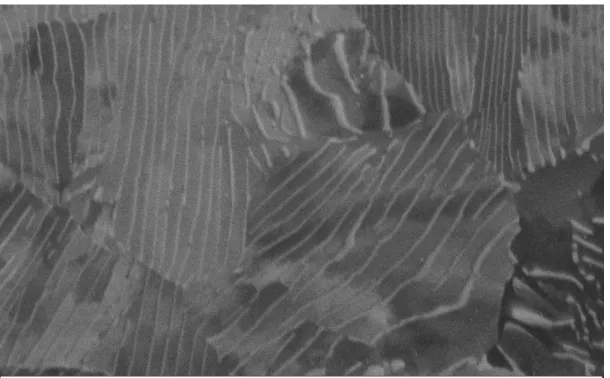
Fig. 1 SEM photo of microstructure in as-patented pearlite [36]. 3
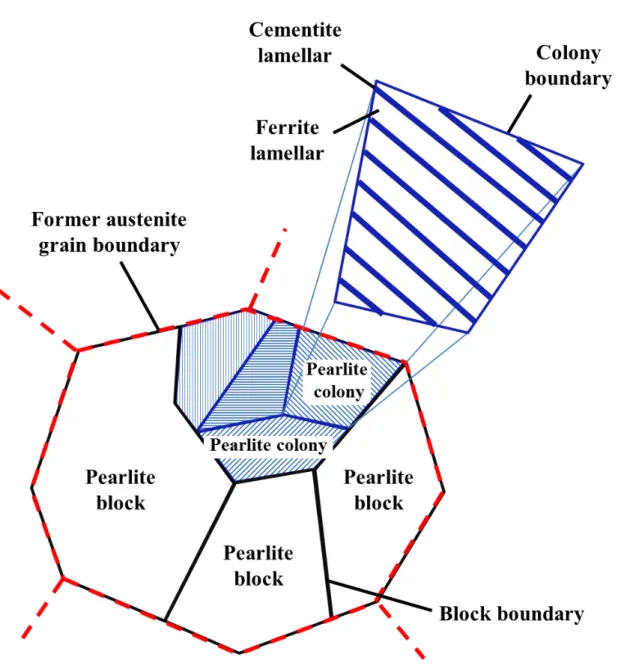
Fig. 2 Schematic diagram of the pearlite microstructure. The description explains
the relative hierarchy of pearlite substructures: the pearlite block structure,
the pearlite colony structure and the pearlite lamellar structure which
consisted of alternate layer of cementite and ferrite lamellae [36]. 4
Fig. 3 Distribution of equivalent strain, eq in two adjacent colonies at nominal
strain o 18%. The angle between the lamellar alignment is denoted as
. The grey arrows indicate the tensile direction [62].
8
Fig. 4 Distribution of plastic strain pl propagation at drawing strain 5%
around block/colony boundaries. (a) and (b) show three colonies with similar
lamellar arrangement: a triple point meet. The dotted lines and arrows
represent block/colony boundaries and lamellar alignment of cementite
respectfully [36].
9
Chapter 2 Analyses condition
Fig. 5 Stress-strain curve of typical mild steel under uniaxial tensile deformation. 16
Fig. 6 Idealisation of elasto-plastic deformation. (a) Elastic-perfect plastic material,
and (b) power plastic hardening material.
22
Fig. 7 Stress-strain curves for cementite and ferrite. 23
Fig. 8 Stress-strain curve for true and nominal curve for cementite. This
figure shows the plastic flow stress for elastic-perfect plastic material stress established for cementite in comparison to the simulation data.
26
Fig. 9 Diagram of the von Mises yield condition in the principal stress space. 29 Fig. 10 The relationship between yield surface and strain increment. 30
Chapter 3 Modelling of pearlite colony
Fig. 11 Basic types of the morphology of cementite in pearlite microstructure. 34
Fig. 12 Schematic of 2-D orthogonal projection and 3-D view of a pearlite colony. (a)
is the orthogonal projection of cementite ( ) and ferrite () lamellar. (b) The direction of the plane is determined by the direction of normal vector, n. The direction of n is determined by the azimuthal angle at the
xy-plane,
and the inclination angle from z-axis, of the plane in 3-Dspace.Chapter 4 Elasto-plastic deformation of single-colony models
Fig. 13 Schematic of five-layered pearlite model. The indentation at the mid-section
of the central cementite is a cosine function. It is fixed along the x-axis at the
left lateral surface, while forced displacement is given at the right lateral
surface. The illustration is exaggerated.
41
Fig. 14
True stress tr vs. plastic strain pl curves to compare Ferrite-org and
the hypothetical Ferrite5, Ferrite 10 and Ferrite 5n500. is a constant.
43
Fig. 15 Distribution of tensile plastic component xxpl at nominal strain
1.529% o
in model (a) ferrite-org (low flow stress, low hardening rate, (b) Ferrite5n500 (high flow stress, low hardening rate) , (c) Ferrite5 (high
flow stress, high hardening rate), and (d) Ferrite10 (high flow stress, high
hardening rate).
45
Fig. 16 Distribution of tensile stress component xx at nominal strain
1.529% o
in model (a) Ferrite-org (low flow stress, low hardening rate, (b) Ferrite5n500 (high flow stress, low hardening rate) , (c) Ferrite5 (high
flow stress, high hardening rate), and (d) Ferrite10 (high flow stress, high
hardening rate).
46
Fig. 17 The nominal stress o versus nominal strain o curves of bulk cementite
and three-layered lamellar structure models.
47
Fig. 18 Schematic of a single-colony structure. Cementite lamellar is denoted as
plane. The alignment of plane depends on the direction of normal vector,
n which is determined by angle and . The schematic also defines the
boundary conditions.
49
Fig. 19 Diagram of pearlite single-colony models. The dimension of the models are
L L L . The thickness of the colony boundary, ferrite lamellae () and cementite lamellae ( ) are L15.The alignment of is inclined at
inclination angle first, then .
50
Fig. 20 Propagation of equivalent strain eq in single-colony models at nominal
strain o 1.5% and o3%.
54
Fig. 21
Distribution of equivalent plastic strain eqpl and plastic tensile strain
component xxpl in single-colony models at nominal strain o3%.
Fig. 22
Distribution of equivalent elastic strain eqel in single-colony models at
nominal strain o3%.
56
Fig. 23
Distribution of total normal strain component tyy and total transverse
strain component tzz in single-colony models at nominal strain o3%. 57
Fig. 24
Distribution of total shear strain components t xy
, t yz
and t zx
in
single-colony models at nominal strain o3%. Here x-, y-, and z-axes are
tensile, normal and transverse axes. The surface of xy is the longitude
surface and zx is the horizontal surface. They are parallel to the tensile
direction. yz is the transverse surface normal to the tensile direction.
59
Fig. 25
Distribution of equivalent stress eq at nominal strain o 3% shown in
separate stress gauges that accommodate both stress ranges for and
phases. The stress are denoted as eq and eq respectively.
61
Fig. 26 The nominal stress o vs. nominal strain o curves of single-colony
models in comparison with monolithic and .
63
Chapter 5 Elasto-plastic deformation of multi-colony models
Fig. 27 SEM of three-types of block/colony regions taken at strain [36] and their 2-D
schematics. The boundary conditions are defined at both lateral surfaces. 67
Fig. 28 The upper row shows the distribution of plastic strain pl in experimental specimens at strain 5%. The lower row shows the distribution of plastic tensile strain component xxpl for FEM analyses results at nominal strain
5%,10%,13%
o
and 15% for model-(a), -(b), and -(c).
70
Chapter 6
Fig. 29 Schematic of 2-D double-colony model. The model parameter is L2L. The
double-colony is divided into Colony1 (C1) and Colony2 (C2) at the colony
boundary (CB). The lamellar alignment in C1 is perpendicular to the tensile
axis (x-axis) while C2 inclines at the angle of from C1. The thickness
ratio of
to is d 2d
; given that
11
L
d . The left lateral surface
is constrained, and the right lateral surface is given forced displacements.
Fig. 30 Distribution of plastic tensile strain component xxpl in 2-D double-colony
models at nominal strain o5%,10%,13% and18% . The angle of
difference between alignments in C1 and C2 are 30 , 45 and60.
75
Fig. 31 Diagram of pearlite 3-D double-colony models. Colony1 (C1) and Colony2
(C2) are joined at the colony boundary (CB). The dimension of the model is
2L L L 2. The thickness of CB, , and are L10. The alignment of
in C2 is fixed. The alignment of in C1 is inclined at inclination angle
first, then .
78
Fig. 32 Diagram of pearlite double-colony models. The dimension of the model is
2L L L 2. The thickness of CB, and , are L10.The alignment of
in C2 is fixed at o135. The alignment of in C1 is inclined at inclination angle first, then .
79
Fig. 33 Development of equivalent strain eq in pearlite double-colony models at
nominal strain o 1.5% and o3%.
82
Fig. 34
Distribution of equivalent plastic strain eqpl and plastic tensile strain
componentxxp at nominal strain o3%.
83
Fig. 35
Distribution of total normal strain component, tyy and total transversal
strain component, tzz at nominal strain o 3%.
85
Fig. 36
Distribution of total shear component for xyt , tyz and zxt at nominal
straino3%.
87
Fig. 37
Distribution of total yz strain component tyz at cross sections of C1, CB
and C2 for model-(b) and model-(e) at nominal strain o3%.
89
Fig. 38
Distribution of total yz strain component tyz at cross sections of C1, CB
and C2 for model-(f) and model-(g) at nominal strain o 3%.
90
Fig. 39
Distribution of equivalent stress eq at nominal strain o 3%. Stress
ranges are arranged for each and are denoted as eq and eq
respectively.
93
Fig. 40 The nominal stress o vs. nominal strain o curves of double-colony
models.
Chapter 7 Discussion
Fig. 41 Distribution of stress components in single-colony models. 99
Fig. 42 The relationship between average equivalent plastic strain and lamellar
alignment towards the tensile direction [36].
102
List of table
Chapter 4 Elasto-plastic deformation of single-colony models
Chapter 1 Overview
1
Chapter 1
Overview
1.1
Introduction
In 1881, Sorby [1] discovered “the pearlycompound” which is later widely known
as “Pearlite”. Pearlite is a type of eutectoid steel. It is the product of austenite
decomposition [2-8] from heat treatment and subsequent cooling process. The patenting
process transforms austenite into a lamellar structure consisting of high-strength yet
brittle cementite and low-strength yet ductile ferrite phases [9,10]. Managing the
annealing process of patenting allows manufacturers to control the strength and
toughness of pearlite during the wire-making process [11-15]. Thus the applications of
pearlite steels range from piano strings to steel cords found in vehicle tires and cable
wires of suspension bridges [15-18]. The brittle/ductile lamellar structure allows
trade-off attributes of high strength and ductility to complement each other [19-29]. To
date, pearlite steel exhibits the greatest strength amongst mass-produced wire materials
Chapter 1 Overview
2
1.2
Pearlite microstructure
Hull and Mehl [9] mentioned that Belaiew [32] initially described the pearlite
colony by assuming that the cementite lamellae were arranged parallel with each other
in the ferrite matrix –where they were thought to have obliged a certain crystallographic
orientation. However, this orientation was considered to be different from the original
austenite crystallographic orientation. Mehl and Smith [33] studied the case [32] and
found that the original austenite predetermined the orientation of ferrite. Jolivet [34]
observed that a pearlite nodule consisted of zones (colonies) where ferrite and cementite
lamellae were alternately layered while lying parallel along a particular direction. The
term “direction” [9,10,33,34] defined the orientation relationships which the
recrystallized cementite/ferrite lamellar structure succeeded indirectly from the parent
austenite.
Almost half a century later, Takahashi et al. [35] explained that the pearlite
microstructure consisted of substructures called the "pearlite block", where the
orientation of the ferritic crystallography was almost the same. A pearlite block was
made up of smaller regions called the "pearlite colony" where the alignment of the
cementite lamellae appeared more or less parallel to each other. Fig. 1 [36] shows the
Chapter 1 Overview
3
Fig. 2 is the schematic of pearlite microstructure. In pearlite, the lamellae show no
particular preferred alignment. Studies showed that when pearlite deforms under
uniaxial tensile deformation, for example, the cold-drawing process, the randomly
aligned cementite lamellae will rotate to realign with the direction of the deformation
[37-41]. Studies emphasised that cementite sustain crystal reorientation by deforming
plastically. The ability for cementite to plastic-deform is crucial for the ductility of
pearlite because cementite is the brittle constituent of the microstructure [22, 42, 43].
Chapter 1 Overview
4
Fig. 2 Schematic diagram of the pearlite microstructure. The description explains the
relative hierarchy of pearlite substructures: the pearlite block structure, the pearlite
colony structure and the pearlite lamellar structure which consisted of alternate layers
Chapter 1 Overview
5
1.3
Deformation of cementite in pearlite
Evidence of cementite in pearlite plastic-deforming can be picked up from
researchers throughout the years [19-23]. Tanaka et al. [44] confirmed that cementite in
colony structures did accommodate plastic deformation at room temperature. Puttick
[19] suggested that cementite deformed plastically by slip and this was justified by
Maurer and Warrington [45]. In fact, Sevillano [46] found that cementite possesses at
least six slip systems, which confirmed that cementite in pearlite is potentially ductile.
For multi-layered brittle/ductile composites, when the low-strength constituent yields,
stress builds up and efficiently transfers to the adjacent, high strength component. These
results are more or less uniform stress distribution throughout the lamellar structure [47].
Such stress partitioning between cementite/ferrite in pearlite prevents stress
localisations, which improve the stability of elasto-plastic deformation in the brittle
cementite. The partitioning of stress greatly enhanced by boundary-strengthening [48].
When the thickness of ferrite is reduced, the strain-hardening ability will improve
especially on the scale smaller than 1 m [20]. This is known as the Hall-Petch
relationship [49,50], which described that the mechanical strength of metals is inversely
proportional to the square root of the mean diameter of the crystal grain. This
Chapter 1 Overview
6
pearlite lamellar structure showed that the propagation of plastic strain in cementite
phase suppressed by layering bulk cementite with ferrite lamellar [52] and the onset of
plastic deformation in cementite delayed [53]. The delay stabilises the plastic
deformation in cementite. These behaviours are observed in high-strength steels
consisting of brittle/ductile multi-phases [54]. Our previous analyses [53] also clarified
the increase of the thickness ratio of ferrite lamella to that of cementite lamella that
allowed wider strain distribution in cementite lamella, which prevents strain from
localising. In pearlite, the thickness, the volume fraction and the continuity nature of
cementite lamellar are controlled by carbon content. Pearlite with lower carbon content
shows better ductility because it can withstand greater reduction of area [24,55]. Tanaka
and Matsuoka [56] used the continuum model to study the effect of lamellar alignment
have on internal stress in cementite with an assumption that cementite remains elastic.
They found out that the work-hardening of pearlite depends on the stress state in the
ferrite matrix. However, this is applicable only when the cementite/ferrite lamellar
model is an equal-stress model [57]. Equal-stress model refers to model with lamellar
alignment perpendicular to the tensile direction. Ferrite as the ductile constituent will
bear most of the plastic deformation because of cementite yields at higher stress.
Chapter 1 Overview
7
at a higher stress flow because of the influence from cementite. Butler and Drucker [58]
suggested the flow stress and strain-hardening of pearlite depend on the orientation of
cementite because of the constraint it has upon the deformability of ferrite. Yasuda and
Ohashi [59] explained it by the understanding of stress-incompatibility from the
differences in the mechanical properties between cementite and ferrite.
1.4
Deformation of block/colony structures in pearlite
It is widely known that the colony influenced the ductility of pearlite [23]. When
the colony size is sufficiently small, the colony boundaries would act as obstacles
against brittle cracks and increase the ductility of pearlite microstructure [60]. However,
for coarse pearlite, brittle fractures tend to occur between neighbouring colonies
according to Miller and Smith [61].
We conducted analyses to investigate how the lamellar alignment in two adjacent
colonies influences the elasto-plastic deformation of pearlite microstructure [62].
Fig. 3 shows the results of the elasto-plastic deformation in two neighbouring colonies
with different lamellar alignments. The mechanical property of the matrix is the
harmonic means of the mechanical properties of cementite and ferrite.
Chapter 1 Overview
8
colonies [63,64]. Therefore, the interactions between the lamellar alignments in
neighbouring colonies influence the elasto-plastic deformation in each colony and the
concentration of strain around the colony boundaries as shown in Fig. 3.
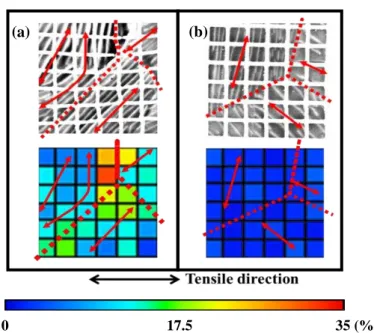
Fig. 4 indicates the distribution of strain in specimen [36] of an as-patented pearlite.
The specimen was embedded with precision markers and subjected to tensile
deformation. The lamellar alignments in both regions inclined approximately at 45
respect to the tensile direction. Even so, the distribution of strain in Fig. 4(a) is almost
the opposite of that in Fig. 4(b). Furthermore, these results are taken at a triple junction
of three colonies where strain highly concentrates [60]. Adachi et al. [66] revealed that
cementite lamellae were twisted and distorted while maintaining the crystal orientation
0 17 36 53 71 80 (%)
Fig. 3 Distribution of equivalent strain,
eq in two adjacent colonies at nominal strain18%
o
. The angle between the lamellar alignment is denoted as . The grey arrows indicate the tensile direction [62].
30
45
18%
o
Chapter 1 Overview
9
with the ferrite which suggests the irregularities of deformation shown in Fig. 4.
However, the two-dimension (2-D) observations of pearlite microstructure do not
provide sufficient information concerning the condition of the lamellar alignment
beyond the surface.
1.5
Complications of 2-D observations
Currently, many types of research depend on the scanning electron microscope
(SEM) [67,68] equipped with electron backscattered diffraction (EBSD) for image
analysis to acquire reliable microstructural and crystallographic data efficiently [69-74].
0 17.5 35 (%)
Fig. 4 Distribution of plastic strain pl propagation at drawing strain 5% around block/colony boundaries. (a) and (b) show three colonies with the similar lamellar
arrangement: a triple point meet. The dotted lines and arrows represent block/colony
boundaries and lamellar alignment of cementite respectfully [36].
Chapter 1 Overview
10
Nevertheless, the existing tools and techniques only provide 2-D information from the
topography of the scanned surface. In reality, the pearlite microstructure is a complex
three-dimension (3-D) crystalline network of randomly aligned cementite lamellae
embedded in the ferrite matrixes that have various orientations. Regardless of the
arbitrary nature of the microstructure, the orientation relationships between cementite
and ferrite have been established by their interfacial planes or habit planes [75-82]. With
this knowledge, researchers assume the probable 3-D shape of the cementite lamellae
[70,71]. To understand what might be occurring inside the pearlite microstructure, the
information concerning the distribution and connectivity of cementite lamellae in 3-D
space is essential. Computer-aided reconstructions by serially sectioned images
revolutionise microstructure characterization from 2-D to 3-D visualisation [66,83-86].
However, most of the examinations is conducted with focused ion beam SEM
(FIB-SEM). The specimen is craved by the FIB gun for interval scanning. This means,
the interval sectioning eventually depletes the specimens. Hence, it physically
impossible to re-examine the 3-D morphology of the same microstructure before and
after mechanical testing [85,86]. Another option is the 3-D imaging by atom probe
topology (ATP) [87]. ATP is indeed a powerful tool that provides atomic-scale
Chapter 1 Overview
11
observe the decomposition of cementite by counting the density of carbon atoms
[88-90]. It does not provide quantitative information such as strain mapping for
evaluating elasto-plastic deformation of microstructures. In the end, for mechanically
tested specimen, researchers are likely given no option but to rely on 2-D based
investigations.
1.6
Research outline
Chapter 1 introduces the brief history and structure of Pearlite. Pearlite colonies are
randomly aligned lamellar structures consisting of high-strength but brittle cementite
and low-strength but ductile ferrite. These microstructural features contribute to the
remarkable strength and ductility of pearlite steel. It is important to elucidate how
lamellar alignments in colonies affect the elasto-plastic deformation in colonies and
around the colony boundaries to understand the mechanical responses of colony
structures. For that purpose, 3-D observation of pearlite microstructure is necessary.
However, researchers still depend on 2-D observations. For that reason, we propose the
use of 3-D finite element analysis.
Chapter 2 explains the classical elasto-plastic theory and the established properties
Chapter 1 Overview
12
deformation. We used commercial finite element software called ANSYS©.
In Chapter 3, we explain in details the modes of modelling 3-D colony models. The
normal vector determines the direction of lamellar alignment. From the perspective of
the normal vector, the cementite plane has two inclinations. From the orthogonal
projection, the cementite plane is inclined from the x-axis at the xy-plane. The second
inclination of the normal vector is around the axis perpendicular to the xy-plane, the
z-axis. In modelling the models, it is important to note that the angles used to describe
the lamellar alignment in each model represent the magnitude and direction of imposed
inclinations/rotations from the perspective of x-axis at xy-plane and around z-axis.
In modelling the 3D colony models, the direction of cementite lamella in 3-D space
of (x,y,z) is determined by the inclination angles of the cementite plane’s normal vector.
Two angles of inclinations describe the direction of the normal vector, the inclination
from x-axis at xy-plane and the inclination around the axis perpendicular to the xy-plane,
z-axis. The basic morphology of cementite lamella is reviewed to create the simplified
versions of 3-D single-colony finite element models. We investigated the effect of
lamellar alignment towards the elasto-plastic deformation in single-colony models.
After that, with 2-D multi-colony models, we imitated pearlite specimensto observe the
Chapter 1 Overview
13
Chapter 4, Chapter 5 and Chapter 6 unfolds the analyses of single-colony,
multi-colonies, and double-colony conducted with 2-D and 3-D models.
In Chapter 4, a single-colony model is a multi-layered lamellar structure. This study
is the continuity of previous analyses [52,53] on pearlite lamellar structure. We studied
the mechanism behind the stability of plastic deformation in cementite phase by
layering it with ferrite. Before we can study the interaction between colonies, we need
to understand the influences which ferrite inflicts on cementite. In fine pearlite
microstructure, ferrite hardens because of size effect. To study the effect of ferrite
hardenability on the stability of cementite’s plastic deformation, we modified the
Swift’s type equation by adding a constant. Stress vs. strain relationship expresses the
mechanical response. The vertical axis and horizontal axis of the graph represents stress
and strain respectively. A constant added to the graph function for the horizontal axis
intercept. So, the constant controls the level of yield stress or level of flow stress. We
introduced possible values for the mechanical properties of ferrite by variating the
strain-hardening rate and level of flow stress. When the lamellar model subjected to
tensile deformation, the effects of ferrite’s strain-hardening rate and level of flow stress
on the stabilisation of cementite’s plastic deformation are studied. Next, we assumed
Chapter 1 Overview
14
lamellar direction on the elasto-plastic deformations of single-colony.
In Chapter 5, we imitate the colony structures of experimental specimens into 2-D
FEM multi-colony models to compare the experimental and FEM elasto-plastic
deformation of multiple colonies.
Since the interaction between colonies is complicated, In Chapter 6, we reduces the
multi-colony models into double-colony models with 2-D and 3-D space lamellar
configuration. Reducing the models into two adjoined single-colony models connected
at the colony boundary allows us to study the fundamental interaction in colony
structure.
In Chapter 7, we discussed the results obtained by dissecting the stress components of
single-colony models to compare with stress partitioning in ferrite/cementite studies
from the crystal plasticity analyses by Yasuda and Ohashi [59]. The discussion shows
that our results agree with the plastic deformation tendencies of pearlite structure
observed experimentally by Tanaka [36]. Finally, we discuss the possible configurations
of dislocations [111-113].
The interesting aspect of this study is the approach of not considering the crystal
plasticity of cementite and ferrite. This thesis describes the understanding of the
Chapter 2 Analyses condition
15
Chapter 2
Analyses condition
2.1
Introduction
Tensile deformation of pearlite single- and double-colony models will be analysed by
employing the classical theory of elasto-plastic deformation in metal under uniaxial
deformation. The onset of plastic deformation in metal is defined at the limit of elastic
behaviour when the material yields the ability to return to its original form. A yield
criterion defines this condition under any combination of stresses. For the plastic
potential to be defined by such criteria constantly, certain assumptions are made. Firstly,
it is assumed that the established materials will be independent of any thermal effect.
Secondly, the materials are assumed to be isotropic. Finally, the Bauschinger effect is
neglected.
2.2
Numerical modelling of elasto-plastic deformation
Chapter 2 Analyses condition
16
Initially, the stress, denoted by , is linearly proportional to strain, denoted by
along OA''. Point A is called the prop'' ortional limit. The Young’s modulus, denoted as
E, is the slope of the function.
It determines the proportionality for the increment of strain to the increment of
stress. This region is known as the elastic region. It is represented by Hooke’s law in
(1).
E
Fig. 5 Stress-strain curve of a typical mild steel under uniaxial tensile deformation.
Chapter 2 Analyses condition
17
The linear deformation is true until point A', which is called the upper yield. This
is followed by a local drop to the lower yield point, A, which is accepted as the elastic
limit. The stress value at this point is called the yield stress, denoted as Y . The stress
oscillates at a plateau to point B . The material deforms perfectly plastic through AB .
At point B , the material starts to harden. From this point, stress builds up as strain
increases until the ultimate tensile stress at point U . This is called strain-hardening,
and the material deforms plastically. If the material is unloaded at any point between
BU , for example at point C , the deformation will follow CD, which is parallel with
the initial elastic deformation path, OA. The recovered strain, DD is the elastic '
strain and denoted as el. Referring to (1), the elastic strain at point DD is tensile '
stress at point C which is denoted as c divided by the slope, which is Young's
modulus,
E
as mentioned. This gives the following equation:el C
E
The remaining strain is the plastic strain, which is denoted as pl. The total strain,
tis the sum of both regions, elastic and plastic, as shown in (2).
t el pl
pl E
After that, the material softens and become unstable because the stress decreases with (1a)
Chapter 2 Analyses condition
18
the increase of strain until it fractures at point F .
In Fig. 5, the positive slope of the true curve, which is represented by the dotted line
indicates the material is becoming stronger as it is deforming plastically. This means
that the true curve defines the strain-hardening of the material [90]. It is difficult to
determine the true stress, which is denoted as
tr, beyond the yield point. This isbecause the increase of strain becomes rapid and the deformation is not uniformed
throughout the material especially after necking. On the contrary, plotting the nominal
curve is simpler because it is defined by the original parameters of the material, in
which data are measured before mechanical testing. To apply this advantage, the
nominal stress, which is denoted as o, must be redefined by true stress.
The true stress, tr is defined as load P divided by the instantaneous
cross-sectional area A. The representation of true stress, tr is given by (3).
tr
P A
Meanwhile, true strain, which is denoted as
tr, is defined as the instantaneous lengthincrement, dL, per unit of the instantaneous length L . The rate of the instantaneous
strain increment is denoted as d
and is represented as:ln dL
d L C
L
Hence, when the total length changes from the original length Lo , to a certain (3)
Chapter 2 Analyses condition
19
instantaneous length, L, it is expressed as true strain, tr as shown in (4a).
ln ln ln lno o
L
L
tr L o
o L
dL L
d L L L
L L
Equation (5) shows the representation of nominal stress, which is denoted by o. It is
defined as load, P , divided by the original cross-sectional area,
A
o.o o P A
The nominal strain is denoted as o. It is defined as the increase per unit of the original
length, Lo, as shown in equation (6).
o o o L L L
Equation (6) can be further rearranged as:
1o o
L L
And,
o 1
o
L
L
A plastic body is considered to be incompressible. This means the volume is
constant throughout the deformation. The changes of volume from elastic straining are
assumed to be sufficiently small and can be neglected. For that reason, the original
volume, Vo is equal to the instantaneous volume, V .
o o o
V V A L AL
Chapter 2 Analyses condition
20
length, L to Lo, as shown in the following (7a).
o o
A L A L
When (6a) is substituted into (7), the relationship between nominal strain, o and the
cross-sectional areas, Ao and A are defined as follows:
1 1
o o o o
o o
A L AL
A A
Hence, the ratio of cross-sectional areas is given as:
( 1) o
o
A
A
So, the representation of nominal stress,
o by true stress, tr is determined in (8)by substituting (7b) into (5).
1 1 o o o tr o P A P A The decrease of nominal stress, o compared with true stress,
can bemathematically explained by substituting equation (7c) into (8).
1
o o o A A Equation (8a) proves that the instantaneous stress or true stress, tr is unable to catch (7a)
(7b)
(7c)
(8)
Chapter 2 Analyses condition
21
up with the growing rate of cross-sectional area, Ao A
when the instantaneous
cross-sectional area,
A
of the material, rapidly decreases to compensate with theelongation as shown in (7a). Meanwhile, the nominal strain,
o can be represented bytrue strain, tr by substituting equation (6b) into equation (4a):
ln ln 1 tr o o L L Given that when ylnx; then xey. So, if
o1
is x and tr is y, therefore;1 1 tr tr o o e e
As shown in Fig. 5, the stress-strain curve is not straight forward. To model the
stress-strain relationship of a material subjected to tensile deformation, idealisation for
elasto-plastic deformation needs to be considered. For this case, two types of
elasto-plastic idealisation shown in Fig. 6 are employed. Fig. 6(a) is elastic-perfect
plastic material. It will be applied to establish brittle material. Fig. 6(b) is power plastic
hardening material. It will be applied to establish ductile material. The non-linear work
hardening will be represented by empirical equations type Swift [92]. These will be
further elaborated in the next section.
(9)
Chapter 2 Analyses condition
22
2.3
Material properties
Fig. 7 shows the stress-strain curves established for cementite and ferrite in this study.
We used Poisson’s ratio 0.3 for both materials. Young’s modulus of bulk cementite
ranges from 176 GPa to 186 GPa [42]. At room temperature, cementite fractures at its
yield point, 2.75 GPa [42,43,89]. The Young’s modulus, E , for cementite is the
arithmetic mean of its Young’s modulus, which is E181GPa. When the yield stress
for cementite is denoted as Y, then, from the Hooke’s law, the elastic limit for
cementite at nominal strain, o is calculated in (10):
2
2.75
1.593 10 181
o
Y GPa
E GPa
Fig. 6 Idealisation of elasto-plastic deformation. (a) Elastic-perfect plastic material, and
Chapter 2 Analyses condition
23
Interestingly, Kanie et al. [94] experimentally proved the cementite can bear elastic
strains, el around 1% to 2%. However, it is tricky to simulate the brittle property of
cementite numerically. Theoretically [95-97], the condition of plastic instability occurs
prior to the onset of necking at the maximum load point. Load P is always
proportional to the product of true stress, tr multiplied by the cross-sectional areaA.
So, the condition for maximum load point is given in (11).
0 tr
tr tr
P A
dP Ad dA
During the plastic deformation, the volume of material is considered to be constant, as
shown in (7). To fit (7) into the condition for maximum load point, it is differentiated on Fig. 7 Stress-strain curves for cementite and ferrite
Tru
e
stre
ss
tr (M
Pa)
True plastic strain
trpl(%)
Cementite
Ferrite
Chapter 2 Analyses condition
24
the instantaneous area, A to obtain dA in (12):
0
o o
AL A L AdL LdA dL dA A L
When (4a) is substituted into (12) the relationship between area and strain is derived.
tr
dA Ad
The strain-hardening rate is obtained by substituting (12a) into the condition of
maximum load point, dP0 from (11).
0
tr tr tr tr tr tr Ad Ad d d
For our analyses, cementite is modelled after the elastic-perfect plastic model. The
strain-hardening rate for cementite is 0 because it is constant. The cross-section A
rapidly becomes smaller to maintain the material's volume, V at yield stress. Meaning,
cementite undergoes necking at the moment it yields. This condition is highly unstable
because cementite is unable to harden..
The stress-strain curve for ferrite is modelled by power plastic hardening material
idealisation. It is represented by the following Swift’s type equation [92]:
pl
N tr a b
This equation is a generalised power law, where true stress, tr is an exponential product of plastic strain, pl. Here, a , b and N are empirical constants determined (12)
(12a)
(12b)
Chapter 2 Analyses condition
25
experimentally by Umemoto [99]. Their values are a493 MPa, b0.002 and
0.28
N respectively.
The input of material properties into ANSYS© is in true stress, tr versus total
strain,
t relationship. Since the plastic flow is determined by Swift’s type equationmentioned above in (13), the values for each true stress,
tr can be determined by anygiven plastic strain,
pl . The elastic region is determined by Hooke’s law asaforementioned in the earlier section. Therefore, the total strain,
t ist tr pl
E
For our analyses, the data input for cementite and ferrite follows the true curve. On the
contrary, the models are given forced displacements, so the analysis results or
simulation data are plotted nominally. Fig. 8 shows the difference between the true and
nominal curve for cementite. The stress values for simulation data, which are
represented by the nominal curve, will decrease around yield point because the
instantaneous cross-section area A, was neglected to simplify the data harvesting.
2.4
von Mises yield condition
The onset of plastic deformation in metal occurs when the combination of stresses in
Chapter 2 Analyses condition
26
expressed in (15) defines the critical value.
2 2
J k
The second deviatoric stress, commonly written as J2 is related to the changes of the
material shape. The yield stress in simple shear is given as k . Since there are six
components of stress, J2, (15) can be represented as follows:
2 2 2 2 2 2
2 ( xx yy) ( yy zz) ( zz xx) 6 xy 6 yz 6 zx
J
When a material is under multiaxial loading condition, the equivalent stress denoted as
eq
is defined in (16).2
3
eq J
Fig. 8 Stress-strain curve for true and nominal curve for cementite. This figure shows
the plastic flow stress for elastic-perfect plastic material stress established for cementite in comparison to the simulated data.
(15)
(15a)
Chapter 2 Analyses condition
27
Square both sides of the (16) and then substitute (15a) into the equation.
2 22 2 2 2 2 2
2 2 2 2 2 2
2 2 2 2 2 2
2 2 2
3
3 ( ) ( ) ( ) 6 6 6
3 ( ) ( ) ( ) 3 6 6 6
3
( ) ( ) ( ) 3
6 1
( ) ( ) ( )
2 eq
xx yy yy zz zz xx xy yz zx
xx yy yy zz zz xx xy yz zx
xx yy yy zz zz xx xy yz zx
xx yy yy zz zz xx
J
3
2 2 2
xy yz zx
Multiply both sides of (16a) with 2 to even the denominator of the equation.
2 2 2 2 2 2 2
2eq(xxyy) (yyzz) (zzxx) 6xy6yz6zx
Thus, the equivalent stress,
eq is expressed as (15c).2 2 2 2 2 2
( ) ( ) ( ) 6 6 6
2
xx yy yy zz zz xx xy yz zx
eq
This form is also known as the von Mises stress. From (15), the relationship in (16a)
can also be expressed as (17).
2 2
2
3 3
eq J k
In the case of uniaxial stress, the yield stress in simple shear relationship with the tensile
yield stress, Y, is given in (18).
3
Y k
Square both sides of (18).
Chapter 2 Analyses condition
28
Compare (17) and (18a).
2 2 2
3
eq k Y
From (18b), if eq2 Y2, therefore (16b) can be rearranged into (18c).
2 2 2 2 2 2 2
(xxyy) (yyzz) (zzxx) 6xy6yz 6zx2Y
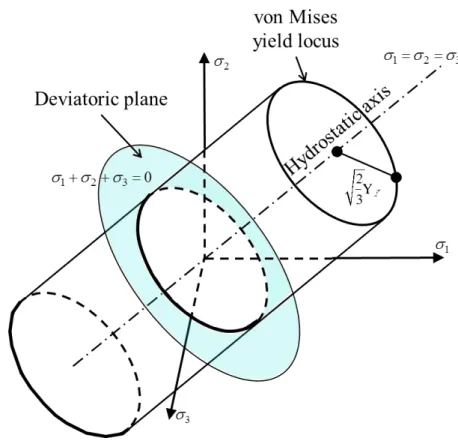
This equation defines the yield surface of the von Mises circular cylinder in the
principal stresses space, which is denoted by 1, 2, and 3, as shown in Fig. 9. The
von Mises yield locus is 2
3Y.
In equation (18), the von Mises yield condition proposed that the onset of plastic
deformation is when the equivalent stress or the von Mises stress,
eq is equal to thetensile yield stress, Y . By neglecting the Bauschinger effect, any stress points on the
surface of the cylinder will correspond to a state of yielding. Whereas, any stress points
inside the cylinder correspond to a state of elastic deformation. In simple tension, (18b)
can be further simplified as (19).
Chapter 2 Analyses condition
29
In Fig. 9, the cylinder is inclined so that the direction cosines of the hydrostatic axis
of each of the principal stress axes are equal, (1 / 3,1 / 3,1 / 3). Thus, at the
hydrostatic axis, the principal stresses are equal, 1 23. On the other hand, the
deviatoric plane where the sum of principle stresses are equal to zero, 1 2 30,
is perpendicular to the hydrostatic axis. These configurations imply that the von Mises
yield locus is not only parallel to the deviatoric plane, but also symmetrical at the
1-,2
-,
3and -axes. The uniform hydrostatic stress does not affect the yield state of aFig. 9 Diagram of the von Mises yield condition in the principal stress space.
Chapter 2 Analyses condition
30
deforming body. The hydrostatic stress influences volume change, therefore, the volume
of the material is constant after yielding. von Mises yield condition depends on the
magnitude and direction of the deviatoric stress, as defined in (15).
2.5
The associative flow-rule
The associated flow-rule [101,102] is defined when the plastic potential of the
material is the yield function. In other words, the flow rule is associated with a
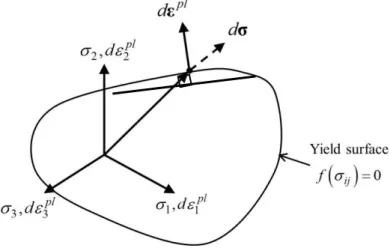
particular yield condition. In this study, von Mises yield condition is employed. Fig. 10
shows the axes of principal stress and principal plastic strain, which are denoted as
1, 1 pl
d
, 2,d 2pl and 3,d 3pl; and their relationship with the plastic strain increment
vector, which is denoted as dεpl
.
The vector of principal stress, is denoted as dσ. Thenormal to the yield surface is given as the differentiation of yield function f
ijChapter 2 Analyses condition
31
towards the vector of the principal stress dσ.
ij is the multiaxial stresses. This iscalled the normality rule and it has been confirmed experimentally on metals. The
equation of the associate flow-rule is given as:
pl ij
ij f
d d
f is the yield function and d is the principal deviatoric stresses and principal plastic
strain increments. In 3-D space, which axes constitute of (x, y, z); the ( d) is expressed
by (20a), where the stress deviations are denoted as sxx,s ,yy szz,s ,xy s ,yz szx.
pl pl pl
pl pl pl
yy xy yz
xx zz zx
xx yy zz xy yz zx
d d d
d d d
d
s s s s s s
The stress deviations represented by s are the subtracts of mean normal stress which ij
is denoted as s from the normal stress tensors which are represented by
ij.ij ij
s s
The mean normal stress relationship with normal stress is defined in (22).
1
3 xx yy zz
s
By applying the von Mises yield condition in (19) to the example of tensile deformation
in the direction of x, the non-vanishing stress component is
xx. The non-vanishingstress component for y and z direction are shown in (22b) together with x.
Chapter 2 Analyses condition
32
Regarding normal stresses, the stress-plastic strain relationships are given as:
2 1 3 2 2 1 3 2 2 1 3 2 plxx xx yy zz
pl
yy yy xx zz
pl
zz zz xx yy
pl xy xy pl yz yz pl zx zx d d d d d d d d d d d d
In ANSYS©, the flow-rule for elasto-plastic deformation is calculated by the
Prandtl-Reuss equations [102-104], and the equations are represented using Hooke’s
law as follows:
1 2 1
3 2
1 2 1
3 2
1 2 1
3 2
1
1 pl
xx xx yy zz xx yy zz
pl
yy yy xx zz yy xx zz
pl
zz zz xx yy zz xx yy
pl
xy xy xy
pl
yz yz yz
d d d d d
E
d d d d d
E
d d d d d
E
d d d
E
d d d
E d 1 pl
zx d zx d zx
E
(23)
Chapter 3 Modelling of pearlite colony
33
Chapter 3
Modelling of pearlite colony
3.1
Morphology of cementite in pearlite
The morphology and evolution of pearlite microstructure is a subject of interest.
Researchers are intrigued by the plastic deformability of cementite inside of pearlite
because it determines the plastic deformation of pearlite [22]. The revision of literature
reviews [22,37,40,41,63] disclosed that many studies agreed on categorising the
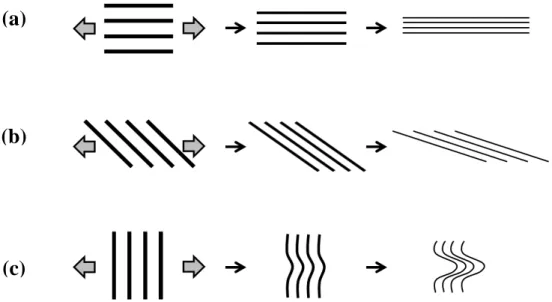
morphology of cementite in pearlite during tensile deformation into three main types as
shown in Fig. 11. In Fig. 11(a), the alignment of cementite is parallel to the tensile axis.
In Fig. 11(b), the alignment of cementite is inclined at a certain degree of inclination
angle, from the tensile axis. In Fig. 11(c), the alignment of cementite is perpendicular to
the tensile axis. From the tensile axis point of view, if the lamellar alignment is parallel
to the tensile axis, the angle is 0, whereas, if the lamellar alignment is perpendicular
to the axis, the angle is 90. Therefore, the range for the inclination angle of a colony
Chapter 3 Modelling of pearlite colony
34 45
, the lamellar structure suffers maximum shear stress [44,56,57,99]. Therefore,
this angle will be considered for the model type illustrated in Fig. 11(b).
3.2
Defining the alignment of cementite lamella in 3-D space
In calculating, the inclination angle of lamellar alignment in pearlite, Belaiew [32]
assumed that cementite and ferrite lamellae are parallel and are closely packed inside a
sphere. Inside a sphere, the coordinate of a point is determined by two angles from the
orthogonal plane and the axis perpendicular to the orthogonal plane. Therefore the
position of the lamella alignment in a 3-D space is explained using the idea of spherical
coordinates.
(b)
(a)
(c)
Chapter 3 Modelling of pearlite colony
35
(a)
(b)
Fig. 12 Schematic of 2-D orthogonal projection and 3-D view of a pearlite colony. (a) is the
orthogonal projection of cementite ( ) and ferrite () lamellar. (b) The direction of the plane is determined by the direction of normal vector, n. The direction of n is determined by the azimuthal angle at the xy-plane,
![Fig. 4 indicates the distribution of strain in specimen [36] of an as-patented pearlite](https://thumb-ap.123doks.com/thumbv2/123deta/9841292.491220/23.892.136.720.218.391/fig-indicates-distribution-strain-specimen-patented-pearlite.webp)