Articles
Quantitative Assessment of
Swallowing Reflex Induction Effect of Cooled Carbonated Water and Water Jelly
M
itsuhori(K
ani) Masaya
1, o
KuTomoko
2, Y
aMauchiShinobu
2, M
otohashiYuka
2, s
atoToshio
*and a
gishiTetsuzo
3(Received Date: March 14, 2020)
Key Words: Swallowing sound, Time-frequency analysis, Swallowing function, Rehabilitation
I. Introduction
Japan has become a super-aging society, and the occurrence of aspiration pneumonia in elder- ly individuals has thus become a serious problem.
Prevention of aspiration pneumonia through ef- fective screening of swallowing function is one of the most important social and medical issues in Japan. In a collaborative effort by industry, uni- versity, and medical science, we have developed the Bio Sound Analyzer (BSA) for quantitative real-time screening in examination of biological functions by noninvasive bedside measurement of biological sounds and wavelet transformation of the obtained biological sound signals. In a previous study of a typical BSA application, we investigated the noninvasive assessment of swal- lowing function by analyzing the swallowing sound signal measured at the cervix. The results showed three acoustic components: Sounds I, II, and III. Videofluorographic examination and syn- chronous measurement of swallowing sounds also revealed that Sound I corresponds to elevation of
the larynx, Sound II corresponds to the movement of the bolus to the hypopharynx, and Sound III corresponds to descent of the larynx. In this light, as a method for quantitative assessment of swal- lowing function, we propose determining times T1, T2, and T3 of these three swallowing sounds from the envelope obtained by 3-dimensional spline interpolation of the swallowing sound sig- nals and calculation of the Swallowing Function Parameter (SFP) = (T2–T1)/(T3–T1) to show the relationships between these times. The present study applied SFP values obtained in swallowing these samples to investigate the effectiveness and optimum physical properties of cooled carbonated water, which is a focus of interest for increasing in- duction of the swallowing reflex, and of jelly foods, which are used as a swallowing-modification food.
II. Experimental Methods
II-1. Investigation of swallowing reflex induc- tion effect of cooled carbonated water
Interest is growing in the use of cooled car-
* sato Toshio: Professor, Graduate School of Engineering; Faculty of Biomedical Engineering, Toin University of Yokohama. 1614 Kurogane-cho, Aoba-ku, Yokohama 225–8503, Japan
1Mitsuhori (Kani) Masaya: Graduate School of Engineering, Toin University of Yokohama
2oKu Tomoko, YaMauchi Shinobu and Motohashi Yuka: Lecturer, Faculty of Crinical Engineering, Toin University of Yokohama
3agishi Tetsuzo: Professor Emeritus of Tokyo Women’s Medical University
bonated water for chemical stimulation by carbon- ic acid to induce the swallowing reflex as a new rehabilitation technique distinct from physical stimulation by coldness or effervescence, but in- formation has been scarce on quantitative assess- ment of the relationship between the carbonic acid concentration of the carbonated water and swal- lowing reflex induction effect. The present study therefore attempted quantitative assessment of this induction effect by measuring the swallowing sounds occurring with carbonated water with dif- ferent carbonic acid concentrations and tempera- tures, then comparing the resulting SFP values.
In a preliminary investigation on the prepara- tion of carbonated water with controlled carbon- ic acid concentration, we set specialized bottles charged with drinking water to a commercially available soda maker (Source, SodaStream Inc.) and injected carbonic acid gas with differing in- jection times to produce the three carbonic acid concentrations of weak, medium, and strong. We then inspected temporal changes in carbonic acid concentrations when the formulated carbonated water was left standing exposed to air. We opened a small hole in the cap of the specialized bottle, inserted a stainless steel pipe into the hole and fabricated a connected portion with a pressure measurement tube, then attached a digital ma- nometer (EM-160W, HODAKA CO., LTD.) to this connected portion and sealed closed the bot- tle containing the carbonic acid gas, then 2 min latermeasured the pressure in the bottle. We then opened the bottle cap, exposing the contents to the air, and let the bottle stand in that state for 3 min, then again closed the cap and measured pressure in the bottle after an interval of 2 min. We repeated this procedure and by measuring the pressure in the bottle at air exposure times of up to 30 min, quantified the change in the internal pressure of the bottle under exposure to air. The carbonated water was made with drinking water tempera- ture-controlled in an isothermal water bath (TR2,
AS ONE Corporation) at a constant temperature of 10°C, 20°C, or 30°C. Following carbonic acid gas injection, again, the bottle was immersed in the water bath and maintained at the specified tem- perature. Measurement was performed three times for each sample. Swallowing sound measurements were then performed with drinking water and car- bonated water of weak, medium, and strong con- centrations of carbonic acid. As shown in Figure 1, a phonocardiographic sensor (TA-701T, NI- HON KOHDEN) was attached with specialized double-side tape (H260, NIHON KOHDEN) and surgical tape on the skin directly above the hyoid bone, where Sounds I and III can be effectively measured, and a second was similarly attached to the skin above the outer side of the trachea di- rectly below the cricoid cartilage, where Sound II can be effectively measured. The participant was instructed to swallow a sample twice within a 20-s measurement time and the swallowing sound generated each time was measured with the BSA.
The timing of swallows was 5 s and 15 s after the measurement initiation signal, and swallowing sounds were measured 5 times for each sample.
Sample quantity per swallow was 5 mL, swallow- ing was performed with the subject in a sitting po- sition, and the subject was instructed to swallow in the usual manner. Following measurement of the swallowing sound, a combined swallowing sound signal was composed by simple addition from Fig.1 Positions of sensors attached on throat surface
the swallowing sound signal obtained by each sensor, and the SFP value was calculated from the envelope obtained by 3-dimensional spline interpolation. Participants comprised 3 healthy men (22~25 years old, mean 23.0 years old) and 2 healthy women (25~35 years old, mean 30.0 years old). All study protocols were performed with the approval of the Toin University of Yokohama Re- search Ethics Committee, and each subject was fully informed of the study objective and contents before providing written consent.
II-2. Investigation of optimum physical prop- erties of jelly foods
In view of the use of jelly foods as swallow- ing-modification foods, we investigated the effect of differences in physical properties of jelly foods on swallowing dynamics and attempted to identify the optimum physical properties for effective pre- vention of aspiration.
The physical properties of jelly foods were assessed by texture profile analysis (TPA), a data analysis method for quantification of food texture, in terms of hardness, adhesiveness, and cohesiveness calculated from the load-time dia- gram obtained for two successive compressions of the sample. The jelly foods investigated in this study were water jellies selected due to the sim- ple preparation methods and widespread usage for water intake.
We first added gelling agent to 100 mL of drinking water at room temperature followed by agitation for 30 s, then immediately poured the sample into a resin container 40 mm in diameter and 15 mm tall, leaving it stand briefly. The quan- tity of gelling agent added was varied from 2.5 g to 4.0 g in increments of 0.5 g, to obtain water jelly in 4 versions with differing physical prop- erties. Each of these 4 water jellies was then left standing for 10–120 min in increments of 10 min, then subjected to TPA on a texture tester (TEX- 100N, JAPAN INSTRUMENTATION SYSTEM
Co., Ltd.). For parameter calculation, the sample was compressed twice in succession using a resin plunger with a compression rate of 10 mm/s and a clearance of 5 mm. Analysis of test results was performed with a software (TEX-PC1, JAPAN INSTRUMENTATION SYSTEM Co., Ltd.) spe- cific to the TEX-100N. Each test was performed 3 times. Measurement of swallowing sounds was next performed using the 4 water jellies with dif- ferent quantities of gelling agent added. As de- scribed in Section II-1, measurement sensors were attached to the skin directly above the hyoid bone for Sounds I and III and above the outer side of the trachea directly below the cricoid cartilage for Sound II. The sound was measured for swallowing of each water jelly of room temperature prepared and left standing for 20 min. For Sound II mea- surement, a sensor was mounted on each side of the cervix because of bolus passage through the left and right piriform recesses. The quantity for each swallow was 3 g. After measurement, the combined swallowing sound signal was composed from the swallowing sound signals obtained by the sensors and SFP value was calculated from the envelope. Participant in these measurements was healthy man in his 20s.
III. Experimental Results
III-1. Changes in internal pressure of carbon- ated water bottles and swallowing sound measurement
Figure 2 shows the measured internal pres- sures of carbonated water bottles containing car- bonated water of the three different carbonic acid concentrations. The results confirmed that for the carbonated water at each temperature, pressure in the bottle decreased with time exposed to air. For the carbonated water at 30°C in particular, results in Figure 2(a) show a very small difference be- tween carbonated water strengths in internal pres-
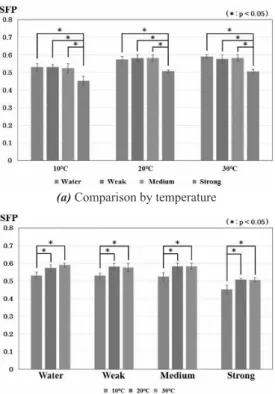
sure at the end of 15 min exposure to air. In this light, the time from gas injection to swallowing of the carbonated water by the participant was held to 10 min at most. Figure 3 shows that SFP calculat- ed from the swallowing sound signal obtained in swallowing samples with varied temperature for drinking water and the carbonated water with 3 different carbonic acid concentrations. As shown in Figure 3(a), SFP was significantly lower when swallowing carbonated water with a strong car-
bonic acid concentration than when swallowing drinking water and carbonated water with weak or medium carbonic acid concentrations. In contrast, no significant difference in SFP value was found among drinking water and carbonated water with weak and medium carbonic acid concentrations regardless of test temperature. As shown for the effect of temperature difference on SFP value in Figure 3(b), for all carbonic acid concentrations, SFP value was significantly lower when swallow- ing samples at 10°C than at 20°C or 30°C, but no significant difference in SFP values was found be- tween samples at 20°C and 30°C for any carbonic acid concentration.
III-2. Assessment of physical properties of water jelly and swallowing sound measure- ment
Figure 4 shows the results of TPA testing with exposure times of 10–120 min in increments of 10 (a) 30℃
(b) 20℃
(c) 10℃
Fig.2 Changes in internal pressure of carbonated water bottles with releasing time to atmosphere
(a) Comparison by temperature
(b) Comparison by carbonation strength Fig.3 SFP values with swallowing each type of
cabonated water
min, for the 4 water jellies differing in the quanti- ty of gelling agent added. The results in terms of hardness in Figure 4(a) show the rise in hardness with increasing gelling agent addition. A moder- ate rise in hardness is observed with increasing exposure time. The results in terms of adhesive- ness in Figure 4(b) show that adhesiveness, like hardness, tended to rise with increasing quantity of gelling agent added, but the change in adhe- siveness is less clear than the change in hardness.
Moreover, no effect of differing exposure times on
adhesiveness was found. In terms of cohesiveness, Figure 4(c) shows a tendency for cohesiveness to decrease with increasing gelling agent. However, as in the adhesiveness test result, the level of dif- ference was unclear. Like the results for adhesive- ness, moreover, no effect of differing exposure times on cohesiveness was found for differences in exposure time. In summary, we concluded from these results that the effect of differences in quan- tity of gelling agent added and in exposure time on the physical properties of water jelly is most clearly evident in jelly hardness.
In light of these results, the present study in- vestigated the relevance of the hardness of water jellies to the SFP value obtained from analysis of the sound generated in swallowing. The findings in Figure 5 on the comparison of hardness and SFP value show that the SFP value is significantly lower in the swallowing of water jelly with addi- tion of 3.5 g of gelling agent, as compared to addi- tion of 2.5, 3.0, or 4.0 g.
IV. Discussion
For the measurement of swallowing sounds with carbonated water, we removed the bottle con- taining the carbonated water from the isothermal water bath, confirmed the temperature, and gave single-swallow 5-mL samples to participants. On completion of the preparation for swallowing by (a) Hardness
(b) Adhesiveness
(c) Cohesiveness
Fig.4 Measurement results of TPA testing with exposure times for 4 water jellies
Fig.5 SFP values with swallowing each type of water jelly
the participant, we had the participant give the signal to start measurement, then measured the swallowing sound with the BSA from that time point. Performance of the measurement in accor- dance with the procedure in this series consisted of having the participant swallow the sample approx- imately 6 min after injection of the carbonic acid gas. A significant difference was found in internal bottle pressure (i.e., carbonic acid concentration) after 6 min of air exposure at the temperature in- dicated in Figure 2. We calculated SFP values from the sounds of swallowing for a total of 12 samples of drinking water and carbonated water with different temperatures and carbonic acid con- centrations. As shown in Figure 3(a), SFP values declined in swallowing carbonated water with strong carbonic acid concentration, but remained unchanged when drinking water and carbonated water with weak and medium carbonic acid con- centrations. Our proposal of SFP value as an indi- cator of swallowing function represents the ratio of Sound II generation time to larynx elevation time and a low SFP value indicates rapid passage of the bolus into the hypopharynx after larynx elevation. We therefore take this to explain how the induction of swallowing reflex by efferves- cence can be obtained by swallowing carbonated water with a strong carbonic acid concentration.
Conversely, we inferred that an induction effect on swallowing reflex by effervescence could not be expected from carbonated water with weak or medium carbonic acid concentrations. However, as shown in Figure 3(b), with carbonated water at 10°C the SFP value was decreased due to an induction effect on swallowing reflex by coldness.
The finding that in the testing of the 12 versions of carbonated water used in the present study, the SFP value was lowest when the subject swallowed carbonated water at 10°C with strong carbonic acid concentration, thus showing that addition of stimulation by coldness to stimulation by efferves- cence can strengthen the induction effect on swal-
lowing reflex.
Jelly foods, thickened foods, and other swal- lowing-modification foods are widely used as a means of preventing aspiration in daily life. These are marketed by many food product producers and are commonly based on standards of foods for per- sons with dysphagia and Universal Design Foods (UDF) categories, but the physical properties of the foods subject to these standards are broadly and unclearly defined. In many cases at home and at nursing facilities, appropriate food care for the swallowing function of individuals is therefore lacking.
The present study therefore measured swal- lowing sounds for 4 water jellies with hardness modified by differing quantities of added gelling agent, and investigated the relationship between water jelly hardness and SFP value. The results showed that SFP value was significantly lower when swallowing 3.5 g of water jelly with addi- tion of gelling agent equivalent to 4,605 N/m2 than when swallowing any other tested samples. The SFP value represents the timing of bolus passage relative to larynx elevation, and a lower SFP value indicates a longer time from Sound II to Sound III, and thus a longer time interval from bolus passage through the pharynx to reopening of the respira- tory tract with descent of the larynx. A water jelly showing lowered SFP value would thus appear to reduce the risk of aspiration after the swallow and that quantitatively assessing hardness by compar- ing SFP values may offer a tool for provision of water jelly that promotes safety in water intake and in rehabilitation of food ingestion and swal- lowing.
We then utilized the swallowing sound mea- surement system to investigate the swallowing reflex induction effect of cooled carbonated wa- ter and optimum physical properties of jelly foods appropriate to prevent aspiration. Comparison of SFP values in the swallowing of carbonated wa- ter with different carbonic acid concentrations and
temperatures indicated that physical stimulation by effervescence and coldness with cooled car- bonated water can induce efficient swallowing movement. When we also used the various water jellies obtained by adding different quantities of gelling agent to assess the physical properties and to measure and analyze the sounds of swallowing, the results showed that, without conflicting with current standards for swallowing-modification foods, the capability found for more detailed elu- cidation of the physical properties of water jellies appropriate for swallowing indicates that our pro- posed swallowing sound measurement system can be applied to facilitate efficient dietary care of pa- tients with swallowing dysfunction.
V. Summary
This study applied SFP values obtained in sample swallowing to investigate the effective- ness and optimum physical properties of cooled carbonated water, representing a focus of interest for increasing induction of the swallowing reflex, and of jelly foods, which are used as a swallow- ing-modification food. The results showed that among the 12 carbonated waters tested, the one yielding the lowest SFP values in swallowing was carbonated water at 10°C and strong carbonic acid concentration. This finding indicated that adding stimulation by coldness to stimulation by effer- vescence can induce a larger swallowing reflex effect. We furthermore considered the effects of the physical properties of water jellies differing by the quantity of gelling agent added, and measured and analyzed the sounds of their swallowing. The results, without conflicting with current standards for swallowing-modification foods, demonstrate a clear capability for more detailed elucidation of the physical properties of water jellies appropriate for swallowing.
[References]
1) T. Sato et al., “Evaluation of swallowing by time-fre- quency analysis of swallowing sounds with wavelet transform”, Therapeutics & Engineering, Vol.17, No.4, pp.181–187, 2005.
2) A. Murakami et al., “Noninvasive biofunctional diagnosis based on time-frequency analysis of var- ious biosounds”, IEICE Tecknical Report, Vol.109, No.135, pp.15–20, 2009.
3) K. Sasaki et al., “Quantitative evaluation method for improvement effect of swallowing function using cubic spline curve of swakkowing sound”, Toin Uni- versity of Yokohama Research Bulletin, No. 32, pp.
117–122, 2015.
4) M. Kani et al., “Time-frequency analysis of swal- lowing sounds in non-invasive evaluation of swal- lowing function”, Abstracts of ASAIO 62nd Annual Conference, p.3, 2016.
5) E. Michou et al., “Examining the role of carbonation and temperature on water swallowing performance:
a swallowing reaction-time study”, Chemical Sens- es, Vol.37, Issue 9, pp.799–807, 2012.
6) K. Sdravou et al., “Effect of carbonated liquid on oropharyngeal swallowing measures in people with neurogenic dysphagia”, Dysphagia, Vol.27, No. 2, pp.240–250, 2012.
7) M. Morishita et al., “Sustained swallowing-im- proving effect of carbonated beverage in elderly inpatients”, Jurnal of Kibi International University Research Institude of Health and Welfare, No.16, pp.7–12, 2015.
8) M. Kani et al., “Swallowing sound analysis system for quantitative evaluation of dysphagia rehabilita- tion”, Toin University of Yokohama Research Bulle- tin, No. 38, pp. 89–96, 2018.