
di f f er ent or der f l ow
har m
oni c s i n Pb- Pb
c ol l i s i ons at √s N
N
=2. 76 TeV
著者
ALI CE Col l abor at i on, Bus c h O
. , Chuj o T. , Es um
i
S. , M
i ake Y. , Sakai S.
j our nal or
publ i c at i on t i t l e
Phys i c al r evi ew
C
vol um
e
97
num
ber
2
page r ange
024906
year
2018- 02
権利
( C) 2018 CERN
, f or t he ALI CE Col l abor at i on
Publ i s hed by t he Am
er i c an Phys i c al Soc i et y
under t he t er m
s of t he Cr eat i ve Com
m
ons
At t r i but i on 4. 0 I nt er nat i onal l i c ens e. Fur t her
di s t r i but i on of t hi s w
or k m
us t m
ai nt ai n
at t r i but i on t o t he aut hor ( s ) and t he publ i s hed
ar t i c l e’
s t i t l e, j our nal c i t at i on, and D
O
I .
U
RL
ht t p: / / hdl . handl e. net / 2241/ 00151539
doi: 10.1103/PhysRevC.97.024906
Systematic studies of correlations between different order flow harmonics
in Pb-Pb collisions at
√
s
NN=
2
.
76 TeV
S. Acharyaet al.∗ (ALICE Collaboration)
(Received 1 October 2017; published 12 February 2018)
The correlations between event-by-event fluctuations of anisotropic flow harmonic amplitudes have been measured in Pb-Pb collisions at √sNN=2.76 TeV with the ALICE detector at the Large Hadron Collider. The results are reported in terms of multiparticle correlation observables dubbed symmetric cumulants. These observables are robust against biases originating from nonflow effects. The centrality dependence of correlations between the higher order harmonics (the quadrangularv4and pentagonalv5flow) and the lower order harmonics (the ellipticv2 and triangularv3 flow) is presented. The transverse momentum dependences of correlations betweenv3 and v2 and betweenv4 and v2 are also reported. The results are compared to calculations from viscous hydrodynamics and a multiphase transport (AMPT) model calculations. The comparisons to viscous hydrodynamic models demonstrate that the different order harmonic correlations respond differently to the initial conditions and the temperature dependence of the ratio of shear viscosity to entropy density (η/s). A small average value ofη/sis favored independent of the specific choice of initial conditions in the models. The calculations with the AMPT initial conditions yield results closest to the measurements. Correlations among the magnitudes ofv2,v3, andv4show moderatepTdependence in midcentral collisions. This might be an indication of possible viscous corrections to the equilibrium distribution at hadronic freeze-out, which might help to understand the possible contribution of bulk viscosity in the hadronic phase of the system. Together with existing measurements of individual flow harmonics, the presented results provide further constraints on the initial conditions and the transport properties of the system produced in heavy-ion collisions.
DOI:10.1103/PhysRevC.97.024906
I. INTRODUCTION
The main emphasis of the ultrarelativistic heavy-ion colli-sion programs at the Relativistic Heavy Ion Collider (RHIC) and the Large Hadron Collider (LHC) is to study the deconfined phase of strongly interacting QCD matter, the quark-gluon plasma (QGP). The matter produced in a heavy-ion collision exhibits strong collective radial expansion [1,2]. Difference in pressure gradients and the interactions among matter con-stituents produced in the spatially anisotropic overlap region of the two colliding nuclei result in anisotropic transverse flow in the momentum space. The large elliptic flow discovered
at RHIC energies [3–7] is also observed at LHC energies
[8–18]. The measurements are well described by calculations utilizing viscous hydrodynamics [19–24]. These calculations also demonstrated that the shear viscosity to the entropy density
ratio (η/s) of the QGP in heavy-ion collisions at RHIC and
LHC energies is close to a universal lower bound 1/4π[25].
The temperature dependence of η/s has some generic
features typical to the most known fluids. This ratio reaches
∗Full author list given at the end of the article.
Published by the American Physical Society under the terms of the Creative Commons Attribution 4.0 International license. Further distribution of this work must maintain attribution to the author(s) and the published article’s title, journal citation, and DOI.
its minimum value close to the phase transition region [25,26]. It was shown, using kinetic theory and quantum mechanical
considerations [27], that η/s∼0.1 would be the correct
order of magnitude for the lowest possible shear viscosity to entropy density ratio value found in nature. Later it was demonstrated that an exact lower bound (η/s)min =1/4π≈
0.08 can be conjectured using anti-de sitter/conformal field
theory (AdS/CFT) correspondence [25]. Hydrodynamical
sim-ulations constrained by data support the view that η/s of
the QGP is close to that limit [23]. It is argued that such
a low value might imply that thermodynamic trajectories for the expanding matter would lie close to the quantum chromodynamics (QCD) critical end point, which is another subject of intensive experimental study [26,28].
Anisotropic flow [29] is quantified with nth-order flow
harmonicsvnand corresponding symmetry plane anglesnin
a Fourier decomposition of the particle azimuthal distribution in the plane transverse to the beam direction [30,31]:
Ed 3N
d3p =
1 2π
d2N pTdpTdη
×
1+2
∞
n=1
vn(pT,η) cos[n(ϕ−n)]
, (1)
whereE,p,pT,ϕ, andηare the particle’s energy, momentum,
transverse momentum, azimuthal angle, and pseudorapidity,
plane of thenth-order harmonic. Harmonicvncan be calculated
asvn= cos[n(ϕ−n)], where the angular brackets denote
an average over all particles in all events. The anisotropic flow in heavy-ion collisions is typically understood as the hydrodynamic response of the produced matter to spatial deformations of the initial energy density profile [32]. This profile fluctuates event by event due to fluctuating positions of the constituents inside the colliding nuclei, which implies that
vnalso fluctuates [33,34]. The recognition of the importance of
flow fluctuations led to the discovery of triangular and higher flow harmonics [9,35] as well as to the correlations between differentvnharmonics [36,37]. The higher order harmonics are
expected to be sensitive to fluctuations in the initial conditions and to the magnitude of η/s [38,39], while vn correlations
have the potential to discriminate between these two respective contributions [36].
Difficulties in extractingη/sin heavy-ion collisions can be
attributed mostly to the fact that it strongly depends on the specific choice of the initial conditions in the models used for comparison [19,39,40]. Viscous effects reduce the magnitude
of the anisotropic flow. Furthermore, the magnitude of η/s
used in hydrodynamic calculations should be considered as an average over the temperature evolution of the expanding
fireball as it is known that η/s depends on temperature. In
addition, part of the anisotropic flow can also originate from the hadronic phase [41–43]. Therefore, both the temperature
dependence of η/s and the relative contributions from the
partonic and hadronic phases should be understood better to
quantify theη/sof the QGP.
An important input to the hydrodynamic model simulations is the initial distribution of energy density in the transverse plane (the initial density profile), which is usually estimated from the probability distribution of nucleons in the incoming nuclei. This initial energy density profile can be quantified by calculating the distribution of the spatial eccentricitiesǫn[35],
εneinn= −{rneinφ}/{rn}, (2)
where the curly brackets denote the average over the transverse plane, i.e.,{· · · } =
dxdy e(x,y,τ0) (· · ·),ris the distance to
the system’s center of mass,φis azimuthal angle,e(x,y,τ0) is
the energy density at the initial timeτ0, andnis the participant
plane angle (see Refs. [44,45]). There is experimental and theoretical evidence [9,35,46] that the lower order harmonics,
v2andv3, to a good approximation, are linearly proportional to
the deformations in the initial energy density in the transverse plane (e.g., vn∝εn for n=2 or 3). Higher order (n >3)
flow harmonics can arise from initial anisotropies in the same harmonic [35,44,47,48] (linear response) or can be induced by lower order harmonics [49,50] (nonlinear response). For instance,v4can develop both as a linear response toε4and/or
as a nonlinear response toε22[51]. Therefore, the higher
har-monics (n >3) can be understood as superpositions of linear
and nonlinear responses, through which they are correlated with lower order harmonics [47,48,50,52,53]. When the order of the harmonic is large, the nonlinear response contribution in viscous hydrodynamics is dominant and increases in more peripheral collisions [50,52]. The magnitudes of the viscous corrections as a function ofpTforv4andv5are sensitive to the
ansatz used for the viscous distribution function, a correction
for the equilibrium distribution at hadronic freeze-out [52,54]. Hence, studies of the correlations between higher order (n >3)
and lower order (v2orv3) harmonics and theirpTdependence
can help to understand the viscous correction to the momentum distribution at hadronic freeze-out which is among the least understood parts of hydrodynamic calculations [45,52,55,56]. The first results for new multiparticle observables which quantify the relationship between event-by-event fluctuations
of two different flow harmonics, the symmetric cumulants
(SC), were recently reported by the ALICE Collaboration
[57]. The new observables are particularly robust against
few-particle nonflow correlations [8] and they provide
in-dependent, complementary information to recently analyzed
symmetry plane correlators [37]. It was demonstrated that
they are sensitive to the temperature dependence of η/s of
the expanding medium and therefore simultaneous descrip-tions of correladescrip-tions between different order harmonics would constrain both the initial conditions and the medium properties [57,58]. In this article, we have extended the analysis of SC observables to higher order harmonics (up to fifth order) as well
as to the measurement of thepT dependence of correlations
for the lower order harmonics (v3-v2 and v4-v2). We also
present a systematic comparison to hydrodynamic and AMPT model calculations. In Sec.IIwe present the analysis methods
and summarize our findings from the previous work [57].
The experimental setup and measurements are described in Sec.III. The sources of systematic uncertainties are explained
in Sec. IV. The results of the measurements are presented
in Sec. V. In Sec. VI we present comparisons to model
calculations. Finally, Sec.VIIsummarizes our new results.
II. EXPERIMENTAL OBSERVABLES
Existing measurements for anisotropic flow observables
provide an estimate of the average value ofη/sof the QGP,
both at RHIC and LHC energies. What remains uncertain is
how the η/s of the QGP depends on temperature (T). The
temperature dependence ofη/sof the QGP was discussed in
Ref. [28]. The effects on hadron spectra and elliptic flow were studied in Ref. [59] for different parametrizations ofη/s(T).
A more systematic study with event-by-event
Eskola-Kajantie-Ruuskanen-Tuominen (EKRT)+viscous hydrodynamic
cal-culations was recently initiated in Ref. [45], where the first (and only rather qualitative) possibilities were investigated (see Fig.1therein). The emerging picture is that the study of indi-vidual flow harmonicsvnalone is unlikely to reveal the details
of the temperature dependence ofη/s. It was already
demon-strated in Ref. [45] that differentη/s(T) parametrizations can
lead to the same centrality dependence of individual flow harmonics. In Ref. [36] new flow observables were introduced which quantify the degree of correlation between amplitudes of two different harmonicsvmandvn. These new observables
have the potential to discriminate between the contributions to anisotropic flow development from initial conditions and
from the transport properties of the QGP [36]. Therefore,
0 10 20 30 40 50
Centrality percentile
0.1 −
0 0.1 0.2 0.3
6
−
10 ×
)
n
,
m
SC(
(a)
c < 5.0 GeV/
T
p | < 0.8, 0.2 < η
|
= 2.76 TeV NN
s ALICE Pb-Pb
0.1) PRL 117 (2016) 182301
×
SC(3,2) (
0.1) PRL 117 (2016) 182301
×
SC(4,2) ( SC(5,2) SC(5,3) SC(4,3)
0 10 20 30 40 50
Centrality percentile
0.5 −
0 0.5 1 1.5
)
n
,
m
NSC(
(b)
c < 5.0 GeV/
T
p | < 0.8, 0.2 < η
|
= 2.76 TeV NN
s ALICE Pb-Pb
NSC(3,2) PRL 117 (2016) 182301 NSC(4,2) PRL 117 (2016) 182301 NSC(5,2)
NSC(5,3) NSC(4,3)
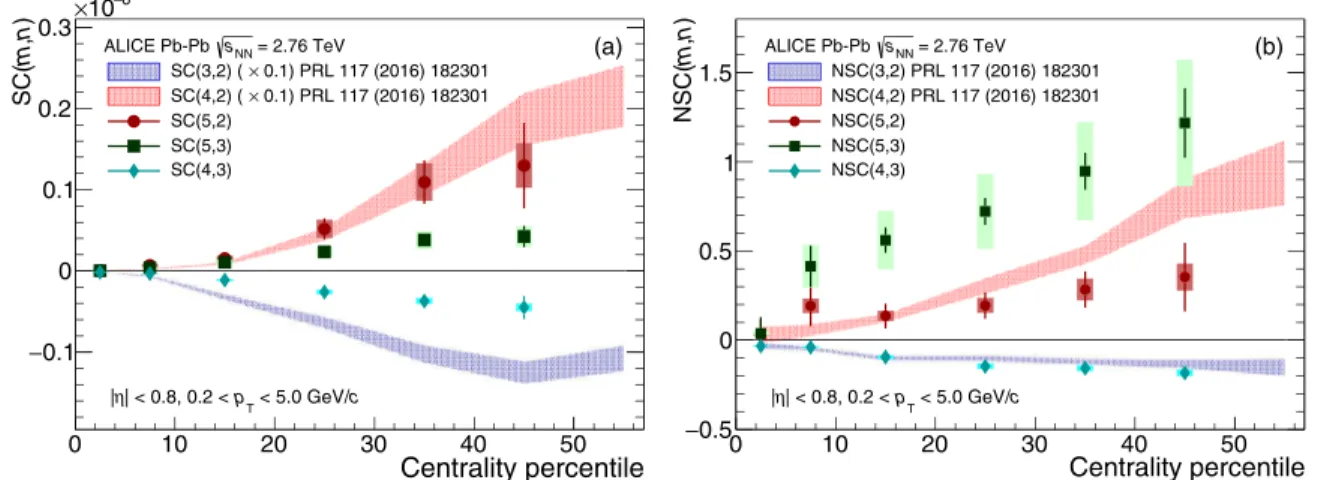
FIG. 1. The centrality dependence of SC(m,n) (a) and NSC(m,n) (b) with flow harmonics form=3−5 andn=2,3 in Pb-Pb collisions at
√s
NN=2.76 TeV. The lower order harmonic correlations [SC(3,2), SC(4,2), NSC(3,2), and NSC(4,2)] are taken from Ref. [57] and shown as bands. The systematic and statistical errors are combined in quadrature for these lower order harmonic correlations. The SC(4,2) and SC(3,2) are downscaled by a factor of 0.1. Systematic uncertainties are represented with boxes for higher order harmonic correlations.
the temperature dependence ofη/s [57], to which individual
flow harmonics are weakly sensitive [45].
For reasons discussed in Refs. [57,60], the correlations between different flow harmonics cannot be studied experi-mentally with the set of observables introduced in Ref. [36].
Based on Ref. [60], new flow observables obtained from
multiparticle correlations, symmetric cumulants (SC), were
introduced.
The SC observables are defined as
SC(m,n)≡ cos(mϕ1+nϕ2−mϕ3−nϕ4)c
= cos(mϕ1+nϕ2−mϕ3−nϕ4)
− cos[m(ϕ1−ϕ2)]cos[n(ϕ1−ϕ2)]
=v2mv2n−v2mv2n, (3)
with the conditionm=nfor two positive integers mandn
(for details see Sec. IV C in Ref. [60]). In this article, SC(m,n)
normalized by the product vm2v2n [57,61] is denoted by
NSC(m,n):
NSC(m,n)≡SC( m,n) vm2
vn2 . (4)
Normalized symmetric cumulants reflect only the strength of the correlation betweenvmandvn, while SC(m,n) has
contri-butions from both the correlations between the two different
flow harmonics and the individual harmonics. In Eq. (4) the
products in the denominator are obtained from two-particle correlations using a pseudorapidity gap of|η|>1.0 which
suppresses biases from few-particle nonflow correlations. For the two two-particle correlations which appear in the definition of SC(m,n) in Eq. (3), the pseudorapidity gap is not needed,
since nonflow is suppressed by construction in this observable.
This was verified by HIJING model simulations in Ref. [57].
The ALICE measurements [57] have revealed that
fluctua-tions ofv2andv3 are anticorrelated, while fluctuations ofv2
andv4are correlated for all centralities [57]. It was found that
the details of the centrality dependence differ in the fluctuation-dominated (most central) and the geometry-fluctuation-dominated
(mid-central) regimes [57]. The observed centrality dependence of
SC(4,2) cannot be captured by models with constant η/s,
indicating that the temperature dependence of η/s plays an
important role. These results were also used to discriminate between different parametrizations of initial conditions. It was demonstrated that in the fluctuation-dominated regime (central collisions), Monte Carlo (MC)–Glauber initial conditions with binary collision weights are favored over wounded nucleon weights [57]. The first theoretical studies of SC observables can be found in Refs. [58,61–65].
III. DATA ANALYSIS
The data sample of Pb-Pb collisions at the center-of-mass energy√sNN=2.76 TeV analyzed in this article was recorded
by ALICE during the 2010 heavy-ion run of the LHC. De-tailed descriptions of the ALICE detector can be found in Refs. [66–68]. The time projection chamber (TPC) was used to reconstruct charged particle tracks and measure their momenta with full azimuthal coverage in the pseudorapidity range|η|<
0.8. Two scintillator arrays (V0A and V0C) which cover the
pseudorapidity ranges −3.7< η <−1.7 and 2.8< η <5.1
were used for triggering and the determination of centrality [69]. The trigger conditions and the event selection criteria are identical to those described in Refs. [8,69]. Approximately
107minimum-bias Pb-Pb events with a reconstructed primary
vertex within±10 cm from the nominal interaction point along the beam direction are selected. Only charged particles recon-structed in the TPC in |η|<0.8 and 0.2< pT<5 GeV/c
were included in the analysis. The charged track quality cuts described in Ref. [8] were applied to minimize contamination from secondary charged particles and fake tracks. The track reconstruction efficiency and contamination were estimated
from HIJING Monte Carlo simulations [70] combined with a
GEANT3 [71] detector model and were found to be
indepen-dent of the collision centrality. The reconstruction efficiency increases with transverse momenta from 70% to 80% for particles with 0.2< pT<1 GeV/c and remains constant at
by secondary charged particles from weak decays and photon conversions is less than 6% atpT =0.2 GeV/c and falls below
1% forpT >1 GeV/c. ThepT cutoff of 0.2 GeV/c reduces
event-by-event biases due to small reconstruction efficiency
at lower pT, while the high pT cutoff of 5 GeV/c reduces
the effects of jets on the measured correlations. Reconstructed TPC tracks constrained to vertex are required to have at least 70 space points (out of a maximum of 159). Only tracks with a transverse distance of closest approach to the primary vertex less than 3 mm, both in the longitudinal and transverse directions, are accepted. This reduces the contamination from secondary tracks produced in the detector material, particles from weak decays, etc. Tracks with kinks (i.e., tracks that
appear to change direction due to multiple scattering orK±
decays) were rejected.
IV. SYSTEMATIC UNCERTAINTIES
The systematic uncertainties are estimated by varying the event and track selection criteria. All systematic checks de-scribed here are performed independently. The SC(m,n) values
resulting from each variation are compared to ones from the default event and track selection described in the previous section, and differences are taken as the systematic uncertainty due to each individual source. The contributions from different sources were added in quadrature to obtain the total systematic uncertainty.
The event centrality was determined by the V0 detectors [72] with better than 2% resolution for the whole centrality range analyzed. The systematic uncertainty from the centrality determination was evaluated by using the TPC and silicon pixel detector (SPD) [73] detectors instead of the V0 detectors. The systematic uncertainty on the symmetric cumulants which arises from the centrality uncertainty is about 3% both for SC(5,2) and SC(4,3) and 8% for SC(5,3). As described in Sec.III, the reconstructed vertex position along the beam axis (zvertex) is required to be located within 10 cm of the nominal
interaction to ensure uniform detector acceptance for tracks within|η|<0.8. The systematic uncertainty from thez-vertex
cut was estimated by reducing thez-vertex range to 8 cm and
was found to be less than 3%.
The analyzed events were recorded with two settings of the magnet field polarity and the resulting data sets have almost equal numbers of events. Events with both magnet field polarities were used in the default analysis, and the systematic uncertainties were evaluated from the variation between each of the two magnetic field settings. The uncertainty due to
thepT dependence of the track reconstruction efficiency was
also taken into account. Magnetic field polarity variation and reconstruction efficiency effects contribute less than 2% to the systematic uncertainty.
The systematic uncertainty due to the track reconstruction procedure was estimated from comparisons between results for the so-called standalone TPC tracks with the same parameters as described in Sec.III, and tracks from a combination of the TPC and the inner tracking system (ITS) detectors with tighter selection criteria. To avoid nonuniform azimuthal acceptance due to dead zones in the SPD, and to get the best transverse momentum resolution, a hybrid track selection utilizing SPD
hits and/or ITS refit tracks combined with TPC information was used. Then each track reconstruction strategy was evaluated by varying the threshold on parameters used to select the tracks at the reconstruction level. A systematic difference of
up to 12% was observed in SC(m,n) from the different track
selections. In addition, we applied the like-sign technique to estimate nonflow contributions [8] to SC(m,n). The difference
between results obtained by selecting all charged particles and results obtained after either selecting only positively or only negatively charged particles was the largest contribution to the systematic uncertainty and is about 7% for SC(4,3) and 20% for SC(5,3).
Another large contribution to the systematic uncertainty originates from azimuthal nonuniformities in the reconstruc-tion efficiency. In order to estimate its effects, we use the
AMPT model (see Sec.VI), which has a uniform distribution
in azimuthal angle. Detector inefficiencies were introduced to mimic the nonuniform azimuthal distribution in the data. For the observables SC(5,2), SC(5,3), and SC(4,3), the variation due to nonuniform acceptance is about 9%, 17%, and 11%, respectively. Overall, the systematic uncertainties are larger for SC(5,3) and SC(5,2) than for the lower harmonics of
SC(m,n). This is because vn decreases with increasing n
and becomes more sensitive to azimuthal modulation due to detector imperfections.
V. RESULTS
The centrality dependence of the higher order harmonic correlations [SC(4,3), SC(5,2), and SC(5,3)] are presented in
Fig.1and compared to the lower order harmonic correlations
[SC(3,2) and SC(4,2)], which were published in Ref. [57]. The correlation betweenv3 andv4 is negative, and similarly for v3andv2, while the other correlations are all positive, which
reveals thatv2andv5as well asv3andv5 are correlated like v2andv4, whilev3andv4are anticorrelated likev3andv2.
The higher order flow harmonic correlations are much smaller compared to the lower order harmonic correlations. In particular, SC(5,2) is 10 times smaller than SC(4,2) and SC(4,3) is about 20 times smaller than SC(3,2).
Unlike SC(m,n), the NSC(m,n) results with the higher order
flow harmonics show almost the same order of the correla-tion strength as the lower order flow harmonic correlacorrela-tions NSC(3,2) or NSC(4,2). This demonstrates the advantage of using the normalized SC observables in which the correlation strength between flow harmonics is not hindered by the differences in magnitudes of different flow harmonics. The NSC(4,3) magnitude is comparable to NSC(3,2) and one finds
that a hierarchy, NSC(5,3) > NSC(4,2)> NSC(5,2), holds
for the centrality range 20–50% within the errors as shown in
Fig.1(b). The SC(5,2) magnitude is larger than SC(5,3), but
the normalized correlation betweenv5andv3is stronger than
the normalized correlation betweenv5 andv2. These results
indicate that the lower order harmonic correlations are larger than higher order harmonic correlations, not only because of the correlation strength itself but also because of the strength of the individual flow harmonics.
It can be seen in Fig.1(a)that the lower order harmonic
0.2 0.4 0.6 0.8 1 1.2 1.4 1.6 0
0.05 0.1
3 −
10 ×
SC(4,2)
0 - 5% 5 - 10% 10 - 20% 20 - 30% 30 - 40% 40 - 50%
(c) 0.06
− 0.04 −
0.02 −
0
3 −
10 ×
SC(3,2)
= 2.76 TeV
NN
s ALICE Pb-Pb
c < 5 GeV/
T
p <
T,min
p | < 0.8, η |
(a)
0.2 0.4 0.6 0.8 1 1.2 1.4 1.6
0 0.5 NSC(4,2) (d)
0.2 −
0.15 −
0.1 −
0.05 − 0
NSC(3,2)
(b)
]
c
[GeV/
T,min
p [GeV/c]
T,min p
FIG. 2. SC(3,2) and SC(4,2) [panels (a) and (c)] as a function of minimumpTcuts in Pb-Pb collisions at√sNN=2.76 TeV are shown in the left panels. The NSC(3,2) and NSC(4,2) [panels (b) and (d)] are shown in the right panels. Systematic uncertainties are represented with boxes.
peripheral collisions. In the case of SC(5,3) and SC(4,3), the centrality dependence is weaker than for the other harmonic correlations. The NSC(5,3) observable shows the strongest normalized correlation among all harmonics while NSC(5,2) shows the weakest centrality dependence. Both NSC(3,2) and NSC(4,3) are getting more anticorrelated toward peripheral collisions and have similar magnitudes.
To study thepT dependence of SC(m,n), we present the
results as a function of the lowpTcutoff (pT,min), instead of
using independentpTintervals; this decreases large statistical
fluctuations in the results. Various minimumpTcuts from 0.2
to 1.5 GeV/c are applied. ThepTdependent results for SC(3,2)
and SC(4,2) as a function of minimumpT cuts are shown in
Figs.2(a)and2(c). The strength of SC(m,n) becomes larger
as pT,min increases. The centrality dependence is stronger
with higher pT,min cuts, with SC(m,n) getting much larger
as centrality percentile or pT,min increases. The NSC(3,2)
and NSC(4,2) observables with differentpT,min are shown in
Figs.2(b)and2(d). The strongpT,mindependence observed in
SC(m,n) is not seen in NSC(m,n). This indicates that thepT
dependence of SC(m,n) is dominated by thepTdependence of
the individual flow harmonicsvn. ThepT,mindependence of
NSC(3,2) is not clearly seen and it is consistent with nopT,min
dependence within the statistical and systematic errors for the centrality range 0–30%, while showing a moderate increase
of anticorrelation with increasing pT,min for the 30–50%
centrality range. The NSC(4,2) observable shows a moderate decreasing trend aspT,min increases. These observations are
strikingly different from thepTdependence of the individual
flow harmonics, where the relative flow fluctuationsσv2/v2
[74] are independent of transverse momentum up to pT
∼8 GeV/c(see Fig. 3 in Ref. [75]).
As discussed in Sec. II, the NSC(m,n) observables are
normalized by the product vm2vn2. These products are
ob-tained from two-particle correlations using a pseudorapidity gap of|η|>1.0. In this paper, we denote thepTintegrated vn{2,|η|>1}asvnin the transverse momentum range 0.2<
pT <5.0 GeV/c. The individual flow harmonics vn used in
calculations of the NSC observables are shown in Fig. 3.
The centrality dependence of vn for n=2−5 is shown in
Figs.3(a)–3(c). Thevnvalues (n <5) are equivalent to those
in Ref. [11]. The fifth-order flow harmonic v5 is shown in
Fig.3(c). ThepT,mindependence ofvnforn=2−4 is shown in
Figs.3(d)–3(f)in all centrality ranges relevant to the measured
NSC(m,n) observables.
VI. MODEL COMPARISONS
We have performed a systematic comparison of the
cen-trality and transverse momentum dependence of the SC(m,n)
and NSC(m,n) to the event-by-event EKRT+viscous
hydro-dynamics [45], VISH2+1 [76,77], and the AMPT [63,78,79]
models. Comparisons forvncoefficients with the model
cal-culations are presented in the Appendix.
In the event-by-event EKRT+viscous hydrodynamic
calcu-lations [45], the initial energy density profiles are calculated
using a next-to-leading order perturbative-QCD+saturation
model [80,81]. The subsequent space-time evolution is
de-scribed by relativistic dissipative fluid dynamics with different parametrizations for the temperature dependence of the shear viscosity to entropy density ratioη/s(T). This model gives a
good description of the charged hadron multiplicity and the
low-pT region of the charged hadron spectra at RHIC and
FIG. 3. The individual flow harmonicsvnforn=2−5 in Pb-Pb collisions at√sNN=2.76 TeV are shown in the left panels [(a), (b), and (c)].v4andv5are shown in the same panel (c). ThepT,mindependence ofvnforn=2−4 is shown in the right panels [(d), (e), and (f)].
parametrizations is adjusted to reproduce the measuredvnfrom
central to midperipheral collisions (see Fig. 15 in Ref. [45] and our Appendix).
The VISH2+1 [76,77] event-by-event calculations for rel-ativistic heavy-ion collisions are based on (2+1)-dimensional viscous hydrodynamics which describes the QGP phase and the highly dissipative and off-equilibrium late hadronic stages with fluid dynamics. By tuning transport coefficients and decoupling temperature for a given scenario of initial
con-ditions, it can describe the pT spectra and different flow
harmonics at RHIC and the LHC [20,76,82,83] energies.
Three different types of initial conditions [58] (MC-Glauber, Monte Carlo Kharzeev-Levin-Nardi (MC-KLN), and AMPT)
along with different constant η/s values have been used for
our data to model comparisons. Traditionally, the Glauber model constructs the initial entropy density from the wounded
nucleon and binary collision density profiles [84]. The KLN
model assumes that the initial energy density is proportional to that of the initial gluons calculated from the corresponding
kT factorization formula [85]. In Monte Carlo versions
MC-Glauber and MC-KLN [86–88] of these models, additional
initial state fluctuations are introduced through position fluc-tuations of individual nucleons inside the colliding nuclei. For the AMPT initial conditions [83,89,90], the fluctuating energy density profiles are constructed from the energy distribution
of individual partons, which fluctuate in both momentum and coordinate space. Compared with the MC-Glauber and MC-KLN initial conditions, the additional Gaussian smearing in the AMPT initial conditions gives rise to nonvanishing initial local flow velocities [89].
Even though thermalization could be achieved quickly in collisions of very large nuclei and/or at extremely high energy
[91], the dense matter created in heavy-ion collisions may
not reach full thermal or chemical equilibrium due to its finite size and short lifetime. To address such nonequilibrium
many-body dynamics, the AMPT model [78,92,93] has been
developed, which includes both initial partonic and final hadronic interactions and the transition between these two phases of matter. The initial conditions in the AMPT are given by the spatial and momentum distributions of
mini-jets and soft strings from the HIJING model [70,94]. For
the data comparisons, three different configurations of the AMPT model have been used: the default one and string melting with and without hadronic rescattering. The input
parameters used in all configurations are αs =0.33 and a
60
−
40
−
20
−
0 −9
10
×
SC(4,3)
(e) 0
20 40
60 −9
10
×
SC(5,3)
(d) 0
0.05 0.1 0.15
0.2 −6
10
×
SC(5,2)
(c) 0
1 2
6
−
10
×
SC(4,2)
EKRT+Viscous Hydrodynamics /s=0.2)
η param0 (
/s(T)) η param1 (
(b) 1.5
−
1
−
0.5
−
0
6
−
10
×
SC(3,2) Pb-Pb sNN = 2.76 TeV
c < 5.0 GeV/
T
p | < 0.8, 0.2 < η
|
ALICE (a)
0.3
−
0.2
−
0.1
−
0
NSC(4,3)
(E) 0 0.5 1 1.5
NSC(5,3)
(D) 0 0.2 0.4
NSC(5,2)
(C) 0 0.5
NSC(4,2)
(B) 0.15
−
0.1
−
0.05
−
0
NSC(3,2)
(A)
0 10 20 30 40 50 10 20 30 40 50
Centrality percentile Centrality percentile
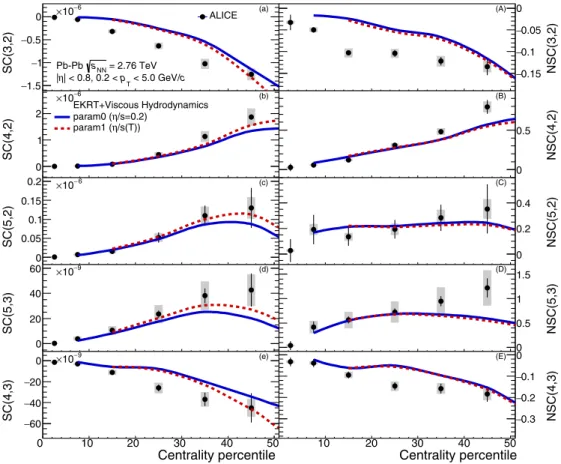
FIG. 4. The centrality dependence of SC(m,n) and NSC(m,n) in Pb-Pb collisions at√sNN=2.76 TeV. Results are compared to the event-by-event EKRT+viscous hydrodynamic calculations [45]. The lines are hydrodynamic predictions with two differentη/s(T) parametrizations. Left (right) panels show SC(m,n) (NSC(m,n)).
andb=0.9 GeV−2. In the string melting configuration, the initial strings are melted into partons whose interactions are
described by the Zhang’s parton cascade (ZPC) model [97].
These partons are then combined into the final-state hadrons via a quark coalescence model. In both configurations, the dynamics of the subsequent hadronic matter is described by a hadronic cascade based on a relativistic transport (ART) model
[98] which includes resonance decays. The string melting
configuration of the AMPT without hadronic rescattering was used to study the influence of the hadronic phase on the development of the anisotropic flow. Even though the string melting version of AMPT [78,99] reasonably well reproduces particle yields,pT spectra, andv2of low-pTpions and kaons
in central and midcentral Au-Au collisions at √sNN=200
GeV and Pb-Pb collisions at√sNN=2.76 TeV [79], it was
observed in a recent study [100] that it fails to quantitatively reproduce the flow harmonics of identified hadrons (v2,v3,v4,
andv5) at√sNN=2.76 TeV. It turns out that the radial flow
in AMPT is 25% lower than that measured at the LHC, which is responsible for this quantitative disagreement [100]. The details of the AMPT configurations used in this article and the comparisons ofpT-differentialvnfor pions, kaons, and protons
to the data can be found in Ref. [100].
A. Centrality dependence of SC(m,n) and NSC(m,n)
Comparison to event-by-event EKRT+viscous
hydrody-namic predictions with various parametrizations of the
temper-ature dependence ofη/s(T) was shown in Fig. 2 of Ref. [57].
It was demonstrated that NSC(3,2) is sensitive mainly to the initial conditions, while NSC(4,2) is sensitive to both the initial conditions and the system properties, which is consistent with
the predictions from Ref. [36]. The model calculations for
NSC(4,2) observable show that it has better sensitivity for
different η/s(T) parametrizations but they cannot describe
either the centrality dependence or the absolute values. The discrepancy between data and theoretical predictions indicates that the current understanding of initial conditions in models of heavy-ion collisions needs to be revisited to further constrain
η/s(T). The measurement of SC(m,n) and NSC(m,n) can
provide new constraints for the detailed modeling of fluctuating initial conditions.
The calculations for the two sets of parameters which de-scribe the lower order harmonic correlations best are compared to the data in Fig.4. As can be seen in Fig. 1 from Ref. [45], for the “param1” parametrization the phase transition from the hadronic to the QGP phase occurs at the lowest temperature, around 150 MeV. This parametrization is also characterized by a moderate slope inη/s(T) which decreases (increases) in the
hadronic (QGP) phase. The model calculations in which the temperature of the phase transition is larger than for “param1”
are ruled out by the previous measurements [57]. While the
correlations between v5 and v2 are well described at all
centralities, the correlations betweenv5andv3are reproduced
0.1 − 0.05 − 0 6 − 10 × SC(4,3) (e) 0 0.05 0.1 0.15 ×10⁻⁶
SC(5,3) (d) 0 0.1 0.2 0.3 6 − 10 × SC(5,2) (c) 0 2 4 6 − 10 × SC(4,2) VISH2+1 /s=0.08 η AMPT, /s=0.16 η AMPT, /s=0.08 η MC-KLN, /s=0.2 η MC-KLN, /s=0.08 η MC-Glauber, /s=0.2 η MC-Glauber, (b) 2 − 1 − 0 6 − 10 ×
SC(3,2) Pb-Pb sNN = 2.76 TeV
c < 5.0 GeV/
T
p | < 0.8, 0.2 < η | ALICE (a) 0.3 − 0.2 − 0.1 − 0 NSC (4 ,3 ) (E) 0 0.5 1 1.5 NSC (5 ,3 ) (D) 0 0.2 0.4 NSC (5 ,2 ) (C) 0 0.5 NSC (4 ,2 ) (B) 0.1 − 0 NSC (3 ,2 ) (A)
0 10 20 30 40 50 10 20 30 40 50
Centrality percentile Centrality percentile
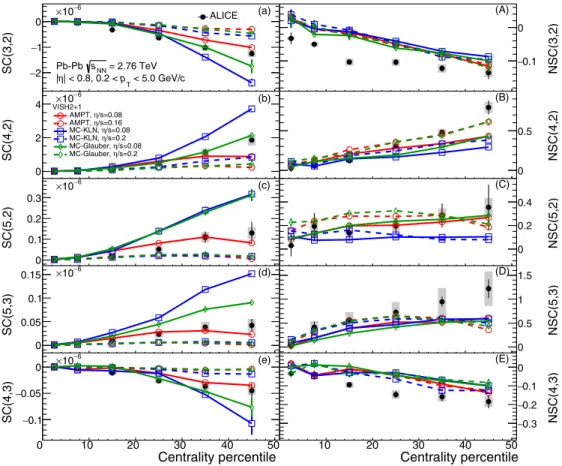
FIG. 5. The centrality dependence of SC(m,n) and NSC(m,n) in Pb-Pb collisions at√sNN=2.76 TeV. Results are compared to various VISH2+1 calculations [58]. Three initial conditions from AMPT, MC-KLN, and MC-Glauber are drawn as different colors and markers. The η/s parameters are shown as different line styles, the small shear viscosity (η/s=0.08) are shown as solid lines, and large shear viscosities (η/s=0.2 for MC-KLN and MC-Glauber and 0.16 for AMPT) are drawn as dashed lines. Left (right) panels show SC(m,n) (NSC(m,n)).
40–50% centrality. In the case ofv4 andv3, the same models
underestimate the anticorrelation in the data significantly in midcentral collisions and fail similarly for the anticorrelation betweenv3andv2.
The comparison to the VISH2+1 calculation [58] is shown
in Fig.5. All calculations with largeη/sregardless of the initial
conditions (η/s=0.2 for MC-KLN and MC-Glauber initial
conditions andη/s=0.16 for AMPT initial conditions) fail to
describe the centrality dependence of the SC(m,n) observables
of all orders, shown in the left panels in Fig.5. Among the cal-culations with smallη/s(η/s=0.08), the one with the AMPT
initial conditions describes the data better than the ones with other initial conditions for all SC(m,n) observables measured,
but it cannot describe the data quantitively for most of the centrality ranges.
However, NSC(4,2) is sensitive both to the initial conditions
and theη/sparametrizations used in the models. Even though
NSC(4,2) favors both AMPT initial conditions with η/s=
0.08 and MC-Glauber initial conditions with η/s=0.20,
SC(4,2) can only be described by models with smallerη/s.
Hence the calculation with largeη/s=0.20 is ruled out. We
conclude that η/s should be small and that AMPT initial
conditions are favored by the data. The NSC(5,2) and NSC(5,3) observables are quite sensitive to both the initial conditions and theη/sparametrizations. The SC(4,3) results clearly favor
smallerη/svalues but NSC(4,3) cannot be described by these
models quantitively.
The SC(m,n) and NSC(m,n) observables calculated from
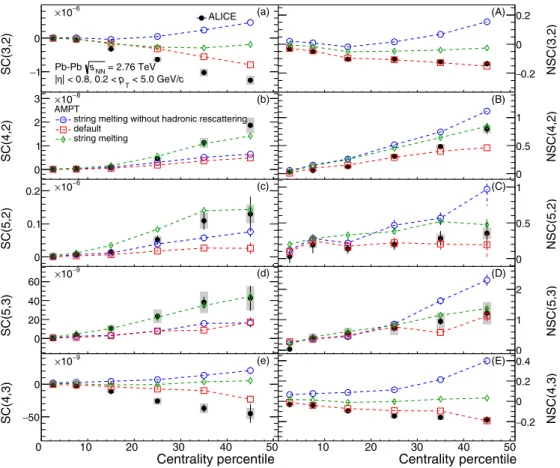
AMPT simulations are compared with data in Fig. 6. For
SC(3,2), the calculation with the default AMPT settings is closest to the data, but none of the AMPT configurations can describe the data fully. The third version based on the string melting configuration without the hadronic rescattering phase is also shown. The hadronic rescattering stage makes both SC(3,2) and NSC(3,2) smaller in the string melting AMPT model but not enough to describe the data. Further investigations proved why the default AMPT model can describe NSC(3,2) but underestimates SC(3,2). By taking the differences in the individual flow harmonics (v2 andv3)
between the model and data into account, it was possible to recover the difference in SC(3,2) between the data and the model. The discrepancy in SC(3,2) can be explained by the overestimated individualvnvalues as reported in Ref. [100] in
all centrality ranges.
50
−
0
9
−
10
×
SC(4,3)
(e) 0
20 40 60
9
−
10
×
SC(5,3)
(d) 0
0.1 0.2 ×10⁻⁶
SC(5,2)
(c) 0
1 2
3 10−6
×
SC(4,2)
AMPT
string melting without hadronic rescattering default
string melting
(b) 1
−
0
6
−
10
×
SC(3,2) Pb-Pb sNN = 2.76 TeV
c < 5.0 GeV/
T
p | < 0.8, 0.2 < η
|
ALICE (a)
0.2
−
0 0.2 0.4
NSC
(4
,3
)
(E) 0 1 2
NSC
(5
,3
)
(D) 0 0.5 1
NSC
(5
,2
)
(C) 0 0.5 1
NSC
(4
,2
)
(B) 0.2
−
0 0.2
NSC
(3
,2
)
(A)
0 10 20 30 40 50 10 20 30 40 50
Centrality percentile Centrality percentile
FIG. 6. The centrality dependence of SC(m,n) and NSC(m,n) in Pb-Pb collisions at√sNN=2.76 TeV. Results are compared to various AMPT models. Left (right) panels show SC(m,n) (NSC(m,n)).
phase on NSC(4,2) is opposite to other observables [SC(3,2), NSC(3,2), and SC(4,2)]. The hadronic rescattering makes NSC(4,2) slightly smaller. It should be noted that the agreement
with SC(m,n) should not be overemphasized since there are
discrepancies in the individualvnbetween the AMPT models
and the data as was demonstrated for SC(3,2). Hence, the
simultaneous description of SC(m,n) and NSC(m,n) should
give better constraints on the parameters in AMPT models. The string melting AMPT model describes SC(5,3) and NSC(5,3) well. However, the same setting overestimates SC(5,2) and NSC(5,2). The default AMPT model can describe NSC(5,3) and NSC(5,2) fairly well, as in the case of NSC(3,2) and NSC(4,2). In the case of SC(4,3), neither of the settings can describe the data but the default AMPT model comes the closest to the data. The NSC(4,3) observable is well described by the default AMPT model but cannot be reproduced by the string melting AMPT model. In summary, the default AMPT model describes well the normalized symmetric cumulants
[NSC(m,n)] from lower to higher order harmonic correlations
while the string melting AMPT model overestimates NSC(3,2) and NSC(5,2) and predicts a very weak correlation both for NSC(3,2) and NSC(4,3).
As discussed in Sec.V, a hierarchy NSC(5,3)>NSC(4,2)>
NSC(5,2) holds for centrality ranges>20% within the errors.
Except for the 0–10% centrality range, we found that the same hierarchy also holds in the hydrodynamic calculations and the AMPT models explored in this article. While NSC(5,2) is smaller than NSC(5,3), SC(5,2) is larger than SC(5,3).
The observed inverse hierarchy, SC(5,2) >SC(5,3), can be
explained by different magnitudes of the individual flow harmonics (v2 > v3). This can be attributed to the fact that
flow fluctuations are stronger for v3 thanv2 [14]. This was
claimed in Ref. [58] and also seen in Ref. [101] based on
the AMPT model calculations. NSC(m,n) correlators increase
with largerη/s in hydrodynamic calculations in the 0–30%
centrality range in the same way as the event plane correlations [102,103]. In semiperipheral collisions (>40%), the opposite
trend is observed.
We list here the important findings from the model compar-isons to the centrality dependence of SC(m,n) and NSC(m,n):
(i) The NSC(3,2) observable is sensitive mainly to the initial conditions, while the other observables are sen-sitive to both the initial conditions and the temperature
dependence ofη/s.
(ii) The correlation strength between v3 andv2 and
be-tween v4 and v3 [SC(3,2), SC(4,2), NSC(3,2), and
NSC(4,3)] is significantly underestimated in hydro-dynamic model calculations in midcentral collisions.
(iii) All the VISH2+1 model calculations with largeη/s
fail to describe the centrality dependence of the corre-lations regardless of the initial conditions.
(iv) Among the VISH2+1 model calculations with small
η/s (η/s=0.08), the one with the AMPT initial
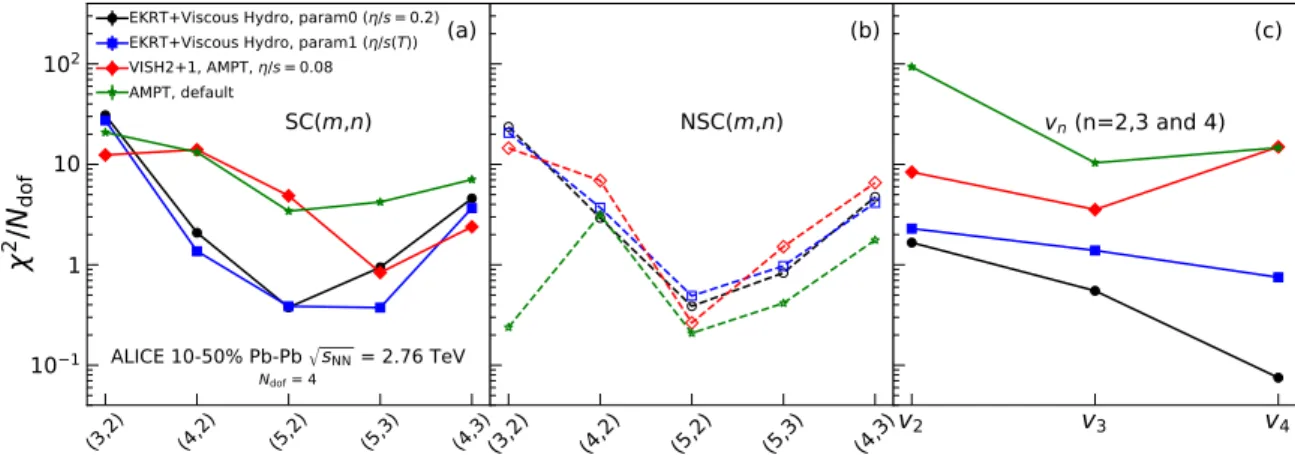
FIG. 7. Theχ2/Ndofvalues calculated by Eq. (5) are shown for SC(m,n) (a), NSC(m,n) (b), and individual harmonicsvn(c). Results are for model calculations which are best in describing the SC observables for each of the three different types of models.
(v) The default AMPT model can describe the
normal-ized symmetric cumulants [NSC(m,n)] quantitively
for most centralities while the string melting AMPT model fails to describe them.
(vi) A hierarchy NSC(5,3)>NSC(4,2)>NSC(5,2) holds
for centrality percentile ranges >20% within the
errors. This hierarchy is reproduced well both by hydrodynamic and AMPT model calculations.
The agreement of various model calculations with the data is quantified by calculating theχ2/Ndof,
χ2/Ndof =
1
Ndof
Ndof
i=1
(yi−fi)2
σi2 , (5)
whereyi(fi) is a measurement (model) value in a centrality bin
i. The systematic and statistical errors from the data are
com-bined in quadrature σi=
σi,2stat+σi,2syst+σf2
i,stat together with the statistical errors of the model calculations. The total number of data samplesNdofin Eq. (5) is 4, which corresponds
to the number of bins in the centrality range 10–50% used inχ2/Ndof calculations. Theχ2/Ndof for model calculations
which are best in describing the SC observables for each of the three different types of models are shown in Fig.7.
The results for SC(m,n) and NSC(m,n) are presented in
Figs. 7(a) and 7(b), respectively. The χ2/Ndof values for
the individual flow harmonics vn forn=2−4 are shown in
Fig.7(c). We found that in the case of the calculations from
VISH2+1 with AMPT initial conditions (η/s=0.08) and
the default configuration of the AMPT model, the χ2/Ndof
values for SC(m,n) are larger than those for NSC(m,n). This
reflects the fact that the individual flow harmonicsvnare not
well described by those models compared to event-by-event EKRT+viscous hydrodynamics. This is quantified in Fig.7(c),
where the χ2/Ndof values for vn are much larger both for
VISH2+1 and default AMPT calculations than event-by-event
EKRT+viscous hydrodynamics. The default configuration of
the AMPT model gives the bestχ2/Ndofvalues for NSC(m,n),
especially for NSC(3,2). However, the χ2/Ndof values of
this model are largest for vn among the models especially
forv2.
Theχ2/Ndofvalues forv2andv3are significantly smaller
than those for SC(3,2) and NSC(3,2) for all the
hydrody-namic calculations. The χ2/Ndof values for SC(4,2) and
NSC(4,2) from event-by-event EKRT+viscous
hydrodynam-ics are comparable to that forv2 but larger than forv4. The χ2/Ndof for calculations for vn with constant η/s=0.20
(“param0”) are smaller than those with temperature-dependent
η/s parametrization with a minimal value of η/s=0.12
at the temperature around 150 MeV (“param1”), while an
opposite trend is observed for SC(m,n), in particular for
SC(4,2) and SC(5,3). This illustrates that a combination of
the SC(m,n) observables with the individual flow harmonics
vnmay provide sensitivity to the temperature dependence of
theη/s(T) and together they allow for better constraints of the
model parameters.
Even though the calculations from event-by-event
EKRT+viscous hydrodynamics give the bestχ2/Ndof values
for both SC(m,n) and NSC(m,n), theχ2/Ndofvalues are large,
especially for the observables which include v3. Even with
the best model calculations, the χ2/Ndof value varies a lot
depending on the model parameters and/or different order SC observables, which implies that the different order harmonic correlations have different sensitivity to the initial conditions and the system properties.
B. Transverse momentum dependence of correlations betweenv2andv3and betweenv2andv4
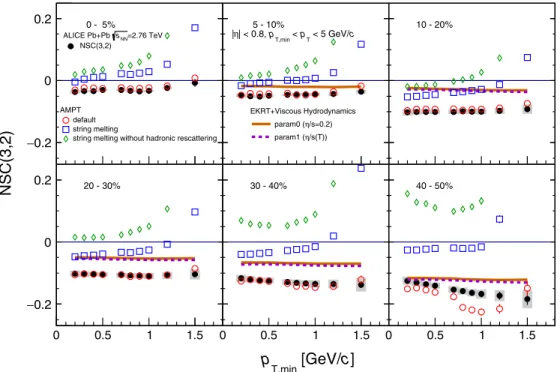
The NSC(3,2) and NSC(4,2) observables as a function of
pT,min are compared to the AMPT simulations in Figs.8and
9, respectively. The observed pT dependence for NSC(3,2)
in midcentral collisions is also seen in AMPT simulations
for higher pT,min. The default configuration of the AMPT
reproduces NSC(3,2), while the other AMPT configurations predict a very strongpTdependence above 1 GeV/c and cannot
describe the magnitudes of both NSC(3,2) and NSC(4,2) simultaneously. In the case of NSC(3,2), the default AMPT
model describes the magnitude andpT dependence well in
all collision centralities except for 40–50%, where the model
underestimates the data and shows a strongerpTdependence
0 - 5%
AMPT default string melting
string melting without hadronic rescattering =2.76 TeV
s ALICE Pb+Pb
NSC(3,2)
20 - 30%
5 - 10%
c < 5 GeV/ p < p | < 0.8, η |
EKRT+Viscous Hydrodynamics /s=0.2) η param0 (
/s(T)) η param1 (
30 - 40%
10 - 20%
40 - 50%
0.2 −
0 0.2 0.2 −
0 0.2
0 0.5 1 1.5 0 0.5 1 1.5 0 0.5 1 1.5
] c [GeV/ T,min p
NSC(3,2)
FIG. 8. NSC(3,2) as a function of the minimumpT cut in Pb-Pb collisions at√sNN=2.76 TeV. Results are compared to various AMPT configurations and event-by-event EKRT+viscous hydrodynamic calculations [45].
data well except for the 10–20% and 40–50% centralities. Comparison of the string melting AMPT configuration with and without hadronic rescattering suggests that a very strong
pTdependence as well as the correlation strength are weakened
by the hadronic rescattering. Consequently, the observed weak
pT dependence may be due to hadronic rescattering. The
relative contributions to the final-state particle distributions from partonic and hadronic stages need further study.
The event-by-event EKRT+viscous hydrodynamic
calcu-lations are also compared to the data in Figs. 8 and 9. In
the case of NSC(3,2), the hydrodynamic calculations
under-estimate the magnitude of the data as discussed in Sec.VI A
0 - 5%
EKRT+Viscous Hydrodynamics /s=0.2) η param0 (
/s(T)) η param1 (
=2.76 TeV s ALICE Pb+Pb
NSC(4,2)
20 - 30%
AMPT default string melting
string melting without hadronic rescattering 5 - 10%
c < 5 GeV/ p < p | < 0.8, η |
30 - 40%
10 - 20%
40 - 50%
0.5 1 1.5 0 0.1 0.2 0.3 0.4
0 0.5 1 1.5 0 0.5 1 1.5 0 0.5 1 1.5
] c [GeV/ T,min p
NSC(4,2)
and show very weakpT dependence for all centralities. The
pT dependence of NSC(3,2) is well captured by the model
calculations in all collision centralities except for 40–50%,
where the data show strongerpTdependence than the models.
The difference between the model calculations with the two
different parametrizations of η/s(T) is very small. As for
NSC(4,2), the model calculations overestimate the magnitude of the data in the 5–20% centrality range and underestimate it
in the centrality range 30–50%. However, thepTdependence
is well described by the model calculations in all centrality ranges, while the difference of the model results for the two parametrizations in most centralities is rather small.
The observed moderatepTdependence in midcentral
col-lisions both for NSC(3,2) and NSC(4,2) might be an in-dication of possible viscous corrections to the equilibrium distribution at hadronic freeze-out, as predicted in Ref. [36]. The comparisons to hydrodynamic models can further help us to understand the viscous corrections to the momentum distributions at hadronic freeze-out [45,52,54–56].
VII. SUMMARY
In this article, we report the centrality dependence of correlations between the higher order harmonics (v4,v5) and
the lower order harmonics (v2,v3) as well as the transverse
momentum dependence of the correlations betweenv3andv2
and betweenv4andv2. The results are presented in terms of the
symmetric cumulants SC(m,n). It was demonstrated earlier in
Ref. [57] that SC(m,n) is insensitive to nonflow effects and
independent of symmetry plane correlations.
We have found that fluctuations of SC(3,2) and SC(4,3) are anticorrelated in all centralities while fluctuations of SC(4,2), SC(5,2), and SC(5,3) are correlated for all centralities. These measurements were compared to various hydrodynamic model calculations with different initial conditions as well as different parametrizations of the temperature dependence of
η/s. It is found that the different order harmonic correlations
have different sensitivities to the initial conditions and the system properties. Therefore, they have discriminating power
in separating the effects of η/s from the initial conditions
on the final-state particle anisotropies. The comparisons to
VISH2+1 calculations show that all the models with large
η/s, regardless of the initial conditions, fail to describe the
centrality dependence of higher order correlations. Based on
the tested model parameters, the data favor smallη/sand the
AMPT initial conditions.
A quite clear separation of the correlation strength for different initial conditions is observed for these higher or-der harmonic correlations compared to the lower oror-der. The default configuration of the AMPT model describes well
the normalized symmetric cumulants [NSC(m,n)] for most
centralities and for most combinations of harmonics which were considered. Finally, we have found thatv3andv2as well
as v4 and v2 correlations have moderate pT dependence in
midcentral collisions. This might be an indication of possible viscous corrections to the equilibrium distribution at hadronic freeze-out. Together with the measurements of individual
harmonics, the new results for SC(m,n) and NSC(m,n) can
be used to further optimize model parameters and put better
constraints on the initial conditions and the transport properties of nuclear matter in ultrarelativistic heavy-ion collisions.
ACKNOWLEDGMENTS
South (COMSATS), Pakistan; Pontificia Universidad Católica del Perú, Peru; Ministry of Science and Higher Education and National Science Centre, Poland; Korea Institute of Science and Technology Information and National Research Foundation of Korea (NRF), Republic of Korea; Ministry of Education and Scientific Research, Institute of Atomic Physics and Romanian National Agency for Science, Technology, and Innovation, Romania; Joint Institute for Nuclear Research (JINR), Ministry of Education and Science of the Russian Federation and National Research Centre Kurchatov Institute, Russia; Ministry of Education, Science, Research, and Sport of the Slovak Republic, Slovakia; National Research Founda-tion of South Africa, South Africa; Centro de Aplicaciones Tecnológicas y Desarrollo Nuclear (CEADEN), Cubaenergía, Cuba, Ministerio de Ciencia e Innovacion and Centro de In-vestigaciones Energéticas, Medioambientales y Tecnológicas (CIEMAT), Spain; Swedish Research Council (VR) and Knut and Alice Wallenberg Foundation (KAW), Sweden; European Organization for Nuclear Research, Switzerland; National Science and Technology Development Agency (NSDTA), Suranaree University of Technology (SUT) and Office of the Higher Education Commission under NRU project of Thailand, Thailand; Turkish Atomic Energy Agency (TAEK), Turkey; National Academy of Sciences of Ukraine, Ukraine; Science and Technology Facilities Council (STFC), United Kingdom; and National Science Foundation of the United States of America (NSF) and United States Department of Energy, Office of Nuclear Physics (DOE NP), United States of America.
APPENDIX: MODEL COMPARISONS OF THE INDIVIDUAL FLOW HARMONICSvn
As discussed in Sec. II, NSC(m,n) is expected to be
insensitive to the magnitudes ofvm andvn but SC(m,n) has
contributions from both the correlations between the two
different flow harmonics and the individual harmonics vn.
Therefore, it is important to check how well the theoretical
models used in Sec.VIdescribe the measuredvndata shown
in Sec.V.vnresults presented in this section are for charged
particles in the pseudorapidity range|η|<0.8 and the
trans-verse momentum range 0.2< pT<5.0 GeV/c as a function
of collision centrality [11].
The measured vn for n=2−4 in Pb-Pb collisions
at √sNN=2.76 TeV are compared to the event-by-event
EKRT+viscous hydrodynamic calculations [45] in Fig.10. In these calculations, the initial conditions andη/s
parametriza-tions are chosen to reproduce the LHCvndata. The calculations
capture the centrality dependence of vn in the central and
midcentral collisions within 5% forv2and 10% forv3andv4.
The VISH2+1 calculations with various initial conditions
andη/s parameters are compared to the vn data in Fig.11.
Neither MC-Glauber nor MC-KLN initial conditions can simultaneously describe v2, v3, and v4. In particular, for
MC-Glauber initial conditions, VISH2+1 with η/s=0.08
can describe well v2 from central to midcentral collisions,
but overestimates v3 andv4 for the same centrality ranges.
For MC-KLN initial conditions, VISH2+1 withη/s=0.20
reproducesv2 but underestimatesv3 andv4for the presented
centrality regions. The calculations with AMPT initial condi-tions improves the simultaneous descripcondi-tions ofvn(n=2, 3,
and 4). The overall difference to the data is quite large if all
the model settings are considered, about 30% forvn(n=2
and 3) and 50% for v4. The calculations with AMPT initial
conditions reproduce the observed centrality dependence with an accuracy of 10–20%.
The AMPT calculations with various configurations are compared to thevndata in Fig.12. The string melting version
of AMPT [78,99] reasonably reproducesvnas shown in Fig.12
within 20% for v2 and 10% for v3 and v4. The version
based on the string melting configuration without the hadronic rescattering phase underestimates the data compared to the
0.05 0.1 0.15
2
v
|>1 η ∆ ALICE (PRL.116.132302) |
EKRT+Viscous Hydrodynamics
/s=0.2) η param0 (
/s(T)) η param1 (
= 2.76 TeV s
Pb-Pb
c < 5.0 GeV/ p | < 0.8, 0.2 <
η
|
(a)
0 10 20 30 40 50 60
Centrality percentile
0.2
−
0 0.2
(Theory-Data)/Data
0.02 0.04 0.06
3
v
|>1 η ∆ ALICE (PRL.116.132302) |
EKRT+Viscous Hydrodynamics
/s=0.2) η param0 (
/s(T)) η param1 (
= 2.76 TeV s
Pb-Pb
(b)
0 10 20 30 40 50 60
Centrality percentile
0.2
−
0 0.2
(Theory-Data)/Data
0.01 0.02 0.03 0.04
4
v
|>1 η ∆ ALICE (PRL.116.132302) |
EKRT+Viscous Hydrodynamics
/s=0.2) η param0 (
/s(T)) η param1 (
= 2.76 TeV s
Pb-Pb
(c)
0 10 20 30 40 50 60
Centrality percentile
0.2
−
0 0.2
(Theory-Data)/Data
0.05 0.1 0.15 0.2 2
v
|>1 η ∆ ALICE (PRL.116.132302) | VISH2+1 /s=0.08 η AMPT, /s=0.16 η AMPT, /s=0.08 η MC-KLN, /s=0.2 η MC-KLN, /s=0.08 η MC-Glauber, /s=0.2 η MC-Glauber,= 2.76 TeV s
Pb-Pb
c < 5.0 GeV/ p | < 0.8, 0.2 <
η
|
(a)
0 10 20 30 40 50 60
Centrality percentile 0.5 − 0 0.5 (Theory-Data)/Data 0.02 0.04 0.06 3
v
|>1 η ∆ ALICE (PRL.116.132302) | VISH2+1 /s=0.08 η AMPT, /s=0.16 η AMPT, /s=0.08 η MC-KLN, /s=0.2 η MC-KLN, /s=0.08 η MC-Glauber, /s=0.2 η MC-Glauber,= 2.76 TeV s
Pb-Pb
(b)
0 10 20 30 40 50 60
Centrality percentile 0.5 − 0 0.5 (Theory-Data)/Data 0.01 0.02 0.03 0.04 0.05 4
v
|>1 η ∆ ALICE (PRL.116.132302) | VISH2+1 /s=0.08 η AMPT, /s=0.16 η AMPT, /s=0.08 η MC-KLN, /s=0.2 η MC-KLN, /s=0.08 η MC-Glauber, /s=0.2 η MC-Glauber,= 2.76 TeV s
Pb-Pb
(c)
0 10 20 30 40 50 60
Centrality percentile 0.5 − 0 0.5 (Theory-Data)/Data
FIG. 11. The individual flow harmonicsvnforn=2−4 in Pb-Pb collisions at√sNN=2.76 TeV [11]. Results are compared to various VISH2+1 calculations [58]. Three initial conditions from AMPT, MC-KLN, and MC-Glauber are shown in different colors. The results for differentη/svalues are shown as different line styles, the small shear viscosity (η/s=0.08) are shown as solid lines, and large shear viscosities (η/s=0.2 for MC-KLN and MC-Glauber and, 0.16 for AMPT) are drawn as dashed lines.
calculations with the string melting version of AMPT, which demonstrates that a large fraction of the flow is developed during the late hadronic rescattering stage in the string melting version of AMPT. The default version of AMPT
underesti-matesvnfor n=2−4 by≈20%. It should be noted that the
default AMPT model can describe the normalized symmetric cumulants [NSC(m,n)] quantitively for most centralities while
the string melting AMPT model fails to describe them. Finally, few selected calculations from three theoretical models which describe thevndata best are shown in Fig.13.
The calculations from event-by-event EKRT+viscous
hydro-dynamics, VISH2+1 with AMPT initial conditions (η/s=
0.08) and the string melting version of AMPT give the best
description of the individual flow harmonicsvn(n=2, 3 and
4) with an accuracy of 5–20%. The centrality dependence differs in the three models as well as in the different order
flow harmonics. Together with SC(m,n) and NSC(m,n), the
simultaneous description of individual flow harmonicsvn at
all orders is necessary to further optimize model parameters and put better constraints on the initial conditions and the transport properties of nuclear matter in ultrarelativistic heavy-ion collisheavy-ions. 0.05 0.1 0.15 2
v
|>1 η ∆ ALICE (PRL.116.132302) |AMPT
string melting without hadronic rescattering
default
string melting
= 2.76 TeV s
Pb-Pb
c < 5.0 GeV/ p | < 0.8, 0.2 <
η
|
(a)
0 10 20 30 40 50 60
Centrality percentile 0.4 − 0.2 − 0 0.2 0.4 (Theory-Data)/Data 0.02 0.04 0.06 3
v
|>1 η ∆ ALICE (PRL.116.132302) |AMPT
string melting without hadronic rescattering
default
string melting
= 2.76 TeV s
Pb-Pb
(b)
0 10 20 30 40 50 60
Centrality percentile 0.4 − 0.2 − 0 0.2 0.4 (Theory-Data)/Data 0.01 0.02 0.03 0.04 4
v
|>1 η ∆ ALICE (PRL.116.132302) |AMPT
string melting without hadronic rescattering
default
string melting
= 2.76 TeV s
Pb-Pb
(c)
0 10 20 30 40 50 60
Centrality percentile 0.4 − 0.2 − 0 0.2 0.4 (Theory-Data)/Data
0.05 0.1 0.15 0.2 2
v
|>1 η ∆ ALICE (PRL.116.132302) | EKRT+Viscous Hydrodynamics /s=0.2) η param0 ( /s(T)) η param1 ( /s=0.08 η VISH2+1, AMPT, AMPT, string melting= 2.76 TeV s
Pb-Pb
c < 5.0 GeV/ p | < 0.8, 0.2 <
η
|
(a)
0 10 20 30 40 50 60
Centrality percentile 0.2 − 0 0.2 (Theory-Data)/Data 0.02 0.04 0.06 3
v
|>1 η ∆ ALICE (PRL.116.132302) | EKRT+Viscous Hydrodynamics /s=0.2) η param0 ( /s(T)) η param1 ( /s=0.08 η VISH2+1, AMPT, AMPT, string melting= 2.76 TeV s
Pb-Pb
(b)
0 10 20 30 40 50 60
Centrality percentile 0.2 − 0 0.2 (Theory-Data)/Data 0.01 0.02 0.03 4
v
|>1 η ∆ ALICE (PRL.116.132302) | EKRT+Viscous Hydrodynamics /s=0.2) η param0 ( /s(T)) η param1 ( /s=0.08 η VISH2+1, AMPT, AMPT, string melting= 2.76 TeV s
Pb-Pb
(c)
0 10 20 30 40 50 60
Centrality percentile 0.2 − 0 0.2 (Theory-Data)/Data
FIG. 13. The individual flow harmonicsvnforn=2−4 in Pb-Pb collisions at√sNN=2.76 TeV [11]. Results are compared with selected calculations from three different types of models which are best in describingvncoefficients.
[1] H. von Gersdorff, L. McLerran, M. Kataja, and P. V. Ruuskanen, Studies of the hydrodynamic evolution of matter produced in fluctuations in pp collisions and in ultrarelativistic nuclear collisions,Phys. Rev. D34,794(1986).
[2] U. Heinz and R. Snellings, Collective flow and viscosity in relativistic heavy-ion collisions, Annu. Rev. Nucl. Part. Sci.
63,123(2013).
[3] K. H. Ackermannet al.(STAR Collaboration), Elliptic Flow in Au+Au Collisions at√sNN=130 GeV,Phys. Rev. Lett.86,
402(2001).
[4] J. Adams et al. (STAR Collaboration), Experimental and theoretical challenges in the search for the quark gluon plasma: The STAR Collaboration’s critical assessment of the evidence from RHIC collisions,Nucl. Phys. A757,102(2005).
[5] K. Adcoxet al.(PHENIX Collaboration), Formation of dense partonic matter in relativistic nucleus-nucleus collisions at RHIC: Experimental evaluation by the PHENIX collaboration,
Nucl. Phys. A757,184(2005).
[6] I. Arsene et al. (BRAHMS Collaboration), Quark gluon plasma and color glass condensate at RHIC? The perspec-tive from the BRAHMS experiment,Nucl. Phys. A 757, 1 (2005).
[7] B. B. Back et al.(PHOBOS Collaboration), The PHOBOS perspective on discoveries at RHIC,Nucl. Phys. A 757, 28 (2005).
[8] K. Aamodt et al. (ALICE Collaboration), Elliptic Flow of Charged Particles in Pb-Pb Collisions at 2.76 TeV,Phys. Rev.
Lett.105,252302(2010).
[9] K. Aamodtet al.(ALICE Collaboration), Higher Harmonic Anisotropic Flow Measurements of Charged Particles in Pb-Pb Collisions at√sNN=2.76 TeV,Phys. Rev. Lett.107,032301 (2011).
[10] B. B. Abelev et al.(ALICE Collaboration), Elliptic flow of identified hadrons in Pb-Pb collisions at√sNN=2.76 TeV,
J. High Energy Phys. 06(2015)190.
[11] J. Adamet al.(ALICE Collaboration), Anisotropic Flow of Charged Particles in Pb-Pb Collisions at√sNN=5.02 TeV,
Phys. Rev. Lett.116,132302(2016).
[12] G. Aadet al. (ATLAS Collaboration), Measurement of the pseudorapidity and transverse momentum dependence of the elliptic flow of charged particles in lead-lead collisions at
√s
NN=2.76 TeV with the ATLAS detector,Phys. Lett. B707,
330(2012).
[13] G. Aadet al.(ATLAS Collaboration), Measurement of the az-imuthal anisotropy for charged particle production in√sNN= 2.76 TeV lead-lead collisions with the ATLAS detector,Phys.
Rev. C86,014907(2012).
[14] G. Aadet al. (ATLAS Collaboration), Measurement of the distributions of event-by-event flow harmonics in lead-lead collisions at√sNN=2.76 TeV with the ATLAS detector at the LHC,J. High Energy Phys. 11(2013)183.
[15] G. Aadet al. (ATLAS Collaboration), Measurement of the centrality and pseudorapidity dependence of the integrated elliptic flow in lead-lead collisions at√sNN=2.76 TeV with the ATLAS detector,Eur. Phys. J. C74,2982(2014).
[16] S. Chatrchyan et al. (CMS Collaboration), Centrality de-pendence of dihadron correlations and azimuthal anisotropy harmonics in PbPb collisions at√sNN=2.76 TeV,Eur. Phys.
J. C72,2012(2012).
[17] S. Chatrchyanet al. (CMS Collaboration), Measurement of the elliptic anisotropy of charged particles produced in PbPb collisions at √sNN=2.76 TeV, Phys. Rev. C 87, 014902
(2013).
[18] S. Chatrchyan et al. (CMS Collaboration), Azimuthal Anisotropy of Charged Particles at High Transverse Momenta in PbPb Collisions at√sNN=2.76 TeV,Phys. Rev. Lett.109,
022301(2012).
![FIG. 2. SC(3,2) and SC(4,2) [panels (a) and (c)] as a function of minimum p T cuts in Pb-Pb collisions at √sNN = 2.76 TeV are shown in the left panels](https://thumb-ap.123doks.com/thumbv2/123deta/9822218.486244/6.884.160.724.102.484/panels-function-minimum-collisions-tev-shown-left-panels.webp)
![FIG. 3. The individual flow harmonics v n for n = 2−5 in Pb-Pb collisions at √ s NN = 2.76 TeV are shown in the left panels [(a), (b), and (c)]](https://thumb-ap.123doks.com/thumbv2/123deta/9822218.486244/7.884.167.723.100.590/fig-individual-harmonics-collisions-tev-shown-left-panels.webp)
![FIG. 10. The individual flow harmonics v n for n = 2−4 in Pb-Pb collisions at √ sNN = 2.76 TeV [ 11 ]](https://thumb-ap.123doks.com/thumbv2/123deta/9822218.486244/14.884.68.818.738.1065/fig-individual-flow-harmonics-pb-pb-collisions-tev.webp)
![FIG. 11. The individual flow harmonics v n for n = 2−4 in Pb-Pb collisions at √ s NN = 2.76 TeV [ 11 ]](https://thumb-ap.123doks.com/thumbv2/123deta/9822218.486244/15.884.73.820.101.428/fig-individual-flow-harmonics-pb-pb-collisions-tev.webp)
