INVITED SURVEY PAPER Special Issue on the Past, Present, and Future of Communications Technologies in the IEICE
Evolution and Future of Information Networks
Tohru ASAMI†a),Fellow, Katsunori YAMAOKA††b),andTakuji KISHIDA†††c),Senior Members
SUMMARY This paper looks at the history of research in the Technical Committee on Information Networks from the time of its inception to the present and provides an overview of the latest research in this area based on the topics discussed in recent meetings of the committee. It also presents possible future developments in the field of information networks.
key words: information network, social information infrastructure, chron- icle, cyber-physical system (CPS), IoT, SDN/NFV, ICN/CCN
1. Introduction
The Technical Committee on Information Networks (here- after referred as “this committee”) was organized in 1982. Its first chair was Professor Minoru Akiyama of the University of Tokyo. Opening the inaugural meeting, Shoji Yoshida from R&D Headquarters, Nippon Telegraph and Telephone Public Corporation (NTT) presented a paper entitled “Trends and Research Items of Communication Networks”[1]. His paper discussed the trends in digital networks with a focus on the domestic public telecommunications network, and iden- tified technical issues entailed in building digital networks, which NTT was developing at that time as the Information Network System (INS)[2]. He clarified that, considering our resource-less and narrow national land, it was the national goal to bring a wealthy future to excess of 100 million of Japanese people by processing trade. Then he argued that it was essential to deploy telecommunications technology and rapidly evolving computing technology in order to establish an industrial structure that is more efficient than in other countries and to reinforce the social infrastructure. Whilst telecommunication technologies have since changed over the years, his argument remains valid; the objective of this com- mittee is to study this social information infrastructure.
Yoshida separated a telecommunications network into three parts: a physical network, a logical network, and ser- vices. This separation is still valid but, at that time, unfortu- nately, this committee stopped short of discussing services,
Manuscript received October 4, 2016.
Manuscript revised January 27, 2017.
Manuscript publicized March 22, 2017.
†The author is with the University of Tokyo, Tokyo, 113-8656 Japan.
††The author is with Tokyo Institute of Technology, Tokyo, 152- 8552 Japan.
†††The author is with NTT Software Innovation Center, Musashino-shi, 180-8585 Japan.
a) E-mail: [email protected] b) E-mail: [email protected] c) E-mail: [email protected]
DOI: 10.1587/transcom.2016PFI0009
deeming that they fell within the ambit of social engineering.
This notion derived from the fact that the Public Telecom- munications Law[3]restricted the rights to provide telecom- munications services to only NTT for domestic services and Kokusai Denshin Denwa Co., Ltd. (currently reorganized as KDDI) for international services. The activities of this committee were based on this premise, and focused mainly on technologies for integrated networks, such as Integrated Services Digital Network (ISDN)[2]and Broadband ISDN (B-ISDN) [4], and this remained the case until the mid- 1990s when those technologies began to be commercially deployed. From then on, contrary to Yoshida’s perception, this commttee has embraced new research topics reflecting the realization that information communication services can- not be fully studied if we only consider technologies and the society that benefits from them, and avoid examining the legal systems that control them.
This paper analyses past and present aspects of network research topics in Sects. 2 and 3. Section 4 looks at future research issues, and Sect. 5 offers conclusions.
2. Chronological Overview of the Activities of the Tech- nical Commttee on Information Networks
This section reviews how studies on the social information infrastructure have evolved.
2.1 Inception of the Technical Commttee on Information Networks (1982-86)
In the early 1980s, reflecting standardization and diffusion of facsimile transmission technology, a variety of data com- munication services, called “telemarketing services,” were developed as successors to telex, which had been the main data communication service and was characterized by real- time transfer of text data. Besides G4 fax, representative data services included telewriting∗, videotex∗∗, teletex∗∗∗and
∗A communication system to transmit handwritten drawings over a telephone network and reproduce in real time in the sequence in which each stroke of a drawing is made.
∗∗A communication system in which TV sets are connected to an information center via telephone circuits, on which a sim- ple image consisting of characters and graphics can be displayed.
Character and Pattern Access Information Network System (Cap- tain system [5]) developed by NTT in1982 provided application services similar to today’s Web services using dedicated terminal devices.
∗∗∗A communication system to transmit text and documents via Copyright©2017 The Institute of Electronics, Information and Communication Engineers
Table 1 Trend of major reserch themes in technical committee on infor- mation networks between 1982 and 2006.
Period Main Researches
1982–1986 G4 Fax, MHS, ISDN/INS, DDX, N1 network, OSI, LAN, Formal description technique
1987–1991 Intelligent network, SDL, OSI management, TMN, “Net- work configuration and control,” “Network and distributed processing”, Groupware, Network Security, LAN/PBX, ATM/B-ISDN, Optical switching, High-speed packet com- munication
1992–1996 Intelligent network, Network software, Specification de- scription, Multimedia communication, Adaptive informa- tion network, Agent-oriented technologies, Network man- agement, Network operation, TMN, Network security, Next generation Internet Broadband network, B-ISDN, ATM, Satellite Internet, Private networks, Campus network, LAN, MAN, PBX,
1997–2001 Voice over ATM, Real-time communication, “Responsive system - aimed at combining real-time performance and high reliability,” “Multimedia, distributed processing and the Internet,” Wide-area virtual LAN
2002–2006 Information appliance, Content delivery, “Web service- based office applications, networking and management,”
Grid, Peer to Peer Networks (P2P), Active network, Access network, Home network, Next Generation Network (NGN), Inter net Protocol Virtual Private Network (IP-VPN), Voice over Internet Protocol (VoIP), Mobile network, Wireless network, ad hoc network, Sensor network, Wearable net- work, Ubiquitous network
mixed mode†. In the late 1980s, these services were grad- ually integrated into a Message Handling System (MHS) after the Recommendations on MHS (Rec. ITU-T X.400 se- ries) were adopted by the International Telecommunications Union (ITU) in 1984[6]. Table 1 shows the history of major research themes in this technical committee until 2006.
An immediate effect of the commercial introduction of these systems was that, in addition to papers from research institutes, a number of papers were submitted from the busi- ness sector to present at the meetings. This was a trend that characterized the technical committee in those days. En- gineers engaged in business operations felt that they were closely associated with the activities of the technical com- mittee. In the early days of the technical committee, 40% of presenters of papers were from telecommunication carriers and 30% were from vendors or universities. The number of research institutes involved was less than 10, indicating the minimal diversity among researchers who were active in the technical committee. Researchers who had attended international conferences, such as the IEEE International Conference on Communications (ICC), presented reports on those gatherings, indicating that technical committee meet- ings served as forums enabling research institutes working on similar subjects to share information about technical trends of those subjects.
Changes in the numbers of primary authors of papers in different organization categories over the years are shown telephone circuits.
†A system with a fax machine as a scanner to transmit the text after converted into character codes; graphics are transferred as fax data.
Fig. 1 Changes in the numbers of primary authors of papers in different organization categories over the year.
in Fig. 1. Authors’ organizations are classified into four cat- egories: carriers (mainly NTT and KDDI), manufacturers, universities, and others (The National Institute of Informa- tion and Communications Technology (NICT), The National Institute of Advanced Industrial Science and Technology (AIST), Nippon Hoso Kyokai (Japan Broadcasting Corpora- tion, NHK), Advanced Telecomunications Research Institute International (ATR), etc.). Over the last 30 years, the num- ber of papers from carriers and that from manufacturers have remained more or less constant at 50 and 30 papers, respec- tively. Universities were largely responsible for the major fluctuations in the total number of papers.
2.2 Liberalization of Telecommunications (1987-91) In 1984, the Telecommunications Business Law [7] came into force with the aim of liberalizing the telecommuni- cations business in Japan. The scope of telecommunica- tions carriers was broadened to include not only Category I telecommunications carriers, which own telecommunica- tions circuits and facilities, but also Category II telecommu- nications carriers, which lease telecommunication circuits from Category I carriers. The law expanded the telecommu- nications market and vitalized the activities of telecommuni- cations manufacturers. This resulted in vendors submitting more than 40 papers per year, on average, pushing the to- tal number of papers to about 140, which was double the former number. However, the proportion of their papers in the technical committee did not change dramatically be- cause the number of papers from carriers and universities also increased. The ISDN was commercially introduced and its connection to Private Branch eXchanges (PBXs) be- came a hot issue. At about the same time, Asynchronous Transfer Mode (ATM) was standardized. Its impact was palpable; the number of ATM-related papers skyrocketed from around 1988. However, there were also intensive re- search activities in other subjects. With a view to using a centralized control architecture to enhance network services, there were attempts to provide switching systems with wide-
ranging functions. One representative technology was the
“intelligent network”[8]. There were studies on specifica- tion description and methods of verifying communication protocols. A representative example was “specification and description language (SDL)”[9]. In addition, research into the open systems interconnection (OSI) protocols was inten- sified. This raised interests in network management, such as “OSI management” and “construction of a telecommu- nications management network (TMN)” [10] and sparked discussion on related technologies for network security. Pa- pers on the local area networking (LAN) mostly focused on layer 2 or layer 1. There were also leading-edge research topics, such as optical switching. Now a technology that is taken for granted, “groupware” was a hot topic in those days. Around that time, the technical committee meetings began to set specific topics for each regular meeting, such as LAN/PBX, intelligent network, high-speed packet com- munication, “network configuration and control,” B-ISDN and optical switching. One of the featured topics selected in 1991 was “network and distributed processing”.
The popular application service implemented at that time was use of email and USENET/NetNews for informa- tion sharing. This was made possible by connecting sci- entific networks in different parts of the world via public telephone networks[11]. In particular, USENET/NetNews was an application based on technologies that we currently call epidemic routing, topic based routing and delay toler- ant network. This was the world’s first and last instance of operating these technologies globally.
2.3 Commercialization of ATM (1992-96)
In 1990, UUNET Technologies launched a commercial IP access service: AlterNet. This paved the way for Japanese carriers to connect to the Internet on a commercial basis[12].
In 1994, the government approved an Internet access service proposed by Internet Initiative Japan Inc. (IIJ), a Category II telecommunications carrier under the Telecommunica- tions Business Law. That event provided the impetus for intensive research into Internet-related topics. Just one year later, the technical committee held a special session on next- generation Internet technologies. The government gave a green signal to interconnection between leased lines and a public network in 1995, and to interconnection from a public network to leased lines and, further, to a public network in the following year. Those regulatory actions dramatically broadened the spectrum of interconnection possibilities of not only the Internet but also the telephone service, and prompted research into how to utilize interconnections.
New research topics that were explored from the late 1980s were “private networks,” which was selected as a spe- cial topic of a technical committee meeting, and “network se- curity” with an emphasis on the user’s perspective. However, when discussions arose on the numbering plan for ATM, the interest of researchers on information networks underwent a paradigm shift to this new technology. Commercialization of ATM inspired manufacturers to submit related papers, keep-
ing the number of papers they submitted to the level of 40 per year, on average. The total number of papers submitted also stayed high.
A notable trend in applications around that time was the rapid proliferation of Web services. By the mid-1990s, just a few years after the invention of WWW, Web service applications expanded from initial document sharing to e- commerce. To support that movement, a secure protocol based on SSL was standardized[13]. Web services grew to become, literally, a social infrastructure in the 2000s.
2.4 Internet-Related Research and Rise in Activities of Universities (1997-2001)
In 1999, the Telecommunications Advancement Organiza- tion (TAO) in Japan started operation of a research and devel- opment testbed network: Japan Gigabit Network (JGN)[14].
Although it was an IP network testbed, it stands as a ma- jor milestone in that it demonstrated how IP networks are built on top of high-speed, high-capacity ATM-based net- works. Special research topics selected for technical com- mittee meetings were related to transmitting audio/video data over a packet network, such as voice over ATM, real-time communication, “responsive system - aimed at combining real-time performance and high reliability,” “multimedia, distributed processing and the Internet,” or to new services, such as wide-area virtual LAN. Those topics indicate that re- searchers were still looking at physical and logical networks.
That era was characterized by intensive research activ- ities carried out by universities and research organizations.
Between 1996 and 2001, twice as many papers were submit- ted by universities compared to the previous five-year period.
It is notable that the number of papers submitted by national research institutes, such as NICT, increased to account for around 6% of the total. Diverse research organizations began submitting papers due to two factors: (1) testbeds, such as the JGN, had become available and (2) the Internet could be studied using only general-purpose computers. In contrast, the number of papers from manufacturers halved compared to the previous period, falling to the same level of activity as was seen at the inception of the technical committee.
From July 1999, an International Standard Serial Num- ber (ISSN) has been attached to each technical report issued by the technical committee. Initially, technical reports were treated as private notes of the technical committee to be read by only those concerned, and they were handwritten. Now that they were being treated as public publications, they be- gan to be recognized internationally as technical committee proceedings without peer review.
2.5 Broadband-Oriented Researches (2002-06)
In 2004, the JGN was upgraded to the JGN2, which can serve as a testbed for multicast and IPv6. This transition raised interest in topics relating to high-speed physical or logical networks, such as IP backbone network, photonic network,
“measurement and performance evaluation of Internet traf-
fic,” super-high-speed network, IPv6, and Quality of Service (QoS) control.
Commercial Internet services began using Asymmetric Digital Subscriber Line (ADSL) and Fiber To The Home (FTTH) as means of access, which resulted in widespread availability of always-on high-speed Internet access services.
This led to research on operational technologies for access network, home network, and “information appliance and Digital Living Network Alliance (DLNA)”[15]. As NTT be- gan preparing to provide Next Generation Network (NGN), Internet Protocol Virtual Private Network (IP-VPN), Voice over Internet Protocol (VoIP) and NGN became topics of great interest.
NTT DoCoMo’s provision of i-mode service in 1999 gave rise to important technical developments in that era.
They included use of IP communication for mobile services, a movement called transition to “3G,” and penetration of wireless LANs. Consequently, discussions began on mo- bile network, wireless network, ad hoc network and sensor network and, further, on wearable network and ubiquitous network. The first paper on a ubiquitous network, which embraced a technical concept identical to today’s IoT, was submitted in 2002. As the concept of terminal broadened, research topics relating to terminals, ranging from versatile terminals such as PCs to single-function terminals such as sensors began to appear. Representative examples of the former were Grid [16] and Peer to Peer Networks (P2P), and those of the latter were sensor network, wearable net- work, and ubiquitous network. Noteworthy new research trends that appeared during this period, in addition to the above, were emergence of information communication tech- nologies at the application layer, such as content delivery and Web service-based office applications, networking and management, and a rise in research activity focusing on in- network processing, such as active network. Because of the social background mentioned above, both carriers and uni- versities were very active, submitting 100 and 200 papers, respectively, in 2004. In the same year, the total number of papers per year reached the highest mark of 340.
A significant development in the application and service fields was new awareness regarding management of personal information, heightened by the penetration of Web services.
Importantly, the Personal Information Protection Law was enacted in 2003. Subsequently, various problems with the law were identified and it was revised in 2015[17].
2.6 Research on the Mobile Internet (2007-11)
Two important events related to information network re- search occurred during this period. The first was revision of the Copyright Law in 2009[18]. The revised law newly permitted use of cache memory in a network to the extent necessary for efficient transmission of data in providing com- munication services. This revision stemmed from an inci- dent in 2004. Isamu Kaneko, developer and distributor of a P2P software program named Winny[19], was arrested on suspicion of aiding and abetting infringement of copyrights.
The revision resolved the copyright-related issues that had been raised by copyright owner organizations. Those issues included not only use of cache memory in a network for P2P and other services but also use of cache memory for search services, backing up of user files by Internet service providers, and copying of packets on routers, all of which arose following commercial deployment of the Internet.
The second event was a rise of new concern about net- work neutrality. As the mobile service went broadband, a limited number of users began to monopolize network re- sources. A dispute arose regarding what kind of traffic en- gineering would be able to satisfy both providers seeking to recover their investments and users demanding privacy protection. The dispute was resolved, for the time being, by establishment of the “Guideline on Treatment of Mas- sive Communication and Protection of Communication Pri- vacy by Telecommunications Carriers (2007)”[20]and the
“Guideline on Operational Standards for Bandwidth Control (2008)”[21]Since this type of traffic engineering issue could infringe not only privacy but also secrecy regarding means of communication, as referred to in Article 21 of the Con- stitution of Japan[22], this important issue would require a good balance among the legal system, technology, and im- plementation. In the early days of the technical committee, matters relating to services were regarded as outside of its scope. However, the Internet could not be studied without considering applications and services. The inherent problem of the initial approach began to surface during this period.
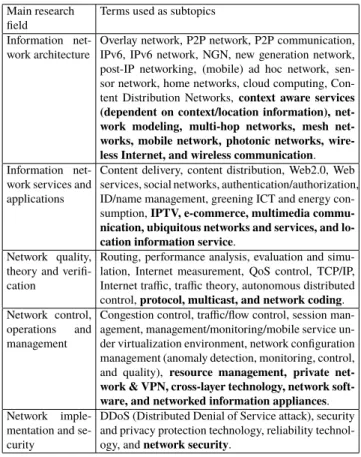
From 2005, when carriers completed commercial intro- duction of broadband and mobile Internet access services, the number of papers submitted by carriers to this tech- nical committee halved. Similarly, the number of papers from universities, which peaked in 2004, has been gradu- ally decreasing to date. Table 2 shows common subtopics that have been discussed in the technical committee since 2007. Subtopics are classified into five major research fields: (i) information network architecture, (ii) informa- tion network services and applications, (iii) network qual- ity, theory and verification, (iv) network control, opera- tions and management, and (v) network implementation and security. Subtopics that do not fit comfortably into one of these fields are indicated in bold type. It can be ob- served that there are numerous subtopics relating to network, protocol, and network structure/management/control, which have been major research topics since the inception of the technical committee. On the other hand, newer research fields, such as information network services and applica- tions, and network implementation and security, have not yet been adequately broken down into subtopics. Although not shown in the table, our analysis of subtopics in each five-year period revealed that some subtopics appeared only for limited periods. For example, in the 2007-2011 period, during which commercialization of the NGN for the fixed network and that of 3G for the mobile network were pro- gressing steadily, subtopics Generalized Multi-Protocol La- bel Switching (GMPLS)[23], Multi-Protocol Label Switch- ing (MPLS)[24], and IP backbone network appeared. In the
Table 2 Subtopics identified in each major research field of technical committee on information networks since 2007.
Main research field
Terms used as subtopics Information net-
work architecture
Overlay network, P2P network, P2P communication, IPv6, IPv6 network, NGN, new generation network, post-IP networking, (mobile) ad hoc network, sen- sor network, home networks, cloud computing, Con- tent Distribution Networks,context aware services (dependent on context/location information), net- work modeling, multi-hop networks, mesh net- works, mobile network, photonic networks, wire- less Internet, and wireless communication.
Information net- work services and applications
Content delivery, content distribution, Web2.0, Web services, social networks, authentication/authorization, ID/name management, greening ICT and energy con- sumption,IPTV, e-commerce, multimedia commu- nication, ubiquitous networks and services, and lo- cation information service.
Network quality, theory and verifi- cation
Routing, performance analysis, evaluation and simu- lation, Internet measurement, QoS control, TCP/IP, Internet traffic, traffic theory, autonomous distributed control,protocol, multicast, and network coding.
Network control, operations and management
Congestion control, traffic/flow control, session man- agement, management/monitoring/mobile service un- der virtualization environment, network configuration management (anomaly detection, monitoring, control, and quality), resource management, private net- work & VPN, cross-layer technology, network soft- ware, and networked information appliances.
Network imple- mentation and se- curity
DDoS (Distributed Denial of Service attack), security and privacy protection technology, reliability technol- ogy, andnetwork security.
2012-2015 period, subtopics femtocell, all-IP mobile net- work, Mobile IP, mobile multicast/broadcast network, and fixed mobile convergence (FMC), which embraced all of the above, emerged. These phenomena pose an issue that the technical committee will need to address in defining its core competence.
2.7 Research on Disaster Resistance (2012-15)
The East Japan Earthquake of 2011 caused a large-scale com- munications failure not only in the directly affected localities but also in surrounding areas. This drew renewed attention to disaster resistance characteristics of networks, and gave rise to papers dealing with disaster planning and business continuity plans (BCP), resilient networks, disaster recov- ery, construction of temporary networks, information trans- mission in a time of disaster, and self-organization. Some subtopics arose in the wake of commercial introduction of particular technologies on which they were based. For ex- ample, Software-Defined Network (SDN)[25]and mobile applications arose based on OpenFlow[26], mobile off-load and mobile terminal control network technology based on mobile social services, M2M based on IEEE802.15.4 (Zig- Bee), and security management based on Bring Your Own Device (BYOD). Other subtopics that emerged concurrently with commercial introduction of their respective technolo- gies included smart grid, cloud network technology and Big Data.
With respect to applications and services, the incen- tive to study P2P was low in Japan because of potential conflict with the Copyright Law. However, no sooner was Bitcoin[27], which skillfully employed P2P technology, is- sued in 2009 than exploded worldwide and it is now poised to bring about a financial revolution. Considering this, and widespread use of Big Data, it is time that we strategically deepen research on topics relating to security and privacy and discover common research seeds that are directly conducive to business creation.
3. Current Status of Research on Information Networks Section 2 presented the changing trend in research on information networks based on chronological changes in subtopics discussed in the Technical Committee on Informa- tion Networks. Based on these findings, this section selects several subfields being studied in the field of information networks and discusses how they are positioned in that field from a technological perspective.
3.1 Integrated Operation of Multimedia/Heterogeneous Applications and NGN
In the early days of communication networks, they were con- structed separately for each service (or application); e.g., a telegraph network, a telephone network, terrestrial and satel- lite broadcasting networks for radio and television and cable TV networks (which are communication networks in a broad sense), and various data communication networks, includ- ing the Internet. However, because it is extremely costly to build and operate individual networks and because it is in- convenient and expensive for users to subscribe to a network for each service, it is only natural that there have been ef- forts to integrate multiple services on a single “multimedia”
network.
As mentioned in 2.1, transition to a multimedia net- work started with transmission of still pictures over the pub- lic switched telephone network (PSTN); e.g., facsimile and videotex services. These attempts were followed by develop- ment of ISDN, on which various services, such as efficient data transmission and videoconferencing, were integrated.
In particular, as stated in 2.2, ATM technology was studied intensively as a core technology for B-ISDN that could pro- vide integrated services at a transmission rate of 155 Mbps, which was an extremely high rate at that time. Unfortu- nately, however, ATM technology and B-ISDN, despite its ability to provide practically perfect communication quality (QoS), proved to be unable to take the place of the Internet, which began to be used for commercial purposes during the same period. Researchers’ vision of penetration of ATM networks to users was not realized. ATM failed to become the “Internet” (a widespread multimedia network).
The wave of transition to multimedia swept over the Internet, which had originally been developed for data com- munication. Mbone, an experimental IP multicast network based on tunneling technology, had already been built in the
early 1990s[28]. Multimedia applications for audio/video communication or for screen sharing, such as vat, nv, vic and wb, were used on that network. They may have worked if communication had been confined within a 10 Mbps Ether- net LAN but were not practical when multiple LANs were involved, requiring use of the Internet. This was because, in those days, the bandwidths of the lines used to connect LANs were so low between 64 Kbps and only 1200 bps that the In- ternet, which operates on the principle of “best effort,” could not provide sufficient communication quality (QoS), particu- larly for real-time services such as audio communication and videoconferencing. To resolve this issue, the IETF defined an Intserv[29]architecture that guarantees bandwidth and delay in the Internet. “Intserv” is a contraction of “integrated services.” Whereas service integration on the telephone net- work is to integrate data communication into the network intended for audio communication, service integration in the Internet is to integrate real-time communication, such as audio/video communication, into the network originally in- tended for data communication. Although the IETF defined RSVP[30], which is equivalent to signaling on the telephone network, in order to make Intserv a reality, no commercial products of IP routers or switches capable of providing the required communication quality control were introduced to the market. Even today, Intserv is still not viable on the In- ternet. In other words, the Internet failed to become “ATM”
(a network capable of guaranteeing communication quality).
Thus, neither the telephone network nor the Internet was successful in providing integrated services. In the 2000s, no carriers or vendors attempted to develop successors to the switching systems in operation on the telephone network.
This was one of the reasons why R&D for construction of a telephone network based on IP technology was initiated.
The result was development of the Next Generation Network (NGN).
The NGN is a communications network on which three major categories of service, called “triple play,” are inte- grated: voice, IP-TV, and data application services. A fourth service, mobile communication, can be added - an attempt called “fixed mobile convergence” (FMC) as stated in 2.6.
Integration of the four services is sometimes referred to as
“quadruple play.” In order to allow this integration, the NGN is composed of IP-based switching nodes (routers).
The technical committee meetings saw a respectable num- ber of reports on how to construct the NGN and on services that could be provided on it. Unfortunately, however, the only communication quality controls, which are required if bi-directional real-time communication such as voice com- munication and videoconferencing is to be provided, that the NGN implemented were call admission control and sim- ple priority control based on communication classes. That quality control derived from DiffServ, which became the mainstream architecture for communication quality control in the Internet following the failure of Intserv. However, this was a far cry from that of ATM, which guarantees end-to-end QoS. Sadly, there appear to be few R&D efforts focusing on this issue. Even this “loose” communication quality control
allows services to be provided without any significant prob- lems, thanks to the abundance of bandwidths available in the Internet, this situation was brought about by progress in device technology. However, in order to be able to handle ever-growing traffic volumes and support the various new applications that will emerge, it is necessary to not remain content with the current state and to pursue R&D aimed at achieving a truly integrated network.
3.2 SDN/NFV
In the early days of the telephone network, a call was es- tablished by an operator manually and physically connecting the lines of the calling and called parties (switching oper- ation). If the two parties resided in different cities, or in different countries, operators of the respective switchboards had to negotiate with each other to establish lines that could physically connect the parties. The caller had to wait for a long time - sometimes hours - before a connection was set up.
Then came automatic exchanges. In a telephone net- work consisting of automatic exchanges, control signals are automatically exchanged to set up connections. This is re- ferred to as “signaling.” Initially, signaling was implemented on the same channel through which voice signals were trans- mitted (channel-associated signaling system). A problem with that method was that it was not possible to send a large variety of signals. To solve that problem, a common-channel signaling system was invented, which separated channels carrying control signals from those conveying voice signals.
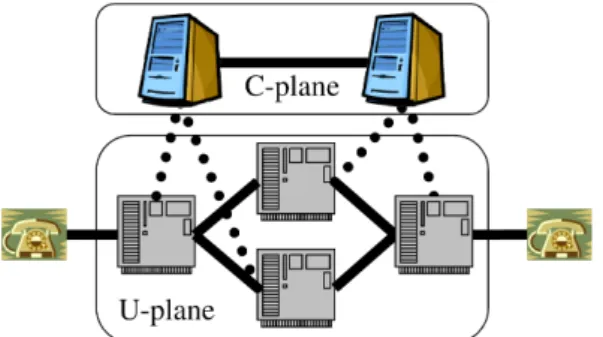
The network of the former is referred to as “a control plane (C-plane)” whilst the network of the latter is called “a user plane (U-plane)” (Fig. 2). The dedicated signaling network can carry a large variety of control signals at high speed.
The telephone network currently in use employs the com- mon channel signaling system No. 7 (SS7)[31].
Thus, automation of the telephone network made it pos- sible to set up a connection as soon as the user dialed the number of the called party. However, this automation did not cover the advanced call services that had been provided by human operators. From the user’s perspective, the only function that was automated was only the bearer service, i.e., establishment of a connection. If the user wanted to receive more advanced call services, he/she still had to rely on hu-
Fig. 2 Telephone network architecture.
man operators. An intelligent network (IN) was proposed in an attempt to enhance the functionality of the telephone network as stated in 2.3.
Specifically, the IN had advanced service processing nodes (IN nodes) consisting of computers and databases in its SS7 network in order to provide advanced call services for
“dumb” telephones, which could not send any information other than the dialed number. It works like this: When the user dials a special number indicating a request for a certain advanced service, the data of the dialed number is sent to an IN node; the IN node that has received this data performs the necessary processing, and controls the relevant exchanges over the SS7 network to implement the requested advanced service. The IN’s design concept of separation into the user plane and the control plane was subsequently inherited by the ISDN, which was an extension of PSTN technology, and by ATM.
In contrast, the Internet was built based on a design phi- losophy called the “end-to-end principle.” This experience- based principle dictates that nodes (routers and switches) in the Internet should perform only a bare minimum function of forwarding packets and that any advanced functionality and service capabilities should be performed by user terminals or servers, which are located at the ends of the Internet. This principle makes it difficult to introduce the type of new ser- vice that can be more efficiently implemented if processed by nodes in the Internet or the type of service that can be provided more securely by nodes in the Internet rather than leaving performance of the required service functions to un- specified parties outside of the Internet.
To enable provision of advanced services, a network architecture called an “active network” was studied as an al- ternative to the above convention[32]. An active network is made up of “active nodes” whose processing capabilities can be specified in programs. In such a network, each packet car- ries a processing program in addition to its payload. When a node in the network receives a packet, it executes the program in the packet, thereby performing the required control func- tions. However, this bold attempt failed to command wide acceptance because the performance levels of both CPUs and memories were inadequate in those days. Consequently, the focus of R&D for providing advanced network services on the Internet shifted to an overlay network and P2P tech- nology.
The above paragraphs have traced the history of R&D efforts to provide advanced network services over the PSTN or the Internet. Today, the software defined network (SDN) and network functions virtualization (NFV) are being studied intensively in a quest to achieve advanced network operation.
The emergence of these technologies can be attributed to the following three factors: First, a variety of functions are al- ready implemented in the Internet, in violation of the end-to- end principle; second, people have begun to see limits to the Internet and want to initiate discussion on developing a more perfect network, starting with a clean slate. This implies greater tolerance for incorporating functions in the Internet;
third, it has been deemed essential to add advanced pro-
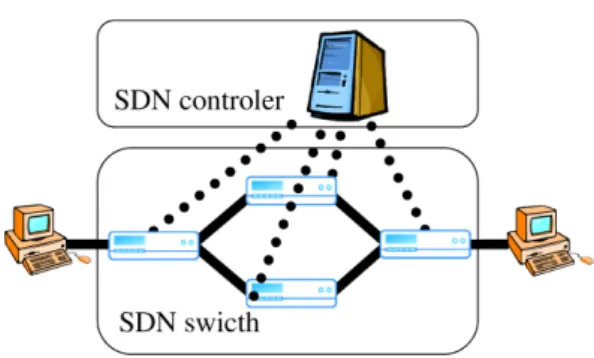
Fig. 3 SDN network architecture.
cessing capabilities within the network in building a PSTN using IP technology in the form of the NGN. Technological positions of the SDN and NFV are described below.
An SDN consists of multiple SDN switches and an SDN controller that centrally controls these switches (Fig. 3). The SDN controller can centrally manage control settings of all the SDN switches under its purview. The control capability of each SDN switch can be changed by software. An SDN switch can hold multiple control rules simultaneously. When a packet arrives at an SDN switch, the switch discriminates the packet and, if it has a rule regarding the handling of that packet, it processes the packet in accordance with that rule.
If the switch does not have such a rule, it refers to the SDN controller as to how to handle the packet and processes the packet in accordance with the instruction given by the SDN controller. It is possible to consider that the SDN architec- ture derived from the PSTN and the active network if we compare the network control part of the SDN to the control plane for signaling in the intelligent network, and compare the packet forwarding part of the SDN to the data plane for active nodes. However, the SDN specification does not re- quire that the control plane be physically separate from the data plane. Therefore, unlike in the PSTN, the SDN does not necessarily need to have dedicated lines for the control plane separate from lines for the data plane. A problem arises if control signals flow in the lines that carry packets. If a fault occurs in a node or a link, making an SDN node unable to communicate with the SDN controller, the node cannot process those packets that must be processed in accordance with rules residing in the SDN controller, even when the data plane is working properly. In addition, the processing performance levels of SDN switches and controllers are still inadequate. Integrated operation of an SDN network consist- ing of nodes with inadequate performance is likely to reveal problems not encountered during R&D or operation of either the intelligent network or the active network. Intensive R&D focusing on these issues will be required.
Network functions virtualization (NFV) was conceived because high computing power is now available. With NFV, various network functions are implemented in software so that network functions and configuration can be renewed eas- ily. NFV is so called because even those functions tradition- ally implemented in hardware are implemented in software using virtualization. A communication network is a gigantic
system consisting of various devices and protocols. With NFV, functions that traditionally were run on independent devices are specified in programs so that network functions can be provided from an execution environment that is free of physical constraints, such as a cloud. NFV can be consid- ered an evolved form of the active network in that, whereas the active network uses programmable nodes that execute software-specified operations in order to provide advanced services, NFV goes one step forward and defines nodes and network devices themselves in software so that these can be implemented in a general-purpose environment. However, whilst NFV inherits the functions processed by network de- vices in the active network, it does not inherit the perfor- mance of its predecessor. Its performance is dependent on the operating environment and, to date, little attention has been paid to this aspect. To enable NFV-based networks to provide services with adequate performance, R&D of virtu- alization should focus not only on functionality but also on performance.
3.3 ICN/CCN
In the early stages of communication networks, they were used only for a limited number of applications, such as voice and facsimile in the case of the PSTN and email and NetNews in the case of the Internet. As networks go broadband and user terminals became more sophisticated devices, such as PCs, media processing has become easier than before, and the networks began carrying not only text data but also audio, still picture and video data. Expansion of bandwidths and increases in number of users boosted multimedia content traffic in the network. Traditionally, content was exchanged over a network only between acquaintances. Today, it is exchanged between unspecified parties. This has accelerated growth in demand for means whereby a user can easily and efficiently retrieve content from an unknown location in a network without worrying about who owns that content.
Responses to this demand started not on the network side but on the application side. The means that began to be used to discover where in the network a particular item of content whose location is unknown actually resided was a search engine. Since many items of content reside on Web servers in the Internet, a user would retrieve an item of content after discovering its details and location using a search engine, which collected location information (meta- information) of items of content on servers. Then, there was the emergence of P2P technology[33],[34]in which, contrary to conventional client-server type applications, end users could exchange content directly; i.e., without have to go through servers. In Napster, which is known to be the very first P2P application, a Napster server held meta-information (location information, etc.) of items of content residing in user terminals (peers). Naptser was running on these termi- nals. When a user requested an item of content, the Napster server sent back meta-information about that item. The ac- tual item was sent from the peer that held it. No servers were involved in content transmission. Later, P2P technology
evolved to Gnutella, which abolished the meta-information server, to WinMX, which a part of peers took over some functions according to the network environment in order to prevent a large-scale P2P network from crashing, then to Winny, which featured high anonymity, and on to eDonkey and BitTorrent, both of which achieved high-speed down- loading by having content distributed across multiple peers.
Thus, it was the application side that first provided the ca- pability to efficiently retrieve content from an unknown lo- cation. Whether the function of retrieving desired content is implemented with a search engine and WWW or with a P2P application, this function can be broadly divided into a con- tent discovery function (acquisition of location information) and a content transfer function.
Whilst the application side achieved efficient content delivery as described above, the effort on the communi- cation network side to provide advance functions started with the provision of an efficient content transfer function.
The content delivery network (CDN) [35]is a network in which copies of original content are distributed in advance to a large number of edge servers that are dispersed in the network so that the user can retrieve the desired content rapidly by accessing the nearby edge server. Although sev- eral CDN providers, such as Akamai, already provide com- mercial CDN services, the items of content that can be de- livered efficiently over a CDN are limited to those for which the user has signed a contract with his/her CDN provider.
Network control using meta-information (meta- networking) was studied with a view to implementing the function of discovering requested items of content some- where in the network[33]. In a conventional communication network, the calling party obtains in advance the location of the target party (i.e., a party to communicate with, which would be content if the purpose of communication is to ac- cess content) by some means, and a connection to that party is set up using that location information. In contrast, meta- networking uses meta-information (name, attributes, etc.) of the target party, instead of its location information, to establish a connection. Specifically, when a user wants to retrieve some content, he/she sends a request that contains meta-information about the target party rather than its lo- cation information. A network node that has received the request interprets the meta-information in it and sets up a route towards the target party. Subsequent nodes repeat this process until the request reaches the destination. Thus, meta- networking provides the content discovery function as part of its network functions, and provides access to the desired content. However, meta-networking is still at a prototyp- ing stage. No commercial products have been offered by vendors.
As described above, both the application side and the network side began providing a function that enables the user to easily and efficiently access content at an unknown location. However, the network side has yet to offer the content discovery function. This function is generally pro- vided using an application-side function, such as a search engine or P2P application. In light of this situation, a set of
new approaches to efficient content delivery were initiated, starting with a clean slate, in a departure from conventional Internet technologies. These were information-centric net- working (ICN) and content-centric networking (CCN). They are essentially identical but with slight differences in detailed mechanism and implementation.
Studies on ICN/CCN can be broadly divided into those on a content discovery function and those on a content trans- fer function, just as the function studied by both the ap- plication side and the network side to enable the user to easily obtain content at an unknown location was divided into those two functions. ICN/CCN provides the content discovery function in a manner similar to the way in which meta-networking and pure P2P, which is a version of P2P application with no central server, provide this function.
Specifically, each network node that has received a content request from a user interprets the name and attributes of the requested content and sends the request in the direction of the node that holds the requested content. Each subsequent node repeats this process until the request reaches the loca- tion of the requested content (content discovery). ICN/CCN provides the content transfer function in a manner similar to that used by Winny, which is a P2P application, or Freenet [36], from which Winny was derived. Specifically, the nodes through which a content request has passed are traced back- ward, hop by hop, to transfer the requested content to the user while simultaneously storing a copy of the content at each of these nodes[37],[38]. As a result, a number of copies of the content are left on the network so that content can be efficiently delivered to subsequent users from a node close to each user. This feature was also provided in CDN. Hence, ICN/CCN could be regarded as an extension of the earlier studied technologies: P2P, meta-networking and CDN.
Several research projects on ICN/CCN, aimed at com- mercial development and involving vendors, have been launched and are intensively implemented, particularly in Europe and North America. ICN/CCN technology is called by a different name in each project[39]–[41]. ITU has re- cently initiated discussions on the technology under the name of data aware networking (DAN) with the aim of developing recommendations [42]. This raises a hope of widespread acceptance in the near future.
4. Research on Information Networks in Coming Years Information networks started up when computers were in- terconnected by communication networks. They have since been expanding rapidly - especially in the case of the Inter- net. Not only has the number of computers connected to an information network increased but also a greater variety of devices are now connected to the network, ranging from servers through PCs and mobile devices, and from coffee pots through sensors and robots. Thus the future informa- tion network will become a social information infrastructure connecting digitally named objects in our society. In par- allel, improvement in hardware performance has prompted dynamic progress in virtualization technology, which creates
virtual devices in software on hardware equipment and con- nects them to information networks. How will information networks evolve in coming years?
4.1 World that can be Envisaged with Future Progress in Information Networks
The Internet of Things (IoT) [43] is a global network to which a wide variety of things are connected in order to exchange information. The IoT has been expanding with the ultimate goal being connection of everything in our world to such a network. Further progress in virtual reality (VR) and augmented reality (AR) technologies will transform not just virtual shopping malls and online banks but cyberspace in its entirety on the Internet into a physical reality.
There has been little direct association between the real world and cyberspace. Humans have acted as intermediaries to establish association between them. However, today, the IoT and the technical revolution in information processing are making cyber-physical systems (CPSs) reality[44],[45].
A CPS collects various data in the real world through a sensor network, analyzes them to generate knowledge by exploiting large-scale data processing technology on com- puters, and provides the obtained information and value to the real world as feedback, thereby vitalizing industries or solving social problems. For example, a CPS collects in- formation about the preferences of a consumer who is pass- ing by a shop advertisement from his/her mobile terminal, and recommends appropriate products based on analysis of the shop’s past purchases record. Upon receiving his/her permission, the system automatically arranges for payment and delivery. CPSs will be applied to the fields of med- ical/health care, industrial/manufacturing processes, smart houses, smart cities, self-driving cars, and physical distribu- tion.
4.2 Issues to be Addressed for Future Information Net- works
Issues that need to be addressed in order to make the above- mentioned world reality can be classified into three cate- gories: (1) how to collect and transfer information from things (issues related to IoT), (2) how to process, analyze and use collected data (issues related to information processing), and (3) how to integrate the real world and cyberspace.
(1) Issues related to IoT
Issues related to collection and transfer of information from things are:
• Development of a high-speed data transfer envi- ronment (high-speed transfer of a large volume of traffic of small-sized data, etc.)
• Development of stable access (technology for sta- ble information collection, fault tolerance, oper- ations and monitoring, flexible routing control, quality, autonomous control, etc.)
• Development of an open connection environment
(ensuring openness, worthy of a common infras- tructure, of the connecting environment, construc- tion of ad hoc networks, reduction of market entry costs, etc.)
• Security (ensuring security of varied and low-cost things, etc.)
• Disaster prevention/mitigation technologies (anti- disaster measures, restoration, etc.)
(2) Issues related to information processing
To make the most of data collected in the IoT, it is nec- essary to address the following information processing- related issues:
• Mechanisms for data discovery (mechanisms for discovering desired items of data collected from a vast array of things, discrimination of things, real-time access, access to history data, etc.)
• Mechanisms for data combination (mechanisms for creating new value by combining different items of data, methods for achieving flexible com- binations of things, etc.)
• Development of advanced and high-speed data analysis (use of artificial intelligence (AI), opti- mal distributed processing technology, such as op- timization of data analysis locations, etc.)
• Standardization of APIs (standardizing open APIs for access to things and systems, etc.)
(3) Issues related to integration of the real world and cy- berspace
Data collected in the IoT are processed and provided to the real world as feedback. The following issues exist with regard to integrating the real world and cyberspace:
• User psychology (impacts of behavior and psy- chology of users freed both spatially and tempo- rally from their mobile terminals on information networks, impacts of services on users’ psychol- ogy, impacts of penetration of social networks, etc.) [46]
• Social systems (responses to hitherto unexpected situations, such as automated driving, etc.)
5. Conclusions
We have looked back over the activities of the Technical committee on Information Networks since 1982 to clarify the progress of information network research. In addition, we have discussed the present and future research topics from the viewpoint of current research status of this area.
In Sect. 2, we have presented the trend in research on information networks based on chronological changes in subtopics discussed in the committee. Some of those are Inception of the Technical committee on Information Networks, Liberalization of telecommunications, Commer- cialization of ATM, Internet-related researches, Broadband- oriented researches, Research on the mobile Internet, and
Research on disaster resistance.
In Sect. 3, we have selected several major subfields of Information Networks to discuss how they are positioned in that field from a technological perspective. Specifically, those are efforts to make the communication network and Internet be the multimedia integrated network, efforts to archive sophisticated network operation, and efforts to real- ize content discovery/distribution services.
In Sect. 4, we have looked at future information network researches. As the real world and the cyber space become closer, we have studied research subjects to realize the CPS which handles real world data collected into cloud services and feeds the analyzed results back to the real world to solve social problems.
Obviously, not all research results become popular in society. We need to understand that the services of informa- tion networks, which are now one of social infrastructures, are based on the balance between social needs and available technical seeds. Moreover, we need to study persistently and assiduously both to improve technologies and to meet social needs.
References
[1] S. Yoshida, “Trends and Research Items of Communication Net- works,” IEICE Technical Report, IN82-1, May 1982.
[2] K. Okada, S. Kano, and H. Ishikawa, “ISDN network interworking in NTT,” GLOBECOM’87, Tokyo, Nov. 1987.
[3] http://law.e-gov.go.jp/htmldata/S28/S28HO098.html (accessed 2016-12-28).
[4] K. Asatani, T. Okada, M. Kawarazaki, Y. Maeda, K. Yamazaki, H. Ichikawa, S. Kuribayashi, and T. Ohba, Introduction to ATM networks and B-ISDN, John Wiley & Sons, 1997.
[5] Y. Utsumi and H. Hata, “CAPTAIN system,” J. IEICE, vol.69, no.7, pp.696–708, July 1986.
[6] Y. Ishibashi, T. Watanabe, and Y. Shimazu, “A study on construction of message handling system,” IEICE Technical Report, IN84-120, March 1985.
[7] http://law.e-gov.go.jp/htmldata/S59/S59HO086.html (accessed 2016- 12-28).
[8] A.M. Workman, M.V. Kolipakam, J.B. Sharpless, V. Stoss, and H.
van der Veer, “International applications of AT&T’s intelligent net- work platforms,” AT&T Technical Journal, vol.70, no.3-4, pp.44–57, 1991.
[9] http://www.sdl-forum.org/SDL/Overview_of_SDL.pdf (accessed 2016-12-28).
[10] http://www.etsi.org/deliver/etsi_tr/101600_101699/101648/01.02.01 _60/tr_101648v010201p.pdf (accessed 2016-12-28).
[11] M. Horton and R. Adams, “Standard for interchange of USENET messages,” RFC1036, Dec. 1987. https://tools.ietf.org/html/rfc1036 (accessed 2016-12-28).
[12] https://en.wikipedia.org/wiki/UUNET (accessed 2016-12-28).
[13] S. Thomas, SSL and TLS Essentialsi - Securing the Web -, John Wiley & Sons, 2000.
[14] https://ja.wikipedia.org/wiki/Japan_Gigabit_Network (accessedl 2016-12-28).
[15] https://static1.squarespace.com/static/54f08a57e4b0e91e31e8c76c/t /57b4a38c2e69cf4a531c4843/1471456142342/DLNA_Marketing_B ooklet_Final_Aug2016.pdf (accessed 2016-12-28).
[16] S. Matsuoka, S. Shinjo, M. Aoyagi, S. Sekiguchi, H. Usami, and K.
Miura, “Japanese computational grid research project: NAREGI,”
Proc. IEEE, vol.93, no.3, pp.522–533, 2005.
[17] http://law.e-gov.go.jp/htmldata/H15/H15HO057.html (accessed
2016-12-28).
[18] http://law.e-gov.go.jp/htmldata/S45/S45HO048.html (accessed 2016- 12-28).
[19] M. Yoshida, S. Ohzahata, A. Nakao, and K. Kawashima, “Controlling file distribution in Winny network through index poisoning,” Proc.
2009 International Conference on Information Networking, pp.1–5, 2009.
[20] https://www.jaipa.or.jp/other/mtcs/guideline_v3.pdf (accessed 2016- 12-28).
[21] https://www.jaipa.or.jp/other/bandwidth/guidelines.pdf (accessed 2016-12-28).
[22] http://law.e-gov.go.jp/htmldata/S21/S21KE000.html (accessed 2016- 12-28).
[23] A. Farrel and A.I. Bryskin, GMPLS: Architecture and Applications, Morgan Kaufmann, 2005.
[24] E. Rosen, A. Viswanathan, and R. Callon, “Multiprotocol label switching architecture,” RFC3031, 2001.
[25] B. Astuto A. Nunes, M. Mendonca, X.-N. Nguyen, K. Obraczka, and T. Turletti, “A survey of software-defined networking: Past, present, and future of programmable networks,” IEEE Commun. Surveys Tuts., vol.16, no.3, pp.1617–1634, 2014.
[26] S. Das, G. Parulkar, and N. McKeown, “Unifying packet and circuit switched networks,” Proc. 2009 IEEE Globecom Workshops, pp.1–6, 2009.
[27] https://bitcoin.org/ (accessed 2016-12-28).
[28] H. Eriksson, “MBONE: The multicast backbone,” Commun. ACM, vol.37, no.8, pp.54–60, 1994.
[29] R. Braden, D. Clark, and S. Shenker, “Integrated services in the Internet architecture: An overview,” RFC1633, IETF, 1994.
[30] R. Braden, L. Zhang, S. Berson, S. Herzog, and S. Jamin, “Resource ReSerVation protocol (RSVP),” RFC2205, IETF, 1997.
[31] A.R. Modaressi and R.A. Skoog, “Signaling system no.7: A tutorial,”
IEEE Commun. Mag., vol.28, no.7, pp.22–35, 1990.
[32] J.M. Smith and S.M. Nettles, “Active networking: One view of the past, present, and future,” IEEE Trans. Syst., Man, Cybern., vol.34, no.1, pp.4–18, 2004.
[33] H. Sunaga, T. Hoshiai, S. Kamei, and S. Kimura, “Technical trends in P2P-based communications,” IEICE Trans. Commun., vol.E87–B, no.10, pp.2831–2846, Oct. 2004.
[34] E.K. Lua, J. Crowcroft, M. Pias, R. Sharma, and S. Lim, “A survey and comparison of peer-to-peer overlay network schemes,” IEEE Commun. Surveys Tuts., vol.7, no.2, pp.72–93, 2005.
[35] A. Vakali and G. Pallis, “Content delivery networks: status and trends,” IEEE Internet Comput., vol.7, no.6, pp.68–74, 2003.
[36] I. Clarke, O. Sandberg, B. Wiley, and T.W. Hong, “Freenet: A distributed anonymous information storage and retrieval system,”
International Workshop on Design Issues in Anonymity and Unob- servability, LNCS 2009, pp.46–66, 2009.
[37] M. Yamamoto, “A survey of caching networks in content oriented networks,” IEICE Trans. Commun., vol.E99-B, no.5, pp.961–973, May 2016.
[38] M. Zhang, H. Luo, and H. Zhang, “A survey of caching mechanisms in information-centric networking,” IEEE Commun. Surveys Tuts., vol.17, no.3, pp.1473–1499, 2015.
[39] G. Xylomenos, C.N. Ververidis, V.A. Siris, N. Fotiou, C. Tsilopoulos, X. Vasilakos, K.V. Katsaros, and G.C. Polyzos, “A survey of information-centric networking research,” IEEE Commun. Surveys Tuts., vol.16, no.2, pp.1024–1049, 2014.
[40] B. Ahlgren, C. Dannewitz, C. Imbrenda, D. Kutscher, and B. Ohlman,
“A survey of information-centric networking,” IEEE Commun. Mag., vol.50, no.7, pp.26–36, 2012.
[41] Md. F. Bari, S.R. Chowdhury, R. Ahmed, R. Boutaba, and B.
Mathieu, “A survey of naming and routing in information-centric networks,” IEEE Commun. Mag., vol.50, no.12, pp.44–53, 2012.
[42] “Framework of data aware networking for future networks,” Recom- mendation ITU-T Y.3033, 2014.
[43] https://en.wikipedia.org/wiki/Internet_of_things (accessed 2017-01-
17).
[44] Ministry of Economy, Trade and Industry, “Industrial structure council commerce, distribution and information committee infor- mation economy subcommittee interim report,” May 2015. http://
www.meti.go.jp/committee/sankoushin/shojo/johokeizai/pdf/report0 1_02_00.pdf (accessed 2017-01-17).
[45] Japan Electronics and Information Technology Industries Associa- tion, “What is cyber physical system?” http://www.jeita.or.jp/cps- e/pdf/01.pdf (accessed 2017-01-17).
[46] M. Murata and M. Naruse, Introduction to Information Network Science, CORONA PUBLISHING, 2015.
[47] N. Wakamiya and S. Arakawa, Bio-inspired Design and Control of Information Networks, CORONA PUBLISHING, 2015.
[48] Hiromichi Shinohara et al., The Information and Communication Technologies in 2030, NTT Publishing, 2015.
[49] S. Sampei et al., “The role of next generation information and telecommunications networks,” J. IEICE, vol.99, no.1, 2016.
[50] M. Takase et al., “Network management technology for comfortable communication,” J. IEICE, vol.99, no.1, p.36, 2016.
Tohru Asami received his B.E. and M.E. de- grees in Electrical Engineering from Kyoto Uni- versity in 1974 and 1976, respectively, and his Ph.D. from the University of Tokyo in 2005. In 1976, he joined KDD (KDDI). Since that time, he has worked in several research areas such as Internet-JUNET Gateway systems, network management systems, and ubiquitous comput- ing. After serving as the CEO of KDDI R&D Labs. Inc. in 2006, he was appointed as a profes- sor at The University of Tokyo in the Department of Information and Communication Engineering in the Graduate School of Information Science and Technology. From 2003 to 2005, he was a vice chairman of the board of directors of the Information System Society in The Institute of Electronics, Information and Communication Engineers, Japan (IEICE-ISS). He is a member of the IEEE and ACM.
Katsunori Yamaoka received the B.E., M.E., and Ph.D. degrees from the Tokyo Institute of Technology in 1991, 1993 and 2000, respec- tively. He left Ph.D. program in 1994 and joined the Tokyo Institute of Technology as an assistant professor at that time. In 2000, he joined the Na- tional Institute of Multimedia Education (NIME) in Japan as an associate professor. Since 2001, he has been an associate professor at the Tokyo Institute of Technology. He has also been a vis- iting associate professor of the National Institute of Informatics (NII) in Japan since 2004. His research interests includes network QoS control for multimedia.
Takuji Kishida received his B.E. degree from Kansai University in 1989, and his M.E. de- gree from Osaka University in 1991. In 1991, he joined NTT and engaged in research and devel- opment of advanced Intelligent Network, Next Generation Network (NGN), cloud systems, and large-scale distributed processing systems. He is currently a project manager in NTT Software Innovation Center.