タイトル
Multiple Attributes Decision Making by Extended
Fuzzy Outranking Method with DSS Framework
著者
天笠, 道裕; AMAGASA, Michihiro
引用
北海学園大学経営論集, 10(4): 37-47
Mul
t
i
pl
e
At
t
ri
but
es
Deci
s
i
on Maki
ng
by
Ext
ended
Fuzzy
Out
ranki
ng Met
hod
wi
t
h DSS Framework
Mi
chi
hi
r
o
AMAGASA
Abs
t
ract
In this paper,the multiple attributes decision making has been proposed by the extended fuzzy outranking method based on the system modeling and discuss the framework for the decision support system of it,which makes it possible to perform evaluating and uniquely ranking the alter -natives without losing the quality of data. In the outranking process of the proposed method,the uncertainty that adheres to decision making can be rationally handled with the concept of fuzziness. Therefore, this methodology provides a powerful sys -tematic evaluation for dealing with the qualitative data in management decision making. The decision support system con-sists of five mathematical models,that is, the conversion model to triangular fuzzy number, the computation model of extended fuzzy outranking relation,the integrated fuzzy outranking relation model,the formulation model of fuzzy subordination matrix,the fuzzy outranking model by system modeling. Furthermore, in order to examine the effectiveness of the proposed method,a practical problem is
studied as an empirical study,which is related to performance records for subjects of study.
Keywords:Multi-attribute decision mak-ing, Alternatives, Uncertainty, Fuzzy outranking relations,α-cut,System model -ing,Decision support system
1.I
NTRODUCTI
ON
In today when the values of the people have diversified,decision makers have to rationally evaluate and rank the alter na-tives taking into account of the various points of view,so called,the aspect of multi-attribute. In management decision making,the fuzzy outranking relations with vagueness are considered to be appli -cable to most objects (Zadeh 1965). In general,when the quantitative and qualit a-tive data are mixed together,the qualit a-tive data contain uncertainty in itself. Until now,the fuzzy outranking method (Roi 1991;Inoue and Amagasa et.al.2008) and the multi-attribute decision-making (Siskos et al.1986)have been proposed as the representative methods to evaluate and
rank the alternatives. In these methods, at the early stages of ranking process,the qualitative data is changed into the quanti -tative one and dealt with in the same way as treated the other quantitative data. However,this will not lead to obtain a satisfied solution for the decision makers because they dont provide a convincing way for evaluating and ranking the alter na-tives with keeping the quality of data.
In this paper,we propose an extended fuzzy outranking method based on the sys -tem modeling(Nagata and Amagasa et.al. 2009)in decision making,which makes it possible to perform evaluating and uni que-ly ranking the alternatives without losing the quality of data. Further the fr ame-work of Decision Support System (DSS)is illustrated.
The fuzzy concept is involved in all of the qualitative data in regard to the attri b-utes. The decision makers establish the fuzzy outranking relations between alter -natives at each attribute,so that the el e-ments of the relation are expressed in the form of the fuzzy membership functions of triangular type(Amagasa and Hirose 2012). Further,a synthesized fuzzy outranking relation is computed on the basis of the fuzzy outranking relations obtained in the previous step. In particular,if a differ -ence between comparative alternatives is found to be little or alternatives are hard to compare each other,then the rule ofα-cut (Amagasa and Hirose 2012) is applied without arranging unreasonable rankings, converting its subtle distinction into noti ce-able description. The synthesized fuzzy outranking relation is also formulated by the fuzzy membership function of tri
angu-lar type.
This methodology provides a powerful systematic evaluation for dealing with the qualitative data in management decision making.
In the outranking process described above,the uncertainty that adheres to deci -sion making can be rationally handled with the concept of fuzziness.
In order to examine the effectiveness of the proposed method,a practical pr ob-lem is illustrated as an empirical study, which is related to performance records for subjects of study with the quantitative data and the qualitative data.
2
.MATHEMATI
CAL PRELI
MI
NARI
ES
-We describe several properties with respect to the fuzzy number and its oper a-tion and mathematical tools as the mat he-matical preliminaries for the extended fuzzy outranking method in decision mak-ing.
2.1 Fuzzy number of triangular type The fuzzy number of triangular type (Inoue and Amagasa 1998)is shown in(a, a,a),which satisfies aaa.
Here,aand aare,respectively,a left edge point,and a center point,and aa right edge point.
Then,the membership function of the fuzzy number of triangular type is defined by eq. (1)as follows.
μx =
0, x a
x−a/a−a,a<x <a
1, x =a
a−x /a−a,a<x <a
0, x a (1) Furthermore,the fuzzy number of tri -angular type is classified as follows;
① a0,a0 ② a0,a0 ③ a0,a0
In this paper,we use the case of the fuzzy number of triangular type shown in(1). Here,we suppose two fuzzy number of triangular type by eq.(2)as follows.
A=a,a,a,B =b,b,b (2) where a0,a0,b0,b0.
Then,the operations of A and B between the fuzzy numbers of triangular type are defined as follows.
① Addition:
A+B =a+b,a+b,a+b ② Subtraction:
A−B =a−b,a−b,a−b ③ Multiplication:
k A=k a,k a,k a,where k is a scalar.
AB =ab,ab,ab),
④ Division:A/B =a/b,a/b,a/b, 2.2 Transformations of quantitative data
and qualitative data to the fuzzy num ber of triangular type
-In this section,we formulate the fuzzy number of triangular type for qualitative data related to the performance records for subjects of study as shown in table 2.
The data S consists of the quantitative data and the qualitative data as follows;
S욡=A욡,B욡,i=1,2,...,n
,where the symboln shows the number of data.
The quantitative data with l attri b-utes,A욡,(i =1,2,...,l)and the qualitative data with m attributes,B욡,(i =1,2,...,m ) are,respectively,expressed as the fuzzy numbers of triangular type(a,a,a)and (b,b,b)with fuzziness.
The quantitative data A욡,(i =1,2,...,l)is transformed to the fuzzy number of tri -angular type with fuzzy parameter q as follows;
A욡=a욡욪욤,a욡,a욡용욤,i=1,2,...,n (3) ,where the symbol q in eq.(3)shows the fuzziness given in advance by the decision makers.
Further,the qualitative data,B욡,(i =1,2,..., m )is also expressed as the fuzzy number of triangular type with the δ recognition levels of decision making for the objects shown in table 1(Edit and Refer to Miller 1956).
Table 1:Transformation the qualitative data to the fuzzy number of triangular type Qualitative data B욡=b,b,b,i=1,2,...,n Level 1 δ−2/δ−1,1,1
Level 2 (δ−3/δ−1,δ−2/δ−1,1
: :
Levelδ−1 0,1/δ−1,2/δ−1 Levelδ 0,0,1/δ−1
2.3 Algorithm to make alternatives out rank with-cut
-In this section,the algorithm to make alternatives outrank is described as fol -lows;
We find the intersection of two fuzzy numbers of triangular types which decides on outranking relation between two alternatives.
We find theα-cut value corres pond-ing to a point of intersection obtained in step 1.
When theα-cut is greater than or equal to the value of intersection,we can discriminate the outranking relation between two alternatives.
For example,we try to compare A (2, 6,10)and B (6,10,14)which are the fuzzy number of triangular type shown in figure 1.
At first we find a value of intersection and get x =8 then. Next,we find theα-cut value corresponding to a point of inters ec-tion and getα=0.5.
In the case ofα0.5,Bis superior to A. In other words,we can discriminate A and B by installing theα-cut.
3
.EXTENDED FUZZY OUTRAN
KI
NG METHOD
-When the quantitative and qualitative data are mixed together,the qualitative data contain uncertainty in itself. Until now,the fuzzy outranking method and the multi-attribute decision-making have been proposed as the representative methods to evaluate and rank the alternatives. In these methods,at the early stages of r ank-ing process,the qualitative data is changed into the quantitative one and dealt with in the same way as treated the other quantit a-tive data. However,this will not lead to obtain a satisfied solution for the decision makers because they dont provide a con-vincing way for evaluating and ranking the alternatives with keeping the quality of data.
In this paper, the extended fuzzy outranking method is proposed on the basis of the system modeling (Amagasa and Hirose 2012),which can pursue the solution reflected the real situation in.
There are various evaluation st an-dards to evaluate the alternatives. In the case of a compound evaluation standard, the superiority and inferiority does not become clear,and contradiction happens for the superiority and inferiority relation, and it is not possible for evaluation easily. Such a slow superiority and inferiority relation is called fuzzy outranking rel a-tions,but there is much that the generosity becomes rather effective.
In this methodology,we handle uncertainty by transforming qualitative data and quantitative data having vagueness into
the fuzzy number of triangular type and derive the fuzzy outranking relation.
Then,the degree that can be convinced that the fuzzy number of triangular type,S (a,a,a)outranks S (a ,a ,a )is ex-pressed inμ(S ,S ). Then,this conviction degree satisfies the following inequality(4).
0,0,0μ(S ,S )(1,1,1). (4) (1)If we can convince that S completely
outranks S ,the following equations are satisfied.
When a>a ,
μS ,S =1,1,1andμS ,S =0,0,0 (2)When a aa ,
Ifα is greater than the value of the cross point of S and S ,the following equa-tion holds,
μS ,S =1,1,1andμS ,S =0,0,0 Otherwise the relation of S and S is indiscriminate,in the interval[a,a ]
μS ,S =1,1,1orμS ,S =1,1,1 Then,the conviction degree of the extended fuzzy outranking relation is der -ived by eq.(5)on the basis of the operation rule for the fuzzy number of triangular type.
μS ,S =S /S =a/a ,a/a ,a/a (5) a/a 1→a/a =1
a/a 1→a/a =1
4
.DECI
SI
ON MAKI
NG METHOD
WI
TH THE EXTENDED FUZZY
OUTRANKING RELATION
BASED ON THE STRUCTURAL
MODELI
NG
We propose a decision making method with the extended fuzzy outranking rel a-tion based on the system modeling as shown in figure 2(Amagasa and Hirose 2012).
In steps 1,2 of figure 2,the data is acquired for the attributes and transform them to the fuzzy numbers of triangular type.
Remarks: the triangular fuzzy number shows the fuzzy number of triangular type Figure 2:Decision making method with the
extended fuzzy outranking relation based on the system modeling
Further,the qualitative data represent -ed withδlevels,that is,evaluation values for the alternatives,is expressed by the fuzzy number of triangular type,B (a,a, a)shown in table 1.
In step 3,we compute the fuzzy outr an-king relations with respect to each of the l +m attributes,that is,a conviction degree expressed byμ욅(S욡,S욢),(k =1,2,...,n)(i =1, 2,...,l;j=1,2,...,m ).
In step 4,the weight w욅,(k =1,2,...,l +m )of the attributes is computed by the ratio method,where
∑ 요웕웋 욆용욇
w욅=1,0w욅1,
and derive an integrated fuzzy outranking relationμ(S욡,S욢),(i ,j=1,2,...,n)by eq.(6), that is,an integrated conviction degree.
μS욡,S욢= ∑ 요웕웋 욆용욇
w욅μ욅S욡,S욢 (6) In step 5,we set upα-cut to decide on outranking between alternatives and for -mulate the extended fuzzy outranking rel a-tion,that is,the fuzzy subordination matrix in system modeling.
In step 6,we identify the structural model based on the extended fuzzy outr an-king relation found in the previous step 5 by making use of the modified structural modeling method(Nagata and Amagasa et. al.2009).
The structural model shows a result of outranking related to the alternatives.
In step 7,we find the final ranking of alternatives from the view points of attri b-utes.
5
.FRAMEWORK FOR THE DECI
SI
ON SUPPORT SYSTEM
-DSS is constructed from software sys -tem,database and model base. DSS soft -ware system is the body of DSS,and it is a set of software that manages the systems. It consists of dialogue generation manage-ment systems,database management sys -tems and model base management systems. In this paper,the decision support sys -tem for the multiple attributes decision making consists of five mathematical models as shown in figure 3,that is,
① the transformation model to tri angu-lar fuzzy number(Fuzzy transfor ma-tion model),
② the computation model of extended fuzzy outranking relation (Extended fuzzy outranking model),
③ the integrated fuzzy outranking rel a-tion model,
④ the formulation model of fuzzy subor -dination matrix(Fuzzy subordination matrix model),
⑤ the fuzzy outranking model by system modeling(Fuzzy outranking model). After this,we call the decision support system for the multiple attributes decision making by the extended fuzzy outranking
MADM-DSS .
The components of MADM-DSS con-sist of the inputs,the user knowledge and expertise,the outputs and the decision making as follows:
(1)Inputs:Input data,questions and mat he-matical models to analyze.
requiring manual analysis by users and/ or decision makers.
(3)Outputs:Transformed data from which MADM-DSS decisions are generated. (4)Decisions:Results generated by
MADM-DSS based on users criteria.
In general,the support given by DSS can be separated into three distinct,interr e-lated categories(Holsapple,C.W.,Wi n-ston,A.B.,1996)as follows:
① Personal Support ② Group Support
③ Organizational Support
MADM-DSS here belongs to Personal and/or Group Support DSS.
MADM-DSS in this paper is represent -ed in figure 3.
The decision-makers and users enter data,questions and model into
MADM-DSS and convey information. MADM-DSS transmits this information to mat he-matical models,that is,
① Fuzzy transformation model ② Extended fuzzy outranking model ③ Integrated fuzzy outranking relation
model
④ Fuzzy subordination matrix model ⑤ Fuzzy outranking model
Then MADM-DSS answers the ques -tions,processing the data and construct the models to adjust. After problem-solving, the solution is returned to users and/or decision makers from MADM-DSS,and resolution or response is returned to the decision-makers from MADM-DSS. At the same time,sentences,graphs and/or reporting can be created as output if it is required.
6.PRACTI
CAL APPLI
CATI
ON
In this section,we illustrate a practical application of the extended fuzzy outr ank-ing method based on the system modeling as an empirical study,which is related to the performance records for subjects of study with the quantitative data and the qualitative data. Further we discuss about the difference between the results by the fuzzy outranking method and the extended fuzzy outranking method,which is based on system modeling proposed here, and examine the validity of the proposed method.
The problem solving process described in figure 2 is illustrated with the perfor -mance records for subjects of study with the quantitative data and the qualitative
data given in advance as follows;
We acquire the data of the performance records for subjects of study from three attributes as shown in table 2 and transform them to the fuzzy numbers of triangular types as shown in tables 3,4 and 5.
We compute the fuzzy outranking relation with respect to each of the three attributes shown in tables 3,4 and 5 in step 2 and show in tables 6,7 and 8, respectively.
Table 2:Performance records for subjects of study from three attributes
g욼 g욽 g욾 A term-end examination Report Attitude of study S욼 80 A B S욽 90 A A S욾 75 B A S욿 65 C C S움 85 A C
Table 3:A term-end examination A term-end examination Fuzzy number of triangular type S욼 80 (75,80,85) S욽 90 (85,90,95) S욾 75 (70,75,80) S욿 65 (60,65,70) S움 85 (80,85,90)
Table 4:Report of study with 3 levels(A, B,C)
Report Fuzzy number of triangular type S욼 A (70,85,100) S욽 A (70,85,100) S욾 B (45,60, 75) S욿 C (25,40, 55) S움 A (70,85,100)
Table 5:Attitude of study with 3 levels (A,B,C) Attitude of study Fuzzy number of triangular type S욼 B (60,70, 80) S욽 A (80,90,100) S욾 A (80,90,100) S욿 C (40,50, 60) S움 C (40,50, 60)
Table 6:Extended fuzzy outranking relation from A term-end examination attri b-ute( ) S욼 S욽 S욾 S욿 S움 S욼 − (0.79,0.89,1) (0.94,1,1) (1,1,1) (0.83,0.94,1) S욽 (1,1,1) − (1,1,1) (1,1,1) (0.94,1,1) S욾(0.82,0.94,1) (0,0,0) − (1,1,1) (0.78,0.88,1) S욿 (0,0,0) (0,0,0) (0.75,0.87,1) − (0,0,0) S움 (0.94,1,1) (0.84,0.94,1) (1,1,1) (1,1,1) −
Table 7:Extended fuzzy outranking relation from the attribute Report of study ( ) S욼 S욽 S욾 S욿 S움 S욼 − (0.70,1,1) (0.93,1,1) (1,1,1) (0.70,1,1) S욽 (0.70,1,1) − (0.93,1,1) (1,1,1) (0.70,1,1) S욾(0.45,0.71,1)(0.45,0.71,1) − (0.82,1,1) (0.45,0.71,1) S욿 (0,0,0) (0,0,0) (0.33,0.67,1) − (0,0,0) S움 (0.70,1,1) (0.70,1,1) (0.93,1,1) (1,1,1) −
Table 8:Extended fuzzy outranking relation from the attribute Attitude of study ( ) S욼 S욽 S욾 S욿 S움 S욼 − (0.60,0.78,1)(0.60,0.78,1) (1,1,1) (1,1,1) S욽 (1,1,1) − (0.8,1,1) (1,1,1) (1,1,1) S욾 (1,1,1) (0.8,1,1) − (1,1,1) (1,1,1) S욿 (0.5,0.71,1) (0,0,0) (0,0,0) − (0.67,1,1) S움 (0.5,0.71,1) (0,0,0) (0,0,0) (0.67,1,1) −
We compute the weight w욅,(k =1, 2,3) of the attributes by the ratio method. As the result of it,the weights for the attributes are obtained as follows;
w욼=0.58 w욽=0.25 w욾=0.17
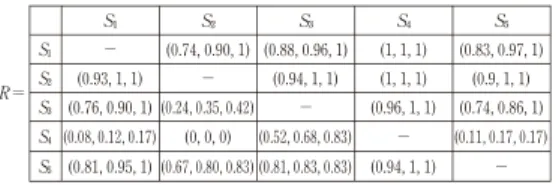
Further,we derive an integrated fuzzy outranking relation R by R = ∑
요웕웋 욾
w욅R욅 and show it in table 9.
We set up α-cut to decide on outranking between alternatives and for -mulate the extended fuzzy outranking relation,that is,the fuzzy subordination matrix in system modeling as follows;
α=max
우웦욱α욡욢 (7) ,where E is a set of indexes showing all of the indiscriminate relations(S욡, S욢)between alternatives.
Theαis recognized as a threshold installed to discriminate any relation between alter -natives. Therefore the maximum value of α욡욢in eq.(7)means a value that will be able to discriminate all of the indiscriminate relations between alternatives in the int e-grated fuzzy outranking relation.
The indiscriminate relations between alternatives in the integrated fuzzy outr an-king relation are picked up as follows;
S욼,S욽,S욼,S욾,S욼,S움,S욾,S움
In order to discriminate the indiscrimi -nate relations between alternatives,theα욡욢
are found as follows; α욼욽forS욼,S욽:0.41 α욼욾forS욼,S욾:0.67 α욼움forS욼,S움:0.89 α욾움forS욾,S움:0.75
Then,αis computed by eq.(7). α=maxα욼욽,α욼욾,α욼움,α욾움
=0.89
Therefore,when we set upα=0.89 in R ,the conviction matrix is obtained as follows.
The subordination matrix in the sys -tem modeling can be found by taking trans -position of the conviction matrix described above as follows;
We can identify the digraph,so called a satisfied solution for the decision makers,for the given problem by making use of the modified structural modeling method.
Table 9:Integrated extended fuzzy outranking relation from three attributes
S욼 S욽 S욾 S욿 S움 S욼 − (0.74,0.90,1) (0.88,0.96,1) (1,1,1) (0.83,0.97,1) S욽 (0.93,1,1) − (0.94,1,1) (1,1,1) (0.9,1,1) R = S욾 (0.76,0.90,1)(0.24,0.35,0.42) − (0.96,1,1) (0.74,0.86,1) S욿(0.08,0.12,0.17) (0,0,0) (0.52,0.68,0.83) − (0.11,0.17,0.17) S움 (0.81,0.95,1)(0.67,0.80,0.83)(0.81,0.83,0.83) (0.94,1,1) − S욼 S욽 S욾 S욿 S움 S욼 − 0 1 1 1 S욽 1 − 1 1 1 S욾 0 0 − 1 1 S욿 0 0 0 − 0 S움 0 0 0 1 − S욼 S욽 S욾 S욿 S움 S욼 − 1 0 0 0 S욽 0 − 0 0 0 S욾 1 1 − 0 0 S욿 1 1 1 − 1 S움 1 1 1 0 −
The result shown in figure 4 shows the ranking of performance records from the three attributes,which are The term-end examination, The report of study,and The attitude of study. It is clear that the best evaluation is given for S욽and the worst one S욿.
In this way,we can successively find a satisfied solution for decision makers and/ or users by applying the proposed method to given problem. Further the result by the proposed method coincides with that one by the traditional fuzzy outranking method.
7.CONCLUSI
ON
It is very important to determine the best alternatives (the satisfied solution) while taking into consideration the decision makers and/or the specialists knowledge and opinion related to the given problem.
In this paper,as a method to solve the problem mentioned above,we proposed the extended fuzzy outranking method in deci -sion making,which makes it possible to perform evaluating and uniquely ranking the alternatives without losing the quality of data. Furthermore,in order to examine the effectiveness of the proposed method, we studied a practical problem as an empir -ical study,which is related to the perfor -mance records for subjects of study.
As the results of it,the characteristics
and merits of the proposed method were clear as follows;
(1)The decision makers can determine the best alternatives(the satisfied solution) while taking into consideration the deci -sion makers and/or the specialists knowledge and opinion related to the given problem.
(2)In comparison with the traditional method,the proposed method has a merit such that is able to find a satisfied solution uniquely and effectively. (3)In case of a difference between compar
-ative alternatives is found to be little and/or alternatives are hard to compare each other,then the rule ofα-cut is applied without arranging unreasonable rankings,converting its subtle disti nc-tion into noticeable description. This methodology provides a powerful sys -tematic evaluation for dealing with the qualitative data in management decision making.
(4)In the proposed outranking process,the uncertainty that adheres to decision making can be rationally handled with the concept of fuzziness.
(5)MADM-DSS framework suggests to be able to apply the proposed method to practical problems effectively and smoothly.
On the other hand,the following will be one of our future works. That is to say, we will have to apply the proposed method to a lot of the multiple attributes decision making problems as empirical studies in management decision making. It will be necessary to discuss about the results of it
Figure 4:Digraph for the problem (A satisfied solution:Ranking of performance records)
and to accumulate the know-how from the studies. These are being left as a subject in the future.
REFERENCES
Aleskerov,F.,Ersel,L.H.,and Yolalan,R.(2004) Multicriterial Ranking Approach For Evaluating Bank Branch Performance,Inter -national Journal of Information Technology and Decision Making ,3,321-335.
Amagasa,M.(2010)Performance Measurement System for Value Improvement of Services, Bulletin of The Australian Society for Oper a-tions Research Inc.,29(1),35-52.
Amagasa,M.,Hirose,H.(2012)Extended Fuzzy Outranking Method in Decision Making, Proceedings of the Asia Pacific Industrial Engineering and Management Systems ,pp. 19-28.
Figueira,J.,Mousseau,V.,and Roy,B.(2005) Multiple Criteria Decision Analysis: State of the Art Surveys ,Chapter 4,133-162,Springer Verlag.
Furems,E.M.,Larichev,O.I.,Roizenson,G.V., Lotov,A.V.and Miettinen,K.(2003)Human behavior in a multi-criteria choice problem with individual tasks of different difficulties, International Journal of Information Tech-nology and Decision Making ,2,29-40. Holsapple,C.W.,Whinston,A.B.(1996)Decision
Support Systems: A Knowledge-Based Approach,West Publishing.
Inoue,H.,and Amagasa,M.(1998)Fundamentals of Fuzzy Theory ,(in Japanese),Asakura Shoten,pp.57-66.
Inoue,H.,and Amagasa,M.et.al.(2008)Peoples Life Indicators By Fuzzy Outranking,Inter -national Journal of Information Technology & Decision Making ,7(3),471-490.
Keener,J.P.(1993)The Perron-Ferbenius t heo-rem and the ranking of footbal1 teams, Society for Industrial and Applied Math-ematics ,35,80-93.
Martel,J.M.and DAvignon,G.R.(1982)Projects Ordering with Multicriteria Analysis, in Multicriteria Analysis.Part II,Applications European J. Operations Research,10,56-69. Miller,G.A.(1956)The Magical Number Seven, Plus or Minus Two: Some Limits on Our Capacity for Processing Information,The Psychological Review.
Nagata,K.,Umezawa,M.,Amagasa,M.,Cui,D. (2009) Modified Structural Modelling Method and Its Application:Behaviour Anal -ysis for East Japan Railway Company,Inter -national Journal of Industrial Engineering and Management Systems ,Vol.7,No.3,pp. 245-256.
Roy,B.(1991)The Outranking Approach and The Foundations of Electre Methods,Theory and Decision,31,49-73.
Saaty,T.L.(1982)Decision Making for Leaders; the Analytical Hierarchy Process for Deci-sions in a Complex World ,Wadsworth,Bel -mont,California.
Siskos,J.,Lombard,J.and Oudiz,A.(1986)The Use of Multicriteria Outranking Methods in the Comparison of Control options Against a Chemical Pollutant,Operations Research Soc., 37,357-371.
Thomaidis,N.S.,Nikitakos,N.and Dounias,G. D.(2006)The evaluation of information t ech-nology projects: a fuzzy multicriteria decision-making approach, International Journal of Information Technology and Deci-sion Making ,5,89-122.
Zadeh,L.A.(1965)Fuzzy Set,Information and Control ,Vol.8,pp.338-353.