Prognostic Significance of C-reactive Protein-to-prealbumin Ratio in Patients with
Esophageal Cancer
Tomoyuki Matsunaga,*† Hiroshi Miyata,* Keijiro Sugimura,* Masaaki Motoori,‡ Kei Asukai,* Yoshitomo Yanagimoto,* Kazuyoshi Yamamoto,* Hirofumi Akita,* Junichi Nishimura,* Hiroshi Wada,* Hidenori Takahashi,* Masayoshi Yasui,* Takeshi Omori,* Masayuki Ohue,* Yoshiyuki Fujiwara† and Masahiko Yano*
*Department of Digestive Surgery, Osaka International Cancer Institute, Osaka 541-8567, Japan, †Division of Surgical Oncology, Department of Surgery, School of Medicine, Tottori University Faculty of Medicine, Yonago 683-8503, Japan, and ‡Department of Surgery, Osaka General Medical Center, Osaka 558-8558, Japan
ABSTRACT
Background The prognostic value of combination of C-reactive protein and prealbumin (CRP/PAlb) in esophageal cancer remains unclear.
Methods We enrolled 167 esophageal cancer patients who underwent curative esophagectomy. Univariate and multivariate analyses were performed to determine the prognostic significance of various markers, including CRP-to-albumin (CRP/Alb) ratio, modified Glasgow prognostic score, neutrophil-to-lymphocyte ratio (NLR), platelet-to-lymphocyte ratio (PLR), and prognostic nutritional index.
Results Receiver operating characteristic analysis revealed the optimal cut-off value of each inflammatory factor, and CRP/PAlb ratio had the greatest discrimina-tive power in predicting recurrence-free survival (RFS) among the examined measures (AUC 0.668). The 5-year overall survival and RFS rates were significantly lower in patients with high CRP/PAlb ratio than in those with low CRP/PAlb ratio (P < 0.001, P = 0.001, respectively). In the univariate analysis, RFS was significantly worse in patients with low BMI, T2 or deeper tumor invasion, positive lymph node metastasis, positive venous inva-sion, high CRP/PAlb ratio, high CRP/Alb ratio, high NLR, and high LMR. Multivariate analysis revealed that CRP/PAlb, but not CRP/Alb, was an independent prognostic factor along with lymph node metastasis. Conclusion CRP/PAlb ratio was useful for predicting the prognosis of esophageal cancer patients.
Key words C-reactive protein-to-prealbumin ratio; esophageal cancer; esophagectomy; inflammatory marker; prognosis
Esophageal cancer is the eighth most frequently diag-nosed cancer worldwide and a highly aggressive malig-nant disease with high metastatic potential.1 Surgery is
the mainstay treatment for esophageal cancer, but the majority of patients who undergo curative resection sub-sequently develop local or systemic recurrence. Despite the development of multimodal therapies, the prognosis
of patients with esophageal cancer remains poor.2–4
Therefore, accurate prognosis predictors are needed to improve patient survival and to provide appropriate preoperative patient counseling.
Host-related factors, such as age, performance sta-tus, and comorbidity, as well as the biological properties of individual tumors, play an important role in cancer outcome.5 In addition to various clinicopathologic
factors and tumor stage, other prognostic indicators for esophageal cancer have been identified.6–8 The close
correlation between cancer and inflammation was first discovered by Virchow in 1863, and increasing evidence has shown that the systemic inflammatory response and nutritional status are associated with the long-term survival outcome in patients with various types of can-cers.9–11 Therefore, a variety of inflammatory indicators,
such as the C-reactive protein (CRP)-to-albumin ratio (CRP/Alb ratio), modified Glasgow prognostic score (mGPS), neutrophil-to-lymphocyte ratio (NLR), and platelet-to-lymphocyte ratio (PLR), have been explored as prognostic predictors in various cancers. These inflammatory markers have been associated with the prognosis of various types of cancers, including esopha-geal cancer.12–17 However, the best predictor of
long-term outcome after potentially curative esophagectomy has remained unclear.
Low serum albumin concentration is another predictor of poor prognosis in patients with esophageal cancer. Several studies have shown that prealbumin has Yonago Acta Medica 2020;63(1):8–19 doi: 10.33160/yam.2020.02.002
Corresponding author: Hiroshi Miyata, MD, PhD [email protected]
Received 2019 October 23 Accepted 2019 November 25 Online published 2019 December 13
Abbreviations: AUC, area under the curve; BMI, body mass index; CP, reactive protein-to-prealbumin ratio; CRP, C-reactive protein; CRP/Alb, C-C-reactive protein-to-albumin ratio; CRP/PAlb, C-reactive protein-to-prealbumin ratio; LMR, lym-phocyte to monocyte ratio; mGPS, modified Glasgow prognostic score; NLR, neutrophil to lymphocyte ratio; OS, overall survival; PLR, platelet to lymphocyte ratio; pN, pathological lymph node metastasis; PNI, prognostic nutritional index; pT, pathological depth of invasion; RFS, recurrence-free survival
a short half-life and can be used as a parameter in nutri-tional status evaluation with demonstrated superiority to albumin.18–21 Prealbumin is also associated with
post-operative recovery and is an independent predictor of prognosis in patients with malignancies.22, 23 Recently,
the preoperative CRP/prealbumin ratio (CRP/PAlb ratio) was reported to have a better predictive value for the recurrence of gastric cancer than traditional inflamma-tory indices.24 However, the prognostic significance of
CRP/PAlb ratio in esophageal cancer is unclear.
This study was performed to investigate the prog-nostic ability of various inflammatory markers includ-ing CRP/prealbumin ratio in patients with esophageal cancer.
MATERIALS AND METHODS Patients
From January 2013 to December 2015, 191 consecutive patients with thoracic esophageal cancer underwent esophagectomy with radical lymph node dissection at the Osaka International Cancer Institute in Japan. Among them, 17 patients did not undergo a preoperative assessment of prealbumin and 7 underwent non-curative esophagectomy, and these 24 patients were excluded. A total of 167 patients were enrolled in this study. Ninety-four patients were treated with neoadjuvant chemo-therapy and 15 patients were treated with neoadjuvant chemoradiotherapy.
The treatment strategy for esophageal cancer was as follows: patients with ≥ T2, non-T4, or node-positive tumors (Stage ≥ 1B) received neoadjuvant chemo-therapy followed by esophagectomy, and patients with T4 tumors suspected to have invaded other organs (T4b) received neoadjuvant chemoradiation therapy. Tumor staging was based on the 7th edition of the Union for International Cancer Control TNM staging system.25
Patients were carefully followed up from the initial treatment until April 2019. Physical examinations and blood tests were performed every 3 months after dis-charge from the hospital. Abdominal ultrasonography and/or computed tomography were performed at least every 6 months to check for recurrence. Institutional review board approval was obtained (No.18033), and informed consent requirements were waived for this study.
Inflammation markers
The nutrition- and inflammation-based prognostic scores examined in this study were the following: CRP/Alb ratio (CRP measured in mg/L and albumin measured in g/L26); CRP/PAlb ratio (prealbumin
measured in g/L); mGPS, which is a combination of
CRP and albumin (patients with a normal albumin level (≥ 3.5 g/L) and normal CRP level (≤ 10 mg/L) were allocated a score of 0, patients with an elevated CRP level (> 10 mg/L) and a low albumin level (< 3.5 g/L) were allocated a score of 1, and patients with both a low albumin level (< 3.5 g/L) and elevated CRP level (> 10 mg/L) were allocated a score of 227); NLR16; PLR28;
LMR,29 and prognostic nutritional index (PNI), which
was calculated by the formula 10 × albumin (g/dL) + 0.005 × lymphocyte count/µL.30 All indicators involved
in the calculation of the nutrition- and inflammation-based prognostic scores were derived within the 5 days prior to surgery.
The Youden index was calculated using the receiver operating characteristic analysis to determine an optimal cutoff value for the recurrent status of esophageal cancer in association with each inflamma-tory factor (CRP/Alb ratio, CRP/PAlb ratio NLR, LMR, PNI, and PLR).31, 32
Statistical analysis
Continuous variables are expressed as mean ± standard deviation. The χ2 test or Fisher’s exact test was used to
compare categorical variables. Student’s t-test was used to compare continuous variables. The Mann-Whitney
U test was used to compare sequential variables.
The Wilcoxon test was used to compare continuous variables. Survival curves were calculated using the Kaplan-Meier method, and differences between survival curves were examined with the log-rank test. Cox regression was used for univariate and multivariate analyses. The hazard ratio and 95% confidence interval were computed with the Cox proportional hazards model. The recurrence-free survival (RFS) period was defined as the period from the date of surgery to the date of recurrence or last follow up without recurrence. For RFS, patients who died without known tumor recur-rence were censored at the last documented evaluation. We used univariate and multivariate analyses of factors considered prognostic for RFS. All calculations were performed using JMP v9.0.1 (SAS Institute, Inc., Cary, NC), and P values of < 0.05 were considered significant.
RESULTS
Patients characteristics
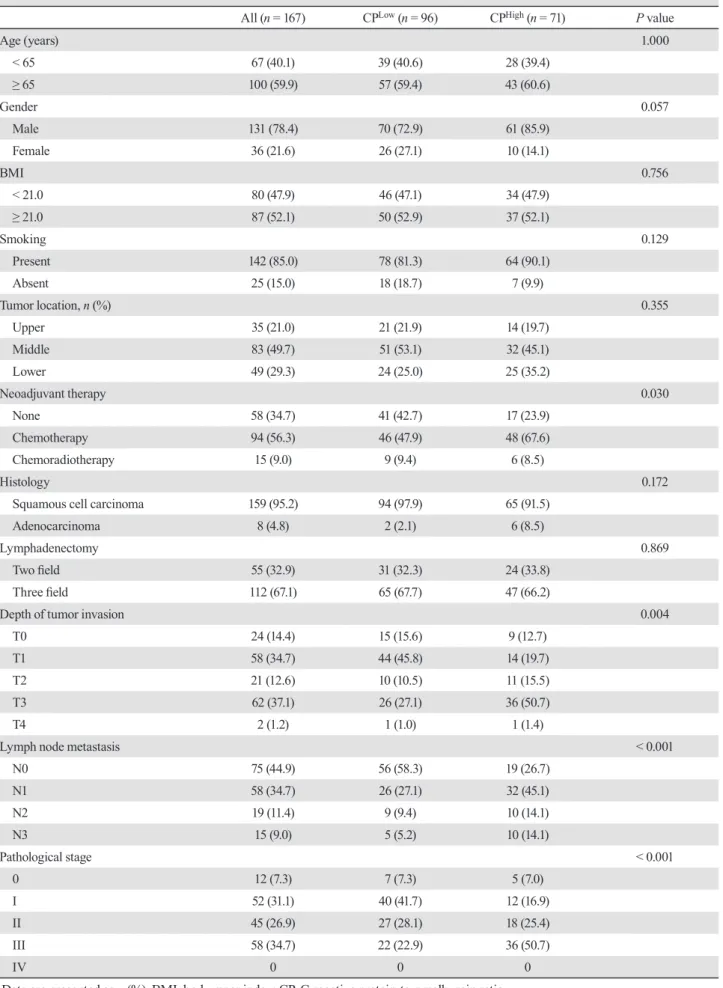
The clinicopathological characteristics of patients are shown in Table 1. Based on the optimal cutoff, patients were divided into the high CRP/PAlb group (CPHigh;
CRP/PAlb ≥ 5.517; n = 71) and low CRP/PAlb group (CPLow; CRP/PAlb < 5.517; n = 96). Neoadjuvant
thera-py was performed more frequently in the CPHigh group
Table 1. Clinicopathologic features of patients with low or high CP
All (n = 167) CPLow (n = 96) CPHigh (n = 71) P value
Age (years) 1.000 < 65 67 (40.1) 39 (40.6) 28 (39.4) ≥ 65 100 (59.9) 57 (59.4) 43 (60.6) Gender 0.057 Male 131 (78.4) 70 (72.9) 61 (85.9) Female 36 (21.6) 26 (27.1) 10 (14.1) BMI 0.756 < 21.0 80 (47.9) 46 (47.1) 34 (47.9) ≥ 21.0 87 (52.1) 50 (52.9) 37 (52.1) Smoking 0.129 Present 142 (85.0) 78 (81.3) 64 (90.1) Absent 25 (15.0) 18 (18.7) 7 (9.9) Tumor location, n (%) 0.355 Upper 35 (21.0) 21 (21.9) 14 (19.7) Middle 83 (49.7) 51 (53.1) 32 (45.1) Lower 49 (29.3) 24 (25.0) 25 (35.2) Neoadjuvant therapy 0.030 None 58 (34.7) 41 (42.7) 17 (23.9) Chemotherapy 94 (56.3) 46 (47.9) 48 (67.6) Chemoradiotherapy 15 (9.0) 9 (9.4) 6 (8.5) Histology 0.172
Squamous cell carcinoma 159 (95.2) 94 (97.9) 65 (91.5)
Adenocarcinoma 8 (4.8) 2 (2.1) 6 (8.5)
Lymphadenectomy 0.869
Two field 55 (32.9) 31 (32.3) 24 (33.8)
Three field 112 (67.1) 65 (67.7) 47 (66.2)
Depth of tumor invasion 0.004
T0 24 (14.4) 15 (15.6) 9 (12.7)
T1 58 (34.7) 44 (45.8) 14 (19.7)
T2 21 (12.6) 10 (10.5) 11 (15.5)
T3 62 (37.1) 26 (27.1) 36 (50.7)
T4 2 (1.2) 1 (1.0) 1 (1.4)
Lymph node metastasis < 0.001
N0 75 (44.9) 56 (58.3) 19 (26.7) N1 58 (34.7) 26 (27.1) 32 (45.1) N2 19 (11.4) 9 (9.4) 10 (14.1) N3 15 (9.0) 5 (5.2) 10 (14.1) Pathological stage < 0.001 0 12 (7.3) 7 (7.3) 5 (7.0) I 52 (31.1) 40 (41.7) 12 (16.9) II 45 (26.9) 27 (28.1) 18 (25.4) III 58 (34.7) 22 (22.9) 36 (50.7) IV 0 0 0
was closely associated with poor clinical characteristics, including T stage (P = 0.004), N stage (P < 0.001) and pathological stage (P < 0.001). No correlations were found among age, gender, body mass index, histology and lymphadenectomy.
Predictive values of CRP/PAlb ratio
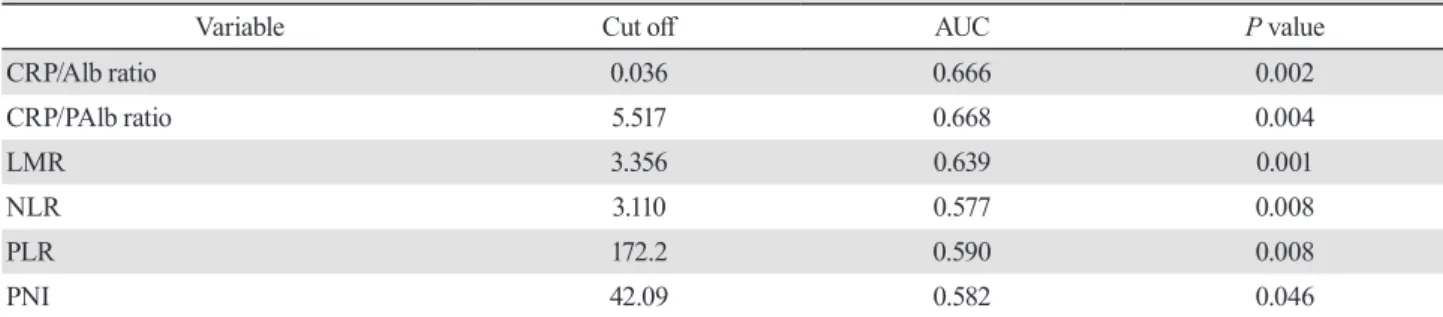
The Receiver operating characteristic analysis revealed the optimal cut-off value of each inflammatory factor (Table 2). CRP/PAlb ratio had the greatest discrimina-tive power in predicting RFS among the examined measures (AUC 0.668). The relationships between CRP/PAlb ratio and various measures of the systemic inflammatory response in patients with esophageal cancer are shown in Table 3. High white blood cell count (P = 0.010), CRP (P < 0.001), platelet (P = 0.002) and CRP/Alb ratio (P < 0.001) were significantly more frequent in the CPHigh group than in the CPLow group.
Low albumin (P = 0.019), prealbumin (P < 0.001) and PNI (P = 0.026) were significantly more frequent in CPHigh patients than CPLow patients. Furthermore, the
mGPS was significantly higher in the CPHigh group
than in the CPLow group (P < 0.001). However, there
was no significant relationship between CRP/PAlb ratio and LMR, NLR and PLR. A statistically significant correlation was observed between CRP/PAlb ratio and CRP/Alb ratio (r = 0.989, P < 0.001, Fig. 1a), although there was only a weak correlation between prealbumin level and albumin level (r = 0.223, P < 0.001, Fig. 1b). Prognosis of esophageal cancer patients
In the study group, 37 patients died of esophageal cancer recurrence and 6 patients died of other diseases (pneumonia, n = 3; other cancer, n = 2; multiple organ failure after a traffic accident, n =1). The overall survival (OS) and RFS rates were significantly poorer in CPHigh
patients than in CPLow patients (P < 0.001 and P = 0.001,
respectively) (Figs. 2a and b). Subgroup analyses based
on TNM stage revealed that CRP/PAlb ratio was signifi-cantly associated with RFS in Stage I and Stage II (Figs. 3a–d). The OS and RFS rates were significantly poorer in patients with a high CRP/Alb ratio than in those with low CRP/Alb ratio (P < 0.001 and P = 0.007, respec-tively) (Figs. 2c and d). Patients with higher LMR and NLR values had significantly poorer OS and RFS com-pared with those with lower LMR and NLR values (Figs. 4a–d). Patients with lower PNI values had significantly poorer OS compared with those with higher PNI values, although there was no statistical difference between PNI and RFS (Figs. 5a and b). However, there was no sta-tistical difference between other inflammatory markers such as PLR and mGPS and prognosis of patients (Figs. 5c and d, Figs. 6a and b).
In the univariate analysis, RFS was significantly worse in patients with low BMI, T2 or deeper tumor in-vasion, positive lymph node metastasis, positive venous invasion, high CRP/PAlb ratio, high CRP/Alb ratio, high NLR and high LMR (Table 4). In multivariate analysis in which CRP/PAlb ratio and CRP/Alb ratio were included as covariates separately because a statistically significant correlation was observed between the two factors (Fig. 1a), CRP/PAlb ratio, but not CRP/Alb ratio, was an independent prognostic factor along with lymph node metastasis (Table 4).
DISCUSSION
In this study, several inflammatory markers were explored as potential prognosis predictors in esophageal cancer. The survival rate was significantly poorer in patients with a high CRP/PAlb ratio, a high CRP/Alb ratio, high LMR and high NLR. Multivariate analysis revealed that only a high CRP/PAlb ratio was an inde-pendent prognostic factor.
Our results demonstrated that CRP/PAlb ratio was the best prognostic factor among various systemic inflammation markers for esophageal cancer patients. Table 2. Receiver operating characteristic analysis for each inflammatory factor
Variable Cut off AUC P value
CRP/Alb ratio 0.036 0.666 0.002 CRP/PAlb ratio 5.517 0.668 0.004 LMR 3.356 0.639 0.001 NLR 3.110 0.577 0.008 PLR 172.2 0.590 0.008 PNI 42.09 0.582 0.046
AUC, area under the curve; CRP/Alb, C-reactive protein-to-albumin ratio; CRP/PAlb, C-reactive protein-to-prealbumin ratio; LMR, lymphocyte to monocyte ratio; NLR, neutrophil to lymphocyte ratio; PLR, platelet to lymphocyte ratio; PNI, prognostic nutritional index.
This result is similar to that of a recent study by Jun et al., where the prognostic value of the CRP/PAlb ratio in patients with gastric cancer was explored.24 They
retrospectively reviewed various inflammation markers for prognosis ability in 401 patients with gastric cancer and found that the predictive value of preoperative CRP/PAlb for the recurrence of gastric cancer was
significantly better than other inflammatory mark-ers. Furthermore, multivariate analysis showed that CRP/PAlb ratio, not CRP/Alb ratio, was an independent factor associated with RFS. Except for our study, there has been only one study showing the prognostic impact of the CRP/PAlb ratio in patients with esophageal cancer. Feng et al. retrospectively reviewed preoperative Table 3. The relationships between CP and various measures of the systemic inflammatory response
All (n = 167) CPLow (n = 96) CPHigh (n = 71) P value
WBC 0.010 < 7970 149 (89.2) 91 (94.8) 58 (81.7) ≥ 7970 18 (10.8) 5 (5.2) 13 (18.3) CRP < 0.001 < 0.15 96 (57.5) 93 (96.9) 3 (4.2) ≥ 0.15 71 (42.5) 3 (3.1) 68 (95.8) Albumin 0.019 < 3.8 80 (47.9) 38 (39.6) 42 (43.8) ≥ 3.8 87 (52.1) 58 (60.4) 29 (56.2) Prealbumin < 0.001 < 24.6 74 (44.3) 28 (29.2) 46 (64.8) ≥ 24.6 93 (55.7) 68 (70.8) 25 (35.2) Platelet 0.002 < 245 80 (47.9) 56 (58.3) 24 (33.8) ≥ 245 87 (52.1) 40 (41.7) 47 (66.2) CRP/Alb ratio < 0.001 < 0.036 95 (56.9) 93 (96.9) 2 (2.8) ≥ 0.036 72 (43.1) 3 (3.1) 69 (97.2) LMR 0.137 < 3.356 112 (67.1) 69 (71.9) 43 (60.6) ≥ 3.356 45 (32.9) 27 (28.1) 18 (39.4) NLR 0.570 < 3.110 131 (78.4) 77 (80.2) 54 (76.1) ≥ 3.110 36 (21.6) 19 (19.8) 17 (23.9) PLR 0.082 < 172.2 98 (58.7) 62 (64.6) 36 (50.7) ≥ 172.2 69 (41.3) 34 (35.4) 35 (49.3) PNI 0.026 < 42.09 39 (23.4) 16 (16.7) 23 (32.4) ≥ 42.09 128 (76.6) 80 (83.3) 48 (67.6) mGPS < 0.001 0 66 (39.5) 61 (63.5) 5 (7.0) 1, 2 101 (60.5) 35 (36.5) 66 (93.0)
CRP, C-reactive protein; CRP/Alb, C-reactive protein-to-albumin ratio; CRP/PAlb, C-reactive protein-to-prealbumin ratio; LMR, lymphocyte to monocyte ratio; mGPS, modified Glasgow prognostic score; NLR, neutrophil to lymphocyte ratio; PLR, platelet to lymphocyte ratio; pT, pathological depth of invasion; pN, pathological lymph node metastasis; PNI, prognostic nutritional index.
Fig. 1. The correlation between each inflammatory factor. The correlation between CRP/PAlb and CRP/Alb (a) and prealbumin and albumin (b). CRP/Alb, C-reactive protein-to-albumin ratio; CRP/PAlb, C-reactive protein-to-prealbumin ratio.
Fig. 2. Relationship of CRP/PAlb ratio and CRP/Alb ratio with long-term prognosis. Overall (a) and recurrence-free (b) survival curves according to the CRP/PAlb ratio in patients with esophageal cancer. Overall (c) and recurrence-free (d) survival curves according to the CRP/Alb ratio in patients with esophageal cancer. CRP/Alb, C-reactive albumin ratio; CRP/PAlb, C-reactive protein-to-prealbumin ratio.
CRP/PAlb ratio and CRP/Alb ratio for prognosis ability in 346 patients with resectable esophageal cancer and found that the predictive value of CRP/PAlb ratio for OS was better than CRP/Alb ratio. Furthermore, multivari-ate analysis showed that CRP/PAlb ratio, not CRP/Alb ratio, was an independent factor associated with OS.33
These results suggest that CRP/PAlb ratio is superior to CRP/Alb ratio in terms of the prognostic value of patients with gastric or esophageal cancer.
Elevated CRP level, which is a marker of systemic inflammation, was found to be a predictor of low survival in patients with various cancers.34 CRP/Alb
ratio is a superior prognostic measure involving inflammatory and nutritional factors in various cancers, including esophageal cancer.35 In our study, CRP/Alb
ratio, CRP/PAlb ratio, LMR and NLR were suitable indicators of an unfavorable prognosis in patients with esophageal cancer, and the P values of CRP/Alb ratio and CRP/PAlb ratio were lower than other those of
other inflammation markers in multivariate analyses. This result is similar to those of Ishibashi et al., who reported CRP/Alb ratio as the most significant indicator of poor long-term outcome in patients with esophageal cancer.34 The authors compared the systemic
immune-inflammatory index, NLR, PLR, and CRP/Alb ratio with established prognostic factors and found that the CRP/Alb ratio was superior to other inflammation-based prognostic scores in terms of prognostic ability. Wei et al. also retrospectively tested the mGPS, NLR, PLR and CRP/Alb ratio together with established prognostic factors in univariate and multivariate Cox regression analyses of OS in 423 esophageal cancer patients.36 The
authors demonstrated that the CRP/Alb ratio showed a superior discriminatory ability compared with the NLR and PLR. These results suggest that the predictive value of the CRP/Alb ratio is superior to that of other inflam-matory markers in esophageal cancer patients.
Previous studies showed that prealbumin has a Fig. 3. Relationship of CRP/PAlb ratio with long-term prognosis according to pathological stage. (a) Recurrence-free survival curve in esophageal cancer patients with Stage 0. (b) Stage I, (c) Stage II, (d) Stage III, CRP/PAlb, C-reactive protein-to-prealbumin ratio.
shorter half-life of 2–3 days and its amount in the body is low.21 Therefore, measurement of prealbumin is a
good marker of visceral protein status and prealbumin is affected earlier by acute variations in protein bal-ance.37, 38 Serum albumin is commonly used as a
surro-gate marker of nutrition; however, its half-life of 21 days and its steady state level of 100 days limit its utility and value.37 Therefore, prealbumin is considered superior to
albumin in nutritional assessment.21 Furthermore,
pre-albumin has recently been identified as an independent prognostic factor in various cancers.39, 40 Based on this
theoretical advantage, CRP/PAlb may be more sensitive and superior to CRP/Alb for tumor prognosis. In this study, we found that CRP/PAlb ratio was more useful for predicting the prognosis of patients with esophageal cancer compared with CRP/Alb ratio.
Our results showed that high CRP/PAlb ratio was significantly associated with deeper depth of
tumor invasion, positive lymph node metastasis and advanced pathological stage. This result was similar to the report of Jun et al. in patients with gastric cancer.24
The authors retrospectively reviewed the association between CRP/PAlb and clinical features in 401 patients with gastric cancer and found that the CRP/PAlb ratio was significantly associated with deeper depth of tumor invasion, positive lymph node metastasis and advanced pathological stage. Furthermore, the CRP/PAlb ratio was significantly associated to inflammation markers including mGPS, NLR, PLR, and CRP/Alb ratio. In our study, CRP/PAlb ratio was significantly associated with mGPS, CRP/Alb ratio, and PNI. In cancer tissues, oncoproteins activate inflammatory transcriptional programs to produce various inflammatory mediators such as cytokines, which can trigger the proliferation and differentiation of inflammation markers, suggesting that the systemic immune inflammatory responses are Fig. 4. Relationship of LMR and NLR with long-term prognosis. Overall (a) and recurrence-free (b) survival curves according to the LMR in patients with esophageal cancer. Overall (c) and recurrence-free (d) survival curves according to the NLR in patients with esophageal cancer. LMR, lymphocyte -to-monocyte ratio; NLR, neutrophil-to-lymphocyte ratio.
Fig. 5. Relationship of PLR and PNI with long-term prognosis. Overall (a) and recurrence-free (b) survival curves according to the PLR in patients with esophageal cancer. Overall (c) and recurrence-free (d) survival curves according to the PNI in patients with esophageal cancer. PLR, platelet-to-lymphocyte ratio; PNI, prognostic nutritional index.
Fig. 6. Relationship of mGPS with long-term prognosis. Overall (a) and recurrence-free (b) survival curves according to the mGPS in patients with esophageal cancer. mGPS, modified Glasgow prognostic score.
significantly associated with tumor progression.41
This study has several limitations. First, we con-ducted this retrospective study in a single institution, and the number of patients was not sufficiently large. Second, we included both patients with or without neoadjuvant therapy and we performed peripheral blood test only after neoadjuvant therapy. Previous studies showed that systemic immunoinflammatory measures are easily affected by chemotherapy and radiation.42
However, Otowa et.al reported that CRP/Alb ratio after neoadjuvant therapy, but not CRP/Alb ratio before neo-adjuvant therapy, was an independent prognostic factor in patients with Stage II/III esophageal squamous cell carcinoma.43 In this study, preoperative data were
ob-tained within 5 days before surgery to reduce the impact of preoperative treatment in patients with neoadjuvant
chemotherapy or neoadjuvant chemoradiotherapy. In summary, our study showed that CRP/PAlb ratio was superior to other systemic inflammation markers as a predictor of prognosis in esophageal cancer patients. A prospective study with a larger number of patients is needed to clarify the utility of CRP/PAlb ratio as a prognostic marker in patients with esophageal cancer.
Acknowledgments: We thank Liwen Bianji, Edanz Editing China (www.liwenbianji.cn/ac), for editing the English text of a draft of this manuscript.
The authors declare no conflict of interest.
Table 4. Univariate and multivariate analyses of prognostic factors for recurrence-free survival in patients with esophageal cancer
Univariate analysis Multivariate analysis (Model A) Multivariate analysis (Model B) Variable Hazard ratio 95% CI P value Hazard ratio 95% CI P value Hazard ratio 95% CI P value Age (≥ 65 vs < 65) 1.232 0.738–2.111 0.429
Gender (Female vs Male) 0.629 0.301–1.185 0.159
BMI (< 21.0 vs ≥ 21.0 ) 1.694 1.025–2.839 0.040 1.592 0.939–2.697 0.084 1.637 0.965–2.775 0.067 Smoking (Present vs Absent) 1.526 0.744–3.677 0.267 Lymphatic invasion (Present vs Absent) 1.698 0.993–2.830 0.053 Venous invasion (Present vs Absent) 2.069 1.249–3.410 0.005 1.758 0.998–3.101 0.051 1.700 0.969–2.983 0.064 pT (2, 3, 4 vs 0, 1) 2.262 1.352–3.899 0.002 1.020 0.559–1.908 0.949 1.068 0.589–1.988 0.830 pN (Present vs Absent) 3.931 2.197–7.564 < 0.001 2.638 1.371–5.371 0.003 2.742 1.427–5.572 0.002 Postoperative pneumonia (Present vs Absent) 1.221 0.506–2.504 0.628 Anastomosis leakage (Present vs Absent) 1.924 0.670–4.360 0.200 CRP/PAlb (≥ 5.517 vs < 5.517) 2.234 1.352–3.740 0.002 1.771 1.037–3.067 0.036 CRP/Alb (≥ 0.0360 vs < 0.0360) 1.979 1.200–3.300 0.008 1.625 0.964–2.766 0.068 NLR (≥ 3.11 vs < 3.11) 2.066 1.197–3.461 0.010 1.377 0.743–2.502 0.304 1.316 0.712–2.385 0.375 LMR (≥ 3.37 vs < 3.37) 2.111 1.274–3.480 0.004 1.571 0.879–2.773 0.126 1.614 0.903–2.849 0.105 PLR (≥ 172 vs < 172) 1.406 0.850–2.318 0.183 PNI (< 42.1 vs ≥ 42.1) 1.411 0.794–2.404 0.232 mGPS 1.640 0.970–2.878 0.065
BMI, body mass index; CI, confidence interval; CRP/Alb, C-reactive albumin ratio; CRP/PAlb, C-reactive protein-to-prealbumin ratio; LMR, lymphocyte to monocyte ratio; mGPS, modified Glasgow prognostic score; NLR, neutrophil to lymphocyte ratio; PLR, platelet to lymphocyte ratio; pT, pathological depth of invasion; pN, pathological lymph node metastasis; PNI, prognostic nutritional index.
REFERENCES
1 Enzinger PC, Mayer RJ. Esophageal Cancer. N Engl J Med. 2003;349:2241-52. DOI: 10.1056/NEJMra035010, PMID: 14657432
2 Gertler R, Stein HJ, Langer R, Nettelmann M, Schuster T, Hoefler H, et al. Long-term outcome of 2920 patients with cancers of the esophagus and esophagogastric junction: evaluation of the New Union Internationale Contre le Cancer/ American Joint Cancer Committee staging system. Ann Surg. 2011;253:689-98. DOI: 10.1097/SLA.0b013e31821111b5, PMID: 21475008
3 van Hagen P, Hulshof MCCM, van Lanschot JJB, Steyerberg EW, Henegouwen MIB, Wijnhoven BPL, et al.; CROSS Group. Preoperative chemoradiotherapy for esophageal or junctional cancer. N Engl J Med. 2012;366:2074-84. DOI: 10.1056/NEJMoa1112088, PMID: 22646630
4 Miyata H, Yamasaki M, Miyazaki Y, Takahashi T, Kurokawa Y, Nakajima K, et al. Clinical Importance of Supraclavicular Lymph Node Metastasis After Neoadjuvant Chemotherapy for Esophageal Squamous Cell Carcinoma. Ann Surg. 2015;262:280-5. DOI: 10.1097/SLA.0000000000000933, PMID: 25211269
5 Roxburgh CSD, McMillan DC. Role of systemic inflamma-tory response in predicting survival in patients with primary operable cancer. Future Oncol. 2010;6:149-63. DOI: 10.2217/ fon.09.136, PMID: 20021215
6 Chen M, Huang J, Zhu Z, Zhang J, Li K. Systematic review and meta-analysis of tumor biomarkers in predicting prognosis in esophageal cancer. Erratum in: BMC Cancer. 2013;13:539. PMID: 24206575
7 Omloo JMT, van Heijl M, Hoekstra OS, van Berge Henegouwen MI, van Lanschot JJB, Sloof GW. FDG-PET parameters as prognostic factor in esophageal cancer patients: a review. Ann Surg Oncol. 2011;18:3338-52. DOI: 10.1245/ s10434-011-1732-1, PMID: 21537872
8 Miyata H, Yamasaki M, Takahashi T, Murakami K, Tanaka K, Yukinori K, et al. Determinants of response to neoadjuvant chemotherapy for esophageal cancer using 18F-fluorodeoxiglucose positron emission tomography (18F-FDG-PET). Ann Surg Oncol. 2014;21:575-82. DOI: 10.1245/s10434-013-3343-5, PMID: 24201746
9 Coussens LM, Werb Z. Inflammation and cancer. Nature. 2002;420:860-7. DOI: 10.1038/nature01322, PMID: 12490959 10 Hirahara N, Tajima Y, Fujii Y, Yamamoto T, Hyakudomi R,
Taniura T, et al. Preoperative Prognostic Nutritional Index Predicts Long-term Outcome in Gastric Cancer: A Propensity Score-matched Analysis. Anticancer Res. 2018;38:4735-46. DOI: 10.21873/anticanres.12781, PMID: 30061243
11 Hong S, Zhou T, Fang W, Xue C, Hu Z, Qin T, et al. The prognostic nutritional index (PNI) predicts overall survival of small-cell lung cancer patients. Tumour Biol. 2015;36:3389-97. DOI: 10.1007/s13277-014-2973-y, PMID: 25527156 12 Miyata H, Yamasaki M, Kurokawa Y, Takiguchi S, Nakajima
K, Fujiwara Y, et al. Prognostic value of an inflammation-based score in patients undergoing pre-operative chemo-therapy followed by surgery for esophageal cancer. Exp Ther Med. 2011;2:879-85. DOI: 10.3892/etm.2011.308, PMID: 22977592
13 Kinoshita A, Onoda H, Imai N, Iwaku A, Oishi M, Fushiya N, et al. Comparison of the prognostic value of inflammation-based prognostic scores in patients with hepatocellular carcinoma. Br J Cancer. 2012;107:988-93. DOI: 10.1038/ bjc.2012.354, PMID: 22878374
14 Inoue D, Ozaka M, Matsuyama M, Yamada I, Takano K, Saiura A, et al. Prognostic value of neutrophil-lymphocyte ratio and level of C-reactive protein in a large cohort of pancreatic cancer patients: a retrospective study in a single in-stitute in Japan. Jpn J Clin Oncol. 2015;45:61-6. DOI: 10.1093/ jjco/hyu159, PMID: 25341546
15 Chen S, Yang X, Feng JF. A novel inflammation-based prognostic score for patients with esophageal squamous cell carcinoma: the c-reactive protein/prognostic nutritional index ratio. Oncotarget. 2016;7:62123-32. DOI: 10.18632/oncotar-get.11389, PMID: 27557504
16 Duan H, Zhang X, Wang FX, Cai MY, Ma GW, Yang H, et al. Prognostic role of neutrophil-lymphocyte ratio in operable esophageal squamous cell carcinoma. World J Gastroenterol. 2015;21:5591-7. DOI: 10.3748/wjg.v21.i18.5591, PMID: 25987784
17 Xie X, Luo KJ, Hu Y, Wang JY, Chen J. Prognostic value of preoperative platelet-lymphocyte and neutrophil-lymphocyte ratio in patients undergoing surgery for esophageal squamous cell cancer. Dis Esophagus. 2016;29:79-85. DOI: 10.1111/ dote.12296, PMID: 25410116
18 Zhao Q, Chen S, Feng JF. A novel inflammation-based prognostic index for patients with esophageal squamous cell carcinoma: neutrophil lymphocyte ratio/albumin ratio. On-cotarget. 2017;8:103535-42. DOI: 10.18632/oncotarget.21989, PMID: 29262582
19 Shapiro J, van Lanschot JJB, Hulshof MCCM, van Hagen P, van Berge Henegouwen MI, Wijnhoven BPL, et al.; CROSS study group. Neoadjuvant chemoradiotherapy plus surgery versus surgery alone for oesophageal or junctional cancer (CROSS): long-term results of a randomised controlled trial. Lancet Oncol. 2015;16:1090-8. DOI: 10.1016/S1470-2045(15)00040-6, PMID: 26254683
20 Gonda K, Shibata M, Sato Y, Washio M, Takeshita H, Shigeta H, et al. Elevated neutrophil-to-lymphocyte ratio is associated with nutritional impairment, immune suppression, resistance to S-1 plus cisplatin, and poor prognosis in patients with stage?IV gastric cancer. Mol Clin Oncol. 2017;7:1073-8. DOI: 10.3892/mco.2017.1438, PMID: 29285377
21 Unal D, Orhan O, Eroglu C, Kaplan B. Prealbumin is a more sensitive marker than albumin to assess the nutritional status in patients undergoing radiotherapy for head and neck cancer. Contemp Oncol (Pozn). 2013;3:276-80. DOI: 10.5114/ wo.2013.35281, PMID: 24596514
22 Wang J, Zhao J, Zhang Y, Liu C. Early enteral nutrition and total parenteral nutrition on the nutritional status and blood glucose in patients with gastric cancer complicated with diabetes mellitus after radical gastrectomy. Exp Ther Med. 2018;16:321-7. DOI: 10.3892/etm.2018.6168, PMID: 29896256 23 Li JD, Xu XF, Han J, Wu H, Xing H, Li C, et al. Preoperative
prealbumin level as an independent predictor of long-term prognosis after liver resection for hepatocellular carcinoma: a multi-institutional study. HPB (Oxford). 2019;21:157-66. DOI: 10.1016/j.hpb.2018.06.1803, PMID: 30082212
24 Lu J, Xu B, Zheng Z, Xie J, Wang J, Lin J, et al. CRP/ prealbumin, a novel inflammatory index for predicting recur-rence after radical resection in gastric cancer patients: post hoc analysis of a randomized phase III trial. Gastric Cancer. 2019;22:536-45. DOI: 10.1007/s10120-018-0892-0, PMID: 30377862
25 Wittekind C. [2010 TNM system: on the 7th edition of TNM classification of malignant tumors]. Pathologe. 2010;31:331-2. DOI: 10.1007/s00292-010-1349-3, PMID: 20703480
26 Fairclough E, Cairns E, Hamilton J, Kelly C. Evaluation of a modified early warning system for acute medical admissions and comparison with C-reactive protein/albumin ratio as a predictor of patient outcome. Clin Med (Northfield Ill). 2009;9:30-3. DOI: 10.7861/clinmedicine.9-1-30, PMID: 19271597
27 Proctor MJ, Morrison DS, Talwar D, Balmer SM, Fletcher CD, O’Reilly DSJ, et al. A comparison of inflammation-based prognostic scores in patients with cancer. A Glasgow Inflammation Outcome Study. Eur J Cancer. 2011;47:2633-41. DOI: 10.1016/j.ejca.2011.03.028, PMID: 21724383
28 Liaw FY, Huang CF, Chen WL, Wu LW, Peng TC, Chang YW, et al. Higher Platelet-to-Lymphocyte Ratio Increased the Risk of Sarcopenia in the Community-Dwelling Older Adults. Sci Rep. 2017;7:16609. DOI: 10.1038/s41598-017-16924-y, PMID: 29192175
29 Wang X, Su S, Guo Y. The clinical use of the platelet to lymphocyte ratio and lymphocyte to monocyte ratio as prog-nostic factors in renal cell carcinoma: a systematic review and meta-analysis. Oncotarget. 2017;8:84506-14. DOI: 10.18632/ oncotarget.21108, PMID: 29137443
30 Onodera T, Goseki N, Kosaki G. [Prognostic nutritional index in gastrointestinal surgery of malnourished cancer patients]. Nippon Geka Gakkai Zasshi. 1984;85:1001-5. PMID: 6438478 31 Kaido T, Ogawa K, Fujimoto Y, Ogura Y, Hata K, Ito T, et al.
Impact of sarcopenia on survival in patients undergoing living donor liver transplantation. Am J Transplant. 2013;13:1549-56. DOI: 10.1111/ajt.12221, PMID: 23601159
32 Ida S, Watanabe M, Yoshida N, Baba Y, Umezaki N, Harada K, et al. Sarcopenia is a Predictor of Postoperative Respiratory Complications in Patients with Esophageal Cancer. Ann Surg Oncol. 2015;22:4432-7. DOI: 10.1245/s10434-015-4559-3, PMID: 25862583
33 Feng JF, Wang L, Jiang YH, Yang X. C-Reactive Protein to Prealbumin Ratio (CPR): A Novel Inflammatory-Nutritional Prognostic Factor for Predicting Cancer-Specific Survival (CSS) and Overall Survival (OS) in Patients with Resectable Esophageal Squamous Cell Carcinoma. J Oncol. 2019;2019:1-11. DOI: 10.1155/2019/4359103, PMID: 31379941
34 Crumley ABC, McMillan DC, McKernan M, McDonald AC, Stuart RC. Evaluation of an inflammation-based prognostic score in patients with inoperable gastro-oesophageal cancer. Br J Cancer. 2006;94:637-41. DOI: 10.1038/sj.bjc.6602998, PMID: 16479253
35 Ishibashi Y, Tsujimoto H, Hiraki S, Kumano I, Yaguchi Y, Horiguchi H, et al. Prognostic Value of Preoperative Systemic Immunoinflammatory Measures in Patients with Esophageal Cancer. Ann Surg Oncol. 2018;25:3288-99. DOI: 10.1245/ s10434-018-6651-y, PMID: 30019304
36 Wei X, Wang F, Zhang D, Qiu M, Ren C, Jin Y, et al. A novel inflammation-based prognostic score in esophageal squa-mous cell carcinoma: the C-reactive protein/albumin ratio. BMC Cancer. 2015;15:350. DOI: 10.1186/s12885-015-1379-6, PMID: 25934640
37 Geisler JP, Linnemeier GC, Thomas AJ, Manahan KJ. Nutri-tional assessment using prealbumin as an objective criterion to determine whom should not undergo primary radical cytoreductive surgery for ovarian cancer. Gynecol Oncol. 2007;106:128-31. DOI: 10.1016/j.ygyno.2007.03.008, PMID: 17466363
38 Guerra LT, Rosa AR, Romani RF, Gurski RR, Schirmer CC, Kruel CD. Serum transferrin and serum prealbumin as markers of response to nutritional support in patients with esophageal cancer. Nutr Hosp. 2009;24:241-2. PMID: 19593499
39 Kawai H, Ota H. Low perioperative serum prealbumin predicts early recurrence after curative pulmonary resection for non-small-cell lung cancer. World J Surg. 2012;36:2853-7. DOI: 10.1007/s00268-012-1766-y, PMID: 22948197
40 Jia RR, Zhong JH, Huo RR, Su QB, Xiang X, Zhao FL, et al. Correlation between serum prealbumin and prognosis of patients with hepatocellular carcinoma after hepatectomy. J Surg Oncol. 2019;119:794-800. DOI: 10.1002/jso.25378, PMID: 30648280
41 Mantovani A, Allavena P, Sica A, Balkwill F. Cancer-related inflammation. Nature. 2008;454:436-44. DOI: 10.1038/ nature07205, PMID: 18650914
42 Namikawa T, Munekage E, Munekage M, Maeda H, Yatabe T, Kitagawa H, et al. Evaluation of Systemic Inflammatory Response Biomarkers in Patients Receiving Chemotherapy for Unresectable and Recurrent Advanced Gastric Cancer. Oncology. 2016;90:321-6. DOI: 10.1159/000446373, PMID: 27225990
43 Otowa Y, Nakamura T, Yamamoto M, Kanaji S, Matsuda Y, Matsuda T, et al. C-reactive protein to albumin ratio is a prognostic factor for patients with cStage II/III esophageal squamous cell cancer. Dis Esophagus. 2017;30:1-5. DOI: 10.1093/dote/dox107, PMID: 28881893