Title
Retrieving Similar Code Fragments based on
Identifier Similarity for Defect Detection
Author(s)
Ishio, Takashi; Matsushita, Makoto; Inoue,
Katsuro; Yoshida, Norihiro
Citation
Issue Date 2008-07-20
Text Version author
URL
http://hdl.handle.net/11094/51558
DOI
10.1145/1390817.1390830
rights
© 2008 ACM. This is the author's version of the
work. It is posted here for your personal use.
Not for redistribution. The definitive Version
of Record was published in DEFECTS '08
Proceedings of the 2008 workshop on Defects in
large software systems, Pages 41-42, 2008-07-20,
http://dx.doi.org/10.1145/1390817.1390830.
Note
Osaka University Knowledge Archive : OUKA
Osaka University Knowledge Archive : OUKA
https://ir.library.osaka-u.ac.jp/
Retrieving Similar Code Fragments based on Identifier
Similarity for Defect Detection
Norihiro Yoshida, Takashi Ishio, Makoto Matsushita, Katsuro Inoue
Graduate School of Information Science and Technorogy, Osaka University 1-3, Machikaneyama-cho, Toyonaka, Osaka, 560-8531, Japan
{n-yosida, ishio, matusita, inoue}@ist.osaka-u.ac.jp
ABSTRACT
Similar source code fragments, known as code clones or du-plicated code, may involve similar defects caused by the same mistake. However, code clone detection tools cannot detect certain code fragments (e.g. modified after copy-and-pasted). To support developers who would like to detect such defects, we propose a method to retrieve similar code fragments in source code based on the similarity of identifiers between a query and a target code fragment. We present two case studies of similar defects in open source systems.
Categories and Subject Descriptors
D.2.5 [Software Engineering]: Testing and Debugging—
Debugging aids and diagnostics; D.2.4 [Software Engi-neering]: Software/Program Verification—Statistical meth-ods
General Terms
Algorithms, Experimentation
1.
INTRODUCTION
Similar code is generally considered as one of factors that make software maintenance more difficult[1, 2, 4]. If devel-opers modify one of similar code fragments, they have to de-termine whether or not apply the same modifications to the others. Similar code is also called code clone or duplicated
code. Developers often introduce similar code by because
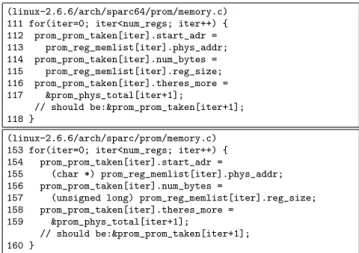
of various reasons (e.g. “copy-and-paste”)[2, 5]. Especially, large-scale software system, such as Linux, JDK(Java Devel-opment Kit), often involves large amount of similar code[4]. Similar code fragments sometimes involve similar defects caused by the same mistake[6, 7]. Therefore, if one of sim-ilar code fragments has a defect, it is necessary to inspect the others. Figure 1 is an example of such code fragments in Linux 2.6.6. Those code fragments involve similar defects caused by accessing incorrect pointer (i.e. &prom phys total). Because type cast operations (e.g. (char *)) are inserted into
(linux-2.6.6/arch/sparc64/prom/memory.c) 111 for(iter=0; iter<num_regs; iter++) { 112 prom_prom_taken[iter].start_adr = 113 prom_reg_memlist[iter].phys_addr; 114 prom_prom_taken[iter].num_bytes = 115 prom_reg_memlist[iter].reg_size; 116 prom_prom_taken[iter].theres_more = 117 &prom_phys_total[iter+1]; // should be:&prom_prom_taken[iter+1]; 118 } (linux-2.6.6/arch/sparc/prom/memory.c) 153 for(iter=0; iter<num_regs; iter++) { 154 prom_prom_taken[iter].start_adr =
155 (char *) prom_reg_memlist[iter].phys_addr; 156 prom_prom_taken[iter].num_bytes =
157 (unsigned long) prom_reg_memlist[iter].reg_size; 158 prom_prom_taken[iter].theres_more =
159 &prom_phys_total[iter+1];
// should be:&prom_prom_taken[iter+1]; 160 }
Figure 1: Similar defects
the lower fragment, code clone detection tools[1, 2, 4] do not treat those code fragments as a pair of code clones. Hence, even if developers find out that one of those code fragments has a defect and perform code clone detection, they can not detect the other code fragment that has similar defect. We propose a new approach that compares only identifiers to detect such code fragments.
In this paper, we focus on similar defects that are involved in code fragments sharing identifiers with the same name, and we propose a method to retrieve similar code fragments based on identifier similarity.
2.
PROPOSED METHOD
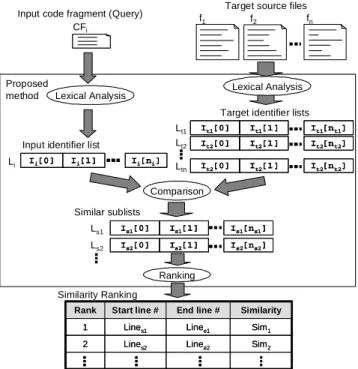
As shown in Figure 2, our method accepts a code fragment as a query and retrieves similar code fragments in target source files. The process comprises the three steps as follows.
(1)Lexical Analysis Both the input code fragment and
the target source files are translated into token se-quences. Then, only identifiers are extracted from each token sequence. Finally, those identifiers are normal-ized based on several rules (e.g. dividing at underscore, number suffix elimination) and are listed as Identifier Lists.
(2)Comparison We compare the input identifier list with
Input code fragment (Query) f Target source files 1 f2 fn Proposed method CFi It1[0] It1[1] It1[nt1] It1[0] It1[1] It1[nt1] It2[0] It2[1] It2[nt2] It2[0] It2[1] It2[nt2] It2[0] It2[1] It2[nt2] It2[0] It2[1] It2[nt2] Ii[0] Ii[1] Ii[ni] Ii[0] Ii[1] Ii[ni] Comparison Linee2 Linee1 End line # Sim2 Lines2 2 Sim1 Lines1 1 Similarity Start line # Rank Linee2 Linee1 End line # Sim2 Lines2 2 Sim1 Lines1 1 Similarity Start line # Rank Input identifier list
Target identifier lists
Li Lt1 Lt2 Ltn Similarity Ranking Similar sublists Is1[0] Is1[1] Is1[ns1] Is1[0] Is1[1] Is1[ns1] Ls1 Is2[0] Is2[1] Is2[ns2] Is2[0] Is2[1] Is2[ns2] Ls2 Ranking
Lexical Analysis Lexical Analysis
Figure 2: The overview of proposed method
The direction of movement of the sliding window
Target identifier list Lt It[0] It[1] It[2] It[3] It[n]
Input identifier list Li Ii[0] Ii[1] Ii[2]
Sliding window
The direction of movement of the sliding window
Target identifier list Lt It[0] It[1] It[2] It[3] It[n]
Input identifier list Li Ii[0] Ii[1] Ii[2]
Sliding window
Figure 3: Sliding window
similarity for each sublist and extract Similar Sublists. The detail of this setep is described later.
(3)Ranking Similar sublists are ranked according to
sim-ilarity between them to the input identifier list. We call the ranking Similarity Ranking.
Figure 3 shows the comparison between an input identifier list and a target identifier list. We call the scope of compar-ison Sliding Window, and it moves through the target identi-fier list. To reduce computational cost, we fix the length of the sliding window to the length of the input identifier list. Hence, the length of a similar sublist is fixed to the length of the input identifier list.
The definition of the similarity in our method is shown in Equation 1. Let Sibe a set of elements in input identifier list Li, Swbe a set of elements in the sliding window. Then we
define the similarity in our method as Similarity(Si, Sw): Similarity(Si, Sw) =
2∗ |Si∩ Sw| |Si| + |Sw|
(1)
In the ranking step, since similar sublists are ranked us-ing the similarity score described above, the code fragments which share more identifiers with the input code fragment are ranked higher in the result. Since the ranking involves a huge number of code fragments, developers may investigate similar code fragments according to their resource.
3.
CASE STUDY
We performed two case studies of software systems, Linux 2.6.6 and Canna 3.6[3].
The arch directory of Linux 2.6.6 has two similar defects (see Figure 1). We used the two code fragments as queries and then retrieved similar code fragments to each of them in the arch directory. As a result, in both of those queries, the two code fragments in Figure 1 are detected as the top two code fragments in the similarity ranking. If one of those code fragments is given, we can detect the other one having similar defect.
The server directory of Canna 3.6 has 19 buffer overflow er-rors. Like the case of Linux, we used the 19 code fragments as queries and then retrieved similar code fragments in the server directory. As a result, in all of those queries, 18 or 19 queried code fragments are ranked in the top 30. If one of those code fragments is given, we can detect the almost the other code fragments having similar defect.
4.
CONCLUSION
In this paper, we proposed a method to retrieve similar code fragments based on identifier similarity. In the case studies, by providing a code fragment having a defect, we could de-tect most of similar defects. We need further case studies on other software systems having similar defects.
Acknowledgments
This reseach was supported by JSPS, Grant-in-Aid for Scien-tific Research (A) (No.17200001) and Grant-in-Aid for JSPS Fellows (No.20-1964).
5.
REFERENCES
[1] B. S. Baker. Finding clones with Dup: Analysis of an experiment. IEEE Trans. Softw. Eng., 33(9):608–621, 2007.
[2] I. D. Baxter, A. Yahin, L. Moura, M. S. Anna, and L. Bier. Clone detection using abstract syntax trees. In
Proc. of ICSM ’98, pages 368–377, 1998.
[3] Canna. http://canna.sourceforge.jp.
[4] T. Kamiya, S. Kusumoto, and K. Inoue. CCFinder: A multilinguistic token-based code clone detection system for large scale source code. IEEE Trans. Softw. Eng., 28(7):654–670, 2002.
[5] M. Kim, L. Bergman, T. Lau, and D. Notkin. An ethnographic study of copy and paste programming practices in OOPL. In Proc. of ISESE 2004, pages 83–92, 2004.
[6] B. Lagu¨e, D. Proulx, J. Mayrand, E. M. Merlo, and J. Hudepohl. Assessing the benefits of incorporating function clone detection in a development process. In
Proc. of ICSM ’97, pages 314–321, 1997.
[7] A. Zeller. Why Programs Fail. Morgan Kaufmann Pub., 2005.