Effect of the Magnetothermal Force on the
Natural Convection Heat Transfer from a
Vertical Plate
著者
Fujiwara Hiroaki, Kaneda Masayuki, Suga
Kazuhiko
journal or
publication title
The 9th JSME-KSME Thermal and Fluids
Engineering Conference (TFEC9)
page range
1-5
year
2017-10
*Corresponding Author: [email protected]
1
EFFECT OF THE MAGNETOTHERMAL FORCE ON THE NATURAL
CONVECTION HEAT TRANSFER FROM A VERTICAL PLATE
Hiroaki Fujiwara, Masayuki Kaneda*, Kazuhiko Suga
Department of Mechanical Engineering, Osaka Prefecture University, Sakai 599-8531, Japan
ABSTRACT
In this study, the natural convection of a paramagnetic liquid from a heated vertical plate is experimentally investigated under the presence of a magnetic field. Since the magnetothermal force depends on the magnetic induction, the magnetic induction is measured for permanent magnets to obtain an effective magnet arrangement. It is confirmed that the alternating arrangement of magnets can induce locally-high magnetic induction. Then, the temperature measurement is carried out for the vertical heated plate set in a tank of the gadolinium nitrate aqueous solution. The magnets are placed behind the heated plate. It is found that the local heat transfer coefficient is affected at the magnet locations, and this effect becomes remarkable when the magnet is placed at the bottom of the heated plate where the local heat transfer becomes maximum.
KEYWORDS:
Magnetothermal force, Natural convection, Paramagnetic fluid, Magnet arrangement, Heat transfer coefficient1. INTRODUCTION
The paramagnetic material has a characteristic to be attracted by the magnetic field, which was discovered in 19th century [1]. Its magnetic susceptibility is known to depend on the inverse of absolute temperature, which is so called Curie’s law. However, the attracting force is negligibly small due to its small magnetic susceptibility. Since superconducting magnets become available, a strong magnetic field of several tesla or more has brought us various new findings such as the levitation of water droplet (magneto-Archimedes effect) [2], nitrogen jet (Wakayama jet) [3], convection control [4-6], etc.
As aforementioned, the magnetic susceptibility depends on the temperature, this so-called magnetothermal force has been studied for the application to the convection control, the magneto-thermal wind [7], etc. For the convection control, the force on the fluid inside an enclosure was mainly studied. This may be two reasons. According to the definition of the magnetic force [8], it depends on the magnetic susceptibility of the material and the gradient of the squared magnetic induction. To apply the large gradient of the magnetic field on the fluid, it is preferable to introduce a cusp-shape magnetic field and a magnetic field by one-turn electric coil surrounding the enclosure. Another reason is to discuss the convection-inducing effect with the well-known Rayleigh-Nusselt relations. The magnetic Rayleigh number was introduced to represent the magnitude of the magnetothermal convection.
In terms of the magnitude of the force, the application to an open system is limited. One representative case is the magnetothermal wind [7], which is a spontaneously-induced air flow from a pipe by the heat and strong external magnetic field. Tagawa et al. [9] numerically discussed the transient oxygen concentration inside an open pipe bundled in a superconducting magnet. Kaneda et al. [10] also reported the effect of the magnetic field on a heated paramagnetic pipe flow. In the case, the gradient of the magnetic field can be enlarged by the electric coil diameter and the electric current.
In this study, the natural convection from a vertical heated plate is considered. This is one of the conventional natural convection problems, and applied to the cooling of the electric device, heat exchanger, etc. To clarify the fundamental characteristics, a single vertical plate is employed. In this case, magnets are placed behind the plate so that the convective flow is not interrupted. The cusp-shape magnetic field is not applicable. Therefore,
2
the magnetic field is measured to obtain the large magnetic induction and its gradient. Then, an experimental study is carried out to investigate the effect of the magnetothermal force on the natural convection.
2. EXPERIMENTAL RESULTS
2.1 Magnetic Susceptibility Measurement
In the present study, a gadolinium nitrate aqueous solution isemployed for the working fluid. It is known as the paramagnetic liquid of which magnetic susceptibility depends on the temperature. Prior to the natural convection measurement, the magnetic susceptibility is measured by using a magnetic balance, Sherwood, MSB-Mk1. The measured magnetic susceptibility is shown in Fig. 1 with reference data by Kaneda et al. [10], Maki et al. [11], and Kenjereš et al. [12]. In this study, the mass magnetic susceptibility of the present working fluid is 1.28 10-7 m3/kg at the concentration of 0.466 mol/kg and the temperature of 298
K. As Fig. 1 suggests, the current measured susceptibility agrees with reference data. The temperature dependence of the magnetic susceptibility is also confirmed. The difference of the susceptibility at T = 10K is about 3 which seems small enough to recognize in the figure, thus is omitted here.
Fig. 1 Mass magnetic susceptibility of the working fluid.
2.2 Magnetic Field from Magnet(s)
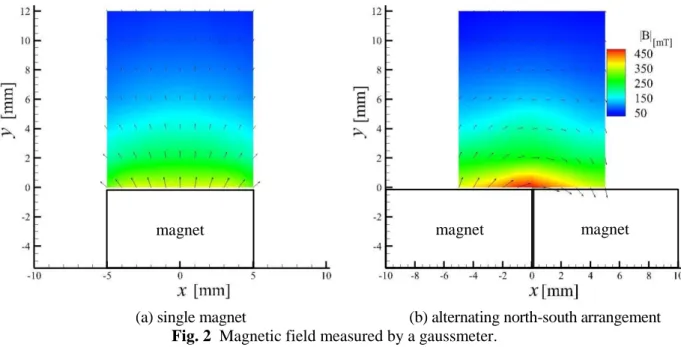
For the effective magnetothermal force, the magnetic field and its induction are crucial. Most of the relevant studies employ the cusp-shape magnetic field or the field induced inside a one-turn electric coil, because its magnetic force can be enhanced. However in this study, the target flow field is the natural convection along single heated plate, which implies that the cusp-shape magnetic field cannot be introduced. To find out the effective magnetic field by arranging magnet(s) along one heated plate, the magnetic field is measured for several cases.For the measurement, a gaussmeter (Lakeshore 421) with a flat probe is used. First, a measurement for a single permanent magnet, size of which is 104010 mm3, is carried out. The surface magnetic induction in the catalogue
of the magnet is 0.435 Tesla. The actual magnetic field distribution is shown in Fig. 2(a). It is confirmed that, the magnetic field is symmetry at the symmetrical center, and the maximum induction is 0.366 Tesla. It is known that, the magnetothermal force is composed of the magnetic susceptibility of the working fluid and the gradient of the square magnetic induction [8]. Because the magnetic induction for a single magnet is limited by its magnetization, the magnitude of the magnetothermal force from a single magnet is restricted and weak. Therefore, the magnetic induction for the plural magnets arranged side by side is investigated. The arrangement is referred to a health device using magnetic field [13]. Two permanent magnets are aligned alternating north-south polarity orientation. The magnetic induction and its field is shown in Fig. 2(b). It is confirmed that the local magnetic induction is
3
enhanced, because the north pole is placed closely to the south pole at the junction of two magnets. For the effect of the magnetothermal force on the heat transfer along a vertical plate, it can be expected that this alternating placement is effective to induce a large magnetic gradient, and resulting magnetothermal force.
(a) single magnet (b) alternating north-south arrangement
Fig. 2 Magnetic field measured by a gaussmeter.
2.3 Effect on Natural Convection Heat Transfer of Vertical Wall
The experimental measurement of the natural convection by a vertical heated plate is carried out in the presence of the magnetic field. The schematic model is shown in Fig.3. The experimental setup is consisted of a vertical heated plate in a tank of 620200160 mm3, a DC power supply, a thermostatic bath, and a PC with a data logger. The tank is filledwith the gadolinium nitrate aqueous solution of 15.48 wt.% (0.466 mol/kg) as a working fluid, and the temperature of the tank is kept at approximately 293K by the heat exchanger tube connected with the thermostatic bath. The vertical plate in the tank is heated by the nonmagnetic stainless foil which is connected to the DC power supply. The net heat flux from the heater to a working fluid is 3 or 5 W/m2. Since the working
fluid is decomposed by an electric current, the stainless foil is electrically insulated by lamination. In order to fabricate the heater as thin as possible to get the magnet closer to the fluid, the foil is laminated by thin film. T-type thermocouples are attached between the stainless foil and a thin acrylic plate to measure the temperature of the heated wall. Three thermocouples are set behind the plate to estimate the heat loss, and two at the bottom and top of the flow path for the measurement of the ambient fluid temperature. To prevent the disturbance flow around the vertical heated plate [14], sidewalls and facing wall are attached to the vertical heated wall. To investigate the effect of the magnetothermal force, a pair of block–type permanent magnet 104010 mm3
with aforementioned magnet arrangement is placed behind the heated plate. That is, one magnet faces the N-pole to the flow path, and the S-N-pole for the other. The detail of a vertical heated plate is shown in Fig. 3(b). The temperature data at each location is obtained at the steady state. The experimental parameters performed in this study are, the cases with and without the magnet, the heat flux from the wall, and the location of the magnets. The heat transfer coefficient is estimated from the following equation,
T T q h w x (1)
where, q is the net heat flux from the heater to the fluid, Tw is the local wall temperature, and T is the bulk
temperature in the bath. It is better to employ the local bulk temperature at the same elevation of wall thermocouple, however, we employed the bath bulk temperature due to the convenience.
4
Fig. 3 Experimental setup. (a)Schematic model of the experimental setup (b) Enlarged image of the vertical
heated plate.
The estimated local heat transfer coefficient from the temperature data is shown in Fig. 4. The abscissa starts from the bottom edge of the heated foil. The magnet location is represented in the figure, where the boundary of two magnets is at 8mm from the bottom. As shown in the figure, a significant difference can be found in the presence of the magnet at the magnet location. That is, the local heat transfer coefficient is suppressed by the application of the magnet, in other words, by the magnetothermal force. Other conditions are experimented such as heat flux from the heater and magnet location, which are omitted due to limitations of space. The effect by the magnet becomes weakened if the heat flux is decreased. Same tendency is observed when the magnet is shifted upward. From these results, it is confirmed that, the magnetothermal force becomes remarkable when the magnet is located where the temperature gradient along the plate is large.
Fig. 4 Local heat transfer rate(xmag : 8 mm, q= 5 W/m2).
3. CONCLUSIONS
5
In this study, the effect of the magnetothermal force on the natural convection heat transfer of a vertical plate is experimentally investigated. The significant findings are as follows.
1. For a magnet arrangement along a plate, the magnetic induction can be enhanced by placing the magnet alternating magnetic pole. The area at high magnetic induction is restricted very near the magnet.
2. The local heat transfer at the magnet location is suppressed. It is remarkable when the magnets are located near the bottom edge of the heating zone. This is because that, the effect of the magnetothermal force becomes effective where the temperature gradient along the plate is maximum.
From these results, it can be concluded that the effect is remarkable if the magnets are properly settled behind the heated wall. Furthermore, it is important the heated wall thickness is also crucial for the effect because the high magnetic induction can be obtained in the vicinity of the magnet surface. In this study, the heated wall is made from a laminated stainless foil, which made the magnetothermal force strong enough.
ACKNOWLEDGMENTS
This study is partially supported by MEXT, Grant-in-aid for Scientific Research (C) No. 15K05838.
REFERENCES
[1] Faraday, M., “On the diamagnetic conditions of flame and gases,” The London, Edinburgh, and Dublin Philosophical
Magazine and Journal of Science, XXXI, third ser., pp. 401-421, (1847).
[2] Ikezoe, Y., Hirota, N., Nakagawa, J., Kitazawa, K., “Making water levitate,” Nature, 393, pp. 749-750, (1998).
[3] Wakayama, N.I., “Behavior of gas flow under gradient magnetic fields,” J. Appl. Phys., 69, 2734, (1991).
[4] Braithwaite, D., Beaugnon, E., Tourniew, R., “Magnetically controlled convection in a paramagnetic fluid,” Nature, 354(14),
pp. 134-136, (1991).
[5] Akamatsu, M., Higano, M., Takahashi, Y., Ozoe, H., “Numerical computation of magnetothermal convection of water in a
vertical cylindrical enclosure,” Int. J., Heat Fluid Flow, 26, pp. 622-634, (2005).
[6] Kenjereš, S., Pyrda, L., Wrobel, W., Fornalik-Wajs, E., Szmyd, J.S., “Oscillatory states in thermal convection of a
paramagnetic fluid in a cubical enclosure subjected to a magnetic field gradient,” Phys. Rev. E., 85, 046312, (2012).
[7] Uetake, H., Hirota, N., Nakagawa, J., Ikezoe, Y., Kitazawa, K., “Thermal Convection Control by Gradient Magnetic Field,” J.
Appl. Phys., 87(9), pp. 6310-6312, (2000).
[8] Bai, B., Yabe. A., Qi, J., Wakayama, N.I., “Quantitative analysis of air convection caused by magnetic-fluid coupling”, AIAA
Journal, 37(12), pp. 1538-1543, (1999).
[9] Tagawa, T., Ozoe, H., Inoue, K., Ito, M., Sassa, K., Asai, S., “Transient characteristics of convection and diffusion of oxygen
gas in an open vertical cylinder under magnetizing and gravitational forces”, Chemical Engineering Science, 56, pp. 4217-4223, (2001).
[10] Kaneda, M., Tsuji, A., Suga, K., “Effect of magnetothermal force on heat and fluid flow of paramagnetic liquid flow inside a pipe”, Applied Thermal Engineering, 115, pp. 1298-1305, 2017.
[11] Maki S., Ataka M., Tagawa T., Ozoe H., Mori W., “Natural convection of a paramagnetic liquid controlled by magnetization force,” AIChE Journal, 51, pp. 1096-1103, (2005).
[12] Kenjereš, S., Pyrda, L., Fornalik-Wajs, E., Szmyd, J.S., “Numerical and experimental study of Rayleigh-Benard-Kelvin convection,” Flow Turbulence Combust., 92, pp. 371-393, (2014).
[13] Colan Totte Co., Ltd., Mechanism of colantotte. Retrieved April 24, 2017, from http://www.colantotte.jp/global/technology/ mechanism.html.