Morphology and coloration of Harpiosquilla harpax (de Haan, 1844) collected from
Osaka Bay and the Kii Channel, Japan, with comments on Harpiosquilla species
from Okinawa Island(Crustacea: Stomatopoda: Squillidae)
Hiroyuki A
RIYAMA1, Charles H. J. M. F
RANSEN2and Hiroki N
AKAJIMA3大阪湾と紀伊水道から採集されたトゲシャコ Harpiosquilla harpax (de Haan, 1844)
の形態と色彩,および沖縄本島産のトゲシャコ属について
有山啓之
1・Charles H. J. M. F
RANSEN2・中島広喜
3抄録︰トゲシャコHarpiosquilla harpax (de Haan, 1844)は本邦から記載された口脚目の1種で,日本から はよく似たH. japonica Manning, 1969も記載されている.大阪湾と紀伊水道産の標本を正確に同定する ため,45個体について形態と色彩を詳細に観察した.タイプ標本との比較により今回の標本はトゲシャ コと同定され,H. japonicaは形態的特徴が合致しタイプ産地が紀伊水道に含まれることからトゲシャ コの新参異名となることが分かった.本種は顕著な突起を欠く額板と長さが幅よりも大きい尾節で特 徴付けられ,本邦以外に台湾,中国,ベトナム,ニュ−カレドニアとオーストラリアから記録されて いる.沖縄本島産のトゲシャコ属の標本を調べたところ,額板に突起を持つものが含まれ,その尾節 の長さは幅とほぼ同じであった.同様の特徴を持つ標本はインド・西太平洋の各地から記録されトゲ シャコに誤同定されてきたが,それらの中には複数種が混在する可能性があるため,沖縄本島産の種 名は決定できなかった.
Abstract: Two mantis shrimp species of Squillidae, Harpiosquilla harpax (de Haan, 1844) and H. japonica Manning, 1969, were originally described from Japan and both are closely similar to each other. To accurately identify Harpiosquilla material collected from Osaka Bay and the Kii Channel, morphological characters and coloration of 45 specimens were examined in detail. As a result of comparison with the type specimens of H.
harpax, the present specimens are identified as that species. Because of close similarity of the morphology and
the type locality contained in the Kii Channel, H. japonica is synonymized with H. harpax. Harpiosquilla harpax is characterized particularly by having the rostral plate lacking a distinct apical projection and the telson longer than broad, and it was recorded from Taiwan, China, Vietnam, New Caledonia and Australia in addition to Japan. Examination of Harpiosquilla specimens collected from Okinawa Island revealed that they have a rostral plate partly with an apical projection and a telson as broad as long. Harpiosquilla specimens having such characters were recorded from many localities in the Indo-West Pacific and have been misidentified as H. harpax. Because there is a possibility that they include multiple similar species, the species name of the specimens from Okinawa Island cannot be determined at present.
Key words: Stomatopoda; Harpiosquilla harpax; Harpiosquilla japonica; Osaka Bay; Kii Channel; Okinawa Island
Harpiosquilla harpax (de Haan, 1844) is one of the mantis shrimps (Stomatopoda) occurring in Osaka Bay
(Ariyama, 2004). This species (Fig. 1A) was originally described as Squilla harpax in De Haan (1833-1850) based on the specimens collected by Ph. F. von Siebold and H. Bürger from Japan (Yamaguchi and Baba, 1993), and has been recorded from various localities in the Indo-West Pacific from Japan to South Africa (see synonym list of the species as shown below). Because of taxonomic confusion among Harpiosquilla species, Manning (1969) revised the genus
Research Article 原著論文
※Contributions from Osaka Museum of Natural Hisåtory No. 489(Accepted Dec. 27, 2020) 1 Osaka Museum of Natural History, Nagai Park 1-23, Higashisumiyoshi-ku, Osaka 546-0034, Japan 大阪市立自然史博物館 〒546-0034 大阪市東住吉区長居公園1-23
2 Taxonomy and Systematics Group, Naturalis Biodiversity Center, P.O. Box 9517, 2300 RA Leiden, The Netherlands 3 Graduate School of Engineering and Science, University of the Ryukyus, 1 Senbaru, Nishihara, Okinawa 903-0213, Japan 琉球大学大学院理工学研究科 〒903-0213 沖縄県中頭郡西原町字千原1
and recognized seven species. In the paper, he described a new species, H. japonica Manning, 1969, from Wakanoura in Japan because the rostral plate lacks a slender anterior projection which is present in H. harpax, and referred H. raphidea Fabricius, 1798, recorded by Fukuda (1913) from Japan (Fig. 1B) to H. japonica. Manning (1969), as well as Manning (1968a), examined the lectotype of Squilla harpax; however, the detailed characters of the type specimen were not shown. Ahyong (2001) synonymized H. japonica with H. harpax owing to the variability of the shape of the rostral plate, but later Ahyong et al. (2008) reinstated H. japonica because of differences of the rostral plate and coloration between the two taxa.
To identify Harpiosquilla species in Osaka Bay accurately, the first author examined not only the specimens from Osaka Bay, but also specimens from the Kii Chanel which includes the coast of Wakanoura, the type locality of
H. japonica. The second author examined the type specimens of H. harpax. Moreover, in the stomatopod collection of
the Ryukyu University Museum, the third author found Harpiosquilla specimens collected from Okinawa Island in the Ryukyu Archipelago where no species of the genus have been recorded in the literature before. In the present paper, morphological characters and coloration of the Japanese specimens are shown in detail and the taxonomy of H. harpax and H. japonica is re-assessed.
Fig. 1. Harpiosquilla harpax (de Haan, 1844) in the literature, entire animal, dorsal views. A, Squilla harpax de Haan, 1844; pl. 51, fig. 1 of De Haan (1844), downloaded from Kyoto University Library Network (2001). B, Squilla raphidea Fabricius, 1798; fig. 2 of Fukuda (1913), scanned from Dobutsugaku Zasshi.
Materials and methods
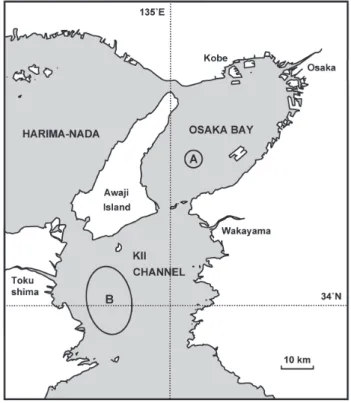
Forty-five specimens caught by fishermen belonging to the Shimosho Fisheries Cooperative Association, Osaka Prefecture and the Tokushimashi Fisheries Cooperative Association, Tokushima Prefecture were examined. Their fishery grounds are Osaka Bay (depth: 30-50 m) and the Kii Channel (depth: 40-70 m), respectively (Fig. 2). The type specimens of Squilla harpax deposited in the Naturalis Biodiversity Center, Leiden, The Netherlands (except for a paralectotype, RMNH.CRUS.S.460) and Harpiosquilla specimens deposited in the Ryukyu University Museum (Fujukan, RUMF), Okinawa, Japan were also examined for comparison. We observed the morphology of all the specimens and coloration of the specimens from Osaka Bay and the Kii Channel. In particular, the observations were focused on the morphology of rostral plate and telson, and photographs of them were taken to be parallel to the dorsal surfaces. The measurement of the total length (TL) of the specimens and morphological terminology follow Ahyong (2001). The telson length and width were measured as shown in Fig. 3. The material examined from Osaka Bay and the Kii Channel is deposited in the Osaka Museum of Natural History (OMNH).
Taxonomic account
Family Squillidae Latreille, 1802 Genus Harpiosquilla Holthuis, 1964
Harpiosquilla harpax (de Haan, 1844)
(Japanese name: Togeshako) (Figs. 1 and 4-9)
Fig. 2. Collecting sites of Harpiosquilla harpax (de Haan, 1844). A, fishery ground of the Shimosho Fisheries Cooperative Association. B, fishery ground of the Tokushimashi Fisheries Cooperative Association. Wakanoura is included in Wakayama City, Wakayama Prefecture.
Fig. 3. Measurement of telson length and width of the specimens.
Fig. 4. Photographs of Harpiosquilla harpax (de Haan, 1844), fresh condition, dorsal views. Entire animal (A, B); anterior part of body (C). A, C, male (OMNH-Ar-12074, TL 181 mm); B, female (OMNH-Ar-12070, TL 177 mm). Scales: 50 mm.
Squilla harpax de Haan, 1844: atlas, pl. 51, fig. 1 [type locality: Japan]. –De Haan, 1849, text, 222. Chloridella raphidea. –Rathbun, 1902: 55 [not Squilla raphidea Fabricius, 1798].
Squilla raphidea. –Fukuda, 1913: 69, fig. 2. –Komai, 1927: 323. –Komai, 1938: 268. –Liu, 1949: 43, pl. 6, figs. 15-17
[not S. raphidea Fabricius, 1798].
Squilla raphidea var. –Gravier, 1937: 186, figs. 8-10 (in part) [not S. raphidea Fabricius, 1798].
Harpiosquilla harpax. –Holthuis, 1964: 140. –Hamano, 1988: 378, figs. 19a, b, 20a-d, 21c-i. –Ahyong, 2001: 257, fig.
126 (in part). –Hamano, 2005: 67, fig. 2-22g-l. –Motoh, 2005: 13, fig. 2. –Machida and Yamamoto, 2006: 32, fig. 3. –Motoh, 2007: 44, fig. 2. –Ugai et al., 2008: 21, pl. 6, fig. 6.
Fig. 5. Harpiosquilla harpax (de Haan, 1844), male (OMNH-Ar-12074, TL 181 mm). A, carapace and anterior, dorsal view; B, right raptorial claw, lateral view; C, 5th thoracic somite (right), lateral view; D, 5-8th thoracic somites (right), dorsal view; E, 6th abdominal somite and telson, dorsal view; F, right uropod, dorsal view. Scales: 10 mm.
Harpiosquilla japonica Manning, 1969: 15, figs. 10, 11 [type locality: Japan]. –Manning, 1995: 158, figs. 87b, d, 88b,
91b, 92a, e, 94b. –Liu and Wang, 1999: 577 (list). –Moosa, 2000: 433. –Ahyong et al., 2008: 114, figs. 88-90.
Harpiosquilla intermedia Manning and Michel, 1973: 113, figs. 1, 2b [type locality: New Caledonia].
Not Squilla harpax. –Tiwari and Biswas, 1952: 358, fig. 3b, d, f. –Ingle, 1963: 18, figs. 9, 36, 59. –Manning, 1968b: 121, fig. 3a [= Harpiosquilla sp. See below Remarks of H. sp.].
Not Harpiosquilla harpax. –Manning, 1966: 87, fig. 1 [= H. stephensoni Manning, 1969, according to Manning (1969)].
Not Harpiosquilla harpax. –Lee and Wu, 1966: 51, fig. 7A-F [= H. indica Manning, 1969, according to Ahyong et al. (2008)].
Not Harpiosquilla harpax. –Manning, 1968a: 15, fig. 4. –Tirmizi and Manning, 1968: 33, fig. 13. –Manning, 1969: 25, figs. 28-38. –Dutt and Ravindranath, 1975: 62, figs. 7-12. –Manning, 1995: 153, figs. 90a, 92b, 93, 95, 96, pl. 28. –Ahyong et al., 1999: 38, fig. 2a-d. –Liu and Wang, 1999: 577 (list). –Ahyong et al., 2008: 108, figs. 82, 83. –Mahapatro et al., 2019: 18, figs. 2-5 [= Harpiosquilla sp. See below Remarks of H. sp.].
Material examined. Lectotype, male (RMNH.CRUS.S.28, TL 152.5 mm), Japan, 1823-1834, coll. Ph. F. von
Siebold and H. Bürger. Three paralectotypes (RMNH.CRUS.S.478: one female, TL 204 mm; two males, TL 177 and 93 mm), same data as lectotype.
One male (OMNH-Ar-12063, TL 168 mm), Osaka Bay (Fig. 2A), 30-50 m deep, caught by fishermen using Ishigeta dredge, 6 Jun. 2016. One male (OMNH-Ar-12064, TL 170 mm), same place and method, 24 Jun. 2020. One male (OMNH-Ar-12065, TL 141 mm), same place and method, 2 Jul. 2020. One male (OMNH-Ar-12066, TL 172 mm), same place and method, 12 Jul. 2020. One female (OMNH-Ar-12067, TL 132 mm), same place and method, 19 Jul. 2020. Two males Ar-12068, TL 150, 124 mm), same place and method, 29 Jul. 2020. Two males (OMNH-Ar-12069, TL 130, 127 mm), same place and method, 3 Aug. 2020. Three males and one female (OMNH-Ar-12070, TL 169, 162, 127, 177 mm), same place and method, 5 Aug. 2020. One male (OMNH-Ar-12071, TL 173 mm), same place and method, 7 Aug. 2020. Three males (OMNH-Ar-12072, TL 158, 122, 116 mm), same place and method, 12 Aug. 2020. Two males and one female (OMNH-Ar-12073, TL 132, 123, 134 mm), same place and method, 16 Aug. 2020. Five males and two females (OMNH-Ar-12074, TL 181, 171, 132, 127, 126, 162, 131 mm), same place and method, 19 Aug. 2020. Three males (OMNH-Ar-12075, TL 193, 165, 144 mm), same place and method, 11 Sep. 2020. Fourteen males and one female (OMNH-Ar-12076, TL 210, 204, 204, 204, 203, 203, 202, 189, 181, 176, 173, 173, 172, 172, 193 mm), Kii Channel (Fig. 2B), 40-70 m deep, caught by fishermen using trawl, 19 Jul. - 10 Aug. 2020.
Diagnosis. Antennal scale translucent. Rostral plate without distinct apical projection, anterolateral margins weakly
convex in larger individuals (see below Variation). Carapace with median carina. Raptorial claw dactylus with 8 teeth, outer margin slightly swollen in large males (see below Variation). Sixth to eighth thoracic somites with intermediate carinae unarmed posteriorly. Sixth abdominal somite with inflated, wide submedian carinae. Telson apparently longer than broad, with inflated, wide median carina and pair of oval, dark brown patches.
Description of male (based on OMNH-Ar-12074, TL 181 mm). Body (Fig. 4A) slender. Cephalon (Fig. 5A)
with eyes large, corneal index (carapace length / cornea width x 100) 297; rostral plate nearly as long as wide, apex obtusely angled, anterolateral margins weakly convex; carapace broadened posteriorly, anterolateral corners each bearing spine, posterolateral margins each with excavation, median carina present, dorsal pit indistinct, intermediate carinae not extending to anterior margin. Raptorial claw (Fig. 5B) large; propodus with series of immovable spines and with 1 long and 2 short movable spines proximally; dactylus with 8 teeth on inner margin, outer margin slightly swollen in proximal half and with low prominence near proximal end.
Thoracic somites (Fig. 5C, D) with fifth somite rounded posterolaterally, but with anteroventrally-oriented lateral process; sixth to eighth somites with indistinct submedian and distinct intermediate carinae, none armed posteriorly, sixth and seventh somites with acute posterolateral process on each side, eighth somite bearing blunt process on each lateral margin. Abdomen with indistinct submedian carinae on first to fifth somites, those on sixth somite inflated, wide;
carinae spined as follows: submedian 6 (spine defaced), intermediate 2-6, lateral 1-6, marginal 1-5. Telson (Fig. 5E) 1.16 times longer than broad; dorsal surface with inflated, wide median carina, spine on posterior end of median carina defaced; margins with 3 pairs of primary teeth, marginal carina about 2.4 times as long as lateral carina, denticle formula: submedian 5, intermediate 12, lateral 1. Uropod (Fig. 5F) with exopod bearing 8 small and 1 large crescent movable spines on outer margin of proximal segment; protopod terminating in long inner and short outer spines, outer margin of inner spine with rounded small lobe proximal to half part; endopod slender.
Description of female (sexual dimorphic characters; based on OMNH-Ar-12070, TL 177 mm, Fig. 4B). Dactylus
of raptorial claw slender, outer margin smoothly curved. Ovary developed.
Variation (all of 45 specimens were examined). Rostral plate (Fig. 6): in large individuals (TL >140 mm),
apex obtusely angled (without distinct apical projection), anterolateral margins weakly convex; in smaller individuals, anterolateral margins slightly concave (Fig. 6G, K) or nearly straight (Fig. 6H, L). Raptorial claw: opposable margin of dactylus with 7 (1%), 8 (97%) or 9 (2%) teeth; outer margin of dactylus in males larger than above-mentioned male (TL 181 mm) slightly more swollen, but not angular. Abdominal somites: posterior spines of intermediate carinae on second somite present on both side (56%), one side (22%) or none (22%); posterior spines of submedian carinae on sixth somite defaced in part of material examined (13%). Telson (Fig. 7): longer than broad in all specimens,
Fig. 6. Photographs of rostral plates of Harpiosquilla harpax (de Haan, 1844), dorsal views. A, male (OMNH-Ar-12076, TL 202 mm); B, male (OMNH-Ar-12074, TL 181 mm); C, male (OMNH-Ar-12076, TL 176 mm); D, male (OMNH-Ar-12074, TL 171 mm); E, male (OMNH-Ar-12072, TL 158 mm); F, male (OMNH-Ar-12075, TL 144 mm); G, male (OMNH-Ar-12074, TL 127 mm); H, male (OMNH-Ar-12072, TL 122 mm); I, female (OMNH-Ar-12076, TL 193 mm); J, female (OMNH-Ar-12070, TL 177 mm); K, female (OMNH-Ar-12073, TL 134 mm); L, female (OMNH-Ar-12067, TL 132 mm).
Fig. 7. Photographs of 6th abdominal somites and telsons of Harpiosquilla harpax (de Haan, 1844), dorsal views. A, male (OMNH-Ar-12076, TL 204 mm); B, male (OMNH-Ar-12074, TL 181 mm); C, male (OMNH-Ar-12076, TL 172 mm); D, male (OMNH-Ar-12065, TL 141 mm); E, male Ar-12072, TL 116 mm); F, female Ar-12076, TL 193 mm); G, female Ar-12074, TL 162 mm); H, female (OMNH-Ar-12067, TL 132 mm).
length-width ratio ranging from 1.06 to 1.19 (average: 1.12; Fig. 8); median carina narrower in smaller individuals (TL <ca. 140 mm; Fig. 7E, H), posterior spine on median carina defaced in 33% individuals.
Rostral plates and telsons of the type specimens (Fig. 9). Rostral plate lacking distinct apical projection;
anterolateral margins weakly convex (Fig. 9A, B, C) or nearly straight (TL 93 mm, Fig. 9D). Telson longer than broad in all specimens (length/width: 1.05–1.11). Another paralectotype (RMNH.CRUS.S.460, female, TL ca. 148 mm) not examined in the present study, rostral plate with convex anterolateral margins (cf. Yamaguchi and Baba, 1993).
Maximum TLs of the specimens examined. Male: 210 mm. Female: 204 mm.
Coloration in life (based on OMNH-Ar-12074, TL 181 mm; Figs. 4A, C, 7B). Eyes greenish silver. Antennal
scale translucent, with gray anterior and posterior margins. Carapace pale brown, with dark patch on middle-posterior part. Raptorial claw, merus pinkish light brown, meral saddle pale yellow, with large and small black marks dorsomedially; propodus white, distal end yellow; dactylus white. Thoracic and abdominal somites yellowish light brown, their posterior margins brown, lateral surfaces pinkish, submedian carinae on sixth somite dark green. Telson slightly-pinkish light brown, median carina dark green, proximal part beside median carina with pair of dark brown oval patches, other carinae green, marginal spines yellow, denticles white. Uropod, proximal segment of exopod light brown, with dark brown inner margin, outer marginal spines yellow, outer two thirds of distal segment yellow, inner one third dark brown; protopod light brown, with brownish green ridge, distal spines yellow; endopod light brown, with dark brown margins.
Remarks. The present specimens are characterized particularly by having the rostral plate lacking a distinct apical
projection (Fig. 6) and the telson longer than broad (Figs. 7, 8) which has been overlooked in the previous studies. Because morphological characters including these characters of the specimens agree well with those of the type specimens of H. harpax (Fig. 9) [although there are minor differences from the figure of De Haan (1844) (Fig. 1A)], the specimens are identified as H. harpax. The characters also coincide with those of Harpiosquilla japonica especially in the rostral plate lacking a slender anterior projection and the type locality of the species is contained in the Kii Channel. Moreover, H. raphidea sensu Fukuda (1913), which was referred to H. japonica by Manning (1969), has a telson longer than broad (Fig. 1B); therefore, although the anterolateral margins of the rostral plate are almost straight in the figures of Manning (1969) and Fukuda (1913), H. japonica is synonymized with H. harpax.
On the other hand, many specimens having a distinct apical projection on the rostral plate and shorter telson have been misidentified as H. harpax (see above synonym lists); they should be referred to another species of Harpiosquilla as discussed below.
Distribution. Japan, Taiwan (Ahyong et. al.,
2008), China (Liu, 1949), Vietnam (Manning, 1995), New Caledonia (Manning and Michel, 1973) and Australia (Ahyong et al., 2008).
Distribution in Japan: Misaki (Komai, 1927), Seto (Komai, 1927; 1938), Tanabe (Komai, 1938), Wakanoura (Rathbun, 1902; Komai, 1938; Manning, 1969), Kii Channel (Hamano, 1988; present study), Osaka Bay (Ariyama, 2004; present study), Tosa Bay (Machida and Yamamoto, 2006), Kashiwajima (Fukuda, 1913; Komai, 1927), Toyama Bay (Motoh, 2007), Kunda Bay and Miyazu Bay (Motoh, 2005), Imari Bay (Hamano, 1988), Nagasaki (Komai, 1927), Nomozaki (Hamano, 1988), and Yatsushiro Sea (Ugai et al., 2008).
Fig. 8. Harpiosquilla harpax (de Haan, 1844). Telson length / telson width relative to total length.
Fig. 9. Photographs of rostral plates (upper) and telsons (lower) of Harpiosquilla harpax (de Haan, 1844), dorsal views. A, male (lectotype, RMNH. CRUS.S.28, TL 152.5 mm); B, female (paralectotype, RMNH.CRUS.S.478, TL 204 mm); C, male (paralectotype, RMNH.CRUS.S.478, TL 177 mm); D, male (paralectotype, RMNH.CRUS.S.478, TL 93 mm).
Harpiosquilla sp.
(Figs. 10 and 11)
Material examined. Two females (RUMF-ZC-00768, TL 262, 157 mm), Nakagusuku Bay, Okinawa Island,
1993. Two males and one female (RUMF-ZC-00769, TL 177, 173, 144 mm), Haneji Bay, Okinawa Island, 19, 21 May, 1985.
Description. Body slender, raptorial claw large (Fig. 10). Rostral plate varying in shape; apical projection distinct
(Fig. 11A, D), small (Fig. 11B) or indistinct (Fig. 11C, E); anterolateral margins strongly concave (Fig. 11A, D), slightly concave (Fig. 11B) or nearly straight (Fig. 11C, E). Telson as broad as long (length/width: 0.97–1.01; Fig. 11A, C-E) or slightly broader than long (length/width: 0.92; Fig. 11B). Other characteristics almost identical to those of H.
harpax sensu Manning (1969).
Maximum TLs of the specimens examined. Male: 177 mm. Female: 262 mm.
Remarks. The specimens collected from Okinawa Island are quite different from the true Harpiosquilla harpax
in the shapes of rostral plate and telson, and can be identified as H. harpax sensu Manning (1969) mainly in having the rostral plate with concave anterolateral margins. Harpiosquilla harpax sensu Manning (1969) including its synonyms has been recorded from various localities: Taiwan (Balss, 1910; Ahyong et. al., 2008), China (Ahyong et al., 1999), Vietnam (Serène, 1954; Manning, 1995), Australia (Manning, 1969; Ahyong, 2001), India (Boone, 1938; Tiwari and Biswas, 1952; Dutt and Ravindranath, 1975; Ghosh, 1987), Pakistan (Tirmizi and Manning, 1968), Red Sea (Ingle, 1963), Madagascar (Manning, 1968a; 1969; 1978) and South Africa (Barnard, 1950). This species is widely distributed in the Indo-West Pacific and there is a possibility that multiple similar species are included; therefore, the species name of the specimens from Okinawa Island cannot be determined at present. Further studies of morphology and genetic analysis on the material from various localities are needed.
If all of Harpiosquilla harpax sensu Manning (1969) are included in a single species, its species name might be
H. malagasiensis Manning, 1978 or H. paradipa Ghosh, 1987, both synonymized with H. harpax by Ahyong (2001),
and the former has priority in the scientific name. Harpiosquilla malagasiensis was described based on a single specimen (female, TL 196 mm) from Madagascar (Manning, 1978). Although the holotype of H. malagasiensis has an apically rounded rostral plate, Ahyong (2001) stated that this shape appears to be the result of damage. Harpiosquilla paradipa
Fig. 10. Photographs of
Harpiosquilla
sp. collected from Okinawa Island. Preserved specimens, dorsal views.
A, female (RUMF-ZC-00768, TL 262 mm ); B, female (RUMF-ZC-00768, TL 157 mm ); C, male (RUMF-ZC-00769, TL 177 mm ); D, male (RUMF-ZC-00769, TL 173 mm ); E, female (RUMF-ZC-00769, TL 144 mm ).
was described based on also a single specimen (male, TL 148 mm) from India (Ghosh, 1987).
Distribution in Japan. Only from Okinawa Island in the Ryukyu Archipelago (present study). Acknowledgments
We express our sincere thanks to Dr. Masayuki Osawa of Research Center for Coastal Lagoon Environments, Shimane University, and Dr. So Ishida of OMNH for appropriate comments on the manuscript. HA would like to thank Mr. Yasuji Oketani for gathering specimens from Osaka Bay, and Dr. Yukio Ueta of Tokushima Agriculture, Forestry, and Fisheries Technology Support Center for donating specimens caught in the Kii Channel.
Literature cited
Ahyong, S. T. 2001. Revision of the Australian stomatopod Crustacea. Records of the Australian Museum, Supplement 26:1-326.
Ahyong, S. T., Chan, T. Y. and Liao, Y. C. 2008. A Catalog of the Mantis Shrimps (Stomatopoda) of Taiwan. National Taiwan Ocean University, Keelung, 190pp.
Ahyong, S. T., Chu, K. H., Chan, T. Y. and Chen, Q. C. 1999. Stomatopoda of the Zhujiang estuary between Hong Kong and Macau. Crustaceana 72:37-54.
Ariyama, H. 2004. Stomatopoda in Osaka Bay. Bulletin of the Osaka Prefectural Fisheries Experimental Station 15:23-27. (in Japanese with English abstract)
Balss, H. 1910. Ostasiatische Stomatopoden. Abhandlungen der Bayerischen Akademie der Wissenschaften, München, Supplement 2, 2:1-11.
Barnard, K. H. 1950. Descriptive list of South African stomatopod Crustacea (mantis shrimps). Annals of the South African Museum 38:838-864.
Boone, L. 1938. Scientific results of the world cruises of the yachts Ara, 1928-1929, and Alva, 1931-1932: Alva Mediterranean cruise, 1933, and Alva South American cruise, 1935, William K. Vanderbilt, commanding. Bulletin of the Vanderbilt Marine Museum 7:1-372, pls. 1-152.
Dutt, S. and Ravindranath, K. 1975. On a collection of stomatopod Crustacea from Andhra Pradesh. Proceedings of the
Fig. 11. Photographs of rostral plates (upper) and telsons (lower) of Harpiosquilla sp. collected from Okinawa Island, dorsal views. A, female ZC-00768, TL 262 mm); B, female ZC-00768, TL 157 mm); C, male ZC-00769, TL 177 mm); D, male (RUMF-ZC-00769, TL 173 mm); E, female (RUMF-(RUMF-ZC-00769, TL 144 mm).
Indian Academy of Sciences 81B:61-66.
Fabricius, J. C. 1798. Supplementum Entomologicae Systematicae. Proft et Storch, Hafniae, 572pp.
Fukuda, T. 1913. On two species of Japanese stomatopods, with list of Stomatopoda found in Japanese seas. Dobutsugaku Zasshi 25:69-72. (in Japanese)
Gravier, C. 1937. Stomatopodes des Côtes d Indo-Chine. Annales de l Institut Océanographique, Nouvelle serie 17:175-211.
Ghosh, H. C. 1987. Stomatopoda: Crustacea. Fauna of Orissa: State Fauna Series 1:305-318.
Haan, W. de. 1833-1850. Crustacea. Siebold, Ph. Fr. de ed., Fauna Japonica, sive descriptio animalium, quae in itinere per Japoniam, jussu et auspiciis superiorum, qui summum in India Batava imperium tenent, suscepto, annis 1823-1830 collegit, notis, observationibus et adumbrationibus illustravit. Lugduni-Batavorum, Leiden, pp. i-xxx, i-xvii, i-xxxi, 1-243, pls. 1-55, A-J, L-Q.
Hamano, T. 1988. Biology of Stomatopoda-11. Stomatopoda from Japan (9) Harpiosquillidae. Aquabiology 10:378-381. (in Japanese)
Hamano, T. 2005. Biology of Stomatopod Crustaceans and Stock Management of the Japanese Mantis Shrimp
Oratosquilla oratoria. Japan Fisheries Resource Conservation Association, Tokyo, 210pp. (in Japanese)
Holthuis, L. B. 1964. Preliminary note on two new genera of Stomatopoda. Crustaceana 7:140-141.
Ingle, R. W. 1963. Crustacea Stomatopoda from the Red Sea and the Gulf of Aden: contributions to the knowledge of the Red Sea, number 26. Bulletin of the Sea Fisheries Research Station, Haifa 33:1-69.
Komai, T. 1927. Stomatopoda of Japan and adjacent localities. Memoirs of the College of Science, Kyoto Imperial University, Ser. B 3:307-354, pls. 13, 14.
Komai, T. 1938. Stomatopoda occurring in the vicinity of Kii Peninsula. Annotationes Zoologicae Japonenses 17:264-275.
Kyoto University Library Network. 2001. Kyoto University Rare Materials Digital Archive Fauna Japonica Crustacea . https://rmda.kulib.kyoto-u.ac.jp/item/rb00000004/explanation/01 (accessed on 12 September, 2020)
Latreille, P. A. 1802-1805. Histoire Naturelle, Générale et Particulière des Crustacés et des Insectes: Ouvrage Faisant Suite aux Oeuvres de Leclerc de Buffon, et Partie du Cours Complet d´Histoire Naturelle Rédigé par C. S. Sonnini. 14 vols. F. Dufart, Paris.
Lee, S. and Wu, S. 1966. The stomatopod Crustacea of Taiwan. Bulletin of the Institute of Zoology, Academia Sinica 5:41-58.
Liu, J. Y. 1949. On some species of Squilla (Crustacea Stomatopoda) from China coasts. Contributions from the Institute of Zoology, National Academy of Peiping 5:27-47, pls. 4-6.
Liu, J. Y. and Wang, Y. 1999. The stomatopod fauna of the China seas. Schram, F. R. and von Vaupel Klein, J. C. eds., Crustaceans and the Biodiversity Crisis. Proceedings of the Fourth International Crustacean Congress. Amsterdam, The Netherlands, July 20-24, 1998, vol. I. Brill, Leiden, pp. 569-582.
Machida, Y. and Yamamoto, A. 2006. Mantis shrimps of the genus Harpiosquilla (Stomatopoda: Squillidae) from Tosa Bay, including a new record of H. sinensis from Japan. Bulletin of the Shikoku Institute of Natural History 3:29-37. (in Japanese with English abstract)
Mahapatro, D., Ahyong, S., Mohanty, B., Mishra, S. S., Pattnaik, A. K. and Mohanty, S. K. 2019. Range extension of a mantis shrimp Harpiosquilla harpax (Family: Squillidae) in the Chilika Lagoon. Indian Journal of Geo Marine Sciences 48:18-24.
Manning, R. B. 1966. Notes on some Australian and New Zealand stomatopod Crustacea, with an account of the species collected by the Fisheries Investigation Ship Endeavour. Records of the Australian Museum 27:79-137. Manning, R. B. 1968a. Stomatopod Crustacea from Madagascar. Proceedings of the United States National Museum 124
(3641):1-61.
Manning, R. B. 1968b. A revision of the family Squillidae (Crustacea, Stomatopoda), with the description of eight new genera. Bulletin of Marine Science 18:105-142.
Manning, R. B. 1969. A review of the genus Harpiosquilla (Crustacea, Stomatopoda), with descriptions of three new species. Smithsonian Contributions to Zoology 36:1-41.
Manning, R. B. 1978. New and rare stomatopod Crustacea from the Indo-West Pacific region. Smithsonian Contributions to Zoology 264:1-36.
Manning, R. B. 1995. Stomatopod Crustacea of Vietnam: the legacy of Raoul Serène. Crustacean Research, Special Number (4):339pp., 38pls.
Manning, R. B. and Michel, A. 1973. Harpiosquilla intermedia, a new stomatopod crustacean from New Caledonia. Proceedings of the Biological Society of Washington 86:113-116.
Moosa, M. K. 2000. Marine biodiversity of the South China Sea: a checklist of stomatopod Crustacea. The Raffles Bulletin of Zoology, Supplement 8:405-457.
Motoh, H. 2005. On the occurrence and fisheries of a robber mantis shrimp, Harpiosquilla harpax. Cancer 14:13-16. (in Japanese)
Motoh, H. 2007. On the occurrence of a robber squillid mantis shrimp Harpiosquilla harpax at the entrance of Nanao Sound, Toyama Bay, the Sea of Japan. Bulletin of the Toyama Science Museum 30:43-46. (in Japanese with English abstract)
Rathbun, M. J. 1902. Japanese stalk-eyed crustaceans. Proceedings of the United States National Museum 26 (1307):23-55.
Serène, R. 1954. Observations biologiques sur les stomatopodes. Memoires de l Institut Océanographique de Nhatrang 8:1-93, pls. 1-10.
Tirmizi, N. M. and Manning, R. B. 1968. Stomatopod Crustacea from West Pakistan. Proceedings of the United States National Museum 125(3666):1-48.
Tiwari, K. K. and Biswas, S. 1952. On two new species of the genus Squilla Fabr., with notes on other stomatopods in the collections of the Zoological Survey of India. Records of the Indian Museum 49:349-363.
Ugai, H., Nagai, Y. and Tomoda, T. 2008. Report of Decapoda and Stomatopoda in Yatsushiro Sea and waters of Goshoura Islands, Kumamoto Prefecture, Japan. Bulletin of Goshoura Cretaceous Museum 9:20-21, pls. 4-6. (in Japanese)
Yamaguchi, T. and Baba, K. 1993. Crustacean specimens collected in Japan by Ph. F. von Siebold and H. Bürger and held by the Nationaal Natururhistorisch Museum in Leiden and other museums. Yamaguchi, T. ed., Ph. F. von Siebold and Natural History in Japan, Crustacea. The Carcinological Society of Japan, Tokyo, pp. 145-570. (in Japanese with English abstract)