域発展と現場での成果:エーバーバッハ修道院が示
す新たな規範?
著者
ポッゲンドルフ ローレンツ
著者別名
Lorenz POGGENDORF
雑誌名
観光学研究
号
16
ページ
97-116
発行年
2017-03
URL
http://id.nii.ac.jp/1060/00008754/
Creative Commons : 表示 - 非営利 - 改変禁止 http://creativecommons.org/licenses/by-nc-nd/3.0/deed.jaAbstract
As a famous tourist destination in Europe and Germany, the River Rhine is still attracting many tourists from all over the world. For the most part, the scenery and rich cultural heritage of the region is well preserved. However, compared to tourism throughout Germany, tourist numbers are stagnating on the Rhine. Probably not all target groups feel addressed. At the same time, the monastery Kloster Eberbach in the Rheingau area shows how proper heritage management makes a difference. This paper analyses latest trends in the area, looks at its strengths and weaknesses, and discusses possible reasons for success in cultural tourism.s
Keywords: River Rhine, cultural tourism, heritage, Eberbach monastery
Introduction and Background
The River Rhine is one of the oldest and most celebrated tourist destinations in Germany. In the late 18th and early 19th centuries, famous writers and composers such as Johann Wolfgang von Goethe, Friedrich Schlegel and Clemens Brentano toured the valley and praised the Rhine passionately. After that, tourism started with the nobility visiting the Rhine valley on their “Grand Tour” through Europe.
Recognizing this trend, the British travel entrepreneur Thomas Cook offered trips to the Rhine from 1855 to a wider audience. His business developed fast. As a result, visitors from England and the Netherlands became the most numerous foreign visitors on the Rhine, which is still true today (Dombrowsky 2011). Furthermore, in the past decades, Japanese tourists also discovered the River Rhine, recently followed by the Chinese as well.
What are the reasons for this success? The introduction to this paper offers some fi rst hints to answer this basic question. The reason why the River Rhine has been a successful tourist destination for over 150 years lies in the combination of two key factors:
First, the main reason is the particular atmosphere of the place, provided by various natural and cultural assets. The river is surrounded by stunning scenery with rocks, steep slopes, woods and
Innovative Cultural Tourism on the German River Rhine
Regional Development and Local Success:
How the Monastery Kloster Eberbach Sets New Standards
Lorenz POGGENDORF*
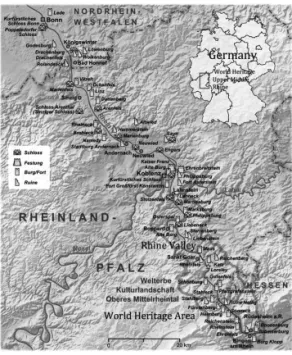
vineyards (Figure 1). Notably, the extended vine fi elds and its terraces have shaped the cultural landscape along the River Rhine for a period of over 1,000 years1) . Needless to say, these vine fi elds offer delicious, world-class wines, which are consumed and appreciated by many tourists. In addition, there exists a rich cultural heritage along the river valley, consisting of picturesque villages, as well as medieval castles and monasteries, which make a romantic atmosphere. For instance, along the river section of the World Heritage "Oberes Mittelrheintal" alone there are 40 castles and even more historic towns just within the World Heritage Cultural Landscape2) (Figure 2).
Second, another reason for the success of this area is its long-term promotion and marketing. By offering the fi rst package tours to British, Dutch, and later also American tourists, Thomas Cook promoted the Rhine valley as a destination on the international tourist map. Many of these tourists wrote fanciful travel reports, which at that time -- in addition to word-of-mouth propaganda -- were the only source of information for curious imitators (Dombrowsky 2011). Traveling the Rhine became a fashion. In the course of time, the romantic image of the Rhine solidifi ed and became a source of inspiration to many people.
What is the difference between then and now? Touring the Rhine in the old days necessitated slow movement by sailing and rowing boats. Visitors travelled the area intensively, with many stopovers and overnight-stays (Figure 3). From the mid-19th century, the revolution of the transport system by upcoming steam ships and train connections accelerated the speed of travel. This led to a reduction in the length of stays, which had consequences for travel patterns. In addition, the demands of modern tourists are very high. Furthermore, there are landscape changes. Basically, the river scenery and cultural landscape have been largely preserved, but creeping changes cannot be denied. Such changes and challenges will be addressed in the next section.
Figure 1: “Rheinsteig” hiking trail near Kaub, typical River Rhine Scenery with its vine fi elds, woods, castles and riverscape. Source: Dominik Ketz, Rheinland-Pfalz Tourismus GmbH ©
Figure 2: The World Heritage Cultural Landscape Upper Middle Rhine. Source: Wikipedia “von Lencer”, edited by author
F i g u r e 3 : C a s p a r S c h e u re n : L u s t i g e Rheinfahrt [Pleasing Rhine Trip] 1839 Source: Wikimedia Commons (image is in the public domain due to its age)
Purpose and Method of Study
Focusing on the German River Rhine, the purpose of this study is to illustrate selected key characteristics, challenges, and future-orientated approaches in contemporary rural heritage tourism. Firstly, I will analyze the regional situation (1). Subsequently, I will present a case study of an ancient Catholic (Cistercian) monastery as a concrete example of what is actually possible on the spot (2). Finally, I will discuss the case of the monastery in the context of the regional situation.
(1) With regard to the regional situation, I have requested available data about tourism and the environment from local authorities, tourist offi ces and citizens' groups (NPOs). I have focused on foreign tourist arrivals in the region, compared to the nationwide trend in overall Germany. I have asked tourist offi ces about the tourists' interests and preferences. Additionally, I have examined landscape changes with possible impact on the quality of the destination: impact by infrastructure development (noise pollution by freight trains) and impact by land use change of vine fi elds (abandoned fi elds on steep slopes). For details and sources of evidence see Table 1, Step 1: Regional Analysis (below).
(2) Next, I have surveyed an ancient Catholic (Cistercian) monastery (Kloster Eberbach) as a case study. Its signifi cance lies in the fact that despite its rural location (outside the famous World Heritage Area “Upper Middle Rhine Valley”) it has been a very successful destination in recent years. I have asked leading staff of the monastery foundation and wine-growing estate about its organizational structure and mode of operation, as well as efforts on restoration, wine production, sustainability, event management, and tourist numbers. Details and sources of evidence are defi ned in Table 1, Step 2: Local Analysis (case study).
Results
Step 1: Regional Analysis a) Investigation area
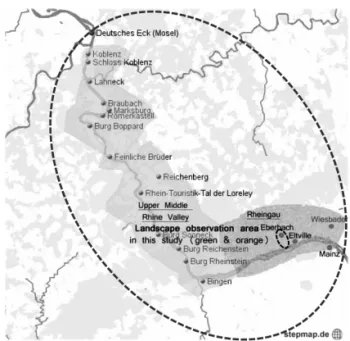
The following map shows the investigation area (Figure 4). It consists of the Middle Rhine Valley between the cities of Koblenz (North) and Mainz (Southwest). The zone from Koblenz to Bingen shows the World Heritage “Upper Middle Rhine Valley”. The zone from Bingen to Mainz is known as the “Rheingau” area, where the case study site “Kloster Eberbach” is situated next to Eltville (marked by a small black oval dotted line). Together, these two zones represent the landscape observation area in this paper. The catchment area of available tourist data is illustrated by the wides grey oval dotted line3). The latest and detailed foreign tourist arrival data was only available for the Rheingau area.
b) Tourist numbers and stream of visitors
Study Method: Objects of Investigation and Sources of Information
Step 1: Regional Analysis The Middle Rhine Valley and Rheingau AreaObjects of investigation Details, reasons, sources of evidence A. Investigation area:
The German River Rhine as a tourist destination. The Middle Rhine Valley between the cities of Koblenz and Wiesbaden/Mainz
This area includes the UNESCO World Heritage “Upper Middle Rhine Valley” and the adjacent “Rheingau” area. It is the most important river section for Rhine tourism. In addition, the case study site (step 2) is situated within this area. The following counties are included: Rheingau-Taunus-Kreis, Koblenz (Kreisfreie Stadt), Mayen-Koblenz, Rhein-Lahn-Kreis, and Mainz-Bingen.
B. Tourism: foreign visitors The overall tourism trend and recent tourist number s (foreign tourist arrivals, Inbound Tourism).
This study focusses on the Inbound Tourism trend, as our area has been a major destination for foreign tourists over a long period of time. Sources: 1) Dombrowsky, M. (2011): [New Touristic Offers in the Upper Middle Rhine Valley]. Latest inclusive tourism study of the main investigation area. 2) [The Regional Database Germany]: Statistical data in the form of standard tables. Data derived from the Regional Statistical Data Catalog of the German Federal Statistical Offi ce and the statistical offi ces of corresponding federal states (Länder).
3) Websites of various cooperative tourism initiatives of the region (see online references)
4) Survey of local tourism organizations (info by e-mail)
C. Landscape changes
Changes of the cultural landscape that are likely to have impact on the integrity and atmosphere as a (romantic) tourist destination
Without any doubt, cultural landscape is of importance for this destination. Sources:
1) Pro Rheintal e. V. (NPO) - impact of train infrastructure development on the Rhine valley (phone call with chairman Frank Gross on 2016/11/14 and website http://www.pro-rheintal.de/)
2) Regional Council of Darmstadt, Department of Viticulture - Dr. Christian Fischer. Land use change on terraced vine fi elds, with numbers of recent years and photos on-site (info by e-mail)
3) Peter Seyffardt, President of the “Rheingauer Weinbauverband”(regional viticulture union) - land use change in terraced vine fi elds (info by e-mail) Step 2: Local Analysis (case study) The former monastery “Kloster Eberbach”
Objects of investigation Details, reasons, sources of evidence
A. Object of investigation (historical summary)
The former Cistercian monastery “Kloster Eberbach” near the town Eltville am Rhein. This well-preserved heritage played an important role for viticulture and regional development of the Rheingau. However, the rural location makes it diffi cult to attract visitors. Being successful nevertheless is remarkable. Sources:
Dr. Hartmut Heinemann, Hessian State Archives (info by e-mail)
Dr. Wolfgang Riedel, historian, Kloster Eberbach “Circle of Friends” (phone call)
B. Landscape features and historical building stock
The monastery’s landscape setting and its historical building stock make the heritage authentic and outstanding. Sources (all information and data via e- mail):
Ms. Anke Haupt, Hessische Staatsweingüer GmbH Kloster Eberbach (Hesse State Wineries), Quality Management
Mr. Michael Palmen, Stiftung Kloster Eberbach (foundation), marketing, press & fundraising, event management and guided tours
Ms. Dipl.-Ing. Dagmar Söder, Chief Conservator, Landesamt für Denkmalpfl ege Hessen, cultural landscape analysis
C. Organization and management
To learn from “Kloster Eberbach” for heritage tourism means to understand its organizational structure and mode of operation. Main focus for heritage tourism is the rich event culture. What the monastery has to offer for its guests in terms of scenery, monuments, culture, winetasting, and hospitality is their point. Sources:
Ms. Anke Haupt, Hessische Staatsweingüer GmbH Kloster Eberbach (wine estate), Quality Management
Mr. Michael Palmen, Stiftung Kloster Eberbach (foundation), marketing, press & fundraising, event management and guided tours
Website: http://kloster-eberbach.de/en/monastery Table 1: Study objective, methods, sources
Heritage Upper Middle Rhine Valley over a period of 23 years (1995-2008). He showed that the average length of stay in the area is short. It dropped slightly from 2,4 nights in 1995 to 2,3 in 2008. At the same time, the overall number of visitors has been stable (Dombrowsky 2011:117).
In line with these results, the current trend from 2007 to 2014 for the World Heritage Upper Middle Rhine Valley and the Rheingau area has been reviewed for this paper4). In recent years,we see a decline in foreign visitor arrivals from 320,000 in 2007 to 295,000 in 2014 (values rounded). The number in 2014 is 92% of the number in 2007, hence a visitor decline of 8 % within seven years (grey-colored rows in Table 2).
By contrast, the nationwide trend shows a strong increase of foreign tourists visiting Germany, from over 24 million in 2007 to nearly 33 million in 2014. The number of 2014 is 135% of the number in 2007, hence an increase of 35% within the same time span of seven years (grey-colored rows in Table 3).
Next, let us have a closer look on foreign tourist arrivals in the Rheingau area, where our case study site is located. The total number of visitors from abroad declined, from 102,000 in 2008 to 94,500 in 2015 (Table 4, values rounded). The number in 2015 is 93% of the number in 2008, hence a visitor decline of 7 % in the Rheingau area within seven years. Here, we see a very similar
local trend as for the overall Middle Rhine Valley (Table 2). For the year 2009, the corresponding chart shows a clear slump in visitor numbers (Figure 5). The stream of visitors then recovered. Since 2014, a further downturn has occurred.
Year Arrivals 2007 319,955 2008 300,457 2009 279,956 2010 283,482 2011 278,596 2012 284,350 2013 289,120 2014 294,952 Percentage change from
2007-2014: -8%
Figure 4: The investigation area of this study (Middle Rhine & Rheingau) Source: Base map from “Openstreetmap” (edited by author)
Table 2: Foreign tourist arrivals to the Middle Rhine & Rheingau. Source: The Regional Database Germany Year Arrivals 2007 24,420,672 2008 24,884,017 2009 24,219,634 2010 26,875,288 2011 28,351,523 2012 30,410,491 2013 31,545,132 2014 32,999,298 Percentage change from
2007-2014: +35%
Table 3: Foreign tourist arrivals to Germany. Source: The Regional Database Germany
Furthermore, if we look at the most signifi cant countries tourist arrivals shown in Table 4, we notice a rather stable stream of visitors from most European countries. A sharp decline is registered for the UK and Japan. In particular, for Japan, the number of visitors in 2015 (5,640) is only 38% of the number in 2008 (14,615). Possible reasons for this trend will be a subject in the discussion.
c) Landscape changes
The fact that the “Upper Middle Rhine Valley” has been designed as a World Heritage Cultural Landscape underlies the importance of landscape for this destination. At fi rst glance, even with modern infrastructure development, the River Rhine landscape seems almost intact. Only on closer inspection does it become clear that there are some challenges to be faced.
1) Scenic changes and noise pollution by trains running through the Rhine Valley Foreign Tourist Arrivals in the Destination Rheingau Area 2008-2015
Country of origin (permanent residence) Arrivals (total) Arrivals (total) Arrivals (total) Arrivals (total) Arrivals (total) Arrivals (total) Arrivals (total) Arrivals (total) Year 2008 2009 2010 2011 2012 2013 2014 2015
From abroad (total)* 102,063 93,441 99,304 99,825 99,515 102,153 100,275 94,521
Denmark 11,984 11,664 14,232 12,455 11,955 10,852 10,290 9,508 France 4,414 3,985 4,604 4,005 3,662 3,443 4,216 4,431 Netherlands 8,279 8,665 8,433 8,239 8,338 8,679 9,292 10,152 Norway 4,156 3,264 3,173 3,081 3,365 4,328 3,917 3,057 Switzerland 5,744 5,341 5,341 7,287 6,623 6,096 5,508 5,430 United,Kingdom,(U.K.) 15,170 15,049 14,519 13,904 12,018 12,639 13,558 12,673 Asia,(total),* 17,143 13,866 15,346 16,410 18,573 20,858 18,441 14,549 China,(incl.,Hongkong) 597 821 762 1,051 1,578 2,739 5,304 5,699 Japan 14,615 11,728 13,117 12,835 14,547 14,953 9,602 5,640 United,States,(U.S.A.) 5,494 4,490 6,008 6,208 6,075 6,856 6,095 5,923 *Please notice: Since this is a table extract and some countries are not reproduced here, the total sum does not correspond to the sum of the indicated numbers of individual countries.
Table 4: Foreign Tourist Arrivals in the Rheingau Area 2008-2015 (total) and most signifi cant countries. Source: © Hessisches Statistisches Landesamt, Wiesbaden, 2016 (edited by author).
Figure 5: Foreign tourist arrivals in the Rheingau area 2008-2015. Compare with Table 4, row 1 “From abroad”
104,000 102,000 100,000 98,000 96,000 94,000 92,000 90,000 88,000 2008 2009 2010 2011 2012 2013 2014 2015
Foreign tourist arrivals in the Rheingau area 2008-2015
Historically, from the 1860s, the fi rst railway lines were constructed in the valley of the Middle Rhine, directly alongside the river. For this, rocks had to be blown up, tunnels built and vineyards removed. Such constructions meant a scenic loss, including a loss of romantic atmosphere to some degree (Dombrowsky 2011:63). In many places, the railroad tracks also separated the cities from the riverbank, which led to scenic impact (ibid). The consequences are still visible today, although contemporary visitors may be used to this (compare Figure 6 with Figure 7).
However, more problematic is severe noise pollution by freight trains passing through the Rhine valley. A passing train produces a sound with a volume of 100 decibels, which is proven to be harmful to health. In the Rhine valley, an unfortunate combination of a high number of trains per day (~400) and night (~100), outdated freight vehicles, and the steep valley slopes refl ect and intensify the noise (Figure 8). Such regular railway noise is not only a burden to local residents, but also a major tourist problem, especially in terms of overnight tourism (Gross 2016)5).
To counter this serious problem, the NPO citizens group “Pro Rheintal” has been founded in 2007. With the help of various scientists, it was recognized that noise must be muted at source. The greatest noise source in rail traffi c is the contact surface between the wheel and the rail. Above all, outdated freight vehicles make the biggest noise, as they use grey cast iron brakes that push directly onto the wheel surfaces. The wheel tread surfaces are thereby intertwined, giving rise to a rushing sound. This can be solved by using plastic instead of grey cast iron, which has been used for trucks for decades (Gross 2016).
As a result of its countless efforts, “Pro Rheintal”
Figure 6: Tanner, Johann Jakob: Bingen am Rhein around 1840, before road and railway constructions (image is in the public domain due to its age)
Figure 7: Railway tracks between the riverbank and settlements today, in the same Middle Rhine area. Source: http://www.pro-rheintal.de/
Figure 8: Railway tracks, noise map and the tunnel effect of noise in the investigation area (Middle Rhine & Rheingau). Source: http://www.pro-rheintal.de/ (edited by author).
has been able to achieve an agreement that 50% of freight cars will be retooled with new, more silent plastic brakes by the end of 2016, and 100% by 2020. In addition, rail web shields from the Japanese manufacturer Sekisui provide noise reduction on the rail, which has already been implemented on both sides of the Rhine6). Using cutting-edge technology, a small noise barrier made of metal is attached directly to the rail and fi xed with a special material (Calmoon) to prevent these plates from resonating (Figure 9). This reduces the sound effectively (ibid).
2) Scenic changes due to abandoned vine fi elds along the Rhine Valley
Another issue for the landscape is related to wine production. Vine terraces have shaped the cultural landscape along the River Rhine since long before tourism
arrived (Burggraaff 2001). Together with a rich historical heritage, these vine terraces served as a main scenic feature for tourists visiting the Rhine Valley. Without its vine fi eld scenery, the Middle Rhine Valley would not have become a World Heritage Site (Mittelrhein-Wein e.V. 20167)).
However, following the mechanization of viticulture and higher labor costs since the 1960s, it became economically less profi table to operate viticulture on the Rhine, especially on steep slopes. Dombroswsky (2011:48) shows a table of Kramer (2005:70) with the area of vineyards in the Upper Middle Rhine Valley.
According to these data, within four decades, the area under cultivation dropped by 40%. At the same time, Dombroswsky (2011) mentions fi nancial incentives as a countermeasure, in order to stop the loss of vine fi elds along the River Rhine.
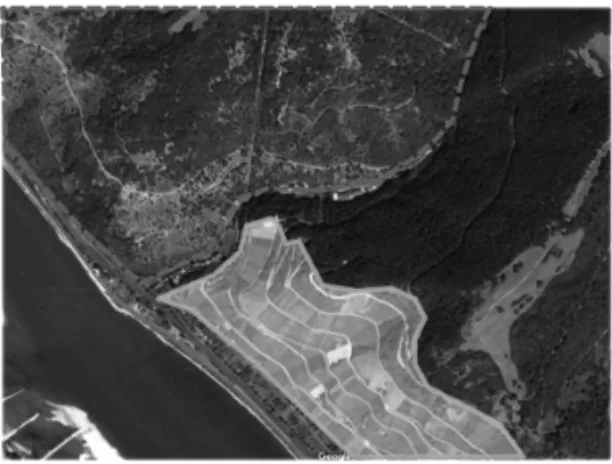
Based on this information, the present essay examines the development of viticulture on steep slopes in recent years. It is interesting to learn that regional experts have become very active in tackling this problem. On the one hand, it is true that abandoned vineyards have been a serious problem. We still see vineyards which have
Figure 9: Latest Calmmoon Rail Railtrack noise shielding made by Sekisui (Japanese manufacturer).
Source: http://www.pro-rheintal.de/
Figure 10: Advanced succession of an abandoned vineyard terrace on the Middle Rhine Valley. Source: Regional Council of Darmstadt, Department of Viticulture ©
Figure 11: Aerial view of wine fi elds in Lorchhausen. Upper part: Abandoned fi elds. The hill is covered up with bushes. Trails between the former fi elds are still visible. Bottom part: Wine fi elds still under cultivation. Source: Regional Council of Darmstadt, Department of Viticulture © (edited by author)
grown completely out of control. Without countermeasures, such slopes will become forests within a few decades (see Figure 10 and Figure 11).
On the other hand, recent developments are encouraging. Since the 1990s, there exists an agricultural support program in the State of Hesse8), available for winemakers who continue to cultivate steep slopes (a program called HALM). In 2003 the program was notifi ed to the European Union (EU-Regulation No. 1308/2013).
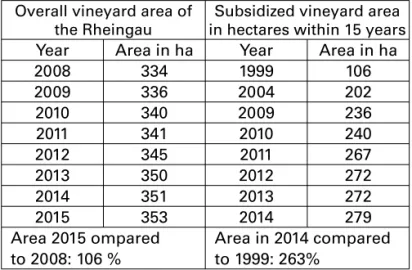
Offi cial statistics of Table 5 show a consolidation of the vineyards in Hesse. In particular, the strong loss of land in the past has been effectively stopped. We now see a moderate increase in the overall cultivated land area (106%), and a strong increase in subsidized vineyard area on steep slopes (263% of the area in 1999). Information provided by local tourist agencies and the Rheingau viticulture union underline this positive trend. Asked if changes in the landscape due to abandoned vine fi elds are perceived by the tourists, the author received the following reply:
“If only individual parcels are laid, this is not the case. But if there are larger (abandoned)
areas, the visitors, perhaps unconsciously, might notice the change in the landscape. However, there is currently no increase in the fallow land area. When bare areas are visible, these are usually vineyards that are replanted.” 9)
Figure 12 shows exactly such a replanted or recultivated vineyard.
Discussion & Conclusion 1: Regional Analysis
First let us discuss tourism fi gures. As the fi gures above demonstrate, overall foreign tourist numbers to the Rhine Valley are stagnating, while they are rising for all of Germany. What could be the reason for this gap? There is probably no simple answer. Still, the author would like to share a few thoughts.
When giving lectures about tourism and culture at Toyo University, I noticed that most students
Overall vineyard area of the Rheingau
Subsidized vineyard area in hectares within 15 years
Year Area in ha Year Area in ha
2008 334 1999 106 2009 336 2004 202 2010 340 2009 236 2011 341 2010 240 2012 345 2011 267 2013 350 2012 272 2014 351 2013 272 2015 353 2014 279 Area 2015 ompared to 2008: 106 % Area in 2014 compared to 1999: 263%
Table 5: Overall vineyard area in the Rheingau (left) and subsidized steep slopes (right). Source: same as in Figure 11
Figure 12: Recultivation of an abandoned vineyard on a steep slope, promoted with agricultural funds by the state of Hesse and the EU. Source: Regional Council of Darmstadt, Department of Viticulture ©
donʼt know anything about the River Rhine. The same holds true for private talks with other young people in Japan. However, when talking to older people, many of them know or even have been travelling to this destination. This is indicative of a generation gap. Table 4 shows a sharp decline of Japanese tourists to the Rheingau in the past seven years (-38%). This decline means that the tourist industry in the River Rhine has to do more to reach younger people. Undoubtedly, the region has much to offer. Cooperation among municipalities for image-building is increasing, and a modern tourism infrastructure is developing, such as wine trails, wine tasting, and various cultural events, including castle tours and interactive museums for children and teenagers, and spa, sauna and wellness package deals10).
Nevertheless, it seems that few young Japanese people are attracted by this. From the authorʼs perspective, it is necessary to change or expand the regionʼs marketing strategy. By contrast, Chinese tourist numbers have skyrocketed in the same time span. This is not a big surprise, as the standard of living of many Chinese has improved. Some are now catching up on what Japanese people have been able to do since several decades ago.
Furthermore, generally speaking, travel has become almost global. This has made competition very fi erce, even for established tourist destinations such as the Rhine.
Second, let us comment on the described landscape changes described above. On the basis of literature studies, the author expected serious landscape diffi culties, especially for the vineyard landscape. After research and analysis of recent developments, however, he is really surprised.
For instance, it is remarkable that in only nine years, the citizen initiative Pro Rheintal e.V. has succeeded in solving the extensive noise problem by passing freight trains. And it is a great achievement to convince politicians to provide sound fi nancial resources for the modernization of railway technology. Long-term effects for overnight tourism are also not to be underestimated. Who would like to spend a holiday (and night) on the “Romantic Rhine” with never ending noise from passing trains? Probably nobody. And that is why the noise reduction is so important and valuable.
Similarly, it is impressive how proactively the problem of abandoned vineyards on steep slopes has been handled. In the area investigated in this study, targeted agricultural incentives at state and EU level reach committed winegrowers on the ground. This helps with the preservation of an amazing cultural landscape. In rural Germany, agriculture, landscape preservation, and cultural tourism is increasingly regarded as a unifi ed entity. Regional stakeholders, including responsible authorities, are now working together to solve problems that exceed individual areas of interest or expertise. It is the authorʼs wish that such interdisciplinary cooperation might become a source of inspiration for preservation and cultural tourism in Japan, too, in particular for its rural areas.
Step 2: Local Analysis (Case Study)
a) Object of investigation (historical summary)
monasteries in Germany. It is located in the Rheingau county, next to the town “Eltville am Rhein”, elevated on the banks of the River Rhine (Figure 4, Figure 13).
In 1136, Cistercian monks came all the way from Clairvaux (France) to Eberbach. These monks were able to found Eberbach with the backing of Archbishop Adalbert I of Mainz. Within the following centuries, the monastery fl ourished, and acquired widely distributed farms, rural estates, and urban sales centres in the region (Riedel 2014, Heinemann 2014, 2015). Eberbach became the largest winemaker in Germany. In 1803, the abbey was dissolved by Prince Friedrich August von Nassau-Usingen and converted into a wine-growing domain11).
After World War II, the monastery came into the possession of the Federal State of Hesse, administrated by the Hessian State Wine Domains. In the course of time, the monastery buidlings were threatened by increasing disintegration.
However, in 1986, the State of Hesse decided to renovate the entire monastery complex. In the same year, parts of the movie “The Name of the
Rose” were fi lmed in this monastery12). Thereby, it became increasingly well-known to the public. In 1998, the monastery complex was transfered into a public foundation, to provide access for the general public, and to continue its preservation.
What makes this monastery a great destination for heritage tourism? It is likely to be the combination of its landscape, historic building fabric, high-quality wine production, wine- tasting and gastronomy, and, above all, its various cultural events. In the following, all these factors are briefl y mentioned; but due to limited space, I will focus on the organization and cultural program.
b) Landscape features and historical building stock
Kloster Eberbachʼs location was selected carefully. Monasteries had to be self-suffi cient. Access to fresh spring water and fi rewood provided by the nearby forest, animal husbandry, and orchards added to their lucrative viticulture. Söder (2007) reveals such traces of historical land use, which are still visible in the landscape (Figure 15, Figure 16). In order to make the context of this monastic
Figure 13: Monastery Kloster Eberbach near Eltville a. Rhein. Oldest wine map of the Rheingau county (ca. 1870s). Source: Kloster Eberbach (edited by author)
Figure 14: Kloster Eberbach, courtyard with former library. Source: Stadt Elteville ©
landscape tangible, the forgotten Klosterrundweg (cloister loop path) has been renovated and was opened in 2015. The cloister loop path gives access to the direct surroundings of the monastery.13) It is visited by the tourists with interest (Palmen 2016).
To illustrate the historic building stock of the monastery itself is beyond the scope of this paper. However, it is worth mentioning that most of the historic buildings, e.g. the basilica, the monksʼ dormitory, and the old wine cellar can all be visited (Figure 17, Figure 18). Step by step, the 33 buildings of the monastery complex are being completely renewed by a general renovation, so far supported by the state of Hesse with an amount of 89 million euros (Jahresbericht 2015).
c) Organization and management
Finally, I will introduce the professional organization and management of Kloster Eberbach, which is outstanding. It is fair
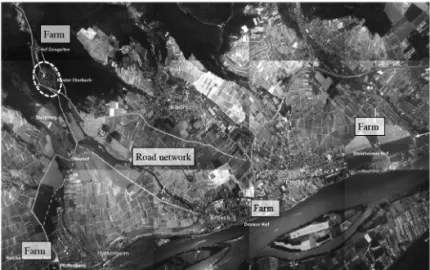
Figure 15: Aerial view on the monastic landscape Eberbach today. The oval dotted line shows the monastery. Pathways to its farms (through the vineyards) are visible. Source: Dagmar Söder, Landesamt für Denkmalpfl ege Hessen © (edited by author)
Figure 18: Old wine cellar with original wine presses from the Middle Ages (still functional). Source: Stadt Elteville ©
Figure 17: Koster Eberbach Monksʼ dormitory hall. Source: Stadt Elteville ©
Figure 16: Aerial picture of Kloster Eberbach, still surrounded by a rich cultural landscape. Source: Dagmar Söder Landesamt für Denkmalpfl ege Hessen ©
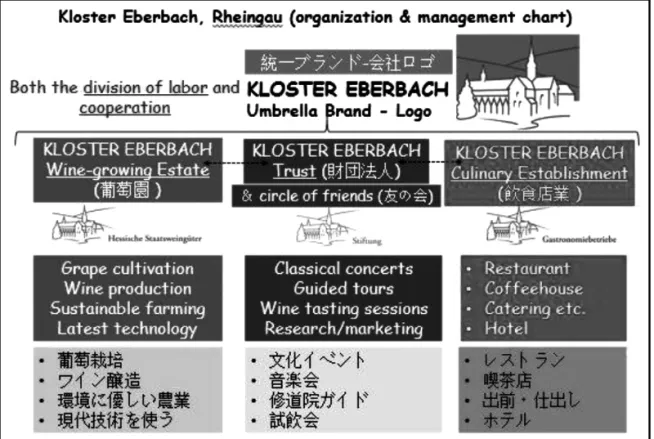
to say that Eberbachʼs expertise sets new standards, especially for heritage tourism. Today Eberbach is run by three independent corporations, which are linked and promoted by a single umbrella brand named “Kloster Eberbach”:
1) Hessische Staatsweingüer GmbH Kloster Eberbach (wine estate, wine production) 2) Stiftung Kloster Eberbach (foundation, cultural events in the monastery)
3) Gastronomiebetriebe Kloster Eberbach (hotel & gastronomy) In the following, these three pillars of Eberbach are briefl y explained: First, the wine estate “Hessische Staatsweingüer
GmbH” emerged from the former Hessian State Wine Domains. In 2003, it became a company, but it remains 100% the property of Hesse, with a statute underlying the goals for the wine estate, as for instance:
● To preserve the cultural landscape
● To continue wine production in a responsible manner,
and
● To keep the steep vinery slopes in the Rheingau
under cultivation
Today, to produce high-class wines, mainly Riesling, the wine estate uses cutting-edge technology (Figure 19). In 2014, they introduced a new optical sorting system, which can be used to sort grapes between ripe and rotten grapes. In addition, their wine is cultivated according to sustainable and green standards, using only a minimum of chemical fertlizers and pesticides (減農薬) in the fi elds (Figure 20). The wine estate also offers guided tours through the vineyards, with wine tastings outside (Haupt 2014).
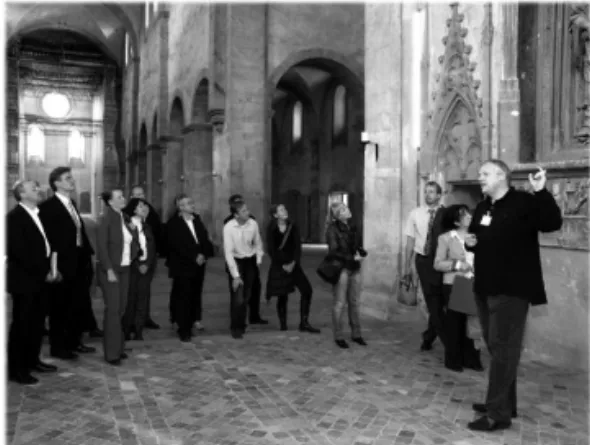
Second, the foundation “Stiftung Kloster Eberbach” is responsible for a wide variety of cultural events in the monastery itself, including the preparation and implementation of a rich cultural program for different target groups. The foundation arranges classical concerts, guided tours, wine tasting sessions, and the marketing (Palmen 2016, Figure 21). This includes historical research by experts of the affi liated “Freundschaftskreis Eberbach” (Friendsʼ Association). In addition, the foundation plans and supervises the ongoing restoration of the heritage site
Figure 19: Modern wine production. Wooden barrel cellar. Source: Hessische Staatsweingüter GmbH Kloster Eberbach
Figure 20:Steinberg vineyard scenery on a warm summer day. Source: Hessische Staatsweingüter GmbH Kloster Eberbach
Figure 21: Guided tour in the Basilica of Eberbach Monastery. Source: Kloster Eberbach
(Jahresbericht 2015).
In particularly, customer-oriented offers and services, such as wine tasting in different settings or special historical tours for children are to be mentioned.
How successful overall are these activities? On the one hand, the rising prominence and regocnition of Eberbach in print may be interpreted as a sign of great success. In 2015, many regional and transregional print and online media featured articles about Eberbach. In addition, the monastery received the KOMPASS Prize from the Federal Association of German Foundations for the category “professional foundation management” (Jahresbericht 2015). This is a great honour. On the other hand,
Figure 22: Visitor numbers to Kloster Eberbach 2007 - 2014 (box- offi ce tickets only) Source: Kloster Eberbach © (edited by author)
Figure 23:Organization & management chart of Kloster Eberbach (overview). Made by author. 110,000 105,000 100,000 95,000 90,000 85,000 80,000 2007 2008 2009 2010 2011 2012 2013 2014
Visitor numbers Kloster Eberbach 2007-2014
if we look at the visitor numbers over the past eight years, the verdict is mixed (Figure 22). Possible reasons for this will be discussed below.
Third, if we look at the fi eld of hospitality which is so important for tourism, hotel and gastronomy are dealt with professionally by various facilities. The cloister restaurant “Klosterschänke” serves local specialities, including excellent wine and tasty beer produced by the monastery. The affi liated hotel “Gästehaus” has modern furnished rooms in a moderate style within the ancient buildings of the monastery, which also has its own new sauna complex. There is also a monastery shop, where wine, beer, and souvenirs can be purchased.
The three pillars of Eberbach and their roles are illustated in Figure 23.
Discussion & Conclusion 2: Local Analysis (Case Study Kloster Eberbach)
Basically, in the case of such an ancient Cistercian monastery like Eberbach, one can expect potential for heritage tourism. This is also related to its special scenic location on the banks of the River Rhine and its vineyards.
Nevertheless, the success of the monastery, which is very rural, and thus where visitors do not even pass by, is remarkable. Without doubt, the general renovation of the monastery, backed by the federal state of Hesse for 20 years, has been a prerequisite for todayʼs success. Without an intact building fabric and and a dignifi ed aura, even a place steeped in history may quickly lose its appeal. This being said, however, the success of the former monastery cannot be explained merely by its general renovation. Rather, the unique organizational structure and operation of the former monastery guarantees high quality in all areas of expertise:
First, we can see wine production at the highest level, using cutting-edge technology, and following eco-friendly standards. At the same time, it is still embedded in the history of the place.
Second, the same is true for its restoration, cultural program, and event management. The marvellous state of the buildings, open space, and cultural landscape provides an impressive, carefully restored backdrop and landscape setting. And, most important, to be able to make the right decisions (how to fi nd the delicate balance of restoration of the old and development of the new), independent historical research, supported by the Friendsʼ Association, makes all the difference when it later comes to the implementation of measures on the ground. It is not just about the appropriate, accurately executed manual renovation by the craftsmen, but also about the vision for the overall context. It it this vision and understanding that ̶ without a sound historical and planning expertise ̶ often falls behind.
As a result of this overall expertise and activities on-site, Kloster Eberbach sets new standards for heritage tourism.
Finally, there only remains the question of stagnating visitor numbers. Basically, around 100,000 vistors per year in Eberbach can be regarded as a high number, which refl ects the success of the monastery. However, the pattern shown in Figure 22 is somehow similar to the pattern for the whole
region seen in Figure 5. The decline in visitor numbers in 2009 (and 2010) is seen as a direct result of the economic crisis following the collapse of Lehman Brothers in the autumn of 2008. The numbers then rise again.
Though, the recent decline since 2013/2014 raises questions. Should this be associated with the increased risk of terrorism in Europe after the terrible IS attacks in France? This would constitute a supra-regional reason, which might explain the new downward trend. Apart from that, the Rheingau as well as Eberbach itself will have to think about the future trend in cultural tourism. For this in particular, it is important to understand all target groups in their way of life even better, in order to make improved offers, according to peopleʼs lifestyle, dreams, and preferences.
The author is convinced that the Rhine as a tourist destination in general and Kloster Eberbach in particular have the skills and potential to cope with this ongoing challenge.
Acknowledgments
Sincere thanks from the author to all contact persons in the region. For their ongoing support, I am particularly grateful to the following persons and institutions: Dr. Christian Fischer (Regierungspräsidium Darmstadt, Dezernat Weinbau), Jacek Walsdorfer (Hessisches Statistisches Landesamt), Frank H. M. Gross (Bürgernetzwerk Pro Rheintal e. V.), Anke Haupt (Hessische Staatsweingüter GmbH Kloster Eberbach), Michael Palmen (Stiftung Kloster Eberbach), Dr. Hartmut Heinemann (Hessisches Hauptstaatsarchiv), Dr. Wolfgang Riedel (Freundschaftskreis Kloster Eberbach), Dipl.-Ing. Dagmar Söder (Landesamt für Denkmalpfl ege Hessen), Ingried Steiner (Rheingauer Weinwerbung GmbH / Rheingauer Weinbauverband e.V.), Hiltrud Specht (Mittelrhein-Wein e.V.), Rolf Wölfert (Rüdesheim Tourist AG), Gabriele Frijio (Rheinland-Pfalz Tourismus GmbH), and Birgit Roßkopf (Stadt Eltville am Rhein).
For kind native language support and corrections I would like to thank Dr. Alice Freeman (English, United Kingdom) and Associate Professor Dr. Kazuko Okamoto (Japanese, Japan).
Notes
All photos and graphs with copyright have been used with kind permission by indicated sources. 1) Cultural landscape (文化的景観): There is no universal defi nition of cultural landscape. However, most
experts regard it as a rather rural area, shaped by traditional farming, forestry, and culture (Konold 2012, Edani 2012). Landform, scenery, long-lasting agricultural practices, local building stock and lifestyle result in a regional unique character. From the perspective of the author, to understand this character and sell it in an appropriate manner as a part of the tourism product, is a key for successful heritage tourism (Vafadari 2013, Poggendorf 2015).
2) The “Upper Middle Rhine Valley” is a 65-km section of the River Rhine between the towns Koblenz and Bingen in Germany, which has been inscribed as a World Heritage Cultural Landscape since 2002. For
further information, see the UNESCO webpage: http://whc.unesco.org/en/list/1066
3) The investigation area includes fi ve administrative districts along the Rhine Valley: Rheingau-Taunus-Kreis, Koblenz (Kreisfreie Stadt), Mayen-Koblenz, Rhein-Lahn-Rheingau-Taunus-Kreis, and Mainz-Bingen. In fact, the borderline and overall area of these counties differ. However, this oval line is suffi cient to represent the catchment area.
4) Data collection consists of foreign tourist arrivals in the investigation area, compare footnote 3.
5) The information and data about noise pollution in the Middle Rhine Valley have been provided by Mr. Frank Gross, chairman of the citizens group “Pro Rheintal”. Phone talk and e-mails on 2016/11/14, with kind permission to use the graphics. Further information provided by Professor Markus Hecht, Department of Rail Vehicles, Technical University Berlin, in the documentary “Stille Bahn” (Silent Train) on http://www.3sat.de/mediathek/ (produced April 30th, 2014, fi ndable on this webpage with keyword search “Stille Bahn”).
6) For further information please see: SEKISUI Infrastructure and Environmental Engineering, SEKISUI Chemical GmbH, Germany: http://www.sekisui-rail.com/en/calmmoon-rail-en.html
7) Mittelrhein-Wein e.V., St. Goar, Ms. Hiltrud Specht on 2016/11/16 fi rst-hand information via e-mail 8) Data are available only for the Rheingau (Hesse). However, Peter Seyffardt, president of the regional
viticulture union, has indicated that a similar trend is true for the whole investigation area (e-mail of 2016/11/07).
9) Statement by Ms. Isabel Meyer, Rheingauer Weinbauverband (viticulture union) on 2016/11/16 via e-mail, translated into English (by the author).
10) The following website provides information in three languages on current tourism offers on the Middle Rhine, for various target groups: “The Romantic Rhine”: http://www.romantischer-rhein.de/en/region 11) 1803 is the year of secularization in Germany; consequently, monasteries were dissolved and church land
expropriated. Eberbach was also affected by this.
12) “The Name of the Rose” is a 1986 Italian-French-German drama mystery fi lm playing in a medieval abbey, directed by Jean-Jacques Annaud, with Sean Connery, and based on the book of the same name by Umberto Eco.
13) The restoration of this loop path was promoted by the EU-LEADER program, which is funding projects at the local level in order to revitalize rural areas (Söder 2016, via e-mail to the author, from 2016/11/21).
References
Burggraaff, P. (2001). UNESCO-Weltkulturerbe Mittelrheintal: Kulturlandschaftspfl ege als Managementkonzept [UNESCO World Cultural Heritage Middle Rhine Valley: Cultural Landscape Maintenance as a Management Concept]. Koblenzer Geographisches Kolloquium. H. Fischer and R. Graafen. Koblenz-Landau: 27-43.
Dombrowsky, M. (2011). Neue touristische Angebote im Oberen Mittelrheintal [new tourist offers in Upper Middle Rhine Valley]. Martin Meidenbauer Verlagsbuchhandlung, München.
Edani, H. (2012). Conservation and Management of Cultural Landscapes. Paper of the Nara National Research Institute for Cultural Properties. Open pdf-online-source: www.nara.accu.or.jp/elearning/2012/ conservation.pdf
Fischer, C. (2016). Regierungspräsidium Darmstadt [Regional Council of Darmstadt]. In addition to statistical data, explanation about vineries and winegrowing promotion policies in the Rheingau area, kindly provided for the author of this essay on 2016/11/11 via e-mail.
Gross, M. F. (2016). Data on noise pollution by freight trains in the Middle Rhine Valley and possible solutions, kindly provided for the author of this essay on 2016/11/14 via e-mails and a 10-minute telephone conservation.
Haupt, A. (2014). Data on the wine estate and overall mode of operation of Eberbach, kindly provided for the author of this essay on 2014/11/03, 10/09, 10/08 & 09/16 via e-mails.
Heinemann, H. (2014). Data on the history of the monastery Eberbach and its estates, kindly provided for the author of this essay on 2014/11/05 via e-mail.
Heinemann, H. (2015). Höfe, Güter und Einkünfte des Klosters Eberbach im Mittelalter. Ein Überblick [farms, estates and income of the monastery Eberbach in the Middle Ages. An overview.]. In: Nassauische Annalen 126, 2015, S. 71-124.
Jahresbericht (2015). Annual report of the foundation Stiftung Kloster Eberbach, latest developments and achievements of the monastery (published online in July 2016: http://kloster-eberbach.de/downloads (click task bar “Kloster”)
Konold, W. (2012). Die funktionale, ideengeschichtliche und sozialhistorische Substanz von Kulturlandschaften [the functional, conceptual and social-historical substance of cultural landscapes]. Schriftenreihe des Landesamtes für Denkmalpfl ege Bremen 9: 312-322.
Kramer, W. (2005). Welterbe Oberes Mittelrheintal -- Bodennutzungen in einer alten Kulturlandschaft [World Heritage Upper Middle Rhine Valley - land use in an old cultural landscape]. Statistische Monatshefte Rheinland-Pfalz 2005 (2): 59-73.
Palmen, M. (2016). Data on the foundation and overall cultural event management of Eberbach, kindly provided for the author of this essay on 2016/11/24, 11/22,11/18 & 11/07 via e-mails.
Poggendorf, L. (2015). Traditional Cultural Landscape and Satoyama. 比較思想・文化研究 Vol.6 (2015). Open pdf-online-source: http://www.thought-and-culture.net/
Riedel, W. (2014). Information on the history of the monastery Eberbach, kindly provided for the author of this essay on 2014/10/07 via a 30-minute telephone conservation.
Söder, D. (2016): Data on the cultural landscape setting of the monastery Eberbach, kindly provided for the author of this essay on 2016/11/21 & 11/18 via e-mails.
Söder, D. (2007). Das Kloster Eberbach und seine Spuren in der Rheingauer Landschaft [The monastery Eberbach and its traces in the Rheingau landscape]. In: Denkmalpfl ege & Kulturgeschichte 3/2007, S. 34-41.
Vafadari, K. (2013): Exploring Tourism Potential of Agricultural Heritage Systems: A Case Study of the Kunisaki Peninsula, Oita Prefecture, Japan. In: Macrothink Institute. Issues in Social Science. ISSN 2329-521X, 2013, Vol. 1, No. 1.
Web sources online (all online sources last viewed on 2016/11/24)
Die Regionaldatenbank Deutschland [The RegionalDatabase Germany] https://www.regionalstatistik.de/genesis/online Hessisches Ministerium für Umwelt, Klimaschutz,
Landwirtschaft und Verbraucherschutz https://umweltministerium.hessen.de/landwirtschaft/ weinbau Kloster Eberbach http://kloster-eberbach.de/en/monastery
Klosterlandschaft Eberbach In: KuLaDig, Kultur.
Landschaft.Digital. https://www.kuladig.de/Objektansicht/P-TB- 20100825-0015 Kulturland Rheingau (municipal cooperative
initiative) http://www.kulturland-rheingau.de/
Mittelrhein Momente (Winegrowers and
gastronomy) http://mittelrheinmomente.de/
Mittelrhein-Wein e.V. http://www.mittelrhein-wein.com/index.html Pro Kulturlandschaft Rheingau e.V. http://www.pro-kulturlandschaft-rheingau.de/ Pro Rheintal e.V. http://www.pro-rheintal.de/index.html Rüdesheim Tourist AG http://www.ruedesheim.de/en/
SEKISUI Chemical GmbH, Germany http://www.sekisui-rail.com/en/calmmoon-rail-en.html The Romantic Rhine http://www.romantischer-rhein.de/en/region/
UNESCO Welterbe Oberes Mittelrheintal http://portalseite.welterbe-mittelrhein.de/index.html Upper Middle Rhine Valley (UNESCO) http://whc.unesco.org/en/list/1066
Zweckverband Welterbe Oberes Mittelrheintal