NOTE Virology
Full Genome Sequences of Zebra-Borne Equine Herpesvirus Type 1 Isolated from
Zebra, Onager and Thomson’s Gazelle
Xiaoqin GUO
1), Satoko IZUME
1), Ayaka OKADA
1), Kenji OHYA
1, 2), Takashi KIMURA
3)and Hideto FUKUSHI
1, 2)*
1)Department of Applied Veterinary Sciences, United Graduate School of Veterinary Sciences, Gifu University, 1–1 Yanagido, Gifu
501–1193, Japan
2) Laboratory of Veterinary Microbiology, Faculty of Applied Biological Sciences, Gifu University, 1–1 Yanagido, Gifu 501–1193, Japan 3)Laboratory of Comparative Pathology, Graduate School of Veterinary Medicine, Hokkaido University, Kita 18, Nishi 9, Kita-ku,
Sapporo 060–0818, Japan
(Received 6 April 2014/Accepted 23 May 2014/Published online in J-STAGE 11 June 2014)
ABSTRACT. A strain of equine herpesvirus type 1 (EHV-1) was isolated from zebra. This strain, called “zebra-borne EHV-1”, was also isolated
from an onager and a gazelle in zoological gardens in U.S.A. The full genome sequences of the 3 strains were determined. They shared 99% identities with each other, while they shared 98% and 95% identities with the horse derived EHV-1 and equine herpesvirus type 9, respectively. Sequence data indicated that the EHV-1 isolated from a polar bear in Germany is one of the zebra-borne EHV-1 and not a recombinant virus. These results indicated that zebra-borne EHV-1 is a subtype of EHV-1.
KEY WORDS: equine herpesvirus, genome sequence, zebra
doi: 10.1292/jvms.14-0183; J. Vet. Med. Sci. 76(9): 1309–1312, 2014
Equine herpesvirus type 1 (EHV-1; genus Varicellovirus,
subfamily alphaherpesvirinae) has been isolated from zebras
and other zoo animals [1, 8, 12, 16, 21]. Especially, the 1
iso-lated from zebras has been focused as an emerging agent
in zoo animals. The EHV-1 associated with zebras has been
called as zebra-borne EHV-1 [1]. Zebra-borne EHV-1 has
been isolated from wild equids kept in zoological gardens.
EHV-1 T-529 was isolated from a Persian onager (Equus
hemionus onager) fetus in February 1984 [16].
Associ-ated with this case, a 9-month-old male plains zebra (Equus
quagga burchelli), which was kept in a pen adjacent to the
onagers, developed illness a week after the onager abortion.
In October 1984, a Grevy’s zebra (Equus grevyi) at the
Lin-coln Park Zoo in Chicago aborted a fetus from which EHV-1
T-616 was isolated [21]. Systemic infection by EHV-1 in a
Grevy’s zebra stallion was also reported in 1998 [2]. EHV-1
has been isolated from non-equine species including camels,
antelopes, cattle, fallow deer, alpacas, llamas and Thomson’s
gazelle (Eudorcas thomsoni) from which EHV-1 94-137 was
isolated [12]. A polar bear (Ursus maritimus), named Jerka,
kept in a zoo in Berlin died from acute encephalitis [8], and
a strain of zebra-borne EHV-1 was subsequently isolated
from it. The nucleotide sequence analysis of the Pol gene
(ORF30 in EHV-1 gene nomenclature [18], a homologue of
herpes simplex virus 1 (HSV-1) UL30) in this virus
indi-cated that the virus was a recombinant virus between EHV-1
and equine herpesvirus type 9 (EHV-9), which was isolated
from an epizootic encephalitis of Thomson’s gazelles kept
in a zoo in Japan [4, 5]. A similar zebra-borne EHV-1 was
detected in an Indian rhinoceros (Rhinoceros unicornis)
af-fected by severe neurological disease [1]. All of these cases
were reported to be associated with zebras (E. q. burchelli
and E. gravyi) kept at places close to the affected animals.
In the present study, we determined the full genome
sequences of 3 zebra-borne EHV-1s isolated from a zebra,
an onager and a gazelle (strains T-616, T-529 and 94-137,
respectively). We have reported the phylogenic relatedness
among the 3 viruses based on the nucleotide sequences of the
genes for glycoproteins B (ORF33, a homologue of HSV-1
UL31), G (ORF70, a homologue of HSV-1 US4), I (ORF73,
a homologue of HSV-1 US7) and E (ORF74, a homologue of
HSV-1 US8), and teguments including ORF8 (a homologue
of HSV-1 UL51), ORF15 (a homologue of HSV-1 UL45) and
ORF68 (a homologue of HSV-1 US2) [6, 10]. Our results in
the present study indicate that the zebra-borne EHV-1 forms
an independent group of viruses phylogenetically and that
the zebra-borne EHV-1 suspected to have killed Jerka is not
a recombinant virus.
T-529 and T-616 were kindly provided by Dr. G. P. Allen
(University of Kentucky, U.S.A.), and 94-137 was kindly
provided by Dr. Kennedy (University of Tennessee, U.S.A.).
The 3 strains of zebra-borne EHV-1 were cultured in fetal
equine kidney (FEK) cells. After the virus stocks were
ob-tained, the stocks were passaged several times for viral
ge-nomic DNA extraction. The viral genome DNA was
extract-ed from the cells [20]. Genome sequences of the 3 strains of
zebra-borne EHV-1 (T-616, T-529 and 94-137) were read by
the next generation sequencer GS Junior (Roche, New York,
NY, U.S.A.) according to the manufacturer’s protocol. The
complete genomes were assembled by reference sequence
mapping with Bowtie 2 [13] and editing with Consed [7] and
*CorrespondenCeto: Fukushi, H., Laboratory of Veterinary
Micro-biology, Faculty of Applied Biological Sciences, Gifu University, 1–1 Yanagido, Gifu 501–1193, Japan.
e-mail: [email protected]
©2014 The Japanese Society of Veterinary Science
This is an open-access article distributed under the terms of the Creative Commons Attribution Non-Commercial No Derivatives (by-nc-nd) License <http://creativecommons.org/licenses/by-nc-nd/3.0/>.
X. GUO ET AL.
1310
SnapGene (GSL Biotech LLC, Chicago, IL, U.S.A.).
The T-616 DNA sequencing indicated to include 2
vi-ruses, designated T-616 substrains 1 and 2, with lengths of
150,562 bp and 148,847 bp, respectively (accession nos.
KF644573 and KF644574, respectively). The lengths of the
T-529 and 94-137 genomes were 147,963 bp and 149,457
bp, respectively (accession nos. KF644580 and KF644575,
respectively). Multiple alignment was examined by MAFTT
[11]. The 3 genomes shared 99% identities with each other
and shared 98% and 95% identities with the horse derived
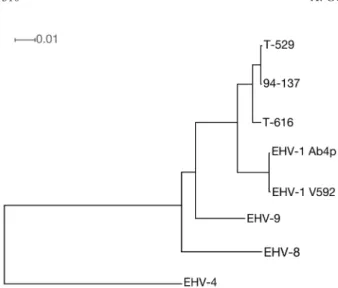
EHV-1 and EHV-9. Phylogenic analyses based on the whole
genome sequences indicated that T-529 and 94-137 are
closely related to each other and distantly related to T-616
(Fig. 1).
Single nucleotide polymorphisms (SNPs) and insertions
and deletions (indels) of nucleotides were detected with
whole genome sequence comparison. The differences among
the genome lengths are caused by large deletions, variation
of tandem repeat sequences including repeats in ORF24 (a
homologue of HSV-1 UL36) and ORF71 (a homologue of
HSV-1 US5), ORF64 (a homologue of HSV-1 ICP4 gene)
downstream and an intergenic region between ORF62 (a
homologue of HSV-1 UL1) and ORF63 (a homologue of
HSV-1 ICP0 gene).
Two large deletions were observed in T-616 substrain 2
and T-529. A 1,714 bps deletion is found in T-616 substrain
2, corresponding to nucleotides 128,715 to 130,428 in T-616
substrain 1 (Fig. 2A). This deletion caused amino acid
se-quence mutation with truncation of ORF70 and the lack of
ORF71 in T-616 substrain 2 (Fig. 2 A and 2B). The 2
sub-strains of T-616 were cloned by plaque purification, and the
difference was confirmed by PCR (Fig. 2C). Although DNA
fingerprints were shown in the report by Wolff et al. [21], it
is unclear that the original isolate from the zebra consisted of
2 substrains or not. On the other hand, the genome of T-529
lacks 1,611 bp region that contains ORF1 and ORF2.
There-fore, T-529 does not possess proteins encoded by ORF1 and
ORF2.
T-529 and 94-137, which are phylogenetically related,
were isolated from zoo animals (an onager and a gazelle,
respectively) that were kept close to plains zebras (E. q.
burchelli), while T-616 was isolated from a Grevy’s zebra
(E. grevyi). The phylogenic relatedness among these
zebra-borne viruses seems to reflect the phylogenetic relatedness
among the host zebra species [3].
We reported that the present 3 zebra-borne EHV-1s
caused severe neurological disease in hamster [10]. Nugent
et al. indicated the EHV-1 causing equine herpesvirus
my-eloencephalopathy should have the neuropathogenic marker
of D752 in ORF30 [17]. The present 3 zebra-borne EHV-1
Fig. 2. (A) Nucleotide deletion from the tail part of ORF70 to the head part of ORF71. The arrow in black indicates the original ORF70. The other arrow in dark grey indicates the truncated tail part of ORF70 caused by deletion. (B) Amino acid sequence alignments of the tail part of ORF70 in Substrains 1 and 2. The amino acid sequences with underline indicate the corresponding sequences shown in the panel A. The amino acid sequence in italic grey indicates the truncated tail of ORF70 caused by the deletion. The asterisks (*) indicate the placement of stop codon in the original nucleotide sequence. (C) PCR results to confirm the presence of 2 viruses in T-616. PCR primers used were as fol-lows: Zebra_71-F 5′-ccaacgtaccatcaagtgcggta-3′ and Zebra_71-R 5′-cgctggtactctcgtaggttgac-3′. PCR was examined by using Prime-STAR Max Premix (TaKaRa Bio, Otsu, Japan) with amplification program as follows: the primary hold at 95°C for 4 min, 30 cycles of 98°C 10 sec, 55°C 15 sec and 72°C 45 sec. Lanes were 100 bp ladder marker (1), T-616 substrain 2 (2), T-616 substrain 1 (3), the original seed stock of T-616 (4) and 1 kbp ladder marker (5). Expected sizes are 344 bps for T-616 substrain 2 and 2,058 bps for T-616 substrain 1.
Fig. 1. Neighbor-joining phylogenic tree based on the genome sequences of 3 zebra-borne EHV-1 (T-616: KF644573; T-529: KF644580; 94-137: KF644575), 2 horse strains of EHV-1 (Ab4p:AY665713; V592:AY464052) [16, 17], EHV-8 (JQ343919) [14], EHV-9 (AP010838) [5] and EHV-4 (AF030027) [19]. All node has 100% bootstrap value. The tree was constructed by Split-sTree [9]. The scale bar is given by average number of mutations per site.
ZEBRA-BORNE EHV-1 1311
Table 1. Amino acid differences and synonymous differences among zebra borne EHV-1
Gene ORF10 ORF15 ORF16 ORF30 ORF33 ORF67
Covered position
com-plete
gene 1 to 218 complete gene 675 to 954
500 to
878 85 to 198 Amino acid
position 19 216 217 107 150 450 739 754 873 939 516 89 109
T-529 L (TTG) P (CCG) F (TTT) E (GAG) R (CGA) A (GCC) L (CTT) S (TCG) F (TTC) K (AAA) N (AAT) A (GCA) V (GTT)
94-137 L (CTG) P (CCG) F (TTT) E (GAG) R (CGA) A (GCC) L (CTT) S (TCG) F (TTC) K (AAA) N (AAT) A (GCA) V (GTT) T-616 L (CTG) P (CCG) F (TTT) E (GAG) R (CGA) A (GCA) L (CTC) S (TCA) F (TTT) K (AAG) N (AAT) A (GCA) V (GTC) Polar Bear
Jerka L (CTG) P (CCA) I (ATT) Q (CAG) L (CTA) A (GCC) L (CTC) S (TCG) F (TTT) K (AAA) D (GAT) A (GCC) V (GTT) Differences among the sequences are indicated by italic. Amino acid and codon are shown. Accession numbers of sequence data of the polar bear Jerka are JQ692315 for ORF10, JQ692311 for ORF15, JQ692313 for ORF16, JQ692312 for ORF30, JQ692316 for ORF33 and JQ692314 for ORF67.
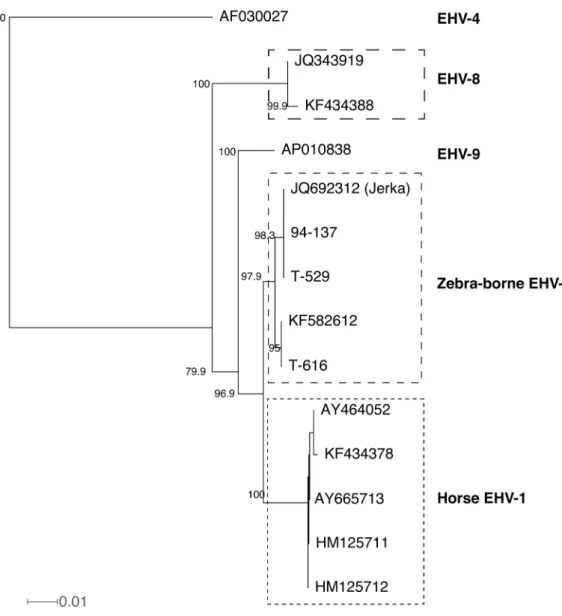
Fig. 3. Neighbor-joining phylogenic tree based on nucleotide sequences corresponding to 2023 to 2832 of ORF30. Labels in the tree are accession numbers. All sequences were obtained from GenBank. Numbers are bootstrap values greater than 70%. The tree was constructed by SplitsTree [9]. The scale bar is given by average number of mutations per site.
X. GUO ET AL.
1312
strains have the neuropathogenic marker D752 in ORF30,
indicating that the 3 strains might be neuropathogenic.
Greenwood et al. [8] reported nucleotide sequences of
ORF10 (a homologue of HSV-1 UL49.5), ORF15 (a
ho-mologue of HSV-1 UL45), ORF16 (a hoho-mologue of HSV-1
UL44), ORF30, ORF33 (a homologue of HSV-1 UL27) and
ORF67 (also called IR6) of the zebra borne EHV-1 isolated
from Jerka. The corresponding amino acid sequences of
ORF10, ORF30 and ORF67 in the present 3 zebra-borne
EHV-1s are identical to those of the zebra-borne EHV-1
isolated from Jerka, although 1 to 4 base differences were
found among them (Table 1). Amino acid sequence
differ-ences were found 1 in ORF15, 2 in ORF16 and 1 in ORF33
between the zebra-borne EHV-1 isolated from Jerka and the
present 3 zebra-borne EHV-1s. These data indicated that the
zebra borne-EHV-1 isolated from Jerka should be regarded as
an almost identical virus to the present 3 zebra-borne
EHV-1s. Greenwood et al. [8] discussed that ORF30 of the virus
isolated from Jerka was a recombinant gene between those
of EHV-1 and EHV-9, with the 5′-portion of the amplicon
being EHV1-like, the middle being EHV9-like and the last
110 bp again being EHV1-like based on computer analysis
of amplicon. Although we evaluated the recombination
pos-sibility of this area using the same data set in the reference
8, we did not find any evidences of recombination in this
area, where they insisted that the recombination occurred,
by using 2 programs of SplitsTree [9] and TOPALi [15].
Phylogenic tree prepared by SplitsTree based on ORF30
nucleotide sequences is shown in Fig. 3. If the
recombina-tion was scientifically supported, the recombinarecombina-tion should
be detected using any algorithms for finding recombination.
Therefore, it is unable to conclude that the zebra-borne
EHV-1 isolated from Jerka was a recombinant virus. The 3
zebra-borne EHV-1 viruses analyzed in the present study and
the virus isolated from Jerka might be a subtype of EHV-1
that was derived from the same ancestor virus of EHV-1.
In recent years, fatal encephalitis induced by the zebra
borne equine herpesvirus has been reported frequently [1, 8].
The risk of zebra-borne EHV-1 infection in the zoos cannot
be ignored.
REFERENCES
1. Abdelgawad, A., Azab, W., Damiani, A. D., Baumgartner, K., Will, H., Osterrieder, N. and Greenwood, A. D. 2014. Zebra-borne equine herpesvirus type 1 (EHV-1) infection in non-Afri-can captive mammals. Vet. Microbiol. 169: 102–106. [Medline] [CrossRef]
2. Blunden, A. S., Smith, K. C., Whitewell, K. E. and Dun, K. A. 1998. Systemic infection by equid herpesvirus-1 in a Grevy’s zebra stallion (Equus grevyi) with particular reference to genital pathology. J. Comp. Pathol. 119: 485–493. [Medline] [CrossRef] 3. Côté, O., Viel, L. and Bienzle, D. 2013. Phylogenetic relation-ships among Perissodactyla: Secretoglobin 1A1 gene duplica-tion and triplicaduplica-tion in the Equidae family. Mol. Phylogenet.
Evol. 69: 430–436. [Medline] [CrossRef]
4. Fukushi, H., Tomita, T., Taniguchi, A., Ochiai, Y., Kirisawa, R., Matsumura, T., Yanai, T., Masegi, T., Yamaguchi, T. and Hirai, K. 1997. Gazelle herpesvirus 1: a new neurotropic herpesvirus immunologically related to equine herpesvirus 1. Virology 227:
34–44. [Medline] [CrossRef]
5. Fukushi, H., Yamaguchi, T. and Yamada, S. 2012. Complete ge-nome sequence of equine herpesvirus type 9. J. Virol. 86: 13822. [Medline] [CrossRef]
6. Ghanem, Y. M., Fukushi, H., Ibrahim, E. S. M., Ohya, K., Ya-maguchi, T. and Kennedy, M. 2008. Molecular phylogeny of equine herpesvirus 1 isolates from onager, zebra and Thomson’s gazelle. Arch. Virol. 153: 2297–2302. [Medline] [CrossRef] 7. Gordon, D. and Green, P. 2013. Consed: a graphical editor for
next-generation sequencing. Bioinformatics 29: 2936–2937. [Medline] [CrossRef]
8. Greenwood, A. D., Tsangaras, K., Ho, S. Y. W., Szentiks, C. A., Nikolin, V. M., Ma, G., Damiani, A., East, M. L., Lawrenz, A., Hofer, H. and Osterrieder, N. 2012. A potentially fatal mix of herpes in zoos. Curr. Biol. 22: 1727–1731. [Medline] [CrossRef] 9. Huson, D. H. and Bryant, D. 2006. Application of phylogenetic
networks in evolutionary studies. Mol. Biol. Evol. 23: 254–267. [Medline] [CrossRef]
10. Ibrahim, E. S., Kinoh, M., Matsumura, T., Kennedy, M., Allen, G. P., Yamaguchi, T. and Fukushi, H. 2007. Genetic relatedness and pathogenicity of equine herpesvirus 1 isolated from onager, zebra and gazelle. Arch. Virol. 152: 245–255. [Medline] [CrossRef] 11. Katoh, K. and Standley, D. M. 2013. MAFFT Multiple sequence
alignment software version 7: Improvements in performance and usability. Mol. Biol. Evol. 30: 772–780. [Medline] [CrossRef] 12. Kennedy, M. A., Ramsay, E., Diderrich, V., Richman, L., Allen,
G. P. and Potgieter, L. N. D. 1996. Encephalitis associated with a variant of equine herpesvirus 1 in a Thomson’s gazelle (Gazella
thomsoni). J. Zoo Wildl. Med. 27: 533–538.
13. Langmead, B. and Salzberg, S. L. 2012. Fast gapped-read alignment with Bowtie 2. Nat. Methods 9: 357–359. [Medline] [CrossRef]
14. Liu, C., Guo, W., Lu, G., Xiang, W. and Wang, X. 2012. Complete genomic sequence of an equine herpesvirus type 8 Wh strain iso-lated from China. J. Virol. 86: 5407. [Medline] [CrossRef] 15. Milne, I., Wright, F., Rowe, G., Marshal, D. F., Husmeier, D. and
McGuire, G. 2004. TOPALi: Software for Automatic Identifica-tion of Recombinant Sequences within DNA Multiple Align-ments. Bioinformatics 20: 1806–1807. [Medline] [CrossRef] 16. Montali, R. J., Allen, G. P., Bryans, J. T., Philips, L. G. and
Bush, M. 1985. Equine herpesvirus type 1 abortion in an ona-ger and suspected herpesvirus myelitis in a zebra. JAVMA 187: 1248–1249. [Medline]
17. Nugent, J., Birch-Machin, I., Smith, K. C., Mumford, J. A., Swann, Z., Newton, J. R., Bowden, R. J., Allen, G. P. and Davis-Poynter, N. 2006. Analysis of equid herpesvirus 1 strain variation reveals a point mutation of the DNA polymerase strongly associ-ated with neuropathogenic versus non- neuropathogenic disease outbreaks. J. Virol. 80: 4047–4060. [Medline] [CrossRef] 18. Telford, E. A., Watson, M. S., McBride, K. and Davison, A. J.
1992. The DNA sequence of equine herpesvirus-1. Virology 189: 304–316. [Medline] [CrossRef]
19. Telford, E. A., Watson, M. S., Perry, J., Cullinane, A. A. and Da-vison, A. J. 1998. The DNA sequence of equine herpesvirus-4. J.
Gen. Virol. 79: 1197–1203. [Medline]
20. Volkening, J. D. and Spatz, S. J. 2009. Purification of DNA from the cell-associated herpesvirus Marek’s disease virus for 454 pyrosequencing using micrococcal nuclease digestion and polyethylene glycol precipitation. J. Virol. Methods 157: 55–61. [Medline] [CrossRef]
21. Wolff, P. L., Meehan, T. P., Basgall, E. J., Allen, G. P. and Sund-berg, J. P. 1986. Abortion and perinatal foal mortality associated with equine herpesvirus type 1 in a herd of Grevy’s zebra. J. Am.