For the Nation's Future:
An Urgent Need for Moral Education Reform in China
Wang Yingjie
Comparative Education Research Center, Beijing Normal University Beijing 100975, ChinaAbstract : Chinese society now is under dramatic changes. The traditional moral system is at crisis as it can not meet challenges brought by these changes. The school moral education is falling far behind of these changes. It is too far away from children's real life, and it is still a knowledge-based subject the same as other subjects in Chinese schools. Now a reform on moral education is undergoing. The new Standards and new subjects have been experimented since 200212003 school year. The children's real life has been a major concern in this experiment. And it has been tried very hard to put children in the center of learning process in moral education. But we have to wait for a few of years to see the result of the moral education reform in China.
Keywords : social changes, crisis, moral education, reform, new Standards, new subjects
China has a long history of civilization and its culture is among the most stable ones in the world nations. It is now under dramatic social changes and remains to be one of the most active areas in economical development. The combination of the stable and strong traditions with the dramatic and rapid changes makes China now a very special place where moral conflicts become very common phenomena. As Mr. Durkheim, a well-known French sociologist in 19th
century, once said, the fast economical growth breaks the original social relations and people accept new concepts easily, and therefore the society easily loses its orientation for development. The traditional value systems can not meet the challenges brought by dramatic changes. In a sense the nation is at risk. Corruption, cheating and immoral phenomena appear very frequently. If China wants to forward its civilization meanwhile continues to develop its economy at a fast speed, it must cure its social diseases before they tum into cancer. In doing so, moral education plays an essential role.
1. Significant Changes in China's Society 1. 1. Changes in Economical System
After several decades of the establishment of the People's Republic of China in 1949, it finally realized it had to depend on economical development in order to survive in the world, and to develop economy China has to substitute the market system for the planning system which had positive effect
only in the initial period of the national development. Since China began to put the market system into effect its economy has been growing extremely fast. The average annual growth rate of GNP is 7.9% between 1986 and 1990, 11.6% between 1991 and 1995. Even in and after Asian monetary storm the average annual growth rate is still 8.1 %. The Gross Domestic Product grows from 1854.8 billion Yuan in 1990 to 9593.3 billion Yuan in 2001 (See table 1). The transformation from the planning system to the market system has brought deep changes in several aspects of the society, which constitute severe challenges to school moral education in China.
Transformation of Government Roles. The government had a decisive role in the economical and social development in the period of the planning system. The government made plans in almost all aspects in social life from industrial or agricultural growth to educational development. The govern-ment was not only an agency to supervise the implegovern-mentation of the plans but also put the plans into effect by itself. The government provided free education, medical care, housing etc., and in one word it took care of everything for people, but in general speaking people's living standard were very low as the population was huge and the economical development was very limited. Since the market system was adopted the central government has distributed more power and responsibilities to the local authorities. Though the government still makes macro plans it depends more on enterprises and social agencies to carry out them. The
government confines its roles to making policy and providing supervision, guidance or service. In the process of shrinking of the government roles, the government is losing ground of serving as the moral authority.
Flowing of Labor Force. When people were assigned a job in the periods of planning system, they got a life-long job. They did not lose their job, but meanwhile they could not easily change their job. Now to change a job became a common phenomenon. People either take an initiative for upward movement or are forced to find a new job when their working unit is closed down or they get dismissed. The service industry and the secondary industry have been pushed forward very fast, which absorb a great deal of labor forces from the first industry. Table 1 shows the average annual growth rates of the secondary industry and the tertiary industry are 9.1 % and 8.6% respectively between 1996 and 2001, but for the primary industry the rate is only 3.3% during the same period. The flowing of labor force makes people deviate from their traditional values. When people work in a same job or place for a life time or a very long period, they tend to develop a loyalty towards their working unit or community. When they have to change their job regularly, they tend to be more self-centered and indivi-dualist, as they can only depend on themselves for job hunting and move upward. When people work in a same job or place for a life time or a very long period, their behavior are easily controlled and supervised constantly by the men they know. When they change job constantly, they often get into a brave new world where they might be tempted to behave very differently. When the rural labors come to the city, they yearn for the city life, but can not settle down in the city. Quite a few of them develop anger towards others and
the society, as they feel they are not treated equally as city people.
Unbalanced Development of Areas and Enlarged Income Gap among Different Groups. When the market system works, there is not much left for the central government to regulate development levels of different areas. "Matthew effect" is one of the major rules in a market economy. The coastal areas with stronger infrastructure, such as open-minded leadership, transportation and communica-tion system etc., attract more investment and more educated people. In contrast, the inner areas lose their professional people and can not lure investors with their poor supporting system, and the big state enterprises built there in the past fell into tremendous difficulties. The schools are much better supported financially in richer areas than in poorer areas.
The market economy provides a lot of opportunities that could hardly be dreamed in the period of planning system. Those brave people who grasp the opportunities going through ventures become rich businessmen. Those lucky people working in prosperous trades, such as foreign business, joint-venture business, banking, real estate and insurance, etc., make much more than other people. People in traditional trades, such as workers in state-run enterprises, who were backbone and much admired in the society, now make much less. Unemployment not heard of in the past is now becoming a serious social problem. And there is no need to mention poor life of peasant in frontier and mountainous areas. When the distribution of social wealth is very unbalanced and unfair, and especially when the trend is enlargement of the income gap, we can hardly expect that people hold high standards of morality. Rich people tend to
Table 1 Aggregate Indicators on Economy
Unit: 100 million yuan
Aggregate Data Average Annual Growth Rate %
Item 1986- 1991-
1996-1985 1990 1995 2000 2001
1990 1995 2001
Gross National Product 8989 18598 57495 88228 94346 7.9 11.6 8.1
Gross Domestic Product 8964 18548 58478 89442 95933 7.9 12.0 8.1
Primary Industry 2542 5017 11993 14628 14610 4.2 4.2 3.3
Secondary Industry 3867 7717 28538 44935 49069 9.0 17.4 9.6
Tertiary Industry 2556 5814 17947 29879 32254 9.4 10.0 8.1
Gross Domestic Expenditure 8792 18320 58511 89357 98618
Total Consumption 5773 11365 33635 54617 58953
Resident Consumption 4589 9113 26945 42912 45923
Public Consumption 1184 2252 6691 11705 13029
look down to poor people. Poor people easily develop hatred towards rich people and the society. Many people are tempted to breach the law to get rich fast.
Transformation of production modes. The planning economy stressed mainly on quantity, but now in the market economy quality became an essential factor for a business to survive in a tight competition. Enterprises now have to tum their extensive mode of production into the intensive and knowledge-based one. The technological revolution just came on time to provide means for the transformation of production modes. China now starts its first step towards a high-tech society. But in a high-tech society there is a tendency to trust more on technology than on people in promoting production. Workers or students are easily regarded as numbers, and administration or governance become inhumane. In a certain sense people are deviated to machines.
1.2. Transformation of a Closed Society into an Open Society China had been a closed society for historical reasons and its cultural traditions before 1980s. Since then it has opened its door to outside world very fast.
Globalization of National Economy. Once China was very proud for its self-dependence policy. It claimed it could feed, cloth, and house its hundreds of millions people without any assistance from outside. But now as China has joined WTO, it has to depend on export and import for its economical development. The total amount of its export and import has grown very fast. (See Chart 1) When the market is
open, not only the commercial goods come in, but also the new life style is in. Now Coca-Cola is one of the most popular soft drinks. McDonald and Kentucky Fried Chicken are widely spread over China, and the largest McDonald restaurant in the whole world locates in Beijing! A lot of children prefer to have their birthday party held in McDonald. Nike shoes and fashion blue jeans are some things school children or yuppies mostly pursue. Materialism starts to play a key role in moral value selection among young people.
Internet and Opening of Cultural Products Market. China was allowed to enter into Internet in 1994. The number of Internet user has increased tremendously since then. The number reached to 33.70 million in 2001, and reached to 80 million in 2003. According to a survey conducted by the National Academy of Social Sciences and Humanities in 2003, the average weekly time of Internet connection of each Internet user in twelve Chinese cities is about 12.4 hours, which is longer than in the U.S., Japan, Germany and Italy. (People's Daily, Oversea Edition, Feb. 12, 2004) The openness, equal access, interaction, anarchy and other natures of Internet attract young people. Young people could build self-image in Internet and easily fall into dummy satisfaction. They escape from the real world and from supervision of their acquaintances. They tend to be more individualist and self-centered in the world created by Internet. Sometimes they are not able to make moral judgment on a mass of information provided by Internet.
Once there were only publications, movies,
T.v.
programs, Chart 1 Aggregate Data on Import and ExportUnit: 100 million American dollars
3500 3000 2500 2000 1500 1000 500 0 1998 1999 2000 2001 2002 I
D
importD
exporttheatres or operas produced within China for Chinese people. They provided moral examples for people to follow. Most of these examples were model workers and peasants, heroes protecting or saving public properties, and heroes of wars against invaders. Now as the market of cultural products is open, Hollywood movies, Japanese cartoons, Korean pop songs, and American basketball etc. all swarm into China. Some American movies are full of violence and sex, and promote individualism instead of collectivism. But Chinese movies can not compete with them, and sometimes even follow after them. The most favorite book now children love to read is Harry Porter. The Korean pop singers can attract thousand and thousand young people. Japanese cartoons and game software are very popular among youngsters. American basketball player Jordan is kind of hero adored by a lot of young people. The cultural products made in China promoting traditional moral values can hardly guard their ground in the market now.
1. 3. Changes in family
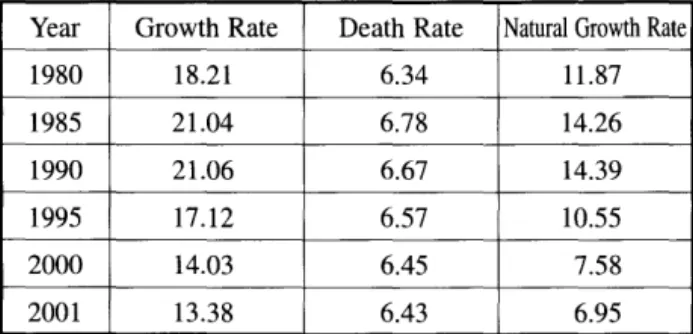
Declining of Population Growth Rate and Shrinking of Family Size. China's population growth rate has been declining continuously since 1990. It was 21.06 %0 in 1990 and declined to 13.38%0 in 2001. (See Table 2) With the success of family planning and fast urbanization the traditional large family has been yielding to one child core family. The average family size reduced to 3.10 people in 2001. (China Statistic Yearbook 2002) The gap among generations is getting wider. The only Childs protected by both parents and four grand-parents tend to be spoilt. They have brought new challenges to educators trained in traditional ways.
Table 2. Birth Rate, Death Rate and Growth Rate of Population . Unite: 0/00 Year Growth Rate Death Rate Natural Growth Rate
1980 18.21 6.34 11.87 1985 21.04 6.78 14.26 1990 21.06 6.67 14.39 1995 17.12 6.57 10.55 2000 14.03 6.45 7.58 2001 13.38 6.43 6.95
Source: National Bureau of Statistics, China Statistic Yearbook 2002.
Disposable family income increased. Along with the rapid economical development people's living standard has been rising significantly. The resident consumption grew from 458.9 billion Yuan in 1985 to 4592.3 billion Yuan in 2001. It increased by ten times in sixteen years. (See Table 1)
This change means parents and lor grand-parents are willing to spend a lot to satisfy children's all demands, rational or irrational. Children are pushed to attend all kinds of training schools after class. Young people have developed materia-lism opposing the Chinese traditional merit of hard work and thrifty.
Increasing of Divorce Rate. One of the most striking changes is that the divorce rate is getting higher. 8.05 million Couples got married and 1.25 million couples divorced in 2001. (See Table 3) This trend seems accelerating. This is very much against the traditional value of close family relationship in China. This is in a way a progress for human rights in a traditional society, but meanwhile hurts children very much. The character development of children in a single-parent family is usually more difficult.
Table 3 Number of Marriage and Divorce Unit: 10 thousand of couples
Year 1985 1990 1995 2000 2001
Marriage 831.1 951.1 934.1 848.5 805.0 Divorce 45.8 80.0 105.5 121.3 125.0
Source: Bureau of Statistics, China Statistic Yearbook 2002.
2. A Nation at Risk: The Traditional Value System at Crisis 2. 1. The Confucian Value System Has Been Criticized
Chinese civilization has lasted for several thousand years. One of the major forces, which have held Chinese society together, is Confucianism. The core values of Confucianism are
1=
(ren) meaning humanity and benevolence,J!..
(yi) meaning justice and righteousness,*L
(Ii) meaning courtesy or manners and ceremony, ~ (zhi) meaning wisdom and wits, and {§ (xin) meaning faith, trust and honesty. In the feudalist society the ruling class with its representative of emperors utilized these values to govern people. People were oppressed and exploited under the name of these values. Women were controlled by men and the younger generation had to listen absolutely to the elders under these values. The Confucianism requires that wife be subject to husband, son be subject to father, and man be subject to emperor. The Confucianism has been criticized for almost a century since the fall of the last feudalist dynasty in 1911. But when it has been criticized, it is often neglected that the Confucianism is not only a philosophy but also a way of living, which has strong impact on Chinese people's way of thinking and daily behavior. When it were lost, people would not have alternative moral standards ready to substitute for it to make moral judgments.2.2. The Communist Value System Is Confronting Challenges After 1949 when the Communist Party took the power in China, Chinese people were very much moved by the great achievements of the new government. Chinese people actually adored Chairman Mao, Premier Zhou Enlai and other leaders. The Communist Party and its leaders were regarded as moral examples, or in other words, moral authorities. The Cultural Revolution broke the perfect moral image of the party and its leaders. When the old revolutionary leaders are gone, it is not easy for the new leaders to establish their authority. When people can not find the moral authority, the society tends to have a moral crisis as people usually learn and implement moral standards following the moral authority in their heart.
After China adopted market economy system, a lot of new problems and phenomena appeared. One of the most serious problems is unequal distribution of social wealth. Drug abuse, prostitution gang Dom and other social diseases, which had been extinguished in early 1950s, appeared again. When the Communist party leaders or educators could not explain these problems with traditional ethic or moral theories of Marxism, Mao's Thought or other communist philosophies, people easily accept other moral values. They tend to judge moral issues by their own feelings or experiences. The relativism in moral standards spreads very fast. People have different moral ideas. The ethic or morality became something subjective and relative. The ethic and moral value, which used to be in the center of Chinese people's life, are withdrawing to the edge.
2. 3. The Serious Consequences
When the ethic or morality withdrew to the edge of social life, when moral judgment became something relative, the society is falling to moral crisis.
The corruption of the government officials, policemen and judges, including those senior officials, is something now people hate the most. The cheating or bribery widely pervaded over almost all vocations is something people concern very much. When people go to hospitals for surgery, they have to think how to bribe a surgeon. When they choose a good school for their children, they are asked to pay "voluntarily" a grand sum beside the tuition or fee. When they have to deal with policemen or judges, they are forced to bribe them. When they go to market, they have to learn how to identify fakes. Living in such an environment some people lost basic moralities. They spit around, they make big noises
In public places, they push through in crowd, they do not
have any sense of environment protection, they do not respect senior people, they cheat in tests, and they use all kind of dirty words etc ...
The most serious consequence is the impact of moral crisis on our children. The focus is on family and society, and individual is not a major concern of the society in Chinese traditional culture. After the establishment of the new republic, the state interest is the first or unique concern in moral education. People are educated to put state interest and nation's need in the first place. In one word, collectivism prevails over individualism in traditional Chinese value. But now, when a child is raised in an only-child family and he/she is the center of three generations, how could we expect him/her to consider other people first? When children see the intensive competition in the market economy, and very different living styles among their peers, how could we expect them not to consider their own future first? When children explore different concepts of the world, different ways of living through various media, how could we expect them to stick on the traditional values? When individualism strikes hard at the society, when the corruption, bribery or cheating pervades, when the divorce rate and crime rate are both getting high, when children do not live in a stable or safe environment, how could we expect them to grow with a healthy value? The dramatic changes in the society challenge our moral education.
3. The Crises in School Moral Education If the nation is at risk because of lack of ethic and morality, school moral education has contributed to this situation, as it is at crisis. Certainly we can blame the society for the crisis we have at school moral education, and if we do so, we are justified to a certain extent. But to blame the society or find other excuses will not help schools overcome the crisis. We have to find out what goes wrong in school moral education.
3. 1. Moral Education Is Too Far from Children'S Real Life Moral education has been equated with political education or ideological education for a long time. Political principles or ideological doctrines have constituted the main content in moral education. Before children learn to be or learn to live together with others, before they are taught courtesy or manners, they are taught political or ideological ideas, In
which children can only learn some principles by heart without real understanding.
Moral education is too much idealized. Moral education some times is equated with ideal education. Human life becomes meaningless without ideals. The value of human beings stands out when the ideals are turned into realities. In this sense, ideal education represents caring for the value of human beings and moral education is to bring up people with ideals. But ideal is not reality. When we pursue ideal moralities and ideal characters, we should not go too far to break away from children's real life. Our school moral education stresses very much on cultivating "communist new person". What moral education transmits are only high standards, such as, to be patriotic, to serve people with one's whole heart and soul, to be so devoted to public interests as to forget ones own interests. In the process of such moral education people as individuals are neglected, and the specific individual growth environment, the desire, sensation or expectation of each individual are not counted. The basic rights and obligations of citizenship are not paid necessary attention to.
When moral education is equated with political education, ideological education and ideal education, dual personalities are cultivated in our children. On one hand they can recite a lot of terms of high standards but do not really understand them or are not really prepared to follow those standards. On the other, children lack the basic social ethics or moralities as they have never been taught these in their school moral education.
When moral education is equated with political education, ideological education and ideal education, citizenship education is often neglected. The education on citizen rights and obligations is essentially important in the contemporary society. To prepare citizens is the prime mission of the modem schools. When it is neglected, the society could be in chaos. If people do not know their rights, the society could be ruled by dictators and therefore become inhumane. If people do not fulfill their obligations or take their responsibilities, the society could not function.
When moral education is too far away from children's life, it is too dull for children to be interested in. Moral education becomes a subject most unpopular among children. A high school in Changzhou did a survey randomly selecting one hundred students. The students were asked "Which value or character influences you most?" The most selected items rank in the following order: Tolerance (15%), Confidence (10%), Sincerity (6%), Braveness (5%), Understanding (4%),
Keeping one's word (4%), which are all closely connected to students' daily life. But those high standards rank in the end: to be patriotic (2%), to love the Communist Party of China (1 %), to serve people with one's whole heart and soul (1 %), to be so devoted to public interests as to forget ones own interests (1%). (Qiu Gaofei, Jan. 8,2004.) From this survey we can see why the students do not like moral education which puts all its focuses on high standards.
3. 2. Knowledge-based Moral Education
Education is a vehicle to carry the national culture from a generation to the next, and meanwhile is restricted by the national culture. We can always find origins in the national culture for the nation's achievements or problems in education.
Chinese education has always been organized with tests in its center for more than two thousand years. Chinese education system grew up from the imperial examination system in the feudal society of China. The only purpose of the imperial examinations was to select government officials for the emperor. Therefore, the only mission of the school was to prepare students to pass the imperial examinations so that they could get into the ranks of the government officials. This culture forms a solid foundation for the log-bridge linking up reading - examinations - government officials (in the modem society, school education - examinations - higher education - middle class members). The log-bridge means the narrow passage that the students compete to go through from the bottom level of education to middle class members. Some schools rank teachers according to their students' test scores and publish regularly the students' name list in the order of their test scores. Such a practice gives a tremendous pressure to schools, teachers and students.
Chinese educators often feel very proud to announce that Chinese children study very hard and their basic knowledge is very solid and systematic. But we often lack courage to confess that we have dross in our culture, which ruins children's healthy development. We strongly believe "reading million books will lead automatically to write beautifully" and "systematic learning is the only way to mastery of a discipline." There must be some truth in this believe. When children take a subject, they have to learn the systematic knowledge of the subject. But from this believe we cram as much knowledge we can to our children.
unavoidable. We believe that we have to force our children to study, as we believe they do not understand how much they can benefit in their future life from their current study. Teachers are put in the center of the learning process in Chinese schools. Teachers are supposed to take a role in the students' life "just next to heaven, earth, emperor and father" in Chinese traditional culture. Teachers dominate the classroom and students follow the instructions of teachers. To respect students is something unknown to some teachers. Some teachers have a prejudice against slow learners. To satirize students is not an unusual phenomenon in Chinese classrooms. In this unfriendly environment students tend to develop an aptitude against learning. A survey conducted by the Research Center of Chinese Youth and a research group of Beijing Normal University shows that only 8.4% of primary school pupils, 10.7% of lower secondary school students and 4.3% of upper secondary school students go to school because "they like to study".
Moral education at Chinese schools can not escape from these cultural traditions. In the current school system with examination in its center, moral education becomes a part of systematic knowledge transmission. The whole process of moral education is to indoctrinate students with knowledge about moralities and ethics. The purpose of moral education is for students to learn by heart knowledge about moralities and ethics in order to pass examination of moral education. Moral education therefore becomes a subject of the curriculum, or more accurately a minor subject (Chinese, mathematics and science etc. are regarded as major ones), while it should be at the center of school education and seep into all aspects of school work.
When examination is in the center of moral education, teacher must be in the center of learning process. Learning becomes a passive experience for students. The high standards and ideological principles are indoctrinated in the classroom. Moral education is locked in the classroom. Without individual experiencing or personal feeling, moral education becomes an education without care of human beings, and individual moral or character development finds no place in it.
Schools usually adopt examinations or written assessment with grades to evaluate children's moral education achievement. The purpose of assessment is therefore used for children's promotion or teachers' cvaluation when it should be formative.
With this knowledge-based moral education, children easily develop "dual characters". They could recite a lot of ideological, moral or ethical principles on one hand, and on the other they behave very differently.
3. 3. Moral Problems of Teachers and Schools
Teachers or schools often can not catch up with dramatic changes of the society. Many older teachers live in the present time but with their mind in the past. They often feel children are not as good morally today as in the past. They keep their traditional concepts or methods of moral education in this different new world. The young teachers grew up with theses changes and they can better understand today's children, but they work in schools guarding the traditional values. And therefore they live and work in a dilemma.
Many teachers do not have access to the Internet. They do not know what children feel or experience in the Internet. Some times they feel puzzled as children know more information than they do. They do not understand this is a time in which older generation can and should learn from younger ones or even children. In their mind the function of education is still transmission of knowledge from older generation to younger ones. When they still hold the center of learning process, the world and children have dramatically changed.
In this market-oriented society, the "sacred" schools or teachers can not avoid being dragged by the market force. Schools are now ranked very top among the fields people dislike the most. Some schools charge unusually high fees besides the school fee set by the government though nine year schooling should be free according to the Law of Compulsory Education. Students are fined for their improper behaviors in some schools. Some parents have to pay a grand sum of money to send their children to good schools in the name of donation. A lot of teachers serve as tutors after school hours to make additional income. To accept presents from children or parents is not an uncommon phenomenon. How could schools or teachers teach moral education if their behaviors are not so moral?
The crises III school moral education have caused very
serious consequences. Many children do not like the subject of moral education. Children are self-centered and some times selfish. They do not know how to live or study together \vith others. They arc educated to respect authority or their seniors. to be patriotic. to love the Communist Party of China
and to believe in communism, but the effect is not so good so far. Violence, juvenile crimes and drug abuse appeared in some schools. Because of all these problems, there is an urgent need for a moral education reform in Chinese schools.
4. The Trends of Current Moral Education Reform Facing the problems in school moral education, China started a reform in 2002. This reform began together with the implementing of the new National Curriculum Standards. There were thirty-three districts/counties selected for the experiment of the new Standards in the Fall semester of 2002. Now the Ministry of Education tries very hard to promote the new Standards throughout the country.
4. 1. Introducing New Subjects in Moral Education In this reform the new subjects of "Moral Character and Life" and "Moral Character and Society" are introduced respectively for the first and the second graders, and the third to the sixth graders. They substitute for the current subjects of "Ideology and Moral Character" and "Social Studies".
Only from the titles of these subjects it is easy to tell that the new subjects put great emphasis on the children's life and its link with the society, while the old ones stressed on ideological principles. The new Standards points out that the new subjects must be based on children's school and social life.
4. 2. Making Moral Education Humane
The new Standards puts "learning to be (humane)" at the core of the new subjects. The abstract and ideological principles are no longer the core content in the new subjects. The new subjects try to help children know themselves and the society, and promote love, responsibility, good habits and characters, and basic principles of citizenship. It is hoped that a new life style is established through moral education, so that children can have a sound and healthy life, a positive and happy life, a life with responsibility and love, and an intelligent and creative life.
4. 3. Building the Base of Moral Education with Children'S Real Life Experience
Moralities are not a bunch of abstract concepts, and they exist in real life. Moralities come from the human needs of living together. And therefore only from their own life experience can people gain moralities. The new subjects care about children's real life. The content of the subjects is closer
to children's real life, and reflects the needs of children in their life. They try to encourage children to use their own eyes to observe the social life, to feel the society themselves, and to study the society with their own methods. The first unit of the new subjects is "I Am a School Pupil Now", but in the old subjects it was "I Am a Chinese". The new subjects start from individual child, and then gradually extend to family, school, community (hometown or home village), nation and the world. The logic of designing of the units is life, and the life sequence is "I Am Growing", "I and My Family", "I and My School", "I and My Hometown", "I Am Chinese", "I Go to the World" according to the new Standards. The themes of different units are designed very much related to children's life, such as, "I Follow Rules in Games", "I Have a Very Happy Chinese New Year", "We All Have Right of Speech". When the real life of children is the base of moral education, the traditional logic in designing subjects or teaching units is broken. The old moral education subjects were designed according to the logic of disciplines, such as ideology, history, and geography etc ...
4. 4. Putting Children in the Center of Moral Learning Process The worst part of the traditional schooling in China is the passive learning of students. Children gain their passive learning attitude in the teacher-centered education. If we need to change this tradition, we have more reason to do so in our moral education. Only through children's activities, experiences, and their own feeling, sensing and compre-hension, can they gain moralities. The new Standards require teachers to put children in real life situations, and design circumstances close to children's real life, where children can raise questions, and with teachers' help find answers by themselves so that they can learn how to deal problems in their life in moral ways. The new subjects have a theme of "Democratic Life". The children at third grade are asked to "Hold a Family Meeting in a Democratic Way", in which children and even their family members can learn to respect each other, solve problems by equal dialogues so that children can have initial comprehension of democracy. An activity of "Campaign for Class Cadres" is designed for the sixth graders, in which children can really use democratic principles to elect their pupil cadres. And other activities such as "Observing Village Head Election" and "Interviewing Congressman" are designed, in which children can extend their democratic life experience to a community, society or the state. In the teaching unit of "Consuming", three themes are designed, which are "You Need Consuming", "Various Consuming Places" and "Be Intelligent Consumers". In these
themes children talk with their parents, visit shopping centers or small shops, and have discussion sessions in their classrooms. The new Standards intend to put children in the center of the learning process when these activities are organized. The role of teachers is supposed to change from knowledge crammer to activity designer and organizer, and guide or councilor. It is expected that children would change their learning attitude, and they would no longer be passive knowledge receiver, and become active participants in the process of learning. It is expected that children would explore moral values and ethic principles, and internalize these values and principles through these activities, and in this way learning to know and learning to do be combined.
4. 5. Reforming Assessment to Stimulate Children's Development
The new Standards explicitly indicate that the assessment in the new subjects should not be used for screening or selection purpose, and the fundamental purpose of the assessment is "to collect information for improvement of instruction, promotion of children's development and realization of the goals of the subjects." The assessment in the new subjects is formative, so that it should be used to make diagnosis on teaching, and encourage children to learn. In the past, the assessment was summative stressing only the result of learning, and only concerned about the knowledge that children could recite. The new Standards require that the assessment should be turned toward the learning process. The assessment should cover children's learning attitude (including the attitude in participating in learning activities), learning abilities and methods (including abilities in observation, exploring, consideration and expression; abilities in collection, organization and analysis of information; ability in working together with others) and the result of learning which means the quality in completion of learning task and children's progress. The new Standards further require that children should be also the subjects of the assessment. Children's self-assessment should be counted as an important part of assessment. The assessment should be qualitative rather than quantitative.
4. 6. Developing and Using Various Resources in Moral Education
The new Standards require that educational administration agencies provide schools with necessary books, media materials and computer softwares for moral education. Teachers and schools are encouraged to utilize museums. libraries, cultural palaces, memorial and historical places.
natural sights, social organizations and government agencies etc. for moral education so that moral education can be closer to the real world and schools can get support from all aspects of the society in moral education.
Conclusion
When a nation's economy develops unusually fast, it is extremely important to strengthen moral education. But now school moral education in China is at crisis. We have started a reform on school moral education and school moral education is actually changing to the right direction. But there are still some problems that need to be attended. First of all it is relatively easy to introduce new subjects of moral education or to compile textbooks for the new subjects, but it is very difficult to transform people's concept. When parents and the society still take moral education as a subject which children must pass for further education, the goal of the new Standards can not be reached. Secondly, the school teachers are still very used to be in the center of learning process and to indoctrinate knowledge in the classroom. If teachers do not change their concepts of education and methods of teaching, the new subjects could not be more than old staff wrapped in a new package, and the new Standards a piece of paper. The teachers of moral education need to be trained. Even with training teachers' educational concepts and teaching methods will not be changed over a short period. The governments and teacher training institutions have to continually commit themselves in teachers training for promoting the new concepts of moral education. Thirdly, it is not easy to balance the basic moral standards with the high moral standards in moral education. In this reform when we stress children's real life and try to abandon the abstract ideological principles from moral education, there could be a danger of losing soul or philosophical guidance for moral education. It is important to set right balance between real life and "high standards" of the society. Fourthly, in this reform, teachers all know the principles of formative assessment in moral education, but they do not really know how to put those it into effect. If we do not make real changes in assessment, we could not actually change anything in moral education. Assessment is a specific field that needs special study. Finally there is a question thOat has lasted for ages, still needs to be answered, as Socrates put in his dialogue, "Could Morality Be Taught?"
We have already started the reform. and the reform is now in a right track, but there are still a lot to do to keep it going.
For the nation's future we need this reform and we must carry it forward.
References:
1. National Bureau of Statistics, China Statistic Yearbook 2002.
2. Ministry of Commerce, Statistic on Import & Export, 2003, www.englishmofcom.com
3. Dai Mucai, Study on Moral Education-Reflection on Moral Education Crisis and Its Origins, http://philosophyol. com/ethics, 2004.
4. Tan Chuanbao, Education for Believe and Moral Education, Postdoctoral Report, Beijing Normal University, April 30, 1998.
5. Qiu Gaofei, Moral Education Begins with Basic Moralities of Children, http://biz.163 .com, 2004.
6. Zhong Yang, The Contemporary Functions of Chinese Traditional Moral Values, Ideological and Political Education, No.8, 2002.
7. Zhneg Yongting, Deng Zeqiu, On the Development of Moral Relations in the Contemporary Society, Ideological and Moral Education, No.ll, 2002.
8. Kang Lanping, Liu Mengxue, Coming out of Ideal Education, Ideological and Political Education, No.6, 2001.
9. Song Ye, Ecological Construction of School Moral Education in the Period of Social Transition, Ideological and Political Education, No.ll, 2002.
1O.Zhang Tianwei, The Great Significances of Moral Development in the Circumstances of Market Economy, Ideological and Political Education, No.2, 2002.
l1.Learning and Implementing "Curriculum Standards" of the Subject "Moral Character and Society", www. pep.com.cnl200310/ca299398.htm.
12.Yin Ming, Li Yuncai, Let Moral Education Return to Life: Analysis on "Moral Character and Life" and "Moral Character and Society" Compiled by Shandong People's Press, www.sdpress.com.cn.