個人間協応における力の制御と学習
2014 年
兵庫教育大学大学院
連合学校教育学研究科
教科教育実践学専攻
(鳴門教育大学)
升本 絢也
目次
第 1 章 序論 ・・・・・・・・・・・・・・・・・・・・・・・・・・・・・4 1.1 はじめに ・・・・・・・・・・・・・・・・・・・・・・・・・・・・4 1.2 協応運動 ・・・・・・・・・・・・・・・・・・・・・・・・・・・・4 1.2.1 自由度の問題 ・・・・・・・・・・・・・・・・・・・・・・・・5 1.2.2 協応運動の科学的検討 ・・・・・・・・・・・・・・・・・・・・5 1.3 協応運動における結合 ・・・・・・・・・・・・・・・・・・・・・・6 1.3.1 両手運動の結合 ・・・・・・・・・・・・・・・・・・・・・・・6 1.3.2 ダイナミカル・システム・アプローチ ・・・・・・・・・・・・・8 1.3.3 両手協応運動のメカニズム ・・・・・・・・・・・・・・・・・・11 1.4 協応運動における誤差補正 ・・・・・・・・・・・・・・・・・・・・12 1.4.1 Uncontrolled manifold hypothesis ・・・・・・・・・・・・・・12 1.4.2 Optimal feedback control 理論 ・・・・・・・・・・・・・・・14 1.4.3 両手の運動の誤差補正 ・・・・・・・・・・・・・・・・・・・・16 1.5 力とタイミングの相互作用 ・・・・・・・・・・・・・・・・・・・・18 1.5.1 力とタイミングの階層性 ・・・・・・・・・・・・・・・・・・・19 1.6 個人間協応運動 (社会的協応) ・・・・・・・・・・・・・・・・・・21 1.6.1 個人間協応運動の同期性 ・・・・・・・・・・・・・・・・・・・22 1.6.2 個人間協応運動の相補性 ・・・・・・・・・・・・・・・・・・・23 1.6.3 ミラー・ニューロン・システム ・・・・・・・・・・・・・・・・25 1.7 概要と目的 ・・・・・・・・・・・・・・・・・・・・・・・・・・・26 第 2 章 片手の周期的力発揮における力とタイミングの相互作用 ・・・・・・28 2.1 目的 ・・・・・・・・・・・・・・・・・・・・・・・・・・・・・・28 2.2 方法 ・・・・・・・・・・・・・・・・・・・・・・・・・・・・・・30 2.3 結果 ・・・・・・・・・・・・・・・・・・・・・・・・・・・・・・34 2.4 考察 ・・・・・・・・・・・・・・・・・・・・・・・・・・・・・・37第 3 章 両手協応運動における左右の力制御に与える力レベルの影響 ・・・・41 3.1 目的 ・・・・・・・・・・・・・・・・・・・・・・・・・・・・・・41 3.2 方法 ・・・・・・・・・・・・・・・・・・・・・・・・・・・・・・44 3.3 結果 ・・・・・・・・・・・・・・・・・・・・・・・・・・・・・・47 3.4 考察 ・・・・・・・・・・・・・・・・・・・・・・・・・・・・・・52 第 4 章 両手協応運動における左右の力制御に与える運動速度の影響 ・・・・55 4.1 目的 ・・・・・・・・・・・・・・・・・・・・・・・・・・・・・・55 4.2 方法 ・・・・・・・・・・・・・・・・・・・・・・・・・・・・・・56 4.3 結果 ・・・・・・・・・・・・・・・・・・・・・・・・・・・・・・58 4.4 考察 ・・・・・・・・・・・・・・・・・・・・・・・・・・・・・・63 第 5 章 個人間協応運動における力とタイミングの制御 ・・・・・・・・・・67 5.1 目的・・・・・・・・・・・・・・・・・・・・・・・・・・・・・・・67 5.2 方法 ・・・・・・・・・・・・・・・・・・・・・・・・・・・・・・68 5.3 結果 ・・・・・・・・・・・・・・・・・・・・・・・・・・・・・・71 5.4 考察 ・・・・・・・・・・・・・・・・・・・・・・・・・・・・・・77 第 6 章 総括 ・・・・・・・・・・・・・・・・・・・・・・・・・・・・・81 6.1 概要 ・・・・・・・・・・・・・・・・・・・・・・・・・・・・・・81 6.1.1 力を入れることと力を抜くこと ・・・・・・・・・・・・・・・・81 6.1.2 力とタイミングの階層性 ・・・・・・・・・・・・・・・・・・・81 6.1.3 両手協応運動における結合と誤差補正 ・・・・・・・・・・・・・82 6.1.4 個人間協応運動における相補的力発揮とその同期 ・・・・・・・・83 6.2 運動学習への示唆 ・・・・・・・・・・・・・・・・・・・・・・・・83 6.2.1 Fitts と Posner の運動学習段階 ・・・・・・・・・・・・・・・83 6.2.2 自由度から見た運動学習段階 ・・・・・・・・・・・・・・・・・84 6.3 展望 ・・・・・・・・・・・・・・・・・・・・・・・・・・・・・・86
6.3.1 個人間協応の力とタイミングの制御に与える声かけの影響・・・・・86 6.3.2 個人間協応における leader-follower の関係・・・・・・・・・・・87 6.3.3 4人の協応運動における力とタイミングの制御・・・・・・・・・・89 6.3.4 個人間と両手の協応運動における階層構造・・・・・・・・・・・・90 6.3.5 自閉症患者における個人間協応運動・・・・・・・・・・・・・・・90 6.3.6 個人間協応運動に与える発達と老化の影響・・・・・・・・・・・・91 引用文献 ・・・・・・・・・・・・・・・・・・・・・・・・・・・・・・92 付記 ・・・・・・・・・・・・・・・・・・・・・・・・・・・・・・・・103 謝辞 ・・・・・・・・・・・・・・・・・・・・・・・・・・・・・・・・105
第 1 章
序論
1.1. はじめに 我々はサッカーやバスケットなどの集団競技において,個人間で共通の目標を達成す るために,自分の運動と他者の運動を巧みに協応させる.たとえば,熟練したサッカー 選手は他者のパスにタイミングに合わせ,ボールをシュートすることができる.近年, 個人間協応運動に関する研究は盛んに行われており,認知心理学者や生態学者は多くの 実験室実験を行い,個人間でどのように情報交換し,動作を協応させているのかを検討 し,そのメカニズムに関する仮説を立てているが,未だに不明確な点が多い.そこで本 研究は片手運動,両手運動,個人間運動という協応運動の階層性を設定した.最初に, 片手運動では運動のパラメータである力とタイミングの協応を調べた.次に,両手運動 では力とタイミングの協応を含んだ左右の手の協応を分析した.最後に,力とタイミン グの協応を含んだ個人間協応を検討した. 1.2. 協応運動 動作の協応(motor coordination)とは,「効果的・効率的な方法でスキルの目的を達 成できるように骨格筋を組織化すること」である.さらに,Turvey(1990)はこの協応 を「外部環境の対象物や他者の動きのパタンに対応して,自分の胴体や四肢のパタンを 組み立てること」と定義した.この協応はコーディネーション(coordination)の訳語 であり,体育学では調整(力),心理学では協応,神経生理学では協調,政治学や社会学 では協調,言語学では等位というようにさまざまな訳語があてられている(石河,1976). 本研究では主として心理学の立場から研究を行うので協応という訳語を用いた. 人間における協応は大きく個人内の協応と個人間の協応に大別される.個人内の協応 は目標に対して四肢,目と手,左右の手などのパタンを組み立てることであり,主とし て,クローズド・スキルを伴う多くの動作にみられ,歩行,書字運動,ピアノ演奏など が例示される.一方,個人間の協応は他者の運動に対して自分の四肢の運動を相互作用させることであり,主として,オープン・スキルを伴うスポーツ場面にみられ,ボール ゲームにおけるコンビネーションプレーが例としてあげられる. 1.2.1 自由度の問題 情報処理論からみた運動制御理論では,中枢神経系の中に記憶,貯蔵されている無数 のプログラムを呼び出し,そのプログラムに基づいて運動が実現すると考えられてきた. しかし,情報処理論的な運動制御理論では説明できない協応運動の問題がある.あるシ ステムを制御するために決定しなければならない変数を自由度と呼ぶが,人体には 800 以上の関節があるように,膨大な自由度がある.このような多くの自由度は複雑な運動 を可能にするが,同時に身体の制御を複雑にさせる要因である.たとえば,右腕を物体 に伸ばす時,手先の位置を決定させるためには,肩関節,肘関節,手首の関節,各指の 関節を制御する変数を決定しなければならない.さらに, 1 つの関節は 2 つの以上の筋 肉を用いて動かすので,自由度が増大する.このように,手先の位置を決めるのに関節 や筋肉の自由度は無数に存在する.さらに,ダンスやテニスなどの全身運動であれば, 運動の自由度は膨大なものになる.この問題を考慮すると,情報処理論的な運動制御理 論に基づいて関節や筋の活動をプログラムするのなら,そのプログラムは膨大な容量と なる.このようなことは自由度の問題と呼ばれる(Berrnstein, 1967).また,課題を解 決するために過剰な自由度が存在することは冗長性(redundancy)と呼ばれ,自由度の 問題は冗長性の問題とも呼ばれる. この問題に対して,ある行為を達成する時に身体各部が連携し,運動の自由度を減ら す機能的な構造がある.その構造はシナジー(synergy)と呼ばれ,身体各部が協応して 働く様子から協応構造(coordinative structure)とも呼ばれる(Turvey, 1990).たと えば,自動車に車輪が 4 つあり,自由度は 4 である.しかし,全ての車輪を個別に制御 することは困難である.したがって,自動車はハンドル 1 つで前輪 2 つを制御できるよ うにし,システムの自由度を 1 つに減少させ,1 つの変数を決定することで制御できる. 1.2.2 協応運動の科学的検討 日常生活やスポーツ活動中における協応運動を検討することは容易ではない.人間は
多くの関節だけでなく,全ての関節において空間(スペーシング),時間(タイミング), 力(グレーディング)の 3 つのパラメータを制御しなければならない.そのため,全て の関節運動とパラメータを計測するためには膨大な測定機器が必要とされる.実際,多 くの研究は効果器や空間,時間,力の制御を個別に検討する傾向にある.また,外部環 境で実験を行う場合,天候,風向きなどの要因によって人間の身体運動は影響を受ける ので,外部環境で行われるスポーツ活動などで,条件を統一して身体運動を測定するこ とは困難をきわめる.さらに,集団競技で多くの人間の位置や動作を正確に測定するこ とは現在の測定器では容易ではない. それに対して,室内実験では,効果器,パラメータ,環境などの要素を限定すること で,ヒトの運動制御の計測を可能にする.たとえば,力やタイミングの制御を検討する ために,多くの研究は人差指のタッピング運動や等尺性力発揮課題を用いてきた.人差 指は錐体路からの支配が強い(図 1,Porter and Lemon, 1995)ので,ヒトの運動制御 を観察することに適している.タイミングの研究には好んでタッピング課題が用いられ る.タッピング課題はタップ間の間隔を数量化し,その変動や目標運動間隔からの誤差 を検討し,タイミングを検討する.一方,力の制御に関する研究では,多くの研究は等 尺性力発揮課題を用いている.等尺性力発揮課題は力検出器に対して,指を伸展させた 状態で力発揮する.つまり,指の屈曲伸展は行わない.このような協応を検討するため には各要素の運動を測定し,相関係数などの指標を用いて,要素間の関係性を調べるこ とで可能になる.さらに,これらのタッピングや等尺性力発揮のような運動を両手や個 人間で行うことで,両手(たとえば,Helmuth and Ivry, 1996; Ranganathan and Newell, 2008; 2009)や個人間(たとえば, Bosga and Meulenbroek, 2007; Konvalinka et al., 2010)の協応が検討できる. 1.3. 協応運動における結合 1.3.1 両手運動の結合 人は野球のバットスイングやバスケットのチェストパスなどで,両手で1つの対象を 正確に操作するために,両手の運動を協応させる.このように,多くの研究は両手協応 の振る舞いを検討することによって,人がどのように運動の自由度を減少させているの
7
かを示した.たとえば,Kelso et al.(1979)は両手の相互作用を検討するために,両 手を異なる目標距離に動かす課題を行った.目標距離が長くなると運動時間は長くなる が,Kelso et al.(1979)は両手で異なる目標距離でも,両手の運動時間が同じになる ことを示した.つまり,一方の手の運動時間が他方の手の運動時間に影響され,両手の 運動時間が同じになった.このように意図せずに複数の要素の運動のパラメータが同じ になる現象は両手の結合(coupling)や引き込み(entrainment)と呼ばれ, 2 つ以上の 自由度を 1 つの単位として制御していると理解されている. 図 1.指の屈筋を制御する大脳皮質のニューロンにおける入出力の関係(Asanuma, 1973, 図は Kandel et al., 1991 から引用). 脊髄の運動ニューロンを介して,ある筋を支配 している錐体路ニューロンは,その筋の伸張またはその筋を覆う皮膚の刺激によって賦 活される.
'"{i::!ri OO
sory
input. Like
neurons
in
the
somatic
sensory cortex,neurons
in
the motor
cortex
have receptivefields
in
theperiph
ery.
Some respond
to
tactile stimuli,
others
tomovements
of
the
hands, and
still
others
to
stretch
ofindividual
musclesor
rotation
ofioints.
What is the relationship
betweenthe location
of thesereceptive fields on
the
body
andthe muscle
groupscon-trolled
bylocal
sectors ofmotor
cortex? Asanuma and hiscolleagues
found
that
some neuronsin
the
motor
cortexreceive proprioceptive
input from
the
muscle
to
which
they
project,
while
others
receiveinput
from
regions ofskin that
tend
to
be sontactedduring contraction of that
same
muscle
(Figure 40-L0).This
sensoryinput is
trans-mitted to
the
motor
cortex by
both
corticocortical
fibersfrom
the somatic
sensory cortex, andby direct
pathwaysfrom
the
thalamus.The correspondence between the muscle receptors
pro-viding
proprioceptive
input
to
cortical
neurons and
thetarget muscles of these same neurons
is
similar
to that
ofmuscle
afferents andhomonymous motor
neuronsin
thespinal
cord.
Phillips
suggestedthat
the
motor
cortexmight
therefore
function
in
parallel
with
the
spinalstretch reflex.
He
envisioned
that
transcortical circuits
convey afferent
information
from
muscles
and
control
contraction
of
muscles
by
^
long
loop pathway
throughthe
motor
cortex (Figure40
10).This
feedbackwould
pro-vide
assistance,supplementing
the
stretch reflex,
whenFIGURE 40-9
During movements
in
any given direction variouscor-tical neurons
with
different preferred directions areactive but the direction of the population vector closely matches that of the direction of movement.
Each cluster represents the activity of one population. The directions of the population vectors (dashed
ar-rows) closely match the direction of the targets.
FIGURE
40-10
Input-output organization of the cortical neurons controlling a flexor of a digit. The neurons are activated by either stretch of the muscle or stimulation of the skin. A parallel mechanism, the spinal loop, is also shown. (Adapted from Asanuma, L973.1
9oo
/
さらに,Helmuth and Ivry(1996)は参加者に周期的な片手タッピングと両手同時タ ッピングを行うように教示した.その結果,両手タッピングは片手タッピングよりもタ ップ間間隔の変動が小さく,両手のタイミングは片手のそれよりも安定した.この結果 から,Helmuth and Ivry は参加者が両手のタイマーを結合することにより,両手のタイ ミングを安定させると推察した.したがって,彼らは,両手の時間的な結合に伴って, 両手運動は片手運動よりもパフォーマンスが高くなることを示した. 1.3.2 ダイナミカル・システム・アプローチ 2 つの効果器の結合は振動子仮説を用いて説明できる.この仮説では,効果器がリズ ムを発生させる振動子(oscillator)で制御され,両手の振動子が機能的に結合すると 考えられている(Haken et al., 1985).さらに,このような複数の独立した要素が存在 する時,それらの間に自然発生的な秩序が生じるシステムに対するアプローチはダイナ ミカル・システム・アプローチと呼ばれる.この理論を裏付ける研究として,Haken et al. (1985)は参加者に両手の人差指の周期的な屈曲伸展運動を課した.この実験では,参 加者は左右の示指を同時に屈曲あるいは進展させ,周期的に繰り返す運動(図 2A と B) と左右の指を交互に屈曲—伸展(一方の指が屈曲し,他方の指が伸展する)させる運動(図 2C と D)を行った.このような周期運動では指を屈曲伸展させた後,再度屈曲させるの で,指は一周すると元の位置に戻る.そのため,周期運動は位相という指標を用いて検 討することができる.位相とは周期運動の過程のどの点にあるかを角度で示したもので ある.たとえば,指の位相が 0°の時を伸展した状態,180°の時を屈曲した状態とした とする.指の位相 360°の時は指の運動が一周して,伸展した状態であり,位相 0°と 同じである.さらに左右の指の周期運動の関係は位相差を用いて確かめる.左右の指の 位相差が 0°になると,左右の指の位相が一致したことを示し,この関係は同位相と呼 ばれる(図 2B).左右の指の位相差が 180°になると,左右の指の位置が反転しており, この関係は逆位相と呼ばれる(図 2D).したがって,左右の指を同時に屈曲伸展させた 周期運動は同位相運動であり,交互に屈曲伸展させた運動は逆位相の運動であった.両 示指の同位相運動では,運動の速度を増加させても同位相から変化しなかった.しかし, 逆位相運動では,運動の速度を増加させた時,左右の指の位相差が 180°から 360°に
図 2.左右の指の同位相運動(A)と逆位相運動(C).同位相運動(B)と逆位相運動(D) における指の位置(Haken et al., 1979).同位相の運動は左右の指を同時に屈曲伸展さ せ,それを繰り返す.逆位相は一方の指は屈曲し,他方の指を伸展させ,交互に屈曲伸 展を繰り返す.両運動では,参加者は時間経過に伴って左右の指の運動を加速させた. 逆位相運動時の左右の指の位置(E)とその位相差(F).位相とは周期運動において指の 位置が周期のどの点にあるのかを示す指標であるが,左右の指の位相差が0°(= 360°) であれば,左右の指の運動は同位相であり,180°であれば逆位相である.逆位相で運 動を開始した時,運動速度を増加させると,左右の指の位相差が 180°から 360°にな り,意図せずに左右の指の運動が逆位相から同位相に移行した(E と F). 同位相(in-phase) 右指の位置 左指の位置 逆位相(anti-phase)
A
C
時間 屈曲 進展D
B
E
F
屈曲 進展 屈曲 進展 時間 180° 0° 360° 左右の指の位相差 逆位相 同位相移行し(図 2E と図 2F),逆位相運動から同位相運動に移行した.したがって,この実験 は両手の振動子の結合を示唆し,ダイナミカル・システム・アプローチを運動制御に応 用した古典的な研究である.さらに,振動子の概念おいて,好みのペースの運動が振動 子にとって最も安定した状態であり,その好みのペースから離れると運動が不安定にな ることを仮定した(Kugler and Turvey, 1986).その概念にしたがって,Sternad et al. (2000)は片手のタッピング運動を用いて,力の変動が特定の運動頻度から離れるにつ れて増加することを示した(図 3).したがって, Sternad et al.の結果は好みのペー ス(効果器固有の頻度)から逸脱すると大きくなり,振動子の概念を証明した.
図 3. 1000 ms,500 ms, 333 ms, 自己ペースのタップ間間隔のタッピングにおける peak force の標準偏差と変動係数.その結果,6 名の参加者において,peak force の標準偏 差と変動係数が特定の運動間隔で最も小さくなるが,その運動間隔から離れると大きく なった.つまり,好みのペースから離れると力の変動は増加し,好みのペースが最も安 定すると提唱した振動子仮説(Kugler and Turvey, 1985)を支持した.
0 2 1000 ms 500 ms 333 ms 自己ペース 変動係数 1 2 3 4 5 6 1 3 Peak force の標準偏差 (N) 10 20 30 Peak force の変動係数 (%) 参加者 0
1.3.3 両手協応運動のメカニズム 左手を支配する右半球と右手を支配する左半球が脳梁を介して情報交換を行うことで, 両手の協応運動が可能になる(図 4A).そのような知見は難治性てんかんを発症し,脳 梁を切断した患者から得られている.上述したように,神経学的に健常な参加者は両手 で運動を行う時に,両手の運動の振幅やタイミングが同じになり,両手運動が空間的, 時間的に結合した.脳梁損傷患者の両手運動は空間的に結合せず,両手運動の空間的結 合は大脳皮質間の情報交換に依存すると示唆された(Franz et al., 1996).しかし,脳 梁損傷患者においても両手の時間的結合は観察されており,両手運動の時間的結合は大 脳皮質より下位の領域で生じると考えられた(総説として,Diedrichsen et al., 2010). 近年の研究は時空間的な結合は分離(discrete)運動と周期運動で依存する情報交換が
図 4.両手(A)と個人間(B)の協応に関与するメカニズム.両手協応は主に脳梁を介 した大脳皮質間の情報交換や皮質下の働きに依存する(Diedrichsen et al., 2003; Spencer et al., 2003).個人間協応運動は主に,他者の視覚情報や聴覚情報を介して情 報交換によって成立する.つまり,個人間の情報交換はワイアレスに行われている (Hasson et al., 2012).
異なると考えられている.分離運動とは運動の開始と終了が前後の運動と区切られてい るものであり,例として投運動が挙げられる.周期運動とは一連の運動が繰り返される ものであり,例として走運動が挙げられる.Ivry らの研究グループ(Ivry and Hazeltine, 1999; Spencer et al., 2003)は脳梁損傷患者に左右の指の屈曲伸展を分離的,周期的 に繰り返すことを要求した.その結果,分離的な運動を行った時,左右の指の空間的な 結合は消失したが,時間的な結合はそのままであった(Ivry and Hazeltine, 1999).そ れに対して,周期的な運動を行った時,左右の指の空間的結合だけでなく,時間的結合 も消失した(Spencer et al., 2003).したがって,周期的運動では,両手運動の空間的 結合も時間的結合も脳梁を介した皮質間の情報交換に依存することが示唆された.この ように,両手協応は大脳皮質間の結合や皮質下の働きによって両手の運動の情報を交換 していると考えられているが,分離運動と周期運動で依存するメカニズムが異なるらし い. 1.4 協応運動における誤差補正
1.4.1 Uncontrolled manifold hypothesis
1980 年代から四肢の運動の結合は精力的に検討されてきたが,近年になり,協応運動 の誤差補正が検討されるようになった.たとえば,ピストルを撃つ際,初心者は肩関節, 肘関節,手首の関節の運動を固定する(図 5,Tuller et al.,1982).しかし,初心者は ピストルを撃つ時に生じる姿勢の変動によってピストルを正確に狙うことはできなかっ た.一方,ピストルの熟練者はピストルを撃つ時に生じる姿勢の変動を様々な関節を変 動させ,吸収することで,銃身の動きを補正した.このように,スポーツの熟練者は様々 な関節の自由度を柔軟に協応させ,誤差を補正することで,正確な運動を実現している のかもしれない.
このような協応運動の誤差補正を理解するために,Latash ら(Scholz and Schöner, 1999; Latash et al., 2002b)は uncontroled manifold hypothesis を提唱した.この 仮説では,運動で生じる変動を課題のパフォーマンスに影響するもの(task-relevant) と影響しないもの(task-irrelevant)に分類する(図 5).つまり,task-irrelevant の変動は課題を達成するために必要以上の自由度であり,冗長性である.Uncontrolled
manifold hypothesis は task-irrelevant varinace を用いて,task-relevant variance を補正すると仮定した(図 5).最近の実験では,Latash et al. (2001)は被験者に 3 本 の指で力発揮し,その総和を目標値に一致させることを要求した(図 6).その結果,課 題に関連しない個々の力の変動(task-irrelevant varinace)は課題に関連する力の総 和の変動(task-relevant variance)よりも大きくなった.したがって,3 本指の個々 の力発揮を変動させ,力の総和を補正していた.このような task-irrelevant varinace の特徴から,Latash(2012)は,身体運動の自由度の多さを冗長性と呼ぶよりも,課題 解決方法の柔軟性と捉え,”豊富さ(abundance)”と呼ぶべきと強調した.uncontrolled manifold hypothesis 仮説は多くの場面における協応運動を理解するために非常に重要 な仮説である(たとえば,Latash et al., 2001; Domkin et al., 2002)が,そのよう な協応方略に達するための処理過程は不明確なままであった.
図 5.ピストルで見られる運動の誤差補正(Tuller et al.(1982)を基に作成).銃身の 動きの変動は的への狙いを狂わせ,銃身の動きの変動は課題パフォーマンスに影響する (task-relevant varinace).しかし,肩,肘,手首の関節の動作は変動したとしても, 直接的に銃身は変動しない(task-irrelvant varinace).したがって,それらの動作の 変動は課題パフォーマンスに影響しない.上級者はピストルを撃つ時に生じる姿勢の変 動を様々な関節を変動させ,吸収することで,銃身の動きを補正する.
1.4.2 Optimal feedback control theory
最適化(optimization)とは少ないコストで最大の成果を挙げることであり,運動制 御における最適化とはより少ない運動指令でより正確に運動を制御することである. 過去四半世紀にわたって,運動を実行する前に,効率的で正確な運動計画が決定され, フィードフォワード制御が行われていると考えられてきた(たとえば,Flash and Hogan, 1985).この理由として,フィードバックを受けてから計画を決定し,運動を行うと,そ の間の時間遅延が生じる.そのような遅延を解消するために,運動前に運動計画を決定 するようなフィードフォワード制御に依存する.しかし,フィードフォワード制御で運 動計画が決定されるのなら,様々な関節や効果器を用いて1つの運動目標を達成する時 に各関節の様々な運動パタンが存在するような自由度の問題を説明できない.しかも, 協応方略は先行して各関節や効果器の運動を計画するよりも,フィードバックを利用し て自分の身体や環境などの様々な状況に応じて柔軟に対応していると考えられる.した がって,協応運動はフィードフォワードの概念のみを用いて説明できない.
従来のフィードフォワードモデルと上述の uncontrolled monifoled hypothesis で生 じた処理過程の問題を解決するために,Todorov and Jordan(2002)はフィードバック を用いて協応運動を最適化しているという optimal feedback control theory を提唱し た(図 7A)(総説として ,Scott, 2004; Todorov, 2004).Optimal feedback control theory
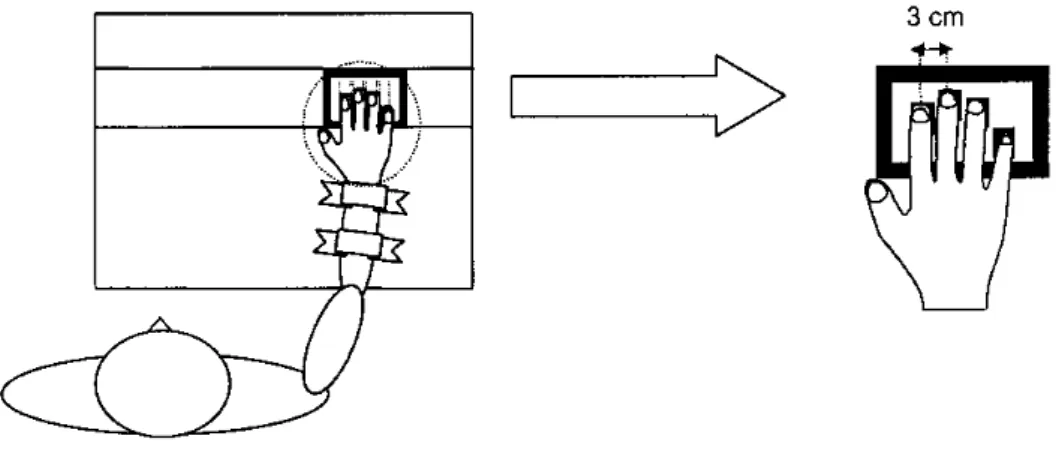
図 6.Latash et al.(2002)の実験設定. 被験者は右手の三本の指で力発揮し,その総和 を目標値に一致させた.参加者は個々の指を変動させ,力の総和を補正した.
Materials and methods
Subjects
Six unpaid healthy volunteers, four males and two females, took
part as subjects in the experiments. All of them were right handed
according to their preferential use of the right hand during writing
and eating. The age of the subjects was 28.3±3.8 years. Their
weight was 72.5±7.1 kg, and their height 1.75±0.08 m. All the
subjects gave informed consent according to the procedures
ap-proved by the Office for Regulatory Compliance of the
Pennsylva-nia State University.
Apparatus
During testing, the subject was seated in a chair facing the testing
table with his/her right upper arm at approximately 45° of
abduc-tion in the frontal plane and 45° of flexion in the sagittal plane, the
elbow at approximately 45° of flexion. A wooden board supported
the wrist and the forearm; two pairs of Velcro straps were used to
prevent forearm or hand motion during the tests. A wooden piece
shaped to fit comfortably under the subject’s palm was placed
un-derneath the palm to help maintain a constant configuration of the
hand and fingers. The subject viewed the monitor, which
dis-played total force produced by individual fingers (Fig. 2).
Four piezoelectric sensors (Model 208A03, Piezotronic Inc.)
were used for force measurement. Analog output signals from the
sensors were connected to separate AC/DC conditioners
(M482M66, Piezotronic Inc.). The system was operating in a
DC-coupled mode, utilizing the sensor’s discharge time constant as
es-tablished by the built-in microelectronic circuit within the sensor.
As such, the sensor’s time constant was theoretically infinite. Each
sensor gave approximately 1% error over the typical epoch of
re-cording of a constant signal. Cotton covers were attached to the
upper surface of the sensors to increase friction and prevent the
in-fluence of finger skin temperature on the measurements. The
sen-sors were placed under each finger of the right hand.
The sensors were mounted inside a steel frame (140×90 mm,
see Fig. 2). The position of the sensors could be adjusted in the
for-ward-backwards direction within a range of 60 mm, to fit the
indi-vidual subject’s anatomy. The steel frame with sensors was placed
inside a groove in the wooden board and positioned so that the
sub-ject could place his or her fingers comfortably on the sensors while
preserving the described arm configuration. A Gateway 450-MHz
microcomputer was used for data acquisition and processing. The
force measured by each sensor was sampled at 200 Hz.
Procedure
There were seven experimental conditions. In the first three, the
subjects were asked to produce force with one finger, index (I),
middle (M), or ring (R). The last four conditions involved two
multifinger tasks, IM and IMR, performed while the frame with
the sensors rested on either stable or unstable support. In the stable
condition (IMs, IMRs), the steel frame with the sensors was
placed directly on the board, as during the single finger tasks (I,
M, R). In the unstable condition (IMu, IMRu), the frame rested on
a narrow beam (4 mm wide) whose other end was placed on the
supporting board. During IMu tests, the beam was placed in the
middle between the index and middle fingers, while during IMRu
tests it was placed under the middle finger. During unstable tests,
the non-involved fingers of the right hand did not have contact
with the sensors. These fingers were lifted passively using
adhe-sive tape so that their fingertips were about 2 cm above their
re-spective sensors. The positions of all the sensors remained
un-changed throughout the experiment. During the trials on stable
support, subjects were explicitly instructed not to lift other,
“unin-volved” fingers off the sensors. They were asked not to pay
atten-tion to possible force generaatten-tion by other fingers.
For each of the experimental conditions, three types of tests
were performed: (1) maximal force production (MVC test); (2)
ramp force production (ramp test); and (3) rhythmical force
pro-duction (oscillation test, see Fig. 2).
During MVC tests, the subjects were asked to produce
maxi-mal force by pressing on the sensors using each of the finger
com-binations (I, M, R, IM, and IMR). The computer generated two
tones (“get ready”), then a trace showing the total force produced
by the explicitly involved fingers started to move across the
screen. The subjects were asked to produce peak force within a 2-s
time window shown on the screen and then to relax. They were
in-structed to pay no attention to possible force generation by other,
“uninvolved” fingers as long as the explicitly involved fingers
generated their peak force. Each subject performed three trials
us-ing each fus-inger combination. The trial with the highest force
pro-duced by the explicitly involved fingers was kept as a reference to
adjust the target forces in the two other tests.
The purpose of the ramp test was to generate linear estimates
of the relations between changes in individual finger forces and in
the total force during a multifinger task. These relations are
non-trivial because of the phenomenon of enslaving (see
“Introduc-tion”). As demonstrated in previous studies, patterns of finger
en-slaving show nearly linear relations between the force produced
by a master finger and forces produced by slave fingers within a
large range of forces (Li et al. 1998; Zatsiorsky et al. 2000). To be
conservative, we asked the subjects to produce ramp patterns of
force from 0% to 40% of MVC by pressing with only one finger
in each separate trial. An oblique red line was shown on the
screen, and the subject’s task was to trace this line in time with the
cursor representing total finger force. The force displayed on the
screen was either the sum of the I and M finger forces or the sum
of the I, M, and R finger forces. All ramp tasks were performed
twice, and the average of the two trials was used to estimate the
effect of enslaving for further analysis.
During the oscillation tests, the subjects had to produce
rhyth-mical force oscillation at a prescribed frequency and amplitude.
The total force produced by the explicitly involved fingers was
displayed online as a yellow trace on the screen located in front
of the subject. Two red horizontal lines were also displayed. The
top and bottom lines were placed respectively at 25% and 5% of
the MVC recorded for the tested finger combination. The task of
the subject was to produce force oscillation such that force
ext-rema just touched the two red lines. Force maxima were to be
synchronized with the beeps of an auditory metronome. The
fre-quency of the metronome was set to 112 bpm (about 1.87 Hz).
This frequency was selected based on earlier pilot studies as a
comfortable one. Each subject performed seven trials for each
finger combination. Each trial lasted 10 s; only data from the last
7 s were analyzed. Before the beginning of the experiment,
sever-al practice trisever-als were given (typicsever-ally between five and ten
tri-als).
The interval between successive trials was about 15 s. The
or-der of the tests as well as the oror-der of the experimental conditions
were pseudo-randomized among subjects. Subjects never reported
fatigue.
155
では,フィードバック情報に基づいて形成された身体の状態に関する内的表象(state estimate)は直ちに次の運動指令に変換される.State estimate は,internal forward model(運動指令の効果を予測するシミュレーター)から生じる運動指令の遠心性コピー (efference copy,これまでの運動結果に基づく予測)とフィードバックを照合すること によって更新される(Optimal state estimator の部分,Wolpert et al., 1995).そし て更新された state estimate は minimal intervention principle に基づいて運動指令 に変換される.つまり,この処理過程では,運動を新たに計画しないので,フィードバ ック遅延が解消される.Minimal intervention principle(図 7A の control policy の 部分)は,神経系が運動中に課題のパフォーマンスに影響する部分の誤差や分散を修正 するが,影響しない部分の偏差を修正しないと予測する(図 7B).Uncontrolled manifold hypothesis と同様に,この制御方略にしたがって運動を行うことは課題に関連しない部 分の分散が関連する部分の分散よりも大きくなることを意味する.
図 7.A:Todorov and Jordan によって提唱された optimal feedback control theory における情報処理回路(Scott,2004 を基に作成).遠心性コピー(efference copy,運 動指令の結果予測)とフィードバック情報によって更新された state estimate を minimal intervention principle にしたがって次の運動指令に変換する.B:Minimal intervention principle における 2 つの変動. X1 と X2 を 2 つの効果器とし,それらの 出力の合計値の目標を 2 とする.Minimal intervention principle は神経系が 2 つの出 力の配分を変動させてその合計値を補正すると予測した. State estimate Body and environment Motor command Noise Task selection Efference copy Noise (Redundant) Task ir relevant X 1-X 2 X1+X 2-Target (Task er ror) Task-relevant 0 2 X1 X2 Optimal state
estimator feedbackSensory Control policy
B A
0 2
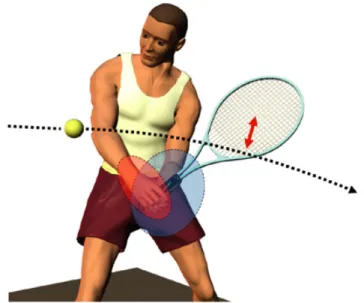
この制御方略が選択される理由には運動指令に付随する不規則なばらつきである運動雑 音(motor noise,総説として,Faisai et al., 2008)が関連している.課題に影響し ない部分を制御することは余分な運動指令を引き起こすだけでなく運動雑音を伴い,余 計な運動指令と運動補正の悪循環が生じる.現在,optimal feedback control theory は障害物に対する運動(Liu and Todorov, 2007),対象物の操作(Nagengast et al., 2009), 両手運動(Diedrichsen, 2007; O’sullivan et al., 2009)などの広い範囲の動作に応 用されている. 1.4.3 両手の運動の誤差補正 スポーツ場面では,テニス選手はラケットを操作する時に,一方の手の動作で誤差が 生じると,その誤差を他方の手で補正するだろう(図 8,Miall, 2010).両手の誤差補 正の先駆的研究として,Diedrichsen(2007)は両手で個別にカーソルを動かし,目標に 到達させる課題(図 9A,two cursor 課題)と両手の平均位置に提示されるカーソルを目 図 8.テニスにおける両手運動の誤差補正の予想図(Miall, 2011).選手はボールにラ ケットを当てるために,右手を動かした時に生じたラケットの位置の誤差を左手で補正 している.この例では,テニスラケットの位置がパフォーマンスに影響するが,左右の 手の位置は直接パフォーマンスに影響しない.
challenges are daunting — the modern
game is extraordinarily fast, and each
action must be made at the limits of
human reaction times, so that tennis
strokes are planned and executed
well before the ball arrives at the
racquet. For a powerful player like
Andy Roddick, the ball is served so
fast — 155 mph — that it reaches the
opponent’s baseline in about 350
milliseconds. Estimating the ball’s
trajectory accurately enough to reach
and return it requires the combination
of incomplete sensory information from
the visual system with prior knowledge
of the ball’s likely distribution of
positions — Roddick tends to get the
ball inside the tramlines more often
than not. Kording and Wolpert
[1]
showed in a laboratory version of this
task that we use a Bayesian approach
in which we optimally integrate sensory
information about the current event
with prior knowledge of the distribution
of past events.
Consider next the challenge for
Roddick’s opponent in returning the
serve. He plans the swing of the
racquet to reach the approaching ball,
but again must integrate his motor plan
with sensory feedback about its
execution. The evolving act must be
refined and modified as the latest
sensory information is processed,
specifying both where the ball is
bouncing and how his race along the
baseline is progressing. Todorov and
Jordan
[2]
developed the theory of
optimal feedback control, in which
sensory feedback and prior knowledge
are combined into a ‘state estimate’ of
the current situation that is integrated
with the goal of the action to
dynamically specify the optimal motor
responses required. The key concept
is of ‘minimum intervention’. Control
gains are adjusted according to the
task, allowing irrelevant parameters
to be uncontrolled (low gain) while
task-critical parameters have high
gain
[3]
. This was a significant advance
over previous theories which could
define an optimal plan in advance of an
action
[4–6]
, but could not easily modify
the plan to deal with intrinsic variation
in its execution or with changes in the
external environment.
Now, take things a step further.
Imagine when someone like me
attempts to play tennis. I might be
ambitious and try a two-handed
backhand stroke. But it goes wrong
(it always does!) and the racquet
misses the ball (
Figure 1
A). Is it
because my left arm was weak, or
my right arm a bit slow? How should
I untangle the ambiguity about the
responsible effector muscles so that
I can first correct the mistake, and
second learn from the mistake to
improve my performance? Because
I am right-handed, my left arm is likely
to be less accurate, so should I try to
use my right arm to correct for the error,
as it is better able to do so, or should
I make my left arm correct the mistakes
it was responsible for, and learn from
them for next time?
As they report in this issue of Current
Biology, White and Diedrichsen
[7]
have developed a clever experimental
design to address these questions.
Participants hold two lightweight
mechanical arms and see the average
of the two handle positions as a cursor
on a screen which they must move
towards a visual target (
Figure 1
B).
Because the cursor reflects the
average of both hands, the task is
inherently redundant — one hand or
the other could do all the work, or
both hands can share the effort
[8]
.
Likewise, an error — introduced
experimentally by rotation of the
path of the cursor around its start
position — is ambiguous and could
have been caused by either the left
hand or the right hand misreaching.
What the authors
[7]
first found is that
for a group of right handers, the left
hand corrected for the rotated cursor
position more than the right hand.
They confirmed this result by testing
left handers, who are typically less
lateralized than right handers, and
found a weak effect in the opposite
direction. Combing both groups, there
was a strong relationship between
handedness and the asymmetry of the
corrections. The more dominant was
one hand, the less likely it was to
correct the error.
White and Diedrichsen
[7]
asked how
the two hands adapted to these errors.
Again, across the group there was a
correlation between the asymmetry
of error correction on one trial and the
asymmetric shift in reaching direction
on the next trial (
Figure 2
). The arm that
corrected more learned more from the
mistake. In an elegant twist, they then
pre-exposed one hand or the other to
a series of high errors, in a unimanual
version of the task, before again testing
the bimanual responses. Their results
show that recent history of poor
reaching performance is enough to
bias the corrective responses and the
learning towards the worse hand. We
do force the bad arm to learn better,
rather than rely on the good arm to do
all the work.
A B 15 10 5 cL cR Cursor 0 -10 Left
hand Righthand
10 0
x-dimension (cm)
Current Biology
y-dimension (cm)
Figure 1. Assigning responsibility for motor errors.
(A) Bimanual actions have redundancy because either or both arms can contribute to the action. So an error — missing the ball — could have been caused by a mistake from either arm. It might also be due to external events, such as a gust of wind. The ellipses indicate unequal certainty about the state of each arm. For right handers, the right arm is more reliable, less uncertain (red ellipse). So the mistake is more likely caused by the more uncertain left arm (blue). (B) Experimental design. The forward movement of a single cursor (centre) towards a target (yellow) is controlled by both unseen arms, but is rotated clockwise about its origin. The two hands share the correction (CL and CR). On the subsequent trial, the two hands also
adjust their initial direction to better control the rotated cursor. (Panel B adapted from [7].) Dispatch
標位置まで動かす課題(図 9B,one cursor 課題)を用いた.このような one cursor 課 題は参加者が両手で1つのカーソルを制御するので,課題を達成するための両手の位置 の組み合わせが多く存在し,冗長的課題(redundant task)とも呼ばれる.また,両課 題において,参加者は運動中,片腕に機械によって外乱を与えられ,片腕の動作を妨げ 図 9.Two cursor 課題(A)と one curosor 課題(B).Two cursor 課題は両手で個別に 2 つのカーソルを動かし,目標位置に到達させる(A).One cursor 課題は両手の平均位置 に提示されたカーソルを目標位置に到達させ,両手で 1 つの対象を操作する課題である (B).到達を開始した後,一方の手に運動を妨げるような外乱(右手では左向きの力場) が与えられた.C:目標到達時における両手の位置の散布図.D;両手の位置の相関関係 における目標に到達するまでの時間経過.Two cursor 課題では,目標到達時の手の位置 は相関せず(図 C と D の青),参加者は両手の到達運動を個別に制御していた.One cursor 課題では,目標到達時の手の位置が負の相関関係になり(図 C と D の赤),外乱によって 右手に左側の誤差が生じると,他方の手を右に動かすことによりカーソルに位置を補正 した.
domain, structured variability can be observed in the synchronisation of bimanual movements. For example, when one hand is used to open a drawer and the other to retrieve an object from the drawer, intermanual time lags are small when the object is picked up, but variable
during other phases of the action[44].
Correlations between effectors are often attributed to synergies (in an explanatory sense). In the context of OFCT, however, structured variability emerges naturally
from task-dependent feedback control[18]. The
regularis-ation term of the cost function enforces the minimal inter-vention principle: Deviations relevant to the external task goal should be corrected, whereas deviations along task-irrelevant dimensions need not be compensated and can thus accumulate. The interplay of these two factors induces structured variability. Importantly, OFCT holds that this structure arises through feedback control rather than reflecting inherent correlations between the feed-forward commands to different effectors. Consistent with this prediction, the negative correlation of the lateral hand positions in the one-cursor task arises over the time course
of the movement (Figure 2c).
Initial gating mechanism
There are situations in which systematic correlations be-tween effectors cannot be attributed to task-dependent feedback control. For example, when the two hands are used to reach simultaneously for two separate goals, OFCT would predict independent control of the two movements. However, strong correlations are observed in both reaction
time and initial acceleration[45,46]. This form of coupling
is generally considered a hard constraint in coordination
[10]: it is not easily modified by task requirements[47].
Indeed, it remained present even when the primary con-nections between the two cerebral hemispheres were absent, despite the fact that the human subjects exhibited considerable independence of the two limbs once the
move-ments are initiated [48,49]. Thus, there appears to be a
general mechanism, probably subcortical [50], that
syn-chronises the onset of different movements, even if they are unrelated. How can the existence of such a strong inherent constraint be reconciled with OFCT?
We propose that, at least for related movements, a coupling mechanism of this sort is necessary within the control architecture assumed by OFCT. Consider the task Figure 3. Structured variability induced by task-dependent feedback gains. (a) Correlations of horizontal endpoint position of the left (x) and right (y) hands are found in the one-cursor task (red line and dots) but not in the two-cursor task (blue line and dots). In the one-cursor task, variability along the task-redundant dimension (distance between hands, left up–right down diagonal) is not corrected. (b) The negative correlation develops during the movement, indicating that it arises from a feedback control law rather than from correlations in the initial motor commands[32].
Figure 2. Task-dependent feedback control during a bimanual task. (a) In the two-cursor task, a force field applied to the left hand is corrected by the action of the left hand alone. (b) In the one-cursor task, part of the correction is performed by the right hand. (c) The task dependent component q(x) of the cost function comprises the distance between the position of the left hand ( pL) and its goal (gL) and the distance between the right hand ( pR) and its goal (GR). Minimisation of this cost function results in independent control gains (L) for the two hands. (d) The cost function for the one-cursor task predicts feedback control in which motor commands for the left hand (uL) depend on the state of both the left hand and right hands ( ˆxLand ˆxR, respectively). Reproduced with permission from Ref.[32].
Review Trends in Cognitive Sciences Vol.14 No.1
35
be tested, the visual feedback of the cursor was
with-drawn in half of the trials, making the one- and
two-cursor conditions identical except for task instructions.
Even without visual feedback, participants showed
similar bilateral reactions in the one-cursor condition
(Figures
1
F and
2
A). Thus, just by changing whether
participants thought they controlled one or two end
effectors, feedback control based on proprioceptive
information could be manipulated.
When adding signal-dependent noise separately to
the movement of each hand, the optimal control policy
for the one-cursor condition predicts that the endpoints
of the two hands should become negatively correlated.
The effect arises because of bilateral corrections of
mo-tor noise, and should gradually arise over the course of
the movement (
Figures 3
A and 3B). Congruent with
this prediction, the movement endpoints on
unper-turbed trials were more negatively correlated in the
one-cursor than in the two-cursor condition, both with
(20.81 versus 20.22, t(9) = 7.283, p < 0.001) and without
(20.44 versus 20.18, t(9) = 3.881, p = 0.004) visual
feed-back. Furthermore, the effect arose after the predicted
time course (
Figures 3
C and 3D). Thus, participants
corrected only for task-relevant error
[3, 5]
, whereas
negative covariation of the hands accumulated.
I then investigated how participants adapted to the
force fields. Previous studies have found the
indepen-dent adaptation of each arm during bimanual
move-ments
[2]
. By using a state-space model (see the
Exper-imental Procedures
), I estimated how much the initial
direction of each hand in trial n + 1 (at 160 ms) was
influ-enced by a perturbation experiinflu-enced in trial n, either on
the same hand (within-hand adaptation rate) or on the
other hand (between-hand adaptation rate).
In the two-cursor condition, the within-hand
adapta-tion rate was 0.12, with limited generalizaadapta-tion to the
other hand (
Figure 2
B). In the one-cursor condition, the
between-hand adaptation rate was significantly higher
[t(9) = 3.37, p = 0.008] and the within-hand significantly
lower [t(9) = 2.43, p = 0.037]. Here, a force field applied
to one hand changed the initial direction in both hands.
Thus, how participants adapted to a unilateral force field
changed substantially with the task goals. A possible
account for the parallel changes feedback control and
adaptation is that the correction of each hand in the
last trial dictates how much the movement should adapt
in the next
[6]
. Consistent with this hypothesis, the
between-hand correction and adaptation rate in
experi-ment 1 were significantly correlated (
Figure 2
C).
So that the changes in adaptation could be confirmed,
participants in experiment 2 (n = 8) adapted for 80 trials
to a velocity-dependent force field of a constant
direc-tion applied to one of the hands. The perturbed hand
(
Figure 4
A) quickly adapted to the large initial errors.
This can also be seen in the change of initial direction
in catch trials, in which no force field was applied
(dashed line). In the two-cursor condition, adaptation
was restricted to the perturbed hand. In the one-cursor
condition, however, the unperturbed hand (
Figure 4
B)
also changed its initial direction, such that it opposed
the force field [t(7) = 7.89, p < .001], allowing the
per-turbed hand to adapt less than in the two-cursor
condi-tion [t(7) = 2.67, p = 0.032].
Previous work has shown that the control of bimanual
movements can change with task requirements
[5, 7]
,
visual feedback
[8, 9]
, and attention
[10]
. Here, I provide
another clean demonstration of this important feature of
the human motor system and show that this flexibility
Figure 1. Experiment 1 Shows Bilateral Movement Corrections in the One-Cursor Condition
(A) In the two-cursor condition, participants reached for two separate targets. In the one-cursor condition, they reached with both hands to move a common cursor to a single target. One of the hands was perturbed with a leftward (red) or rightward (blue) force field or was unperturbed (black).
(B) Predicted movement trajectories based on the optimal control policy.
(C) Movement trajectories observed in experiment 1, averaged across participants and hands.
(D) The y velocity (dashed line) and x velocity (red, blue, and black solid lines) of the perturbed hand.
(E and F) The x velocity of the unperturbed hand with (E) and without (F) visual feedback shows the onset of the correction in the one-cursor condition. The shaded area indicates the across-subject standard error (SE).
Current Biology Vol 17 No 19
1676
be tested, the visual feedback of the cursor was
with-drawn in half of the trials, making the one- and
two-cursor conditions identical except for task instructions.
Even without visual feedback, participants showed
similar bilateral reactions in the one-cursor condition
(Figures
1
F and
2
A). Thus, just by changing whether
participants thought they controlled one or two end
effectors, feedback control based on proprioceptive
information could be manipulated.
When adding signal-dependent noise separately to
the movement of each hand, the optimal control policy
for the one-cursor condition predicts that the endpoints
of the two hands should become negatively correlated.
The effect arises because of bilateral corrections of
mo-tor noise, and should gradually arise over the course of
the movement (
Figures 3
A and 3B). Congruent with
this prediction, the movement endpoints on
unper-turbed trials were more negatively correlated in the
one-cursor than in the two-cursor condition, both with
(20.81 versus 20.22, t(9) = 7.283, p < 0.001) and without
(20.44 versus 20.18, t(9) = 3.881, p = 0.004) visual
feed-back. Furthermore, the effect arose after the predicted
time course (
Figures 3
C and 3D). Thus, participants
corrected only for task-relevant error
[3, 5]
, whereas
negative covariation of the hands accumulated.
I then investigated how participants adapted to the
force fields. Previous studies have found the
indepen-dent adaptation of each arm during bimanual
move-ments
[2]
. By using a state-space model (see the
Exper-imental Procedures
), I estimated how much the initial
direction of each hand in trial n + 1 (at 160 ms) was
influ-enced by a perturbation experiinflu-enced in trial n, either on
the same hand (within-hand adaptation rate) or on the
other hand (between-hand adaptation rate).
In the two-cursor condition, the within-hand
adapta-tion rate was 0.12, with limited generalizaadapta-tion to the
other hand (
Figure 2
B). In the one-cursor condition, the
between-hand adaptation rate was significantly higher
[t(9) = 3.37, p = 0.008] and the within-hand significantly
lower [t(9) = 2.43, p = 0.037]. Here, a force field applied
to one hand changed the initial direction in both hands.
Thus, how participants adapted to a unilateral force field
changed substantially with the task goals. A possible
account for the parallel changes feedback control and
adaptation is that the correction of each hand in the
last trial dictates how much the movement should adapt
in the next
[6]
. Consistent with this hypothesis, the
between-hand correction and adaptation rate in
experi-ment 1 were significantly correlated (
Figure 2
C).
So that the changes in adaptation could be confirmed,
participants in experiment 2 (n = 8) adapted for 80 trials
to a velocity-dependent force field of a constant
direc-tion applied to one of the hands. The perturbed hand
(
Figure 4
A) quickly adapted to the large initial errors.
This can also be seen in the change of initial direction
in catch trials, in which no force field was applied
(dashed line). In the two-cursor condition, adaptation
was restricted to the perturbed hand. In the one-cursor
condition, however, the unperturbed hand (
Figure 4
B)
also changed its initial direction, such that it opposed
the force field [t(7) = 7.89, p < .001], allowing the
per-turbed hand to adapt less than in the two-cursor
condi-tion [t(7) = 2.67, p = 0.032].
Previous work has shown that the control of bimanual
movements can change with task requirements
[5, 7]
,
visual feedback
[8, 9]
, and attention
[10]
. Here, I provide
another clean demonstration of this important feature of
the human motor system and show that this flexibility
Figure 1. Experiment 1 Shows Bilateral Movement Corrections in the One-Cursor Condition
(A) In the two-cursor condition, participants reached for two separate targets. In the one-cursor condition, they reached with both hands to move a common cursor to a single target. One of the hands was perturbed with a leftward (red) or rightward (blue) force field or was unperturbed (black).
(B) Predicted movement trajectories based on the optimal control policy.
(C) Movement trajectories observed in experiment 1, averaged across participants and hands.
(D) The y velocity (dashed line) and x velocity (red, blue, and black solid lines) of the perturbed hand.
(E and F) The x velocity of the unperturbed hand with (E) and without (F) visual feedback shows the onset of the correction in the one-cursor condition. The shaded area indicates the across-subject standard error (SE).
Current Biology Vol 17 No 19
1676
A
B
C
られた.その結果,two cursor 課題では目標位置に到達した時の両手の位置は相関せず (図 9C と D),両手の運動は個別に制御された.One cursor 課題では目標値に到達した 時の手の位置は負の相関関係を示しており,外乱によって右手が過剰に右に動かされる と,外乱のない左手を左に動かすことでカーソルの位置を補正した.したがって, 1 つ の対象を制御する課題では,参加者は両手の運動を結合させるよりも,両手の運動の誤 差補正によって課題を達成した.このような one cursor 課題における両手の運動の誤差 補正は uncontrolled manifold hypothesis や optimall feedback control theory を用 いて説明でき,課題パフォーマンスに影響しない両手の位置を変動させることで,カー ソルの位置の変動を補正した.両手運動の誤差補正は冗長性のある課題におけるパフォ ーマンスを向上させるために重要な方略であるといえるが,両手の運動の結合と誤差補 正のような 2 つの制御方略はどういった条件で決定されるのかは不明確な点が多い. 1.5 力とタイミングの相互作用 ヒトは両手協応運動のように四肢間の協応だけでなく, 2 以上つの運動パラメータを 相互作用させることがある.先行研究はタッピング課題(Inui et al., 1998; Sternad et al., 2000)や等尺性力発揮課題(Newell and Carlton, 1985; Carlton et al., 1993) を用いて,力とタイミングの相互作用について検討している.たとえば,Inui et al. (1998)はタッピング課題を用いて,参加者に好みの運動間隔と力を 1/2 または 2 倍に するように要求した.つまり,この実験は 3 通りのタップ間間隔と力を組み合わせて,9 通りの課題を設定した.その結果,すべての力の強さにおいて,好みのタップ間間隔は 400 ms 前後であり,2 倍の間隔は 800-900 ms であり,1/2 の間隔は 230-250 ms であっ た(図 10A).このように,力の増減に関わらず,タップ間間隔はかなり正確に増減が制 御されていた.それに対して,タップ間間隔が 2 倍になると,力も顕著に強くなり,力 は正確に制御されなかった(図 10B).さらに,Inui らの一連の研究(Inui and Ichihara , 2001; Inui and Hatta, 2002)は好みのペースに近い 400 ms と 500ms の運動間隔で目標 筋力 2-4N のタッピング課題では,タップ間間隔の変動係数は 5%未満であるが,力のそ れは 20%であり,タイミングの制御は力制御よりも著しく不正確であった.しかし,こ れらの変動も練習によって改善され,熟練したピアニストは力の変動係数を 10%未満に
抑え,力発揮を正確に制御できた.この結果はタイミングと力の制御が独立でなく,タ イミングは力の制御に一方的に影響を与えることを示した.この結果は力の制御よりも 早く個々の動作のタイミングが習得できるが,力の微調節は膨大な時間を要することを 示唆した. 1.5.2. 力とタイミングの階層性 複雑で大規模なシステムでは,階層性が存在する.2 つの階層の間には,上位の階層 がその構成単位である下位の階層の働きの引き金を引き,下位の階層に応じてあらかじ め決められたパタンにそってその機能を果たす構造が見られる(団,1976).この点に関 連して,Rinkenauer et al.(2001)は 2 つの条件で両手の力発揮課題における力とタイ ミングの階層性を検討した.力非対称条件では参加者が両手で同時に力発揮し,左右で 異なる力の目標に一致させた.時間非対称条件では参加者が左右の手で異なるタイミン グで力発揮し,左右で同じ目標値に一致させた.力非対称条件では,両手の力は相関し
図 10.Inui et al.(1998)における力とタイミングの平均値.参加者は好みのペース と力でタッピング課題を行った後,好みのペースと力の 1/2 と 2 倍で課題遂行した.つ まり,参加者は 3 通りの運動間隔と 3 通りの力を組み合わせ,計 9 通りの条件で課題を 行った. Peak force (N) 乾 におけるタイミングと力は異なる中枢系で制御され ているという知見 ングに比較して,力の制御は非常に難しいことが示 された. 用を検討するために,各被験者の ップ間間隔と力との相関係数を算出した. 名に正の相関関係が認められた.つまり,タップ間 間隔が長くなればなるほど,発揮筋力も大きくなっ た.さらに,どのような課題の時に相関関係がみら タップ間間隔 (ms) 0 200 400 600 800 1000 1200 1400 5 10 15 20 0 1/2の力 好みの力 2倍の力 1/2の力 好みの力 2倍の力