Characteristics of
a
Mobile Charged
Particle
in Oscillating
Electric
Fields
Haiduke SarafianThe Pennsylvania State University
University College
York,PA
17403
Abstract
We consideran arrayof$1D$and$2D$rectilinear time-dependent chargedistributionsandevaluate their respective associated
electric fields along specific directions. Wethenplacealoose point-like charged particle in designated respective fields. The
equation describing the motion of the charged particle in each
case
isa
challenging$ODE$. ApplyingaComputer AlgebraSystem suchasMathematica[1] wesolve the equations numerically. Utilizing thesesolutions weanalyzetheir relevant
kinematic quantities. Foracomprehensive understandingwesimulate themotions.
keywords: Time-dependent Charge Distributions, Motion ofa Charged Particle in aTime-dependent ElectricField,
Numeric Solutions ofODEs,Mathematica.
$\blacksquare$IntroductionandMotivation
Theelectrostaticinteractionof twopoint-likecharged particles is nonlinear. Themotionof
a
loosecharge in the field ofa
secondstatic charge is described withanonlinear$ODE$. Traditionallyoneattempts solving theequation analytically. Even in
this“trivial”
case
the solutionis challenging. Generalizations of this scenario basedonthetwo-bodyproblem aggressivelyaredemanding. Furthermore,theequation of motion describingthe movementofacharge inatime-dependent electric field
generatedbyasecondstationarychargedistributionsareaggressively complicated. The classic approach callstosearch for
analytic solutions. Althoughthegoal is respectfully appreciative, 1)themajority ofthecasestheequationsarenotsolvable
2$)$attemptingtoseekanalyticsolutions derailsthefocus and objectives of the physics of the problems, and3) these attempts
hampertherateof scholarly production. $\ln$thisarticlethe author utilizesaComputer Algebra System, Mathematica and
mapsoutasystematic approach ofovercoming the aforementioned problematic issues. Beginning withatwo-body point-like
chargedparticles systematicallythe scenariosaregeneralized. For eachscenario, 1)a problem is posed,2)asolution is
offered,3)kinematics of the motion is analyzed,and finally4)themotionsaresimulated for comprehensive understanding.
Effectively, theentire workthatis composed oftext,symbolicandnumeric computation, graphsandsimulations
are
compiledinonesinglefile. This article is composed of eight sectionsandafewsubsections. The articles closes with
a
few concludingremarks. $\blacksquare$Section 1
Case la. $A$two-body point-like charge-chargeinteraction
Theproblemis posed: 1)Consider astationary point-likecharged particle. Releasealoose secondary chargedparticleinthe
fieldof theformer. Assuming the chargesare identicalin $sign$”.determinethekinematics of the loose particle. 2) Repeat
thescenario assumingthecharge ofthestationary particle is time-dependent and fluctuates withrespecttotime accordingto
asinusoidalfunction.
$arrow$
$\blacksquare$Solution: Inordertoformtheequation of motion for the loose particleweapply Newton’s secondlaw,$F=ma$. The
force $arrow$
$RIMS_{-}Sara\Gamma ian_{-}November27_{-}2012.nb$
$k=9.0 \cross 10^{9}\frac{Nm^{2}}{c^{2}}$
.
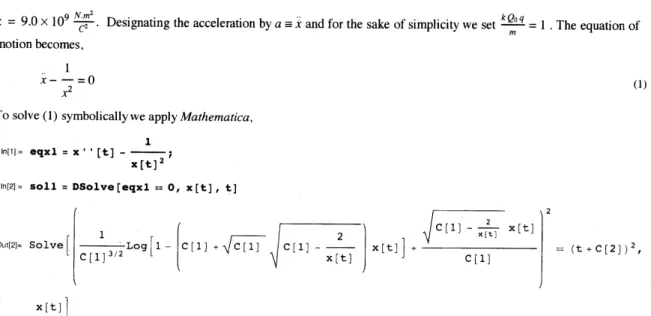
Designatingtheaccelerationby$a\equiv\dot{x}$andfor the sake of simplicityweset $\frac{kQ_{0}q}{m}=1$ .The equation of
motionbecomes,
1
$x\prime.--=0x^{2}$ (1)
To solve(1)symbolicallyweapplyMathematica, 1
$|nl||=$ eqxl
$=x”[t]-;\overline{x[t]^{2}}$
$|n[2]=$ soll $=$DSolve$[$eqxl $—-$ $O$, x$[t],$ $t]$
$O\cup t[2]=$ Solve$[[ \frac{1}{C[1]^{3/2}}{\rm Log}[1-(C[1]+\sqrt{C[1]}\sqrt{C[1]-\frac{2}{2C[t]}})x[t]]+\frac{\sqrt{c[1]-\frac{2}{x[t]}}x[t]}{C[1]}$
2
$==(t+C[2])^{2},$
$x[t]]$
Mathematica failstosolve(1) symbolically. Wethen trysolving numerically;thisrequirestwoinitial conditions. Assuming
the loose particle beginsat rest,$\{x(O\},\dot{x}(0\}=\{1,0\}$wewrite,
$|n|3]=$ solxll $=$NDSolve$[\{ eqxl =_{-}^{-}0, x[O]---- l. , x‘[0]----0\}, x[t], \{t, 0,2. \}]$ ;
Table 1 is the tabulated values of thetimeand theposition.
$|n|4]=$ tabxll $=$TableForm[Table $[\{t, x[t] /.$ solxll}$, \{t, 0,2. O, 0.2\}],$
TableHeadings$arrow\{$None, { $t,$$s”,$ $\mathfrak{n}_{X}[t]"\}\}]$;
Although the solutionof thepositionvs.time is given numerically, Mathematica allowsdifferentiatingthe equationwith
respecttotimetoevaluate thecorresponding velocityandacceleration. These solutionsareshowninthecorresponding plots.
$|n[5]=$ {velocityll, accelerationll}
$=\{D[x[t]/.$ solxll, $\{t, 1\}], D[x[t]/.$ solxll, $\{t, 2\}]\}$;
$|\cap|6]=$ plotvelocityll $=$ Plot[velocityll, $\{t, O, 2. \},$
PlotStyle $arrow$ { Thick, Red}, AxesLabel $arrow\{\prime\prime t, s", " v,m/s"\}$,
GridLines$arrow$ Automatic];
$|n[7]---$ plotaccelerationll $=$ Plot$[$accelerationll, $\{t, 0,2. \},$
PlotStyle$arrow$ {Thick, Green}, AxesLabel
$arrow\{//t,$$s”,$ $/a,m/s^{2\prime\prime}\}$, GridLines$arrow$ Automatic$]$;
$|n[8]=$ plotxll $=$ Plot$[x[t]/$
.
solxll, $\{t, 0,2. \},$PlotStyle $arrow$Thick, AxesLabel$arrow t”t,$
$s”,$ $/x,m”$}, GridLines$arrow$Automatic];
Plots of these three quantitiesareshownin Fig 1.
$|n[9]=$ GraphicsGrid[{{plotxll, plotvelocityll, plotaccelerationll}}, ImageSize$arrow 500$
] x,m $v,m/s$ $a,m/s^{2}$
$Out[9]=$
$\blacksquare$Case lb. Fortheoscillating stationary charge
$RIMS_{-}Sara\hslash an_{-}November27_{-}2012.nb$
$f=5$Hz. This low frequency makes theoscillationsvisiblytraceable. As in thepreviouscase,
wc
set$\frac{KQ_{0}q}{m}=1$. Theequation of motion for
a
setifinitialconditions,$\{x(O),\dot{x}(0)\}=\{0.5,0\}$becomes,$Cos[2\pi ft]$
$|n||0)\overline{-}f=5\cdot$; eqlf
$=x”[t]–$
;$x[t]^{2}$
$| \bigcap_{l^{\mathfrak{d}}}’|’ 1|=$ solxllf $=$ NDSolvo$[\{--O, x[O]--0.5(*1.O*), x’[0]----0\}, x[t], (t, 0,4. \}]i$
Figure2is the corresponding display of theassociatedkinematics.
$|n[12_{J}^{1}=$ plotxl lf $=$ Plot$[x[t]/$
.
solxllf, $\{t, O, 4. \},$PlotStyle$arrow$Thick, AxesLabel$arrow\{"t,$$\epsilon^{n},$ $/x,n”\},$ $GrldLinosarrow$ Automatic];
$|ni\rceil 3|=$ {velocityllf, $acc\bullet 1\epsilon ratlon$llf} $=\{Dtx[t]/$
.
solxllf, $\{t,$ $1\}],$ $D[r[t]/$.
solxllf, $\langle t,$ $2\}]\}_{i}$$|r\}14|=$ plotvelocityllf$=$ Plot[velocityllf, $\{t, 0,4. \},$
PlotStyle$arrow$ {rhick, $R\bullet d$}, $lx\bullet\epsilon Lab\bullet larrow\{\prime\prime t, s", " v,m/s"\},$ $GridLin\bullet\iotaarrow$Automatic]$j$
$|nV5]=$ plotaccelerationllf $=$ Plot$[$accelerationllf, $\{t, 0, l. \},$
PlotStyle$arrow\{?hick, Gre\bullet n\},$ $lz\bullet$sLabel$arrow\{"t,$$s”,$ $/$a,r
$/s^{2_{\mathfrak{n}}}\}$, GrldLln$\bullet\bullet$$arrow$Automtic$]\}$
$|)(16)=$ GraphicsGrid[$(\{$plotxllf.’ plotvelocityllf, plotaccelerationllf}}, ImageSize$arrow 500$]
$x.m aJI\gamma s^{2}$
$vnV^{S}$$Out\{\mathfrak{l}6\vdash-$
$t,s t\delta$
Figure2. Display of thcposition,velocity and acceleration for$Q(t)=KQ_{0}qCos(2\pi ft)$
Foracomprehensive andvisual understanding
we
simuatethecorresponding motion. Note the color of the fixed chargechanges accordingly.
$|n|\ln=$ plotPointCharge $:=$ Graphic$\iota[\{1Iu\bullet$[Coe$[2\pi$ft$]]$, Dizk$[\{0,0\},$ $O.02]\}]$; $|n|_{1}’8|=$ plotXaxis $=$Graphice$[$$(Bhin, Liu\bullet [\{\{0,0\}, \{1, O\})$$]\}]i$
$|n\mathfrak{l}^{1}9|=$ Manipulate$[\{$Show$[\{$plotXaxis, plotPointCharge /. $tarrow r,$
Grapbics$[\{Red, DAsk[(x[t]/. solxllf[1\Pi/. tarrow r, 0\}, O.02]\}]\}, l\varpi ag\bullet 8izearrow 200],$
plotxllf}, $\{\{\tau, 0, \prime\prime t’\}, 0,4,0.025\}]$
$0$ $\ulcorner.$ . $\cdots$-..-.,.,-.. ..–.. —..
$—$
$\cdots$–.. ..– $|_{1}’19]=$$1 2 3 4$
–$\cdot$$J$$RIMS_{-}Sara\Gamma\dot{/}an_{-}November27_{-}2012.nb$
$\blacksquare$Case2.Weconsideracharged lineandapoint-likeloosecharge
The
source
ofthestatic charge isalineof length$l$.
Applying basic principles[2] yieldsthe electric field alongtheextensionof theline,$E(x)=k \frac{Q_{0}}{x(x-t)}$. Onemayplot the$E(x)$vs.xe.g.$P=0.5m.$
$\ln[20|=$ EfieldStarightLine$[x_{-}]=1/(x(x-\sqrt{}))/.$ $t-\succ 0.5$;
$|n[21|=$ Plot[EfieldStarightLine$[x],$ $\{x, (/+0.1)/. ; -> O. 5, (\prime +3.0)/. 1-\succ O. 5\},$
PlotStyle$arrow$Thick, $AxesLabe1_{(}arrow\{\prime\prime x, m", " E_{-}$field$, N/C”\}$, GridLines $arrow$Aut6matic];
Theequation ofmotionof
a
loose charged particle with charge$q$is,$\dot{x}-=0\underline{kQ_{0}q}\underline{1}$
(2)
$m x(x-P)$
Hereagainweset $\frac{kQ_{0}q}{m}=1$. Thisequation numericallycanbesolved accordingtothe procedure explained in the previous
case. The authorskippedthis setsand leaves the exercisetointerested reader.
For the time-dependent
case
wereplace$KqQ_{0^{\int}}m$with$(KqQ_{0} \int m)$Cos$(2\pi ft)$andformits equation of motion. For visualclaritywede-magnify thenumeric coefficient by
a
factor of0.4.$|n[22]=$ values $=\{\sqrt{}-\succ 0.5,$ $\delta-\succ 0.25,$ $\frac{kQ_{0}q}{m}arrow 1.0,$ $farrow 5.$$\}$;
$|\cap 123]=$ eqx2 $=x$‘ ‘ $[ t]-0.4(\frac{kQ_{0}q}{m})$ (EfieldStarightLine$[x]/.$ $xarrow x[t]$) Cos$[2\pi$ft$]//$
.
values;$|n[24]=$ solx2 $=$ NDSolve$[\{ eqx2--=0, x[O] --=0.6, x\prime[O] ----0\}, x[t], \{t, 0,2. O\}]j$
$|n[25]=$ plot2 $=$ Plot$[x[t]/$
.
solx2, $\{t, 0,2.0\}$, PlotStyle $arrow$Thick,AxesLabel $arrow\{"t,$$s”$, “$x,m”\}$, GridLines $arrow$Automatic, PlotRange$arrow$All];
Weevaluate thevelocityandthe accelerationof theloose,mobile charge,andcomparethem to thepreviouscase.
$|n[26]=$ {velocity2f, acceleration2f} $=\{D[x[t]/. solx2, \{t, 1\}], D[x[t]/. solx2, \{t, 2\}]\}$ ; $|n|27|=$ plotvelocity2$f=$ Plot[velocity2$f,$ $\{t, 0,2. \},$
PlotStyle$arrow$ {Thick, Red}, AxesLabel$arrow\{\prime\prime t, s", " v,m/s"\}$, GridLines$arrow$Automatic]$i$
$|n|2S]=$ plotacceleration2f$=$ Plot$[acceleration2f,$ $\{t, 0.01,2. \}$, PlotStyle$arrow$ {Thick, Green},
AxesLabel$arrow\{"t,$$s”$, “$a,m/s^{2,\prime}\}$, GridLines
$RIMS_{-}Sara\Gamma;an_{-}November27_{-}20J2.nb$
$|n[29]=$ GraphicsGrid[{{plotxllf, plot2}, {plotvelocityllf, plotvelocity2$f$},
{plotaccelerationllf, $plotaccoleration2f$}$\}$, ImageSize$arrow 500$]
$x.m$ $x.m$
$VJ\eta/S vMs$
$a\mathcal{M}s^{2} afls^{2}$
Figure2. Display of impact ofatime-independent electric fieldtoatime-dependent fieldonthe kinematics of the loose
charge.
One notices the frequencies of the oscillations in thesetwocases are different. Thepoint-likecharge-charge interaction,in
thefirst
case
study has the frequency of$f=5$Hz,thesame as
thefrequency of the charge. On thecontrary,for the secondcasethefrequency is about$f=3$Hz. One interprets thisas adirect impact of the shape of the charge distribution of the fixed
chargedsource.
The simulation codegenerates theanimation and also assists in visualizingthephysical arrangementof theproblem.
$|n[30]=$ plotChargedLine $:=$
Graphics$[${Thickness[0.02], Hue [Cos$[2\pi$ft$]]$, Line$[\{\{0,$ $\circ\}$, {’ /. values, $0\}\}]\}]$ ;
$RIMS_{-}Sara\Gamma ian_{-}November27_{-}2012.nb$
$|n[32|=$ Nanipulate[{Show[{plotXaxis, plotChargedLine/. $tarrow r,$
Graphics[$\{$Red, Disk$[\{x[t]/.$ $solx2[1\prod/.$ $tarrow r,$ $0\},$ $0.02]\}]\}$, lmageSize$arrow 200$],
plot2}, $\{\{\tau, 0, " t"\}, 0,2, 0.025\}]$
$\blacksquare$Case3. We considertwo
horizontal parallel charged lines. Thetwofinite charged parallel lines of length$P$areseparated
byadistance$\delta$eachwith chargeQ.
The$E$-field of the given charge distributionatapoint along the bisector ofthelinesfor
distances$x>P$is givenby, $E[x]=KQ_{0}$$[ 2. /i( \frac{1}{\sqrt{(x-,)^{2}+\langle\frac{6}{2})^{2}}}-\frac{1}{\sqrt{x^{2}+(\frac{\delta}{2}\rangle^{2}}}]]$. Thisisacomposite equationbasedon the fieldequation given inthepreviouscase.
Onemaywishtoplot thisfield. The codeis given;however,duetomanuscriptspacelimitation theoutpmis suppressed.
$|n[33]=$ EfieldTopBottom$[x_{-}]$ $:=2.$ $/1( \frac{1}{\sqrt{(x-t)^{2}+(\frac{\delta}{2}\rangle^{2}}}-\frac{1}{\sqrt{x^{2}+\langle\frac{\delta}{2}\rangle^{2}}}1/$
.
values$|\cap[34]=$ Plot[EfieldTopBottom$[x],$ {$x,$ $(1+0.1)$ $/$
.
values, $(i+3.0)/$.
values},PlQtStyle$arrow$Thick, AxesLabel $arrow\{\prime\prime x, m", /E_{-}$field, $N/C”\}$, GridLines$arrow$ Automatic];
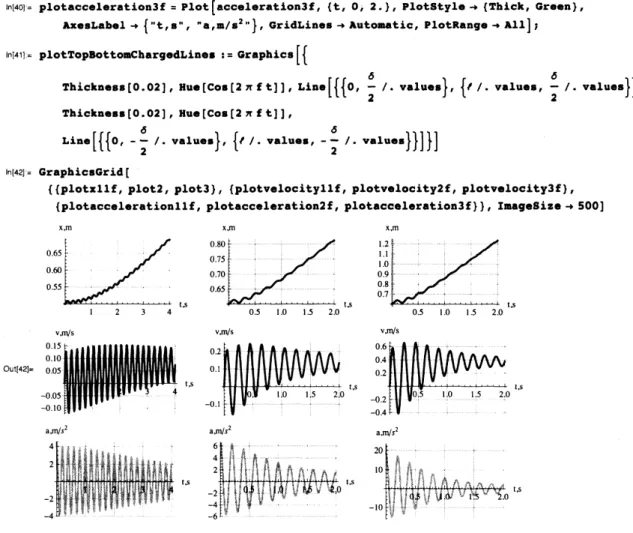
Fortime-dependent charge $Q$asinthepreviouscase weconsider$Q(t)=Q_{0}$Cos$[2\pi ft]$. Thecorrespondingequation of
motionforacharge$q$becomes,
$|n[35]=$ eqx3 $=x$‘ ‘
$[ t]-(\frac{kQ_{0}q}{m}1$ (EfieldTopBottom$[x]/.$ $xarrow x[t]$) Cos $[2\pi ft]//$
.
values;Assigningasetof initial conditionswesolvetheequation numerically.
$|n[36|\circ$ solx3 $=$ NDSolve$[\{eqx3 ==0\dot{},x[O]--=0.6, x’[0]--=0\}, x[t], \{t, 0,2.0\}]$;
Utilizing the solutionweplot its kinematicsvs.time.
$|n\dot{\downarrow}37]=$ plot3 $=$Plot$[x[t]/$
.
solx3, $\{t, 0,2.0\}$, PlotStyle $arrow$Thick,AxesLabel $arrow t”t,$$s”$, “
$x,m”$}, GridLines$arrow$ Automatic, PlotRange$arrow$All];
$|n[3S]=$ {velocity3f, acceleration3f} $=\{D[x[t]/. solx3, \{t, 1\}], D[x[t]/. solx3, \{t, 2\}]\}$ ; $|n(39]=$ plotvelocity3f $=$Plot[velocity3f, $\{t, 0,2. \},$
PlotStyle $arrow$ {Thick, Red}, AxesLabel $arrow t”t,$$s”,$
$\prime$
RIMS Sarafian No$vember27_{-}2012.nb$
$|n\{40|=$ plotacceleration3f$=$ Plot$[$accelerat $ion3f,$ $\{t, 0;2. \},$ PlotStyl$\bullet$$arrow\{$Thick, $Gr\bullet\bullet n\},$ $lxesLabelarrow\{"t,$$s”,$ $na,m/s^{2,\prime}\}$, GrldLin$\bullet$$garrow$Automatic, PlotRange$arrow$All$]$;
$|\cap|41|--$ plotTopBottomChargedLines $:=$ Graphics$[\{$
Thickness$[0.02]$, Hu$\bullet$[Coc$[2\pi$ft$]$], Line$[\{\{0,$ $\underline{\delta}/$
.
values$\},$ $\{l/$
.
values,$\underline{\delta}/$
.
values$\}\}],$
2 2
Thickness[O. 02], Hue$[$Cos$[2\pi St]],$
$\delta$ $\delta$
Line$[\{\{0,$
$–/.$
$values\},$ $\{i/$.
valu$\bullet\bullet$, -– /. $v\bullet 1u\circ e\}\}]\}]$2 2
$|n|42|\overline{-}$ GraphicsGrid[
{{plotxllf, plot2, plot3}, {plotvelocityllf, plotvelocity2f, $plotvolocAty3f$},
{plotaccelerationllf, plotacceleration2f, $plotacc\bullet 1\bullet ration3f$}$\}$, ImageSize$arrow 500$]
$KJn$ $x,m$ x,m
$v\mu lVs vps vfls$
$Out[42]=$
$ar\int s^{2}$ a$lWs^{2}$ $arVs^{2}$
$ts$
Figure
3.
Display ofthe$\{x, v, a\}$vs.
$t$forcase
1through 3.Foravisual understanding
we
simulate themotionas
wcll.$RIMS_{-}Sarar\prime an_{-}N0$vemb$er27_{-}2012.nb$
$|n[44|=$ Nanipulate[{Show[{plotXaxis, plotTopBottomChargedLines /. $tarrow\tau,$
Graphics$[ \{ Red, Disk[\{x[t]/. solx3[1\prod/. tarrow r, 0\}, 0.02]\}]\}, lmageSizearrow 200],$
plot3}, $\{\{r, 0, /t"\}, 0,2, O.025\}]$
$\blacksquare$Case4. Weconsideraverticalchargedline. Inthisscenariocharge
$Q$is distributedevenlyon avertical lineof length$\delta.$
Theelectricfield along the symmetry axisline,$x$
.
The distanceawayfromthelineis given by,$E[x]=KQ \frac{1}{x\sqrt{x^{2}+(\frac{\delta}{2})^{2}}}.$
$|n[45]=$ EfieldLeftVerticalLine$[x_{-}]$ $:=\underline{1}/$
.
values$x\sqrt{x^{2}+\langle\frac{\delta}{2})^{2}}$
Ascaledplotofthefield, $\frac{1}{KQ}E(x)$ isshown; the outputis suppressed.
$|$n[4\^o]$=$ Plot[EfieldLeftVerticalLine$[x]$, {
$x,$ $(1+O.$$1)/$
.
values, $(’+3.0)/$.
values},PlotStyle$arrow$ Thick, AxesLabel$arrow\{\prime\prime x, m", /E_{-}$field, $N/C”\}$, GridLines$arrow$Automaticl;
The equation of motion of the corresponding field foratime-independent field is:
$x(t)- \frac{KQq}{m}[\frac{1}{x\sqrt{x^{2}+(\frac{\delta}{2})^{2}}}]=0$. Setting $\frac{KQ_{0}q}{m}=1$following the procedure given inthepreviouscases onemaysolve theequation numerically. Theexercise is left
to
theinterested of the reader. Herewesolve theequation of motion foratime-dependent oscillating charge distribution. Its
solution forasetofinitial conditionsis,
$|n[47]=$ eqx4 $=x$‘ ‘
$[ t]-(\frac{kQ_{0}q}{m}1$ (BfieldLeftVerticalLine$[x]/.$ $xarrow x[t]$) Cos$[2\pi$ft$]//$
.
values;Utilizingthissolutionweevaluate theequationandthendisplay its kinematics.
$|n[4S]=$ solx4 $=$ NDSolve$[\{ eqx4---- 0, x[O]--=0.6, x‘[0]=_{-}^{-}0\}, x[t], \{t, 0,2.0\}]$;
$|n[49]=$ plot4 $=$Plot$[x[t]/$
.
solx4, $\{t, 0,2.O\}$, PlotStyle$arrow$ Thick,AxesLabel $arrow t”t,$$s”$, “$x,m”$}, GridLines$arrow$Automatic, PlotRange$arrow$All]
$i$
$|n[50]=$ {velocity4f, acceleration4f} $=\{D[x[t]/. solx4, \{t, 1\}], D[x[t]/. solx4, \{t, 2\}]\}$ ; $|n[51]=$ plotvelocity4f$=$ Plot[velocity4f, $\{t, O, 2. \},$
$RIMS_{-}Saraf\dot{/}an_{-}November27_{-}2012.nb$
$|n[S2]=$ plotacceleration4f$=$ Plot$[acceleration4f,$ $\{t, O, 2. \}$, PlotStyle $arrow$ { Thick, Green},
AxesLabel$arrow\{^{\mathfrak{n}}t,$$s”,$ $\mathfrak{n}a,m/s^{2_{\mathfrak{n}}}\}$, GridLines$arrow$Automatic, PlotRange$arrow$All$]$;
$|\cap[53]=$ GraphicsGrid[{{plotxllf, plot2, plot3, plot4},
{plotvelocityllf, plotvelocity2f, plotvelocity3f, plotvelocity4f},
{plotaccelerationllf, plotacceleration2f, plotacceleration3f,
plotacceleration4f}$\}$, lmageSize$arrow 500$];
Figure4. Display of the$\{x, v, a\}$vs.$t$forcase1 through4.
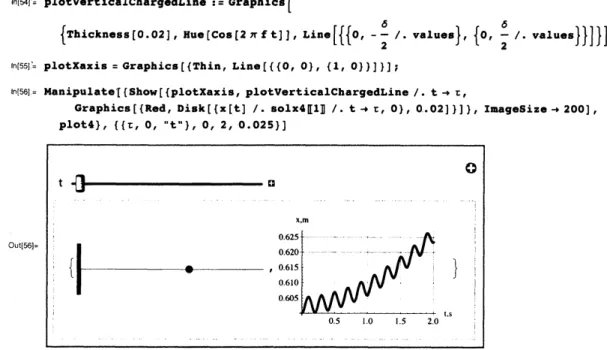
Duetomanuscriptspacelimitation the graphic output is suppressed. Foravisual understandingwesimulate the motionas
well.
$|\cap|54|=$ plotVerticalChargedLine $:=$Graphics$[$
$\{Xhickness[0.02]$, Hue [Cos$[2\pi$ft$]$], Line$[\{\{0,$ $- \frac{\delta}{2}/$
.
values$\},$ $\{0,$ $\frac{\delta}{2}/$.
values$\}\}]\}]$$|n[S5|^{\backslash }=$ plotXaxis $=$Graphics$[\{$rh$ln$, Line$[\{\{O,$ $0\},$ $\{1,0\}\}]\}]$;
$|n|56]=$ Manipulate$I${Show[{plotXaxis, plotVerticalChargedLine/. $tarrow r,$
Graphics$[\{$Red, Disk$[\{x[t]/$
.
solx4[1] /. $tarrow r,$ $0\},$ $0..02]\}]\}$, lmageSize$arrow 2OO$],plot4}, $\{\{r, 0, \mathfrak{n}t"\}, 0,2,0.025\}]$
$\oplus$
$Out\iota 56|=$
$1$
$–$ $-$–
$\blacksquare$Case5. We consider
a
horizontallydisplaced vertical line charge distribution. The physics of thiscase
is similartoCase4. Inthisscenariothe vertical chargeslidesalongthe$x$-axisby
a
length$f$. Replacing$x$with$x-l$inthefieldequationofCase4yieldsthe neededfieldforthe
case
athand.$|n[s\eta_{r}$ ZfieldRightVerticalLine$[x_{-}]$ $:=1/(( x-\sqrt{})\sqrt{}((x-t\rangle^{2}+(\frac{\delta}{2})^{2}))/$
.
values$|n[S8)z$ Plot [EfieldRightVerticalLine $[x],$ {$x,$ $(’+O.$$1)/$
.
values, $(/+3.O)$ $/$.
values},PlotStyle $arrow$Thick, AxesLabel$arrow t”x,$$m”$, “$B_{-}$field, $N/C^{\mathfrak{n}}$}, GridLines$arrow$ Automatic];
The correspondingequation of motion foratime-dependent charge distributionis,
$|n[\S 9]=$ eqx5 $=x$ ‘ ‘ $[ t]-(\frac{kQ_{0}q}{m}1$ (ZfieldRightVerticalLine$[x]/.$ $xarrow x[t]$) Cos$[2\pi$ft$]//$
.
values;Thenumeric solution of this equation forasetof initial conditions yieldsthekinematics ofthecharge$q.$
$RIMS_{-}Sarar/an_{-}November27_{-}2012.nb$
$|n[61]=$ plot5 $=$ Plot$[x[t]/$
.
solx5, $\{t, 0,2.O\}$, PlotStyle$arrow$ Thick,AxesLabel$arrow t”t,$$s”$, “$x,m”$}, GridLines
$arrow$Automatic, PlotRange$arrow$All];
$|\cap[62]=$ {velocity5f, acceleration5f} $=\{D[x[t]/. solx5, \{t, 1\}], D[x[t]/. solx5, \{t, 2\}]\}_{i}$
$|n[63]=$ plotvelocity5f$=$ Plot[velocity5f, $\{t, 0,2. \}$, PlotStyle $arrow$ {Thick, Red},
AxesLabel $arrow\{/t, s", " V;^{m/s"}\}$, GridLines$arrow$Automatic, PlotRange$arrow$All]
$i$
$\ln\{64_{}1=$ plotacceleration5f$=$ Plot$[$acceleration$5f,$ $\{t, 0,2. \}$, PlotStyle $arrow$ {Thick, Green},
AxesLabel$arrow\{\prime\prime t,$$s”,$ ‘a,m$/s^{2_{\mathfrak{n}}}\}$, GridLines$arrow$Automatic, PlotRange$arrow$ All$]$;
$|\cap[65]=$ GraphicsGrid[{{plotxllf, plot2, plot3, plot4, plot5},
{plotvelocityllf, plotvelocity2f, plotvelocity3f, plotvelocity4f, plotvelocity5f},
{plotaccelerationllf, plotacceleration2$f$, plotacceleration3$f,$
plotacceleration4f, plotacceleration5f}$\}$, lmageSize$arrow 800$]$i$
Figure5. Displayof the$\{x, v, a\}$vs.$t$forcase1 through 5.
Duetomanuscriptspace limitationthegraphicoutputis suppressed.
$\blacksquare$Case6. Weconsidertwoverticalparallel charged lines. We
combine thefieldsofCase 4and5. The code todisplaythe
corresponding field is given;itsoutputis suppressed.
$|n[66|=$ Plot[EfieldLeftVerticalLine$[x]+$EfieldRightVerticalLine$[x],$
{$x,$ $(i+0.1)/$
.
values, $(’+3.0)$ $/$.
values}, PlotStyle$arrow$ Thick,AxesLabel$arrow\{\prime\prime x, m\mathfrak{n}, /E_{-}$field, $N/C”\}$, GridLines $arrow$Automatic];
Theequationof motion,its solution andrelatedkinematicsare,
$|n[67]=$ eqx45$=$
$x$‘ ‘ $[ t]-(\frac{kQ_{0}q}{m})$ ((EfieldLeftVerticalLine[x] $+$BfieldRightVerticalLine$[x]$) $/.$ $xarrow x[t]$)
Cos $[2\pi ft]//$
.
values;$|n[68|=$ solx45 $=$ NDSolve$[\{eqx45 ----0, x[O]----0.6, x’[0]=_{-}^{-}0\}, x[t], \{t, O, 2.O\}]$ ;
$|n[69]=$ plot45 $=$ Plot$[x[t]/$
.
solx45, $\{t, O, 1.0\}$, PlotStyle$arrow$ Thick,AxesLabel$arrow t”t,$$s”,$ $\prime\prime x,$$m”$}, GridLines $arrow$Automatic, PlotRange$arrow Al1$];
$|n[70]=$ {velocity45f, acceleration45f} $=\{D[x[t]/. solx45, \{t, 1\}], D[x[t]/. solx45, \{t, 2\}]\}_{i}$ $|n[71]=$ plotvelocity45f $=$ Plot[velocity45f, $\{t, 0,2. \}$, PlotStyle$arrow$ {Thick, Red},
AxesLabel$arrow t”t,$$s”$, “$v,m/s”$}, GridLines
$arrow$Automatic, PlotRange$arrow$All];
$|n[72]=$ plotacceleration45f$=$ Plot$[$acceleration$45f,$ $\{t, 0,2. \}$, PlotStyle$arrow$ {Thick, Green},
AxesLabel$arrow\{"t,$$s”,$ $/a,m/s^{2,\prime}\}$, GridLines$arrow$Automatic, PlotRange$arrow$ All$]$;
$|n[73]=$ GraphicsGrid[{{plotxllf, plot2, plot3, plot4, plot5, plot45},
{plotvelocityllf, plotvelocity2f, plotvelocity3f, plotvelocity4f, plotvelocity5f, plotvelocity45f}, {plotaccelerationllf, plotacceleration2f, plotacceleration3f,
plotacceleration4f, plotacceleration5f, plotacceleration45f}$\}$, ImageSize$arrow 800$];
Duetomanuscriptspacelimitation the graphic output is suppressed.
Figure6. Displayof the$\{x, \nu, a\}$vs.$t$forcase1 through5.
$\blacksquare$Case 7. We considerahorizontalone-end-closed one-end-open rectangular
chargedbox. Thisscenari$0$isgeneratedby
$RIMS_{-}S arafia\bigcap_{-}November27_{-}2012.nb$
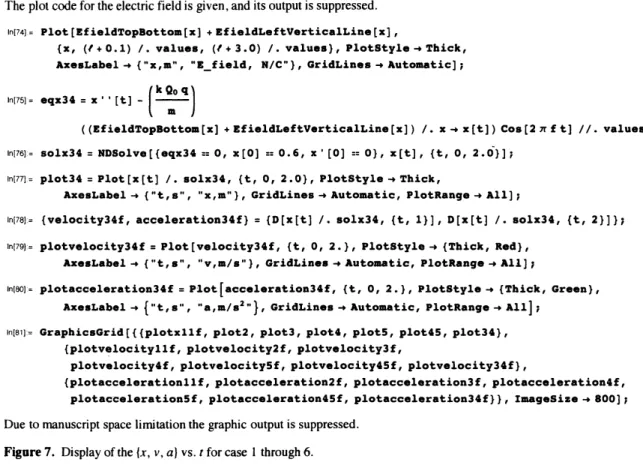
The plotcodefor the electric field isgiven,and its output issuppressed.
$|n|74]=$ Plot [!fieldTopBottom$[x]+$BfieldLeftVerticalLine[$x],$
$\{x,$ $(’+0.1\rangle/.$ values, $\langle’*3.0)$ $/$
.
values$\}$, PlotStyl$\bullet$$arrow$rhick,AxesLabel$arrow\{"x,m",$ $\prime\prime Z_{-}$field, $N/C”\}$, GridLines $arrow$Automatic];
$|\cap \mathfrak{l}75]_{\Xi}$ eqx34 $=x$‘ ‘$[ t]-(\frac{kQ_{0}q}{m}1$
$((BfieldTopBotto\varpi[x]+$BfieldLeftVerticalLine[$x])/. xarrow x[t])$ Cos$[2\pi ft]//$
.
values;$|n[76|=$ solx34$=$ NDSolve$[\{eqx34---- 0, x[O]\overline{-}--0.6, x ‘ [0]=_{-}^{-}0\}, x[t], \{t, 0,2.O^{-}\}]i$
$|n[77]=$ plot34 $=$ Plot$[x[t]/$
.
solx34, $\{t, 0,2.0\}$, PlotStyle$arrow$rhick,AxesLabel$arrow\{\prime\prime t, s", /x, m"\}$, GridLines $arrow$Automatic, PlotRange$arrow$ All]$i$
$\ln[7S]=$ {velocity34f, acceleration34f} $=\{D[x[t]/. solx34, \{t, 1\}], D[x[t]/. solx34, \{t, 2\}]\}_{i}$ $|n|79|=plotv\bullet locity34f=$ Plot[velocity34f, $\{t, 0,2. \}$, PlotStyle $arrow\{$Bhick, Rod$\},$
AxesLabel $arrow\{\prime\prime t, s", /v,m/s^{\mathfrak{n}}\}$, GridLines$arrow$Automatic, PlotRange$arrow$All]$i$
$|n|S0]=$ plotacceleration34f$=$ Plot$[accel\bullet ration34f,$ $\{t, 0,2. \}$, PlotStyle $arrow$ {Thick, Green},
AxesLabel $arrow\{\prime\prime t,$$\epsilon",$
$\mathfrak{n}$
a,m$/s^{2,\prime}\}$, GridLines$arrow$ Automatic, PlotRange$arrow$All$]$;
$|n[S1]=Graphlc\epsilon Grid$[{{plotxllf, plot2, plot3, plot4, plot5, plot45, plot34},
{plotvelocityllf, plotvelocity2f, plotvelocity3f,
plotvelocity4f, plotvelocity5f, plotvelocity45f, plotvelocity34f},
{plotaccelerationllf, plotacceleration2f, plotacceleration3f, plotacceleration4f,
plotacceleration5f, plotacceleration45f, $plotaccoleration34f$}$\}$, lmageSize$arrow\epsilon oo$] ;
Duetomanuscriptspacelimitation the graphic output is suppressed.
Figure7. Display of the$\{x, v, a\}$
vs.
$t$forcase
1 through6.For
a
visual understandingwe
simulateth$e$motionas
well.$\ln|S2]=$ plotRotatedCup $:=$Graphics$[\{$Thickness[O.02],
Hue[Cos$[2\pi$ft$]$], Line$[\{\{0,$ $- \frac{\delta}{2}/$
.
values$\},$ $\{t/$.
values, $- \frac{\delta}{2}//$.
values$\}\}],$Thickness[0.02], Hue[Cos$[2\pi$ft$]$],
Line$[\{\{0,$ $\underline{\delta}/$
.
values$\},$ $\{l/$.
values, $\underline{\delta}/$.
values$\}\}],$ 2 2Thickness$[O. 02]$, Hue$[$Cos$[2\pi ft]]$, Line$[\{\{0,$ $- \frac{\delta}{2}/$
.
values$\},$ $\{0,$ $\frac{\delta}{2}/$.
values$\}\}]\}]$$RIMS_{-}Sara\Gamma/an_{-}No$vemb$er27_{-}2012.nb$
$|n[84|=$ Nanipulate$[\{$Show$[\{$plotXaxis, plotRotatedCup /. $tarrow\tau,$
Graphics$[ \{Red, Disk[\{x[t]/. solx34[1\prod/. tarrow\tau, 0\}, 0.02]\}]\}, lmageSiaearrow 200],$
plot34}, $\{\{\tau, 0, /t"\}_{t}0,1.2, 0.025\}]$ $0$ $1$ $Out[S4]=$ 0.5 10 $1S$ 2.0 $\wedge\cdot$–
Figure$7a$
.
Schematicof theone-end-closed one-end-openrectangularcharge distribution(leftgraph),andpositionvs.time(right graph).
$\blacksquare$Case8. We consideracharged rectangular closed box. By combining the configurations of Case 3,
4and5
we
arriveatthe field of
a
rectangularcharged distribution. Asin thepreviousscenarios the relevant associated information yields,$|n[S5]=$ Plot[EfieldTopBottom$[x]+$EfieldLeftVerticalLine$[x]+$EfieldRightVerticalLine$[x],$
{$x,$ $(1+0.1)/$
.
values, $(1+3.0)/$.
values}, PlotStyle$arrow$Thick,AxesLabel$arrow t”x,$$m”$, “$E_{-}$field, $N/C”$}, GridLines$arrow$Automatic];
$|n|S6|=$ eqx345 $=x$“
$[t]-(\underline{kQ_{0}q}m)$
((EfieldTopBottom$[x]+$EfieldLeftVerticalLine$[x]+$EfieldRightVerticalLine$[x]$) $/.$
$xarrow x[t])$ Cos$[2\pi$ft$]//$
.
values;$|n[s\eta=$ solx345 $=$ NDSolve$[\{eqx345 =_{-}^{-}0, x[0]----O. 6, x’[0]--=0\}, x[t], \{t, 0,2. O\}]i$
$|n[8S|=$ plot345 $=$Plot$[x[t]/$
.
solx345, $\{t, 0,0.8\}$, PlotStyle$arrow$Thick,AxesLabel $arrow t”t,$$s”$, “
$x$,m’1}, GridLines $arrow$Automatic, PlotRange$arrow$All];
$|n[S9]=$ {velocity345f, acceleration345f} $=\{D$[$x[t]/$
.
solx345, $\{t,$ $1\}$], $D$[$x[t]/$.
solx345, $\{t,$ $2\}$]$I$;$|n[90]=$ plotvelocity345f $=$ Plot[velocity345f, $\{t, 0,2. \}$, PlotStyle$arrow$ {Thick, Red},
AxesLabel$arrow\{\prime\prime t, s", /v,m/s^{\mathfrak{n}}\}$, GridLines$arrow$ Automatic, PlotRange$arrow$All];
$|n[91]=^{-}plotacceleration345f=$ Plot$[$acceleration345f, $\{t, 0,2. \}$, PlotStyle$arrow$ {Thick, Green},
AxesLabel$arrow\{\prime\prime t,$$s”,$ $/a,$$m/s^{2,\prime}\}$, GridLines$arrow$Automatic, PlotRange$arrow$All$]$;
$|n[92]=$ GraphicsGrid[{{plotxllf, plot2, plot3, plot4, plot5, plot45, plot34, plot345},
{plotvelocityllf, plotvelocity2f, plotvelocity3f, plotvelocity4f,
plotvelocity5f,
$plotvel$
, plotvelocity34f, plotvelocity345f},{plotaccelerationllf, plotacceleration2f, plotacceleration3f,
plotacceleration4f, plotacceleration5f, plotacceleration45f,
plotacceleration34f, plotacceleration345f}$\}$, lmageSize$arrow 800$];
$RIMS_{-}Sara\Gamma\prime an_{-}No$vemb$er27_{-}2012.nb$
$|n[93)=$ plotRectangularBox $:=$ Graphics$[\{$Thickness$[O. 02],$
Hue[Cos$[2\pi$ft$]$], Line$[\{\{0,$ $- \frac{\delta}{2}/$
.
values$\},$ $\{t/$.
values, –$\frac{\delta}{2}/$.
values$\}\}],$Thickness$[O. 02]$, Hue[Cos$[2\pi$ft$]$],
Line$[\{\{0,$ $\underline{\delta}/$
.
values$\},$ $\{t/$.
values, $\underline{\delta}/$.
values$\}\}],$ 2 2Thickness[0.02], Hue [Cos$[2\pi$ft$]$], Line$[\{\{0,$ $-\underline{\delta}/$
.
values$\},$ $\{0,$
$\underline{\delta}/$
.
values$\}\}]t$2 2
Thickness[0.02], Hue$[$Cos$[2\pi ft]],$
Line$[\{\{t/.$ $values_{t}-\frac{\delta}{2}/$
.
values$\},$ $\{1/$.
values, $\frac{\delta}{2}/$.
values$\}\}]\}]$plotXaxis $=$Graphics$[\{Thin$, Line$[\{\{O,$ $0\},$ $\{1$, $0\}\}]\}]$;
Manipulate$[\{$Show$[\{$plotXaxis, plotRectangularBox /. $tarrow\tau,$
Graphics$[ \{Red, Disk[\{x[t]/. solx345[1\prod/. tarrow r, 0\}, 0.02]\}]\}, lmageSiaearrow 200],$
plot345}, $\{\{r, 0, /t"\}, O, O. 28,0.025\}]$
$\blacksquare$Summary andConclusions
Itistheobjective ofthisarticletodemonstrate byutilizingaComputer Algebra System(CAS),particularly Mathematicaon$e$
maydeviate fromthetraditionalrouteofsolvingproblems. The ultimate objective ofaphysics research project isthe output
of theanalysis and Mathematica providesonesuch innovative approach. The traditional approachtosolve,a
mathematical-physics problem inmostscenariosencounterssolving complicatedequationsanalytically. One devotesconsiderableefforts
doing
so
and failsinmostcases.
This derails thefocuson
theobjectives. The authorbelievesCAS andparticularlyMathe-matica isanalternative effective approach. The examples shown in this article demonstrate how effectively
one can
focuson
the objectives of the proposed problems and convenientlywithoutdistraction achieve thesetgoals. Theexamplesarechosen
from electromagnetismand theproposed approach easilymay be appliedtoother fields of interest. Also it isworthwhile
pointingoutthattheentire manuscriptincludingtext,symbolic and numeric computations,tables,andgraphsareembodied
inonesinglefile. Thisby itself isatremendous advantageassistingtoavoidcompiling multiple individualfiles.
$\blacksquare$Acknowledgement
Theauthor is gratefultothechair of the organizerofthe Researeh Institute for Mathematical Sciences Symposium, Professor
Yasuyuki Nakamura-san for inviting himtopresent this article. He isalsothankful forthefinancial support of the RIMSof
Kyoto University, Japan. The paperspresentedatthesymposium wereinformative and stimulating. Theauthor isecstatic
$RIMS_{-}S ara\Gamma ja\bigcap_{-}November27_{-}2012.nb$
theoretical physics,atthe Center for TheoreticalPhysics/KyotoUniversity
on
August 22,2012.$\blacksquare$ References
[1]MathematicaV 8.04,Wolfram Research Inc.
[2]Halliday, ResnickandWalker,“Fundamentals of Physics”, 8thedition,John Wiley andSons,Inc.2008.
Reitz andMilford,“Foundations of Electromagnetic Theory”, Addison-Wesley Publishing Company, Inc. 1960