A table of coherent
band-Gordian
distances between knots
Taizo Kanenobu
(Osaka
City
University)
Hiromasa
Moriuchi
(OCAMI)
Abstract
We introducesome criteria for two links, which arerelated by a coherent band surgery,
usingthe determinant, and theJones, HOMFLYPT, and $Q$polynomials. Wegive a tableof
coherentband-Gordian distances between two knots with up tosevencrossings.
1
Introduction
There are several criterion for two links, which are related by a band surgery or crossing
change. In this paper,
we
introduce further criteriausingthe determinant, and the Jones,HOMFLYPT, and$Q$ polynomials. $A$bandsurgery and
a
crossing changeare
local changes ina
link diagramas
shown in Figure. 1. Ifwe
consider oriented links, thereare
two types fora
bandsurgery
according to an orientation; a coherent band surgery (Fig 2) andan
incoherent
one.
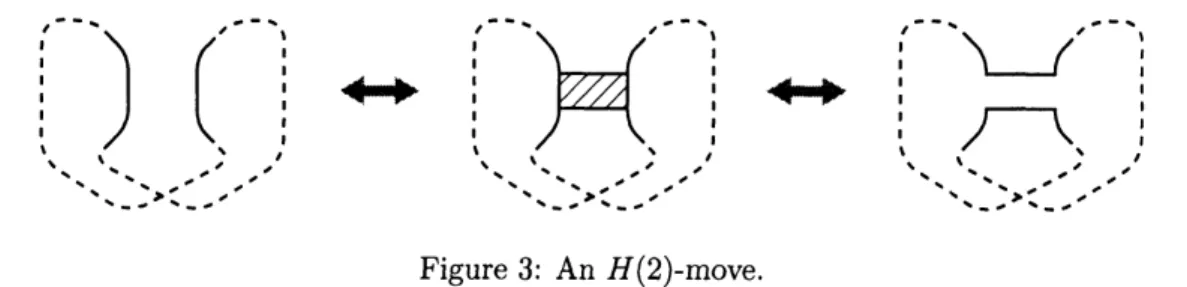
In particular, an incoherent band surgery between two knots is called an$H(2)$-move [14] (Figure. 3). Recently, these local moves are studied in connection with
an application to the study of DNA site-specific recombination; see [5, 6, 9].
$)$ $(*\phi\wedge\vee$
Figure 1: $A$ band surgery and a crossing change.
$111111)\backslash \prime--\backslash --,$ $(\backslash 1\backslash _{--}\prime^{--}/11111$ $\infty$ $\infty 111111’\backslash --\backslash --\prime\underline{\mapsto}_{\backslash _{-arrow}}^{\backslash }1\prime^{--}\prime 11111$
Figure 2: $A$ coherent band surgery.
Given two links $L$ and $L’$,
we
want to decide whether theyare
related by a bandsurgery or a crossing change. The signature and Arf invariant are most useful tools for
with this problem: for
a
coherent band surgery,see
[19, 21];for
a
crossing change,see
[30, 32, 35, 40, 41, 42]; for
an
$H(2)$-move,see
[20, 23, 26];see
also [1].$111||I)_{;\backslash \prime\prime\prime}(1|1\backslash \backslash \prime\prime\backslash \backslash \backslash ;_{\backslash ,\backslash _{-\prime}}\prime\prime\backslash ,\prime\prime./\backslash 111$
$\sim$ $\sim$
$1111_{1}11 \backslash \backslash \prime\prime\backslash \prime\backslash \backslash \backslash \backslash \backslash \bigcup_{/ ,\backslash \backslash \prime\prime\prime}/\prime\backslash \backslash \backslash \prime’\prime\prime\prime II|$
Figure 3: An $H(2)$-move.
Our main results
are
two criteria: The first one is acondition on the determinant of alinkor knot which is obtained from a 2-bridge knot by acoherent band surgery or $H(2)-$
move
(Theorem 3.2), which is easily obtained by using aconditionon
the determinant ofa
knot obtained froma
2-bridge knot bya
crossing change due to Hitoshi Murakami [32](Proposition 3.1).
The second
one
uses some
special values of the polynomial invariants. For the Jonespolynomial,
we
have a criterionon
two links whichare related bya
coherent bandsurgery[19, Theorem 2.2] (Theorem 4.2). Developing this,
we
obtain Theorem 4.6. Ina
similarway, for the HOMFLYPT polynomial
we
obtain Theorem 5.4 developing Proposition 5.1,andfor the$Q$polynomialTheorem6.2 developingProposition6.1. We give
some
examples for each of these criteria, which display the efficiency of them. Ina
forthcoming paper [24]we
will makea
detailed reporton
these criteria.Notation. For knots and links with up to 9 crossings we
use
Rolfsen notations [38,Appendix $C$]. For
a
knotor
link $L$,we
denote by $L!$ its mirror image. Foran
oriented2-component link with $c$crossingswe usethe notations$c_{n}^{2}$ and$c_{n}^{2’}$, wherewe usually suppose
that linking number of$c_{n}^{2}$ is negative and that of$c_{n}^{2’}$ is positive
as
in Table 2 in [21];more
precisely, $c_{n}^{2}$
denotes an
orientedlink
with negative linking number with diagramas
inthe table of [38] and $c_{n}^{2’}$ denotes
one
of the oriented links obtained from $c_{n}^{2}$ by reversingthe orientation of
one
component.2
Some
invariants
The Conway polynomial$\nabla(L;z)\in Z[z][4]$, the Jones polynomial $V(L;t)\in Z[t^{\pm 1/2}][17],$
and the HOMFL$YPT$polynomial$P(L;v, z)\in Z[v^{\pm 1}, z^{\pm 1}][10,17,36]$
are
invariants of theisotopy type of an oriented link $L$, which
are
defined by the following formulas:$\nabla(U;z)=1$; (1) $\nabla(L_{+};z)-\nabla(L_{-};z)=z\nabla(L_{0};z)$; (2) $V(U;t)=1$; (3) $t^{-1}V(L_{+};t)-tV(L_{-};t)=(t^{1/2}-t^{-1/2})V(L_{0};t)$; (4) $P(U;v, z)=1$; (5) $v^{-1}P(L_{+};v, z)-vP(L_{-};v, z)=zP(L_{0};v, z)$, (6)
$L+ L_{-} L_{0}$
Figure 4: $A$ skein triple. where $U$ is the unknot and $(L_{+}, L_{-}, L_{0})$ is a skein triple.
Foraskein triple $(L_{+}, L_{-}, L_{0})$, the link $L_{+}$ isobtained from $L_{-}$ bychanging
a
crossing,and vice versa, and the link $L_{0}$ is obtained from $L+$
or
$L_{-}$ bya
coherentband surgery,
and vice
versa. Conversely,
it is easy tosee
the following:Lemma 2.1.
If
a $c$-component link $L$ and $a(c+1)$-component link $M$ are related by a coherent band surgery, then there exist $c$-component links $L_{+},$ $L_{-}$ and $(c+1)$-componentlinks $M+,$ $M$-such that each
of
the following isa
skein triple: $(L_{+}, L, M),$ $(L, L_{-}, M)$, $(M_{+}, M, L),$ $(M, M_{-}, L)$.For a $c$-component link $L,$ $i^{c-1}V(L;-1)$ is
an
integer and the determinant $\det L$ isgiven by $\det L=|V(L;-1)|$. Putting $t=-1$ in Eq. (4),
we
obtain-$V(L_{+};-1)+V(L_{-};-1)=2iV(L_{0};-1)$;
(7)
Let $(L_{+}, L_{-}, L_{0})$ be a skein triple. Then Murasugi [34, Lemma 7.1] has shown:
$|\sigma(L_{\pm})-\sigma(L_{0})|\leq 1$
.
(8)Since we
may consider the link $L_{+}$or
$L_{-}$as obtained
from $L_{0}$ bya
coherent band surgery,and vice versa, we have the following.
Proposition 2.2. (i)
If
two oriented links $L$ and$L’$are
related by a coherent bandsurgery,then
$|\sigma(L)-\sigma(L’)|\leq 1$
.
(9)(ii)
If
two oriented links $L$ and$L’$are
related by a crossing change, then$|\sigma(L)-\sigma(L’)|\leq 2$
.
(10) The $Arf$invariant (or Robertello invariant) [37] ofa knot $K$, Arf$(K)$, is given byArf$(K)=a_{2}(K)\in Z_{2}$, (11)
where $a_{2}(K)$ is the
coefficient
of$z^{2}$of the Conway polynomial of$K$.
Wheneveran
equality in this paper containsan
Arf invariant it is to be understood in thesense
of$mod 2$. Wesay that an oriented link $L$ isrelated (in the senseofRobertello [37]) to aknot $K$
if there
exists
a
smooth embedding ofa
planar surface $F$ in $S^{3}\cross I$such that $F$ meets$S^{3}\cross\{0,1\}$
transversely in $K$ and $L$, respectively. Let $L$ be a proper link, that is, the sum of the
linking numbers of any component of $L$ with all the other components is even. We may
define its Arf invariant to be the Arf invariant of any knot $K$ related to it. In particular,
we have:
Proposition 2.3.
If
a knot$K$ is obtainedfrom
aproper 2-component link $L$ by a coherent3
Determinant
of
a
link
obtained from
a
2-bridge
knot
by
a
band
surgery
For relatively prime integers $p,$ $q$ with
$p>q>0$
and $p$ odd, we let $S_{p,q}$ denote the2-bridgeknot for which the lens space of type $(p, q)$ is the 2-fold branched
cover
of$S^{3}$. More explicitly, let $a_{1},$ $a_{2},$ $a_{3},$$\ldots,$$a_{n}$ be positive integers obtained from the continued fraction$\frac{p}{q}=a_{1}+\frac{1}{1}$. (12)
$a_{2}+\overline{a_{3}+\frac{1}{+\frac{1}{a_{n}}}}$
Then$S_{p,q}$ is isotopic to
a
2-bridgeknot in Conway’s normal form $C(a_{1}, a_{2}, a_{3}, \ldots, a_{n-1}, a_{n})$as
shown in Figure. 5, where the box containing an integer $a$ or $-a,$ $a>0$, denotes a2-braid
as
shown in Figure. 6. Also, $S_{p,-q}$ presents the mirror image of $S_{p,q}$; cf. [25,Sec. 2.1].
Figure 5: The 2-bridge knot $C(a_{1}, a_{2}, a_{3}, \ldots, a_{n-1}, a_{n})$.
$a$crossings $a$
crossings
Figure 6: 2-braids.
The following criteria is due to H. Murakami [32, Corollary 2.8].
Proposition 3.1. Suppose that
a
knot $K$ is obtainedfrom
a
2-bridge knot $S_{p,q}$ bya
crossing change. Then there exists
an
integer $s$ such that:$|\det K-p|/2\equiv\pm qs^{2} (mod p)$. (13)
Using this,
we
may deduce the following.Theorem 3.2. Suppose that a link $L$ is obtained
from
a 2-bridge knot $S_{p,q}$ bya
coherentor
incoherent band surgery. Then there existsan
integer$s$ such that:Proof.
Suppose that$L$and$S_{p,q}$ are relatedbya coherent band surgery. Then byLemma2.1there exists
a
knot $K$ such that $(K, S_{p},{}_{q}L)$ is a skein triple. From Eq. (7) we have-$V(K;-1)+V(S_{p,q};-1)=2iV(L;-1)$,
(15) which implies
$2 \det L=|2iV(L;-1)|=|-V(K;-1)+V(S_{p,q};-1)|$
.
(16)Since
$K$ and $S_{p,q}$are
related bya
crossing change, by Proposition3.1
there exists aninteger $s$ such that Eq. (13) holds, which implies
$\det K+p\equiv\det K-p\equiv\pm 2qs^{2} (mod 2p)$, (17)
Since$\det K=|V(K;-1)|$ and$p=|V(S_{p,q};-1)|$, combining Eqs. (16) and (17), we obtain
Eq. (14).
$\square$
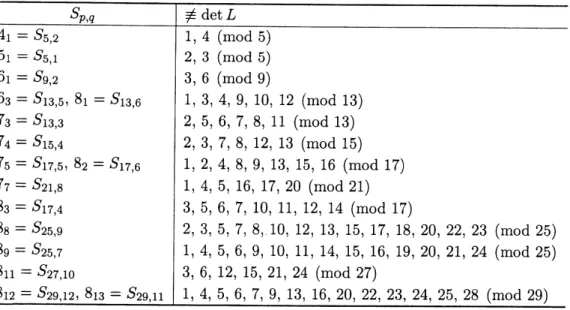
By Theorem3.2 a 2-bridge knot mayhave
some
condition onthe values of$\det L$, where$L$ is either
a
2-component link with $d_{cb}(S_{p},{}_{q}L)=1$or a
knot with$d_{2}(S_{p},{}_{q}L)=1$. For
2-bridge knots with up to 8 crossings, Table 1 lists these values; the remaining 2-bridge
knots $3_{1},5_{2},6_{2},7_{1},7_{2},7_{6},8_{4},8_{6},8_{7},8_{14}$ have
no
such restrictions.Table 1: Values which $\det L$ does not take with $d_{cb}(S_{p},{}_{q}L)=1$ or $d_{2}(S_{p)}{}_{q}L)=1$
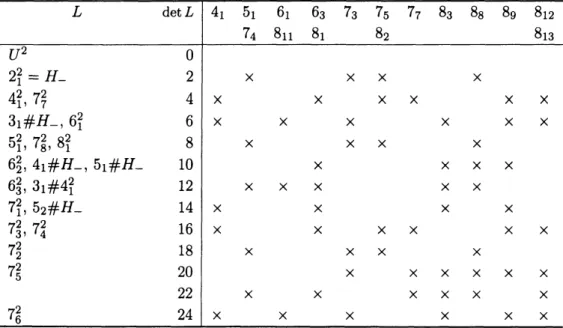
Example 3.3. Table2 shows 2-component links whicharenot obtainedfromthe 2-bridge
knots in Table 1 by a coherent band surgery. The symbol $\cross$ means that the link in the
row is not obtained from the 2-bridge knot in the column by acoherent band surgery. For
example, the knot$6_{1}$ and the link $6_{1}^{2}$
are
not related by acoherent band surgery;moreover
this implies that $K\in\{6_{1},6_{1}!\}$ and $L\in\{6_{1}^{2},6_{1}^{2’}, 6_{1}^{2}!, 6_{1}^{2’}!\}$
are
not related by a coherentTable2: Links and 2-bridge knots which are not related by a single coherent band surgery.
4
Coherent
band-Gordian distance
The following is Proposition 2.3 in [22]:
Proposition 4.1.
If
two knots $K$ and $K’$ are related by a sequenceof
two coherentband surgeries, then they
are
related bya
single $SH(3)$-move, and viceversa.
Thus$d_{cb}(K, K’)=2sd_{3}(K, K’)$ and $u_{cb}(K)=2su_{3}(K)$
.
The following is Theorem 2.2 in [19].
Theorem 4.2.
If
two links$L$ and$L’$are
related bya coherent bandsurgery, $d_{cb}(L, L’)=1,$then
$V(L;\omega)/V(L’;\omega)\in\{\pm i, -\sqrt{3}^{\pm 1}\}$
.
(18)Then we have the following, which is given in [22, Theorem 3.1].
Corollary 4.3.
If
two knots $K$ and$K’$are
related by a single$SH(3)$-move, $sd_{3}(K, K’)=$$1$, then
$\circ_{\backslash }^{I}\prime\backslash \backslash \backslash \backslash C^{l},\backslash ---\prime/$’ $SH(3)$
-move
$\ovalbox{\tt\small REJECT}$
$\ovalbox{\tt\small REJECT} ||$
$\infty$
Figure 7: An $SH(3)$-move is correspond to two coherent band surgeries.
Example 4.4. Let $K=4_{1}$ and $K’=3_{1}!\# 3_{1}$. Then $sd_{3}(K, K’)>1$; see [15, Table 1].
Since $\sigma(K)=\sigma(K’)=0$, the signature cannot show $sd_{3}(K, K’)>1$. However, since
$V(K;\omega)=-1,$ $V(K’;\omega)=3$,
we can
prove by using Corollary4.3.
In Table 3we
list allsuch pairs ofknots with up to
7
crossings.Table3: Pairs of knots $K$ and $K’$ with $|\sigma(K)-\sigma(K’)|\leq 2$ and $sd_{3}(K, K’)>1.$
$\overline{\frac{KK’\sigma(K)\sigma(K’)V(K;\omega)V(K’;\omega)}{4_{1}3_{1}!\# 3_{1}00-13}}$
$5_{2} 3_{1}!\# 3_{1} 2 0 -1 3$
$7_{6} 3_{1}!\# 3_{1} 2 0 -1 3$
$6_{2} 3_{1}\# 3_{1} 2 4 1 -3$
$7_{2} 3_{1}\# 3_{1} 2 4 1 -3$
$7_{3}!
3_{1}\# 3_{1} 4 4 1 -3$
Thefollowing is Theorem 5.2 in [24].
Theorem 4.5. Suppose that $a(c+1)$-component link$L’$ is obtained
from
a $c$-componentlink $L$ by a coherent band surgery.
If
$V(L’;\omega)=\eta iV(L;\omega)=\pm i^{c}(i\sqrt{3})^{\delta},$ $\eta=\pm 1$, then$i^{c}V(L’;-1)\equiv\eta i^{c-1}V(L;-1)(mod 3^{\delta+1})$
.
Theorem 4.6. Suppose that two links $L$ and$L’$ are related by a sequence
of
two coherentband surgeries, $d_{cb}(L, L’)=2$. Let $L$ be a $c$-component link.
If
$V(L;\omega)=-V(L’;\omega)=$$\pm i^{c-1}(i\sqrt{3})^{\delta}$, then
By Proposition 4.1, we have:
Corollary 4.7.
If
two knots $K$ and $K’$are
related bya
single $SH(3)$-move, $sd_{3}(K, K’)=$$1$, and $V(K;\omega)=-V(K’;\omega)=\pm(i\sqrt{3})^{\delta}$, then
$V(K;-1)\equiv-V(K’;-1) (mod 3^{\delta+1})$ (21)
Example 4.8. Let $K=6_{1}$ and $K’=3_{1}$
.
Then $sd_{3}(K, K’)>1$.
Since
$\sigma(K)=0,$ $\sigma(K’)=2$, the signature cannot show $sd_{3}(K, K’)>1$. However, since $V(K;\omega)=i\sqrt{3},$ $V(K’;\omega)=-i\sqrt{3},$ $V(K;-1)=9,$ $V(K’;-1)=-3$,we can
prove by using Corollary4.7.
In Table 4
we
list all such pairs ofknots with up to 7 crossings.Table4: Pairs of knots $K$ and$K’$ with $|\sigma(K)-\sigma(K’)|\leq 2$ and $sd_{3}(K, K’)>1.$
$\overline{\frac{KK’\sigma(K)\sigma(K’)V(K;\omega)V(K’;\omega)V(K;-1)V(K’;-1)}{6_{1}3_{1}02i\sqrt{3}-i\sqrt{3}9-3}}$
$6_{1} 7_{4} 0 -2 i\sqrt{3} -i\sqrt{3} 9 -15$
$6_{1} 7_{7} 0 0 i\sqrt{3} -i\sqrt{3} 9 21$
$6_{1} 3_{1}!\neq 4_{1} 0 -2 i\sqrt{3} -i\sqrt{3} 9 -15$
$7_{4}!
7_{7} 2 0 i\sqrt{3} -i\sqrt{3} -15 21$
$7_{7}!
7_{7} 0 0 i\sqrt{3} -i\sqrt{3} 21 21$
$\underline{3_{1}\neq 4_{1}7_{7}20i\sqrt{3}-i\sqrt{3}-1521}$
Similarly,
we
have:Corollary 4.9.
If
two 2-component links $L$ and $L’$are
related bya
sequenceof
twocoherent bandsurgeries, $d_{cb}(L, L’)=2$, and $V(L;\omega)=-V(L’;\omega)=\pm i(i\sqrt{3})^{\delta}$, then
$V(L;-1)/i\equiv-V(L’;-1)/i (mod 3^{\delta+1})$ (22)
In Table 4
we
list all pairs of 2-component links with up to 6 crossings, whichcan
be shown to have coherent band-Gordian distance $>2$ by Corollary 4.9 but cannot be
shownby using the signature. Thus by Table3 in [15] we can conclude they havecoherent band-Gordian distance 4.
Table5: Pairs oflinks $L$ and $L’$ with $|\sigma(L)-\sigma(L’)|\leq 2$ and $d_{cb}(L, L’)=4.$
$\overline{\frac{LL’\sigma(L)\sigma(L’)V(L;\omega)V(L’;\omega)V(L;-1)/iV(L’;-1)/i}{3_{1}\neq H_{+}6_{3}^{2}13-\sqrt{3}\sqrt{3}6-12}}$
$3_{1}\# H+ 6_{3}^{2’} 1 -1 -\sqrt{3} \sqrt{3} 6 -12$
$T_{6’}!
6_{3}^{2} 1 3 -\sqrt{3} \sqrt{3} 6 -12$
5
The
HOMFLYPT
polynomial
Let $\Sigma_{k}(L)$ be the $k$-fold cyclic covering space of$S^{3}$ branched over
a
link $L$. Lickorish andMillett [27, Theorem 2] have shown:
$P(L;i, i)=(-2)^{\tau/2}$, (23)
where $\tau=\dim H_{1}(\Sigma_{3}(L);Z_{2})$
.
Putting $v=z=i$ in Eq. (6),we
obtain$P(L_{+};i, i)+P(L_{-};i, i)+P(L_{0};i, i)=0$, (24)
where $(L_{+}, L_{-}, L_{0})$ is a skein triple. Using this, we have a criterion on the HOMFLYPT
polynomials of two links which
are
related bya
crossing change [29, Theorem 1.1]or
a
coherent band surgery [21, Proposition 2.4].
Proposition 5.1.
If
two links $L$ and $L’$are
related by either a crossing changeor
acoherent band surgery, then
$P(L;i, i)/P(L’;i, i)\in\{1, -2^{\pm 1}\}$. (25)
The Conway polynomial $\nabla(L;z)$ of
a
$c$-component link $L$ may be written $\nabla(L;z)=$$z^{c-1}\varphi(z),$ $wh_{\sim}ere\varphi(z)$ is an integer polynomial in $z^{2}$
.
Then we obtain asymmetric integerpolynomial $\triangle_{L}(t)$ by
$\triangle_{L}(t)=\varphi(t^{1/2}-t^{-1/2})\sim$, (26)
which is called the Hosokawa polynomial [12]; cf. [33, pp.120]. Then Hosokawa and
Kinoshita [13] have shown the following; cf. [28, Corollary 9.8]:
Proposition 5.2. The order
of
thefirst
homologygroupof
the$k$-fold
cyclic covering spaceof
$S^{3}$ branchedover
a$c$-component link $L,$ $H_{1}(\Sigma_{k}(L);Z)$, is given by
$k^{c-1} \prod_{j=1}^{k-1}\triangle_{L}(\xi^{j})\sim$, (27)
where $\xi w$ a primitive $kth$ root
of
unity.Using Proposition 5.2, we obtain:
Lemma 5.3. Let $L$ be a $c$-component link.
If
$P(L;i, i)=(-2)^{h}$, then$[\nabla(L;z)/z^{c-1}]_{z^{2}=-3}\equiv 0 (mod 2^{h})$
.
(28) Using this lemma,we
obtain the following.Theorem 5.4. Suppose that $a(c+1)$-component link $L’$ is obtained
from
a $c$-componentlink $L$ by a coherent band surgery.
If
$P(L;i, i)=P(L’;i, i)=(-2)^{h}$, then6
The
$Q$polynomial
The $Q$ polynomial $Q(L;z)\in Z[z^{\pm 1}][3,11]$ is
an
invariant of the isotopy type ofan
unoriented link $L$, which is defined by the following formulas:
$Q(U;z)=1$; (30)
$Q(L_{+};z)+Q(L_{-};z)=z(Q(L_{0};z)+Q(L_{\infty};z))$, (31)
where $U$ is the unknot and $(L_{+}, L_{-}, L_{0}, L_{\infty})$ is an unoriented skein quadruple.
$)(\wedge\vee$
$L_{+}$ $L_{-}$ $L_{0}$ $L_{\infty}$
Figure 8: An unoriented skein quadruple.
Let $\rho(L)=Q(L;(\sqrt{5}-1)/2))$
.
Then Jones [18] has shown$\rho(L)=\pm\Gamma 5$ (32) where $r=\dim H_{1}(\Sigma(L);Z_{5})$.
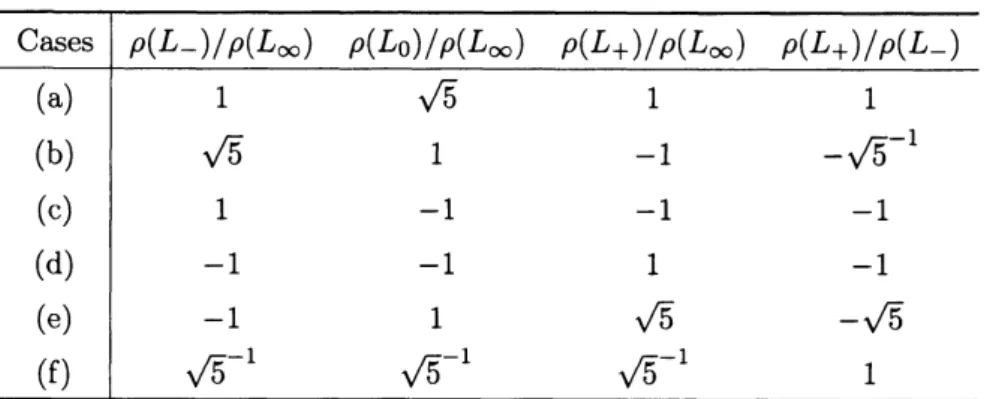
Furthermore, Rong [39] has shown that there aresix
cases
for the ratios among$\rho(L_{-})$,$\rho(L_{+}),$ $\rho(L_{0}),$ $\rho(L_{\infty})$
as
in Table 6.Table 6: The values of the $Q$ polynomials at $z=(\sqrt{5}-1)/2.$
Using Table 6,
we
have criteriaon
the $Q$ polynomials of two links whichare
relatedby
a
crossing change [40, Theorem 4.1]or a
band surgery [19, Theorem 3.1].Proposition 6.1. (i)
If
two links $L$ and$L’$ are related by a crossing change, then(ii)
If
two links $L$ and$L’$ are related by a band surgery, then$\rho(L)/\rho(L’)\in\{\pm 1, \sqrt{5}^{\pm 1}\}$ . (34)
Moreover, using Table 6, we have the following.
Theorem 6.2. Suppose that two links $L$ and $L’$ are related by either a crossing change
or a
bandsurgery
and that $\rho(L)=\rho(L’)=\pm\Gamma 5$.
Then$\det L+\det L’\equiv 0$ $or$ $\det L-\det L’\equiv 0$ $(mod 5^{r+1})$
.
(35)Example 6.3. $d_{cb}(9_{39}!, 6_{2}^{2})>1$. Since $\rho(9_{39}!)$ $=\rho(6_{2}^{2})=-\sqrt{5},$ $\det(9_{39}!)=55$, and
$\det(6_{2}^{2})=10$, the result follows by Theorem 6.2. Note that since $\sigma(9_{39}!)=2,$ $\sigma(6_{2}^{2})=3,$
we cannot use Proposition 2.2.
7
Table of
$d_{cb}(K, K’)$We give atable ofcoherent band-Gordian distances between two knots (cf: [15, Table 1])
Table 7: Coherent band-Gordian distances between two knots with up to 6 crossings.
Table 8: Coherent band-Gordian distances between two knots with up to 7 crossings.
Acknowledgements
The first author was partially supported by KAKENHI, Grant-in-Aid for Scientific
Re-search (C) (No. 21540092), Japan Society for the
Promotion
ofScience.
References
[1] Y. Abe andT. Kanenobu, Unorientedbandsurgery onknots and links, Kobe J. Math.
(to appear).
[2] J.
S.
Birman and T. Kanenobu, Jones’ bmid-platformula
and a new surgery triple,Proc.
Amer.
Math. Soc. 102 (1988),687-695.
[3] R. D. Brandt, W. B. R. Lickorish, and K. C. Millett, A polynomial invariant
for
unoriented knots and links, Invent. Math. 84 (1986),
no.
3, 563-573.[4] J. H. Conway,
An
enumemtionof
knots and links, andsome
of
their algebmicprop-erties, Computational
Problems
inAbstract
Algebra (Proc. Conf., Oxford, 1967),Pergamon, Oxford, 1970, pp.
329-358.
[5] Isabel D. Darcy and D. W. Sumners, A strand passage metric
for
topoisomemseaction,
KNOTS
96 (Tokyo), World Sci. Publ., River Edge, NJ, 1997, pp. 267-278.[6] Isabel K. Darcy, Biological distances
on
DNA knots and links: applications to XERrecombination, J. Knot Theory Ramifications 10 (2001),
no.
2, 269-294, Knots inHellas 98, Vol. 2 (Delphi).
[7] Isabel K. Darcy, Kai Ishihara, Ram K. Medikonduri, and Koya Shimokawa, Rational
tanglesurgery andXer recombination
on
catenanes, Algebr. Geom. Topol. 12 (2012),no. 2,
1183-1210.
[8] Isabel K. Darcy and De Witt Sumners, Rational tangle distances
on
knots and links,Math. Proc. Cambridge Philos. Soc. 128 (2000), no. 3, 497-510.
[9] Yuanan Diao, Claus Ernst, and Anthony Montemayor,
Nullification of
knots andlinks, J. Knot Theory Ramifications 21 (2012), no. 6, 1250046, 24 pp.
[10] P. Freyd, D. Yetter, J. Hoste, W. B. R. Lickorish, K. Millett, and A. Ocneanu, A
new
polynomial invariant
of
knots and links, Bull. Amer. Math. Soc. (N.S.) 12 (1985),no.
2,239-246.
[11] C. F. Ho, A polynomial invariant
for
knots and links–preliminary report, AbstractsAmer. Math. Soc. 6 (1985), 300.
[12] Fujitsugu Hosokawa, On$\nabla$-polynomials
of
links, Osaka Math. J. 10 (1958),273-282.
[13] Fujitsugu Hosokawa and Shin’ichi Kinoshita, On the homology group
of
branched[14] J. Hoste, Y. Nakanishi, and K. Taniyama, Unknotting opemtions involving trivial
tangles, Osaka J. Math. 27 (1990), no. 3, 555-566.
[15] KaiIshihara and Dorothy Buck,
Nullificaiton
distance between links with smallcross-ing numbers, Proceedings of “Mathematics of Knots IV”, 2011, pp.
182-188.
[16] Kai Ishihara and Koya Shimokawa, Band surgeries between knots and links with small
crossing numbers, Prog. Theor. Phys. Suppl. 191 (2011),
245-255.
[17] V. F. R. Jones, Hecke algebm representations
of
bmid groups and link polynomials,Ann. of Math. (2) 126 (1987),
no.
2, 335-388.[18] V. F. R. Jones, On
a
certain valueof
theKauffman
polynomial, Comm. Math. Phys.125 (1989),
no.
3,459-467.
[19] T. Kanenobu, Band surgery
on
knots and links, J. Knot Theory Ramifications 19(2010), no. 12, 1535-1547.
[20] T. Kanenobu, $H(2)$-Gordian distance
of
knots, J. Knot Theory Ramifications 20(2011),
no.
6,813-835.
[21] T. Kanenobu, Bandsurgery
on
knots and links, $\Pi$, J. Knot Theory Ramifications 21(2012), no. 9, 1250086, 22 pp.
[22] T. Kanenobu, $SH(3)$
-move
and other localmoves
on knots, preprint.[23] T. Kanenobu and Y. Miyazawa, $H(2)$-unknotting number
of
a
knot,Commun.
Math.Res. 25 (2009),
no.
5,433-460.
[24] T. Kanenobu and H. Moriuchi, Links which
are
related bya
band surgeryor
crossingchange, submitted.
[25] Akio Kawauchi, A survey
of
knot theory, Birkh\"auser Verlag, Basel, 1996, Ranslated and revisedfrom
the1990
Japanese original by the author.[26] W. B. R. Lickorish, Unknotting by adding
a
twisted band, Bull. London Math. Soc.18 (1986), no. 6, 613-615.
[27] W. B. R. Lickorish and K. C.Millett, Some evaluations
of
link polynomials, Comment.Math. Helv. 61 (1986),
no.
3,349-359.
[28] W. B. Raymond Lickorish, An introduction to knot theory, Graduate Texts in
Math-ematics, vol. 175, Springer-Verlag, NewYork, 1997.
[29] Y. Miyazawa, Gordian distance and polynomial invariants, J. Knot Theory
Ramifi-cations 20 (2011),
895-907.
[30] Yasuyuki Miyazawa, The Jones polynomial
of
an
unknotting numberone
knot, Topol-ogy Appl. 83 (1998),no.
3,161-167.
[31] Anthony Montemayor,
On
nullification
of
knots and links, Master’s thesis, Western Kentucky Univ., 2012.[32] H. Murakami, Some metrics on classical knots, Math. Ann. 270 (1985),
no.
1, 35-45.[33] K. Murasugi, Knot theory
&
its applications, ModernBirkh\"auser Classics, Birkh\"auser Boston Inc., Boston, MA, 2008, Translated from the 1993 Japanese original byBo-hdan Kurpita, Reprint of the 1996 translation.
[34] Kunio Murasugi, On
a
certain numerical invariantof
link types, Rans. Amer. Math.Soc. 117 (1965), 387-422.
[35] Yasutaka Nakanishi, A note
on
unknotting number, Math.Sem.
Notes Kobe Univ. 9 (1981),no.
1,99-108.
[36] J\’ozef H. Przytycki and Pawel Traczyk, Invariants
of
linksof
Conway type, Kobe J.Math. 4 (1988), no. 2, 115-139.
[37] R. A. Robertello, An invariant
of
knot cobordism, Comm. Pure Appl. Math. 18(1965),
543-555.
[38] Dale Rolfsen, Knots and links,
AMS
Chelsea Press, Providence, RI, 2003, Originallypublished: Berkeley, CA: Publish
or
Perish Inc. 1976.[39] Y. W. Rong, The
Kauffman
polynomial and thetwo-fold
coverof
a link, IndianaUniv. Math. J. 40 (1991), no. 1, 321-331.
[40] A. Stoimenow, Polynomial values, the linking
form
and unknotting numbers, Math.Res. Lett. 11 (2004),
no.
5-6,755-769.
[41] Ichiro Torisu, The determination
of
the pairsof
two-bridge knots orlinks with Gordiandistance one, Proc.
Amer.
Math. Soc. 126 (1998),no.
5,1565-1571.
[42] Pawel haczyk, A criterion
for
signed unknotting number, $Low$-dimensional topology(Funchal, 1998), Contemp. Math., vol. 233, Amer. Math. Soc., Providence, RI, 1999,
pp. 215-220.
Department of Mathematics, Osaka City University
Sugimoto, Sumiyoshi-ku Osaka 558-8585 JAPAN
$E$-mail address: kanenobu@sci. osaka-cu.
ac.
jp$*\beta RiF^{\infty}|\Delta_{arrow}\star\not\cong^{\backslash }\star\not\cong\beta_{\pi\Phi 5^{\backslash }ffl_{J\iota}^{i7}H}^{\Leftrightarrowt}\Leftrightarrow(_{\tau\supset}^{-}\equiv\ovalbox{\tt\small REJECT}^{B=},J^{\backslash }\Xi$
Osaka City University Advanced Mathematical Institute Sugimoto, Sumiyoshi-ku Osaka 558-8585
JAPAN
$E$-mail address: moriuchi@sci. osaka-cu.