ON
IMMERSED
ORIENTED SURFACES
AND THEIRPLANE PROJECTIONS
MINORU YAMAMOTO (山本稔,愛知教育大学)
DEPARTMENT OF MATHEMATICS, AICHI UNIVERSITY OF EDUCATION
1. INTRODUCTION
The author has been supported by Grant-in-Aid for Young Scientists (B) JSPS (No. 21740058).
2.
STABLE
MAPIn this section,
we
give the definition andsee
properties ofa
stable map.Let $f$ : $Marrow \mathbb{R}^{2}$ be
a
smooth map ofa
closed connected surface $M$into the plane. We denote the set
of
such maps by $C^{\infty}(M, \mathbb{R}^{2})$, which isequipped with the Whitney $C^{\infty}$-topology. A smooth map $f$ is said to be
a
stable map if in $C^{\infty}(M, \mathbb{R}^{2})$, thereexists
an
open neighborhood $U$ of $\tilde{f}$suchthat for
any
$\tilde{g}\in U,\tilde{g}$ is $C^{\infty}$ right-left equivalent to $f$, i.e., there exist twodiffeomorphisms $\Phi$ : $Marrow M$ and $\varphi:\mathbb{R}^{2}arrow \mathbb{R}^{2}$ such that the diagram
$Marrow^{\Phi}M$
$\overline{f}\downarrow$ $\downarrow\tilde{g}$
$\mathbb{R}^{2}arrow \mathbb{R}^{2}$
$\varphi$
is commutative.
For
a
smooth map $f;Marrow \mathbb{R}^{2}$,we
denote by $s(f)$ the set of the pointsin $M$ where the rank of the differential of $\tilde{f}$ is strictly less than two. We
say that $S(\tilde{f})\subset M$ is
a
singular set of $f$ and $f(S(f))\subset \mathbb{R}^{2}$ isan
apparentcontour of $f$
.
The following
characterizations of
stable mapsare
well-known (see [2, 8],for example).
Proposition 2.1. A smooth map $f;Marrow \mathbb{R}^{2}$
of
a closedsurface
$M$ isa
stable map
if
and onlyif
thefollowing conditions aresatisfied.
(i) For every $q\in M$, there $ex:ist$ local coordinates $(x, y)$ and (X,Y)
around $q\in M$ and $f(q)\in \mathbb{R}^{2}$ respectively such that
one
of
thefol-lowing holds:
$(a)(X\circ\tilde{f}, Yo\tilde{f})=(x, y)$ ($q$ : regularpoint),
$(b)(Xo\tilde{f}, Yo\tilde{f})=(x, y^{2})$ ($q$ :
fold
point),$(c)(Xo\tilde{f}, Yo\tilde{f})=(x, y^{3}-xy)$ ($q$ : cusp point).
(ii)
If
$q\in M$ isa
cusp point, then $\tilde{f}^{-1}(f(q))\cap s(f)=\{q\}$.
(iii) The
map
$f|$($S(\tilde{f})\backslash \{cusp$points})
isan immersion
withnormal
cross-ings.
Note that $s(f)$ is
a
compact l-dimensional submanifold of $M$ and thenumber of cusp points is finite. Let $U\subset M$ be a tubular neighborhood of
$S(\tilde{f})$
.
Then the restriction of $f$on
the closure cl$(M\backslash U)$ is an immersion.By the apparent contour of $f,$ $\mathbb{R}^{2}$ is naturally stratified into 2-,
1- and
0-dimensional strata. The unionofl-and0-dimensional strataforms $\tilde{f}(S(f))$
.
On each l-dimensional stratum, we can define an orientation
as
follows.We fix the canonical orientation
on
$\mathbb{R}^{2}$.
Let $\Omega$ be a connected component
of $\mathbb{R}^{2}\backslash \tilde{f}(S(\tilde{f}))$
.
We associate to $\Omega$ a non-negative integer$n_{\overline{f}}(\Omega)$, which
is the number of points in the fiber of $\tilde{f}$
over
any point of $\Omega$. Every1-dimensional stratum is adjacent to exactly two connected components of
$\mathbb{R}^{2}\backslash \tilde{f}(S(\tilde{f}))$
.
Since
these two components have distinct$n_{\overline{f}}(\Omega)$-values,
we
can
orient each l-dimensional stratum in $f(S(\tilde{f}))$so
that the region withthe larger $n_{f}(\Omega)$-value is
on
its left. Since $f|$($S(\tilde{f})\backslash \{$cusppoints})
isan
Suppose that is
an
oriented closed surface and is oriented plane. Let $q$ be a cusp point ofa stable map $f;Marrow \mathbb{R}^{2}$.
For a sufficiently smallneighborhood $U$ of $f(q)$, the map $f|v$ : $Varrow U$ has degree $\pm 1$, where $V$
is the component of $f^{-1}(u)$ containing $q$
.
We call $q$ isa
positive (resp.negative) cusp if the local degree of$f$ at $q$ equals $+1$ (resp. $-1$).
3.
IMMERSION LlFTInthe following,
we
assume
that $M,$ $\mathbb{R}^{3}$and $\mathbb{R}^{2}$
are
oriented. In this case,Haefliger$s$ theorem is restated
as
follows.Theorem 3.1 (Haefliger [3]). A stable map $f;Marrow \mathbb{R}^{2}$ has
an
immersionlift
if
and onlyif
each connected componentof
$S(\tilde{f})$ haseven
numberof
cusppoints.
Let $f:Marrow \mathbb{R}^{2}$ be
a
stable map which hasan
immersion lift. On eachconnected component offold points $S(\tilde{f})\backslash$
{cusp
points}, we can
puta
sign$+1$ or-l which satisfies the following rule.
$\bullet$ Let $C$ and $C’$
be
two connected componentswhich
adjacent to thesame
cusp point. Then $C$ andC’
have the opposite signs.If
a
sign of$C$ is $+1$ (resp. $-1$),we
call $C$a
positive (resp. negative) fold anda
signcan
be puton
each image of fold component. Sucha
stable map $\tilde{f}$ iscalled
a
signed stable map.Let $f:Marrow \mathbb{R}^{2}$ be a signed stable map and $U$ a tubular neighborhood
of $S(\tilde{f})$. Since $M$ is oriented, $U\backslash s(f)$ is divided into two regions $U+$ and
$U$-where $f|U+$ (resp. $f|U_{-}$) is
an
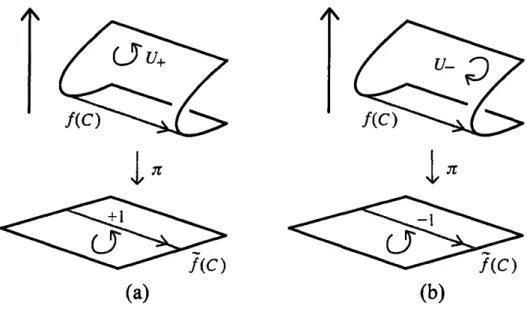
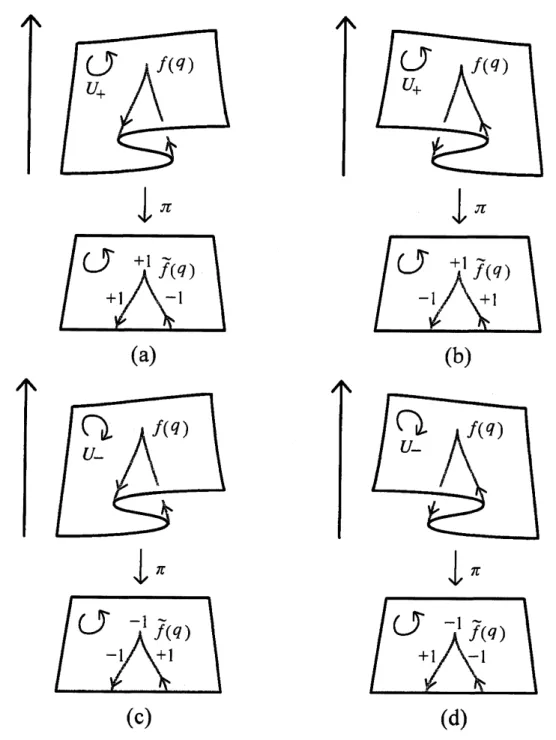
orientation preserving (resp. reversing)immersion. We construct an immersion lift $f_{U}$ : $Uarrow \mathbb{R}^{3}$
over
$f|u$ whichsatisfies the following.
(1) If $C$ is
a
positive fold, $f$ is defined as Figure 1(a).(2) If $C$ is
a
negative fold, $f$ is definedas
Figure 1 (b).(3) If$q$is
a
positive cusp and negative foldcomes
in $q$for the orientationof $S(\tilde{f}),$ $f$ is defined as Figure 2(a).
(4) If$q$ is
a
positivecusp and positive foldcomes
in $q$ for the orientationof $S(\tilde{f}),$ $f$ is defined as Figure 2(b).
(5) If$q$is
a
negativecusp and negative foldcomes
in$q$for the orientationof $s(f),$ $f$ is defined as Figure 2(c).
(6) If$q$ is
a
negative cusp and positive foldcomes
in$q$ for theorientationof $s(f),$ $f$ is defined as Figure 2(d).
Definition 3.2. Let $f;Marrow \mathbb{R}^{2}$ be
a
signed stable map and $U$a
tubularneighborhood of$S(\tilde{f})$
.
Ifan
immersion $f$ : $Marrow \mathbb{R}^{3}$ satisfies the above rules(1)$-(6)$
on
$f|U$,we
call $f$an
immersion liftover
the signed stable map $f$.
4. $f$-REGULAR HOMOTOPY
In this section,
we
state that $f$-regular homotopy classescan
bedeter-mined.
Theorem 4.1.
If
$f$ and $g:Marrow \mathbb{R}^{3}$are
immersionlifts
over the signed$\downarrow\pi$ $\downarrow\pi$
(a) (b)
FIGURE 1. Immersion lifts if (a) $C$ is
a
positive fold, (b) $C$is
a
negative fold.Corollary 4.2. Let $f:Marrow \mathbb{R}^{2}$ be a stable map which has
an
immersionlift.
(Note that $f$ is not signed.) The numberof
$f$-regular homotopy classesis $2\# S(\overline{f})$
, where $\# S(\tilde{f})$ is the number
of
connected componentsof
$S(\tilde{f})$.
We have
a
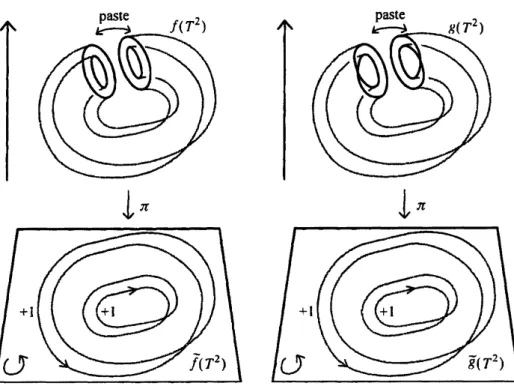
following example which is related to Theorem 4.1.Example 4.3. Let $T^{2}$ be
an
oriented torus and $l$ and $m$ longitude andmeridian of $T^{2}$, respectively. Let $f$ and
$\tilde{g}$ : $T^{2}arrow \mathbb{R}^{2}$ be signed stable
maps which satisfy the following properties. They do not have cusp points,
$f(S(\tilde{f}))=\tilde{g}(S(\tilde{g}))$, both signs
are
the same, $f|\iota=\tilde{g}|l$ and $\tilde{g}|m$are
planecurves
whoserotation numbers equa12 (or-2), $f|m$isa
simple closed planecurve.
See
Figure3.
By thetheorem
of Pinkall [6], immersionlifts
$f$ and$g:T^{2}arrow \mathbb{R}^{3}$
over
$f$ and $\tilde{g}$ respectivelyare
not regularly homotopic.Theorem
3.1
and Example4.3
mean
that if$M\neq S^{2}$,an
apparentcontourwith sign does not determine
a
regular homotopyclass. We needinformationof immersion $f|(M\backslash s(f))$
.
5. REGULAR HOMOTOPY LIFT OVER A GENERIC HOMOTOPY
Let $f$and$\tilde{g}$ : $Marrow \mathbb{R}^{2}$ be stable mapsand $\tilde{F}$ :
$M\cross[0,1]arrow \mathbb{R}^{2}$
a
homotopybetween $f$ and $\tilde{g}$. If
$\tilde{F}$
satisfies thefollowing conditions, we call $\tilde{F}$
a
generichomotopy between $f$and $\tilde{g}$ (see [5]).
(1) There is
a
finite set of parameter values $0<t_{1}<\cdots<t_{n}<1$(possibly empty) in $(0,1)$
.
(2) For any $t\in(0,1)\backslash \{t_{1}, \ldots, t_{n}\},\tilde{F}|M\cross\{t\}$ : $M\cross\{t\}arrow \mathbb{R}^{2}$ is
a
stablemap.
(3) For each $t_{i}$ and a sufficiently small positive value $\epsilon$, the
moves
ofapparent contours of$\tilde{F}|M\cross\{t\}(t\in(t_{i}-\epsilon, t_{i}+\epsilon))$
are
classified intolips (type $L$), beaks (type $B$), swallowtail (type $S$), cusp-fold (type
$\downarrow\pi$ $\downarrow\pi$
(a)
(b)
$\downarrow\pi$ $\downarrow\pi$
(c)
(d)
FIGURE 2. Immersion lifts if (a) $q$ is a positive cusp and
negative fold
comes
in, (b) $q$ isa
positive cusp and positivefold
comes
in, (c) $q$isa
negativecusp and negativefoldcomes
in, (b) $q$ is
a
negative cusp and positive foldcomes
in.We call each $t_{i}$ is
a
bifurcation pointon
a
generic homotopy $\tilde{F}$.
Let $\tilde{F}$
: $M\cross[0,1]arrow \mathbb{R}^{2}$ be
a
generic homotopy between signed stablemaps $f$ and $\tilde{g}$ and let $f$ and
$g$ immersion lifts
over
$f$and $\tilde{g}$, respectively. Ifthere exists
a
regular homotopy $F:M\cross[0,1]arrow \mathbb{R}^{3}$ between $f$ and $g$ suchthat $\pi\circ F=\tilde{F}$, we call $F$ a regular
homotopy lift
over
$\tilde{F}$.
Theorem 5.1. Let $f$ and$\tilde{g}$ : $Marrow \mathbb{R}^{2}$ be signed stable maps.
If
there existsageneric homotopy$\tilde{F}$
$\downarrow\pi$ $\downarrow\pi$
FIGURE 3. Two stable maps $f$and$\tilde{g}$ : $T^{2}arrow \mathbb{R}^{2}$ whichsatisfy
that $\tilde{f}(S(\tilde{f}))=\tilde{g}(S(\tilde{g}))$ and both apparent contours have
positive signs. But their immersion lifts $f$ and $g:T^{2}arrow \mathbb{R}^{3}$
are
not regularly homotopic.convention
as
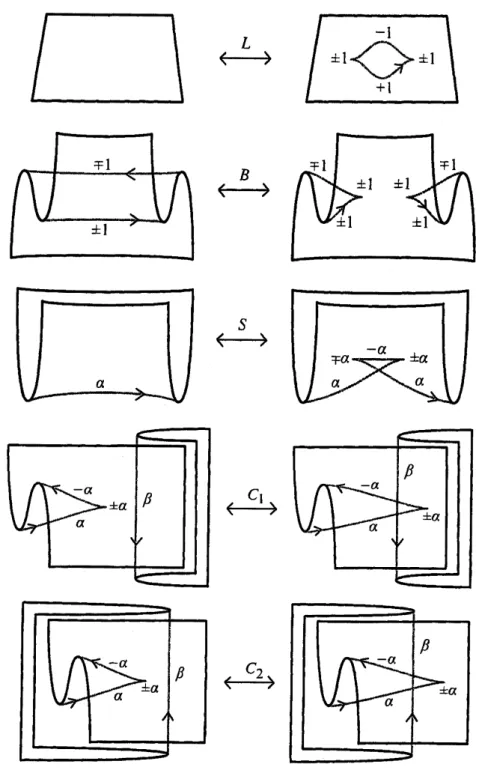
depicted in Figures 4 and 5, then $\tilde{F}$has
a
regular homotopylift
$F:M\cross[0,1]arrow \mathbb{R}^{3}$.
As
an
application ofTheorem 5.1,we
have the following example.Example 5.2. If $f$ and $\tilde{g}$ :
$S^{2}arrow \mathbb{R}^{2}$
are
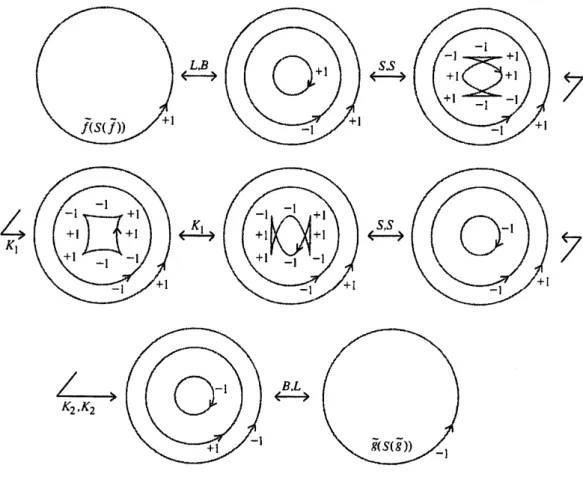
signed stable maps such that$f(s^{2})=\tilde{g}(S^{2})=D^{2},$ $f(S(\tilde{f}))=\tilde{g}(S(\tilde{g}))$ is
a
simple closedcurve
and thesign of$S(\tilde{f})$ (resp. $S(\tilde{g})$) is $+1$ (resp. $-1$). Then there is
a
generic homotopy$\tilde{F}$
:
$S^{2}\cross[0,1]arrow \mathbb{R}^{2}$between
$f$ and $\tilde{g}$which
has
a
regular homotopylift
$F$ : $S^{2}\cross[0,1]arrow \mathbb{R}^{3}$
.
See Figure 6. By the definitions of$f,\tilde{g}$, the regularhomotopy lift $F$
over
$\tilde{F}$corresponds to
an
eversion of the embedded sphere.Our eversion in Example 5.2 is almost
same
as
the eversion given byFlrancis [1]. But in his picture, self intersections of immersedspheres
were
notdrawn. ProfessorMikami Hirasawa and the author draw
a
regular homotopyover
the generic homotopy ofFigure 6, precisely. So,we
can
follow how selfintersections
move
duringour
sphere eversion. Our eversion will appear intheir preparing paper,
REFERENCES
[1] G. K. Francis, A topological picturebook, Springer, NewYork, 2007.
[2] M. GolubitskyandV. Guillemin,Stablemappings and their singularities, Grad-uate Texts in Mathematics, Vol. 14, Springer-Verlag, New York, Heidelberg, 1973.
[3] A. Haefliger, Quelques remarques sur les applications
differentiables
d’une$rightarrow^{L}$
$rightarrow^{B}$
$rightarrow^{S}$
FIGURE 4. Bifurcations of type $L,$$B,$$S$ and $C$ which have
regular homotopy lifts. Here, $\alpha=\pm 1$ and $\beta=\pm 1$ and $\alpha$ and
$\beta$ vary independently.
[4] I. James and E. Thomas, Note onthe classification ofcross-sections, Topology
4 (1966) 351-359.
[5] T. Ohmoto and F. Aicardi, First order local invariants of apparent contours, Topology45 (2006), 27-45.
[6] U. Pinkall, Regular homotopy classes
of
immersedsurfa
ces, Topology24 (1985), 421-434.[7] S. Smale, A
classification of
immersions ofthe two-sphere,Trans. Amer, Math. Soc. 90 (1958), 281-290.$rightarrow^{K_{1}}$
$rightarrow^{K_{2}}$
$rightarrow^{T_{1}}1$
$rightarrow^{T_{2}}$
FIGURE 5. Bifurcations oftype$K$ and $T$ which haveregular
homotopy lifts. Here, $\alpha=\pm 1,$$\beta=\pm 1$ and $\gamma=\pm 1$ and $\alpha,$$\beta$
and $\gamma$ vary independently.
[8] H. Whitney, On singularities ofmappings ofeuclidean spaces. I. Mappings of the plane into the plane, Ann. of Math. (2) 62 (1955), 374-410.
FIGURE
6.
A sequence ofapparent contours ofa
genericho-motopy between $f$ and $\tilde{g}:S^{2}arrow \mathbb{R}^{2}$ which has
a
regularho-motopy lift. This regular homotopy corresponds to