Myanmar's apparel industry in the new
international environment : prospects and
challenges
著者
Kudo Toshihiro
権利
Copyrights 日本貿易振興機構(ジェトロ)アジア
経済研究所 / Institute of Developing
Economies, Japan External Trade Organization
(IDE-JETRO) http://www.ide.go.jp
journal or
publication title
IDE Discussion Paper
volume
430
year
2013-09-01
INSTITUTE OF DEVELOPING ECONOMIES
IDE Discussion Papers are preliminary materials circulated to stimulate discussions and critical comments
IDE DISCUSSION PAPER No. 430
Myanmar’s Apparel Industry in the New
International Environment:
Prospects and Challenges
Toshihiro KUDO*
September 2013
Abstract
Myanmar’s apparel industry had long been denied access to Western markets due to sanctions against its military government. The birth of a “civilian” government in March 2011 improved Myanmar’s relations with the international community, and Western sanctions were largely lifted. Regained market access is expected to trigger rapid growth of Myanmar’s apparel exports. This paper examines this impact with a comparison to Vietnam’s apparel industry.
The industry’s prospects are getting bright, but the business environment has recently changed drastically in Myanmar. A new challenge for Myanmar’s apparel industry is remaining globally competitive. This paper also examines advantages and disadvantages that apparel firms in Myanmar experience. Although its abundance of low-wage workers remains a source of competitiveness, Myanmar needs its government to play a more active role to build the foundation of the industry.
Keywords: Myanmar (Burma), apparel, international market, export, sanctions,
economic growth
JEL classification: F14, J39, L67
* Senior Research Fellow, Research Planning Department, Institute of Developing Economies, JETRO, Chiba, Japan ([email protected]).
The Institute of Developing Economies (IDE) is a semigovernmental, nonpartisan, nonprofit research institute, founded in 1958. The Institute merged with the Japan External Trade Organization (JETRO) on July 1, 1998. The Institute conducts basic and comprehensive studies on economic and related affairs in all developing countries and regions, including Asia, the Middle East, Africa, Latin America, Oceania, and Eastern Europe.
The views expressed in this publication are those of the author(s). Publication does not imply endorsement by the Institute of Developing Economies of any of the views expressed within.
INSTITUTE OF DEVELOPING ECONOMIES (IDE), JETRO 3-2-2, WAKABA,MIHAMA-KU,CHIBA-SHI
CHIBA 261-8545, JAPAN
©2013 by Institute of Developing Economies, JETRO
No part of this publication may be reproduced without the prior permission of the IDE-JETRO.
1 Introduction
Asia had begun its ascent up the development ladder through garment exports (Sachs, 2005:195), and Myanmar follows suit. With its abundant supply of low-wage labor, Myanmar has an apparent comparative advantage in labor-intensive industries. In the country, apparel sewing has been the only manufacturing entity that participates in regional and global production and distribution networks. Apparel represents the only type of exported manufactured goods in the country.
Nevertheless, this apparent comparative advantage had long been suppressed, mainly due to a hostile international environment. Myanmar’s apparel industry has both grown and declined over the past two decades subject to the changing international environment and consequent availability and absence of market access. Myanmar increased its apparel exports steadily in the 1990s and up through the beginning of the 21st century, but the exports have greatly declined since 2003, when the Unites States imposed an import ban on all Myanmar’s products.
Contrarily, Vietnam increased its apparel exports steadily in the 1990s, and rapidly in the first decade of 21st century. The Vietnamese case is in sharp contrast with Myanmar’s, and provides an interesting reference point. Myanmar and Vietnam are both located in mainland Southeast Asia, and both have medium-sized populations, with about 60 million for Myanmar and about 90 million for Vietnam. They are latecomers in the Association of Southeast Asian Nations (ASEAN), and their GDP per capita was less than US$100 in 1990.1 The two countries experienced centrally controlled planning economies, and both opened up their economies and started exporting apparel in the early 1990s. However, their performances since then have been very different. In 2010, the export value of apparel from Vietnam was 20 times higher than that from Myanmar.
What are the reasons behind such a gap in performance between the two countries’ apparel industries? Many reasons have been identified, but among them a critical difference is access/non-access to international markets (Goto and Kudo, 2013). On one hand, Vietnam’s apparel industry enjoyed increasing access to the global economy and international markets by its improved relations with the United States, particularly in the first decade of 21st century. On the other, Myanmar had been losing access to international markets by strengthened sanctions from the United States, the European Union (EU), and others.
1
According to the International Monetary Fund (IMF)’s World Economic Outlook Database (April, 2013), Myanmar’s GDP per capita of 1990 was US$68 and that of Vietnam was US$98.
This paper argues that Myanmar’s apparel industry’s lack of or limited access to international markets has been a major factor behind its stagnation in the last two decades, even though people have pointed out many other constraints and obstacles including bad government policy. In this regard, the experience of Vietnam’s apparel industry offers a contrasting case without sanctions from the international community, and such a situation is currently being realized in Myanmar since the establishment of a “civilian” government in March 2011. Then, this paper envisages the prospects of Myanmar’s apparel industry under the new environment.
The prospects are getting brighter for the apparel industry in Myanmar due to its restored access to international markets. However, the business environment surrounding Myanmar’s apparel industry has drastically changed in recent years. A sharp rise in the local currency’s real exchange rate pushed up apparel workers’ wages in terms of the US dollar. In spite of the apparent existence of a nation-wide labor surplus, there has been an occasional shortage of workers in Yangon. Infrastructure services including electricity and transportation are still unreliable and costly compared to competitor countries. New challenges for Myanmar’s apparel industry are expanding its production capacity to meet increased demand and remaining competitive in international markets. This paper examines the advantages and disadvantages that apparel firms experience in Myanmar.
The outline of this paper is as follows. Section 2 provides the historical background of the country’s apparel industry. Section 3 examines the impact of market access/non-access to Western countries on the growth and decline of Myanmar’s apparel industry with comparison to Vietnam’s case. Section 4 examines the advantages and disadvantages that apparel firms in Myanmar experience. In conclusion, we draw readers’ attention to the role of the government. The military government had long suppressed realization of the apparel industry’s comparative advantage. Now the government has to play a more active role to build the foundation of the industry to capitalize on the opportunities provided by restored access to international markets.
2 Growth and Decline of Myanmar’s Apparel Industry
Figure 1 presents the export performance of Myanmar’s garment industry based on two different sources of information: the United Nations’ Comtrade and import data from 22 major countries that import Myanmar-made apparel. Between 1990 and 2001,
Myanmar’s apparel industry increased its exports by 69 times. Apparel’s share of Myanmar’s total exports increased from 2.5 per cent in 1990 to 39.5 per cent in 2000. Apparel became the largest exported good of the country. Although the United States and the EU deprived Myanmar of the generalized system of preferences (GSP) status since 1997, they did not deny Myanmar access to their markets in the 1990s. As a result, the United States offered the largest market, and in 2000, it absorbed more than 50 per cent of Myanmar’s apparel exports. The EU provided the second largest market and was the recipient of nearly 40 per cent in the same year.
0 100 200 300 400 500 600 700 800 900 1000 19 85 19 86 19 87 19 88 19 89 19 90 19 91 19 92 19 93 19 94 19 95 19 96 19 97 19 98 19 99 20 00 20 01 20 02 20 03 20 04 20 05 20 06 20 07 20 08 20 09 20 10 20 11 20 12
(Source) UN comtrade and World Trade Atlas.
Figure 1 Myanmar's apparel exports
UN Comtrade 22 Major importers
( Million US$)
(Source) UN Comtrade and World Trade Atlas.
However, Myanmar lost access to the United States’ markets in 2003 due to sanctions, which included an import ban.2 This led to a drastic decline in Myanmar’s apparel exports, and by 2005, they had contracted to 38 per cent of the export value of 2001, the peak year. As a result, apparel firms in Myanmar started to explore Asian markets, Japan in particular. In 2007, Japan became the largest market for Myanmar’s apparel exports, together with Germany, and increased its share to absorb about 50 per cent of all Myanmar’s apparel exports in 2012 (Figure 2). South Korea also increased its share
2
On the assessment of impact of United States sanctions on Myanmar’s apparel industry, refer to Kudo (2008a).
from 2010 onwards, and accepted about a third of Myanmar’s apparel exports in 2012. 0 100 200 300 400 500 600 700 800 900 1997 1998 1999 2000 2001 2002 2003 2004 2005 2006 2007 2008 2009 2010 2011 2012
(Source) World Trade Atlas.
Figure 2 Myanmar's apparel exports by destination
Others South Korea Japan EU (15 members) United States (Million US$)
3 Market Access
A most influential factor that harmed Myanmar’s apparel industry was obviously denial of access to the markets of advanced Western nations under the international community’s sanctions regime. How serious was the damage? Can denial of or limitations to access to Western markets mostly explain the stagnation of Myanmar’s apparel industry during the period of military government? To answer this question, we compare the performance of exports in both Myanmar’s and Vietnam’s apparel industries.
Like Myanmar, Vietnam entered the export-oriented apparel industry in the early 1990s, and steadily increased its apparel exports through this decade. Vietnam’s apparel exports were close to double those of Myanmar’s in 2000. Since then, the gap in apparel exports between the two countries has become extremely large (Figure 3). In 2010, Vietnam’s apparel exports were 20 times larger than those of Myanmar’s. Given their similarity in resource endowment and historical background, Vietnam’s experiences can be possibly regarded as a model for Myanmar’s apparel industry if Myanmar had access to international markets in the last two decades.
were affected by Western sanctions and markets that were not. The former includes the markets of the United States and the EU, and the latter includes those of Japan and South Korea.3 The United States, the EU, and Japan accounted for 77.8 per cent of the world’s total apparel imports in 2010, and most of the trade flow was from developing countries to developed countries (Fukunishi and Yamagata, 2013:5-6). Therefore, market access to these three countries is almost equal to that of the world’s markets.
0 2,000 4,000 6,000 8,000 10,000 12,000 1990 1991 1992 1993 1994 1995 1996 1997 1998 1999 2000 2001 2002 2003 2004 2005 2006 2007 2008 2009 2010 (Source) UN Comtrade.
Figure 3 Apparel exports of Myanmar and Vietnam
(Million US$)
US Sanctions (July 2003) US BTA (Dec. 2001)
3.1 Demands Affected by Sanctions
As described in the previous section of this paper, Myanmar’s apparel exports had been seriously damaged by the United States’ sanctions of 2003. By contrast, Vietnam’s apparel exports have shown continued robust growth since 2002, having better access to the United States markets. Vietnam signed a bilateral trade agreement with the United States (US Bilateral Trade Agreement: USBTA) in July 2000, which went into force in December 2001. The USBTA accorded Vietnam a most favored nation (MFN) status, and was instrumental in facilitating Vietnam’s exports to the United States (Goto, 2009). The share of the United States in Vietnam’s total apparel exports jumped from 3.2 per cent in 2000 to 63.0 per cent in 2003. Access to the United States’ markets contributed
3
South Korea has increased its apparel imports from Myanmar since 2010. However, this paper mainly deals with the Japanese market as one that has not been affected by Western sanctions.
to the rapid growth of Vietnam’s apparel industry in the first decade of the 21st century. The United States’ contribution to the growth of Vietnam’s apparel exports was more than 60 per cent for 2001−2011.4
Myanmar exported more than eight times the apparel to the United States than Vietnam in 2000, one year before the USBTA with Vietnam came into force, and two years before the United States’ import ban on Myanmar was imposed (Table 1). The United States’ market size is much larger than that of Japan. The United States imported apparel worth US$77.9 billion in 2012, while Japan imported apparel worth US$32.1 billion in the same year.5 Moreover, it is said that the United States’ markets are easier for apparel firms in developing countries to enter since the quantity of orders are large, designs are simple, and customers and buyers are not particular about sewing quality (Goto et al, 2011:364-368). On the contrary, Japanese customers and buyers are meticulous about sewing quality, strict on delivery, and order small quantities with complicated designs, although the sewing charges are a little higher than those for the United States’ market. Therefore, the United States’ markets were very attractive to apparel firms in Myanmar at that time. If Myanmar had been given continued access to the United States’ markets, its apparel industry could have rapidly grown in the last decade, as shown by Vietnam’s experience.
4
Calculated by the author based on the Vietnam export figures drawn by World Trade Atlas.
5
Here, the item “apparel” includes both Harmonized Commodity Description and Coding System (HS) 61 (knit apparel) and HS 62 (woven apparel).
Table 1 Apparel exports of Myanmar and Vietnam to the United States, the EU and Japan (US$ million, times, %) 1997 1998 1999 2000 2001 2002 2003 2004 2005 2006 2007 2008 2009 2010 2011 2012 Myanmar (Value) 85.3 127.8 185.7 403.5 408.0 298.6 232.7 0.0 0.0 0.0 0.0 0.0 0.0 0.0 0.0 0.0 Vietnam (Value) 25.9 28.4 36.1 47.2 47.8 876.0 2339.0 2505.9 2665.4 3158.5 4293.5 5151.6 5005.7 5797.5 6556.0 7027.0 Gap (VNM/MYM) 0.3 0.2 0.2 0.1 0.1 2.9 10.1 - - - -Myanmar (Share) 0.2% 0.3% 0.4% 0.7% 0.7% 0.5% 0.4% 0.0% 0.0% 0.0% 0.0% 0.0% 0.0% 0.0% 0.0% 0.0% Vietnam (Share) 0.1% 0.1% 0.1% 0.1% 0.1% 1.5% 3.7% 3.7% 3.8% 4.3% 5.7% 7.0% 7.8% 8.0% 8.3% 9.0% Myanmar (Value) 94.1 118.0 155.1 276.1 348.8 307.2 339.9 457.4 237.1 256.6 215.7 210.4 174.4 175.6 179.9 139.5 Vietnam (Value) 542.8 580.3 614.8 671.9 661.5 616.0 554.0 757.2 820.5 1232.7 1471.1 1758.8 1631.4 1774.1 2299.1 2166.9 Gap (VNM/MYM) 5.8 4.9 4.0 2.4 1.9 2.0 1.6 1.7 3.5 4.8 6.8 8.4 9.4 10.1 12.8 15.5 Myanmar (Share) 0.2% 0.3% 0.4% 0.6% 0.8% 0.6% 0.6% 0.7% 0.3% 0.3% 0.2% 0.2% 0.2% 0.2% 0.2% 0.2% Vietnam (Share) 1.3% 1.4% 1.4% 1.5% 1.5% 1.3% 1.0% 1.2% 1.2% 1.6% 1.7% 1.8% 1.9% 2.0% 2.2% 2.4% Myanmar (Value) 1.1 2.3 2.1 4.6 7.5 15.0 32.2 44.8 52.7 71.4 95.5 132.6 149.2 183.4 348.7 408.2 Vietnam (Value) 483.5 422.7 446.1 579.7 524.6 458.8 484.5 548.1 588.1 615.7 690.1 837.8 1005.6 1170.2 1778.9 2090.8 Gap (VNM/MYM) 440.1 183.0 213.5 126.9 70.2 30.6 15.0 12.2 11.2 8.6 7.2 6.3 6.7 6.4 5.1 5.1 Myanmar (Share) 0.0% 0.0% 0.0% 0.0% 0.0% 0.1% 0.2% 0.2% 0.2% 0.3% 0.4% 0.5% 0.6% 0.7% 1.1% 1.3% Vietnam (Share) 3.0% 3.0% 2.8% 3.1% 2.9% 2.8% 2.6% 2.7% 2.8% 2.7% 3.1% 3.4% 4.2% 4.6% 5.7% 6.5%
(Note) The figure includes both HS61 (knit apparel) and HS62 (woven apparel). (Source) World Trade Atlas.
US
EU
In addition to the United States’ markets, EU markets were also affected by the sanctions. The EU (15 member countries only) imported US$90.7 billion worth of apparels in 2012, which was 16 per cent larger than imports by the United States. Myanmar’s apparel exports to the EU increased from US$94.1 million in 1997 to US$457.4 million in 2004, an increase of 4.9 times. However, since then, its apparel exports to the EU continuously declined, by around 60 per cent, to about US$180 million in 2011. This decline was not caused by the deprivation of GSP status on Myanmar’s imports by the EU in 1997, because Myanmar’s apparel industry had successfully increased its exports to the EU between 1997 and 2004.
The decline was apparently caused by the United States’ sanctions of 2003 even though they did not directly target EU markets. Some buyers for EU markets became reluctant to purchase made-in-Myanmar apparel, being afraid of possible boycott campaigns by consumers and/or NGOs stimulated by the United States’ sanctions of 2003. Some EU members introduced a targeted import ban against designated apparel manufacturers in Myanmar. For example, the apparel manufacturing joint venture between Myanmar Daewoo International and the Union of Myanmar Economic Holdings Ltd., a company owned by active and former military officers, was blocked access to the German market.
In 2004, Myanmar’s apparel exports to the EU were US$457.4 million, while those of Vietnam were US$757.2 million, just under double of those of Myanmar. Vietnam has since increased its apparel exports to the EU, reaching US$2.3 billion in 2011, tripling its total of 2004. On the contrary, Myanmar exports were limited to US$180.0 million in 2011, a 60 per cent decline from 2004. Consequently, the gap ratio of Vietnam’s apparel exports compared with Myanmar’s increased from 1.6 times in 2003 to 15.5 times in 2012. If Myanmar had been given full access to EU markets like Vietnam, Myanmar’s apparel industry could have penetrated them in the last decade.
The United States lifted its import ban on Myanmar on November 16, 2012, just three days before President Obama’s historic visit to Myanmar on November 19, 2012. The EU suspended its sanctions on Myanmar in April 2012 for one year, and permanently ended them the next year. In July 2013, the EU decided to bring Myanmar back under the “Everything But Arms (EBA)” preferential trade regime, which grants duty-free and quota-free access to the European market for all products except arms and ammunitions (EC, 2013). Myanmar’s apparel industry has thus restored its access to Western markets and many American and European apparel firms started to visit Myanmar seeking
business opportunities. Orders of apparel from the West will soon return to Myanmar.
3.2 Demands Not Affected by Sanctions
After falling to their lowest levels in 2005, Myanmar’s apparel exports have gradually recovered due to Asian demand, which was unaffected by Western sanctions. Unlike the EU, Asian countries’ customers generally are not sensitive to democracy and human rights issues of apparel-exporting countries. As a consequence, international buyers for Asian countries did not shun purchasing apparel from Myanmar despite Western sanctions.
The recovery of Myanmar’s apparel exports has been first led by orders from Japan, followed by those from South Korea. In 2012, the former accounted for 49 per cent of Myanmar’s apparel exports, and the latter accounted for 33 per cent. Till 2003, Japan’s share of Myanmar’s apparel exports had been miniscule. When apparel firms in Myanmar lost their access to the United States’ markets, they first tried to shift their exports to EU markets. However, as mentioned above, the EU had also become reluctant to procure made-in-Myanmar products, due to fear of possible boycott campaigns. Around the same time, Japanese buyers had strengthened the “China Plus One” strategy against the increasing labor costs and shortage of workers in China’s apparel industry, and an outbreak of severe acute respiratory syndrome (SARS) occurred in South China and Hong Kong between November 2002 and July 2003. As a result, the motives of both demand and supplier sides met each other and it followed that Myanmar increases its apparel exports to Japan.
In 2003, Myanmar’s apparel exports to Japan were only US$32.2 million, while those of Vietnam were US$484.5 million, 15 times larger than those of Myanmar (Table 1). Since then, Myanmar’s apparel exports to Japan steadily increased, reaching US$408.2 million in 2012, an increase of 12.7 times. For the same period, Vietnam increased its apparel exports to Japan from US$484.5 million to US$2090.8 million, an increase of 4.3 times. The gap in apparel exports to Japan between Vietnam and Myanmar declined from 15 times in 2003 to about 5 times in 2012. As a destination of Myanmar’s apparel exports, Japan increased its share from 2.2 per cent in 2002 to 49.0 per cent, the largest share, in 2012.
Myanmar’s apparel exports to Japan have grown more rapidly than Vietnam’s for the period of 2004−2012. Nevertheless, the absolute gap in apparel exports to Japan between the two countries has widened from US$503 million in 2004 to US$1.7 billion in 2012. Japan was not an easy market for Myanmar apparel firms to enter. Goto et al.
(2011:364-365) examines different market conditions by export destination, considering the case of Vietnamese apparel suppliers. Most Vietnamese apparel produced for Japan is on the higher value-added end, with relatively complex designs and product specifications, compared with those for the United States and EU. The buyers in the Japanese market see Vietnamese suppliers’ key sources of competitiveness subject to stringent quality requirements. Thus, catering and entering to the Japanese market is generally recognized as being more difficult than gaining entry to the United States’ and the EU’s markets for Vietnamese apparel firms. This is probably true with the case of Myanmar’s apparel firms as well.
It took a considerable time for apparel firms in Myanmar to enter the Japanese market. One of the earliest apparel firms in Myanmar that started production for the Japanese market was Kojima Apparel (Kudo ed., 2008b). It started full-fledged production in 1999, but failed to continue operations since it could not meet the short lead time required for ladies fashion apparel, which was their specialized item. After the withdrawal of this Kojima Apparel, most of the apparel produced in Myanmar for the Japanese market are men’s suits, men’s shirts, men’s overcoats and work wear and so forth, apparel that require neither frequent style changes nor quick delivery.
Most apparel for the Japanese market has been produced by foreign-affiliated companies, either 100 per cent foreign-owned or a joint venture with Myanmar’s firms (Table 2). This is a distinct feature for apparel production destined for the Japanese market. As Kudo (2010) described, Myanmar’s national firms vigorously entered apparel production for United States and EU markets in the late 1990s and early 2000s. Most firms that entered the apparel industry at that time were national ones. However, Myanmar’s national apparel firms apparently had difficulty entering the Japanese market even after they lost their biggest market due to the United States’ sanctions of 2003. Consequently, the number of apparel firms that exported to the Japanese market was small. In 2007, the top three firms in Myanmar occupied nearly 50 per cent of its total apparel exports to Japan, and the top ten firms accounted for more than 80 per cent of that.
Table 2 Main apparel exporters of Myanmar to Japan (2007)
US$ in million Share (%)
Myanmar Daewoo International 15,024,103 24.4% JV with UMEHL Daewoo, South Korea 1990 3000 mens' shirts, working wear
Myanstar Garment 8,561,993 13.9% 100% foreign Starnesia, South Korea 2001 2500 mens's suits, working wear
TI Garment 6,146,930 10.0% 100% foreign Tomiya Apparel, Itochu Japan 2002 1050 men's shirts, casual and jackets Myanmar Postarion 5,484,269 8.9% 100% foreign Matsuoka, HK (originally Japan) 2000 1000 working wear
Shining Access 3,572,586 5.8% Myanmar private (Japan affiliated) 2000 500 men's shirts
Dragon State 3,279,816 5.3% 100% foreign H.W.A. Glory, Tomen,
HK&Japan 1995 1200 men's shirts, jackets and slacks
Myanmar Hae Wae 2,182,898 3.6% 100% foreign Hae Wae, South Korea 1998 1080 jackets, trousers
Asian Just 2,024,118 3.3% Myanmar private (Japan affiliated) 1997 700 men's suits
Famoso 1,825,609 3.0% 100% foreign Daiei Kisei Fuku, Japan 2003 647 men's suits
Diam ond Arrow 1,820,227 3.0% (transferred to Blessing Intertrade) n.a. n.a. n.a.
Mega One Garm ent 1,464,061 2.4% Myanmar private - 2001 800 working wear
Myanm ar Glogon 1,323,239 2.2% JV with private Global Yes, South Korea 1998 2000 jackets, coats, best
As ia Ros e Mfg. 1,296,918 2.1% Myanmar private (Japan affiliated) men's slacks
Myanm ar Gus ton Molinel* 1,055,274 1.7% 100% foreign Guston Molinel, France 1997 450 working wear
Kyi Khant 983,155 1.6% Myanmar private - 2001 500 jackets, and slacks Myanmar Hwa Fuh 917,205 1.5% (transferred to Dragon State)
Yangon Pan Pacific 879,201 1.4% 100% foreign Pan Pacific, South Korea 1998 n.a. n.a.
A-1 Garm ent 658,212 1.1% Myanmar private - 2001 1000 jackets, coats, slacks
Bles s ing Intertrade 620,502 1.0% Myanmar private (Japan affiliated) 2007 600 slacks, working wear
Myanm ar Segye 393,305 0.6% JV with UMEHL Segye, South Korea 1990 1400 jackets, slacks, skirts
Others 1,951,528.0 3.2%
Total 61,465,149 100.0% - - - - -
(Note) *A Japanese firm bought the factory in 2005, and the name was changed to Sakura Garment.
(Source) Myanmar Textile and Garment Directory, various numbers, companies' pamphlets, and autor's interviews.
Main export items Company name
Exports (2007)
Ownership Foreing partners Establishe
d year
Number of workers
Goto et al. (2011:366) discusses that Japanese trading companies or brand apparel firms usually coordinate value chains for the Japanese market, while Hong Kong, Taiwan, and Korean traders do the same for the United States and EU markets. To meet the stringent quality requirements and precise specifications of Japanese retailers, Japanese buyers are strongly committed to raising the technical capacity of suppliers in developing countries. In other words, Japanese buyers do not buy on-the-spot. They often dispatch their technical staff to suppliers on a relatively long-term basis, mostly at their expense, to raise suppliers’ capacity to meet their required quality and specifications. The Japanese market was not easy for Myanmar apparel firms to enter immediately after the sanctions imposed by the United States. However, once the Japanese buyers commit to suppliers at their own cost, it is only logical for them to continue purchasing apparel from these suppliers to recover their initial expenses.
In this fashion, Myanmar’s exports to Japan have constantly and steadily increased since 2003. Once Myanmar was given market access, it was able to enhance its production and exports even to the Japanese market, a difficult one for apparel firms in low-income countries.
Myanmar’s apparel exports to the Japanese market will likely increase in the coming years. In spite of the steady growth of Myanmar’s apparel exports to Japan, Myanmar’s share of total Japanese apparel imports was just 1.3 per cent in 2012, equivalent to 1.6 per cent of China’s total import share in the same year (Table 3). Notwithstanding the wide-spread idea of “China Plus One,” China’s share in Japanese apparel imports has not declined, keeping at nearly 80 per cent, for the period between 2005 and 2012. The second largest import source of apparel to Japan was Vietnam, with a share of 6.5 per cent in 2012.
This means that a shift of 1.6 per cent of Japan’s imports of Chinese apparel to Myanmar would double Myanmar’s production for the Japanese market. A similar shift of about three per cent would double Myanmar’s total apparel production. A small drive for Japanese apparel buyers’ “China Plus One” strategy will actually cause a sizeable increase in demand for made-in-Myanmar apparel.6
6
Table 3 Japan's imports of apparel
Growth
US$ million Share US$ million Share (times)
1 China 14194.3 76.2% 25104.2 78.3% 1.8 2 Vietnam 579.7 3.1% 2089.9 6.5% 3.6 3 Italy 881.9 4.7% 817.8 2.6% 0.9 4 Indonesia 208.6 1.1% 634.7 2.0% 3.0 5 Bangladesh 16.9 0.1% 486.3 1.5% 28.8 6 Thailand 259.8 1.4% 429.0 1.3% 1.7 7 Myanmar 4.6 0.0% 408.2 1.3% 89.4 8 India 136.3 0.7% 292.8 0.9% 2.1 9 South Korea 805.5 4.3% 211.0 0.7% 0.3 10 Cambodia 1.7 0.0% 190.8 0.6% 109.4 World Total 18617.8 100.0% 32060.0 100.0% 1.7
(Note) HS61 (Knit Apparel) and HS62 (Woven Apparel) are combined. (Source) Calculated from World Trade Atlas.
Rank Country 2005 2012
Thus, market access does matter. During the military government period, Myanmar suffered from a lack of or limited access to international markets. Considering the experience of Vietnam’s apparel industry, Myanmar’s apparel industry would have rapidly grown in the first decade of the 21st century if it were granted market access to the United States and EU.
With Myanmar’s new civilian government, in place since March 2011, pushing for real changes in international relations and on the political front, the United States and EU have already relaxed and/or lifted their sanctions against Myanmar. The international business community now regards this country as Asia’s last frontier, as opposed to one of the outposts of tyranny.7 Myanmar’s apparel industry has regained access to international markets including those of the United States, the EU, and others. Moreover, the “China Plus One” strategy will encourage more orders to come to Myanmar.
4 Advantages and Disadvantages of Myanmar’s Apparel Firms
With access to international markets, demands for made-in-Myanmar apparel will
7
“Outposts of tyranny” was a term used in 2005 by United States Secretary of State Condoleezza Rice to characterize the governments of certain countries as being totalitarian regimes or dictatorships. Burma (Myanmar) was named as one of outposts of tyranny together with Belarus, Cuba, Iran, North Korea and Zimbabwe.
substantially increase in the new international environment. However, the business environment surrounding Myanmar’s apparel industry has drastically changed in recent years. A sharp rise in the real exchange rate of the local currency pushed up apparel workers’ wages in terms of US dollars. Many labor strikes for higher pay occurred in 2012 and 2013. Challenges facing the Myanmar’s apparel industry now are expanding its production capacity to meet increased demand and remaining competitive in international markets.
This section includes an assessment of the competitiveness of Myanmar’s apparel industry by examining availability of productive factors and production and logistics costs. Thus, advantages and disadvantages that apparel firms in Myanmar experience are assessed.
4.1 Initial Investment Requirement
The apparel industry requires only a small amount of initial investment, which is mainly spent on sewing machines. For example, an entrepreneur who was interviewed by the author in September 2005 indicated that a leather shoe factory, which is also considered to be labor-intensive, generally required an investment four times larger than that for an apparel factory for the same scale of workforce.8
This is an ideal feature of the industry for Myanmar, where national entrepreneurs face severe financial constraints and full-fledged foreign investment had long been suppressed by the military government. According to a survey conducted by the author in 2005 under the title “Survey on Garment Industry in Myanmar (SGIM),” the average ratio of equity to debt for 142 sample firms engaged in apparel production was as high as 98 per cent in 2004. This implies that they were mostly self-financed. There were only eight firms among the 142 that received bank loans.
Myanmar’s banking sector is still small and segmented. A private banking sector exists in Myanmar, but their lending is heavily constrained. It is difficult for the banks to determine the credit-worthiness of potential borrowers as financial information and auditing is weak and small enterprises are not required to produce financial statements (OECD, 2013:66). In such a situation, the apparel industry is the main export industry
8 This entrepreneur had long business experience in both the apparel and footwear
that national companies in Myanmar can enter on the basis of their own financial strength.
4.2 Labor Availability, Wages, and Educational Background
Most apparel factories in Myanmar operate on the basis of cutting, making, and packing (CMP) arrangements. Overseas buyers do everything except production; they find customers, design products with detailed specifications, and procure and supply raw materials to apparel factories in Myanmar. Apparel factories in Myanmar do the cutting, sewing, and packing only. They then export all products to overseas markets (Kudo, 2009a:79). The business operation of apparel factories with CMP arrangements thus includes production and logistics costs only, and these consist of items such as labor wages, electricity and diesel, transportation, communications, factory and office rentals, maintenance and repair of sewing machines, and administrative expenses. The most important cost item among these is labor wages.9
4.2.1 Labor Availability
One of the most obvious advantages of Myanmar is the availability of abundant, low-wage, and relatively well-educated labor. The working-age population (15−59 years of age) increased from 20.6 million (56 per cent of the total population) in FY1985 to 32.7 million (59 per cent of the total) in FY2005, and further to 36.9 million (62 per cent of the total) in FY2010 (CSO 2006 and 2011).10 There are a large number of unemployed and underemployed workers in Myanmar’s labor markets, especially in rural areas. Fujita (2009:250) estimated that agricultural labor households with no tillage rights of land constituted 20−40 percent of households in rural Myanmar. He also indicated that their real wage rate in rice terms (rice wage) declined to 50−60 per cent during the last two to three decades (Fujita, 2009:260). This segment of the population could be mobilized to become apparel workers once industrialization and urbanization accelerates.
9
According to IDE Garment Firm Surveys in Bangladesh, Cambodia and Madagascar, labor cost occupied 47 per cent of value-added of garment firms in each country.
4.2.2 Labor Wages
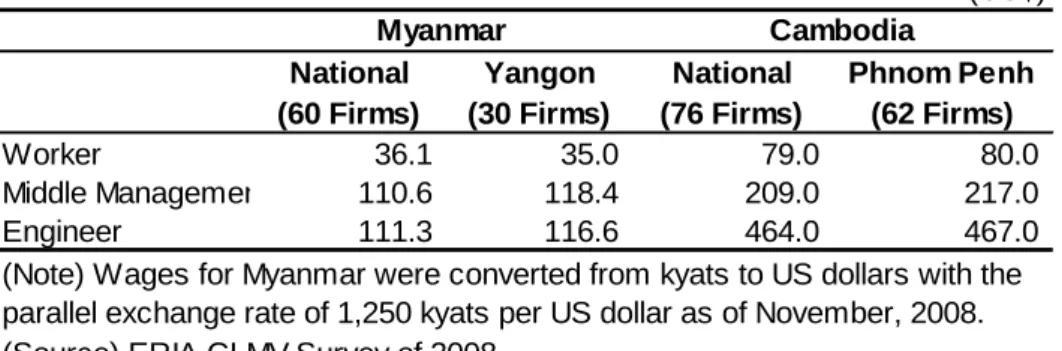
The average monthly wages of sewing-machine-operators in Myanmar were about US$20 between late 2000 and mid-2005 (Kudo ed., 2008b).11 Kudo (2010) confirms the average monthly wages of workers in 2004 were US$18 based on his survey of 100 sewing-machine operators in Yangon. These were among the lowest wages in Asia. Since then, wages of apparel workers in Myanmar have risen to almost double by April 2008. According to this author’s interviews with eight apparel firms in Yangon in April 2008,12 average monthly wages were US$38 and ranged from US$32 to US$43. A similar level of estimated wages was given by the ERIA-CLMV Survey of 2008 (Table4).13 According to this survey, the average monthly wages of general workers including sewing operators in Yangon, Myanmar were US$35 in 2008, while those in Phnom Penh, Cambodia were found to be US$80. Average wages of Myanmar workers were lower than the Cambodian minimum wages of US$50 for apparel and footwear workers at that time.14
Table 4 Average monthly wages, 2008
(US$) National (60 Firms) Yangon (30 Firms) National (76 Firms) Phnom Penh (62 Firms) Worker 36.1 35.0 79.0 80.0 Middle Managemen 110.6 118.4 209.0 217.0 Engineer 111.3 116.6 464.0 467.0
(Source) ERIA-CLMV Survey of 2008.
Myanmar Cambodia
(Note) Wages for Myanmar were converted from kyats to US dollars with the parallel exchange rate of 1,250 kyats per US dollar as of November, 2008.
11
In general, international buyers of apparel products pay more attention to wages in US dollars than those denominated in local currencies. In this research, the author converted Myanmar worker wages in kyats into US dollars using parallel exchange rates.
12
See Kudo ed. (2008b) for details of interviews.
13
A survey was conducted by the Economic Research Institute for ASEAN and East Asia (ERIA)-CLMV study team in November-December, 2008 to assess the business and investment environment in Cambodia, Lao PDR, Myanmar, and Vietnam. Sixty firms were surveyed in Myanmar. Of these, 30 were located in Yangon, 20 in Mandalay, and 10 in Myeik. Ten firms were apparel industries; nine of these were located in Yangon and one in Mandalay. There were 76 firms surveyed in Cambodia; 62 of these were in Phnom Penh. As for the detailed results of ERIA-CLMV Survey, 2008, see Kudo (2009b).
14
In addition to unskilled labor, the salaries of middle management and engineers in Myanmar were found to be lower than in Cambodia, even though the quality and qualification of those human resources were unknown and may not be exactly comparable.
The wages of apparel workers in Myanmar continued to increase, and labor strikes started to break out following the legalization of labor organizations and the loosened grip on security under the civilian government. According to some domestic media, it is said there were more than 800 labor strikes in Myanmar in 2012 and early 2013, and many of them broke out in apparel factories. Given the guidance of Myanmar’s government, the Myanmar Garment Manufacturers Association (MGMA) proposed model wages for apparel workers around May−June, 2013 (Table 5). These model wages comprised basic salary, cost-of-living allowance, overtime, and regular attendance and productivity bonuses. If a skilled sewing operator (Grade B) works 27 days per month with 88 hours overtime, then she will earn US$84 per month, which is equivalent to the minimum wage of Cambodian workers as of May 2013.15 It is reported that many apparel workers who joined the strikes agreed to the model wages.
Table 5 MGMA's proposed model wages for apparel workers
regular attendance productivity bonus total wages
daily monthly daily monthly hourly monthly monthly monthly monthly monthly (US$)
Sewing operators (Grade B) 1150 31050 500 13500 313 27544 5000 5000 82094 84
Sewing operators (Grade C) 1100 29700 300 8100 300 26400 3000 3000 70200 72
Trainees 1000 27000 100 2700 273 24024 3000 0 56724 58
(Source) Myanmar Times dated June 11-17, 2012.
basic salary cost-of-living
allowance overtime
(Notes) 1) Workers are supposed to work 27 days per month. 2) The exchange rate of kyat is 975 kyats per US dollar on August 2, 2013, based on the Central Bank of Myanmar's reference rate.
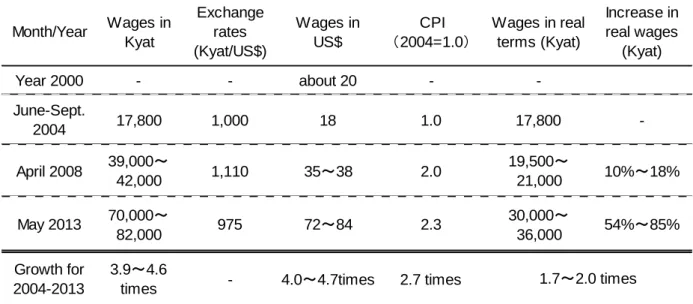
Table 6 shows the historical trend of apparel workers’ wages in Myanmar and its related figures. This table is constructed from the various surveys and author’s interviews mentioned earlier. According to this table, the wages of apparel workers in terms of US dollars increased by about two times for the period of 2004−2008, while they increased by 2 to 2.4 times for the period of 2008−2013. There are two factors behind such a constant increase.
15
The minimum wages include health allowances, but exclude transportation costs, attendance bonus and overtime.
Table 6 Approximate monthly wages of apparel workers Month/Year Wages in Kyat Exchange rates (Kyat/US$) Wages in US$ CPI (2004=1.0) Wages in real terms (Kyat) Increase in real wages (Kyat) Year 2000 - - about 20 - -June-Sept. 2004 17,800 1,000 18 1.0 17,800 -April 2008 39,000~ 42,000 1,110 35~38 2.0 19,500~ 21,000 10%~18% May 2013 70,000~ 82,000 975 72~84 2.3 30,000~ 36,000 54%~85% Growth for 2004-2013 3.9~4.6
times - 4.0~4.7times 2.7 times
(Source) Wages in kyat for Year 2000 are based on the author's inverviews, those for Year 2004 are based on SGIM (2005), those for Year 2008 is based on the author's interviews in Yangon in April 2008 (Kudo ed., 2008J), and those for Year 2013 is based on the MGMA's model wages in May-June 2013. Exchange rates are from market sources. CPI is from CSO SMEI (various numbers).
1.7~2.0 times
First, inflation appears to cause a constant rise in apparel workers’ wages in kyat, the local currency. The consumer prices index (CPI) increased by two times for the period of 2004−2008. As a result, the rise in nominal wages in kyat was mostly offset by inflation, and workers’ real wages increased marginally for this period. On the other hand, inflation was contained for the period of 2008−2013, and consequently, the real wages of apparel workers increased by 54 per cent to 85 per cent for the said period. It must be noted, however, that the model wages of 2003 presuppose 27 working days per month with 88 hours overtime (more than three hours per day). Realized wages could be lower, though no survey has been conducted. In addition, CPI is sometimes criticized as underestimating the real inflation rates in Myanmar due to a distorted consumption basket and a defect in the price reporting system. Moreover, living costs in Yangon are apparently increasing more rapidly than in other local cities and rural areas. The actual improvement of the living standards of Myanmar’s apparel workers could be much smaller than the figures indicated in Table 6.
Second, the kyat appreciation in real terms caused a sharp rise of wages in terms of the US dollar. Workers’ wages (in US$) increased by 4.0–4.7 times for the period of
2004−2013, which is much higher than for real wages denominated in kyat. The gap is largely explained by kyat appreciation in real terms. The nominal exchange rate of kyat against the US dollar did not change much for the period of 2004−2013. However, Myanmar experienced high inflation for the said period. Therefore, the kyat’s real exchange rate appreciated by 200 per cent in the five-year period of 2006−2011, declining the value of the US dollar in Myanmar to one third of its previous level.16 This steeply pushed up the wages of Myanmar’s workers in terms of the US dollar.
The competitiveness of Myanmar’s apparel industry has been based on its low-wage workforce. With the kyat’s appreciation, the gap in wages in US dollars between Myanmar’s workers and those in its neighboring countries is getting smaller. For example, the annual labor costs paid to one worker in Myanmar were US$1,100 in 2012, while those in Bangladesh and Cambodia were US$1,478 and US$1,424, respectively, in the same year (JETRO, 2012:64).17 Myanmar’s apparel industry is now required to improve its productivity and quality for remaining competitive in the international market.
4.2.3 Educational Background
It is difficult to know the quality of workers, but educational background may be regarded as an effective, though not the best, proxy for it.18 Myanmar citizens are relatively well-educated, and its literacy rate is considerably higher than that of Cambodia, Lao PDR, and Bangladesh (Table 7). Myanmar’s literacy rate for women is almost as high as that for men. This is important for the apparel industry in Myanmar since women constitute a majority of the labor force in this sector. Gross school enrollment rates for primary education are more than 100 per cent for all countries except Bangladesh. Apparel sewing generally requires workers to have basic education only, and all the countries in the table except Bangladesh meet such requirements. Myanmar also has secondary and tertiary school enrollment ratios comparable to
16
Kubo (2012) examined the sources of kyat appreciation, and identified administrative controls on foreign exchange and imports as well as a resource boom as main sources.
17 The figures are based on JETRO’s survey on Japanese-affiliated firms only in the
said countries. They may not represent the labor cost level of local firms.
18
Fukunishi and Yamagata (2013:5) points out extensive education is not required for sewing-machine operators in developing countries by referring to some economics literature. However, educational background is one of measurable indicators for human capital.
Cambodia, Lao PDR, and Bangladesh, although they are behind Vietnam.
Table 7 Literacy rate and school enrollment rate
GDP per capita (2013) (% of people ages 15 and above) (% of females ages 15 and above) (primary; % gross) (secondary; % gross) (tertiary; %
gross) (current US$)
Myanmar 92.3 (2010) 89.9 (2010) 125.6 (2010) 54.3 (2010) 14.8 (2011) 884 Cambodia 73.9 (2009) 65.9 (2009) 125.6 (2011) 44.4 (2008) 14.5 (2011) 1,017 Lao PDR 72.7 (2005) 63.2 (2005) 126.0 (2011) 45.8 (2011) 17.7 (2011) 1,587 Vietnam 93.2 (2010) 91.1 (2010) 106.3 (2011) 57.2 (1998) 24.4 (2011) 1,705 Bangladesh 56.8 (2010) 52.2 (2010) 88.9 (2004) 51.9 (2011) 13.6 (2011) 891 China 94.3 (2010) 91.3 (2010) 113.1 (2011) 81.4 (2011) 26.8 (2011) 6,629 (Source) World Bank, World Development Indicators , on-line, accessed August 5, 2013.
Literacy rate School enrollment
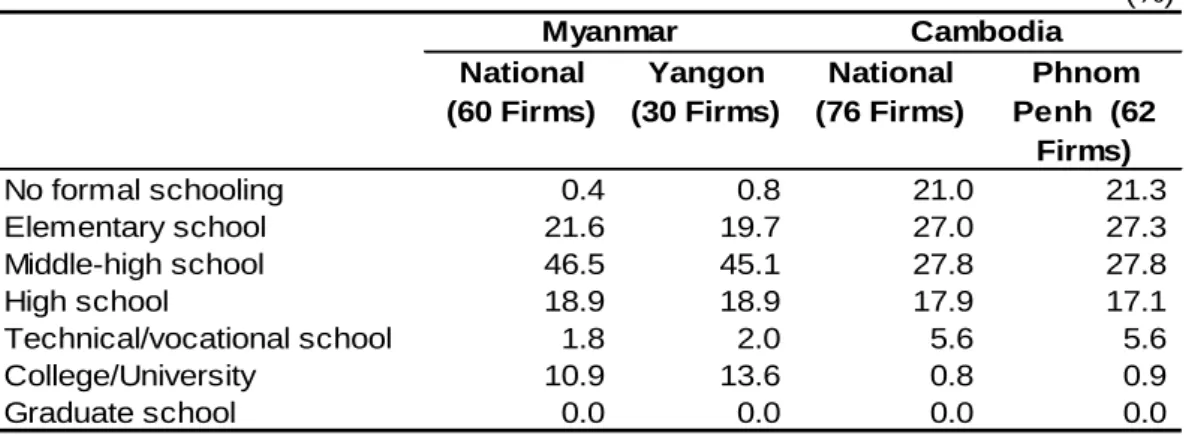
According to the ERIA-CLMV Survey, the educational level of Myanmar’s general workers was significantly higher than that of Cambodia in 2008 (Table 8). Almost all workers in Myanmar had formal schooling, while about 20 per cent of Cambodian workers did not. Nearly half of Myanmar’s workers received a middle school education, but only about 30 per cent of Cambodian workers achieved this level. Finally, about 10 per cent of Myanmar’s workers graduated colleges or universities, while virtually no Cambodian workers received such education. In conclusion, apparel workers in Myanmar have comparable, or better, educational backgrounds as its competitors such as Cambodia, Lao PDR, and Bangladesh.
Table 8 Educational background of workers, 2008
(%) National (60 Firms) Yangon (30 Firms) National (76 Firms) Phnom Penh (62 Firms) No formal schooling 0.4 0.8 21.0 21.3 Elementary school 21.6 19.7 27.0 27.3 Middle-high school 46.5 45.1 27.8 27.8 High school 18.9 18.9 17.9 17.1 Technical/vocational school 1.8 2.0 5.6 5.6 College/University 10.9 13.6 0.8 0.9 Graduate school 0.0 0.0 0.0 0.0
(Source) ERIA-CLMV Survey of 2008.
Myanmar Cambodia
(Note) We asked owners and/or managers of firms to classify their workers’ educational background according to the grades shown in the table. Then, we averaged share of workers in each grade over the sample firms.
4.2.4 Labor Issues
Despite a nation-wide surplus of labor, there has been an occasional shortage of apparel workers in Yangon. Behind this shortage lies stagnant growth in the purchasing power of apparel workers’ wages, as discussed above. Due to increased living costs in Yangon and the slow rise in wages, many apparel workers have difficulty surviving in Yangon, and some go abroad to seek jobs with higher wages. Many apparel workers, particularly experienced ones, appear to have migrated to Mae Sot, a town on the Myanmar–Thailand border, where many apparel factories have congregated (Kudo and Kuroiwa, 2009).
Another challenge is high labor turnover in the apparel industry. The ERIA-CLMV Survey contains questions on subjective evaluation of labor issues. Table 9 shows that high labor turnover ratio is regarded as a more severe problem by 10 apparel firms of the 60 firms interviewed nationwide. Compared to other industries, apparel firms also faced more severe difficulties in recruiting workers.
All these challenges may eventually erode Myanmar’s primary advantage in terms of availability of an abundant, low-wage, and well-educated labor force. Some apparel factories began to relocate to Bago, about 80 km northeast of Yangon, and to Pathein, about 190 km west of Yangon, where worker recruitment was easier and turnover rates lower. The civilian government is also considering permitting the construction of worker dormitories on the factories’ premises. The military government did not allow workers to live in dormitories adjacent to factories, due to fear of labor strikes cum political protests. They also closed all university dormitories for the same reason. With all these efforts, the apparel industry in Myanmar needs to secure workers in a sustainable manner.
Table 9 Average firm rating on labor, 2008 National (60 Firms) Garment (10 Firms) National (76 Firms) Phnom Penh (62 Firms) Quality of workers 3.3 3.2 3.2 3.2
Quality of middle management 3.4 3.6 3.4 3.3
Quality of engineers 3.5 3.6 3.3 3.3
Labor cost 3.1 3.2 3.3 3.3
Ease of recruiting workers 3.5 3.1 3.3 3.2
Labor turnover 3.4 2.7 3.1 3.0
Labor Relations 3.6 3.7 3.1 3.0
Average 3.4 3.3 3.2 3.2
(Notes) Ratings utilize the following scale: 1=very poor, 2=poor, 3=fair, 4=good and 5=excellent. Out of 62 firms in Phnom Penh, 52 deals with garments.
(Source) ERIA-CLMV Survey of 2008.
Myanmar Cambodia
4.3 Electricity and Energy
Although apparel factories in Myanmar can employ relatively low-wage workers, factories must pay more for electricity and diesel than firms in other competitor countries. Electricity in Myanmar is by far the poorest of infrastructural services. According to the aforementioned Garment Survey of 2005, the shortage and unreliability of the electricity supply has been a severe obstacle for apparel production (Kudo, 2010). In the same survey, 69 of 139 respondents answered that they had experienced power interruptions more than three times a day, and these had often lasted more than three hours. Consequently, 134 out of 141 respondents used or shared their own generators.
The electricity supply did not improve much by the end of 2008. In the ERIA-CLMV Survey of 2008, firms were asked to rate infrastructure services using a five-point scale where 1 means “very poor” and 5 means “excellent.” The average rating of electricity in Myanmar was considerably lower than that in Cambodia (Table 10). However, firms in each country answered the questionnaire independently, and may not have known of the situation in other countries. Nevertheless, the average rating of electricity in Myanmar was significantly lower than the average rating of other infrastructure services in the country. Thus, the poor electricity supply can be identified as one of the most serious obstacles for manufacturers in Myanmar.
Table 10 Average firm rating of infrastructure, 2008 National (60 Firms) Yangon (30 Firms) National (76 Firms) Phnom Penh (62 Firms) Electricity 2.2 2.2 3.0 3.0 Water 3.5 3.7 3.3 3.4 Gas/Fuel 3.2 3.5 3.3 3.3 Transportation 3.3 3.2 3.4 3.3 Telecommunication 3.1 2.8 3.4 3.5 Industrial estates 2.9 2.7 3.5 3.5
Accommodation for foreigners 3.3 3.0 3.7 3.7
Average 3.1 3.0 3.4 3.4
(Notes) Ratings utilize the following scale: 1=very poor, 2=poor, 3=fair, 4=good and 5=excellent. (Source) ERIA-CLMV Survey of 2008.
Myanmar Cambodia
One apparel factory interviewed in April 2008 was 100 per cent foreign-owned (Hong Kong) and had 1,050 workers. At that time, total wages were US$40,000 (US$38 per capita) per month, but electricity costs were US$7,000 per month. Diesel for running a generator when the factory had power failures was US$4,000 per month. As a result, expenses for electricity and diesel were about 30 per cent of the labor costs in the factory. The electricity supply of this particular factory was better than that of other private factories because it was located on a plot of land leased from the Ministry of Industry No.1.19 A nearby apparel factory suffered a much more severe shortage of electricity. They experienced a three-hour blackout daily during the rainy season and had only three hours of electricity daily during the dry season.
Another example is a domestic apparel factory in Myanmar with 415 workers. Total wages were US$18,400 (US$44 per capita) per month. Electricity charges were US$960, and the cost for diesel was US$6,100. The sum of these costs was equivalent to 38 per cent of the labor costs. This may represent a more general and prevalent situation than the first case because this factory was located in an industrial zone along with many other similar apparel factories. According to the Garment Survey of 2005, the ratio of electricity and diesel costs to wages was 39 per cent. Thus, expenses for electricity and diesel easily outweigh any reduction in production costs that result from the inexpensive wages paid to Myanmar’s workers.
19
There were two ministries of industry in Myanmar. One was primarily in charge of light industries such as those manufacturing consumer goods. The other was in charge of heavy industries such as those manufacturing capital goods. The two was merged in August 2012, to become Ministry of Industry.
However, there was a sign of improvement in electricity supply in 2010. A follow-up survey of SGIM of 2005 was conducted in 2011, and the author refers to it as the SGIM of 2011. In this survey, we asked the same 59 companies of SGIM of 2005 the same question on the situation of the electricity supply. The summary of answers is shown in Table 11. In SGIM of 2005, 24 companies answered that the electricity supply was a very severe obstacle in the firms’ operations, and 22 companies regarded it as a major obstacle. In SGIM of 2011, the numbers were reduced to three and five, respectively. On the contrary, 36 companies regarded electricity supply either as a minor or no obstacle for their operation. Moreover, there were many projects to increase electricity supply under the Thein Sein administration. International donors started to resume their full-fledged economic assistance, and thus power supply seems to steadily increase in the near future.
Table 11 Apparel firms' assessment of electricity in Yangon, 2010 Very severe obstacle Major obstacle Moderate obstacle Minor obstacle No obstacle Do not know Total
SGIM (2005) for Year 2004 24 22 5 5 3 0 59
SGIM (2011) for Year 2010 3 5 14 24 12 1 59
(Source) SGIM, 2005 and 2011.
(Note) The same fifty-nine apparel firms are respondents for both SGIM 2005 and 2011.
4.4 Logistics and Communication
Once an apparel factory moves to Myanmar, it must pay additional logistics costs. Due to underdevelopment of upstream and supporting industries, apparel factories in Myanmar must generally import all raw materials and auxiliary items with the probable exception of carton boxes and plastic bags. After sewing, all products are exported to overseas markets. International buyers placing orders with apparel factories in Myanmar by CMP arrangements must bear these transportation costs. A negative aspect for them is that transportation fees to ship cargo to and from Yangon are higher than the fees charged at international seaports in neighboring countries.
Table 12 shows freight charges for vessels shipping from the Port of Yangon in Myanmar, Leam Chabang Port in Thailand, and Port of Singapore. Freight charges for outgoing vessels from the Port of Yangon are more expensive than other major ports
such as the Port of Bangkok or Leam Chabang. According to an interview with a manager of a freight forwarder in Yangon20, if an apparel firm in Yangon ships one 20-foot container to Tokyo or Yokohama, it costs US$1,300 and takes about 20 days. By contrast, it costs US$1,340 to transport a 40-foot container from Leam Chabang Port to the Port of Tokyo or Yokohama and takes only eight to nine days. This is due to economies of scale in transportation, and Leam Chabang Port has a much larger number of calling vessels. The World Bank (2009:172) reports that it costs about US$400 to ship a container to the United States from China, about US$800 to ship from India, and US$1,300 to ship from Sierra Leone. China’s enormous trade is a major reason for low transport costs, and these falling transport costs have encouraged countries to move production to China. Leam Chabang Port also provides more reliable transport and handling services than the Port of Yangon.
Table 12 Freight charges for 20-foot containers (US$)
From Yangon Port to From Leam Chabang Port to From Singapore to
Freight Charges Freight Charges 2007 March 2007 September 2008 March 2008 February 2008 February
Singapore 480 265 1050 6 days 450 2 days -
-Bangkok 685 475 1250 14 days 80 0-1day 450 2 days
Port Klang 580 400 1038 5 days 400 3-5 days - 1 day
Jakarta &
Surabaya 800 460 1050 5 days 700 5-8 Days 200 2 days
Yokohama 1340(40 FCL)* 8-9 days 940(40 FCL)* 7 days
Calcutta 925 940 1725 14 days
Qingdao 900 655 1350 10 days
Cebu 1150 800 1300 14 days
(Note) *Freight charges from Leam Chabang/Singapore -Yokohama are for 40-foot containersthat are "full container loaded" (FCL). (Source) Freight charges for vessels departing from Yangon Port are from MIFFA. Freight charges for vessels departing from Leam Chabang Port and Singapore are from JETRO (2008:262-263).
Port of Destination
Freight Charges
Travel Time Travel Time Travel Time
(All vessels go to Japan via Singapore or Port Klang.)
Freight charges for outbound vessels from the Port of Yangon tend to fluctuate widely and a seasonal factor does exist. According to a freight forwarder in Yangon, about two thirds of Myanmar’s exports from the Port of Yangon in 2007 were agricultural produce such as beans, pulses, and rice; most of the remaining exports were apparel. As agricultural produce exports peak between February and May after harvesting, freight
20
charges for outbound vessels tend to increase in this season.
In addition to this seasonal factor, a wide fluctuation of freight charges also results from the small number of calling vessels at the Port of Yangon. The volume of container handling of all ports in Myanmar (including Yangon, Sittway, and Mawlamyine) was only 165,384 TEU21 in FY2005. Leam Chabang Port alone handled 3.76 million TEU containers.22 Only small vessels call at the Port of Yangon and are have been moving their cargo to the Port of Singapore, Port Klang, Port of Bangkok, or Laem Chabang Port. At these ports, shipments are aggregated into much larger and faster ships for longer hauls. There are only five liners at the Port of Yangon. These include Myanmar Five Star (a national flag carrier) and four foreign liners. The capacity of calling vessels is small due to the shallow depth of the river, which is about 400 TEU in the rainy season and 300 TEU in the dry season. It is obvious that apparel firms located in Bangkok and its suburbs have an advantage in logistics over those in Yangon and its suburbs.
Myanmar’s apparel factories can consider utilizing road transport between Yangon, Myanmar and Bangkok, Thailand to reduce transportation time. Table 13 shows a comparison of transport time between road and marine transport from Bangkok and Yangon.23 Road transport could offer advantageous alternative logistics to the marine route in terms of time. It took 68.3 hours for a truck to run from Yangon to Ayutthaya, Thailand via the Myawaddy−Mae Sot Border Gate. On the other hand, marine transport took 21.5 days. This road route is part of East-West Economic Corridor proposed by the Asian Development Bank (ADB). By utilizing road transport, apparel factories in Yangon could shorten not only export time but also import time. If they can import textile and other raw materials from Thailand, they could substantially reduce the production lead-time. This may make it possible for them to produce fashion and seasonal apparel items that require a quick turnaround time.
21 TEU stands for “20-foot equivalent units,” which is the measure of a box 20 feet long
and 8 feet wide with a maximum gross mass of 24 metric tons (WB [2009:178]).
22 The figure for Myanmar comes from the Myanmar Port Authority; the one for Laem
Chabang is from Ootaka (2007:57).
23
Road transportation figures are based on a trial run by a truck arranged by JETRO in November 2012.
Table 13 Comparison between road and marine transport (time)
<Road transport*> (Hrs) <Marine transport> (Days)
Transport time 62.4 Transport time 17.5
Ayutthaya-Mae Sot 10.5 Time on the sea 15
Mae Sot-Yangon 16.1 Ayutthaya-Leam Chabang Port 0.5
Waiting time 35.8 Delivery in Yangon 2
Customs clearance 5.9 Customs clearance 4
Export (Thai side) 0.5 Export (Thai side) 1
Import (Myanmar side) 5.4 Import (Myanmar side) 3
Total 68.3 Total 21.5
(Note) *Time is based on a trial run of a truck for November 14-17, 2012. (Source) JETRO (2013).
However, the road route is not yet available for commercial cargo transportation. The road conditions on some parts of the route are dangerous for large vehicles to traverse. The 38 km road between Kawkareik and Thingan Nyi Naung crosses the Dawna Range, and a hilly section is restricted to one-way traffic, i.e., odd days for ascending vehicles and even days for descending vehicles. In addition, the border crossing through Myawaddy requires tedious and time-consuming negotiations with the Myanmar authorities in advance.
Another obstacle is the high costs associated with road transport. Table 14 shows a comparison between road and marine transport for the same case of a trial run in November 2012. The total costs for road transport were three times higher than those for marine transport. Transport charges for a truck were five times higher than those of marine transport. This is mainly because the truck could not find cargoes for its return. Customs clearance charges at the Myawaddy−Mae Sot Border Gate were also higher than at the Port of Yangon. Transshipment of cargo from a Myanmar truck to a Thai truck is required at the border gate, which cost US$300. Both road infrastructure development and smoother crossings through border gates are necessary to make road transport between Yangon and Bangkok commercially viable.
Table 14 Comparison between road and marine transport (costs)
(US$)
Items Road* Marine
Transport charges 2,000 400
Customs clearance charges 400 160
Import license 200 Documents 250 Transshipment 300 0 Port charges 0 60 Others 300 30 Total 3,300 1,100
(Note) *Costs are based on a trial run of a truck for November 14-17, 2012. (Source) JETRO (2013).
300
Communication services are also poor in Myanmar. Table 15 shows access to mobile phones, telephone lines, and the internet in CLMV, Bangladesh, and China. As of 2011, Myanmar had the lowest values in access to mobile phones and internet. What is worse, perhaps, is that the gap between Myanmar and others grew wider through the first decade of the 21st century, when all countries except Myanmar vigorously invested in their telecommunications infrastructure. Myanmar started substantial investment only after the establishment of the civilian government in 2011.
Table 15 Telecommunication access in 2011
(per 100 people) Myanmar Cambodia Lao PDR Vietnam Bangladesh China
Mobile cellular subscriptions 2.6 96.2 87.2 143.4 56.1 73.2
Telephone lines 1.1 3.7 1.7 11.5 0.6 21.2
Internet users 1.0 3.1 9.0 35.1 5.0 38.3
(Note) Measures are based on 100 people.
(Source) World Bank, World Development Indicators , on-line.
4.5 Preferences to LDCs
Availability of preferential treatment for advanced nations also affects the competitiveness of apparel industries in developing countries. Special and preferential treatment of exports from least developed countries (LDCs) makes a difference in success. For example, the African Growth and Opportunity Act (AGOA) offers preferential access to the United States markets for imports from Sub-Saharan African
countries and helps to create urban-based manufacturing employment in beneficiary countries (Sachs, 2005:195).
In principle, LDCs are entitled to entertain preferential treatments given by importing countries. As an LDC, Myanmar shall be eligible for those preferences. However, since 1997, Myanmar’s exports have been deprived the status that could be enjoyed under the EU’s GSP. Furthermore, from 2003 to 2012, the United States banned all imports from Myanmar. With the political and economic reforms of the Thein Sein administration, Myanmar is now enjoying preferential treatment. The EU decided to provide Myanmar with the Everything But Arms (EBA) treatment from July 2013 (EC, 2013). The US lifted its import ban of made-in-Myanmar products except some designated items such as jade and gems in November 2012.
Myanmar’s apparel exports have long enjoyed tariff exemptions from Japan. Japan offers a scheme of special preferential treatment for LDCs, and never deprived Myanmar of such a status even under the military regime. While China and Vietnam have to bear a 7.4 to 10.0 per cent tariff on woven shirts and blouses for example, Myanmar, along with other LDCs, does not have to pay such tariffs as long as it meets the rules of origin. The tariff exemption has thus far promoted apparel exports from Myanmar to Japan.
Nevertheless, many competitors other than LDCs have recently enjoyed preferential trade arrangement with proliferating free trade agreements (FTAs). The Japan–Vietnam Economic Partnership Agreement (JVEPA) came into effect in October 2009, and preferential treatment is accorded to its apparel exports to Japan provided their products meet the rules of origin. The ASEAN–Japan Comprehensive Economic Partnership (AJCEP) was also signed between Japan and ASEAN members, and the latter can enjoy preferential treatment for their apparel exports to Japan provided their products meet the rules of origin. Thus, preferential treatment given to LDCs is gradually becoming ineffective in terms of promotion of apparel exports to Japan. Myanmar needs to compete with other apparel producing countries on a level playing field.
4.6 Advantages and Disadvantages
The main location advantages of Myanmar include the availability of abundant, low-wage, and relatively well-educated labor, and preferential treatment for LDCs. The
main location disadvantages of Myanmar include shortage of electricity and expensive energy costs, costly and inefficient logistics, and poor communication services. Although we have not discussed this factor in detail, cumbersome and time-consuming administrative procedures are also identified as business obstacles in Myanmar. Thus, there are both advantages and disadvantages for apparel firms in Myanmar. Firms decide whether to locate in Myanmar based on a calculation of costs and benefits.
The simple way to attract more apparel firms to Myanmar is to enhance the location’s advantages and reduce its disadvantages for potential investors, be they domestic or foreign. Myanmar’s most important location advantage is the availability of low-wage labor. However, it is difficult for the government to manipulate worker wages by policy intervention. Wages are principally determined by market forces, and the government has little leeway to intervene in labor markets or to change wages. The real exchange rate of the kyat decides the internationally comparable level of wages for workers in Myanmar. Here again, Myanmar’s government is powerless to control the real exchange rate.
However, Myanmar’s government can reduce costs related to infrastructure and administrative services. The government can improve infrastructure services by instituting better public policies and promoting more public investment. The electricity supply should be the first priority. The rehabilitation and improvement of the Port of Yangon is also important for reducing transport costs and times. Transport services tend to enjoy economies of scale, so the government should attract more business establishments and plants, domestic and foreign, to Yangon. As demand for transport services increases, agglomerated firms will enjoy better transport services with cheaper prices and greater frequency. This will enhance the competitiveness of firms located in Yangon and will eventually attract more firms to that area. Thus, a virtuous cycle starts to evolve. The Port of Yangon should consider how to obtain rapid, frequent, cheaper, and more reliable access to the Port of Singapore. This port is a major Asian hub from which Myanmar’s products can be exported to global markets. Providing better feeder services from Yangon to Singapore should take priority.
In a nutshell, low-wage workers alone are not enough to attract apparel firms to Myanmar. Wage differences between apparel workers in Thailand and those in Myanmar are quite big. However, such a gap may be wide enough to attract Myanmar’s workers to Thailand, but not wide enough for Thai apparel firms to relocate to Myanmar. Myanmar’s location advantages derived from labor costs can easily be offset by other disadvantages such as electricity shortages, costly and lengthy logistics, poor
telecommunication services, and administrative red tape (see Figure 4).
Figure 4 Gaps in wages and other costs
(Source) The author.
5 Concluding Remarks
Myanmar is a country that apparently has comparative advantage in labor-intensive industries, including apparel sewing. Nevertheless, Myanmar’s apparel industry failed to grow as a leading industry of the economy, as in Vietnam, Cambodia, and Bangladesh. The growth of Myanmar’s apparel industry had been stunted by the sanctions from the West. On the contrary, the industry successfully increased its exports to Japan and South Korea, which did not impose sanctions on Myanmar even during military rule. The growth of apparel exports to these markets clearly shows Myanmar’s comparative advantage in this industry. Once it is given full access to the world markets, Myanmar’s apparel industry will certainly realize its potential comparative advantage, and such a
China ASEAN4 Myanmar
Wage gap not wide enough for foreign firms to relocate to Myanmar
G ap i n ot he r c os ts w ide e nough to pr eve nt for ei gn fir ms f ro m r elo ca tin g t o M ya nm ar Wages Costs for electricity, logistics, and so forth
Myanmar