INTRODUCTION
Adenosine triphosphate-sensitive potassium (KATP)
channels are widely distributed in various tissues, and respond to changes in the cell metabolism (1). In vascular smooth muscle cells, the opening of KATP
channels causes vasodilation under physiological and pathophysiological conditions (2).
Nicorandil is a KATPchannel opener with
nitrate-like properties used in the management of angina pectoris (3, 4). Furthermore, a recent prospective randomized multicenter study demonstrated that prophylactic administration of nicorandil during operation reduced the frequency of cardiac events in patients undergoing noncardiac surgery (5). How-ever, our previous studies have indicated that in-travenous anesthetics, including ketamine directly inhibited KATPchannel activities (6 - 8). Thus, it is
ORIGINAL
Effects of ketamine on nicorandil induced ATP-sensitive
potassium channel activity in cell line derived from rat
aortic smooth muscle
Takashi Kawano
1, Katsuya Tanaka
1, Yinhua
1, Satoru Eguchi
2, Hiroaki Kawano
1,
Akira Takahashi
3, Yutaka Nakaya
4, and Shuzo Oshita
1 1Department of Anesthesiology,2
Department of Dental Anesthesiology,3
Department of Preventive Environment and Nutrition, and4
Department of Nutrition and Metabolism, Institute of Health Biosciences, the University of Tokushima Graduate School, Tokushima, Japan
Abstract : Purpose : Nicorandil opens adenosine triphosphate-sensitive potassium (KATP)
channels in the cardiovascular system and is being increasingly used for the treatment of angina pectoris. In the present study, we tested whether intravenous anesthetic agent ketamine affected nicorandil-induced native vascular KATPchannel activation. Methods :
We used excised inside-out patch clamp configurations to investigate the direct effects of ketamine racemate and S-(+)-ketamine on the activities of KATPchannels in cultured
rat aortic smooth muscle cells. Furthermore, we also investigated whether intracellular MgADP could modulate ketamine inhibition. Results : Nicorandil significantly activated KATPchannel activity, whereas this channel activity was completely blocked by
glibencla-mide, a specific KATPchannel blocker. Ketamine racemate inhibited the nicorandil induced
KATPchannel activity (IC50=34 1
!
M, n=14), but S-(+)-ketamine was less potent thanketa-mine racemate in blocking nicorandil induced KATPchannel activities (IC50=226 7
!
M,n=10). Application of MgADP to the intracellular side of the channel was able to decrease the inhibitory potency of ketamine racemate on nicorandil induced KATPchannel activities.
Conclusions : Our results indicate that ketamine inhibits nicorandil induced KATP
chan-nel activities in a dose dependent and stereoselective manner. Furthermore, increase of intracellular MgADP attenuates the inhibitory potency of ketamine racemate. J. Med. Invest. 57 : 237-244, August, 2010
Keywords : intravenous anesthetics, ketamine, nicorandil, potassium channel, patch-clamp configuration.
Received for publication February 8, 2010 ; accepted March 24, 2010.
Address correspondence and reprint requests to Katsuya Tanaka, Department of Anaesthesiology, Institute of Health Biosciences, the University of Tokushima Graduate School, Kuramoto, Tokushima 770 - 8504, Japan and Fax : + 81 - 88 - 633 - 7368.
important to understand whether significant interac-tions might occur between nicorandil and intrave-nous anesthetics when both drugs are adminis-trated concurrently.
KATPchannels are regulated by changes in
intra-cellular ATP and ADP concentrations (1). Previous studies on native KATPchannels have suggested that
nicorandil action is also dependent on the presence of MgADP (9, 10). But whether the action of keta-mine on nicorandil induced KATPchannels depends
on the presence of MgADP is currently unknown. In the current study, we used patch clamp tech-niques to examine the electrophysiological effects of ketamine on nicorandil induced KATPchannel
ac-tivity in cultured rat aortic smooth muscle cells. We also determined the effects of intracellular MgADP on ketamine action.
MATERIALS AND METHODS
Cell culture
A continuous line of A10 vascular smooth muscle cells, derived from the thoracic aorta of fetal rats, was obtained from the American Type Culture Collec-tion (ATCC). The cells were cultured in Dulbecco’s modified Eagle’s medium (DMEM) containing 10% fetal bovine serum (Life Technologies, Invitrogen, Carlsbad, CA, USA), 3.7 mg ml-1NaHCO
3, and 100
μg ml-1 gentamycin at 37"$in a humidified
atmos-phere of 95% air and 5% CO2. The medium was
changed initially after 48 h and then every 2-3 days. When the cells had formed a confluent monolayer after 7-9 days, they were rendered quiescent by in-cubation in serum - free medium for 24 h and then harvested by the addition of 0.05% trypsin and 0.1% fetal bovine serum. Cells were used for experiment after 12 passages.
Electrophysiological analysis
Channel currents were recorded with a patch clamp amplifier (CEZ 2200 ; Nihon Kohden, Tokyo, Japan) and stored in a personal computer (Aptiva ; In-ternational Business Machine Corporation, Armonk, NY, USA) with an analogue-to-digital converter (DigiData 1200 ; Axon Instruments, Foster City, CA, USA). pClamp version 7 software (Axon Instru-ments, Foster City, CA, USA) was used for data ac-quisition and analysis.
Electrophysiological measurements
Single channel currents were recorded in the
inside-out configurations using a patch clamp am-plifier as described previously (6-8). The intracel-lular solution contained 140 mM KCl, 2 mM EGTA, 2 mM MgCl2, and 10 mM HEPES (pH=7.3). The
pi-pette solution contained 140 mM KCl, 1 mM CaCl2,
1 mM MgCl2, and 10 mM HEPES (pH=7.4). Patch
pipettes were pulled with an electrode puller (PP-830 ; Narishige, Tokyo, Japan). Recordings were made at 36#0.5"$. The resistance of pipettes filled with internal solution and immersed in Tyrode’s so-lution was 5-7 MΩ. The sampling frequency of the single-channel data was 5 KHz with a low-pass fil-ter (1 KHz). The open probability (Po) was
deter-mined from current amplitude histograms and was calculated as follows : %*= # )"# $ +)$) ! " &'$$
where tjis the time spent at current levels
corre-sponding to j=0, 1, 2, N channels in the open state ; Tdis the duration of the recording ; and N is the
number of the channels active in the patch. Record-ings of 1-2 min were analyzed to determine Po. The channel activity was expressed as NPo. The NPo in the presence of drugs was normalized to the base-line NPo value obtained before drug administration and presented as relative channel activity.
Superfusates were directly applied to cells in the glass-bottom plastic cell bath (2-ml volume) at a rate of 2-2.5 ml/min using a plastic syringe (50-ml volume), vinyl chloride tubing (0.8-mm ID ; 50-cm length), and syringe pump (Terumo STC-525 ; Tokyo, Japan). When the concentration-dependent effects of drugs were studied, the superfusion was stopped for approximately 1 min at each concentra-tion, and these drugs were injected into the cell bath using a glass syringe to five final concentra-tions in a cumulative manner (total volume injected was approximately 10-20μl). Thus, the superfusion was stopped for total of approximately 5 min, and preliminary studies showed that stopping superfu-sion for approximately 5 min had no significant effects on electrophysiological measurements. The drug concentration needed to induce half-maximal inhibition of the channels (IC50) and the Hill
coeffi-cients were calculated as follows : ,= #!!%!&!##
(""
where y is the relative NPo, [D] is the concentration of drug, Kiis the IC50, and H is the Hill coefficient.
Statistics
All data are presented as means!SE. Repeated-measures analysis of variance, followed by the Stu-dent-Newman-Keuls test, was applied to identify significant differences among the effects observed with different concentrations of ketamine racemate or S-(+)-ketamine. Paired statistical comparisons were made using paired t tests. In all comparisons, P!0.05 was considered significant.
Drugs
Ketamine racemate, S-(+)-ketamine, glibencla-mide, and nicorandil were obtained from Sigma-Aldrich Japan (Tokyo, Japan). Glibenclamide and nicorandil were dissolved in dimethylsulfoxide
(DMSO, the final concentration of solvent in the cell bath was 0.01%). Preliminary studies showed that 0.02% of DMSO, a 2-fold higher concentration than used in the present study, had no significant effects on cultured rat aortic smooth muscle KATP
channel currents.
RESULTS
Nicorandil induced KATPchannel activities in A10 cell derived from rat aortic smooth muscle
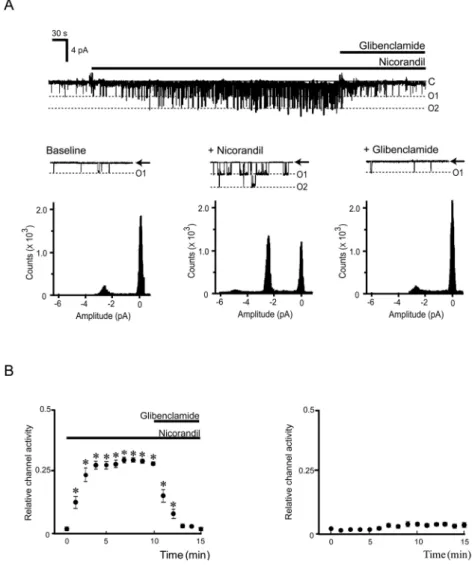
The effects of nicorandil on KATPchannel in
in-side-out patch clamp configuration were recorded (Figure 1A). Single channel activities were observed infrequently before treatment of nicorandil (NPo!
Figure 1. Shingle - channel characteristics of adenosine triphosphate - sensitive potassium channels in inside - out patch clamp configu-ration. (A) Representative traces of channel currents recorded from A10 cells are shown. Membrane potentials were clamped at - 60 mV. Nicorandil (100μM) and glibenclamide (0.5 μM) were added to the intracellular solution as indicated by the horizontal bar. C, closed channel level ; O1 and O2, open channel levels with one or two channels open simultaneously, respectively. Amplitude histo-grams were plotted by binning the data from the original recordings. The relative peaks of the histogram indicate the periods the channel resides in each conductance level. (B) The relationship between NPo and time after application of nicorandil (100μM, left panel) and no application of nicorandil (time control, right panel). Each vertical bar represents measurements from 12 patches (mean!SE). * p!0.05 versus baseline.
0.001, n=10). Application of 100μM nicorandil to the bath solution (intracellular side) significantly acti-vated K+-selective channel activities. These channel
activities were completely blocked by 0.5μM gliben-clamide, a specific KATPchannel inhibitor (Figure 1A,
n=10), suggesting that the activity is indeed due to KATPchannel currents. Figure 1B shows the
relation-ship between nicorandil-induced NPo values and time for the traces. Approximately 4-5 min after ap-plication of 100μM nicorandil, NPo reached steady-state (0.26!0.02, n=10). Identical control experi-ments in the absence of nicorandil resulted in no KATPchannel activation or inhibition during the same
time periods (Figure 1B, n=5). In addition, the sin-gle channel conductance was 29.4!1.2 pS (Figure 2, n=17), as measured by the current-voltage relation-ship between -80 and +60 mV membrane potential under conditions of symmetrical 145 mM K+.
Effects of ketamine racemate on nicorandil induced KATPchannel activities
To assess the effects of ketamine on nicorandil induced KATPchannel activities in the absence of
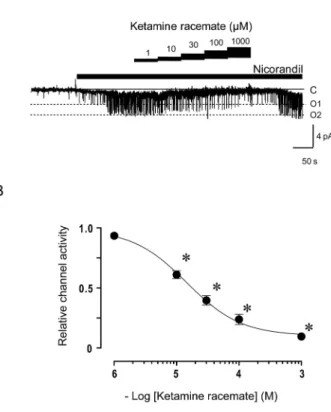
in-tracellular ADP, we measured single channel cur-rents on inside-out patches in the presence of keta-mine racemate. Application of 1-1000μM ketamine racemate to the intracellular membrane surface in-hibited the nicorandil induced KATPchannel currents
in a dose dependent-manner. As indicated in Figure 3A the inhibitory effects of ketamine racemate on
KATPchannel activities were readily reversible.
The dose-dependent effects of ketamine racemate on nicorandil induced KATPchannel activities in the
absence of intracellular ADP are shown in Figure 3B. The IC50and Hill coefficient (h) of ketamine
racemate for the KATPchannels are 34!1 μM and
0.93 (n=14), respectively. The average percent re-covery of KATPchannel activities after washout of
ketamine racemate was 92!2% of the NPo meas-ured before drug treatment.
Effects of S-(+)-ketamine on nicorandil induced KATPchannel activities
In contrast to ketamine racemate, S-(+)-ketamine at 1-30μM did not significantly inhibit nicorandil induced KATPchannel currents (Figure 4A, n=11),
indicating that the inhibitory effect of ketamine on
Figure 2. The current- voltage relationship for adenosine triphosphate - sensitive potassium channel currents. Each verti-cal bar represents measurements from 17 patches (mean!SE).
Figure 3. Effects of ketamine racemate on nicorandil induced adenosine triphosphate - sensitive potassium channel currents in the inside - out patch clamp configuration. (A) Representative ex-ample of nicorandil induced channel currents obtained before and after the application of ketamine racemate (1 - 1000μM) is shown. Nicorandil (100μM) and ketamine racemate were added to the intracellular solution as indicated by the horizontal bar. C, closed channel level ; O1 and O2, open channel levels with one or two channels open simultaneously, respectively. (B) Dose -dependent effects of ketamine racemate on the nicorandil induced channel activities. Each vertical bar constitutes measurements from 14 patches (mean!SE). *p!0.05 versus baseline.
nicorandil induced KATPchannel activities may be
stereoselective.
The dose-dependent effects of S-(+)-ketamine on nicorandil induced KATPchannel activities in the
ab-sence of intracellular ADP are shown in Figure 4B. The IC50and Hill coefficient (h) of S-(+)-ketamine
for the nicorandil induced KATPchannels are 226!7
μM and 1.01 (n=10), respectively. The average per-cent recovery of KATPchannel activities after
wash-out of S-(+)-ketamine was 94!3% of the NPo meas-ured before drug treatment.
Effects of ketamine racemate on nicorandil induced KATPchannel activities in the presence of intracel-lular ADP
Recent studies have demonstrated that the ef-fects of KATPchannel agonists (9, 10) and ketamine
racemate (8) on KATPchannels are modified by
in-teraction of MgADP with sulphonylurea receptors (SURs). Therefore, we next examined whether the inhibitory effects of ketamine racemate on nicorandil induced KATPchannel currents in rat aortic smooth
muscle cells are affected by the presence of intra-cellular MgADP.
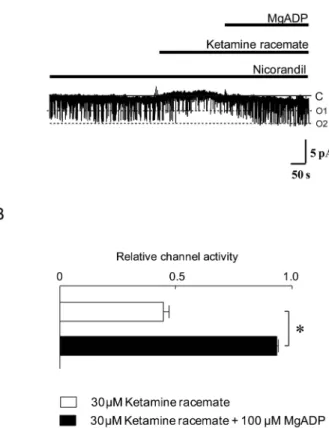
Figure 5A and 5B shows the effects of 30 μM ketamine racemate on nicorandil induced KATP
chan-nel activities in the absence or presence of a physi-ological concentration of MgADP (100μM). Appli-cation of MgADP to the intracellular side of the channels significantly reduced the ketamine race-mate inhibition of nicorandil induced KATPchannel
activities. In addition, the inhibitory potency of keta-mine racemate on nicorandil induced KATPchannel
Figure 4. Effects of S - ( + ) - ketamine on nicorandil induced adenosine triphosphate - sensitive potassium channel currents in the inside - out patch clamp configuration. (A) A representative example of nicorandil induced channel currents obtained before and after the application of S - ( + ) - ketamine (1 - 1000μM) is shown. Nicorandil (100μM) and S-(+)-ketamine were added to the intracellular solution as indicated by the horizontal bar. C, closed channel level ; O1 and O2, open channel levels with one or two channels open simultaneously, respectively. (B) Dose -dependent effects of S - ( + ) - ketamine on the nicorandil induced channel activities. Each vertical bar constitutes measurements from 14 patches (mean!SE). *p!0.05 versus baseline.
Figure 5. Effects of ketamine racemate and MgADP on nicoran-dil induced adenosine triphosphate - sensitive potassium channels in the excised inside - out configuration. (A) Representative ex-ample of nicorandil induced channel currents in the absence or presence of ketamine racemate and MgADP is shown. Nicoran-dil (100μM), ketamine racemate (30 μM) and MgADP (100 μM) were added to the intracellular solution as indicated by horizontal bars. C, closed channel level ; O1 and O2, open channel levels with one or two channels open simultaneously, respectively. (B) The relative channel activities in the presence of ketamine racemate without MgADP (open columns) or with MgADP (closed columns). The horizontal bars indicate the mean!SE (n = 12), respectively. *p!0.05 versus without MgADP value.
activities was attenuated in the presence of intcellular MgADP (Figure 6A and 6B) ; ketamine ra-cemate significantly inhibited nicorandil induced KATPchannel activities only at the highest
concen-tration (1000μM, n=8, p!0.05 vs. baseline).
DISCUSSION
In the present study, we recorded single KATP
channel currents using an inside-out patch clamp configuration and demonstrated that ketamine ra-cemate and S-(+)-ketamine inhibited these channel activities induced by nicorandil in a concentration-dependent manner. Furthermore, the inhibitory ef-fects of ketamine racemate had approximately 7-fold higher potency than those of S-(+)-ketamine. Since ketamine racemate is a mixture of S-(+) and
R-(-)-ketamine stereoisomers, this observation would suggest that block of KATPchannels by
keta-mine enantiomers may be at least partly stereose-lective. Our results also demonstrated that intracellu-lar MgADP restored the inhibitory action of keta-mine racemate on nicorandil induced KATPchannel
activities.
KATPchannels, which are widely distributed in
many tissues, respond to alterations in the metabolic activity of the cell and thereby act as sensors of glu-cose and oxygen availability (1, 11). In the cardio-vascular system, the sarcolemmal KATPchannels are
present both in cardiomyocytes and vascular smooth muscle cells (1). Recent physiological studies on mice lacking different KATP channel subunits have
begun to clarify the roles of cardiac and vascular KATPchannels in cardiovascular pathophysiology.
Cardiac KATPchannel (Kir6.2- / -)-deficient mice had
a number of cardiac abnormalities during myocar-dial ischemia or severe stress, including impaired ischemic preconditioning and attenuated electro-cardiographic ST changes (12). Impaired vascular smooth muscle function was a feature of Kir6.1-deficient and SUR2-Kir6.1-deficient mice and manifested as episodic coronary artery vasospasm and a high rate of sudden death (13, 14). Nicorandil is a po-tent cardiac and vascular KATPchannel opener (9).
In clinical practice, therefore, this drug is widely used in the treatment of ischemic heart disease (4). A recent study further suggested that prophylactic administration of nicorandil proved useful in the pe-rioperative prevention of cardiac complications (5).
Our previous study demonstrated that ketamine racemate directly inhibited sarcolemmal KATP
chan-nels that formed by subunits expressed in COS-7 cells (8). The present study indicates that ketamine racemate also inhibits nicorandil induced KATP
chan-nel activities in native vascular smooth muscle cells (VSMCs). During surgical anaesthesia, clinical plasma concentrations for ketamine racemate are 20-50μM, with approximately 12% of the drug be-ing bound to plasma proteins (15). In current study, the threshold concentrations of ketamine racemate which inhibits nicorandil induced KATPchannel
ac-tivities ("10μM) are within this range, but the con-centrations of S-(+)-ketamine required for inhibi-tion were very high ("100μM). It is likely, there-fore, that ketamine racemate inhibits KATPchannel
activities induced by nicorandil at clinically relevant concentrations. These results suggested that keta-mine racemate could impair nicorandil induced phar-macological organ-protection against intraoperative
Figure 6. Effects of ketamine racemate on nicorandil induced adenosine triphosphate - sensitive potassium channels in the ex-cised inside - out configuration under intracellular MgADP con-taining condition. (A) Representative example of nicorandil and MgADP induced channel currents before and after the applica-tion of ketamine racemate is shown. Nicorandil (100μM) with MgADP (100μM) and ketamine racemate (1-1000 μM) were added to the intracellular solution as indicated by horizontal bars. C, closed channel level ; O1 and O2, open channel levels with one or two channels open simultaneously, respectively. (B) Dose -dependent effects of ketamine racemate on the nicorandil induced channel activities in the presence of MgADP. Each vertical bar constitutes measurements from 8 patches (mean!SE). *p!0.05 versus baseline.
ischemic or hypoxic injury mediated by KATP
chan-nels. Indeed, racemic ketamine, but not the S-(+)-ketamine stereoisomer, was found to block early and late preconditioning in rabbit hearts (16, 17) and inhibit vasorelaxation induced by a KATP
chan-nel opener, levocromakalim (18).
A previous study reported that acute ischemic pre-conditioning in the rabbit heart is observed with nicorandil treatment prior to ischemia, but not after myocardial ischemia (19). These results indicate that activation of KATPchannels during metabolic
stress is essential for pharmacological organ pro-tective effects of nicorandil.
During metabolic stress such as hypoxia or ische-mia, the concentration of intracellular ADP rises while the levels of intracellular ATP drop. Similar to intracellular ATP, other magnesium nucleotides can modulate KATPchannel activity, with the most
dramatic effects being caused by MgADP, which antagonizes the inhibitory effects of ATP (1, 9). Our recent electrophysiological results suggested that application of intracellular MgADP enhances the in-hibitory effects of ketamine racemate on the activity of reconstituted KATPchannels expressed in COS-7
cells (8). We therefore hypothesised that intracel-lular MgADP also may enhance the inhibitory ef-fects of ketamine racemate on nicorandil induced KATPchannel activities. Surprisingly, our results
dem-onstrated that the inhibitory effect of ketamine ra-cemate at a clinically relevant concentration (30μM) on nicorandil induced KATPchannel activities was
almost completely abolished by application of intra-cellular MgADP. These data suggest that the thera-peutic effectiveness of nicorandil might not be im-paired by ketamine racemate under metabolic stress conditions. The exact mechanisms of these effects have not been clearly identified. A recent study, however, indicated that metabolic inhibition signifi-cantly increased the potency of nicorandil on pig coronary artery relaxation (20). These results sug-gest that MgADP may enhance nicorandil induced KATPchannel activities. Thus, our results suggest
that the MgADP enhancement of KATPchannel
ac-tivation of nicorandil could mask the inhibitory ef-fects of ketamine racemate.
The inherent limitations of this study model must be addressed. First, the concentration of nicorandil we used in the current study (100 μM) should be much higher than the clinically relevant concentra-tions (approximately 1μM) (21). Therefore, it may be difficult to directly extrapolate our results to in
vivo conditions. Second, we performed patch clamp
experiments in cultured, not freshly isolated, VSMCs to avoid using damaged cells. Although cultured cells may undergo a variety of phenotypic changes, the functions of vascular KATPchannels (e.g.
sensi-tivity of KATPchannel modulators and single channel
conductance) were consistent with those of KATP
channels previously recorded in freshly isolated VSMCs (22).
In conclusion, our results demonstrated that keta-mine inhibits nicorandil induced vascular KATP
chan-nels activity in a dose-dependent and stereoselec-tive manner. However, our results further indicated that increase of intracellular MgADP markedly at-tenuated the inhibitory effect of ketamine. These results suggested the possibility that ketamine might not impair the beneficial vasodilative effects of ni-corandil as a KATPchannel opener under conditions
of metabolic inhibition.
ACKNOWLEDGMENT
This study was supported in part by Grant-in-Aid for Young Scientists (B) (No. 19791067) from the Ministry of Education, Culture, Sports, Science and Technology, Japan
REFERENCES
1. Yokoshiki H, Sunagawa M, Seki T, Sperelakis N : ATP-sensitive K+channels in pancreatic,
cardiac, and vascular smooth muscle cells. Am J Physiol 274 : C25-37, 1998
2. Brayden JE : Functional roles of KATPchannels
in vascular smooth muscle. Clin Exp Pharma-col Physiol 29 : 312-6, 2002
3. Taira N : Nicorandil as a hybrid between ni-trates and potassium channel activators. Am J Cardiol 63 : 18J-24J, 1989
4. IONA Study group : Effect of nicorandil on coronary events in patients with stable angina : the Impact of Nicorandil in Angina (IONA) randomised trial. Lancet 359 : 1269-75, 2002 5. Kashimoto S, Seki M, Ishiguro T, Yoshioka H,
Nagata O, Nishimura K, Kikuchi T, Yamada T, Iwade M, Omi A, Honda O, Sakamoto A, Ogihara Y, Fujimoto K, Nakaigawa Y, Kato J, Watanabe A, Nomura M, Takeda J : Nicorandil decreases cardiac events during and after non-cardiac surgery. J Clin Anesth 19 : 44-8, 2007 6. Kawano T, Oshita S, Takahashi A, Tsutsumi Y,
Tomiyama Y, Kitahata H, Kuroda Y, Nakaya Y : Molecular mechanisms of the inhibitory ef-fects of propofol and thiamylal on sarcolemmal adenosine triphosphate-sensitive potassium channels. Anesthesiology 100 : 338-46, 2004 7. Kawano T, Oshita S, Takahashi A, Tsutsumi Y,
Tomiyama Y, Kitahata H, Kuroda Y, Nakaya Y : Molecular mechanisms of the inhibitory effects of bupivacaine, levobupivacaine, and ropiva-caine on sarcolemmal adenosine triphosphate-sensitive potassium channels in the cardiovas-cular system. Anesthesiology 101 : 390-8, 2004 8. Kawano T, Oshita S, Takahashi A, Tsutsumi Y, Tanaka K, Tomiyama Y, Kitahata H, Nakaya Y : Molecular mechanisms underlying ketamine-mediated inhibition of sarcolemmal adenosine triphosphate-sensitive potassium channels. An-esthesiology 102 : 93-101, 2005
9. Fujita A, Kurachi Y : Molecular aspects of ATP-sensitive K+channels in the cardiovascular
sys-tem and K+channel openers. Pharmacol Ther
85 : 39-53, 2000
10. Shen WK, Tung RT, Machulda MM, Kurachi Y : Essential role of nucleotide diphosphates in nicorandil-mediated activation of cardiac ATP-sensitive K+channel. A comparison with
pinacidil and lemakalim. Circ Res 69 : 1152-8, 1991
11. Noma A : ATP-regulated K+channels in cardiac
muscle. Nature 305 : 147-148, 1983
12. Suzuki M, Sasaki N, Miki T, Sakamoto N, Ohmoto-Sekine Y, Tamagawa M, Seino S, Marbán E, Nakaya H : Role of sarcolemmal KATPchannels in cardioprotection against
ische-mia/reperfusion injury in mice. J Clin Invest 109 : 509-16, 2002
13. Miki T, Suzuki M, Shibasaki T, Uemura H, Sato T, Yamaguchi K, Koseki H, Iwanaga T, Nakaya H, Seino S : Mouse model of Prinzmetal angina by disruption of the inward rectifier Kir6.1. Nat Med 8 : 466-72, 2002
14. Chutkow WA, Pu J, Wheeler MT, Wada T, Makielski JC, Burant CF, McNally EM : Epi-sodic coronary artery vasospasm and hyperten-sion develop in the absence of Sur2 KATP
chan-nels. J Clin Invest 110 : 203-8, 2002
15. Reich DL, Silvay G : Ketamine : An update on the first twenty-five years of clinical experience. Can J Anaesth 36 : 186-97, 1989
16. Müllenheim J, Frässdorf J, Preckel B, Thämer V, Schlack W : Ketamine, but not S(+)-keta-mine, blocks ischemic preconditioning in rab-bit hearts in vivo. Anesthesiology 94 : 630-6, 2001
17. Müllenheim J, Rulands R, Wietschorke T, Frässdorf J, Preckel B, Schlack W : Late pre-conditioning is blocked by racemic ketamine, but not by S(+)-ketamine. Anesth Analg 93 : 265-70, 2001
18. Dojo M, Kinoshita H, Iranami H, Nakahata K, Kimoto Y, Hatano Y : Ketamine stereoselec-tively affects vasorelaxation mediated by ATP-sensitive K+channels in the rat aorta.
Anesthe-siology 97 : 882-6, 2002
19. Imagawa J, Baxter GF, Yellon DM : Myocardial protection afforded by nicorandil and ischaemic preconditioning in a rabbit infarct model in vivo. J Cardiovasc Pharmacol 31 : 74-9, 1998 20. Davie CS, Standen NB : Enhancement of the
vasorelaxant potency of nicorandil by metabolic inhibition and adenosine in the pig coronary artery. Cardiovasc Res 37 : 791-8, 1998 21. Kaneko T, Saito Y, Hikawa Y, Yasuda K,
Makita K : Dose-dependent prophylactic effect of nicorandil, an ATP-sensitive potassium chan-nel opener, on intra-operative myocardial is-chaemia in patients undergoing major abdomi-nal surgery. Br J Anaesth 86 : 332-7, 2001 22. Quayle JM, Nelson MT, Standen NB :
ATP-sensitive and inwardly rectifying potassium channels in smooth muscle. Physio Rev 77 : 1165-232, 1997