Unknotting tunnels and canonical decompositions of punctured torus bundles over a circle
阪大・理
作間誠
(Makoto SAKUMA)Let $M$ be a compact orientable 3-manifold whose boundary is a torus. An unknotting
tunnel for $M$ is a properly embedded arc $\tau$ in $M$ such that $cl(M-N(\mathcal{T}))$ is a handlebody
(of genus 2). In [SW] it is observed through computer experiments that the unknotting
tunnels for $M$ seem to have nice geometric features when $M$ is hyperbolic. In fact, it is
conjectured that any unknotting tunnel for a hyperbolic knot complement is isotopic to
an edge of its canonical decomposition. (See [A] forrelated theoretical study, and see $[\mathrm{E}\mathrm{P}$,
$\mathrm{W}]$ for the definition of the canonical decomposition.)
One purpose of this note is to point out that the conjecture holds for punctured torus bundles over $S^{1}$ if we assume “a result of $\mathrm{J}\phi \mathrm{r}\mathrm{g}\mathrm{e}\mathrm{n}\mathrm{s}\mathrm{e}\mathrm{n}$
” [Jr]. In fact, we show that any
unknotting tunnel of such a manifold is isotopic to an edge of the topological ideal de-composition of $M$ explained by [FH]. The term “a result of $\mathrm{J}\phi \mathrm{r}\mathrm{g}\mathrm{e}\mathrm{n}\mathrm{s}\mathrm{e}\mathrm{n}$” means that the
decompositionof$M$ in [FH] is the canonical decomposition. Further, we report that
exper-imentsusing Snappea show that any unknotting tunnel of such a manifold is isotopic to the “shortest vertical arc”. However, as is complained in [B2], there is no proof of the “result of$\mathrm{J}\phi \mathrm{r}\mathrm{g}\mathrm{e}\mathrm{n}\mathrm{s}\mathrm{e}\mathrm{n}$
” written down; there is no proof even of the “fact” that the decompositions
are genuine geometric ideal decompositions.
The other purpose of this note is to record the current state of my understanding of
$\mathrm{J}\phi \mathrm{r}\mathrm{g}\mathrm{e}\mathrm{n}\mathrm{S}\mathrm{e}\mathrm{n}’ \mathrm{s}$ result (for more detailed record, please see [S]). However, I must confess that
it is far from satisfactory, and I ask the readers to let me know any suggestions concerning
the note.
After having obtained the topological results in Part 1, I learned that they are already obtained by Klaus Johannson [Jh] and Tsuyoshi Kobayashi [K]. I would like to thank themfor teaching me their results. Concerning Part II of this note, though it is far from complete by the lack of my ability, I would like to thank many mathematicians for their kind support. Troels $\mathrm{J}\phi \mathrm{r}\mathrm{g}\mathrm{e}\mathrm{n}\mathrm{s}\mathrm{e}\mathrm{n}$ kindly explained his result to me in a day in 1992. Colin
Adams and Alan Reid sent me copies of$\mathrm{J}\phi \mathrm{r}\mathrm{g}\mathrm{e}\mathrm{n}\mathrm{S}\mathrm{e}\mathrm{n}’ \mathrm{s}$ unfinished paper on my request. Hyam
Rubinstein and Iain Aitchison gave me a chance to stay at the University of Melbourne during the summer ($=\mathrm{t}\mathrm{h}\mathrm{e}$ winter in Australia) in 1995, where I devoted to the project to
understand$\mathrm{J}\phi \mathrm{r}\mathrm{g}\mathrm{e}\mathrm{n}\mathrm{s}\mathrm{e}\mathrm{n}’ \mathrm{s}$ paper. Iain Aitchison and Craig Hodgson kindly shared muchtime
for the project and offered me valuable suggestions and warm encouragement. Sadayoshi Kojima, Ken’ichi Ohsika, Yoshihide Okumura, and Masahiko Taniguchi kindly listened to
my unsatisfactory talk and gave me valuable suggestions and informations. I. TOPOLOGICAL CLASSIFICATION OF THE UNKNOTTING TUNNELS FOR PUNCTURED TORUS BUNDLES OVER A CIRCLE
Let $T$be a punctured torus. For an orientation-preserving self-homeomorphism $\phi$on $T$,
MAKOTO SAKUMA
Theorem 1. [Johannson, Kobayashi] Let $\alpha$ bea properly embedded arc in $M_{\phi}$
.
Then$\alpha$ is an unknotting $t$unnel for $M\psi$ if and only if$\alpha l\mathrm{i}$es on a fiber $T$ after an isotopy and
satislies $\alpha\cap\phi(\alpha)=\emptyset$
.
Theorem 2. [Johannson] (1) Suppose $\phi$ is ellipti$c$, i.e., $|tr(\phi)|<2$
.
Then $M_{\phi}$ admits aunique unknotting $t$unnel up to isotopy.
(2) $\mathit{3}\mathrm{u}pp_{\mathrm{o}s}\mathrm{e}\phi$ is parabolic, $i.e.,$ $|tr(\phi)|=2$. Then $M_{\phi}$ admits an unknotting $t$unnel if and only if$\phi$ or $\phi^{-1}$ is conjugate
$to\pm$
. In this $c$as$e$, there is only one unknotting$t$unnel for$M_{\phi}$ up to isotopy.
(3) $A\mathrm{S}S$ume that $\phi$is hyperbolic, $i.\mathrm{e}.,$ $|tr(\phi)|>2$
.
Then $M_{\phi}$ admits anunknotting$t$unnel ifand only if$\phi$ or $\phi^{-1}$ is conjugate$to\pm$
for some positive integer$n$
.
In this case, the $\mathrm{n}\mathrm{u}\mathrm{m}be\mathrm{r}$ of the unknotting $t$unnels for $M_{\phi}$ up to isotopy is equal to 2 or 1 according as $n=1$ or $n>1$
.
Remark 3. In Theorem 2 (3), we can easily see that each of the unknotting tunnel is an edge of the topological ideal decomposition of $M_{\phi}$ explained in [FH].
The characterization of punctured torus bundles follows from the result of Ochiai and Takahashi [OT] which determines the Heegaard genera of closed torus bundles over $S^{1}$
.
Since Theorem 1 and its generalization to arbitral punctured surface bundles are already
obtained by $\mathrm{K}$ Johannson and T. Kobayashi, we give only the proof ofTheorem 2 (3) by
using Theorem 1.
To do this, we identify the set $V$of the isotopy classes of essential arcs in$T$with$\mathbb{Q}\cup\{\infty\}$
.
The latter set is embedded in the ideal boundary $\partial \mathbb{H}^{2}$
of the hyperbolic plane $\mathbb{H}^{2}$
.
Let $D$be the diagram of$SL(2, \mathbb{Z})$, i.e., the tessellation of$\mathbb{H}^{2}$
by ideal triangles with vertices in $V$
such that the ideal simplex spanned by three points in $V$ belongs to $D$ if and only if the
corresponding three arcs on $T$ are mutually disjoint. Then $\phi$ induces an isometry of $\mathbb{H}^{2}$
respecting $D$, which we denote by $\phi_{*}$. An element $\alpha$ of $V$ satisfies $\alpha\cap\phi(\alpha)=\emptyset$ as arcs in
$T$ if and only if the hyperbolic line
$\mu$ spanned by the ideal vertices $\alpha$ and $\phi_{*}(\alpha)$ belongs to $D$. Suppose this condition is satisfied and suppose $\phi$is hyperbolic. Then $\phi_{*}$ is a hyperbolic
translation along a line, say $\lambda$. Let $f$-and $f_{+}$ be the repelling and the attractive fixed
points of$\phi_{*}$. Then these points do not lie in $V$, and $\lambda$ is a linejoining them. Let
$I_{1}$ be the closure of component of$\partial \mathbb{H}^{2}-\{f_{-}, f_{+}\}$ containing the point $\alpha$, and let $I_{2}$ be the closure of the remaining component. For two points $x$ and $y$ in int$(I_{1})$, we denote $x<y$ if $f_{-},$ $x$,
$y$, and $f_{2}$ lies in $I_{1}$ in this order. It should be noted that the relation $\alpha<\phi_{*}(\alpha)<\phi_{*}^{2}(\alpha)$
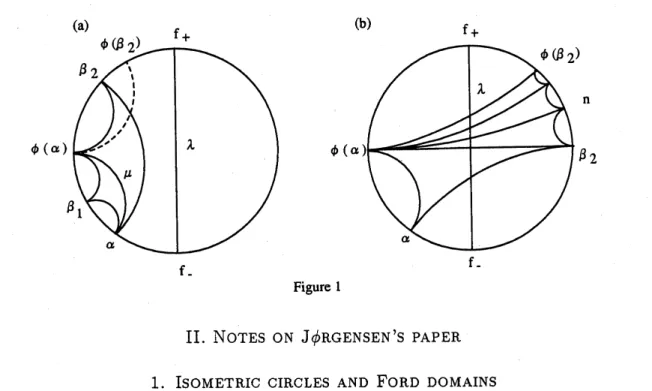
holds. Let $\sigma_{i}(i=1,2)$ be the ideal simplices in $D$ having $\mu$ as an edge, and let $\beta_{i}(\in V)$ be the remaining vertex of $\sigma_{i}$. We may assume $\beta_{1}$ lies “between” $\alpha$ and $\phi_{*}(\alpha)$. Let $\mu_{2}$ be the edge of $\sigma_{2}$ with endpoints $\alpha$ and $\beta_{2}$.
Lemm 3. $\beta_{2}li$es in $I_{2}$ and hence
$\mu_{2}$ intersects
$\lambda$.
Proof.
Suppose $\beta_{2}$ lies in $I_{1}$. Then we have $\alpha<\beta_{1}<\phi_{*}(\alpha)<\beta_{2}<\phi_{*}(\beta_{2})$, and hence$\phi_{*}(\mu_{2})$ intersect the interior of $\sigma_{2}$ (see Figure 1 $(\mathrm{a})$), a contradiction.
Figure 1 $(\mathrm{b}))$. Then we can see that $\phi^{-1}$ is conjugate $\mathrm{t}\mathrm{o}\pm$. If $n>1$, then for an element $\gamma$ of $V$ the line joining $\gamma$ and $\phi_{*}(\gamma)$ belongs to $D$ if and only if $\gamma$ is
the image of$\alpha$ by a power of $\phi_{*}$. On the other hand, if$n=1$, then the above condition is
satisfied ifand only if$\gamma$ is the image of $\alpha$ or $\beta_{2}$ by a power of $\phi_{*}$. Thus the number of the
unknotting tunnels for $M_{\phi}$ is two or one according as $n=1$ or $n>1$.
(b) $\mathrm{f}_{-}$
.
$\mathrm{t}_{-}$
Figure 1
II. NOTES ON $\mathrm{J}\phi \mathrm{R}\mathrm{G}\mathrm{E}\mathrm{N}\mathrm{S}\mathrm{E}\mathrm{N}’ \mathrm{S}$ PAPER
1. ISOMETRIC CIRCLES AND FORD DOMAINS
Let $A$ be aM\"obius transformation $A(z)=(az+b)/(cz+d)$ , where ad-bc $=1$
.
Suppose$A(\infty)\neq\infty$, then the isometric circle $I(A)$ of$A$ is defined by
$I(A)=\{z\in \mathbb{C}||A’(_{Z)}|=1\}=\{z\in \mathbb{C}||CZ+d|=1\}$
.
$I(A)$ is a circle in $\mathbb{C}$ with center $-d/c=A^{-1}(\infty)=\mathrm{p}\mathrm{o}\mathrm{l}\mathrm{e}(A)$ and radius $1/|c|.$ $A$ sends
$I(A)$ to $I(A^{-1})$, which has the center $\mathrm{p}_{\mathrm{o}1}\mathrm{e}(A^{-1})=a/c$and the radius $1/|c|$. It should be
noted that
(1.1) pole$(A^{-1})-\mathrm{P}\mathrm{o}\mathrm{l}\mathrm{e}(A)=(a+d)/c=\tau(A)/c$
where $\tau(A)$ is the trace of$A$
.
Let $\ell(A)$ be the line in $\mathbb{C}$ which passes through the center of$I(A)$ andforms the angle$\pi/2-\arg(\mathcal{T}(A))$with the vector $\tau(A)/c$. (Thus the intersection of
$I(A)$ and $\ell(A)$ is pole$(A)\pm i/\tau(A).)$ Then the M\"obius transformation $A$ has the following
expression (see [F]).
(1.2) $A=$ ($\mathrm{t}\mathrm{r}\mathrm{a}\mathrm{n}\mathrm{s}\mathrm{l}\mathrm{a}\mathrm{t}\mathrm{i}\mathrm{o}\mathrm{n}$ by
MAKOTO SAKUMA
Lemma 1.3. Let $A$ and $B$ beM\"obius $t$ransformations. Then we have the following:
(1) If$z$ belongs to $I(A)\cap I(B)$, then $B(z)$ belongs to $I(AB^{-1})\cap I(B^{-1})$.
(2) If$I(A)\cap I(B)\neq\emptyset$ then $I(AB^{-1})\cap I(B^{-1})\neq\emptyset$ and $I(BA^{-1})\cap I(A^{-1})\neq\emptyset$
.
(3) If $I(A)$ is tangen$t$ to $I(B)$ from the outside, then $I(AB^{-1})$ [resp. $I(BA^{-1})\mathit{1}$ is tangent to $I(A^{-1})$ [resp. $I(B^{-1})$] from the inside.
(4) $\theta(A, B)+\theta(B^{-1}, AB^{-1})+\theta(BA^{-1}, A-1)=2\pi$, where $\theta(X, \mathrm{Y})$ denote the exterior
angle between the isometric circles $I(X)$ and $I(\mathrm{Y})$.
Let $G$ be a discrete subgroup of $PSL(2, \mathbb{C})$, and assume that the stabilizer $G_{\infty}$ of $\infty$ in $G$ consists of only parabolic elements. For an element $A$ of $G-G_{\infty}$, let $Ih(A)$ be the
hyperplane in the upper half space $\mathbb{H}^{3}$
bounded by $I(A)$. Denote by $\tilde{P}h(G)$ [resp. $\tilde{P}(G)$]
the subset of$\mathbb{H}^{3}$ [resp.
$\mathbb{C}$] which consists of all points lying exterior to each of
$Ih(A)$ [resp.
$I(A)](A\in G-G_{\infty})$. Let $Ph(G)$ [resp. $P(G)$] be the intersection of $\tilde{P}h(G)$ [resp. $\tilde{P}(G)$]
with a “vertical” fundamental region of the action of $G_{\infty}$ on $\mathbb{H}^{3}$
[resp. $\mathbb{C}$]. Then
$Ph(G)$
[resp. $P(G)$] is a fundamental region of the action of $G$ on $\mathbb{H}^{3}$ [resp.
$\mathbb{C}$], and is called a
Ford domain of $G$.
2. A WARM-UP EXAMPLE
Let $A$ and $B$ be hyperbolic M\"obius transformations preserving the real axes. Assume
that $I(A),$ $I(A-1),$ $I(B)$, and $I(B^{-1})$ are mutually disjoint and lie as illustrated in Figure
2.1 (1). Then $A$ and $B$ generate a Schottky group of genus 2. In fact, the region exterior
to $Ih(A^{\pm 1})$ and $Ih(B^{\pm 1})$ is the Ford domain of $<A,$ $B>$
.
Push $I(A)$ and $I(B^{-1})$ together until they touch, then the region exterior to $Ih(A^{\pm 1})$
and $Ih(B^{\pm 1})$ remains to be a fundamental region of $<A,$ $B>$. By Lemma 1.3 (3), $I(AB)$ [resp. $I(B^{-1}A^{-1})$] is tangent to $I(B)$ [resp. $I(A^{-1})$] and is ready to become visible (see
Figure 2.1 (2)$)$.
Push further $I(A)$ and $I(B^{-1})$ together so that they intersects in two points. Then, by
Lemma 1.3, $I(AB)$ and $I(B^{-1}A^{-1})$ become visible, and the region exterior to $Ih(A^{\pm 1})$, $Ih(B^{\pm 1})$, and $Ih((AB)^{\pm 1})$ is afundamental region of $<A,$$B>\mathrm{b}\mathrm{y}$ Lemma 1.3 (4) and by
$\mathrm{P}\mathrm{o}\mathrm{i}\mathrm{n}\mathrm{c}\mathrm{a}\mathrm{r}\mathrm{e}^{\text{ノ}}’ \mathrm{s}$ theorem on fundamental polyhedra [M] (see
Figure 2.1 (3)).
Push $I(AB)\cup I(B)$ and $I(A)\cup I(B^{-1}A^{-1})$ together so that $I(B)$ and $I(A)$ intersects.
Then, as in the above, $I((BA)^{\pm 1})$ become visible and the region exterior to $Ih(A^{\pm 1})$, $Ih(B^{\pm 1}),$ $Ih((AB)^{\pm 1})$, and $Ih((BA)^{\pm 1})$ is a fundamental region of $<A,$ $B>$ (see Figure
2.1 (4), (5)$)$ The simplest arrangement satisfying theabove conditions is the one illustrated in Figure 2.1 (6).
Pushthe two blocks in Figure 2.1 (6) together until they meet. Then $I(K^{\pm 1})$ with $K=$
$[A, B]=ABA^{-1}B^{-1}$ breakout and theregion exterior to$Ih(A^{\pm 1}),$ $Ih(B^{\pm 1}),$ $Ih((AB)^{\pm 1})$,
$Ih((BA)^{\pm 1})$, and $Ih(K^{\pm 1})$ is a fundamental region of $<A,$ $B>$ (see Figure 2.1 (7), (8)).
As $I(AB)$ approaches $I(BA),$ $I((K^{\pm 1}))$ become bigger (see Figure 2.1 (9)). Finally,
when $I(AB)$ and $I(BA)$ coincide, $IC$ becomes parabolic with $\infty$ as its fixed points. (see Figure 2.1 (10)$)$. Thus $G_{0}=<A,$$B>\mathrm{i}\mathrm{s}$ a Fuchsian group representing apunctured torus.
(1)
$- 1$
$\mathrm{n}$ $\Delta$ $\mathrm{R}$
$\mathrm{A}^{-1}$ (6) $\mathrm{A}^{-1}\mathrm{B}^{-1}$ $\mathrm{B}^{-1}$ A BA AB $\mathrm{B}$ $\mathrm{A}^{-1}$ $\mathrm{B}^{-1}\mathrm{A}^{-1}$ Figure2.1 (Part I)
(7) $- 1$ $- 1$ $- 1$ A $\mathrm{B}$ $\mathrm{B}$ A BA AB $\mathrm{B}$ (8) $- 1$ $- 1$ $- 1$ $- 1$ $- 1$ $- 1$ A $\mathrm{B}$ $\mathrm{B}$ A BA AB $\mathrm{B}$ A $\mathrm{B}$ A (9) $v$ $\kappa^{-1}$ (10)
3. Two GENERATOR SUBGROUPS OF $PSL(2, \mathbb{C})$
Let $G$ be the group generated by two loxodromic elements $A$ and $B$ of$PSL(2, \mathbb{C})$, and
let If be the commutator $[A, B]$. If$\tau(I\zeta)=2$, then we can see that either $G$ is elementary
or indiscrete. So, we assume $\tau(I\zeta)\neq 2$. Then the axes of$A$ and $B$ do not share a common
endpoint and hence we can find an element $R$ of $PSL(2, \mathbb{C})$ which satisfies the following
c.onditions
(see [Th, Prop 5.4.1]).(3.1) $R^{2}=1$, $RAR=A^{-1}$, $RBR=B^{-1}$
(In fact, $R$ is given by $(2-\mathcal{T}(I\zeta))^{-1}/2$(AB-BA).) Put $\tilde{G}=<A,$ $B,$$R>$
.
Then the index$[\tilde{G}, G]$is at most 2, and $\tilde{G}$
is discrete if and only if$G$is discrete. Put $P=AR$ and $Q=BR$.
Then we see $P^{2}=ARAR$ $=AA^{-1}=1,$ $Q^{2}=1$, and $IC=(PR)(QR)(RP)(RQ)=$
$(PRQ)^{2}$
.
Thus If has a square root $\sqrt{K}=PRQ$, and we see(3.2) $A=\sqrt{I\zeta}Q$, $B=\sqrt{IC}^{-1}P$, $AB=\sqrt{I\iota’}R$
Supposefurther that $K$is parabolic. After conjugation, we may assume
$I\iota’=$
.Then $\sqrt{I\mathrm{f}}$ acts on $\mathbb{C}$ as the Euclidean translation $\sqrt{I\mathrm{f}}(z)=z+1$
.
So the following holdsfor any M\"obius transformation $X$.
(3.3) $I(\sqrt{I\zeta}^{m_{X}}\sqrt{K}^{n})=\sqrt{I\mathrm{f}}-n(I(x))$
By using $(3.1)-(3.3)$, we obtain the following:
$I(A^{-1})=\sqrt{I\zeta}(I(A))$, $I(B^{-1})=\sqrt{IC}^{-1}(I(B))$,
(3.4)
$I((AB)-1)=\sqrt{I\mathrm{f}}(I(AB))$, $I(AB)=I(BA)$.
An ordered pair
{X,
$\mathrm{Y}$}
of elements of$G$is called a generator pair of$G$if$X$ and $\mathrm{Y}$ generate$G$ and [X,$\mathrm{Y}$] $=K(=[A, B])$. If
{X,
$\mathrm{Y}$}
is agenerator pair, the ordered triple{X,
$X\mathrm{Y},$$\mathrm{Y}$}
is called a generator triple of $G$. Note that (3.4) holds not only for the generator triple
{
$A,$AB,$B$}
but also for any generator triple{X,
$X\mathrm{Y},$$\mathrm{Y}$}.
By identifying $G$ with the imageof the fundamental group of a puncturedtorus, there is a natural correspondence between the set of the generator triples of$G$ up to conjugation and the set of the ideal triangles of
the diagram of $SL(2, \mathbb{Z})$.
Next, we give a parametrization of the groups $G$ up to conjugacy. The following fact is
well-known (cf. [B1]).
Lemma 3.5. (1) Let$X,$ $\mathrm{Y},$ $X’$, and$\mathrm{Y}’$ bematrices in$SL(2, \mathbb{C})$
.
Suppose$(\tau(X), \mathcal{T}(\mathrm{Y}),$$\mathcal{T}(x\mathrm{Y}))=$$(\tau(X’), \mathcal{T}(\mathrm{Y}^{;}),$$\tau(x’\mathrm{Y}’))$. Then, either $\tau([X, \mathrm{Y}])=\tau([X’, \mathrm{Y}/])=2$ or there is a matrix $P$
in $SL(2, \mathbb{C})$ such that $X’=PXP^{-1}$ and $\mathrm{Y}’=P\mathrm{Y}P^{-1}$.
(2) Forany complex $\mathrm{n}$um$b\mathrm{e}\mathrm{r}sx,$ $y$, and $z$, there are matrices $X$ and $\mathrm{Y}$ in $SL(2, \mathbb{C})$ such
that $(\tau(X), \tau(\mathrm{Y}),$$\tau(X\mathrm{Y}))=(x, y, z)$
.
The following trace identities are well-known, where $X$ and $\mathrm{Y}$ are matrices in $SL(2, \mathbb{C})$
.
(3.6) $\tau(X)\tau(\mathrm{Y})=\tau(x\mathrm{Y})+\tau(X\mathrm{Y}^{-1})$
MAKOTO SAKUMA
Let $\tilde{\mathcal{R}}$
[resp. 71] be the set of the pairs $(A, B)$ of matrices in $SL(2, \mathbb{C})$ [resp. $PSL(2,$$\mathbb{C})$]
with $\tau([A, B])=-2$up to conjugacy. Then by the aboveresult, there isabijection between
$\tilde{\mathcal{R}}$
and the set of the solutions of the
Markoff
equations $x^{2}+y^{2}+z^{2}=xyz$ over $\mathbb{C}$, where$(A, B)$ corresponds to $(\tau(A), \tau(B),$$\tau(AB))$. For a solution $(x, y, z)$ of the Markoff equation
with $z\neq 0$, the following matrices give the cross section for the correspondence.
$A=(^{x-y}$$X/Z$ $x/z_{Z}^{2}y/$
),
$B=,$
$AB=$
.
For this group, we have
$IC=$
.
This cross section is constructed by using thefollowing facts. Put $A=(a_{ij}),$ $B=(b_{ij})$, and $AB=(c_{ij})$.
(1) By (1.2) and the identity$A=\sqrt{I\mathrm{f}}Q$, we have$Q=$ ($\mathrm{r}\mathrm{e}\mathrm{f}\mathrm{l}\mathrm{e}\mathrm{c}\mathrm{t}\mathrm{i}\mathrm{o}\mathrm{n}$in
$P(A)$)$\mathrm{o}$($\mathrm{i}\mathrm{n}\mathrm{V}\mathrm{e}\mathrm{r}\mathrm{S}\mathrm{i}\mathrm{o}\mathrm{n}$ in
$I(A)$),
and $\tau(A)/a_{21}=1$. Thus $a_{21}=\tau(A)=x$. Similarly, we have $b_{21}=-\tau(B)=y$ and
$c_{21}=\tau(AB)=Z$.
(2) $\mathrm{p}_{\mathrm{o}1}\mathrm{e}(A)-\mathrm{p}_{\mathrm{o}1}\mathrm{e}(B^{-1})=-a_{22}/a_{21}-b_{11}/b_{21}=-c_{21}/a_{21}b_{21}=-Z/(xy)$
.
Similarly, $\mathrm{p}_{\mathrm{o}1}\mathrm{e}(AB)-\mathrm{p}\mathrm{o}\mathrm{l}\mathrm{e}(A)=y/(zx)$ and $\mathrm{P}^{\mathrm{o}\mathrm{l}\mathrm{e}(B)(AB}-_{\mathrm{P}^{\mathrm{o}\mathrm{l}\mathrm{e}}}$) $=x/(yz)$.
(3) Normalize the group so that pole$(AB)=0$. Then $c_{22}=0$.
The above observation (2) leads us to another parameter of $\mathcal{R}$, namely, the triple
$(a_{1}, a_{2}, a_{3})$ determined by
$a_{1}=x/(yz)$, $a_{2}=y/(zx)$, $a_{3}=z/(xy)$.
This parameter satisfies $a_{1}+a_{2}+a_{3}=1$ and is called the complex $probab\dot{i}litie\mathit{8}$
.
Since$x^{2}=1/(a_{2}a_{3})$, $y^{2}=1/(a_{3}a_{1})$, $z^{2}=1/(a_{1}a_{2})$,
$(a_{1}, a_{2}, a_{3})$ with $a_{i}\neq 0$ determines the trace parameter $(x, y, z)$ modulo signs and hence it
determines the conjugacy class ofagroup $G$in$PSL(2, \mathbb{C})$. The Fuchsiangroup constructed
in the last section corresponds to $(a_{1}, a_{2}, a_{3})=(1/3,1/3,1/3)$.
The identity (3.6) enables us to know the effect of a base change to the parameters. If
we change the generator triple
{
$A,$AB,$B$}
to $\{AB^{-1}, B, A\}$, then the corresponding traceparameter $(x’, y”, Z)$ and the complex probabilities $(a_{1}’, a_{2}, a_{3})’$; are calculated as follows:
(3.8) $(x’, y’, Z’)=(xy-z, y, x)$, $(a_{1}’, a_{2}’, a_{3}’)=(1-a_{3}, a_{2}a_{3}/(1-a_{3}),$$a_{1}a3/(1-a_{3}))$
.
4. A WAY TO THE FIGURE-EIGHT KNOT
Consider the subspace of $\mathcal{R}$ consisting of those pairs $(A, B)$
which generate quasi-Fuchsiangroups, and let$\mathcal{T}$
be the connected component of the subspace which contains the Fuchsian group $G_{0}$ in Section 2. We start from the Fuchsian group $G_{0}$ and deform it in$\mathcal{T}$.
The domain $\tilde{P}(G_{0})$ in the complex plane has two components, the upper polygon $\tilde{P}_{+}(G_{0})$
and the lower polygon $\tilde{P}_{-}(G_{0})$. The quotient of$\Omega(G_{0})$, the domain of discontinuity, by $G_{0}$
consists of a pair ofpunctured tori $\tilde{P}_{+}(G\mathrm{o})/G0$ and $\tilde{P}_{-}(G_{0})/G_{0}$
.
Each of the upper$A,$ AB, and $B$ (in this order) and their images by the powers of the Euclidean translation
$\sqrt{I\mathrm{t}’}(z)=z+1$. In this sense, we say that each of the upper and lower boundaries is of
type
{
$A,$AB,$B$}
(see Figure 4.1 (1)).Ifwe push $I(AB)$ (and its images by the powers of $\sqrt{I\iota^{\nearrow}}$) upward, then the part of the
lower boundary contained in $I(AB)$ decreases and finally it vanishes. At this moment, the
lower boundary consists of arcs of the isometric circles of$A$ and $B$ (inthis order) and their
images by the powers of $\sqrt{IC}$
.
In this sense, we say that the lower boundary is of type$\{A, B\}$. $\partial\tilde{P}h(G)$ consists of parts of the isometric hemispheres of$A,$ AB, and $B$, and their
images by the powers of $\sqrt{I\iota^{\nearrow}}$. Though these are the only visible isometric hemispheres,
we can see by Lemma 1.3 that the isometric hemisphere of $AB^{-1}$ (and its images by the
powers of $\sqrt{I\zeta}$) touch the lower boundary at the vertex on $I(A)\cap I(B^{-1})$ (and its images by the powers of $\sqrt{K}$) and are ready to appear (see Figure 4.1 (2)).
If we deform further, then the isometric circle of $AB^{-1}$ breaks out from the lower
boundary, and the lower boundary becomes of type $\{AB^{-1}, A, B\}$ (see Figure 4.1 (3)).
We would be able to continue this process as illustrated in Figure 4.1 (4), (5) and would obtain a 1-parameter family of quasi Fuchsian groups, and finally as the limit of these
groups we would obtain the group as illustrated in Figure 4.2 (see [JM]). This is not a
quasi-Fuchsian group any more but is the fiber group of the once punctured torus bundle over a circle with monodromy
5. THE SIDE PARAMETER
Each group $G$ in $\mathcal{T}$ has the upper polygon $\tilde{P}_{+}(G)$ and the lower polygon $\tilde{P}_{-}(G)$. As
in the previous section, each of these polygons would be represenred by a generator triple (or by a generating pair in degenerate case). Let $\{A_{*}, A_{*}B_{*}, B_{*}\}$ be the generator triple
corresponding to $\tilde{P}_{*}(G),$ $\mathrm{w}\mathrm{h}\mathrm{e}\mathrm{r}\mathrm{e}*=+\mathrm{o}\mathrm{r}-$. Let $\theta(A_{*}),$ $\theta(A*B*)$, and $\theta(B_{*})$ be the angles
$\in[0, \pi/2]$ characterized by the following identities:
$A_{*}^{-1}(\infty)+(*i/\tau(A_{*}))\exp(*i\theta(A_{*}))=B_{*}^{-1}(\infty)+(*i/\tau(B_{*}))\exp(-*i\theta(B_{*}))$ $(A_{*}B_{*})^{-}1(\infty)+(*i/\tau(A_{**}B))\exp(*i\theta(A_{*}B_{*}))=A_{*}^{-1}(\infty)+(*i/\tau(A_{*}))\exp(-*i\theta(A_{*}))$ $B_{*}^{-1}(\infty)+(*i/\tau(B_{*}))\exp(*i\theta(B_{*}))=(A_{*}B_{*})^{-}1(\infty)+(*i/\tau(A_{*}B*))\exp(-*i\theta(A_{*}B_{*}))$
Each ofthese identities arises from expressing the common vertex of two adjoining sides by its position on each of the two circles, relatively to the mid-points of the sides. It follows that $\theta(A_{*})+\theta(A_{*}B_{*})+\theta(B_{*})=\pi/2$. $\mathrm{J}\phi \mathrm{r}\mathrm{g}\mathrm{e}\mathrm{n}\mathrm{s}\mathrm{e}\mathrm{n}$ asserts that the following holds:
Theorem 5.1. For each pair of ideal triangles in the diagram of$SL(2, \mathbb{Z})$ with associated
side parameters
{
$\theta(A_{*}),$$\theta(A*B_{*}),$$\theta(B_{*})$ satsifying$\theta(A_{*})+\theta(A_{*}B_{*})+\theta(B_{*})=\pi/2$, where$*=\pm \mathrm{a}nd0\leq\theta<\pi/2$, th$ere$ is a unique group in $\mathcal{T}$ realizing the parametr.
It is not difficult to prove the theorem in case $\{A_{+}, A_{+^{B_{+,+}}}B\}=\{A_{-}, A_{-}B-, B-\}$
(cf. [S]) and we can confirm that the first step of the series of deformations in Section 4 is actually possible. But, I do not know how to prove the theorem for the general case and how to show that the sequence of the groups in Section 4 actually has the limit.
(1) $A8$ $(l)$ $\mathrm{B}$ A $\mathrm{B}^{\neg}$ $A$$\beta^{-L}$ $\overline{\text{ト}_{}\mathrm{i}}74r\not\subset\iota_{+}$. $1$
$\overline{\text{ト}_{}?^{\mathrm{I}4Y}}\mathrm{i}\mathrm{e}+$. $\iota$
6. THE CANONICAL DECOMPOSITIONS OF PUNCTURED TORUS BUNDLES
Put
$L=$
and$R=$
.
Then anyhyperbolic matrix $\phi$of$SL(2, \mathbb{Z})$ is conjugate to $\epsilon L^{n_{1}}R^{n_{2}}\cdots L^{n}2k-1R^{n_{2k}}$ where $\epsilon=\pm 1,$ $k\geq 1$, and $n_{i}>0(1\leq$$i\leq 2k)$. To construct the complete hyperbolic structure on the punctured torus
bundle$M_{\phi}$, weconstruct acompletehyperbolic structure of theinfinite cycliccover
$\tilde{M}_{\phi}(\cong T\cross \mathbb{R})$ such that the covering transformation $(x, t)arrow(\phi(x), t)$ acts
as an
isometry. Such a structure would be obtained as the limit ofquasi-Fuchsian groups as in the previous section. To be precise, consider the axis $\lambda$ of the action
$\phi_{*}$ on
$\mathbb{H}^{2}$. Then the infinite strip consisting
of the ideal triangles of the diagram $D$ of
$SL(2, \mathbb{Z})$ intersecting $\lambda$ is periodic withperiod $L^{n_{1}}R^{n_{2}}\cdots L^{n}2k-1R^{n_{2k}}$ ”
(see Figure 6.1). Consider an increasing sequence of subarcs $\lambda_{1}\subset\lambda_{2}\subset\cdots$ of $\lambda$
such that
$\bigcup_{i}\lambda_{i}=\lambda$. Then for each $i$, there is a quasi-Fuchsian group $G_{i}$ in $\mathcal{T}$ such that the
“types” of the upper polygon$\tilde{P}_{+}(G_{i})$ and the lower polygon$\tilde{P}_{-}(G_{i})$ arerepresented
by the two points $\partial\lambda_{i}$ in $D$. Then the sequence
$\{G_{i}\}$ would converge to a group
$G$, which gives the desired hyperbolic structure of$T\mathrm{x}\mathbb{R}$
.
Further there would bea natural bijection between the set of the faces of the extended Ford domain of$G$
and the set of the vertices of the infinite strip about $\lambda$
.
Recall that the canonicaldecomposition is the geometric dual of the Ford domain, in particular, each edge
of the canonical decomposition is obtainedas the image of the vertical line through the center of the isometric hemisphere supporting aface of the Ford domain. Thus there would be a natural bijection between the set of the edges of the canonical decomposition of $M_{\phi}$ and the set of the vertices of the infinite strip modulo the
actionof$\phi_{*}$. The induced triangulation of the cusp
cross
sectionwould bedescribedas follows (see [B2, $\mathrm{F}\mathrm{H}]$). Identify the infinite strip with $[0,1]\cross \mathbb{R}$ in $\mathbb{R}^{2}$, so
that
the transformation $\phi_{*}$ is conjugated to the map $(x, y)arrow(x, y+1)$
.
We extend thisto a triangulation of $\mathbb{R}^{2}$
by a process of repeated reflection in the pair of vertical lines which form the boundary of this strip. The triangulation of$\partial M_{\phi}$ is given by the quotient by the group generated by $(x, y)arrow(x, y+1)$ and $(x, y)arrow(x+4, y)$ if
$\epsilon=+1$. The “length” of the edges of the canonical decompositions are calculated
ffom the traces of the generators of the fibre group $G$.
The explicit form of the group $G$ is obtained from a solution of the following
equations. Put $s_{1}= \sum_{i=\circ}dd$ ni and $s_{2}= \sum_{i=\mathrm{e}ven}n_{i}$
.
Let $x_{i}(0\leq i\leq s_{1})$ and $y_{i}$$(0\leq i\leq s_{2})$ be the traces of the elements of$SL(2, \mathbb{Z})$ corresponding to the vertices
of the infinite strip as illustrated in Figure 5.1. Then the following holds:
(1) If $x,$ $y,$ $z$, and $w$
are
the traces of two adjacent “triangles” $xyz$ and $xyw$,then $z+w=xy$ (see (3.6)). This enables us to express $\{x_{i}\}$ and $\{y_{i}\}$ in terms of $x_{0},$ $x_{1}$, and $y_{0}$
.
(2) $x_{0}^{2}+x_{1}^{2}+y_{0}^{2}=x_{0}x_{1}y_{0}$ by (3.7).
(3) $x_{0}=x_{s_{1}}$ and $y_{0}=y_{s_{2}}$ by the periodicity.
The aboveequations arereduced toasingle polynomial equationin
one
variable, andthegeometricsolution satisfiesthe triangle inequality $\sqrt{|a_{1}|}-\sqrt{|a_{2}|}<\sqrt{|a_{3}|}<$$\sqrt{|a_{1}|}+\sqrt{|a_{2}|}$, where $a_{1}=x_{0}/(x_{1}y\mathrm{o}),$ $a_{2}=x_{1}/(y0x0)$, and $a_{3}=y_{0}/(X_{1^{X}0)}$
.
Suppose $\phi$ is asin Theorem3 inPartI, i.e., $k=1,$ $n_{1}=1$, and
$n_{2}=n$. Then the
in $x$ defined by
$[0]=0$
,
$[1]=1$,$[n+1]+[n-1]=x[n]$
.Then the trace $x_{1}$ is asolution of
$[n+1]^{2}+[n]^{2}-[n+1][n-1]-3[n+1]+[n-1]+2=0$
.
The traces $\{y_{i}\}$ are obtained by$y_{-1}=x_{0}$, $y_{0}=[n]x_{0}/([n+1]-1)$, $y_{i+1}+y_{i-1}=x_{0}y_{i}$.
Example 6.1. (1) If$n=1$, then $x_{0}=y_{0}=(3+\sqrt{3}i)/2$.
(2) If $n=2$, then $x_{0}=(8)^{1/4},$ $y_{0}=(16)^{1/4}$, and $y_{1}=(32)^{1/4}$. Since the
unknotting tunnel corresponds to $x_{0}$ and since $|x_{0}|<|y_{0}|<|y_{1}|$, it is the shortest
vertical edge.
[A] C. Adams, Unknotting tunnels in hyperbolic 3-manifolds, Math. Ann. 302
(1995), 177-195.
[B1] $\mathrm{B}.\mathrm{H}$
.
Bowditch,Markoff
triples and qusifuchsian groups, preprint.[B2] $\mathrm{B}.\mathrm{H}$. Bowditch, A variation
of
$McShane’ s$ identityfor
once-punctured torusbundles, preprint.
[EP] $\mathrm{D}.\mathrm{B}$.A. Epstein and $\mathrm{R}.\mathrm{C}$. Penner, Euclidean decompositions
of
noncompacthyperbolic manifolds, J. Diff. Geom. 27 (1988), 67-80.
[FH] W. Floyd and A. Hatcher, Incompressible
surfaces
in punctured torusbun-dles, Topology Appl. 13 (1982), 263-282.
[F] Ford, Automorphic Functions, Chelsea, 1951.
[Jh] K. Johannson, personal communication.
[Jr] T. $\mathrm{J}\phi \mathrm{r}\mathrm{g}\mathrm{e}\mathrm{n}\mathrm{s}\mathrm{e}\mathrm{n}$, On pairs
of
punctured tori, unfinished manuscript.[JM] T. $\mathrm{J}\phi \mathrm{r}\mathrm{g}\mathrm{e}\mathrm{n}\mathrm{s}\mathrm{e}\mathrm{n}$ and Marden, Two doubly degenerate groups, Quart. J. Math.
30 (1979), 143-156.
[K] T. Kobayashi, Talk at the meeting “Musubime no kouzou no tayousei to
sono oyou” in 1988.
[Ms] B. Maskit, On Poincar\’e’s theorem
for fundamental
polygons, Adv. in Math.7 (1971), 219-230.
[OT] M. Ochiai and M. Takahashi, Heegaard diagrams
of
torus bundles over $S^{1}$,Comment. Math. Univ. St. Pauli 31 (1982), 63-69.
[S] M. Sakuma, hand written note.
[SM] M. Sakuma and J.Weeks, Examples
of
canonicaldecompositionsof
hyperboliclink complements, Japanese Journal of Math. 21 (1995), 393-439.
[Th] W. P. Thurston, The geometry andtopology
of
three manifolds, mimeographed note.[We] J. Weeks, Convex hulls and isometries
of
cusped hyperbolic manifolds,Topol-ogy Appl. 52 (1993),
127-149.
Department of Mathematics, Graduate School of Science, Osaka University,
Machikaneyama-cho 1-16, Toyonaka, Osaka, 560, Japan -mail: [email protected]