Studies on Myokinase in the Muscle of Fishes
III : Catalytic Properties of Myokinase I and
II from Carp Muscle
著者
OOSHIRO Zentaro, HAYASHI Seiichi, FUKUSHIMA
Masakazu
journal or
publication title
鹿児島大学水産学部紀要=Memoirs of Faculty of
Fisheries Kagoshima University
volume
27
number
1
page range
91-97
別言語のタイトル
魚類筋肉ミオキナーゼに関する研究 III : コイ筋
肉中のミオキナーゼIおよびIIの酵素化学的性質
URL
http://hdl.handle.net/10232/13116
Vol. 27, No. 1, pp. 91^*97 (1978)
Studies on Myokinase in the Muscle
of Fishes-III
Catalytic Properties of Myokinase I and II
from Carp Muscle
Zentaro Ooshiro*, Seiichi Hayashi* and Masakazu Fukushima*
Abstract
Effect of bivalent metal ions on the activity of myokinase I and II from carp mu scle was investigated. Co++, Mn++ and Mg++ increased the activity of myokinase II by 160, 118 and 84 % respectively, but only Mg++ increased the activity of myokinase I slightly. EDTA inhibited the activity of myokinase II, but did not effect that of myokinase I. Myokinase II treated with EDTA was re-activated by dialyzing against Tris-Cl buffer (pH 7.6) containing MgCl2 and MnCl2. Mg++ increased the thermal stability of myokinase II. Km values for ADP of myokinase I and II were 13. 3 mM and 6.7 mM at 20°C respectively. Activated energies of myokinase I and II were 6. 75 and 5. 61 Kcal per mole enzyme respectively.
Myokinase I and II were isolated and purified from carp muscle as described previously". After gel filtration by Sephadex G-75, myokinase I and II were purified by DEAE-cellulose and CM-cellulose respectively. On the other hand it
was reported by Noda et al.2) that crystaline myokinase was isolated from carp
muscle. They used phosphocellulose to purify the enzyme and used the buffersolution containing substrates, ATP and AMP, to elute the enzyme from pho
sphocellulose.
However they reported there was no isozyme from carp muscle.
Molecular weights of myokinase I and II were 27,000 and 22,000 respectively"
and that of the enzyme isolated by Noda et al.2) was 22, 000.
We assumed that if myokinase I and II isolated by us were the artifact dur
ing the purification procedure, by such as proteases, catalytic properties of my
okinase I and II were almost the same. If myokinase I and II were not the
artifact, they had different catalytic properties.
So we investigated the effect
of bivalent metal ions and EDTA on the activity of the enzymes, thermal stabi
lity and kinetics of the enzymes. Optimal temperature, optimal pH and nucleotide specificity of the enzymes were reported previously".
Myokinase I and II
showed the same optimal temperature, 35°C, the same optimal pH, pH 7. 5, and
the same nucleotide specificity.92 Mem. Fac. Fish., Kagoshima Univ. Vol. 27,No. 1 (1978)
Experimental procedure
Preparation of myokinase I and II Myokinase I and II were prepared as desc ribed previously". Carp muscle was homogenized with 5 volumes of 0.5^ KCl. After salting out by (NH4)2S04, myokinase I and II were separated by gel filt ration using Sephadex G-75. Furthermore myokinase I was purified by DEAE-cellulose and myokinase II was purified by CM-DEAE-cellulose. Homogeneity of myo kinase I and II was recognized by polyacrylamide gel electrophoresis in the presence of sodium dodecyl sulfate.
Enzyme assay Myokinase activity was assayed by measurement of the amount of ATP produced by the enzyme using Dowex 1 x 4 (CI type, 100-200 mesh) as described previously". Assay mixture was 2. 5 mM ADP and 25 mM Tris-Cl bu ffer (pH 7.6), and incubated at 30°C. Reaction was stopped by 30^ perchloric acid. After filtration (Toyo No. 2), filtrate was neutralized with 5N KOH. One enzyme unit is defined as the production of 1 umole of ATP per min at 30°C.
Materials Dowex 1 x 4 (100-200 mesh) and ADP were purchased from Dow Chemical Co. and Sigma Chemical Co. respectively. Other reagents were obta
ined from Wako Pure Chemical Co. and Nakarai Chemical LTD.
Results
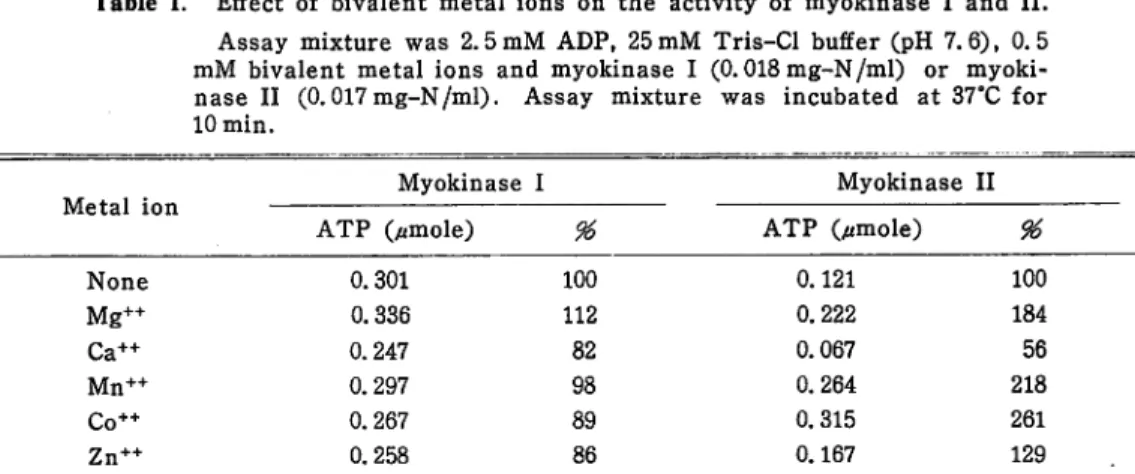
Effect of bivalent metal ions Effects of bivalent metal ions on the activity of myokinase I and II were investigated. Assay mixture was 2. 5 mM ADP, 25 mM Tris-Cl buffer (pH 7.6), 0. 5mM bivalent metal ion and purified myokinase, and incubated at 37°C for 10 min. Table 1 shows the result. Effect of bivalent met al ions on the activity of myokinase I was clearly different from that on myo kinase II activity. Co4""1", Mn4*4" and Mg++ increased the activity of myokinase II by 161, 118 and 84^ respectively. On the other hand the activity of myokinase I was increased only by Mg4"4* slightly, other bivalent metal ions such as Ca4"*, Mn4*4", Co4"4* and Zn4*4" inhibited the enzyme activity slightly.
Table 1. Effect of bivalent metal ions on the activity of myokinase I and II. Assay mixture was 2.5mM ADP, 25 mM Tris-Cl buffer (pH 7.6), 0.5 mM bivalent metal ions and myokinase I (0.018mg-N/ml) or myoki nase II (0.017mg-N/ml). Assay mixture was incubated at 37°C for
10 min.
Metal ion
Myokinase I Myokinase II
ATP (//mole) % ATP Cumole) %
None 0.301 100 0.121 100 Mg++ 0.336 112 0.222 184 Ca++ 0.247 82 0.067 56 Mn++ 0.297 98 0.264 218 Co++ 0.267 89 0.315 261 Zn++ 0.258 86 0.167 129
Thermal stability Purified myokinase I and II were incubated with 0.05 M Tris-Cl buffer (pH 7.6) alone or with 0. 05 M Tris-Cl buffer containing ImM of MgCl2, MnCl2 or CoCl2 at 50°C for various periods. After the appropriate period of incubation, the portion of the enzyme was cooled in ice bath and its activity was assayed. Myokinase I and II were inactivated by incubation at 50°C for 1 h and 12 h respectively (Fig. 1.). Myokinase I, which was incubated with the buffer containing MgCl2 at 50°C for 1 h, was maintained 70 % of inital activity. It was assumed that Mg++ protected myokinase I as well as myokinase II from denaturation by incubation at 50°C. Protective effect of Co++ or Mn++, which increased the activity of myokinase II remarkably, on the thermal stability of myokinase II was not obserbed. Contrary the effect of Mg++ on the thermal stability of myokinase II, Co++ accelerated denaturation by incubation at 50°C.
100 • F» ftyok inase I tj 50 •
1^
.= - * . • 0'W
=* ^^~"-——•Hours incubated with metal Ions
Hours Incubated with metal -Ions
Fig. 1. Thermal stability of myokinase I and II. After the appropriate period of incubation with or without bivalent metal ion at 50°C, the residual activity of the enzy
me was assayed.
O O intact enzyme
A A incubated with Mn++
-0 incubated with Mg++
-A incubated with Co++
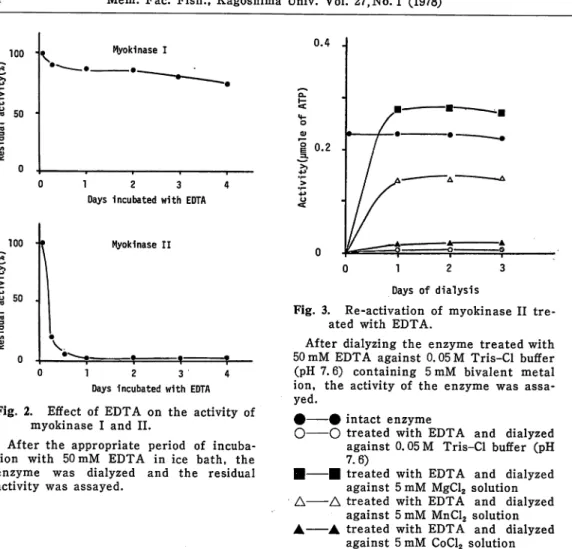
Effect of EDTA Purified myokinase I and II were added in a equal volume of 0.05M Tris-Cl buffer (pH 7.6) containing 0. IM EDTA, and incubated in ice bath for 4 days. After the appropriate period of incubation, the portion of the enzyme was dialyzed against distilled water. Then the residual activity of the enzyme was assayed. As shown in Fig. 2., myokinase II was inhibited by EDTA almost completely. Contrary myokinase II, myokinase I was not inhibited by
EDTA.
Myoki-94 Mem. Fac. Fish., Kagoshima Univ. Vol. 27,No. 1 (1978)
100
50
Myokinase I
1 2 3 4
Days incubated with EDTA
00 •
\
Myokinase II 50 . 0-1
• ? t = * 0 1 2 3 4Days incubated with EDTA
Fig. 2. Effect of EDTA on the activity of
myokinase I and II.
After the appropriate period of incuba tion with 50 mM EDTA in ice bath, the
enzyme was dialyzed and the residual
activity was assayed.
Days of dialysis
Fig. 3. Re-activation of myokinase II tre
ated with EDTA.
After dialyzing the enzyme treated with 50 mM EDTA against 0.05 M Tris-Cl buffer (pH 7.6) containing 5mM bivalent metal ion, the activity of the enzyme was assa
yed.
# # intact enzyme
O O treated with EDTA against 0.05 M Tris
7.6)
• • treated with EDTA against 5 mM MgCl2
A A treated with EDTA
against 5 mM MnCl2
A A treated with EDTA
against 5mM CoCL and dialyzed -CI buffer (pH and dialyzed solution and dialyzed solution and dialyzed solution nase II treated with EDTA was dialyzed against 0. 05 M Tris-Cl buffer (pH 7.6) containing 5mM of MgCl2, MnCl2 or CoCl2. Mg4*4* re-activated the enzyme treated with EDTA and the activity of re-activated enzyme showed almost equal to that of the intact enzyme (Fig. 3.). Mn44 also re-activated the enzyme treated with EDTA, but its activity was about 60^ of that of intact enzyme. Co4*4* which most promoted the activity of myokinase II did not re-activate the enzyme tre ated with EDTA.
Kinetics of myokinase I and II The Km values for the substrate, ADP, of myokinase I and II were estimated by measuring ATP using Dowex 1x4 resin descibed in "Experimental procedure*. Fig. 4. shows Lineweaver-Burk plots for the substrate, ADP, at 20°, 30° and 40°C. In both cases linear reciprocal plots were obtained which allowed estimation of the Km values of myokinase I and II to be 17.40 and 7. 37 mM at 30°C respectively. These values are some what higher than those reported for myokinases from the muscle of mammals4), rat and bovine liver4)5) and yeast4>.
1/v x 102
3 . 2 . v^20°c/
/3o°c/
V
>//^ /*40°C -0.2 -0.1 0 0.1 0.21/ADP(M) x 10"°
1/ADP(M) x 10"3
Myokinase I Myokinase IIFig. 4. Lineweaver-Burk plots for myokinase I and II.
The maximal velocities for the reaction, 2ADP-*ATP+AMP, catalyzed by the carp muscle myokinase I and II were estimated by the intercepts on the veloci ty axis presented in Fig. 4. The values of myokinase I and II at 30°C and pH 7. 6 were 171 and 139 moles of ATP formed per min per mole enzyme respecti vely. Molecular weight values of 27,000 for myokinase I and 22, 000 for myoki nase II were utilzed for these calculations.
F, Myokinase I
Myokinase II
3.1 3.2 3.3 3.4 3.5
1/T x 103
96 Mem. Fac. Fish., Kagoshima Univ. Vol. 27, No. 1 (1978)
Activated energies for myokinase I and II were obtained by Arrhenius plots
and were 6. 75 and 5. 61 Kcal per mole enzyme respectively as shown in Fig. 5.
Discussion
We found that myokinase I and II which were recognized to be homogeneous
by polyacrylamide gel electrophoresis in the presence of sodium dodecyl sulfate
had not only different molecular weight, but also different catalytic properties.
Effect of bivalent metal ions and EDTA on the activity of the enzymes, thermal
stability and kinetics of the enzymes were quite different from each other. Us
ing ADP as substrate, the activity of myokinase II was increased by Co4*4*, Mn4"4*
and Mg++. However the activity of myokinase I was not so increased by Mg4*4*
as that of myokinase II, and was inhibited by Mn44-, Ca4*4-, Co++ and Zn+4\ If it
is true as described by Noda4) that the metal ion is combined with the nucle oside di- or triphosphate to form a complex, and that there are two substratesites per enzyme active site - a site for binding a nucleoside monophosphate or
a metal-free diphosphate and another site for binding metal-nucleoside tripho
sphate or a metal bound diphosphate, substrate sites of myokinase I and II se
ems to be different. It was also assumed from the effect of EDTA on the activity of myokinase I and II that the substrate sites of these enzymes were di
fferent. Myokinase I was not inhibited by EDTA, but myokinase II was inhibi ted extensively.
Myokinase II treated with EDTA was re-activated by dialyzing against Tris-Cl
buffer containing MgCl2. Mg4*4* increased the thermal stability of myokinase II
as well as myokinase I.From the results of kinetic studies, we found that either of myokinase I and
II had higher values of Km for ADP than myokinases from other sources had.Further studies on kinetics under the presence of Mg++ may be required, since
myokinase I and II need Mg++ for optimal activity.We concluded that myokinase I and II were not the artifact during the puri
fication procedure, by such as proteases. Because if they were the artifact, it
was assumed that they had almost the same catalytic properties.
However they
had quite different catalytic properties. The discrepancy between the results on myokinases reported by us and by Noda et al.2) is still remained. The reco gnition of myokinase I and II purified by the method of Noda et al.2) will be necessary.References
1) Ooshiro, Z., Fukushima, M. and Hayashi, S. (1974) : Studies on myokinase in the muscle of fishes—I. Bull Jap. Soc. Sci. Fish., 40, 291-298.
2) Noda, L., Schulz, G. E. and Zabern, I. V. (1974) : Crystalline adenylate kinase from carp muscle. Eur. J. Biochem., 50, 1-7.
3) Fukushima, M., Hayashi, S. and Ooshiro, Z. (1974) : Studies on myokinase in the
4) Noda, L. (1973): Adenylate kinase in "Enzymes" (ed. by Boyer, P. D.) Vol. VIII, 279-305 (Academic Press, New York and London).
5) Markland, F. S. and Wadkins, C. L. (1966): Adenosine triphosphate: adenosine 5-monophosphate phosphotransferase of bovine liver mitochondria. /. Biol Chem., 241,