Biochemical Studies on the Keeping Quality of
Fish Muscle : Lowering of Freshness and
Thermo-stability of Actomyosin ATPase Activity
in the Dorsal Muscle of Various Fish from
Ryuku Fishing Ground at Different Temperatures
著者
NISHIMOTO Jun-ichi, MIKI Hidemasa
journal or
publication title
鹿児島大学水産学部紀要=Memoirs of Faculty of
Fisheries Kagoshima University
volume
28
page range
65-72
別言語のタイトル
琉球斜面漁場における数種漁獲物の筋肉特性につい
て
Biochemical Studies on the Keeping Quality
of Fish Muscle*1
Lowering of Freshness and Thermo-stability of Actomyosin ATPase Activity in the Dorsal Muscle of Various Fish from Ryuku
Fishing Ground at Different Temperatures
Jun-ichi Nishimoto*2 and Hidemasa Miki*2
Abstract
The lowering of freshness of several fish from Ryuku fishing ground and the thermo-stabilities of their myofibrillar proteins (actomyosin) at different temperatures were studied. Freshness was measured by estimating K-values of the samples at 0°, 10°, 20° and 30°C, whereas thermo-stabilities of actomyosin at 25°, 30° and 35°C by way of liberated inorganic phosphate. Rate constants of freshness lowering and inacti-vation of AM-Ca2+-ATPase activities were evaluated.
Regardless of the species, the freshness lowering rate increased with tempera ture as expected. Among the samples, Hanafuedai gave the highest lowering rate. The thermo-stabilities of the AM-Ca2+-ATPase activities of the samples varied with the species. The actomyosin of Kyusenfuedai and Kidai appeared to be more stable than Hanafuedai and Hamadai at 30°C.
The fish proteins are far liable to denature than that of livestock meat and
cereals. As such, special care must be taken to keep this fast deteriorating material at high freshness level right in the production centers. To achieve
this, knowledge of the properties of fish muscles must be known. For fish
from sub-tropical sub-deep sea, few information are available and more have to be known. Thus, this study was undertaken. Particularly, it gathered informa tion on the changes in freshness lowering rate and thermo-stabilities of the
myofibrillar proteins of fish caught from Ryuku fishing grounds.
Materials and Methods
Preparation of Samples
The following fish samples caught from the sub-deep sea of Ryuku area were used in this study: Hanafuedai (Tropidinius amoenus), Hamadai (Etelis carbunculus),
Kyusenfuedai (Lutjanus caeruleovittatus), Shirodai (Cymncranius japonicus) and Kidai
** A part of the comprehensive study on the reasonable exploitation of the ocean fishing grounds in the extra-shelf regions around Ryuku Island Arc headed by Dr. T. Takahashi of Kagoshima University.
66 Mem. Fac. Fish., Kagoshima Univ. Vol. 28 (1979)
(Taius tumifrons). Immediately after catch, they were killed, frozen and then stored at -35°C. Samples were withdrawn within a period of one month. Estimation of K-value1-2)
The K-value of the samples was measured by column chromatography using the method of Uchiyama et al.3>. The ion-exchanger used was Dowex 1x4, Cl~
type, with a mesh of 50 to 100.
Determination of ATPase Activity of Actomyosin (AM)
The AM solution was prepared using the method of Takashi et al.4). The AM-Ca2+-ATPase activity was measured by mixing 0.06 M KC1, 0.005 M CaCl2, 0.001M ATP, 0.025M Trismaleate buffer (pH 7. 0) and 2-3mg/ml protein at 25°C. The amount of inorganic phosphate liberated during the reaction was measured using the method of Fiske-Sabbarow5) .
Determination of Inactivation Rate Constants of AM-Ca2+-ATPase Activity
Several two ml of AM solution which contain about 5-8mg/ml protein were placed in test tubes and were incubated at 25°, 30° and 35°±1. 0°C at different times for 40 minutes, then they were cooled quickly and their ATPase activities were determined. The reaction was found to be a first order process, thus the rate constants of the inactivation of AM-Ca2+-ATPase activities were calculated
by the following formula":
KD = 1/t ((lnC0-lnCt)
where KD is the rate constant, C0 and Ct are the ATPase activity before and after adequate incubation for time (t).
Results and Discussion
Decomposition of Adenosine 5'-Triphosphate and Its Derivatives
Changes in K-value ("Ikinoyosa"") During Storage
The remaining ATP (Adenosine 5'-triphosphate) and its derivatives (Adenos ine 5'-diphosphate, Adenosine 5'-monophosphate, Inosine 5'-monophosphate) indicated by (100-K) % after incubation of the fish muscles at different times under various temperatures are shown in Fig. 1. Apparently the freshness of the samples decreased with time and the logarithm of the decrease, log (100-K), gave characteristically straight lines in all the fish muscles. At high tempera ture storage, Hanafuedai gave the fastest decrease among the four fish samples.
Rate Constants of the Decrease in ATP and Its Derivatives
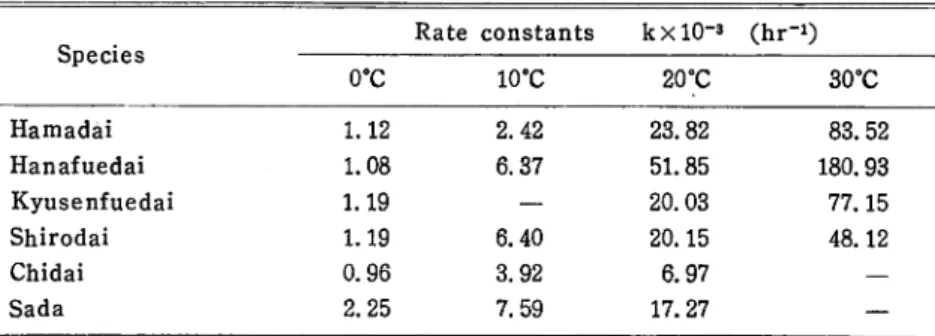
The decomposition of ATP and its derivatives appeared to be a first order reaction. The rate constants were calculated accordingly and are shown in Table 1. As expected, the rate constants of all the samples increased with temperature. Of all the samples, Hanafuedai gave the highest increase. Its decomposition rate constant appeared to be two to three times as much as that
2 4 6 Time in days + 20 °C 2.0 1.8 1.6 0
£^c
c a -_1_ _L. 0 5 10 15 20 25 Time in hrs 30 10 20 30 Time in hrs + 30 °CFig. 1 Remaining K-value after storage at various temperature.
O: Hamadai, fj: Kyusenfuedai, A: Hanafuedai, X : Shirodai
Table 1. Rate constants of the increase in K-value of the muscle of
various fish at different temperatures.
Species
Rate constants k x lO"3 (hr-*)
0°C 10°C 20°C 30°C Hamadai 1.12 2.42 23.82 83.52 Hanafuedai 1.08 6.37 51.85 180.93 Kyusenfuedai 1.19 — 20.03 77.15 Shirodai 1.19 6.40 20.15 48.12 Chidai 0.96 3.92 6.97 — Sada 2.25 7.59 17.27 —
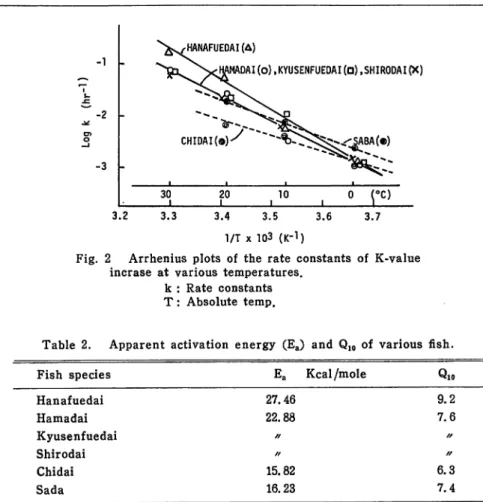
of other samples at 20° and 30°C. This can be clearly gathered from the
Arr-henius plot of the decomposition rate constant of the samples versus tempera
ture (Fig. 2). Obviously, Hanafuedai gave the steepest rise in log of the rate constant with temperature. Compared with the commonly known fast deterio rating Saba (mackerel), Hanafuedai was found to be more deteriorative. As a matter of fact, the Q10 of the freshness deterioration reaction in Hanafuedai based on the apparent activation energy of the reaction was about 9.2 while
68 Mem. Fac. Fish., Kagoshima Univ. Vol. 28 (1979)
-1
-3
'^•HANAFUEDAI (A)
>|J3S\^MDAI(o) .KYUSENFUEDAI(D), SHIRODAI (X)
CHIDAI(«K
^C^v^^|/\BA(«)
30 20
1 1 110 1 0 (°c)1
3.2 3.3 3.4 3.5 3.6
1/T x 103 (K-l)
Fig. 2 Arrhenius plots of the rate constants of K-value
incrase at various temperatures,
k : Rate constants
T: Absolute temp.
3.7
Table 2. Apparent activation energy (Ea) and Q10 of various fish.
Fish species Ea Kcal/mole Qio
Hanafuedai 27.46 9.2 Hamadai 22.88 7.6 Kyusenfuedai / / / / Shirodai / / / / Chidai 15.82 6.3 Sada 16.23 7.4
Saba was about 7. 4. This being so, it is suggested that to keep the freshness of Hanafuedai, low temperature condition is essentially necessary.
Relative Thermo-stabilities of AM-ATPase Activities in the Fish
Samples Dorsal Muscle
Rate Constants of Inactivation of AM-Ca2+-ATPase Activities at Various Temperatures
In Fig. 3, the curves of thermal inactivation of AM-Ca2+-ATPase activities in the dorsal muscle of the different fish samples at 25°, 30° and 35°C are shown. It should be noted that it is quite impossible to get exact inactivation curves at 35°C because the rate of inactivation of AM-Ca2+-ATPase activities was very fast. Furthermore, the curves are logarithmic. Being so, the logarithm of the
specific AM-Ca2+-ATPase activities was calculated and was plotted as a function
of time (Fig. 4). The plots showed characteristically straight lines, thus the inactivation process in the samples was regarded as first order reaction (exclu
ding 35°C curves).
Accordingly, the inactivation rate constants were calculated
di-Time ( min.)
Fig. 3 Thermal inactivation of actomyosin Ca2+-ATPase activities in the muscles of various fish species.
Hanafuedai Kyusenfuedai Hamadai Kidai
25 °C 30°?
^*j-25°C U <D -1 _ ' L-40 0 20 40 0 20
Heating time (min)
Fig. 4 Logarithm of the actomyosin of Ca2+-ATPase activity in the dorsal muscles
of various fish species as function of time.
70 Mem. Fac. Fish., Kagoshima Univ. Vol. 28 (1979)
Table 3. Inactivation rate constsnts of the actomyosin Ca2+-ATPase activities in the muscles of various fish at pH 6.8 in 0.6 M KC1 at 25° and 30°C. Species KD (sec-1) 25°C 30°C 35°C Hanafuedai 2.8x10-* 21.4x10⁻⁴ — Hamadai 5.3x10-* 20.4x10⁻⁴ — Kyusenfuedai 0.7x10⁻⁴ 3.2x10⁻⁴ — Kidai 4.7x10⁻⁴ 5.7x10⁻⁴ 19.5x10⁻⁴
fferent fish samples have different thermo-stabilities at various temperatures.
The order of their thermo-stabilities at 30°C are as follows: Kyusenfuedai >
Ki-dai>Hamadai>Hanafuedai.
Effect of Temperature on the Inactivation of AM-Ca2+-ATPase Activities in the Fish Samples Dorsal Muscle
The curves of inactivation of AM-Ca2+-ATPase activities in the dorsal muscle
of the different fish samples after 30 minutes incubation at various temperatures
are shown in Fig. 5. From the curves, it is evident that there was wide varia
tion in the inactivation of AM-Ca2+-ATPase activities among the samples.
As
to the temperature to reduce the AM-Ca2+-ATPase activities to 50% for 30 minutes, Hamadai gave about 24°C, Kidai about 24.5°C, Hanafuedai about 26°C and Kyusenfuedai about 31°C. The differences in the temperatures of 50 % re duction in the AM-Ca2+-ATPase activities among the samples are about 7°C at the most. > lanafuedai dai 25 30 Heating temp. (°C)Fig. 5 Inactivation of actomyosin Ca2+-ATPase activities
in the dorsal muscles of various fish at different temperatures for 30min.
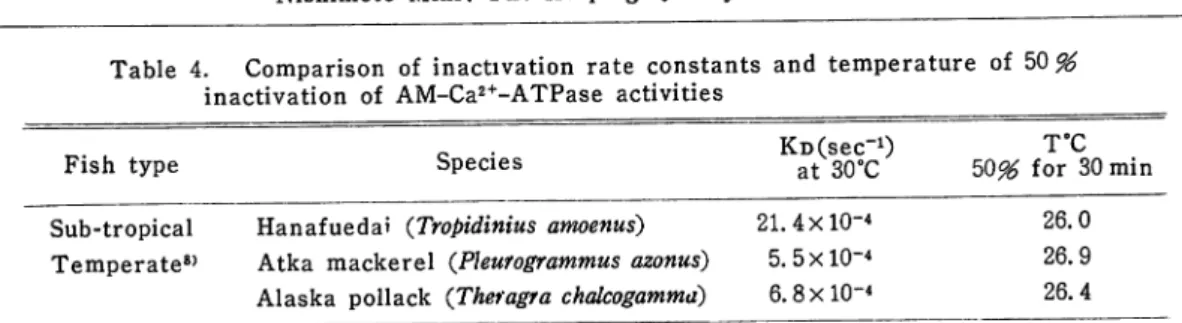
Arai et al.8) reported that AM-Ca2+-ATPase activities in the dorsal muscle of
sub-tropical fish they studied was stable and was very unstable in temperate
Table 4. Comparison of inactivation rate constants and temperature of 50 %
inactivation of AM-Ca2+-ATPase activities
c
.
KD(sec"1)
T°C
Fish type Species at 30°c b§% for 30 min
Sub-tropical
Hanafuedai (Tropidinius amoenus)
21.4x10⁻⁴
26.0
Temperate10
Atka mackerel (Pleurogrammus azonus)
5.5xl0-4
26.9
Alaska pollack (Thefagra chalcogamma) 6.8 X 10~4 26.4
rate of inactivation of AM-Ca2+-ATPase activities in the samples appeared to be 2 to 3 times more unstable than that of temperate fish8'9) despite almost similar
temperature of 50^ reduction in activities (Table 4).
Conclusion and Recommendation
This study clearly showed that the rate of freshness deterioration in the mu scles of fish from Ryuku fishing grounds, a sub-tropical zone, is very fast at high
temperatures such as 30° to 35°C.
This is most particularly true for Hanafuedai.
As to thermo-stabilities of Ca2+-ATPase activities of the AM of such fish, Kyu senfuedai and Kidai are more stable than Hanafuedai and Hamadai at 30°C storage.
From the standpoint of preservation, the results of this study suggest that fish meat from sub-tropical seas must be subjected to low and exact temperature conditions if they are to be consumed raw e. g. "Sashimi" and "Sushi". Fur thermore, when such fish meat have become stale, they must be processed to edible products like canned fish, fish cake, etc. The latter presents a number
of problems and studies must be done to solve them.
Acknowledgment
The authors extend sincere thanks to the Ministry of Education for financing
this research. Also they wish to thank Mr. A. Ono and Mr. J. Tobimatsu for
their technical assistance.
References
1) Saito, T., K. Arai and M. Matsuyoshi: Bull. Jap. Soc. Sci. Fish., 24, 749-750 (1950).
2) Saito, T.: Bull. Jap. Soc. Sci. Fish., 27, 461-470 (1961).
3) Uchiyama, H., H. Kobayashi: "Suisan Seibutsu Kagaku Shokuhin gaku Jikkensho" (Ed. Saito, T., H. Uchiyama, S. Umemoto and S. Kawabata), Koseisha Koseikaku,
1974, 270-274.
4) Takashi, R., K. Arai and T. Saito: Bull. Jap. Soc. Sci. Fish., 36, 169-173 (1970). 5) Fiske, C. and Y. Subbarow: /. Biol. Chem., 66, 375-400 (1925).
6) Yasui, T., H. Kawakami and F. Morita: Agr. Biol. Chem., 32, 225-233 (1968). 7) Uchiyama, H. and S. Ehira: Bull. Jap. Soc. Sci. Fish., 36, 977-992 (1970).
72 Mem. Fac. Fish., Kagoshima Univ. Vol. 28 (1979)
8) Arai, K., K. Kawamura and C. Hayashi: BuU. Jap. Soc. Sci. Fish., 39, 1077-1085 (1973).
9) Yabe, K., K. Nakamura, M. Suzuki and Y. Ito: Bull. Jap. Soc. Sci. Fish., 44, 1345-1350