Keratinolytic Properties of PrPSc-degrading
Enzyme E77
著者
Mitsuiki Shinji, Takasugi Mikako, Goto
Masatoshi, Kanouchi Hiroaki, Oka Tatsuzo
journal or
publication title
鹿兒島大學農學部學術報告=Bulletin of the
Faculty of Agriculture, Kagoshima University
volume
59
page range
37-42
Prion diseases are characterized by the conversion of the normal cellular form of the prion protein (PrPC
) into an insoluble, protease-resistant abnormal form (PrPSc
) [ , ]. There have been some reports of PrPSc
-degrading enzymes, but the keratinase from Bacillus licheniformis [ ] and the subtilisin-enzyme Properase [ ] need additional chemical and physical treatments for the degradation of PrPSc. Only an alkaline protease E from Streptomyces sp. and NAPase from Nocardiopsis sp. TOA- have been reported to be able to degrade PrPSc
without further treatment [ , ].
It has been reported that the specificity toward keratin is an important factor in the degradation of PrPSc
by proteases [ , , ]. In a previous paper, we also reported that NAPase possessing a keratin-degrading ability was able to degrade PrPSc [
, ]. Nevertheless, the PrPSc
-degrading protease E has not been investigated in terms of its keratin degrading properties. In this paper we describe the keratinolytic properties of PrPSc
-hydrolysing E .
Shinji MITSUIKI1), Mikako TAKASUGI1), Masatoshi GOTO2),
Hiroaki KANOUCHI3)and Tatsuzo OKA3)†
Received for Publication, September ,
It is suggested that the keratinolytic activity of proteases are associated with the degrading activity of the abnormal type prion protein (PrPSc
). We tried to analyze the keratinolytic properties of the PrPSc -degrading enzyme E . E showed a much greater keratinolytic activity than proteinase K and subtilisin. The maximum activity of keratin was observed at a pH value of . at °C. E also showed a pH-independent adsorbability for keratin. These profiles of E were the same as the PrPSc
-degrading enzyme NAPase, except for high alkaline conditions. E and NAPase showed lower collagenolytic and elastinolytic specificities.
Key words: Prion; keratinase; protease
†
:Correspondence to: Tatsuzo OKA(Laboratory of Veterinary Physiology) Tel - - , E-mail: [email protected]
1)
Department of Industrial Chemistry, Kyushu Sangyo University, Fukuoka - , Japan
2)
Division of Bioresource and Bioenviromental Sciences, Kyushu University, Fukuoka - , Japan
3)
Preparations of the enzyme and protein content
The alkaline protease E from Streptomyces strain -GP- D- and NAPase from Nocardipsis sp. TOA- were purified utilizing the same process as described in a previous paper [ , ]. Subtilisin Carlsberg and proteinase K (Sigma-Aldrich) were purified by cation-exchange and gel-filtration chromatographies, respectively. The protein content was determined by the Lowry method [ ] using bovine serum albumin as a standard. Sodium dodecyl sulfate-polyacrylamide gel electrophresis (SDS-PAGE) was prepared as described by Laemmli [ ].
Protease activity assay
The protease activity was measured using the Anson-Hagiwara’s method [ ]. . ml of . % ca-sein in a mM glycine-NaCl-NaOH buffer (pH . ) and . ml of enzyme solution were incubated at °C. After incubation for min, the reaction was brought to an end by the addition of . ml of trichloroacetic acid ( . M). The mixture was further incubated at °C for min, and filtered through a Toyo filter paper (No. C). The free amino acids in the filtrate were measured with a Folin-phenol reagent.
Keratinase activity assay
Forty μg of E , subtilisin or proteinase K and mg of keratin powder (Tokyo Kasei) were incu-bated with shaking in a ml glycine-NaCl-NaOH buffer (pH . ) and a mM KCl-NaOH buffer (pH . ) at °C for hours. The reaction was brought to an end by adding a . ml of . M trichloroacetic acid solution. The mixture was further incubated at °C for min and filtered. The lib-erated peptides in the filtrate were measured photometrically at nm. One unit of keratinolytic activ-ity was defined as the amount of enzyme that released μg of tyrosine per hour. The optimal pH and tem-perature were measured at pH values ranging from . to . and at temperatures ranging from to
°C.
Keratin absorbability assay
Fifteen μg of E , subtilisin or proteinase K and mg of keratin powder were incubated at °C in various ml buffers: mM Tris-HCl (pH . ), mM glycine-NaCl-NaOH (pH . - . ). After -min incubation, the reaction mixture was centrifuged ( , Xg for min) and the remaining caseinolytic activity of supernatant was measured.
Collagenase and elastase activity assay
Forty μg of E , NAPase, subtilisin or proteinase K and mg of collagen or elastin (Sigma-Aldrich) were incubated with shaking in a ml Tris-HCl buffer (pH . ) and a mM glycine-NaCl-KCl-NaOH buffer (pH . ) at °C for hour. The reaction was brought to an end by adding μl of M acetic acid. After centrifugation at °C and , Xg for min, . ml of each reaction mixture was added to a . ml of . M sodium acetate buffer (pH . ). After this, ml of a ninhydrin reagent (Sigma-Aldrich) was added; the free amino groups were measured according to the manufacturer’s in-structions. One unit of the activity was defined as the amount of enzyme that released μg of glycine per hour.
Properties of the keratin hydrolysis
Fig. shows the time courses of the keratin hydrolysis by E . Comparing these results with our pre-vious paper, E exhibited a comparable hydrolyzing-ability toward keratin with NAPase [ , ]. The keratinolytic activity of E at pH . was about - and -fold increase on the results obtained with subtilisin and proteinase K, respectively. The specific activity at a pH value of . ( , unit/mg) was slightly higher than NAPase [ ]. The optimal pH and temperature of E were . and °C, respec-tively (Fig. ). E showed a lower keratinolytic activity than NAPase under high alkaline conditions be-cause of the difference in pH stability (data not shown).
Fig. 1. Hydrolysis of keratin by E , subtilisin and proteinase K. The reaction was carried out
at °C. Symbols: ●, E ; ■, subtilisin; ▲, proteinase K.
Fig. 2 A, B. Effects on pH and temperature of the keratinolytic activity of E . (A) Effects on pH
of the keratinolytic activity. The reaction was carried out at °C. (B) Effects on tem-perature of the keratinolytic activity. The reaction was carried out at pH . .
Properties of keratin absorption
The absorbability of E was observed at pH values ranging from . to . (Fig. ). E showed more than % of the adsorption rate for keratin, which was pH-independent. Comparing these results with our previous paper, E exhibited a comparable adsorbability for keratin with NAPase [ ]. E and NAPase possess a high absorbability for insoluble substrates in agreement with other insoluble sub-strate-hydrolyzing enzymes [ - ].
Properties of the insoluble substrates hydrolysis
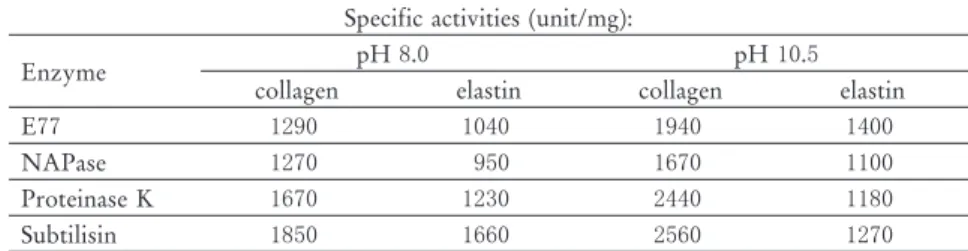
Table shows the hydrolyzing activities of E , NAPase, proteinase K and subtilisin with collagen and elastin. E and NAPase had a lower ability to hydrolyze proteins than proteinase K and subtilisin. The relative activity (specific activity of keratin versus collagen) at a pH value of . was about a fold increase in the results obtained from proteinase K and subtilisin.
We came to the conclusion that the keratin-hydrolyzing and adsorbable abilities of these enzymes are closely related to the degrading ability of PrPSc. Further studies using mutant E and NAPase are cur-rently underway to reveal insights into the molecular mechanism of keratin and PrPSc
-degradation.
[ ] Prusiner, S.B., Scott, M. R., DeArmond, S. J., and Cohen, F. E.: Prion protein biology. Cell, ,
-( ).
[ ] Weissmann, C.: Molecular genetics of transmissible spongiform encephalopathies. J. Biol. Chem.,
Shinji MITSUIKI, Mikako TAKASUGI, Masatoshi GOTO, Hiroaki KANOUCHI, and Tatsuzo OKA
Fig. 3. Effects on pH of the keratin adsorbability of E , subtilisin and proteinase K. Symbols:
●, E ; ■, subtilisin; ▲, proteinase K.
Table 1. Enzyme activities with collagen and elastin.
Specific activities (unit/mg):
Enzyme pH . pH .
collagen elastin collagen elastin E
NAPase Proteinase K Subtilisin
, - ( ).
[ ] Hui, Z., Doi, H., Kanouchi, H., Matsuura, Y., Mohri, S., Nonomura, Y., and Oka, T.: Alkaline serine protease produced by Streptomyces sp. degrades PrPSc
. Biochem. Biophys. Res. Commun.,
, - ( )
[ ] Langeveld, J. P. M., Wang, J. J., Van de Wiel, D. F. M., Shin, G. C., Jan Garssen, G., Bossers, A., and Shin, J. C. H.: Enzymatic degradation of prion protein in brain stem from infected cattle and
sheep. J. Infect. Dis., , - ( )
[ ] McLeod, A. H., Murdoch, H., Dickinson, J., Dennis, M. J., Hall, G. A., Buswell, C. M., Carr, J., Taylor, D. M., Sutton, J. M., and Raven, N. D.: Proteolytic inactivation of the bovine spongiform
encephalopathy agent. Biochem. Biophys. Res. Commun., , - ( )
[ ] Hui, Z., Minamiguchi, K., Doi, H., Kinoshita, N., Kanouchi, H., and Oka, T.: Recombinant alka-line serine protease II degrades scrapie isoform of prion protein. In Vitro Cell. Dev. Biol. Anim.,
, - ( )
[ ] Mitsuiki, S., Hui, Z., Matsumoto, D., Sakai, M., Moriyama, Y., Furukawa, K., Kanouchi, H. and Oka, T.: Degradation of PrPSc by keratinolytic protease from Nocaridiopsis sp. TOA- . Biosci.
Biotechnol. Biochem., , - ( )
[ ] Yoshioka, M., Miwa, T., Horii, H., Takata, M., Yokoyama, T., Nishizawa, K., Watanabe, M., Shinagawa, M., and Murayama, Y.: Characterization of a proteolytic enzyme derived from a
Bacillus strain that effectively degrades prion protein. J. Appl. Microbiol., , - ( ) [ ] Suzuki, Y., Tsujimoto, Y., Matsui, H., and Watanabe, K.: Decomposition of extremely
hard-to-degrade animal proteins by thermophilic bacteria. J. Biosci. Bioeng., , - ( )
[ ] Mitsuiki, S., Sakai, M., Moriyama, Y., Goto, M., and Furukawa, K.: Purification and some proper-ties of a keratinolytic enzyme from an alkaliphilic Nocardiopsis sp. TOA- . Biosci. Biotechnol.
Biochem., , - ( )
[ ] Mitsuiki, S., Ichikawa, M., Oka, T., Moriyama, Y., Sakai, M., Sameshima, Y., Goto, M., and Furukawa, K.: Molecular characterization of a keratinolytic enzyme from an alkaliphilic
Nocaridopsis sp. TOA- . Enzyme Microb. Technol., , - ( )
[ ] Lowry, O. H., Rosebrough, N. J., Farr, A. L., and Randall, R. J.: Protein measurement with the Folin phenol reagent. J. Biol. Chem., , - ( )
[ ] Laemmli, U.K.: Cleavage of structural proteins during the assembly of the head of bacteriophage
T . Nature, , - ( )
[ ] Hagiwara, B.: Proteolytic enzymes. In "Methods of Enzymatic Analysis" Vol. , ed., Asakura
Publishing, Tokyo, - ( )
[ ] Goto, M., Semimaru, T., Furukawa, K., and Hayashida, S.: Analysis of the raw starch-binding do-main by mutation of a glucoamylases from Aspergillus awamori var. kawachi expressed in
Saccharomyces cerevisiae. Appl. Environ. Microbiol., , - ( )
[ ] Medve, J., Stahlberg, J., and Tjemeld, F.: Isotherms for adsorption of cellobiohydrolase I and II from Trichoderma ressei on microcrystalline cellulose. Appl. Biochem. Biotechnol., ,
-( )
[ ] Folders, J., Algra, J., Roelofs, M. S., van Loon, L. C., Tommassen, J., and Bitter, W.: Characterization of Pseudomonas aeruginosa chitinase, a gradually secreted protein. J. Bacteriol.,
, - ( )
[ ] Cazemier, A. E., Verdoes, J. C., van Ooyen, A. J., and Op. den Camp., H. J.: Molecular and bio-chemical characterization of two xylanase-coding genes from Cellulomonas pachnodae. Appl.
Shinji MITSUIKI, Mikako TAKASUGI, Masatoshi GOTO, Hiroaki KANOUCHI, and Tatsuzo OKA
満生慎二
1)・高杉美佳子
1)・後藤正利
2)・叶内宏明
3)・岡達三
3)† 要 約 プロテアーゼのケラチン分解能と異常プリオン分解能には相関があるのではないかと推察されている。 そ こで我々は, 先に報告した異常プリオンタンパク質分解酵素E のケラチン分解特性について解析した。 E の比活性は unit/mgであり, proteinaseKおよびsubtilisinと比較し, ケラチンを強力に分解すること が明らかになった。 E のケラチン分解能の至適pHは . , 至適温度は ℃であった。 また, pH非依存型 の高い吸着能を示すなど, 高アルカリ領域以外では, 先に報告した異常プリオン分解酵素NAPaseとほぼ同 様の特性を示した。 一方, E のコラーゲンおよびエラスチンに対する特異性はNAPaseと同様低かった。 キーワード:異常プリオン, ケラチナーゼ, プロテアーゼ † :連絡責任者:岡 達三 (獣医学科分子病態学研究室)Tel - - , E-mail: [email protected]
1) 〒 - 福岡市東区松香台 - - 九州産業大学 工学部物質生命化学科 微生物工学教室 2) 〒 - 福岡市東区箱崎 - - 九州大学大学院 生物資源環境科学研究科 発酵化学教室 3) 〒 - 鹿児島市郡元- - 鹿児島大学農学部獣医学科 分子病態学教室