国際化推進共同研究概要
No. 1
19EA-1
タ イ ト ル: Dynamical mechanisms of stratospheric control on the tropical troposphere and ocean
研究代表者: UEYAMA, Rei 所内世話人: 江口 菜穂 研究概要: ここ 30 年間で北半球夏季に南東太平洋の水温の低下がみられ、それは赤道をまたぐ 南西風の強化、すなわち対流圏内の南北循環場(Hadley 循環;HD 循環)が北側へシフ トしたことに起因することがわかった。さらに HD 循環の強化が、近年の温室効果気体 の増加による成層圏の寒冷化によって変調をきたした成層圏の南北循環場(Brewer-Dobson 循環)と関係することが示唆された。今回、衛星観測から導出された雲頂高度デ ータを用いて、熱帯対流圏界面遷移層 (TTL; Tropical Tropopause Layer) に陥入する 背の高い積雲対流の雲頂高度が、ここ 10 年間で、特にアフリカ大陸からアジア域の夏 季にかけて北進していることを観測的に明らかにした。極端に深い積雲対流の増加は、 二酸化炭素濃度の増加による地表面の温暖化と、熱帯成層圏の冷却による熱帯対流 圏界面の静的安定性の低下の相乗効果によって強制されると推測される。
Dynamical Mechanisms of Stratospheric Control on the
Tropical Troposphere and Ocean
Rei Ueyama (NASA Ames Research Center)
I. Abstract
Cooling of the equatorial southeastern Pacific Ocean occurred since the
mid-to-late 1990s in association with enhanced cross-equatorial southerlies,
which were associated with a strengthening of the deep ascending branch of the
boreal summer Hadley circulation over land extending into the stratosphere.
The center of anomalous convective activity moved southward to the equatorial
Indian Ocean–Maritime Continent region from boreal summer to winter
following the seasonal march, which strengthened the surface easterlies over the
equatorial central Pacific. Accordingly, ocean surface cooling expanded over the
equatorial central Pacific. Analyses of satellite-derived convective cloud top
occurrences (Pfister et al., 2020) suggest that the fundamental cause of the
recent decadal change in the tropical troposphere and the ocean is a poleward
shift of convective activity that resulted from a strengthening of extreme deep
convection penetrating into the tropical tropopause layer (Fig. 1), particularly
over the African and Asian continents and adjacent oceans. We conjecture that
the increase in extreme deep convection is forced by a combination of land
surface warming due to increased CO
2and a reduction of static stability in the
tropical tropopause layer due to tropical stratospheric cooling.
II. Introduction
Changes in the tropical circulation from the mid to late 1990s included (i)
a slowdown, or hiatus, of global warming associated with a decrease in the
tropical eastern Pacific sea surface temperature (SST), (ii) the advancement of
the onset of the Asian summer monsoon, and (iii) an increase in precipitation in
western Africa over the Sahel and in southern Africa during the austral summer.
In addition to these large-scale circulation changes, mesoscale phenomena such
as an increase in Mesoscale Convective Systems over the Sahel were also
reported. Each of these elements should be investigated independently in great
detail, as well as their relationships to each other and their roles in global climate
change. Without the latter, we will be unable to see the ‘big picture’. The goal of
this study was to provide a framework for assembling these diverse pieces of the
climate-change puzzle by investigating the connection between the atmosphere,
including the stratosphere, and ocean in the tropics.
Global observational studies using various satellite datasets have given us
substantial insight on the statistical distribution of the altitudes of deep
convection, including radar from TRMM and GPM, convective overshoot using IR
satellite data, microwave from AMSU-B, IR brightness temperatures, space-borne
cloud radar from CloudSat, and space-based lidar from CALIOP. Here we make
use of global constellation of geostationary weather satellites to estimate the
heights of convective cloud tops globally every three hours.
III. Method/Data
We analyzed a variety of datasets including JRA55 reanalysis, outgoing
longwave radiation derived from High Resolution Infrared Radiation Sounder,
Global Precipitation Climatology Project precipitation, COBE-1 gridded SST, and
tropical overshooting clouds derived from brightness temperature differences
measured by three high-frequency channels of the Advanced Microwave Sensing
Unit module B or the Microwave Humidity Sensor.
Preliminary analyses of satellite-derived convective cloud top altitudes
(Pfister et al, 2020) were also used to corroborate the tropical convective
overshooting cloud data. Our approach for calculating the convective cloud top
altitudes is based on the assumption that rainfall, screened with a proper
threshold, can define the area where convection is occurring. These rainfall data,
coupled with the infrared satellite information, can then define both the regions
where the mass-transporting convective cores occur, and their altitude.
IV. Results
The eastern equatorial Pacific Ocean in the southern hemisphere cooled
since the mid 1990s in association with a strengthening of cross-equatorial
southerlies near the surface. We showed that this was likely induced by a
northward shift and strengthening of convective activity around the
climatological deep ascending branch of the Hadley circulation during boreal
summer over the African–Asian sector. Additionally, we found that variations in
convective activity and SST are related to vertical velocity near the tropopause
(Fig. 1).
Figure 1: A schematic of the recent changes in the tropics: Lower stratospheric
cooling from increased tropical upwelling (a) supports a deepening of extreme
convection over the heated continental regions (b). Extreme deep convection
over land enhances cross-equatorial near-surface winds over the ocean (c) which
further fuels convection through moisture transport and lowers the sea surface
temperature from summer to autumn (d).
It is difficult to demonstrate a causal relationship among variables having
large trends. Nevertheless, time lags introduced in selected variables from
summer to autumn suggest that the aforementioned processes are related.
Current global models have difficulty simulating the effect of extreme deep
convection on the TTL. Suitably designed numerical experiments using global
models with improved convective parameterizations will be needed to add
further support to these ideas.
V. Discussion/Summary
We hypothesize that recent tropical circulation changes originate
primarily from a strengthening of deep convective activity over the continents
and their vicinity in the summer hemisphere, particularly over the African‒Asian
sector. Stratospheric variation has generally been treated as a problem separate
from recent surface climate change, but the results of this study demonstrate
that stratospheric changes should be examined together with tropospheric
changes. Further investigation is needed to determine whether the stratosphere
is merely passively responding to the tropospheric warming or playing an active
role in the tropospheric circulation change.
To better understand the details of the stratosphere‒troposphere
coupling process, we will investigate the coupling process as depicted in
convective overshooting and cloud top data (Pfister et al., 2020) in a future
study. Specifically, the 0.25° longitude/latitude resolution, 3-hourly cloud top
data will be useful for illustrating the time evolution of deep convective activity
over a given region in response to stratospheric forcing. As illustrated in Figure
2, enhanced upwelling and subsequent cooling of the tropical lower stratosphere
support deep convective activity over land (via a reduction in static stability in
the tropical tropopause layer), most notably over tropical Africa. This is
consistent with previous findings that show that dynamically-induced tropical
stratospheric cooling can trigger deep convective activity in the troposphere
(e.g., Eguchi et al., 2015; Kodera et al., 2015; Eguchi et al., 2016).
Figure 2: Evolution of (from top to bottom) pressure vertical velocity at 70
hPa, tropical mean temperature anomaly in the TTL, occurrence of
convective cloud tops above 17km, and pressure vertical velocity
anomalies in the troposphere over the tropical African sector.
–0.001 0Evolution over the African sector (20W - 50E)
[T]’ [ω] 70hPa ascent 50hPa 70hPa 100hPa (29 July 2007) cloud tops >17km tropical (20S-20N) lower stratospheric forcing tropospheric response in the NH tropics (12.5 - 20N) [ω]’ 100hPa 200hPa 300hPa 500hPa 1000hPa +3 0 K –3 +0.03 0 Pa s-1 –0.03 17 SPARCjws2017_Ueyama - October 8, 2017
VI. References
• Eguchi, N., Kodera, K., and Nasuno, T.: A global non-hydrostatic model study
of a downward coupling through the tropical tropopause layer during a
stratospheric sudden warming, Atmos. Chem. Phys., 15, 297-304, 2015.
• Eguchi, N., Kodera, K., Funatsu, B. M., Takashima, H., and Ueyama, R.: Rapid
convective transport of tropospheric air into the tropical lower stratosphere
during the 2010 sudden stratospheric warming, SOLA, 12A, 13-17, 2016.
• Kodera, K., Funatsu, B. M., Claud, C., and Eguchi, N.: The role of convective
overshooting clouds in tropical stratosphere-troposphere dynamical
coupling, Atmos. Chem. Phys., 15, 6767-6774, 2015.
• Pfister, L., Ueyama, R., Jensen, E., and Schoeberl, M.: A method for obtaining
high frequency, global, IR-based convective cloud tops for studies of the
tropical tropopause layer, in preparation, 2020.
VII. List of Publications and Selected Presentations
• Kodera, K., N. Eguchi, R. Ueyama, Y. Kuroda, C. Kobayashi, B. M. Funatsu,
and C. Claud (2019), Implications of tropical lower stratospheric cooling
in recent trends in tropical circulation and deep convective activity,
Atmos. Chem. Phys. Discuss., 19, doi:10.5194/acp-19-2655-2019.
• Kodera, K., N. Eguchi, R. Ueyama, B. M. Funatsu, and C. Claud (2019),
Influence of tropical lower stratospheric cooling on extreme deep
convective activity and tropical cyclones, AOGS 16th Annual Meeting, 28
Jul – 2 Aug, Singapore. (oral)
• Ueyama, R., and E. Jensen (2019), Impacts of deep convection on clouds
and water vapor in the UTLS, American Geophysical Union Fall Meeting
2019, 9-13 Dec, San Francisco, USA. (oral, invited)
• Kodera, K., N. Eguchi, R. Ueyama, L. Pfister, B. M. Funatsu, and C. Claud
(2019), Role of extreme deep convection over land on recent tropical
change, American Geophysical Union Fall Meeting 2019, 9-13 Dec, San
Francisco, USA. (oral)
• Eguchi, N., and K, Kodera (2019), Influence of stratospheric dynamics on
deep convection and equatorial waves, American Geophysical Union Fall
Meeting 2019, 9-13 Dec, San Francisco, USA. (poster)
• Ueyama, R., E. Jensen, M. Krämer, L. Pfister, and M. Schoeberl (2020),
Impact of convectively-detrained ice crystals on the humidity of the
tropical tropopause layer during boreal winter, 100
thAmerican
Meteorological Society Annual Meeting and Middle Atmosphere One-Day
Symposium, Boston, USA. (poster)
VIII. Research meeting and discussion
Participants: Rei Ueyama, Nawo Eguchi, Kunihiko Kodera
Date: 11 December 2019
Location: AGU Fall Meeting 2019
Discussion topics:
• Possible stratospheric forcing of deep convection and precipitation
over the Sahel region in July 2010
• Asian Summer Monsoon Chemical and Climate Impact Project
(ACCLIP): science goals, flight scenarios, forecast products including
SPRINTARS aerosol product, and usage of the airborne measurements
for our research
IX. Additional information
Rei Ueyama was on maternity leave during this award period from September
through December 2019. The results reported here are based on work that was
primarily completed before and after the leave period.
X. Members
Rei Ueyama
NASA Ames Research Center
Nawo Eguchi
RIAM, Kyushu University
Kunihiko Kodera
Meteorological Research Institute
国際化推進共同研究概要
タイトル:
Model inter-comparison study of long-range chemical
transport model to have a better understanding of PM2.5
issue over East Asia
研究代表者:
Zifa WANG
所内世話人:
鵜野 伊津志
実施期間:
新型肺炎による渡航制限で予定していた来日は中止された
概要:
共同利用経費での来日は出来なかったが、2014 年から 2019 年にかけての中国
—韓国—日本の PM2.5 の濃度変化についての観測データの解析とモデル結果の整
理を行い越境汚染の硫酸塩から硝酸塩へのパラダイム・シフトに関して成果を
取りまとめて、英文学術雑誌に投稿した。この研究の事前の会合を 2019 年6月
28日中国大連で半日間の中国と日本の大気汚染に関する研究会として開催し
た。また 2020 年1月14日から24日まで中国大気物理研の Li Jie 教授が中
国側の経費で来日し応用力学研で共同研究を行った。
No. 2
19EA-2
タイトル:
Model inter-comparison study of long-range chemical
transport model to have a better understanding of PM2.5
issue over East Asia
研究代表者:
Zifa WANG (中国科学院大気物理研究所)
共同研究の目的
本共同研究では、中国華北平原から北京にかけて観測される高濃度の PM2.5
汚染とその韓国・日本域への越境影響について、野外観測結果の解析と複数の
化学輸送モデル(NAQPMS, CMAQ, GEOS-CHEM など)を用いた相互比較実験を進めて
いる。
中国と福岡での最新のエアロゾルの観測装置、ライダーなどを駆使したデー
タの蓄積を独自に行い、同時に、中国・韓国・台湾・日本・アメリカ合衆国の
研究者が進めているアジア域の化学輸送モデル相互比較実験(MICS-Asia)への
参画を通じて、PM2.5 大気汚染のモデルの問題点とその改良を進め、化学輸送モ
デルの精緻化を目指す。
共同研究の成果
最近の PM2.5
濃度の減少は、中国国内でも明らかで北京では 2013 年から 2019
年にかけて年平均濃度は 102 µg/m
3から 43 µg/m
3と 58%も減少している。また、
福岡でも 2014 年の 18.4 µg/m
3から 2019 年で 13.8 µg/m
3と減少している。中国
では SO2
の減少率が最大で、NOx 減少率はその 1/3 程度、NH3
排出量の経年変動は
これらに対して少ない。このため従来は(NH4)2SO4
の形成に使われた NH3
が余剰に
なり、NH4NO3
の生成量が増加すると考えられる。従って、越境輸送される PM2.5
の組成の変化が懸念され、風下域に沈着する S/N 成分の比が変化し、海洋・陸
上生態系への影響も危惧される。以上の観点から、観測データの解析とモデル
結果の整理を行い越境汚染の硫酸塩から硝酸塩へのパラダイム・シフトに関し
て成果を取りまとめて、英文学術雑誌に投稿した。
No. 2
19EA-2
国際化推進共同研究概要
タイトル: Turbulent mixing in the Kuroshio Current off Taiwan
研究代表者: JAN, Sen
所内世話人: 遠藤 貴洋
概要:国際化推進共同研究 19EA-3「Turbulent mixing in the Kuroshio Current off Taiwan」は、昨年度
に引き続き、共同研究・研究集会ともに計画通りに実施された。今年度の共同研究の成果をもとに、国際誌 への投稿論文 2 編を執筆中で、国際学会では 3 件の発表が行われた。また研究集会には、海外から 8 名、日 本から 14 名と昨年度を上回る参加者があり、黒潮が海山を乗り越えることで生じる強い乱流混合の時空間変 動の解明を進めていく上で、有意義な国際研究集会となった。Discussion session にて、次年度もこの共同 研究を続けていくことで合意がなされ、その具体的な計画を議論した。
No. 3
19EA-3
Report on 2019 RIAM International Joint Research Project
Turbulent mixing in the Kuroshio current off Taiwan
JAN, Sen (Institute of Oceanography, National Taiwan University)
Objective
Turbulent mixing in the ocean controls transport of heat, freshwater, dissolved gasses, and pollutants. Turbulent mixing is also of crucial importance for ocean biology, from determining the flow field for the smallest plankton to setting large-scale gradients of nutrient availability. Recent observations suggest that the interaction of large-scale, low-frequency geostrophic currents with steep topography produces a rich sub-mesoscale and mesoscale vorticity field, which initiates a cascade of energy down to small scales and turbulence. The Kuroshio off Taiwan is the very region where such processes are highly expected, especially over the I-Lan Ridge between Taiwan and Yonaguni Island, Japan (Figure 1). This joint research project aims to quantify the turbulent dissipation and associated nutrient transport in the Kuroshio current over the I-Lan Ridge.
Research Plan
(1) Carry out the tow-yo microstructure measurements along transects across and downstream of the I-Lan Ridge (2) Organize an international research workshop in the end of the fiscal year, where the observed results will be
shared and discussed
The members involved in this collaborative research and their roles are:
• JAN, Sen (NTU, Professor): Representative person
• YANG, Yiing Jang (NTU, Associate Professor): Analysis of the mooring data
• CHANG, Ming-Huei (NTU, Associate Professor): Analysis of the VMP-500 data
• CHEN, Jia-Lin (National Cheng Kung University, Assistant Professor): Numerical modelling using
OpenFOAM
• LIU, Chih-Lun (NTU, Research Assistant): Numerical modelling using MITgcm
• GUO, Xinyu (Ehime University, Professor): Numerical modelling using POM
• NAGAI, Takeyoshi (Tokyo University of Marine Science and Technology, Assistant Professor): Analysis of
the tow-yo microstructure profiler data
• MATSUNO, Takeshi (RIAM, Emeritus Professor): Analysis of the TurboMAP data
• SENJYU, Tomoharu (RIAM, Associate Professor): Analysis of the mooring data
Figure 1. Bird’s-eye view of bathymetry around the I-Lan Ridge. The Kuroshio current flows over the ridge to enter the East China Sea.
• ENDOH, Takahiro (RIAM, Associate Professor): In charge of the collaborative research
• TSUTSUMI, Eisuke (The University of Tokyo, Project Assistant Professor): Numerical modelling using
MITgcm
Summary of collaborative research
(1) Field experiment
The field experiment was carried out over the I-Lan Ridge off Taiwan using R/V Legend on July 1-5, 2019. In addition to Dr. Matsuno of RIAM, Dr. Nagai of Tokyo University of Marine Science and Technology and his students joined the cruise to handle the tow-yo microstructure profiler. We carried out the microstructure measurements along four transects across the I-Lan Ridge. The ship moved northward twice along each transect to cover both the high and low tide periods.
Based on this field experiment, we are currently writing two articles on flow instability and turbulent mixing around sill in the I-Lan Ridge as well as its influence on nutrient transport of the Kuroshio current. The international conference presentations related to this project are:
1. CHEN, Jia-Lin, et al., Dynamics and variability of topography-induced shear instabilities in western boundary currents, Ocean Sciences Meeting 2020, San Diego, USA, February 16-21, 2020.
2. MATSUNO, Takeshi, et al., Intensified vertical mixing around various sea mounts along the Kuroshio and its contribution to the ecosystem, Ocean Sciences Meeting 2020, San Diego, USA, February 16-21, 2020. 3. ENDOH, Takahiro, et al., Trapped core formed within second-mode nonlinear internal waves over the shelf
break of the East China Sea, Ocean Sciences Meeting 2020, San Diego, USA, February 16-21, 2020.
(2) International research workshop
In order to share and discuss the observed results, “Workshop on turbulent mixing in the Kuroshio current over the topography” was held at RIAM on February 1, 2020. Eight overseas researchers and students as well as 14 Japanese researchers attended this workshop.
The research budget provided for this international joint research project has been used to support the travel expenses of the following three speakers:
• YANG, Yiing Jang (NTU, Associate Professor)
• CHANG, Ming-Huei (NTU, Associate Professor)
• CHEN, Jia-Lin (National Cheng Kung University, Assistant Professor),
and the following two attendees:
• ZHU, Siteng (Toyama University, Doctoral Student)
In the discussion session of this workshop, we agreed to continue our collaborative research in the next fiscal year, and then discuss the possibility to submit a paper introducing this joint program to the journal such as
Oceanography or Frontiers in Marine Science.
The program of the workshop is shown below.
Figure 2. Dr. Yiing Jang Yang of NTU presenting the results of the mooring observations over and around the I-Lan ridge.
Figure 3. Dr. Takeyoshi Nagai of Tokyo University of Marine Science and Technology presenting the
Workshop on turbulent mixing in the Kuroshio current over the topography
Place: Conference room at 2nd floor, RIAM, Kyushu University
Date: February 1, 2020
Purpose:
1) Share and discuss the analyzed results of the observations and numerical simulations of turbulent mixing processes in the Kuroshio current
2) Define the outline of several manuscripts
3) Discuss the future direction of our research cruise
Time Table:
10:30 Takahiro Endoh (RIAM, Kyushu University): Opening remarks
10:35 Sen Jan (IO, National Taiwan University): Seasonality of mixing in the Kuroshio east of Taiwan
11:05 Ming-Huei Chang (IONTU): Recent observations of small-scale processes above I-Lan Ridge
11:35 Eisuke Tsutsumi (AORI, The University of Tokyo): Strong turbulent mixing induced by
Kuroshio-topography interaction and its tidal modulation at the I-Lan Ridge: observation and numerical simulation
12:05-13:30 Lunch time
13:30 Yiing Jang Yang (IONTU): Results of mooring observations on the I-Lan Ridge
14:00 Jia-Lin Chen (National Cheng Kung University): Instability waves forced by unsteady shear flow in
stratified ocean
14:30 Takeyoshi Nagai (Tokyo University of Marine Science and Technology): Three-dimensional mapping
of turbulent dissipation rates in the Kuroshio near I-Lan Ridge and in Tokara Strait
15:00-15:15 Coffee break
15:15 Jie Gao (CMES, Ehime University): Motion and commotion due to a seamount in the Kuroshio and their
effects on nutrient transport
15:45 Xinyu Guo (CMES, Ehime University): Temporal variations of nutrient concentration east of Taiwan
16:15 Discussion (Chairman: Xinyu Guo)
国際化推進共同研究概要
No. 4
19EA-4
タ イ ト ル: Cloud-radiation and Climate feedbacks / Satellite multi-sensor cloud and aerosol observations
研究代表者: WANG, Zhien 所内世話人: 佐藤 可織 研究概要:国際化推進共同研究 19EA-4 では,2019 年 11 月 25 日-11 月 27 日の期間に九州大学筑紫キャンパ スにおいて第 8 回 EarthCARE 国際サイエンスワークショップを宇宙航空研究開発機構(JAXA),欧州 宇宙機関(ESA),情報通信研究機構(NICT),大気物理統合解析センター(CIRAP),九州大学,応用力 学研究所と共催した。国際ワークショプでは 5 件の基調講演の他,一般口頭発表とポスターセッショ ンが行われ, EarthCARE, Aeolus, CloudSat, CALIPSO, MODIS, CERES, GPM, GCOM, Himawari など 衛星コミュ二ティ, DYAMOND など高解像度モデリング・コミュ二ティ, GCM 気候変動研究コミュ二ティ, 数値予報モデル・データ同化コミュ二ティなど,国内外から約 100 名の専門家が参加し,活発な議論 が行われた。
Cloud-radiation and Climate feedbacks / Satellite multi-sensor cloud and aerosol observations
Zhien Wang (University of Colorado, Boulder) Objective
Aerosol and cloud play a critical role in regulating earth energy balance; however, they are still poorly understood and represented in weather and climate models. To advance our climate models to reliably predict future climate changes, improved understanding of aerosol, cloud, and their interactions from observations are needed. Satellite multi-sensor observations are essential to characterize aerosol and cloud globally and to better understand related processes. Measurements from current CloudSat and CALIPSO satellites together with other A-train satellites and future EarthCARE satellite offer new opportunities to advance our understanding of cloud and aerosol. Both laboratories have developed multiple multi-sensor algorithms to utilize these new data. The international research workshop on using CloudSat and CALISPO satellite data will prepare us to more efficiently use EarthCARE data for cutting-edge atmospheric research.
Summary of the International Research Workshop
8th International EarthCARE Science Workshop
The Earth Clouds, Aerosol and Radiation Explorer (EarthCARE) is a joint European/Japanese (ESA/JAXA/NICT) mission. 94GHz-Doppler cloud profiling radar, high spectral resolution lidar operated at 355nm, multi spectral imager and broad band radiometer will be employed. The combination of these instruments will provide three-dimensional distribution of clouds with vertical motion, aerosols, and precipitation and their radiative characteristics. The eighth international EarthCARE workshop was held in Fukuoka from 25–27 November 2019, following the seventh international EarthCARE Science Workshop held in Bonn in June 2018. The workshop was a great success, and provided an excellent opportunity to address grand challenges in Earth science related to clouds, aerosols, radiation, cloud feedback, precipitation, climate change predictions, numerical weather predictions, and extreme events. Around 100 experts from science communities of EarthCARE, Aeolus, CloudSat, CALIPSO, MODIS, CERES, GPM, GCOM, Himawari, high resolution global modeling (such as the DYAMOND Initiative), GCM, NWP, Assimilations, climate change predictions and modeling extreme weather events participated the workshop. Presentations were given in the following sessions:
(1) Keynote lectures 1-5
(2) Observations and process studies 1-6 (3) Modeling and Assimilation 1-5 (4) Radiation
(5) Current status of EarthCARE 1-2 Outcome of the workshop
The workshop gave rise to fruitful discussions on:
・Requirements for future water-cycle observations
・Energy balance: observational and climate modeling study
・Latest results from high-resolution model inter-comparison studies on cloud and precipitation
・Current status and problems in climate modeling of aerosols and clouds - Development of accurate prognostic
cloud physics schemes using EarthCARE data
・Challenges focusing on precipitation and mixed phase cloud retrievals/ Multi-sensor synergy for studying aerosol
impacts on mixed-phase cloud properties, temperature dependency of mixed-phase cloud properties, and for model evaluations.
・Future precipitation changes/ Process studies on the formation of warm rain and heavy precipitation.
・Development of new observation systems for: cloud and aerosols studies, satellite calibration. ・ACCP, the NASA’s satellite initiative for aerosols, clouds convection and precipitation.
Workshop Chairs:
Hajime Okamoto (Kyushu University, Japan) Anthony Illingworth (University of Reading, UK)
Riko Oki (JAXA, Japan) Tobias Wehr (ESA/ESTEC, The Netherlands)
Workshop Science Committee:
Zhien Wang (University of Colorado Boulder, US) Deborah Vane (JPL, US))
Dave Winker (NASA Langley, US) Seiji Kato (NASA Langley, US)
Masaki Satoh (University of Tokyo, Japan) Kentaroh Suzuki (University of Tokyo, Japan)
Tomoaki Nishizawa (NIES, Japan) Takashi Nakajima (Tokai University, Japan)
Kaori Sato (Kyushu University, Japan) Takuji Kubota (JAXA, Japan)
Chikako Takahashi (JAXA, Japan) Yuji Ohno (NICT, Japan)
Teruyuki Nakajima (JAXA, Japan) Nobuhiro Takahashi (Nagoya University, Japan)
Ulla Wandinger (TROPOS, Germany) Luca Baldini (CNR ISAC, Italy)
Alessandro Battaglia (University of Leicester, UK) Helene Chepfer (LMD/IPSL, France)
Nicolas Clerbaux (RMIB, Belgium) Jason Cole (Environment Canada)
Julien Delanoë (LATMOS, France) David Donovan (KNMI, The Netherlands)
Jürgen Fischer (Free University of Berlin, Germany) Silke Gross (DLR, Germany)
Robin Hogan (ECMWF, UK) Rob Koopman (ESA/ESTEC, The Netherlands)
Pavlos Kollias (Stony Brook University, US) Riko Oki (JAXA),
Tobias Wehr (ESA/ESTEC, The Netherlands) Anthony Illingworth (University of Reading, UK)
Hajime Okamoto (Kyushu University)
International support:
JAXA, ESA, NICT, The Center for Integrated Research on Atmospheric Physics (CIRAP), Kyushu University, and Research Institute for Applied Mechanics (RIAM).
Workshop Agenda:
8th International EarthCARE science workshop
25 November 2019 (Monday)
TIME TITLE Speaker
12:00 Registration
13:00 Welcome Chair: Hajime Okamoto
13:05 Welcome by RIAM Director Kazuaki Hanada
13:15 Opening Remarks from ESA Alain Lefebvre
13:25 Opening Remarks from JAXA Teruyuki Nakajima
Keynote 1 Chair: Hajime Okamoto
13:35 Scientific Background of Grand Plan for Space-based Water Cycle
Observations at JAXA Toshiki Iwasaki
Current status of EarthCARE 1 Chair: Hajime Okamoto
14:05 Satellite, Project overview and Programmatics Alain Lefebvre
14:25 CPR status Eiichi Tomita
Modeling and Assimilation 1 Chair: Hajime Okamoto
14:35 EUREC4A campaign set-up, radar-lidar and in-situ measurements in
trade-cumulus clouds Sandrine Bony (Julien Delanoë)
14:50 Toward better representation of aerosols and clouds in climate models:
Current status and problems to be addressed Toshihiko Takemura
15:05 Poster
Keynote 2 Chair: Anthony Illingworth
16:05 Aeolus Status Tommaso Parrinello
Modeling and Assimilation 2 Chair: Anthony Illingworth
16:35 Potential of EarthCARE for improving weather forecasts via direct
assimilation of radar reflectivity and lidar backscatter Marta Janiskova (Mark Fielding) 16:50 Differing impacts of absorbing and scattering aerosols on global energy
budget: A climate modeling study Kentaroh Suzuki
Observations and Process studies 1 Chair: Anthony Illingworth
17:05 Validation of Aeolus aerosol and cloud products with ground-based lidar observations at different locations in the northern and southern hemispheres
Ulla Wandinger
17:20 A Mechanism for the Maintenance of Sharp Tropical Margins Hirohiko Masunaga 17:35 5-year results of the Global Precipitation Measurement (GPM) mission in
Japan Takuji Kubota
17:50 PSC climatology based on CALIOP measurements from 2006-2019 Michael Pitts (Hajime Okamoto)
18:00 Discussion of first day Anthony Illingworth,
Hajime Okamoto
26 November 2019 (Tuesday)
Current status of EarthCARE 2 Chairs: Robin Hogan
9:00 Data Products developed in Europe and Canada Michael Eisinger
9:10 Data Products developed in Japan Riko Oki
Keynote 3 Chair: Robin Hogan
9:20 Energy balance, radiative heating rate in the atmosphere, and
entropy production Seiji Kato
Observations and process studies 2 Chairs: Robin Hogan
9:50 A new rainfall rate algorithm for EarthCARE with independently validated
accuracy Anthony Illingworth
10:05 Algorithms to retrieve optical and microphysical properties of aerosol,
cloud, and precipitation from ATLID, MSI, and CPR measurements Tomoaki Nishizawa 10:20 ATLID L2a Extinction Backscatter and Depolarization Profile Algorithms Dave Donovan 10:35 Doppler calibration of EarthCARE Cloud Profiling Radar using JMA Wind
Profiler Network (WINDAS) Yuichi Ohno
10:50 Poster
Modeling and Assimilations 3 Chairs: Kentaroh Suzuki
11:20 NICAM results of the project DYAMOND for global storm-resolving
model intercomparison Masaki Satoh
11:35 A New Perspective for Future Precipitation Change from Intense
Extratropical Cyclones Chihiro Kodama (Tatsuya Seiki)
Observations and process studies 3 Chairs: Kentaroh Suzuki
11:50 Aerosol-cloud target classification using combined airborne lidar and
radar measurements Eleni Marinou
12:05 Calibration and Validation of EarthCARE’s Cloud Profiling Radar Data
Products Ousmane O. Sy
12:20 Relationship of Dust Load and Cloud Phase Partitioning over High
Latitudes Using CALIPSO Products Kazuaki Kawamoto
12:35 LUNCH and Group Photo
Keynote 4 Chairs: Ulla Wandinger
13:35 Mixed-phase cloud macrophysical and microphysical properties from A-train Satellites
Zhien Wang
Observations and process studies 4 Chairs: Ulla Wandinger
14:05 The contributions of passive, integrated and physical constraints to synergistic retrievals of cloud and precipitation from EarthCARE
Shannon Mason (Robin Hogan) 14:20 Development Status of Ground-based W-band Cloud Radars for
Calibration and Validation of EarthCARE/CPR
Hiroaki Horie 14:35 A-CARE: Improving EarthCARE aerosol classification by combining lidar
and airborne in-situ aerosol measurements
Moritz Haarig 14:50 Continuous measurement of particle backscatter and extinction profiles
with a 355-nm high-spectral-resolution lidar
Yoshitaka Jin
15:05 Feature Mask determination using UV lidar data Gerd-Jan van Zadelhoff
15:20 A radar-only combined radar-radiometer precipitation algorithm Kaya Kanemaru
15:35 Poster
16:00 Heaviest rainfall and tallest storms: Their weak linkage and related
large-scale environments Atsushi Hamada
16:15 Bridging CALIPSO and Earth-CARE for Cloud Science: the difference of
wavelength issue studied from IPRAL ground-based lidar Marjolaine Chiriaco 16:30 Insight into growth and decay processes of liquid cloud inferred from a
combined analysis of CloudSat and geostationary satellites Akira Yamauchi 16:45 EarthCARE’s Multi-Spectral Imager aerosol stand-alone product Nicole Docter (Jurgen Fischer) 17:00 Methodology of early phase validation for EarthCARE MSI cloud
products, lessons learned from GCOM-C SGLI Takashi Y. Nakajima
Radiation Chairs: Tomoaki Nishizawa
17:15 The EarthCARE BBR BM-RAD product Nicolas Clerbaux
17:30 Methodology and results on estimating radiative fluxes for the EarthCARE BBR instrument
Carlos Domenech (Nicolas Clerbaux)
Discussion of the Second day Robin Hogan,
Kentaroh Suzuki, Ulla Wandinger, Tomoaki Nishizawa
17:45 End of second day
19:00 Workshop Dinner
27 November (Wednesday)
Keynote 5 Chairs: Masaki Satoh
9:00 ACCP: the emerging NASA vision for the future David Winker
Modeling and Assimilations 5 Chairs: Masaki Satoh
9:30 Cloud observation in the Tokyo metropolitan area using scanning Ka-band
radars Tadayasu Ohigashi
9:45 Modeling of snow precipitation interaction with a 3D lidar scanner Gilles Roy 10:00 Reconciling a compensating error between precipitation process
constraint and energy budget requirement Takuro Michibata
10:15 Global aerosol simulations with a cloud-system resolving model Daisuke Goto
10:30 Poster
Observations and process studies 6 Chairs: Dave Donovan
11:00 In situ observation of cloud droplet size distribution from Tokyo Skytree Ryohei Misumi 11:15 Spatial and seasonal variability of clouds over the South-West Indian
Ocean based on the DARDAR products
Hélène Vérèmes 11:30 Characteristics of ice clouds over mountain regions detected by
CALIPSO and CloudSat satellite observations
Tatsuya Seiki 11:45 Narrowing down assumptions of ice crystal shape in radar-lidar retrievals
using solar radiance measurements
Florian Ewald 12:00 On the use of a multi-wavelength high spectral resolution airborne lidar
to study the sensitivity of extinction and lidar ratio retrievals to lidar measurement techniques
Quitterie Cazenave
12:15 Discussion of 3rd day Masaki Sato, Dave Donovan
12:25 End of Workshop
Poster Exhibition
Poster Number Poster Title Author
P1 EarthCARE Flight Segment Status Michael Eisinger
P2 EarthCARE Ground Processor Development Status Michael Eisinger
P3 Status of the optical instruments payload on ESA’s EarthCARE mission (1) Kotska Wallace P4 Status of the optical instruments payload on ESA’s EarthCARE mission (2) Kotska Wallace P5 Status of the optical instruments payload on ESA’s EarthCARE mission (3) Kotska Wallace P6 JAXA A-train Products Towards Synergistic Study for EarthCARE Yuichiro Hagihara P7 Evaluation of Simulated EarthCARE Doppler Velocity with NICAM Yuichiro Hagihara P8 Observation of Atmospheric Dynamics from Spaceborne radars: Added value of Doppler capability and sequence of “Z-only” observations Ousmane O. Sy P9 Creation of EarthCARE simulated data sets for algorithm development and testing. Dave P. Donovan P10 JAXA EarthCARE algorithm development using the Joint-Simulator (Joint Simulator for Satellite Sensors) Chikako Takahashi P11 The benefit of airborne measurements for EarthCARE preparation Silke Gross P12 Cloud and aerosol optical properties observed by the airborne and ground-based lidars Eiji Oikawa P13 Experimental validation of D parameter model for droplet sizing using off-axis lidar measurements Gilles Roy P14 ESA-EVE polarization lidar: A novel mobile reference system for Cal/Val activities Peristera Paschou
P15 Validation of the EarthCARE Mission Rob Koopman
P16 Recent development and application of Joint Simulator for Satellite Sensors Tempei Hashino P17 The EarthCARE Multi Spectral Imager cloud products Anja Hünerbein
(Vasileios Tzallas) P18 Development and Validation of the 4-sensor algorithm for radiative fluxes Akira Yamauchi P19 Evaluation of cloud vertical structures and their radiative effect in MIROC using CloudSat/CALIPSO satellite observations Kosuke Yamamoto P20 Monte Carlo simulator (McRALI) for three dimensional cloudy atmosphere remote sensing with high spectral resolution lidar and Doppler radar Alain Alkasem P21 Ground-based remote sensing of heterogeneous clouds using sky-view camera and
three-dimensionalradiative transfer model Rei Kudo
P22 RadSnowExp: Multi-Sensor, Multi-Platform Study of Arctic and Mid-Latitude Storms Mengistu Wolde P23 Precipitation characteristics in coastal area of Alaska revealed from GPM DPR and
CloudSat CPR Shunsuke Aoki
P24 Cloud structure and microphysics associated with polar lows over the Nordic Seas based on the DARDAR satellite products Constantino Listowski (Julien Delanoë) P25 Supercooled liquid water, ice and mixed-phase in Antarctic clouds, using the DARDAR satellite products Constantino Listowski (Julien Delanoë) P26 An Impact of microphysics schemes on the evaluation method using CALIPSO Woosub Roh P27 Identification of Particle Growth Processes in Marine Low Clouds Using Spatial Variances of Imager-Derived Cloud Parameters Takashi M. Nagao P28 CADDIWA : An airborne campaign to investigate aerosol-radiation-cloud interactions
in the tropics with a multi-(space)mission perspective
Cyrille Flamant (Julien Delanoë) P29 Common Retrieval of Atmospheric Aerosol Properties for geostationary and polar-
orbital Satellite Imaging Sensors Mayumi Yoshida
P30 How EarthCARE AC-TC products will be useful for studying regional cloud and
aerosol coverage Irbah Abadnour
P31 Remote Sensing of aerosol optical properties in the coastal areas Kazuma Aoki P32 Profiling of aerosols and clouds in Reunion Island (21°S, 55.5°E) Hélène Vérèmes
P33 Cirrus clouds detected by GOSAT TANSO-FTS Nawo Eguchi
P34 Estimation and assimilation of cloud water content over land and its verification using satellite-based passive and active microwave observations Rie SETO
国際化推進共同研究概要
No. 5
19EA-5
タ イ ト ル: Japan-Korea Oceanography Seminar on Regional Oceanography and Atmospheric Sciences 研究代表者: NOH, Yign 所内世話人: 広瀬 直毅 研究概要: 本共同研究の代表者であるNoh 教授(延世大学校)と所内世話人である広瀬教授(九大応力研)がコン ビーナーとなり、2020 年 1 月 20 日~21 日に宮崎県宮崎市内の会議施設にて、47 名が参加し、日韓海洋 研究セミナー “The 16th Japan-Korea Joint Seminar on Ocean Science” を開催した。
Report
2020 年 1 月 20 日~21 日に宮崎県宮崎市のホテル・フェニックスシーガイアリゾート コテージ・ヒムカ にて、日韓海洋研究セミナー “The 16th Japan-Korea Joint Seminar on Ocean Science” を開催した。
47 名が参加し、全 36 件の講演を、年齢の若い順に発表してもらった。プログラムは、添付の通りであ る。 全講演を通じて活発に質疑応答が交わされた。トップバッターの申教授(公州大学校)・金研究員(KIOST) は、定年退職のため招待者として講演を行った。学生の拙い発表の後に、博士研究員や教員がお手本を 見せる意図で年齢順にしたが、コンビーナーの狙いとは逆に、学生の発表自体は、発表練習も積んで英語 も流暢という印象を受けた。若者ほど質疑応答には戸惑う傾向にあり、学生(および若手研究者)の英語コ ミュニケーションの経験機会を提供する当セミナーの存在意義は相変わらずである。 日本と韓国の海洋学者と若い学生が集い、東アジア縁辺海の研究成果をワークショップで発表すること で研究内容の意見交換及び国際交流を増進させることができた。特に若い大学院生を育てる良い機会で、 大学院の学生が英語で発表及び質疑応答をすることで国際的な感覚を身に付けることも出来た。 2 日目後半には、研究発表を元に、今後の共同研究に関する討議、特にアイデア交換を行った。 CREAMS プロジェクトに代表されるように、応用力学研究所は長年、東アジア縁辺海の海洋研究をリード している。そこで東アジア海洋の研究を活発に行っており、地理的にも日韓の接点となる九州大学応用力 学研究所が、いわば「日韓海洋学会」の中核を担ってきた。今後は、日本海洋学会と韓国海洋学会の共催 として当セミナー継続する可能性を探る。特に対馬海峡の観測データや東アジア縁辺海データ同化モデル の解析値を活用することによって、日韓の領域的な海洋学の発展が望まれ、さらには環境問題や大気海 洋相互作用まで波及効果があった。 尹教授と承教授の協力で始まった日韓セミナーも既に16 回目を迎えたが、相変わらず活気にあふれて いる。特に今回は韓国側からの参加者が多く、世代交代が進んでいる印象を受けた。日本側もまだ少数だ が若く元気な大学院生がすこしずつ増えている。
The 16th Japan-Korea Joint Seminar on Ocean Sciences
Conveners: Yign NOH (Yonsei University)
Naoki HIROSE (
Research Institute for Applied Mechanics, Kyushu University)
Hong-Ryeol SHIN (
Kongju University)
Venue: Phoenix Seagaia Resort Cottage HIMUKA (
Miyazaki Prefecture in Japan)
Date: January 20-21, 2020
[
Monday
, January 20th]
08:45 Opening Address (Naoki HIROSE)
--- Morning session ---
08:50-09:20 Hong-Ryeol SHIN (Kongju University)
(invited)
Physical Characteristics and Classification of the Ulleung Warm Eddy
09:20-09:30 Sung-Hyun CHO, Jae-Hong MOON (Jeju University)
Decadal variability of the Kuroshio intensity in the East China Sea and its
connection with the climate variability
09:30-09:40 Taro MOTOSHIMA, Tianran LIU, Naoki HIROSE (Kyushu University)
Global ocean modeling for thermal energy estimation
09:40-09:50 Daichi TAKATORI, Tomoharu SENJYU (Kyushu University)
Analysis of the current data recorded with a moored buoy in Tokara Strait
09:50-10:00 Takuya HIROOKA and Takahiro ENDOH (Kyushu University)
Estimates of vertical eddy diffusivity in the bottom boundary layer from
microstructure measurements
10:00-10:10 Hyun-Jun JANG, Jae-Hong MOON (Jeju University)
Long term variation of volume transport in the Korea Straits and variation of heat
contents in the East Sea
Numerical experiment on vertical motion of microplastics with both physical and
biological processes
10:20-10:30 Hiromi MATSUURA, Katsuto UEHARA, Shinichiro KIDA (Kyushu
University)
Decreasing trend of M2 tidal amplitude observed along northwestern Kyushu
10:30~10:45 Break
10:45-11:00 Ingwon KIM, Hong-Ryeol SHIN (Kongju University), Cheol-Ho KIM
(KIOST)
Warm and Cold eddies in the southwestern East Sea (Japan Sea)
11:00-11:15 Subin KIM, Jae-Hong MOON (Jeju University)
Influence of sea surface cooling due to the Yellow Sea Bottom Cold Water on
weather conditions around Korean Peninsula
11:15-11:30 Keidai MASAKI, Ning ZHAO, Naoki HIROSE (Kyushu University)
Effect of sea surface temperature on torrential rain that occurred in Tsushima on
September 1, 2015
11:30-11:45 Yuxiang QIAO, Hirohiko NAKAMURA, Ayako NISHINA and Shin-ichiro
KAKO (Kagoshima University)
Interannual-decadal velocity variations over the Kuroshio Extension and Kuroshio
system
11:45-12:00 Young Min PARK (GeoSystem)
Development of a red-tide forecasting system
12:00~14:00 Lunch
--- Afternoon session ---
14:00-14:30 Cheol-Ho KIM (KIOST)
(invited)
Projection of future sea level change in the East Asian Regional Seas
14:30-14:50 Akie SAKAI, Tomoharu SENJYU (Kyushu University)
Near-inertial Internal Waves in the Japan/East Sea
14:50-15:10 Sang-Chul CHA, Jae-Hong MOON (Jeju University)
Temporal evolution of global mean sea level rise
15:10-15:30 Joseph BASCONCILLO, Il-Ju MOON (Jeju University)
Increased typhoons affecting Korea and Japan in a changing climate
15:30-15:50 Yeonju CHOI, Yign NOH (Yonsei University)
The comparison of the convective boundary layer in the atmosphere and the ocean
at different latitudes
15:50-16:10 Ji-Seok HONG, Jae-Hong MOON (Jeju University)
A weakly coupled data assimilation for short-term prediction of severe weather
16:10-16:30 Byeong-Jun LIM, You-Soon CHANG (Kongju University)
Analysis of extreme sea level change around the East China Seas including Korea
16:30~16:50 Break
16:50-17:10 Il-Ju MOON, Youjung OH (Jeju University)
(invited)
Effects of recurvature and eye size on typhoon-induced ocean waves
17:10-17:30 Haejin KIM, Naoki HIROSE, Katsumi TAKAYAMA (Kyushu University)
Biological effects on the long-term decrease in dissolved oxygen concentration in
the East/Japan Sea
17:30-17:50 Daehyuk KIM, Hong-Ryeol SHIN (Kongju University), Cheol-Ho KIM
(KIOST), Naoki HIROSE (Kyushu University)
Characteristics of the East Sea (Japan Sea) circulation depending on surface heat
flux and its effect on Branching of the Tsushima Warm Current
17:50-18:10 You-Hyun BAEK, Il-Ju MOON (Jeju University)
Accuracy of satellite-observed and numerical model-calculated SST around the
Korean peninsular
18:10-18:30 Jae-Ho LEE, You-Soon CHANG, Shaoqing ZHANG (Kongju University)
Observation System Simulation Experiment for the JMA serial observation lines in
the Northwestern Pacific
18:30-18:50 Tianran LIU, Naoki HIROSE (Kyushu University)
OTEC power potential estimation at the Aguni Basin using a high-resolution ocean
model
19:00~ Dinner
[Tues
day,
January 21st ]
--- Morning session ---
08:45-09:05 Jae-Hong MOON, Joonho LEE (Jeju University)
(invited)
Developing the data assimilative operational forecasting model in the
north western pacific
09:05-09:25 Ashley BRERETON, Yign NOH (Yonsei University)
A mechanism for thin phytoplankton layer generation
09:25-09:45 Dong-Hoon KIM, Chaewook LIM, Seung-Buhm WOO (Inha University)
The Deep Learning Prediction of Nino-3.4 SST Anomalies
09:45-10:05 Yohei ONUKI (Kyushu University)
Quasi-local method of wave decomposition in a slowly varying medium
10:05-10:25 Hidekazu TSUJI and Naoki HIROSE (Kyushu University)
Numerical Study of Generation and Propagation of Large Internal Waves in the
East China Sea
10:25~10:45 Break
10:45-11:05 Ichiro YASUDA (University of Tokyo)
(invited)
Ocean vertical mixing observation and impact
(invited)
The route to a spring phytoplankton bloom simulated by a Lagrangian
plankton model
11:25-11:45 Takeshi Matsuno (Kyushu University), Eisuke Tsutsumi (University of
Tokyo), Tomoharu Senjyu, Takahiro Endoh (Kyushu University), Daisuke
Hasegawa (Tohoku National Fisheries Research Institute), Yiing Jang
Yang, Sen Jan (National Taiwan University), Hirohiko Nakamura
(Kagoshima University), Xinyu Guo (Ehime University), Ichiro Yasuda
(University of Tokyo)
(invited)
Vertical mixing intensified around sea mounts in the Kuroshio
11:45-12:05 Young Ho SEUNG (GeoSystem)
(invited)
A review of the Tsushima Current Dynamics
12:05-12:25 Tetsuo Yanagi (Kyushu University)
(invited)
Value of Relation in the Japanese Satoumi
12:25~ General Discussion (Naoki HIROSE)
国際化推進共同研究概要
No. 6
19EA-6
タ イ ト ル: Circulation and Water mass modification in the abyssal Japan/East Sea
研究代表者: SHIN, Hong-Ryeol 所内世話人: 千手 智晴 研究概要: 深海における海水の鉛直混合は、海洋の熱塩循環を維持するために必須の現象である。海水混合のエ ネルギー源としては潮汐と海上風が大きな割合を占めるが、日本海のような半閉鎖的な縁海では潮汐が 非常に弱いため、風によって励起される内部波、特に近慣性周期の内部重力波(近慣性内部波)が重要と 考えられる。日本海南東部の大和海盆の深層で、2014 年 5 月に行った流速計の係留観測の結果を解析し たところ、散発的な近慣性内部波イベントが観測された。イベント期間中の流速変動には、鉛直的にコヒー レントな構造を保ちつつ、深度と共に振幅が増大するという特徴がみられた。このような特徴は、風起源の 下向きに伝播する近慣性内部波と、海底で反射された上向きの近慣性内部波が重なり合うことで説明でき る。また、一般に深層水の成層は弱いため、流速の底層強化にともなう鉛直シアーは容易に不安定な状況 を生じ得ることが明らかとなり、近慣性内部波イベントにともなう深海での鉛直混合の促進が示唆された。 この仮説を検証し、精密化するために、2019 年 10 月に大和海盆西部の深海に再び流速計を係留した。こ れらの流速計は、2020 年 5 月に回収する予定である。
Circulation and water mass modification in the abyssal Japan/East Sea
Hong-Ryeol Shin (Kongju National University)
Tomoharu Senjyu (RIAM, Kyushu University)
Introduction
Vertical mixing in the deep sea is essential for maintaining the oceanic thermohaline
circulation. The main sources of energy for abyssal mixing are considered to be tides and wind (Munk
and Wunsch 1998). However, the wind contribution is likely to be more in the Japan/East Sea where
tidal flows are negligible except in the Tsushima Basin in the southwest. To investigate the behavior
of near-inertial internal waves (NIWs) generated by wind in the deep sea, we have been carried out
deep flow and hydrographic observations in the southern part of Japan/East Sea. We here report the
flow intensification by the superposition of NIWs in the abyssal Yamato Basin in the southeastern
Japan/East Sea.
Observations
An acoustic Doppler current profiler (ADCP) and two single-point acoustic current meters
were moored at Sta. YB in the eastern Yamato Basin during the periods May 12–23 and October 16–
27, 2014 (Fig. 1). In addition, two current meters were deployed at 950 and 1975 m of Sta. YB-S
(south of Sta. YB), which were 2.6 km apart, during the period from October 14, 2013 to October 16,
2014. Therefore, we discuss the current records during May 2014. The temporal interval for the
measurements at Sta. YB was set to 1 min for all equipment, although the measurement interval for
the current meters at Sta. YB-S was set to 30 min. The spatial interval for the ADCP at Sta. YB was
set to 4-m bins. The deployment and recovery of the current meters were conducted by T/V Nagasaki
Maru of Nagasaki University.
Results and Discussion
An active NIW event occurred below 2475 m in the Yamato Basin during May 12–16, 2014
(Fig. 2). This was followed by the upward propagation of a wave packet from 2475 to 950 m at speeds
ranging 0.75–1.39 cm s
−1. The near-inertial flows (1.07f) during the event exhibited a vertically
coherent phase, although their amplitude increased with depth by a factor of 1.5 from 2475 to 2635
m. The observed flow characteristics can be explained by the superposition of downward-propagating
NIWs that can be excited by a strong wind event and upward-propagating NIWs that bounced off the
seabed. As the stratification in the abyssal Japan/East Sea is very weak, a slight vertical shear by the
flow intensification can induce an unstable condition. This suggests the promotion of vertical mixing
in the deep sea during significant NIW events.
To confirm the above idea, we redeployed an ADCP and current meters in the bottom layer
of the western Yamato Basin in October 2019. These current meters will be recovered in May 2020.
Fig. 1 Location of Sta. YB (left) and schematic of the moorings at Stas. YB and YB-S (right)
Fig. 2 Time series of inertial component of flows at Stas. YB and YB-S in May 2014. The red and
blue lines indicate the zonal and meridional components. Blue arrows indicate conceptual view of the
flow intensification due to the superposition of downward- and upward-propagating NIWs.
国際化推進共同研究概要
No. 7
19NU-1
タ イ ト ル: High-field side transient CHI plasma start-up on QUEST
研究代表者: NELSON, Brian, A
所内世話人: 花田 和明
研究概要: 同軸ヘリシティ入射(CHI)は経済的な核融合炉を実現させる球状トカマク(ST)装置のため のプラズマ立ち上げ手法として HIT-II や NSTX などで研究されている。QUEST の CHI 実験では軽元素不純物の低減が期待される全面金属壁構造において、SF-FNSF(米国 で設計されたデモ炉)に適した新配位電極の開発が行われている。HIT-II や NSTX では 容器内側壁と外側壁を連結する入射磁束の磁力線に沿って電流を駆動させる。 QUEST では下部ダイバータ板上に絶縁されたトロイダルリング状の電極が設置され、 ダイバータ下の PF コイルにより形成される入射磁束はリング状電極(陰極)と外側容器 壁(陽極)を連結し、CHI プラズマは電極間にガスを入射して電圧を印加させることで生 成される。2019 年度の実験ではリング状電極と中心柱間を連結させることで、HIT-II や NSTX の結果とよく似た CHI プラズマ発展が得られた。 プラズマの平衡制御のために使用される QUEST の PF コイルはリング状電極から離れ ており、接続されている電源の制御速度は速くない。また現状の QUEST のトロイダル 磁場は HIT-II や NSTX の磁場よりも低い。これらの要因は適切な CHI プラズマ発展に 不利となる。2019 年度の実験では QUEST の CHI システム改善のための、QUEST にお ける HIT-II、NSTX 配位プラズマ特性の再現性が評価された。これまでのリング状電極 と外側容器壁を連結した配位では、非常に高い入射電流に対してトロイダル電流の増 倍率は1程度と低く、適切なプラズマ発展(狭い footprint を維持した発展)を得ることが 出来なかった。リング状電極と中心柱間を連結させることで、1)入射電流値が大きく減 少して電流増倍率が増加、2)プラズマの持続時間がそれまでの数倍に改善、3)プラズ マが狭い footprint を維持したまま真空容器内部へ大きく発展するなどの結果が得られ た。これらは HIT-II、NSTX 配位プラズマ特性をよく再現している。ただし明確な閉じ込 め配位の形成は観測されなかった。 本実験結果により QUEST における HIT-II、NSTX 配位プラズマ特性の再現性が確認さ れた。この結果に基づき、CHI 入射磁束形成のためのコイル増設が計画されている。試
作コイルによる評価を実施後、常設コイルの設計、導入を行う。これによる成果は ST 装 置における CHI と ECH の組み合わせ手法の研究及び核融合炉の設計に貢献する。
High-field side transient CHI plasma start-up on QUEST
2 January 2020
R. Raman1, K. Kuroda2, K. Hanada2, H. Canbin2, M. Ono3, B.A. Nelson1, E. Hatem2, T. Onchi2, M. Hasegawa2, M.
Nagata4, O. Mitarai5, T.R. Jarboe1
1 University of Washington, Seattle, WA, USA
2 Kyushu University, Kyushu, Japan
3 Princeton Plasma Physics Laboratory, Princeton, NJ, USA
4 University of Hyogo, Himeji, Japan
5 Institute for Advanced Fusion and Plasma Education, Japan
Introduction
Methods for starting a plasma discharge in a spherical tokamak (ST) without reliance of the center
solenoid are essential for the validity of the ST concept. These methods could also simplify and reduce
the cost of tokamak-based systems and make them more economical by eliminating components that
are not needed during steady-state operation. Coaxial Helicity Injection (CHI) for an ST, first developed
on HIT-II at the Univ. of Washington and then further developed on NSTX, is the method for which
scaling to larger devices such as reactors is well understood. On QUEST, this method would be further
developed using the unique all metal capability of QUEST, which is predicted to reduce low-z
impurities. In addition, CHI on QUEST will develop a new configuration that is much more suited to
an ST-FNSF.
Basic concept for CHI operation on QUEST
On HIT-II, and on NSTX, CHI is implemented by driving current along externally produced field lines
that connect the inner and outer vacuum vessel components in the presence of externally generated
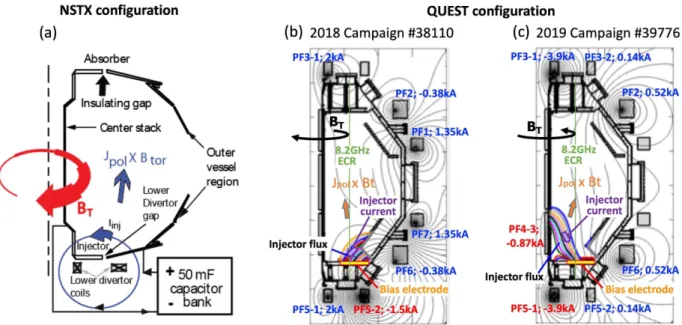
toroidal and poloidal magnetic fields. This is qualitatively shown in Fig. 1 (a). On QUEST, as briefly
described in Fig. 1 (b), a toroidal ring electrode is mounted on top of the existing lower divertor plate,
and the electrode separated from the divertor plate using a toroidal alumina insulator. Magnetic flux
generated by the lower divertor coils connects this electrode plate (the cathode) to the outer vessel (the
anode). Gas is injected in the gap between these electrodes and a 20-30mF capacitor bank, charged up
to 2kV is discharged across these electrodes to generate the CHI plasma. In the recent experiments
conducted during 2019, the electrode was biased with respect to the center stack on QUEST as shown
in Figure 1(c). This is more like the configurations used on HIT-II and NSTX.
Progress with CHI on QUEST
An area in which the implementation of CHI on QUEST is different from that on NSTX is that the
Poloidal Field (PF) coils that are needed for equilibrium control are much farther away from the CHI
electrodes and the power supplies that operate these coils have slower current slew rates than the ones
We acknowledge helpful discussions with Prof. Zushi, Mr. Noda (V-Tech Limited) and Mr.
on NSTX. In addition, the toroidal field capability of QUEST is much lower than that on NSTX. Both
these factors have made it more difficult to properly shape the injector flux into a narrow flux foot print
condition that is necessary for forcing reconnection to occur in the injector region. To improve the CHI
design for QUEST, during 2019 we conducted a test of CHI in a HIT-II/NSTX configuration to first
assess if some of the performance features for the HIT-II/NSTX configurations could be reproduced on
QUEST. If this is indeed the case, then this would provide the needed information to address the other
concern related to the improved positioning of the CHI injector coil with respect to the electrode.
Figure 1: (a) Layout of the transient CHI startup systems in NSTX. The blue circle is the poloidal injector flux produced by the lower divertor coils. This connects the two lower divertor plates, which are insulated. Gas is injected in the region below the divertor gap. On NSTX typically a 5 to 15mF capacitor bank charged up to 1.7kV is used to produce the injector current. (b) Typical vacuum field line configuration for CHI discharge initiation on QUEST. (c) Configuration of the new injector configuration used in the 2019 experiments.
Fig 2: Comparison of transient CHI discharges in the (a) old (bias to outer vessel) configuration and in the (b) new recently conducted experiments in 2019 in which the electrode is biased with respect to the center stack as on HIT-II and NSTX.
Figure 2 shows a comparison of two discharges
in which the injector region is different. When the
injector flux is formed between the bias electrode and outer vessel wall (the old configuration) [1],
the injector current flowing from electrode is very high but the toroidal current is comparable to the
injector current showing that the current multiplication ratio is about 1. The flux evolves but its
footprint becomes wide. When the injector flux is formed between the bias electrode and inner vessel
wall, the injector current is substantially reduced, and the plasma evolves with a narrow footprint
configuration to fill the entire height of the vessel (figure 1). In addition, the plasma current pulse
duration increases by several times that in the other configuration and the outer leg of the current
channel is much clearly defined. The latter result has many similarities to the discharges generated
by the conventional electrode on HIT-II and NSTX. References [2,3].
The main results from the new configurations are:
• Injector current drops to very low value, and the current multiplication ratio (toroidal current /
injector current) becomes very high, as on NSTX.
• The discharge pulse duration also dramatically improves
• The fast camera images show good resemblance to NSTX CHI plasmas; however, although the
injector current becomes very small, closed flux formation cannot be clearly ascertained at this
time.
These new experiments, however, are quite promising in that they have been able to reproduce many
of the important features seen on HIT-II and NSTX. An important difficulty that remains is that because
of the large distance between the divertor coils and electrodes, only a small portion of the coil flux
connects the electrodes, and our ability to shape this flux is also very limited. These new results now
provide a basis for improving the CHI injector coil location on QUEST. To further test this configuration
with an optimally positioned injector coil, a new (temporary) PF coil will be used during the 2020
experiments. The design work for this coil has now been completed, and a new low-cost capacitor
bank-based power supply is also now mostly built. The coil will be installed during January 2020. After a
successful test during 2020, a new (permanent) CHI coil could be installed on QUEST to support
detailed CHI + ECH studies in support of ST and tokamak reactor designs. We also note that, through
a collaboration with the University of Washington and PPPL, we are also conducting a conceptual
design study of the transient CHI configuration for the 3T ST-40 device in the United Kingdom.
References
[1] Kuroda K et al 2018 Plasma Phys. Contr. Fusion 60 115001.
[2] Raman R et al 2004 Phys. Plasmas 11 2565.
[3] Raman R et al 2011 Phys. Plasmas 18 092504
__________________________________________
We acknowledge helpful discussions with Prof. Zushi, Mr. Noda (V-Tech Limited) and Mr. Rogers (Univ. of
国際化推進共同研究概要
No. 8
19NU-2
タ イ ト ル: Plasma start-up and sustainment in spherical tokamak configuration by RF
研究代表者: SHEVCHENKO, Vladimir 所内世話人: 出射 浩 研究概要: Scevchenko さん分 令和2年1月30−31日の 2 日間で国際 WS を開催した。欧州から 1 名、米国から 3 名、国内の学外者が 7 名、別途、共同研究で訪れていた中国の研究者、応研関係者の参加があった。QUEST 実験の最近の進 展に加え、国内外実験の進展、新たなシミュレーション解析などが議論された。特に今年度は、新規の ST40 実験での発表があり、他の発表も加え、関連する QUEST での非誘導プラズマ電流立ち上げに関し、 共同研究が広く議論された。欧州方から1件、米国から2件、中国から1件、国内で9件の研究成果発表が あり、活発な議論があった。