MEMOIRS OF SHONAN
INST]TUTE OP TECHNOLOGV
VoL 28,No,1,1994
Feature
of
FarInfraredRadiation
-An
Overview
of
Its
BiomedicalApplication-TadashiFusE*
and
Masao
TAKi**
This
paper
presents
an overview ofthe
biomedical
applications offar
infrared
radiatien.Far
infrared
radiation of
5-30
micrometer wavelengthsis
dealt
within
the
case ofthe
applications utilizingincoherent
radiation, and wavelengthslonger
than
about30
rnicrometers aretaken
asthe
object ofinterest
when spectroscopic technologyis
concemed.First,
penetration
offar
infrared
radiationinto
biolegical
tissues
is
described
whichis
the
basis
for
the
biomedical
applications offar
infrared
radiation.
Second,
the
biomedical
application utilizingthermaL
effects offar
infrared
radiation;temperature
measurement,infrared
thermography
andphysical
therapy.is
reviewed.Third,
far
infrared
spectroscopy and relatedtechnology
are examined.From
the
spectroscopic point of view,millimeter waves and microwaves are also considered, especially when extremely
large
molecules ofthe
biological
bodies
are concerned,Finally,
possibility
of nenthermal effects offar
infrared
radiationto
the
biological
bodies
is
investigated
based
on atheoretical
modelproposed
by
H.
FrOhlich.
1.
Introduction
When
onediscusses
far
infrared
radiation,it
is
necessaryto
define
the
range of wavelengths offar
infrared
because
variousdefinitions
offar
infrared
exist.The
wavelengths of so calledfar
infrared
rangefrom
about25
micrometersthrough
1
millimeter.It
is
overthis
rangethat
the
rotation spectra appearin
molecules ofgreat
interest
to
the
discipline
of spectroscopy.0n
the
otherhand,
it
extendsdown
to
about5
micrometers
in
those
applications which utilizethe
energy offar
infrared
radiation such asinfrared
heating.
For
further
information
about
the
classificationof
far
infrared
radia-tion
in
terms
of wavelengths, referto
refer-encei},
Further,
in
this
latter
case,the
actualwave-lengths
ofinterest
are notlonger
than
about30
micrometers
because
the
emitted
energy
of
the
radiation
is
decreasing
sharplybeyond
30
mi-crometers.
Thus
the
term
far
infrared
is
actual-ly
usedto
denote
different
wavelength rangesseparately corresponding
to
far
infrared
spec-*
asfi]le]ijiSP
tyma,
**MRas.iZrt\I7zz
SIZut
5
al
lO
n
12
H・xr!Ltit
troscopy
orfar
infrared
heating.
So
wediscuss
far
infrared
radiationhere
accordingto
eachdefinition
explained
above.
That
is,
when
we
deal
withfar
infrared
applications utilizingin-coherent radiation, wavelengths of
5
through
30
micrometers
aretaken
as
the
wavelengthrange
for
discussion.
When,
however,
wedeal
with
far
infrared
spectroscopy orfar
infrared
technology
utilizing coherent radiation,wave-lengths
longer
than
about30
micrometers aretaken
asthe
object ofinterest
Furthermore,
from
the
viewpointof
continu-ity
in
the
nature ofcoherent
radiation,
whenwe
deal
withthe
technology
utilizing coherentradiation, millimeter waves and microwaves
will also
be
properly
included.
According
to
this
classification,the
biomedical
applicationsof
the
C02
laser,
whose wavelengths are1O's
ofmicrometers, are excluded.
This
subjectis
to
be
discussed
specificallyby
other experts.2.
Penetration
ofFar
Infrared
Radiation
into
Biological
Tissue
An
important
basic
knowledge
requiredto
discuss
the
biomedical
applications offar
infra-red radiation
is
the
penetration
characteristicsmaMIRFrt7keee
ag
28
g
ag
1
e
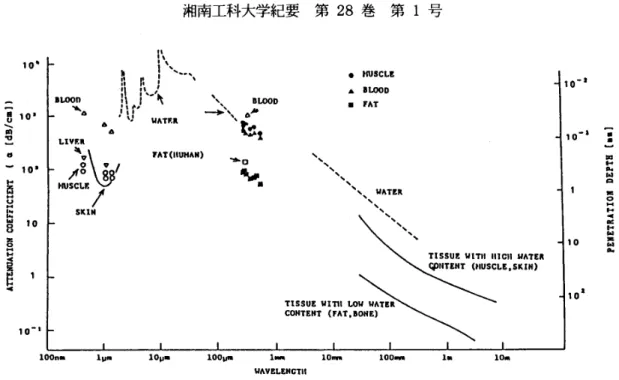
10-=: 10,taEti-loiklitrHltg loug:Eei( 10p- 100vn 1an 10"r- 100nt- 1" 10-V-VELEHCTIIFig.
1.
Attenuation
coeMcient ofbiological
tissues.
T=::es::zats-Figure
1
shows
the
attenuation coefficient ofbiological
tissue
to
electromagnetic radiationranging
from
radiowavesthrough
infrared
radiation2].
An
incident
plane
electromagneticwave
passing
into
the
materialis
regarded,in
most
cases,
as
attenuating
exponentially
asit
proceeds.
Although
various expressionshave
been
employedto
expressthe
quantity
ofthe
attenuation
depending
onthe
wavelengths,here
in
Figure
1,
the
attenuationcharacteris-tics
arepresented
in
terms
ofthe
attenuationcoeMcient,
in
dB/cm.
The
penetration
depths,
which are
defined
by
the
distance
wherethe
energy of
the
incident
radiation
is
decreased
to
e-i with respect
to
the
value atthe
surface, arealso
shown
in
Figure
1,
Because
the
biological
tissues
contain alarge
arnount
of
water
which absorbsfar
infrared
radiation strongly,
the
transparency
ofthe
bio-logieal
tissues
to
far
infrared
radiationis
verylow
asshown
in
Figure
1.
Consequently,
mostof
the
incident
far
infrared
radiation
passing
into
the
biological
tissue
is
absorbedin
the
vicinity of
it's
surface.Although
somebiolog-ical
tissues
with
less
water content show aslightly
higher
transparency,
the
values ofthe
penetration
depth
for
dehydrated
biological
tissues
are
no
more
than
three
times
larger
at
the
mostthan
those
attheir
naturalstate,
Judging
from
these
facts,
it
is
reasonablethat
the
present
biomedical
applications offar
in-frared
radiation
have
been
those
taking
advan-tage
oftheir
strong absorption characteristics,and very
few
biomedical
applications utilizingother characteristics of
far
infrared
radiationhave
been
seen
in
the
case
of
in
vivo
so
far.
3.
Applications
of
Far
Infrared
Radiation
to
Biomedical
Engineering
TemPerature
Measurements
andin,frared
71hermograPhy:
The
energydistribution
of
the
radiation emitted
frorn
ablack
body
at roomtemperature,
including
the
human
body
tem-perature,
shows apeak
around1O
micrometersin
wavelength.The
biological
tissues
alsoshow
large
valuesof
the
radiation
coefficients
at
those
temperatures
as well aslarge
values ofabsorption
coefficients,and
the
measurementson
the
temperatures
ofthe
human
body
sur-face
have
been
widelypracticed
utilizing
these
characteristics.
The
value of1.0
for
the
radia-tion
coefficient
ofthe
skin
surface
has
been
frequently
quoted
according
to
Hardy3L
It
has,
however,
been
pointed
outthat
Hardy's
method
of
measurement
was
incorrect
and
it
is
said
that
the
actual valueis
slightly smallerthan
1.04).
This
fact
canbe
aproblem
in
those
tempera-Eeature
of
Jinr
1}ofrared
Radiation
ture
ofthe
body
surfaceis
needed.Thermography
which supplies valuableclin-ical
information
is
one ofthe
mostfirmly
estab-lished
technologies
amongthe
medicalapplica-tions
ofinfrared
radiation.It
is
atool
for
obtaining
the
temperature
distribution
image,
which
is
formed
by
two-dimensional
scanningover
the
body
surface using radiationther-mometers.
It
takes
about1
secondto
accom-plish
oneframe
ofthe
image
by
means ofthe
existing optical scanning
technique.
Recently
the
SPRIT
detector
has
been
developed
whichdetects
pixels
on a scanningline
in
parallel
andwhich shortens
the
time
to
complete animage
to
about1/30
second.As
a consequence, ahigh
speed version of
time
seriesimages
ofthe
tem-perature
distribution
onthe
surface ofthe
human
body
has
become
feasible,
andhas
been
recognized
as
a
newtool
for
the
measurementof
physiological
functions5L
Those
methods measuringbody
tempera-tures
by
means
of
detecting
the
heat
radiated
from
the
body
surfacetake
advantage ofthe
high
emissivity ofbiological
tissues,
whichmeans a
high
absorptionin
the
biological
tis-sues as well,
This,
conversely,implies
that
the
temperature
measurementsby
means ofthis
method are
limitted
to
knowing
onlythe
sur-face
temperature
of
skin,
and
information
about
the
temperatures
atthe
deep
parts
of abody
cannot
be
given.
So,
anothertechnique,
whichis
alsobased
onthe
principle
of
radiation measurements,is
used
for
temperature
measurements onthe
deep
part
of abody.
This
uses microwaveswhose wavelengths are
far
longer
than
far
in-frared
radiation6).Rhysicat
Therupy
utitizinghar
infra7ed
Radia-tion:
A
thermal
therapy
usinginfrared
radia-tion
has
long
been
practiced
whichhelps
to
ease
pains
orto
promote
blood
circulation.In
many cases
infrared
Iamps,
whichget
their
infrared
radiationby
eliminatingthe
visiblecomponents
from
the
emittedlight
from
ther-mal
lamps,
have
been
used asthe
infrared
radi-ator.
In
those
casesthe
wavelength ofthe
infrared
radiationis
centered around1
mi-crometer.On
the
otherhand,
comparativelylow
tem-perature
heaters
whose surfaces are coatedby
ceramics
withhigh
emissivityfor
far
infrared
have
also
corne
to
be
employed recently.Al-though
favorable
effects offar
infrared
heating
on
human
bidoes
have,
sometimes.been
em-phasized
by
somepractitioners,
their
mecha-nisms,
however,
have
notbeen
clarified.Since
the
absorption offar
infrared
radiatienis
ex-tremely
strongin
biological
tissue
as
stated
in
section
2,
mostof
the
energy
ofthe
incident
far
infrared
radiationis
dissipated
nearthe
skin,say within some
100
micrometersin
depth
from
the
surface.Therefore
a
doctrine
of
"penetrability
of
far
infrared
radiationin
the
human
body",
whichhas
afterbeen
em-phasized
by
somepeople
in
the
field
ofthermo-therapy,
is
notdue
to
the
penetration
offar
infrared
radiationitselL
However,
far
infrared
thermotherapy
has
afeature
in
its
high
conversion
efficiency
from
the
electromagnetic
energyto
heat
energyin
the
biological
tissues,
The
far
infrared
thermo-therapy
alsohas
an advantage overthe
exist-ing
infrared
thermotherapy
in
terms
ofuni-forrnity
ofheating
which resultsfrom
the
fact
that
it
makesthe
size ofthe
light
sourcelarger
in
orderto
produce
the
necessary amount ofilluminance.
In
contrastto
this
method, adevice
whichheats
the
deep
part
ofthe
human
body
usinginfrared
lamps
equipped with aO.9-1.2
mi-crometer
bandpass
filter
is
commerciallyavail-able.
This
nearinfrared
version ofthermo-therapy
has
quite
oppositefeatures
to
far
infra-red version
in
that
it
heats
the
deep
parts
ofthe
human
body
suppressing erythema causedby
the
temperature
rise atthe
skin surface, sincenear
infrared
radiation with wavelengths ofO.9-1.2
micrometershas
an
extremely
high
penetrability
into
the
human
body7).
In
this
case,
the
ground
for
adopting nearinfrared
radiation as a means of
heating
is
clear.Although,
it
has
notbeen
clarified
whichis
preferable
as a means ofheating,
far
infrared
ornear
infrared,
the
result of astudy
comparing
the
heat
sensitivity ofthe
human
body
to
nearmeetIrv)it#eet
ag
28
g
ee
1
e
Matsui8).
According
to
these
results,
man
is
likely
to
feel
more "heatwith
pain"
whenex-posed
to
infrared
radiation(1.5-4.8
micrometerand
6-20
micrometer
wavelength>than
whenexposed
to
nearinfrared
radiation(O.72-2,7
micrometer
wavelength)under
the
same
amount of
illuminance.
As
Matsui
commented,near
infrared
radiationhas
high
reflectabilityas well as
high
penetrability,
therefore
the
netenergy
absorbed
by
a
human
body
is
small.These
characteristics arepartly
refiectedin
these
results.
So,
in
discussion
of
the
biological
effects of
infrared
radiation,it
is
necessaryto
compare
far
infrared
radiation
withnear
infra-red radiation
in
terms
oftheir
physiological
effects,
as
well
as
their
sense
of
warmth
at
equal values of specific absorption rate.
Besides
thermal
applicators
which
use
far
infrared
heaters,
atextile
sheet coated withceramics
of
high
far
infrared
emissivity
has
also
been
tested
for
therapeutic
applications.In
this
case noheaters
areinvolved.
Although
it
has
been
reportedthat
the
device
waseffec-tive
in
maintaining warmth,its
scientificbasis
has
notyet
been
illustrated.
In
short,
although
far
infrared
technology
has
come
to
be
introduced
into
various
branches
of medical application9).clear
illustra-tions
have
notbeen
given
a$to
whatis
the
crucial
point
for
each medical application ofthe
far
infrared
radiation.This
is
partly
due
to
the
fact
that
little
analyticalinvestigation
onthe
effects offar
infrared
radiation
onbiologi-cal
bodies
has
been
madebased
onthe
theory
of
heat,
Assessment
of
far
infrared
thermal
therapeutics
shouldproperly
be
made onthe
above
mentionedground$.
4.
Biomedical
Applications
ofFar
Infrared
Radiation
in
Terrns
of
Spectroscopy
har
infrared
SPectroscopy:
The
far
infrared
region of wavelengths
longer
than
about
30
micrometers
is
wherethe
molecular retationspectra are observed,
This
wavelength regionalso coincides with
that
ofthe
skeletalvibra-tions
ofthe
biological
macro-molecules.There-fore,
far
infrared
radiationis
important
in
the
spectroscopic study of
the
structure ofDNA
and
proteins
whichplay
important
rolesin
biological
bodies,
However,
far
infrared
spec-troscopy,
evenby
means ofthe
highsensitive
Fourie
transform
spectroscopy,has
notbeen
able
to
provide
sufficientinformatien
to
con-tribute
to
biomedical
engineering exceptfor
some
basic
research,This
is
because
far
infra-red radiation
is
strongly absorbedin
the
watercontained
in
the
biological
tissue$,
and alsobecause
the
spectroscopic experiments need anamount of specimen which
is
not availablefrom
the
biological
tissues,
The
extremelyhigh
cost
of
the
experimental
apparatusfor
far
infrared
spectroscopymay
also
have
impeded
the
spectroscopic experiments.Raman
spectroscopy
is
consideredto
be
more useful
to
obtain
information
in
the
far
infrared
region
from
biological
tissues
than
is
common spectroscopy
by
meansof
the
direct
use
of
the
far
infrared
radiation.
Thus,
present
spectroscopic researches
on
biological
materi-als
have
been
made mainlyby
means
of
the
low
oscillatingfrequency
Raman
spectroscopyexcited
by
visiblelight.
Considering
the
strong
absorption
of
far
infrared
radiationin
water,it
is
clearthat
this
methodis
superiorto
commonspectroscopy
for
the
biological
materialswhich,
in
most cases. containlarge
amounts ofwater.
The
longitudinal
acoustic modes areob-served
in
the
macro molecular chainsby
meansof
Raman
spectroscopy.Since
the
Raman
scat-tering
frequencies
areinversely
proportional
to
the
length
ofthe
ma ¢ro molecular chains,the
Raman
scattering
frequencies
observed
in
extremely
large
molecules ofthe
biological
bodies
range notonly
overthe
far
infrared
region
but
also extendto
rnillimeter waves andmicrowaves.
For
example,it
has
been
es-timated
that
the
Raman
scatteringfrequency
in
along
macro molecular chain such asthe
DNA
molecules wouldbe
6GHz
(O.2cm-i>tOL
Therefore,
from
the
spectroscopic
point
of
view,
far
infrared
radiation canbe
reasonablyconsidered alongside millimeter waves and
mi-crowaves.
The
photon
energy offar
infrared
radiationmole-Eeatute
of
thr
Icbared
Radiation
cules of
biological
material and alsoless
than
the
thermal
agitation energy at room andbody
temperature.
Therefore,
along withthe
strongabsorption
of
far
infrared
radiationin
biologi-cal
tissue,
there
exists
a continuityin
natureamong
the
radiation atthese
wavelengths,Ac-cordingly, when
investigating
the
biological
effects of
far
infrared
radiationin
terms
of
spectroscopy,
it
shouldbe
naturalto
considerwavelengths
beyond
1
millimeter and upto
the
mlcrowave reglon,
Although
the
present
state of art offar
infra-red spectroscopy
for
clinical applicationsis
far
from
promising,
it
is
consideredthat
its
impor-tance
to
basic
research willgrow.
Ilossibildy
of
IVbnthermat
Efacts:
Although,
apart
from
basic
research,far
infrared
radia-tion
has
notbeen
intreduced
into
clinicalappli-cations as
far
as weknow,
the
interaction
be-tween
the
electromagnetic radiationin
this
region
and
biological
bodies
is
attractinginter-est.
This
is
on
the
ground
of
the
safetyprob-lems
relatedto
the
effect of electromagneticradiation
on
biological
bodies,
These
safetyproblems
have
been
pointed
outfrom
variousfieldsii).
The
biological
effects of electromagneticra-diation
have
been
discussed
by
classifyingthem
into
two
categories, namely,the
thermal
effects and
the
nonthermal effects.The
ther-mal effects are
the
ones arisingfrom
the
tem-perature
risecaused
by
absorption
of
the
elec-tromagnetic
energyin
biological
bodies,
whilethe
nonthermal effects arethe
onesdeveloped
directly
by
the
electromagneticfield.
A
theoretical
modelproposed
by
H.
Fr6hlich
has
been
wellknown
sincethe
1960's
andwhich attempts
to
describe
the
mechanismsof
the
nonthermal effect ofthe
electromagneticfield
atfrequencies
from
submillimeter waves,the
longest
wavelength region offar
infrared
radiation,
through
microwavesi2).This
theoret-ical
modelis
summarised asfollows:
Coherent
oscillations existin
biological
bodies,
andthey
have
a nonlinearinteraction
between
them
whichplays
animportant
rolein
controllingthe
function
of
the
cells.
This
is
through
the
intervention
ofthe
energytransfar
between
the
large
number oftion
modesin
proteins
andthe
biological
membranes.
Fr6hlich
has
derived
the
following
conse-quences:
1)
The
oscillationshave
a metastablestate
with strong electric
polarization.
2)
In
the
casethat
energyis
appliedto
them,
the
oscillations concentrate on aspecific mode and an excitation with a
macroscopic order
takes
place,
3)
A
long
distance
interaction
between
the
oscillation modes of
identical
frequency
exlsts.
Fr6hlich,
based
on
these
consequences,has
also
predicted
that
electromagnetic radiationranging
from
far
infrared
radiationthrough
microwaves
has
nonthermal effects onbiologi-cal
bodies.
Among
the
early experiments with regardto
this
theory
is
a studymade
by
Webb
et
al.This
has
been
wellknown
andhas
shown
that
the
Raman
shiftlines
withlaw
wave number(
tr40
cm-i) are observed only at a
paticular
stage ofdevelopment
ofthe
synchronized active cellsofE coli
bacteria.
Their
studyhas
also shownthat
the
ratioR
ofthe
intensities
of anti-Stokes andStokes
Raman
shiftlines
of124cm-i
andef
118cm-i
of
active
EL
coti.B.
bacten'a
wouldbe
measured andfound
to
be
R21.0
whichis
far
abovethe
thermal
equilibrium value.This
implies
that
the
biological
system was excitedstrongly above
thermal
excitationi3),
Many
researches with regardto
Fr6hlich
model
followed
Webb
et al.'sand a symposium
on
the
subject washeld
in
1982i`L
Arnong
the
results of
those
studies,the
experimentscon-ducted
by
Grundler
et al, are noted as a verygood
agreement withFrOhlich
model.They
have
reported
that
the
growth
rate ofyeast
cultures was strongly enhanced or suppressed
under
the
influence
of millirneter wavesin
the
vicinity of
42GHz
according sharplyto
fre-quency
deviations
of only8MHzi5),
Despite
their
experimentsbeing
carried
out extremelycarefully
in
orderto
avoid
artifacts,Furia
et aLrepeated
the
experiment and reportedquite
mamr*gv<%Eg
eg
2s
g
eg
1e
problem
of nonthermal effects of millimeterwaves on
the
growth
rateof
yeast
cultures
has
not
yet
been
brought
to
a
conclusioni7).
Several
studies onthe
effect ofthe
electro-magnetic radiation on
the
functions
ofbiologi-cal membranes
have
been
reported andindi-cate
the
possible
influence
ofthe
electromag-netic radiation on
the
phase
transformation
of
the
biological
membranes and conformation ofproteinsi8)・i9L20}.
It
is
notedthat
all ofthese
researches were carried out
paying
attentionto
the
temperature
dependent
characteristics
of
the
function
of enzymes andthe
permeability
of
the
biological
membranes.If
the
electromag-netic radiation should
produce
physical
effectson
the
functions
of
the
biological
membranes,
then
possible
application of electromagneticradiation
to
controlling
the
function
of
the
membranes would
be
expected.Many
researches onthe
nonthermaleffects
of
the
electromagnetic
radiation onbiological
bodies
have
been
conducted at relativelylong
wavelengths
up
to
the
microwave region,This
is
due
to
the
needs arisingfrom
the
safetyproblems
associated withelectromagnetic
compatibility.
Readily
available
instrumenta-tion
at
the
high
frequency
regionup
to
micro-waves may
also
be
another reasonfor
much ofthe
research.However,
in
referenceto
the
Fr6hlich
rnodel,the
shorter wavelengthreg-ions
such as millimeter waves andfar
infrared
radiation are of
interest
in
terms
ofthe
interac-tien
between
the
electromagnetic
radiation
and
biological
bodies
in
association withthe
skeletal vibrations
in
the
biological
molecules.No
hard
experiments onthe
effects offar
infrared
radiation onbiological
bodies
has
been
reported, exceptfor
afew2}.
In
orderto
open a new
phase
in
the
application offar
infrared
radiation
to
biomedical
engineering,further
basic
investigation
about
the
interac-tion
between
far
infrared
radiation andbiolog-ical
bodies
is
necessary,5.
Con
¢ludingRemark
With
regardto
the
applications offar
infra-red radiation
to
biomedical
engineering,the
tendency
to
consider
biomedical
applicationsutilizing
thermal
effects offar
infrared
radia-tion,
and
the
possibility
ofbiomedical
ap-plications
in
terms
of
spectroscopyhas
been
reviewed.
In
short,the
present
state ofthis
discipline
is
premature
in
terms
ofbasic
knowl-edge except
for
someparticular
technology,
In
other words,
it
maybe
saidthat
the
far
infrared
region
has
sofar
been
exceptionally neglectedthroughout
the
entire wavelengthband
ofelec-tromagnetic
radiation.However,
the
technolo-gy
whichfi11s
upthe
gap
between
light
andmicrowaves
is
making
remarkableprogress
and so
it
is
anticipatedthat
the
application offar
infrared
radiationto
biornedical
engineer-ing
willbe
materialized stepby
step.
References
1)
1986
Joint
National
Convention
Record
of
tutions
ofElectric,
Information
and relatedgineers,
part
2
(1986),
25-49
(in
Japanese),
2}
T.
Fuse
andM,
Taki,
Paper
ofTech.
Group
on
Application
efLight
andVisual
Sence,
I.E.E.
Japan.
LAV-87-l
(1987)
(in
Japanese).
3)
J.
D.
Hardy
andC.
Mushenheim,
J,
Clinical
Invest.
13
{1934),
817-831.
4)
T.
Togqwa,
BME,
2,
3{1988),
156-160
{in
nese).
5)
L
Fujimasa,
BME,
2.
3
(1988),
180-184
(in
nese),
6)
S.
Mizushina,
BME,
2,
3
(1988),
171-174
{in
anese),
7>
T.
Arai,
O
plus
E,
70
<1985),
94-101
<in
nese).
8)
M.
Matsui,J,
Japan
So.
ofInfrared
Sc,
andTech.
12
(1987),
18-26
(in
Japanese).
9)
Kogyogijutsu-kai,
Up-to-date
Technology
of
Far
Infrared
Application
(1987)
(in
Japanese).
10)
M.
TsuboL
Kagakuno
Ryoiki
(Chemical
Field),
139-Ex,
(1983),
119-134
(in
Japanese).
11)
The
Ministry
ofPost
andTelecommunications,
Report
ofStudy
onElectromagnetic
rnent around
Establishments
utilizingmagnetic
Waves
(1987)
(in
Japanese).
12)
H,
FrOhlich,
Advances
in
Electron
Phys.
53
(1981),
85-152,
13)
S.
J,
Webb,
et at.Phys.
Let.
69A
(1979),
408.
14)
tations
in
Biological
Systems
{1983),
Verlag.
Aeature
of
har
inhared
Radiation
16)
L.
Furia,
et al,,IEEE
Trans,
BME,
BME-33
{1986),
993-999.
17)
S.
M.
Motzkin,
IEEE
Ninth
Anual
Conf.
Eng.
in
Med.
andBio.
Soc.
(1987},
446-447,
18)
M
Taki,
et at.9th
Int'1
Conf.
onInfrared
and
Millimeter
Waves
(1984),
24-25,
19)
J.
W.
Allis,
et al.Bioelectromagnetics,
3
(1987L