Bull. Mar..Sci. Ftsh. Kochi Univ.
'
No. 17, pp. 1-5, I997
Notes on a rare deep-sea eelpout, Melanostigma orientale,
from Tosa Bay, southern Japan (Perciformes, Zoarcidae)
Yoshihiko MAcHIDAi and Chung-Lyul LEE2
i Department ofBiology, Faculty ofScience, Kochi Universdy, 2-5-1 Akebono-Cho, Kochi 780, laPan 2 Dopartment ofBiology, College ofAiatural Science, Kunsan Nationat University, Kunsan 573-701, Korea
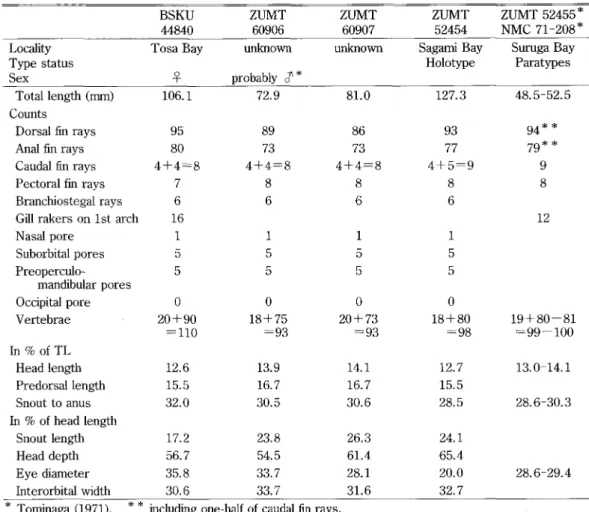
Abstract: A single, 106.1 mm tota1 length female specimen of the deep-sea zoarcid fish species, Melanostigma orientale, trawled from Tosa Bay was compared with the holotype and two hitherto unrecorded specimens from tmknown localities. This species has been represented by only four specimens collected in Suruga Bay and Sagami Bay, centralJapan. The following intraspecbic variation in meristic counts of M. orientale were confu;med: 18-20+73-90=93rllO vertebrae, 86-95 dorsal fin rays, 73-80 anal fin rays, 7-8 pectoral fin rays, 8-9 caudal fin rays and 12-16 rakers on the first giil arch. The specimen, from. Tosa Bay possesses 110 total
vertebrae, 90 caudal vertebrae, 95 dorsal and 80 anal fin rays, 7 pectoral fin rays, 16 rakers on the first gill arch,
and large and slightly recurved anterior jaw teeth which dfier from those of the holotype and additional specimens.
Key words: Melanostigma on'entale, Deep-sea zoarcid, Tosa Bay, Intraspecbic variation
INTRODUCTION
Fishes of the family Zoarcidae, commonly known as eelpouts, are broadly distributed in tropical seas to the Arctic and the Antarctic regions (Anderson, 1994). Hatooka (1993)
reported 64 eelpout species comprising 22 genera from Japanese waters. Of these,
Petroschmidtin albonotata and P. tayamensts are presently considered to be members of Lycodes, and AIIolePts hollandi should be transferred to the genus Bothrocara (Anderson,
1994). in addition, Deijuginin 1'aPonica is a junior synonym of D. ochotensis (Anderson, 1994). Machida and Ohta (1996) first recorded the occurrence of Taranetzella lyoderma from Sumga Bay, central Japan. Currently, 64 species and 21 genera of this family are known in the waters around Japan.
The deep-sea species, Melanostigma on'entale Tominaga, 1971, has been considered to be
endemic to Japan (Tominaga, 1971; Hatooka, 1993; Anderson, 1994). This species was
described on the basis of three specimens collected from the depths of Sagami Bay and Suruga Bay, though 'Anderson'(1994) noted the presence of four M. orientale individuals from theselocalities, indicating the presence of a single non-type specirnen. In 1988, a single specimen of
this species• was trawled from Tosa Bay, southern Japan, by the RIV Kotaka Maru of the
Nansei National Fisheries Research Institute. In addition, we had an opportunity to examine
two unknown locality specimens of M. orientale deposited in the Department of Zoology,
University Museum, University of Tokyo (ZUMT). Subsequent study of the fish revealed that this species exhibited remarkable intraspecific variation in some importnnt meristic characters and denta1 morphology. Therefore, we herein report our specimen in some detail.
Methods for measuring and counting generally followed Hubbs and Lagler (1958), and
terminology of the cephalic sensory pores followed Anderson (1994). Counts for venica! finrays and vertebrae including urostyle were taken from radiographs. The specimen is deposited in the fish collection of the Department of Biology, Faculty of Science, Kochi University
(BSKU).
Melanostigma orientale Tominaga, 1971 aapanese name: Konnyaku-hadaka-genge)
Fig. 1. Melanostigma orienlale, BSKU 44840,106.1 mm TL, from Tosa Bay.
Melanostigma on'entale Tominaga, 1971: 151
(original description); Hatooka, 1993: 909;
Anderson, l994: 38.
Material examined. BSKU 44840,
106.1 mm total length (TL), female with ripened eggs, 32059'19'N, 133035'52"E,
Tosa Bay, southern Japan, 700-720m, otter trawl, RlV Kotaka Maru, 21 Jun. 1988.
Comparative material. Three M.
ortentale specimens: ZUMT 52454,
holotype, 127.3 mm TL, probably male " ,
Sagami Bay, 26 Jan. I968; ZUMT
60906-60907, two specimens, 72.9-81.0
mm TL, sex unlmown, localities and date
unknown. [*after Tominaga (1971)]
Description.
Body elongate (Fig. 1), subcylir}drical Mouth oblique, small,
Nostril single in each side, with a short tube. Gill opening small, pore-like, situated just
along lower border of eye from
Preoperculomandibular canal running from behi pore. Occipital pore absent. Jaw teeth
teeth in jaws enlarged, sharp-pointed (Fig. 2).
o F. "i" tAit " arf i (8L. : e e c)}
bb
7
Do
o
QO
o
Fig. 2. Anterior orientale, part of head BSKU 44840. of Melanostigma Scale ! 5 mm.Counts and measurements are given in Table 1.
before pectoral fin base, compressed posterioriy.
the gape not reaching to a vertical from anterior margin of orbit (Fig. 2).
Eye large, covered with transparent spectacle. above pectorai fin base. Suborbital canal running
behind nasal tube to posterior margin of iris.
nd mandibular symphysis to below last suborbital conical, movable, arranged in irregular rows. AnteriorDEEP-SEA EELPOUT FROM TOSA BAY
3Table 1. Comparison of Melanostigma orientale specimens
BSKU
44840
ZUMT
609e6ZUMT
60907ZUMT
52454ZUMT 52455 *
NMC 71-208"
Locality Type status Sex Tosa Bay\
unknown probably 8"unknown Sagami Bay Holotype
Suruga Bay
Paratypes
Total length (mm)
Coumts
Dorsal fin rays Anal iiin rays Caudal fin rays Pectoral fin rays Branchiostegal rays Gma rakers on lst arch Nasal pore Suborbital pores mandibular pores Occipital pore Vertebrae in 9o of TL Head length Predorsai length Snout to anus ln 9o of head length Snout length Head depth Eye diameter Interorbital width 106.1
95
80
4+4=8
7 616
1 5 5 o20+90
=110
12.6 15.5 32.0 17.2 56.7 35.8 30.6 72.989
73
4+4=8
8 6 15
5
o
18+75
-93
13.9 16.7 30.5 23.8 54.5 33.7 33.7 81.086
73
4+4=8
8 61
5
5
o
20+73
-93
14.1 16.7 30.6 26.3 61.4 28.1 31.6 127.393
77
4+5=9
8 61
5
5
o
18+80
-98
12.7 15.5 28.5 24.1 65.4 20.0 32.7 48.5-52.5 94" "79"*
9 8 1219+80-81
=-99-1OO
13.0-14.1 28.6-30.3 28.6-29.4" Tominaga (1971),
**
including one-half of caudal fin rays.fin originating above middle of pectoral fin. Anal fin origin slightiy behind anus. Head, body and all fins covered with loose skin. Pelvic fins, scales and lateral lme absent.
Color in alcohol: Skm semitransparent without melanophores. Anterior part of head,
especially both jaws, dark brown, becoming paler posteroventrally. Areas around mandibular symphysis, gill openings and anus dark brown. Upper part of body with minute, light brown
spots. Peritoneum and orobranchial cavity black.
Discussion. The genus Melanostima comprised of seven species is externally
characterized by the following characters: 4-5 suborbital pores, gill slit a pore-like opening
above pectoral fin, single pair of nasal pores, flesh gelatinous, scales and pelvic fins absent,
vomerine and palatine teeth present, and 5-10 pectoral fin rays (Anderson, 1994). It has
18-23+62-81=82-100 vertebrae (Anderson, 1994). BSKU 44840, ZUMT 60906 and ZUMT
60907 were readily identfied as a species of Melanostigma from their external characters. Tominaga (1971) considered that M. orientale, which was described as the fifth species in the genus, differed from other Melanostigma spp. by higher counts of its vertebrae (more than 93) and dorsal and anal fin rays including one-half of caudal rays (more than 92 and 77,
respectively). The number of precaudal vertebrae of the holotype was given as 19 in the
original description, though the present study revealed it to be 18. The count of the present material is 20, and those of the two unknown locality specimens are 18 and 20. Pahn (1977) described M. inexPectatum from the western equatorial Pacdic as the sixth species in the genus. This species has 22+73=95 vertebrae, 95 dorsal and 76 anal fin rays, which include
one-half of the caudal fin rays, and 16 gill rakers on the first arch (Parin, 1977). The seventh
species in the genus, M. vitiazi, was described based on a single specimen taken from the
Banda Sea (Paim, 1979). Although M. vitinzi possesses 23+71 =94 vertebrae, the presence
of a single lateral 1ine in this species is mique in the genus (Parin, 1979; Anderson, 1994).
Apparently, M. onientale is closely related to M. inexPectatum (Anderson, 1994: fig. 54).
The counts of dorsal and anal fin rays including one-half of caudal im rays are 97 and 82 in the M. ortentale holotype, and 99 and 84 in BSKU 44840, respectively. These counts are 93
and 77 in ZUMT 60906, and 90 and 77 in ZUMT 60907, respectively. The number of caudai
vertebrae of ZUMT 60907 is less than that of the M. inexPectatum holotype accerding to Parin (1977). Although it is impossible to discriminate the four specimens exarnined in this study
from M. inexPectatum in the counts of dorsal and anal fin rays, the two are clearly different in
the counts of precaudal vertebrae. We, therefore, identified BSKU 44840, ZUMT 60906 and
ZUMT 60907 as M. orientale. Parin (1977) considered 16 rakers on the first gill arch to be one of the diagnostic characters of M. inexPectatum. The count of 16 in BSKU 44840 indicates that the two species are indiscriminate in this character. Parin (1977) also gave the following characters to be diagnostic of M. inexPectatum: head small, 9.0 times in TL (=11.19e), preanal distance 2.9 in TL (=34.59o), and eye small, 2.2 times in head length (=459o). We think that
it may be diracult to distinguish M. orientale irom M. inexPectatum in the former two
morphometuics, and the eye diameter of M. inempectatum is longer than that of M. ortentale. It is clear that the present species exhibits wider intraspecific variation in the proportional dimensions given in Table 1. Although Grinols (1966) mentioned that morphometric variation of M. Pammelas were not excessive, our result may suggest the difficulties in discriminating Melanostigma species from each other based on morphometric characters.
The counts for vertebrae, 90 caudal and 110 in total, of BSKU 44840 are hitherto unknown large numbers in the genus, i.e. 18 - 23 + 62 - 81 = 82 - 100 (Anderson, 1994). There are few known specimens in
each Indo-Pacific Melanostigma species
(Anderson, 1994). The present finding of
intraspecific variation in the vertebral count of M. orientale strongly indicates that there
is more intraspecific variation in this
character in the genus, at least for the
indo-Pacdic species. Hatooka (1993) gave the
pectoral im ray count of M. orientale to be
11, but his count is erroneous.
Anterior jaw teeth of BSKU 44840 are
externally visible. However, anterior upper jaw teeth of the holotype are hidden by theupper lip (Tominaga, 1971: fig. 1). We
confirmed this in the holotype (Fig. 3), andthere were no discrepancies between the
si
. " oCe
e-pQ
"v
Åé
Q
/
oo
D
o
o
o
Fig. 3. Anterior part of head of Melanostigma orientale holotype, ZUMT 53454, 127.3 mm TL, from Sagami Bay. Scale === 5 mm.
DEEP-SEA EELPOUT FROM TOSA BAY 5
holotype and two ZUMT specimens in this character. Jaw teeth of the four examined
specimens are all conical, and posterior teeth are shorter 'than anterior ones as in M. Pammeltzsreported by YarberTy (1965). However, anterior jaw teeth of BSKU 44840 are slightly
recurved and clearly longer than those of the holotype and two ZUMT specimens. According toAnderson (1994), jaw teeth of adult males of the genus Melanostigma are enlarged and
caniniform, and teeth in males are fewer than .in females. Unfortunately, we were not able to
deterrnine the sex of the three ZUMT specimens, though Tominaga (1971) considered the
holotype (127.3 mm TL) probably being male. BSKU 44840 (106.1 mm TL adult female)
suggests that enlarged anterior jaw teeth in female M. orientale may represent hitherto
unknown sexual dmorphism in the genus, or intraspecific variation in M. ortentale
ACKNOWLEDGMENT
We thank the captain arid crew of the R1V Kotaka Maru and tihe staff of the Nansei National Fisheries Research Institute, Kochi City for donation of the M. orientale specimen frorn Tosa Bay. Our cordial thanks also go to K. Sakamoto (ZUMT) for the loan of comparative material
in this study.,
REFERENCES
ANDERsoN, M. E., 1994. Systematics and osteology of the Zoarcidae (Teleostei: Perciformes). 1. L. B. Smith Jnst. IchthyoL, Jchthyol. Bult., 60, 1-120.
GRiNoLs, R. B., 1966. Nomhern records of the zoarcid, Metanostigma Pammelas, in the eastern subarctic Pachic region. CoPeia, 1966, 601rr602.
HATooKA, K., 1993. Zoarcidae. In T. Nakabo (ed.), Fishes of Japan with pictorial keys to the species. Tokai Univ. Press, Tokyo. pp. 898-913, 1343-1345. (inJapanese).
HuBBs, C. L. and K. F. LAGLER, 1958. Fishes of the Great Lakes region. Butl. Cranbroole Inst. Scr'., 26, 1-213. whcHmA, Y. and S. OHTA, 1996. First finding of the deep-sea eelpout, Taranetzella lyoderma, from Japan (Zoarcidae, Lycodinae). Ichthyol. Res., 43, 90-92.
PARiN, N. V., 1977. A new species of Melanostigma (Zoarcidae, Osteichthys), M. inexPectatum, from the westem equatorial Pacdic. Tmdy Inst. Ofeeanol., Akad. Alauk SSSR, 107, 63-67. (in Russian).
PARiN, N. V., 1979. Melanostigma (Bandichthys) vitia2i - a new deep-sea fish (Melanostigmatidae, Osteichthys) from the Banda Sea. V(ipr. Jlehitiol., 19, 150-153. (in Russian).
ToMINAGA, Y., 1971. Melanestigma orientale, a new species of zoarcid fish from Sagami Bay and Suruga Bay, Japan. IaPan. 1. Ichthyol., 18, 151-156.
YARBERRy, E. A., 1965. 0steology of the zoarcid fish Melanostigma Pammelas. Copeia, 1965, 442-462.
'