取干イ干取 取
Annual Report of Pro Natura Fund Vol.19 (2010
Breeding of the Black-faced Spoonbill Platalea minor
in Peter the Great Bay Primorye, Russia . Situation and prospects
Yu.V. Shibaev
1The history 1995-2009 of natural introduction of black-faced spoonbills Platalea minor into a new area is described. Their new breeding area - Furugelm Island, Peter the Great Bay, South Primorye - is over 600 km from the known ones. Eight years has passed since the species was first recorded there to the first trial of nesting. For the entire period of watch the process of occupation of the new area has had a positive tendency. The survey of the Peter the Great Bay coastal strip in 2009 showed an absence of black-faced spoonbills along the greater part of the coast. In 2009 two pairs of birds successfully nested on Furugelm Island. The re-sightings obtained from 5 color-banded spoonbills showed links with the wintering grounds in Japan, Hong Kong, China and Vietman. Possibility of the Platalea minor’s breeding at other sites of the Sea-of-Japan region is assumed.
The black-faced spoonbill is a rare, locally spread species with little abundance. It is included in the Red Books of various levels - regional, national and international.
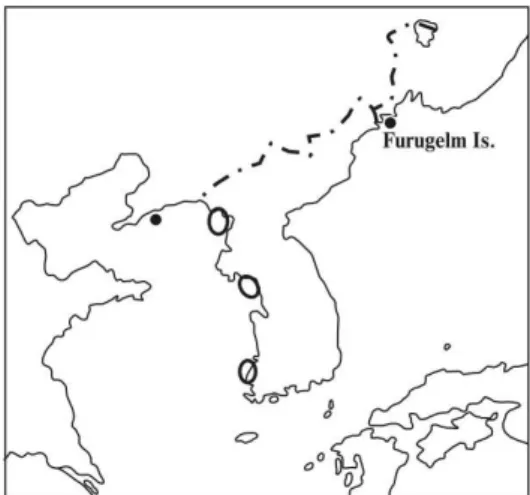
Until recently, this species was known to nest only in the Yellow Sea Basin Won 1994, Chong et al. 1996, Bird Life International 2001, Ueta at al. 2002 etc.. In our region, the black-faced spoonbill was first observed in the lower reaches of the Tumen River, North Korea territory, in the first half of the 20th century Yamashina 1941 . Thereafter, the species has never observed there until recently. True, there is a supposition that the vagrants of this species might be missed, assigning them automatically to occurring here white spoonbill Platalea leucorodia . In the 1990s, the researchers began to register the Black-faced Spoonbill in the South Primorye Nechaev and Shibaev 1996, Litvinenko and Shibaev 1999 . Currently, Platalea minor nests here regularly Litvinenko and Shibaev 2005 . The new place is more than 600 km away from the main breeding area and located in other region - Sea of Japan Basin Furugelm Island, Peter the Great Bay Fig1 .
1 Institute of Biology and Soil Sciences, FEB RAS
Fig1取 Nesting area of Platalea minor and new nesting point - Furugelm Island
取干イ平取 取 Fig2取 Study area
Sections in the coastal zone of the Peter the Great Bay in spring and autumn of 2009 1-22 . I-VII - islands with breeding colonies I - Furugelm Island, area where black-faced Spoonbills nest at present; VI - seabird colony ceased to exist; II - V, as well as Arsom Is. - islands theoretically suitable for nesting of black-faced spoonbill. Arrows show places of Pl. minor sighting during initial period of colonization .
Over a period of time, the southern Primorye and Peter the Great Bay are, in particular, of special scientific interest to the authors. The researches are carried out within the continent coastal strip and on the Bay's islands.
The Furugelm Island is a basic place of our stationary research.
The colonial birds are a basic object of attention. Here, the greatest breeding site of colonial birds in the Primorsky Krai is situated. On the Island, different species of cormorants, herons, gulls and auks nest. The Island is partially covered with the broad-leaved forest and characterized by abrupt slopes presented to the north and south-east. The distance to the continental coast is about 6 km.
Since the black-faced spoonbill began nesting on the Furugelm Island, our special attention has been concentrated on this species stationary observations - monitoring of a grouping .
Before 2009, a monitoring has been carried out mainly on the basis of the nesting ground of black-faced spoonbills on Furugelm Island. The stationary works on the Island have generally included the population estimate, nesting success, color banding etc. In 2009, they fell on May-July.
However, in order to reach the adequate estimation of Furugelm's Black-faced Spoonbill group condition, it was necessary to present the situation on the adjacent territories.
In 2008, our research was supported by PRO NATURA FUND the management of which thought good to give a grant. Therefore, we have extended the area under study in 2009.
取干イ年取 取
We consider the special surveys of the Peter the Great Bay coastal zone in 2009 for the purpose of detecting the black-faced spoonbills as an element of the rare species monitoring. The following factors have served as the reasons for surveys:
occurrence of individual birds Platalea minor on the coasts in the early stage of the species coming Nechaev and Shibaev 1996, Litvinenko and Shibaev 1999, Surmach 2003, personal communication Fig2 ;
availability of the feeding biotopes suitable from the physiognomic viewpoint; availability of unpopulated islets with sea birds colonies near the coastal line Fig2 .
Analysis of the cartographic materials allowed us to identify up to 22 areas Fig2 needing to be specially surveyed us potential Spoonbill sites on the Bay coasts. These are shallow bights, lagoons, estuaries and other types of shallow water areas looking suitable as the feeding cites for the black-faced spoonbill. These sections are associated with the known seabird colonies in the Peter the Great Bay.
Two surveys were carried out:
April 9 - May 9, 2009 early nesting period ; August 23 - September 24 post-nesting period .
A length of each route reached about 1400 km. Near 2/3 of them fall on the works themselves and 1/3 on the return to the departure point. The routes were identical. The surveys have been performed with the use of expeditionary high-mobility tracks as there are no smooth roads everywhere. The vehicles could be used as a berthing space. The rowing boat and outboard motorboat were also used. For observations, a telescope and 12X binocular were applied. For field reconnaissance, all elevated grounds and top of “box” of vehicle were used.
As the indicators of the biotope suitability for black-faced spoonbills in the absence of the black-faced spoonbills themselves , the resting or foraging water birds of other species are considered. Mainly these were various herons as well as gulls, waders, etc. The presence of people and their activity were also taken into consideration.
The survey should provide an estimate of the actual in case of birds' detection or theoretical suitability of particular areas for Platalea minor. The estimate of suitability of the observed coastal areas is not absolute. We had no opportunity enough time for carrying out the long and repeated investigations each of target place.
The task was complicated by the fact that the survey was carried out during not only breeding season but also during migration when the situation with birds abundance was very dynamic. For example, an absence of herons most important species - indicators at any place could be resulted from decreasing in migration rather than from a biotope inadequacy.
Thus, the situation should be refined afterwards within the “suspicious” sections.
Particular emphasis has been placed on the coastal territories near Furugelm Island. It is an area where our black-faced spoonbills feed. The territorial distribution of birds, presence of banded spoonbills were recorded and also camps of hunters for waterfowls within important Spoonbills' feeding habitats were mapped during the hunting seasons, both spring and autumn.
We had a chance to monitor the process of Black-faced Spoonbill expansion to the southern Primorye beginning from the time of its first appearance in the region.
1995 ― first sightings of Platalea minor on the Peter the Great Bay coasts Nechaev and Shibaev 1996 .
1996-2002 ― period of regular sightings Litvinenko and Shibaev 1999, Nechaev 2003, Surmach 2003, personal
取干イィ取 取 communication, Litvinenko and Shibaev 2005 .
2003 ― first unsuccessful attempt to nest on Furugelm Island. 2004-2009 ― period of annual successful nesting at this place.
Eight years passed from the moment the birds come to the first trial to nest and 9 years to the successful breeding. For 15 years 1995-2009 of the species settling in the new breeding area we observe a positive tendency: appearance, regular sightings, first breeding and stable reproduction. Every year, 2-3 pairs of Platalea minor are nesting on the Island. Now there is a real potential to increase the species abundance within the known breeding zone on Furugelm Island. In 2009, 2 pairs bred successfully there.
Information on the observed area and survey results 2009 is shown in Fig2 and Table1. As a whole, the obtained results reflect the situation with sufficient objectivity.
As expected, the southern 3 sections 1.2.5 proved to be the most suitable for Platalea minor as the feeding grounds and resting places. The sections 3 and 4 looks suitable but should be additionally refined. The sections 10-17 can be considered to be partially suitable see in Table1 .
Table1取 Information of the sections examined within the coastal zone of the Peter the Great Bay in spring and fall of 2009 1 Sections 1-5 are parts of “Tumen Wetland”. Territory is for a long time in need of the “Ramsar” status and
other protective actions Litvinenko and Shibaev 2001 . 2 Points of recording the single Pl. minor in the past.
取干イイ取 取
When evaluating the human activities within the Peter the Great Bay coastal area, three its lines should be noted: use of beaches and low-lying shores for summer holidays with sea bathing; meanwhile, the sea coast is actively developed: the tourist camps, hotels and roads are constructed and full transformation of the natural landscape is not infrequent; sport waterfowling during spring and autumn migrations; non-commercial fishing almost everywhere ; often, as the component of the summer holiday.
A general tendency is an increase in the human presence and activities within the coastal zone. This tendency will evidently continue afterwards.
The sections 1-5 constitute a part of the territory identified as a prospective and subjected to conservation wetland
“Tumen or Tumangan wetland” Litvinenko and Shibaev 1996, 2001 . Its effective protection is a goal of primary importance but, nevertheless it is not solved for many years. For the first time, attention was given to it more than 30 years ago Litvinenko 1982 .
When the perspectives of species in the southern Primorye are considered, the presence of a number of small islets with colonies of sea and land birds has engaged our attention Fig2. These islets are theoretically suitable for nesting of Platalea minor, however, their colonization in perspective is only possible in case of taking special measures for protection of the continental habitats associated with them. It is a difficult problem. Several islets Fig2 II, III constitute a part of the Far-Eastern marine reserve. Two others, IV, V Verkhovsky Islands, Karamzina Island should be included in the Reserve.
Nearby with colony on Furugelma Isl., on the Democratic People's Republic of Korea territory, there is one more inlet, Arsom Nando . On it, the seabird colony is located and this inlet is a protected territory Tsoy Kvasu and Chen Chan
取干イゥ取 取
Ir 2007 and, supposedly, suitable for nesting of black-faced spoonbills Fig2 .
A total lack of vagrant Black-faced Spoonbills within greater part of the examined coasts of the Peter the Great Bay is noteworthy. We have only observed birds in the immediate vicinity of Furugelm Island Table1 . The survey was quite meticulous - omission of birds is precluded. The shortage of suitable feeding grounds can not be cause of the birds’ absence. First, they exist and some of them look sufficiently suitable Table1 . Secondly, in the early stage of colonization, single Platalea minor were recorded on the Bay Fig2 Nechaev and Shibaev 1996, Litvinenko and Shibaev 1999, Surmach 2003, personal communication .
The probable cause of locality of the black-faced spoonbills sighting during surveys of 2009 is that, beginning with 2003, a certain “point of attraction” for all birds to nesting ground on Furugelm Island has appeared. Apart from breeding part of local Black-faced Spoonbill population there are also immature individuals or adults currently not involved in breeding spent all breeding season.
From 2006, a marking of few Black-faced Spoonbills is performed on Furugelm Island. We have marked only young birds in order to minimize an anxiety factor. In 2006-2009, 13 individuals were color-banded.
This work would be meaningless but for the situation was especially favorable. In the countries of the East Asia China, Taiwan, Republic of Korea, Japan and Vietnam , particular attention of specialists and many competent birdwatchers has been given to the fate of a rare species, Black-faced Spoonbill. They are fitted out excellent optical devices and photo equipment. Only due to a quick eye and interest of these people, the initial information of the occurrence of our birds outside their nesting area was obtained. The circumstance of especial importance is the yearly total winter censuses of Black-faced Spoonbills in which the organizers draw a large quantity of participants. At this time, a probability of detecting the birds with plastic bands marks should substantially increase.
Some information of encountered birds is given in Table2 and Fig3.
Some preliminary conclusions: During migrations and wintering, a small group its number reaches now not more than 1% of the total number of species of our birds is distributed within the considerable space, occupying the greater part of the species range. The birds reach the southernmost wintering grounds of Pl. minor Hong Kong, Vietnam . Most probably, it takes more than one season.
Most likely, the flyways continental and island coincide, to a large degree, with those for the major part of species Ueta et al. 2002 .
Over the course of one season, the birds from Furugelm Island may be recorded at different widely separated points evidently, they took different roads . Most probably, some of these situations can be explained by different origin of birds on Furugelm Island its occupation could be from different territories .
Information on distribution of our birds at the age of 1+ and 2+ years conforms to data by Ueta et al. 2002. At least, a part of our immature birds stays at the wintering ground or on the flyway. One of our birds stayed in Japan south-western Honshu Island while the other migrated along the shores from Hangzhou Bay China to Red River Vietnam .
取干イ可取 取
Table2取 Sightings of Platalea minor color-banded ringed on Furugelm Island Primorsky Krai, Russia in 2006-2008
Between July 12 and 29, 2006, we watched on Furugelm Island Pl. minor with rings that, as it turned out, was ringed by K. Ozaki Yamashina Inst. for Ornithology . The bird was ringed on Okinawa Island Japan on July 3, 2005 Right tibia - yellow ring No. J07 + metal ring; left tibia - combination of small plastic rings - blue/green .
Fig3取 Places of sightings and number of records of Black-faced Spoonbills ●1 ringed on Furugelm Island and Okinawa Island . Arrows show probable flyways.
取干イ拠取 取
Fig4取 Protected and needy to be protected territories on the utmost south-west of Primorsky Krai ... Boundary of the Far-Eastern Marine Reserve;
- - - Boundary of the natural park.
===== Territory and water area of “Tumen wetland”.
The perspectives of future stable existence of Platalea minor breeding population on the south of Primorsky Krai are related to species security assurance within the nesting ground and on the adjacent territories.
Furugelm Island where the species is now nesting is a part of the Far-Eastern Marine Reserve, organization within the limits of which any economical activities were precluded. The feeding grounds of these birds are located on the adjacent coasts and are overlapped entirely by other protected territory, Natural Park “Khasansky”. In Fig4, the location of these protected territories is shown.
However, if the nesting grounds are well protected then, as for the feeding biotopes, the situation is opposite. The Natural Park “Khasansky” established in 1997 is actually not protected territory. It is a place where waterfowling is traditional over the years. Fig5 illustrates this situation partly. The spring hunting season is relatively short and intensive 16 days in 2009 . The autumnal one is less intensive and longer more than 2 months .
As a rule, the actual hunter has a quick-firing, magazine arm and cross-country vehicle. The latter circumstance resulted in that there are no points inaccessible to him. As early as 1960-1980s, there were places which have not been reached by the hunters. There, migratory birds felt great security. However, a low level of the ecological awareness and biological incompetence of hunters remained unchanged since then. Therefore, the rare species of birds are as before killed. The principal criteria for firing necessity are same - object distance and its sizes generally, regardless of the species belonging .
取干イ拡取 取
The first of black-faced spoonbills noted in our area was killed and thrown out by one of such shot in 1995. The hunters let fly also at cranes Grus japonensis, Grus vipio , swans etc. We can not assert that it is a standard situation but such cases are not infrequent.
The serious threat to safety of Platalea minor as well as many other birds and seals feeding in the lower reaches of Tumen River is brought by industrial effluent discharge to the river. The waste waters are discharged by enterprises situated upstream on the Democratic People's Republic of Korea and Chinese territories.
It is needed: to transform the natural park “Khasansky” regional control level into the national park Federal control ; to increase a park territory including in it the Ptichye Talmi Lake Basin; to prohibit the spring hunting at first, on Primorsky Krai territory and, later on, on the Far-Eastern District territory .
It should be noted that the strong counteraction of the hunting “lobby” occurs.
Fig5取 Spring distribution of hunting camps within “Tumen wetland” at the beginning of the hunting season on April 1-3, 2005; opening of hunting season - April 2.
1 - one vehicle; 2 - 2-4 vehicles; 3 - 5-6 vehicles; 4 - more than 10 vehicles; 5 - higher grounds of territory; 6- boundary of the national park “Khasansky”.
取干ゥ0取 取
Fig6取 Autumn distribution of hunters within “Tumen wetland” on September 19-20, 2009; opening of hunting - September 5.
Legend - see Fig5 Solid line outlines the area of Platalea minor sightings.
取干ゥ干取 取
1 For the first time, a Black-faced Spoonbill has attempted to nest on Furugelm Island southern Primorsky Krai, Russia in 2003. The attempt proved to be unsuccessful. In succeeding years 2004-2009 , a situation has stabilized. Every year, 2-3 pairs bred successfully there.
2 Monitoring of forming of Furugelm’s Black-faced Spoonbill group in southern Primorsky Krai Russia 1995-2009 showed that this process is characterized by positive tendency.
3 The number of russian population of Black-faced Spoonbill is currently not exceed 1% of the world population.
4 The situation in the breeding colony is favorable. The Furugelm Island is a part of the Far-Eastern Biosphere Marine Reserve, organization with the status of strict protection.
5 At the same time, the feeding grounds on the continent are in practice not protected although they are located on the natural park “Khasansky” territory. It is needed to raise the natural park status local control to the national park federal control one.
6 Major threats to the local group of Black-faced Spoonbill are: Development by people of the coastal territories up to their full transformation tourism, summer holiday with sea bathing, noncommercial fishing etc. . Presence of many people anxiety factor ; Spring and autumn waterfowling; anxiety factor and direct destruction of birds; Pollution of the Tumen river including its delta with industrial waste of enterprises situated upstream China, DPRK .
7 A surveying the coastal zone of the Peter the Great Bay spring, early autumn showed that on the continental coast the Black-faced Spoonbills are only sighted within a zone of attraction to the known nesting ground on Furugelm Island. Occupation by them of other sections islands in the Bay is currently not likely.
8 The first results of color-banding ringing suggest that the birds migrate from Furugelm Island practically throughout the whole space of the species migration and wintering.
9 Estimating the development dynamics of events in the southern Primorye, we conclude that it conforms to the world population dynamics Yu Yat-tung and Wong Chi-chun 2006, etc. . Evidently, these processes are interrelated. It seems likely that the events in the global population as a whole induced some individuals to move to a new region.
10 The analysis of situation indicates that, most probably, the Black-faced Spoonbills might reach into our region from the Japanese wintering grounds.
11 We do not eliminate a possibility of nesting of Black-faced Spoonbills in other places of the Sea of Japan coasts. In particular, it seems that the islands in the Yonghung man Bay and also Arsom Nando Island
DPRK are suitable for this purpose.
We appreciate our foreign colleagues to operating information concerning the sightings of birds ringed by us: Dr. K. Ozaki Bird Migration Research Centre, Yamashina Institute for Ornithology , Mr. M. Ueta Wild Bird Society of Japan , Mr. Y.T. Yu Hong Kong Bird Watching Society , Mr. S. Chan Bird Life Asian Division , Mr. Nguen Duc Tu Bird Life Vietnam and Mr. K. Kirihara Yonago bird park .
The spirit of co-operation and amicability around the problems related to Platalea minor is productive and pleasant. Our surveys carried out in 2009 were impossible without special financial support. We are very much obliged to the
取干ゥ平取 取
Nature Conservation Society of Japan and the PRO NATURA FOUNDATION-JAPAN for the grant of “PRO NATURA FUND” awarded to us.
We thank our colleague and recommender Dr. Yu. Fujimaki for confidence, benevolence and patience.
Special gratitude is addressed to our colleague Mr. S. G. Surmach for assistance and co-operation during field studies as well as at a period of preparation of this manuscript. We thank our unfailing assistant in technical execution of manuscripts and our colleague V. N. Chernobaeva.
We appreciate our partners in the expeditionary works N. I. Gorlach and A. N. Katkov. Owing to their experience, optimism and unpretentiousness, all complications related to expeditionary living conditions rough roads, bad weather, transport breakdown etc. were successfully overcome.
Bird Life International. 2001. Threatened Birds of Asia. Cambridge U.K. The Bird Life International. 3030 pp. Chong J., Pak U., Rim Ch. and Kim T. 1996. Breeding biology of Black-faced Spoonbill Platalea minor. Strix, 14: 1-10.
Litvinenko N.M. 1982. On the necessary protection of Tumannaya River Mouth at the stopping – place of cranes. Cranes of East Asia, Vladivostok: Far East Science Center Academy of Sciences of the USSR, 92-97pp Russian .
Litvinenko N.M., Shibaev Yu.V. 1996. Importance of the Lower Reaches of Tumangan River for bird diversity Materials for organization of National park and additional Ramsar site // Birds of the wetlands of the southern Russian Far East and their protection . Far East Branch Russian Academy of Sciences, Vladivostok, 49-75 Russian .
Litvinenko N.M., Shibaev Yu.V. 2001. Birds of wetland “Tumangan” Biodiversity and problems of protection // The state of environment and biota of the southwestern part of Peter the Great Bay and the Tumen River Mouth . Vladivostok, Dalnauka, 2: 5-19.
Litvinenko N.M., Shibaev Yu.V. 1999. Some new ornithological records and observations from the extreme south-west part of Primorye. Russ. J. Ornithol, Express-issue 71: 9-16 Russian .
Litvinenko N.M., Shibaev Yu.V. 2005. Black-faced Spoonbill Platalea minor// Red Data Book Primorsky krai. Animals. Vladivostok, 209pp Russian .
Nechaev V.A., Shibaev Yu.V. 1996. Black-faced Spoonbill – Platalea minor Temminck et Schlegel – a new species in Russian fauna // Birds of the wetlands of the southern Russian Far East and their protection. Vladivostok. Far-Eastern Branch, Russian Academy of Sciences. pp.231-232 Russian .
Nechaev V.F. 2003. New information of the South Primorye birds, Russ. J. Ornithol. Express-issue, 210: 86-89 Russian .
Ueta M., Melville D.S., Wang Y., Ozaki K., Kanai Yu., Leader P.J., Wang Ch., Kuo Ch. 2002. Discovery of the breeding sites and migration routes of Black-faced Spoonbill Platalea minor. Ibis, 144: 340-343.
Won Pyong-oh. 1994. Recent discovery of Black-faced Spoonbill breeding in South Korea, Asian Wetland News, 7: 24-25.
Yamashina Y.A. 1941. Natural History of the Japanese Birds. Tokyo, 2: 1-1079.
Yu Yat-tung and Wong Chi-chun. 2006. The International Black-faced Spoonbill Census: 6-8 January. 33pp.
取干ゥ年取 取
ハュンヂダゝヴメンネ゙ルチ第19期 助成成果報告書 (2010
要約
ュク゚日曓海沿岸部 る
ェュゼメバメキウ個体群 調査
Yu.V. Shibaev
ェ ュ ゼ メ バ メ キ ウPlatalea minor 局 地 的
る生息数 少 い稀少種 ュク゚極東 ュク゚
連邦 国際的 ヤセチタヴシノセェ 挙 られ い
る ェュゼメバメキウ 1990 ハモペヴ
モ゠南部 記録 れ始 現在 繁殖 いる
ェ ュ ゼ メ バ メ キ ウ 1995 ヌ ム ヴ ダ ャ 大 帝
沿岸 初 記録 れ 1996~2002 定期的
観察 れるよう 2003 初 ネャオ
ャヘ島 繁殖 成 2004
~2009 毎 2~3 い 繁殖
生息地を明ら る ヌムヴダャ大
帝 大陸部 調査 必要 ある
2009 4暻 初 ら9暻20日 次 項 目 い
調査
1 ネャオャヘ島 定期的調査 繁殖結果調査
各昷期 状況調査 標識 実施
2 ネャオャヘ 島 繁殖 る 個体 大陸 採餌
利用 る地域 広 特徴
3 ヌムヴダャ 大帝 沿岸部 調査 ェュ ゼメバ
メキウ 採餌環境 適否評価
4 人 よる撹 乱 影響評価 ハモペヴモ ゠南部
る ェ ュ ゼ メ バ メ キ ウ 生 息 域 大 予
測 ジモヅレァケダスュツ゛極東海 自然保
護区 役割
ヌ ム ヴ ダ ャ 大 帝 沿 岸 部 調 査 5暻 初 8暻
曒~9暻 実施 調査 自動車を利用
島 最 近い地域ネャオャヘ島 繁殖 るェュゼメ
バメキウ 採餌場 調査 自動車を利用
結果 り ある
2009 ネャオャヘ島 3 い 繁殖 2
い 繁殖を成 幼鳥4羽 巣立 1 い
抱 段階 繁殖失敗 失敗 要因 近く 繁
殖 る大型ィペベ よる捕食 ある 幼鳥 全 親
大陸部 渡り 何回 観察 れ 幼
鳥 標識 れ いる 繁殖結果 例 並 あ
沿岸沿い 調査 ェュゼメバメキウ ネャ
オャヘ島近く 観察 れ 内 れ 外 地
域 観察 れ 考えられる 要
因 1 定着個体 数 少 い 2 10数
る 沿 岸 部 活 発 開 発家 屋 建 設 ヤ ェ モ
゠ヴクミル地域 る人 存在 ある
う 一 生 息 地 あ る デ キ ル 地 方 最 南 西 部ダ
ブル河沿い 撹乱要因 ヤェモ゠ヴクミル 訪
れる人々や狩猟春 秋 よる ある
全 体 ハ モ ペ ヴ モ ゠ 南 部 る ェ ュ ゼ メ バ メ
キウ 大 能性 回 調査 前 考え
られ い 大 く い 回 ヌムヴダャ大帝
沿 岸 調 査 よ り よ う 確 評 価 能
現在明ら 地域 るェ
ュ ゼ メ バ メ キ ウ 生 息 数 増 ハ メ ケ る よ う
保護対策 第一 採餌環境 必要性 ある
現 在 沿 海 地 方 ェ ュ ゼ メ バ メ キ ウ 個 体 群 全 個
体群 1% ある れ 非常 値 ある
稀少種 生活力を示 繁殖 る
いう 実 要 ある
推薦者:藤巻 裕蔵
取干ゥィ取 取