Article
Sustainability Concept in Decision-Making: Carbon
Tax Consideration for Joint Product Mix Decision
Wen-Hsien Tsai1,*, Jui-Chu Chang1, Chu-Lun Hsieh1, Tsen-Shu Tsaur2and Chung-Wei Wang1 1 Department of Business Administration, National Central University, No. 300, Jhongda Rd., Jhongli,
Taoyuan 32001, Taiwan; [email protected] (J.-C.C.); [email protected] (C.-L.H.); [email protected] (C.-W.W.)
2 Department of Business Administration, Fuzhou University of International Studies and Trade,
Fuzhou 350202, Fujian, China; [email protected]
* Correspondence:[email protected]; Tel.: +886-3-4267247; Fax: +886-3-4222891
Academic Editor: Giuseppe Ioppolo
Received: 22 September 2016; Accepted: 17 November 2016; Published: 26 November 2016
Abstract:Carbon emissions are receiving greater scrutiny in many countries due to international forces to reduce anthropogenic global climate change. Carbon taxation is one of the most common carbon emission regulation policies, and companies must incorporate it into their production and pricing decisions. Activity-based costing (ABC) and the theory of constraints (TOC) have been applied to solve product mix problems; however, a challenging aspect of the product mix problem involves evaluating joint manufactured products, while reducing carbon emissions and environmental pollution to fulfill social responsibility. The aim of this paper is to apply ABC and TOC to analyze green product mix decision-making for joint products using a mathematical programming model and the joint production data of pharmaceutical industry companies for the processing of active pharmaceutical ingredients (APIs) in drugs for medical use. This paper illustrates that the time-driven ABC model leads to optimal joint product mix decisions and performs sensitivity analysis to study how the optimal solution will change with the carbon tax. Our findings provide insight into ‘sustainability decisions’ and are beneficial in terms of environmental management in a competitive
pharmaceutical industry.
Keywords: carbon tax; time-driven activity-based costing (TDABC); mathematical programming; joint product mix; theory of constraints (TOC); sustainability decision-making
1. Introduction
There are many companies using the same raw materials in continuous production processing and that use the same processes to output joint products of two or more different characteristics or uses, such as the petroleum industry, chemical industry, steel industry and pharmaceutical industry. Such split-off joint products may be sold immediately or be further processed before being sold. The costs prior to the split-off point are joint costs, which are the main costs required for the production of various products; while the costs of additional processing procedures of some joint products are separable costs. After the split-off point, whether to sell or continue to process is subject to the marginal contribution of further processing, capacity resource constraints, market demands and other factors [1–3].
The Paris Agreement was signed by 195 nations on the 12 December 2015 to strengthen the global response to the threat of environmental climate change, which was in the context of sustainable development and efforts to eradicate poverty, after the 1992 United Nations Framework Convention on Climate Change (UNFCC) and the 1997 Kyoto Protocol. In Article 2 of the Paris Agreement, the increase in the global average temperature is anticipated to be held to well below 2◦C above pre-industrial
levels, and efforts are pursued to limit the temperature increase to 1.5◦C above pre-industrial levels
(United Nations, 2015). Carbon emissions are receiving greater scrutiny in many countries due to international forces to reduce anthropogenic global climate change. The carbon tax constraint is one of the most common carbon emission regulation policies that companies must incorporate into their production and pricing decisions. Activity-based costing (ABC) and the theory of constraints (TOC) have been applied to solve product mix problems; however, a challenging aspect of the product mix problem involves evaluating joint manufactured products, while reducing carbon emissions and environmental pollution to fulfill social responsibility. Many scholars have proposed using TOC, ABC and linear programming (LP) to solve the product mix problem and obtain the optimized results [1,4–8]. TOC assumes how companies make the most efficient use of resources under existing resources; thus, the model is suitable for short-term decision-making. ABC assumes that all resources can be allocated according to activities, which are then allocated to cost objectives based on the activity drivers. Furthermore, it enables enterprises to recognize value-added and non-value-added activities in order to improve the use of resources; thus, the model is suitable for long-term decision-making.
The conventional ABC model contains a large number of activities. With the changing growth scales of business operations or production processes, in order to measure the different resources used, as well as the costs attributable to operations and production, new activities must be constantly added, which renders production more complex. In addition, many complex cost drivers require the subjective estimates of staff; thus, allocation percentages are also subjectively set by staff, which may lead to various product mix decision-making results due to subjective differences. If the conventional ABC method does not fully use time drivers, it may overlook potential unused capacities regardless of whether resources are fully used, and they will be attributable to the product cost [9]. To achieve higher accuracy, activities must be piecemealed; however, more piecemeal activities can easily create too large a database. In addition, when there are multiple constraints and integer solution assumptions in TOC, there may not be an optimal solution [10,11]. Although Fredendall and Lea [12] suggested that the optimal solution can be obtained by repeated solution-finding iterations, such an approach will become more complex in the face of added constraints; thus, enterprises will gradually pay more than the exact cost in order to obtain more accurate cost information for consideration.
Therefore, in 2004, Kaplan and Anderson proposed time-driven activity-based costing (TDABC), which is mainly based on the total time of an activity as a cost allocation basis. TDABC applies time drivers directly from the resource to the cost objective, omits the time-consuming and subjective estimates of the first stage and does not require an estimated time percentage investment for each activity at the second stage. Compared to the conventional ABC model, it can better reflect the complex realities and time differences of different activities [13–15]. In addition, in the conventional ABC model, the costs of activity centers are attributed to cost objectives without considering the capacity use of the activity centers. TDABC measures resources used according to output, where only the costs of use (time) is attributed to the cost objective; thus, enterprises can clearly recognize whether the resources of each activity center have been adequately used [16]. With limited resources, companies pursue long-term profits, while reducing environmental pollution, to fulfill social responsibility [17–19]. Therefore, joint product mix decision-making should consider the marginal contribution of continuous processing, capacity resource constraints, market demand and other factors [1,3,4], as well as reducing pollution emissions [20]. As TDABC is a new management tool, previous relevant research literature on TDABC is relatively limited [14,16,21].
green decision-making. The remainder of this paper is organized into four sections. Section2details the literature regarding the concepts of the carbon tax, TOC, ABC and TDABC in the pharmaceutical industry. This study develops the TDABC model for joint product decisions in Section3. A numerical example is used to demonstrate how to solve these models with MIP through sensitivity analysis and under the possible constant carbon tax, to lead to an optimal solution in Section4. Finally, this study presents the conclusions in Section5.
2. Literature Review
2.1. Carbon Tax
Carbon taxes are important and aim to reduce the carbon emissions that are directly related to the carbon content of fuels. In the green building industry, the management of carbon emissions from green building projects contributes to the acquisition of accurate building cost information and reduces the environmental impact of these projects. The levying of carbon taxes also increases building costs for construction companies. With the heightened awareness of corporate social responsibility (CSR), construction companies must consider carbon emission costs to help accurately predict building costs and reduce the project’s overall impact on the environment [22]. Therefore, carbon taxes are levied according to the emission price per ton. In fact, carbon taxes are an important policy tool for environmental protection, as it prompts companies to pursue optimal environmental management under tax considerations.
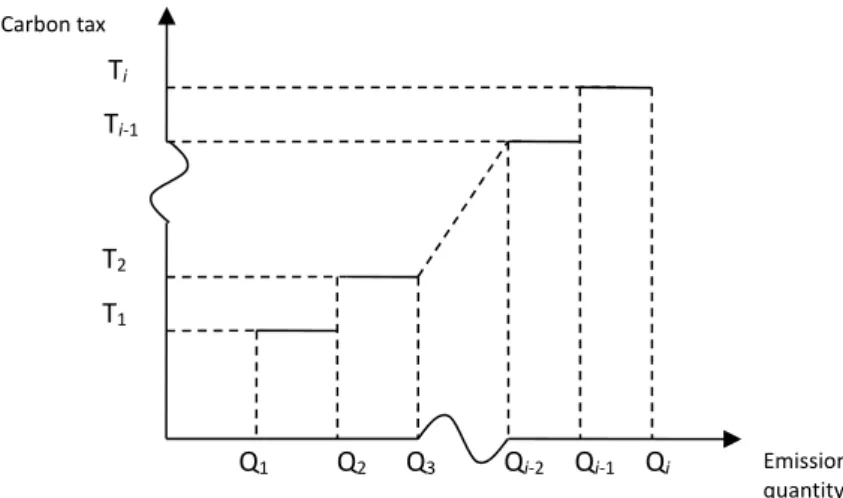
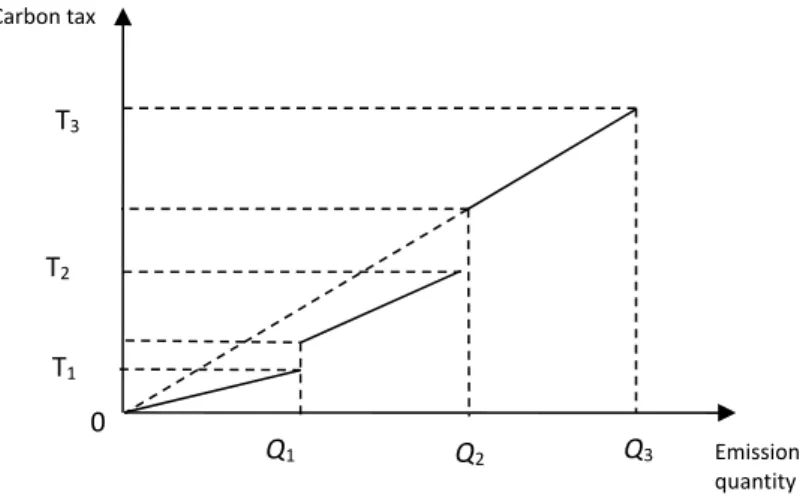
Currently, carbon taxes are assessed differently from country to country due to variances in environmental policies, and companies must incorporate carbon taxes in their production and pricing decisions. This study intends to explore the effects of carbon tax levy methods on joint product mix decisions. Figure1presents the minimum threshold for carbon taxes (i.e., no taxes below the thresholds). Figure2shows the levy of carbon taxes at a specific tax rate in the absence of tax thresholds. Figure1illustrates the fixed tax rate schedule once the threshold has been surpassed. Figure2shows the full progressive tax rates once the threshold has been reached. A higher rate is imposed on higher carbon contents, and all carbon content levels are accompanied by corresponding progressive rates. While the full progressive tax system reports better results in carbon reductions, the extra progressive tax system seems a more reasonable approach, as the latter allows for different rates at different carbon levels and can create a meaningful impact in carbon reductions.
Ti
Ti-1
Emission quantity Q1 Q2 Q3 Qi-2 Qi-1 Qi
T2
T1 Carbon tax
T1 T3
Emission quantity T2
0
Q1 Q2 Q3
Carbon tax
Figure 2.The full progressive tax rate.
2.2. Concepts of ABC and TDABC
Kaplan and Cooper first proposed ABC in 1988, which was mainly to overcome the distorted situation under the conventional cost accounting system and cost of subsidies [23]. The disadvantage of the conventional cost system is the assumption that the cost allocation basis of manufacturing costs is quantity related. In fact, not all manufacturing costs and quantities are related; therefore, the conventional cost system may cause cost distortions, leading managers to make erroneous pricing decisions. When the proportion of enterprise manufacturing costs and the degree of product diversification are higher, the possibility of cost distortion through the conventional cost accounting system is higher. The adoption of the ABC method can provide enterprises with value-added information and non-value-added costs in a systematic manner, in order to generate a more precise and efficient performance with sustainable consciousness [24].
ABC uses a two-stage cost allocation method, which considers resource drivers and activity drivers. At the first stage, the correlation between resources and activity costs is analyzed by planning the resources into a number of activity centers. At the second stage, the appropriate cost drivers are determined according to different activity levels (e.g., unit-level, batch-level, product-level, facility-level), in order to summarize cost databases before attributing costs to cost objectives, thus obtaining reliable cost allocation information [9,25]. Kaplan and Cooper argued that ABC emphasizes the relationship between the activities and the consumption of resources; therefore, it can provide product decision-making information and help managers with decisions regarding product design, pricing, product mix, marketing and process improvement [26].
cost objective and simplify cost steps to reduce the risk of the non-objective estimation of drivers due to the number of cost allocations during the computation process [28,29].
Another feature of TDABC is the use of a time equation to express the complexity of the actual operation, as follows:
Y=β0+β1χ1+β2χ2+. . .+βiχj
whereβ0is the standard time of basic activities;β1(i= 1, 2, . . . ,n) is the estimated time for additional
activities;χj(j= 1, 2, . . . ,n) is the events of the additional activities, which can be a continuous variable,
an intermittent variable or a dummy variable [28]. Pernot et al. (2007) pointed out that TDABC can clearly demonstrate how long it takes to complete a certain activity, which can increase transparency, as compared to the conventional cost accounting system or ABC [13,30]. Varila et al. (2007) argued that it is more suitable to use time drivers rather than activity drivers if the resource consumption and time are directly correlated. By case study, they found that complex activities cannot be measured by ABC’s single activity driver; therefore, they proposed using bar codes, radio frequency identification (RFID) and other automatic data collection (ADC) methods in order to improve the disadvantages, including manual collection time, costs and the impossibility of immediate updating [31]. Kaplan and Norton (2008) mentioned that TDABC can predict the required production capacity according to future sales targets and is mainly used to determine required production capacity according to previous experience. When productivity or processes are improved, it can easily update time equations, estimate the resources required to determine the number of required staff and equipment and predict future profits, in order to understand profitability through the preparation of expected profit and loss accounts [32,33].
2.3. Applying TOC and ABC to Product Mix Decision-Making
In recent years, sustainable development strategies for enterprises have become an important global issue, as it is very important to create sustainable competitive advantages for enterprises. Enterprises must consider the shortage of resources, time, personnel and money, by selecting the optimal management systems under resource constraints, know how to cope with the interdependencies among various criteria, deal with constraints on resources and demonstrate how to select management systems for phase implementation [34].
TOC, as proposed by Goldratt and Cox, is mainly to resolve short-term product mix and processing bottleneck resource problems, as it improves the method of the conventional cost accounting system, which hinders the effective output of a company, and argues that all organizations have restrictions that will affect the operation of the entire organization. Therefore, bottlenecks can be identified by TOC, which improves such limitations [35].
product mix [8], found that the bottleneck factors determine the level of product mix flexibility and that bottleneck improvements make a better contribution to non-bottleneck improvements.
2.4. The Pharmaceutical Industry Joint Product Mix Decision-Making
In the pharmaceutical industry, the joint production process from APIs’ processing to drugs for medical use is very complex. By case study combined with TOC through accurate cost analysis, it can assist managers in joint product mix decision-making analysis. Regarding joint products’ optimal product mix decision-making, Hartley (1971) discussed the further processing or direct sale of joint products after the split-off point by using mathematical equations to determine how many of the joint products should be sold and how many require further processing after the split-off point [3]. Tsai et al. (2007) used the algorithm to analyze the optimal joint products mix decision-making of TOC [38]. Tsai and Lai (2007) took further advantage of mathematical planning, as combined with TOC through accurate cost analysis, to design an activity-based cost decision-making model that enables companies to maintain a balance between internal production and outsourcing [39]. Tehrani and Michelot (2009) used the actual case of a refinery to discuss the effective use of the LP mathematical model for allocation regarding joint costs [40,41]. Tsai et al. (2013) combined the activity costing system and TOC to propose using the LP mathematical model to analyze product mix optimization decision-making in the case of a green manufacturing system, while considering continuous improvements of scale and other factors [20].
As TDABC is a new management tool, the relevant research literature is relatively limited. This paper uses information relating to the process of the pharmaceutical industry from APIs to drugs for medical use, in order to establish TOC, ABC and TDABC joint product mix models. The MIP method is used to solve the problem of the optimal joint products mix, analyze the resources used and determine the further processing or resale of the joint products after the split-off point. The findings can provide reference for managers in decision-making.
3. Models for Joint Product Mix
Most previous studies proposed using TOC or ABC to solve product mix problems. This paper establishes TOC, TDABC and ABC joint product mix models and sensitivity analysis with the carbon tax. In order to maximize total profit under various resource constraints, the case company, which produces joint products, must assess the desirability of further processing of such joint products after the split-off point. Three decision models for joint products mix are presented in this paper, and a simplified case is used to demonstrate the process of decision-making and profit analysis under each model. It is assumed that the case company can plan according to the current production capacity, but cannot increase the production capacity of activities in the case of insufficient production capacity. The mixed integer programming (MIP) method is used to obtain the optimal joint product mix, analyze the resources used and determine whether joint products should be directly sold or be further processed after the split-off point, and the models are compared in order to determine the model that can maximize profits.
3.1. Notations
3.1.1. Decision Variables
The following are the notations of the decision variables used in this paper:
π is the company’s profit;
η0 is the quantity of material APIs for the production of the joint product;
ηi0 is the production quantity of joint productDi0at the split-off point;
ηi1 is the quantity of joint productDi1processed further in a separate process after the split-off point;
gi is the units ofDi1products produced by processing each unit ofDi0products after the split-off
point (coefficient of processing production after the split-off point); βi0 is the batches of joint products;
βi1 is the batches of products processed after the split-off point;
δi0 is the quantity of a shipment of joint productDi0;
δi1 is the quantity of a shipment of productDi1processed further in a separate process after the
split-off point;
Ri0 is the demand for joint productDi0;
Ri1 is the demand of productDi1after the split-off point;
σ1 is the tableting department labor/hour production capacity;
σm is the production capacity of tableting machine operating hours;
σ0 is the order processing and tableting control department production capacity;
σδ is the shipping department production capacity;
στ is the pharmaceutical inspection capacity;
συ is the VOCs’ disposal capacity;
τi0 is a zero, one variable; if joint productDi0is not produced, it is zero; otherwise, it is one;
τi1 is a zero, one variable; if productDi1is processed further in a separate process, but is not produced
after the split-off point, it is zero; otherwise, it is one.
3.1.2. Parameters
The following notations of the parameters are used in this paper:
Xi0 is the unit price of joint productDi0at the split-off point;
Xi1 is the unit price of joint productDi1processed further in a separate process after the split-off point; MA0 is the unit price of material APIs for the production of the joint product;
MAi1 is the unit price of material APIs for the further processing of the joint products; FC is the marketing, plant guard and management costs;
tli0 is the direct labor hours demanded for the production of joint productDi0;
tli1 is the direct labor hours demanded for the production of productDi1processed further in a
separate process after the split-off point;
tmi0 is the hours for the operation of the tableting machine for the production of joint productDi0; tmi1 is the hours required for the processing and production of productDi1after the split-off point; tbi0 is the time to initiate the tableting machine for joint productDi0;
tbi1 is the time to initiate the tableting machine for joint productDi1processed further in a separate
process after the split-off point;
toi0 is the time of order processing of joint productDi0;
toi1 is the time of order processing of joint productDi1processed further in a separate process after
the split-off point;
tci0 is the time to shift each batch of APIs for joint productDi0to the tableting department;
tci1 is the time to shift each batch of APIs for joint productDi1processed further in a separate process
after the split-off point to the tableting department; tδi0 is the time to ship joint productDi0;
tδi1 is the time to ship productDi1processed further in a separate process after the split-off point; tpi0 is the time to package each unit of joint productDi0;
tpi1 is the time to package each unit of joint productDi1processed further in a separate process after
the split-off point;
tτi1 is the time for inspection of productDi1processed further in a separate process after the
split-off point;
tvi0 is the time for the disposal of each batch of volatile organic compounds (VOCs) produced in the
production of joint productDi0;
tvi1 is the time to for the disposal of each batch of volatile organic compounds (VOCs) produced in
the production of productDi1processed further in a separate process after the split-off point; bi0 is the quantity of joint productDi0of each batch;
bi1 is the quantity of joint productDi1of each batch; si0 is the quantity of each shipment of joint productDi0; si1 is the quantity of each shipment of productDi1;
kl is the unit labor hourly costs of the tableting department;
km is the unit tableting machine’s operating cost per hour;
k0 is the unit labor/hour costs of the order processing department; kδ is the unit labor/hour costs of the shipping department;
kτ is the unit pharmaceutical inspection hourly cost.
3.2. The TDABC Model
This paper establishes a new product mix model using the TDABC concept, which considers production capacity limitations and market demands. Moreover, it analyzes the resources used and whether joint products should be directly sold or be further processed after the split-off point. The models are compared in order to determine the model that can maximize profits. Unlike ABC, TDABC can directly allocate resources through objective time drivers to cost objectives by omitting the first stage, which requires time and subjective estimations of the time consumed for each activity. In addition, through this model and based on future market demands, this paper predicts the resources required to determine how to use resource capacity and, thus, makes optimal product mix decisions. The company’s profit objective function and constraints can be expressed as follows:
MAXπ=total revenue−total APIs cost of common processes and separate processes−labor
costs of tableting−costs of tableting machinery−order processing costs−shipping costs−inspection
costs−VOC disposal costs−sales administrative costs.
MAXπ = (∑n
i=1Xi0ηi0+ n ∑
i=1Xi1ηi1) −(∑n
i=1MAiηi1/gi+η0MA0) −(∑n
i=1tli0klηi0+ n ∑
i=1tli1klηi1) −(∑n
i=1tbi0klβi0+ n ∑
i=1tbi1klβi1+ n ∑
i=1tbi0kmβi0+ n ∑
i=1tbi1kmβi1) −[∑n
i=1(toi0+tci0)koβi0
+∑n
i=1(toi1+tci1)koβi1] −[∑n
i=1(tδi0δi0+tpi0ηi0)kδ + n ∑
i=1(tδi1δi1+tpi1ηi1)kδ] −[∑n
i=1(tτi0kττi0) + n ∑
i=1(tτi1kττi1)] −(∑n
i=1tvi0kvβi0+ n ∑
i=1tvi1kvβi1)
−FC
(1)
Constraints:
η0= n
∑
i=1
(ηi0+ηi1/gi)/ωi,i=1, 2, . . . ,n (2)
ηi0÷βi0=bi0,i=1, 2, . . . ,n (3)
ηi1÷βi1=bi1,i=1, 2, . . . ,n (4) n
∑
i=1
(tli0ηi0+tli1ηi1+tbi0βi0+tbi1βi1)≤σl,i=1, 2, . . . ,n (5)
n
∑
i=1
n
∑
i=1
(toi0βi0+toi1βi1+tci0βi0+tci1βi1)≤σo,i=1, 2, . . . ,n (7)
ηi0÷δi0=si0,i=1, 2, . . . ,n (8)
ηi1÷δi1=si1,i=1, 2, . . . ,n (9) n
∑
i=1
(tδi0δi0+tpi0ηi0+tδi1δi1+tpi1ηi1)≤σδ,i=1, 2, . . . ,n (10)
n
∑
i=1
(tτi0τi0+tτi1τi1)≤στ,i=1, 2, . . . ,n (11)
0≤ηio≤Ri0τi0,i=1, 2, . . . ,n (12)
0≤ηi1≤Ri1τi1,i=1, 2, . . . ,n (13) n
∑
i=1
(tvi0βi0+tvi1βi1)≤σv,i=1, 2, . . . ,n (14)
Equation (1) represents the objective function, which suggests that the company is in pursuit of profit maximization. Equations (2)–(14) are constraints. Regarding Equation (2), the joint production process of a joint product may produce joint products of different percentages; thus, each joint product and the quantity of joint input APIs have different proportions, whereωiis called the first processing
production coefficient. Therefore, the quantity of the joint products, as produced by inputting the APIs, is the multiplication of the joint product’s first processing production coefficient and the quantity of the common input APIs. In addition to direct sales, the produced joint products can be processed by a second process in order to produce different types of joint products. In the second processing process, the quantity of the joint products can be changed according to a certain percentage of the quantity of joint products at the split-off point. Therefore,giis the second processing production coefficient.
However, as the joint products produced in the joint production process are not necessarily processed for a second time, they can be directly sold. Hence, the addition of the directly sold joint product quantity at the split-off point and the quantity of products for the second processing equals the quantity of the joint products produced in the joint production process; Equations (3) and (4) ensure that the product quantity is the times of the batch; Equation (5) is to ensure that the tableting department’s labor hours will not be more than the maximum labor production capacity; Equation (6) is to ensure the tableting machine operation and initialization machine hours are not more than the maximum machine hours of production capacity; Equation (7) is the production capacity limitation of the order processing and tableting control department; Equations (8) and (9) are to ensure that the quantity of the products is the times of the shipping times; Equation (10) is the limitation of the shipping department’s production capacity; Equation (11) is the pharmaceutical inspection hourly production capacity; Equations (12) and (13) are the demand capacity. In other words, if a product is not produced, thenτioorτi1=0 will result in Equations (12) and (13)qi0orqi1=0; conversely, if it is produced, then
τioorτi1=1 will result in Equations (12) and (13) 0≤ηi0≤Ri0or 0≤ηi1≤Ri1; Equation (14) is the
3.3. TOC Model
The assumptions of TOC and TDABC (ABC) are different; the assumption of TOC is based on the resources supplied, while the assumption of TDABC (ABC) is based on the resources used. Namely, in addition to materials, TOC assumes that no resources will change with production output, while TDABC (ABC) argues that related resources, in addition to materials, are controllable to prevent unused production capacity. Therefore, the only difference between TOC and TDABC is the objective function, while the remaining constraints are the same. In summary, the TOC objective function is shown as follows:
MAXπ= (
n
∑
i=1
Di0ηi0+ n
∑
i=1
Di1ηi1)−( n
∑
i=1
MAiηi1/fi+η0MA0)−
∑
j∈l,m,o,δ,τ,vKj−FC (15)
TOC regards the material as changed, and the remaining direct labor, manufacturing costs and sales administrative costs as the fixed costs. Therefore, in Model (15), in addition to material costs, the total cost of processes are ∑
j∈l,m,o,δ,τ,ν
KjandFC.
3.4. ABC Model
The major differences between TDABC and ABC include the allocation approach, drivers and unused production capacity. Regarding the allocation approach, ABC is two-staged, while TDABC is one-staged. Regarding the determination of drivers, ABC can be resource-based, activity-based or time-based, while TDABC is time-based. Regarding unused production capacity, TDABC can actually measure the working efficiency, understand the condition of idle production and clearly distinguish between used and unused production capacity. In the ABC system, if not all of the time-based drivers are used, employee inefficiency cannot be accurately measured. This study examines the impact of the two-stage allocation of ABC and the one-stage allocation of TDABC on product mix decision-making. Therefore, ABC and TDABC assume that the time driver, objective function and TDABC are the same. However, prior to the activity allocation of ABC at the second stage, it should estimate the percentage of the activities. By comparison, TDABC has more constraints. By using the ABC method, Equations (5)–(7) and (10) should be converted into the following equations according to the percentage of the time input for various activities:
n
∑
i=1
(tli0ηi0+tli1ηi1)≤σlαl,i=1, 2, . . . ,n (16)
n
∑
i=1
(tbi0βi0+tbi1βi1)≤σlαl,i=1, 2, . . . ,n (17)
n
∑
i=1
(tmi0ηi0+tmi1ηi1)≤σmαm,i=1, 2, . . . ,n (18)
n
∑
i=1
n
∑
i=1
(toi0βi0+toi1βi1)≤σoαo,i=1, 2, . . . ,n (20)
n
∑
i=1
(tci0βi0+tci1βi1)≤σoαo,i=1, 2, . . . ,n (21)
n
∑
i=1
(tδi0δi0+tδi1δi1)≤σδαδ,i=1, 2, . . . ,n (22)
n
∑
i=1
(tpi0qi0+tpi1qi1)≤σδαδ,i=1, 2, . . . ,n (23)
Compared to TDABC, ABC has the additional procedure of estimating the time percentage of the activities at the first stage; therefore, it has more constraints. In Equations (16)–(23), the percentages of the time input into various activities areαl,αm,αo,αδ.
3.5. Sensitivity Test with Carbon Tax
Carbon taxes are an important taxation aimed to reduce carbon emissions and are directly related to the carbon content of fuels [6,41]; therefore, carbon taxes are levied according to the emission price per ton. The full progressive tax system, as shown in Figure2, reports better results in carbon reductions; thus, this study intends to explore the sensitivity analysis effects of carbon tax levy methods on joint product mix decisions. In Equations (24)–(32), the carbon tax cost and the related constraints can be expressed as follows:
Carbon taxcost=m1×DT+m2×ET+m3×FT, (24)
n
∑
i=1
TAiryi=DT+ET+FT, (25)
DT≥0, (26)
DT ≤G1Q1, (27)
ET>G2Q1, (28)
ET≤G2Q2, (29)
FT>G3Q2, (30)
FT≤G3Q3, (31)
G1+G2+G3=1, (32)
where,
mr is the carbon tax rate of ther-th carbon emission charge level;
Qr is the upper limit of ther-th carbon emission charge level;
Gr is a zero/one variable;Gr=1 means that the carbon emission quantity is within the
r-th carbon emission charge level;
4. An Illustrative Case
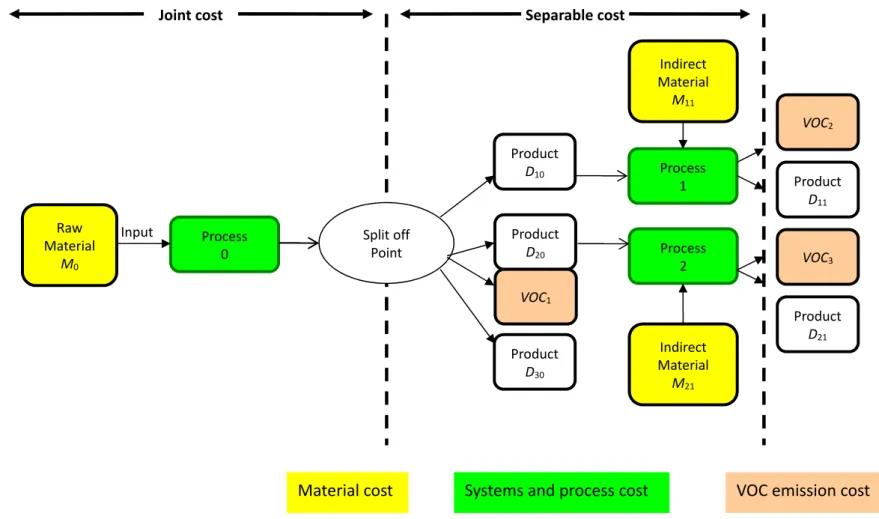
By using the information of the pharmaceutical industry from APIs’ processing to drugs for medical use, this paper establishes TDABC, TOC and ABC joint product mix models in order to analyze the resources used and whether joint products after the split-off point are directly sold or further processed. LINGO software is used to obtain the optimal solutions of the various variables of the models, which are illustrated in the following case. Gama is a manufacturer of APIs, which produces large amounts of APIs for downstream manufacturers. Meanwhile, the company has some patented pharmaceutical technologies to add excipients into some APIs in order to process them into medication for further use and clinical purposes. In joint production Process 0, if the company inputs one pound of API raw materialM0for processing, it can produce three types of drugs after the split-off
point, includingD10(one unit),D20(one unit) andD30(one unit).D10andD20are special APIs that
can be further processed, and their market demands are significantly greater thanD30. The required
production unit labor hours, hours for each initialization hour and hours for drug inspection are the lowest, while the unit machine hours for each batch is the highest. In addition, the production process ofD20can produce the same amount ofVOC1. D30is a normal API, as compared to other
APIs; its hours for each initialization and drug inspection are the highest, and the time to transfer the APIs to the production department is the longest. In addition, regarding each unit ofD10, if
added with excipientM11in Process 1, it can produce one unit ofD11for each unit ofD20; if added
with excipientM21in Process 2, it can produce one unit ofD21. The sale prices ofD11andD21after
processing are higher than the prices ofD10andD20at the split-off point; however, the market demand
is significantly lower thanD10,D20 orD30. In addition, D11 andD21 require more hours of drug
inspection, and equal amounts ofVOC2andVOC3will be produced during the production process.
Therefore, the disposal costs of relevantVOCs should be borne. The company’s order processing and tableting control departments are mainly for order processing and the inspection of each batch of APIs to the tableting department. On average, each order processing takes about 20 min and requires 40 min, 40 min, 60 min, 40 min and 40 min, respectively, to transfer the produced APIs ofD10,D20, D30,D11andD21to the tableting department; and requires about 40 min for each shipping order in the
packaging and shipping departments. Moreover, it requires 6 min for the packaging of each unit of product and 10 h, 50 h and 40 h for processing each batch ofVOC1,VOC2andVOC3, respectively, and
the costs are $400,000. The production process is as shown in Figure3, and the relevant production data are as shown in Table1.
Unlike TDABC, ABC must estimate the time percentages of various activities before the implementation of the second stage activity allocation. Therefore, in order to compute the product mix of the Gama Company under the ABC system, the following additional production information should be provided: order processing and production control departments spend about 30% in order processing and the remaining 70% in shifting the production APIs to the tableting department. The tableting department spends about 85% of its time in tableting and 15% of its time in the preparation of the tableting machine. Regarding machines and equipment, tableting requires about 90% of the time, and the initialization of the tableting machine requires about 10% of the time. Regarding the shipping department, on average, 85% of its time is for packaging, and 15% of its time is for shipping.
Figure 3. Pharmaceutical production flow chart. Input Process
0
Split off Point
Product D10
Product D20 Raw
Material M0
Process 1
Process 2
Product D11 VOC2
VOC3
Product D21 Indirect
Material M11
Indirect Material
M21
Joint cost
Separable cost
Material cost
Systems and process cost
VOC emission cost
Product D30 VOC1
Table 1.Example data.
Panel A: Production Information
Process 0 Process 1 Process 2
Product D10
Product D20
Product D30
Product D11
Product D21
Maximum demand Ri0 Ri1 8000 9000 6000 4800 4000
Selling price Xi0 Xi1 $145 $144 $135 $155 $155
Production Coefficient ei fi 1 1 1 1 1
Material of APIs MA0 MAi1 $70 $20 $25
Labor hours tli0 tli1 0.3 0.4 0.5 0.6 0.7
Machine hours tmi0 tmi1 0.7 0.6 0.5 0.4 0.3
Setup hours tbi0 tbi1 2 3 5 2 2
Inspection hours tτi0 tτi1 100 100 150 300 250
VOC disposal hours (per batch) 10 50 45
Quantity of batch bi0 bi1 560 560 300 180 180
Quantity of shipment si0 si1 280 280 150 90 90
Carbon Tax Constraint
Carbon tax rate:m1= $3/unit;m2= $4/unit;m3= $5/unit
The upper limit of three carbon emission charge level:Q1= 12,000;Q2= 15,000;Q3= 25,000 3 2 2
Marketing, plant guard and management $400,000
Panel B: Resources Consumed Tableting Labor Tableting Machinery Ordering Shipping Inspection VOC’s Disposal
Resources $717,640 $430,440 $10,000 $123,000 $70,250 $105,000
Available capacity (hours) σl= 18,640 σm= 16,880 σo= 250 σδ= 4100 στ= 1000 σv= 3000
4.1. TDABC
Gama Company’s joint production activity information and input data are used to develop the TDABC objective function (1) and Constraints (2)–(14), as shown in TableA1; whereη0,ηi0,ηi1,
βi0,βi1,δi0 andδi1are non-negative integers, τi0andτi1are zero and one variables. According to
TableA1, under the TDABC model, the optimal product mix is the input of APIM0(30,660 pounds)
for processing to produce three different types of drugsD10 (7840 units),D20(8960 units) andD30
(5400 units) after the split-off point for direct sale to downstream drug manufacturers. SomeD10
andD20can be further processed after the split-off point to produce drugsD11(4500 units) andD21
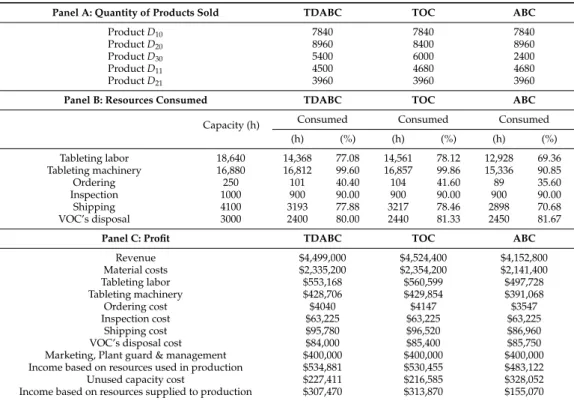
(3960 units). As shown in Table2, the labor of the tableting department requires 14,368 h; the tableting machine operation requires 16,812 h; order processing requires 101 h; pharmaceutical inspection requires 900 h; shipping requires 3193 h; and VOC disposal requires 2400 h, which suggests that the maximum profit of the case company, as based on resources used, is $534,881.
Table 2.Company Gama’s comparative analysis of the three decision models.
Panel A: Quantity of Products Sold TDABC TOC ABC
ProductD10 7840 7840 7840
ProductD20 8960 8400 8960
ProductD30 5400 6000 2400
ProductD11 4500 4680 4680
ProductD21 3960 3960 3960
Panel B: Resources Consumed TDABC TOC ABC
Capacity (h) Consumed Consumed Consumed
(h) (%) (h) (%) (h) (%)
Tableting labor 18,640 14,368 77.08 14,561 78.12 12,928 69.36 Tableting machinery 16,880 16,812 99.60 16,857 99.86 15,336 90.85
Ordering 250 101 40.40 104 41.60 89 35.60
Inspection 1000 900 90.00 900 90.00 900 90.00
Shipping 4100 3193 77.88 3217 78.46 2898 70.68
VOC’s disposal 3000 2400 80.00 2440 81.33 2450 81.67
Panel C: Profit TDABC TOC ABC
Revenue $4,499,000 $4,524,400 $4,152,800
Material costs $2,335,200 $2,354,200 $2,141,400
Tableting labor $553,168 $560,599 $497,728
Tableting machinery $428,706 $429,854 $391,068
Ordering cost $4040 $4147 $3547
Inspection cost $63,225 $63,225 $63,225
Shipping cost $95,780 $96,520 $86,960
VOC’s disposal cost $84,000 $85,400 $85,750
Marketing, Plant guard & management $400,000 $400,000 $400,000 Income based on resources used in production $534,881 $530,455 $483,122
Unused capacity cost $227,411 $216,585 $328,052
Income based on resources supplied to production $307,470 $313,870 $155,070
4.2. TOC
By using the company’s joint production activity information and input data, the TOC objective function (15) and Constraints (2)–(14) can be expressed, as shown in TableA2; whereη0,ηi0,ηi1,βi0,
βi1,δi0andδi1are non-negative integers,τi0andτi1are zero and one variables. According to TableA2,
under the TOC model and after the split-off point, the optimal product mix is the input of APIM0
(30,880 pounds) required for processing in order to produce three different drugs, includingD10
(7840 units),D20(8400 units) andD30(6000 units), for direct sales to downstream drug manufacturers.
SomeD10andD20can be processed for drugsD11(4680 units) andD21(3960 units) after the split-off
4.3. ABC
By using the company’s joint production activity information in Table1and the input data, ABC objective function (1) and Constraints (2)–(4), (8) and (9), (12)–(14) and (16)–(23) can be expressed, as in TableA3; whereη0,ηi0,ηi1,βi0,βi1,δi0andδi1are non-negative integers,τi0andτi1are zero and
on variables. TableA3shows that under the ABC model, the optimal product mix is the input of APIM0 (27,840 pounds) for processing in order to produce three types of drugs after the split-off
point, includingD10(7840 units),D20(8960 units) andD30(2400 units), for direct sale to downstream
drug manufacturers. SomeD10 and D20 are processed to produce drugs after the split-off point,
includingD11(4680 units) andD21(3960 units). As shown in Table2, the tableting department’s labor
requires 12,928 h; the tableting machine operation requires 15,336 h; order processing requires 89 h; pharmaceutical inspection requires 900 h; shipping requires 2898 h; and VOC disposal requires 2450 h, which suggests that the maximum profit of the company, as based on the resources used, is $483,122.
4.4. Analysis
Panel A and Panel C in Table2show the differences of TOC, ABC and TDABC decision-making models in terms of joint product mix and profit. TOC makes assumptions on the basis of resources supplied, while ABC and TDABC make assumptions on the basis of resources used. In TDABC, the optimal joint product mix is to produce 7840 units ofD10, 8960 units ofD20, 5400 units ofD30,
4500 units ofD11and 3960 units ofD21, and the expected profit is $534,881. In TOC, the optimal joint
product mix is to produce 7840 units ofD10, 8400 units ofD20, 6000 units ofD30, 4680 units ofD11
and 3960 units ofD21, and the expected profit is $313,870. In ABC, the optimal joint product mix is
to produce 7840 units ofD10, 8960 units ofD20, 2400 units ofD30, 4680 units ofD11and 3960 units of D21, and the expected profit is $483,122. Therefore, profits based on resources will be the most in the
TDABC system, followed by TOC and ABC. However, TDABC assumes that resources are controllable; therefore, unused production capacity can be used for other purposes or reduced. The assumptions of ABC are similar to those of TDABC; meaning unused production capacity costs can be avoided by management’s decision-making; hence, unused production capacity costs are not considered. Conversely, TOC assumes that resources are uncontrollable; therefore, unused production capacity will be regarded as cost. However, in order to compare with TOC on the basis of resources supplied, TDABC considers unused production capacity costs; thus, profit under the consideration of the basis of resources supplied is smaller or equal to the profit on the basis of the resources used. In addition, regarding the differences between ABC and TDABC in terms of profit: ABC compared to TDABC has the time and procedures of various activities at the first stage and, thus, has more constraints. As a result, the product mix will be different, and the profit will be lower than TDABC.
Panel B in Table2illustrates the resources used under TOC, ABC and TDABC decision-making models so that decision-makers can effectively control idle production capacity. As costs should be allocated in two stages, in the case of the ABC system, at the first stage, the company should attribute resource costs to different activity centers according to the resource drivers. At the second stage, the costs of various activities centers are attributed to various cost objectives according to cost drivers.
4.5. Sensitivity Test with Carbon Tax
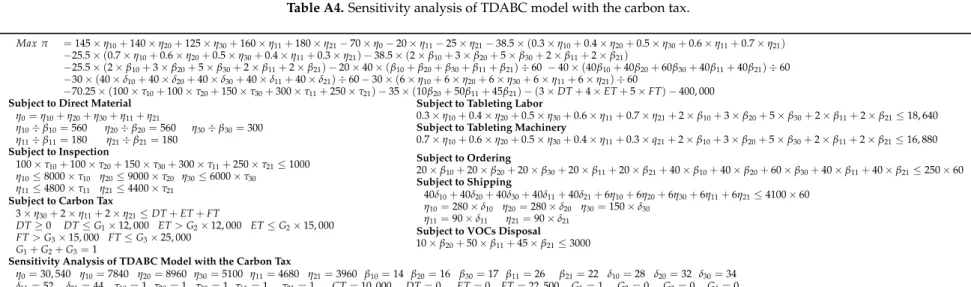
This study performs sensitivity analysis to show how the optional solutions are affected by the characteristics of the carbon tax. The sensitivity test is performed with carbon tax cost (24) and the related constraints (25) to (32) by using the TDBC model shown in TableA4. The optimal product mix is the input of APIM0(30,540 pounds) for processing to produce three different types of drugs,D10
(7840 units),D20(8960 units) andD30(5100 units), after the split-off point for direct sales to downstream
drug manufacturers. SomeD10andD20can be further processed after the split-off point to produce
drugs D11 (4680 units) and D21 (3960 units). The tableting department’s labor requires 14,368 h;
inspection requires 900 h; shipping requires 3193 h; and VOC disposal requires 2400 h, which suggests that the maximum profit of the case company, as based on the resources used, is $420,502, and the carbon tax is $112,500.
5. Discussion
TDABC time drivers go directly from resources to cost objectives and omit the time-consuming first stage of subjective estimation, as there is no need to estimate the time percentage of various activities at the second stage. Compared to the conventional ABC, it can better reflect the reality and time differences between different activities.
In the case of profit based on resources supplied, the profit will be highest in the case of TOC, followed by TDABC and ABC. Regarding the differences in the profit between TOC and TDABC, in addition to the differences caused by product mix, the degree of control of resources by management will be one of the influencing factors. Furthermore, regarding decision-making from the perspective of resources used, management will adopt the TDABC system. However, from the viewpoint of resources supplied, management will adopt the TOC system.
The results of this study point out that ABC, as compared to TDABC, has more allocation constraints; thus, the average production capacity utility is lower than that of TDABC. In addition, under limited resources, the company should consider reducing environmental pollution in the pursuit of long-term profit. TDABC produces far fewer VOCs, as compared to TOC and ABC, suggesting that the optimal product mix model can effectively minimize waste discharge in the production process in order to reduce relevant waste disposal costs and environmental impact. To test the robustness of the above results, this study also performs sensitivity testing, where global emissions are kept, rather than the constant carbon tax rate across scenarios. In other words, this study assumes the TDABC model, as this design avoids evaluating different global emissions levels, as the emission changes are equal across the joint product mix.
In this paper, the presented decision-making models are solved using LINGO software in order to obtain the optimal solutions of the various variables of the model. In practice, a decision-maker may want to find an optimal solution under the given resource constraints. However, this optimization is conditional and depends on the preset objective structure. Since the selection of objective structures may be qualitative and must consider multiple stakeholders and criteria, this paper suggests using the LINGO model to determine the final objective structure and solution. LINGO software can solve linear, nonlinear (convex and nonconvex/global), quadratic, quadratically constrained, second order cone, semi-definite, stochastic and integer optimization models more quickly, more easily and more efficiently. Table3shows the limits of the various variables and constraints of the various LINGO versions. The computational performance of the LINGO model also depends on the memory available in the computer system and not only the maximum problem dimensions of LINGO capacity.
Table 3.The limits for the various LINGO versions.
Version Total Variables Integer Variables Nonlinear Variables Constraints
Super Lingo 2000 200 200 1000
Hyper Lingo 8000 800 800 4000
Industrial Lingo 32,000 3200 3200 16,000
Extended Lingo Unlimited Unlimited Unlimited Unlimited
Source: [42].
6. Conclusions
product mix decision-making for joint products using a mathematical programming model and the joint production data of pharmaceutical companies for processing active pharmaceutical ingredients (APIs) into drugs for medical use. This paper has three major considerations; first is to establish the joint product mix model, as based on TDABC. This decision-making model can accurately attribute used resources to the cost objective and separate unused idle production capacity for management as a reference for decision-making. Secondly, as compared to the conventional ABC model, the proposed TDABC joint product mix model is not subject to the influence of the percentages of time input in the various activities of different departments. Therefore, the optimal joint product mix has higher profit than that of the conventional ABC model, and this study performed sensitivity analysis to show how the optional solutions are affected by the characteristics of carbon tax. Third, this study proposed using MIP to solve the problem of the optimal joint product mix. In addition to converting the non-linear model into a linear model in order to obtain the global optimal solution, it can add constraints in line with reality and according to the decisions of management.
The empirical results show that profit based on resources will be the most in the system of TDABC, followed by TOC and ABC; while for decision-making according to the perspective of the resources used basis, management will prefer the TDABC system. However, from the viewpoint of the resources supplied basis, management will prefer the TOC system. Finally, as compared to TDABC, ABC has more allocation constraints; thus, the average production capacity utility is lower than that of TDABC.
By using the example of a pharmaceutical company, this study illustrates the feasibility of TDABC in a joint product mix, which is expected to integrate the conceptual structure with the various modules of the enterprise resource planning (ERP) system for analysis and application in companies of other industries, in order to help managers effectively improve processes, reduce costs, analyze value, modify strategy and make other decisions. Compared to traditional costing, more comprehensive tools and concepts are available to analyze material, carbon emissions and energy flows within production systems, as well as their financial and ecological consequences. In addition, limited by the production activity information, as provided by the case company, this study cannot learn the production strategy in the case of insufficient production capacity. Future studies can further consider improving long-term production capacity insufficiency through production strategies, such as outsourcing and increasing labor or equipment in response to market demand to satisfy customer orders and maximize company profits. As a new management and accounting tool, relevant literature and discussions regarding TDABC are insufficient; thus, future studies can apply other management and strategy dimensions, such as the agent-based simulation model and corporate carbon footprint management.
This paper was based on some specific assumptions; for example, this paper assumed that potential competitors’ prices are not sensitive to the temporary price changes of a company’s product in the short term. In future studies, researchers can relax the assumptions to explore more complicated and realistic situations.
Acknowledgments:The authors are extremely grateful to the Sustainability journal editorial team and reviewers who provided valuable comments for improving the quality of this article. The authors also would like to thank the Ministry of Science and Technology of Taiwan for partial financial support of this research under Grant No. MOST104-2410-H-008-045.
Appendix
Table A1.Optimal joint product mix decision analysis of the TDABC model.
Maxπ =145×η10+140×η20+125×η30+160×η11+180×η21−70×η0−20×η11−25×η21−38.5×(0.3×η10+0.4×η20+0.5×η30+0.6×η11+0.7×η21)
−25.5×(0.7×η10+0.6×η20+0.5×η30+0.4×η11+0.3×η21)−38.5×(2×β10+3×β20+5×β30+2×β11+2×β21)
−25.5×(2×β10+3×β20+5×β30+2×β11+2×β21)−20×40×(β10+β20+β30+β11+β21)÷60 −40×(40β10+40β20+60β30+40β11+40β21)÷60
−30×(40×δ10+40×δ20+40×δ30+40×δ11+40×δ21)÷60−30×(6×η10+6×η20+6×η30+6×η11+6×η21)÷60
−70.25×(100×τ10+100×τ20+150×τ30+300×τ11+250×τ21)−35×(10β20+50β11+45β21)−400, 000
Subject to Direct Material
η0=η10+η20+η30+η11+η21
η10÷β10=560 η20÷β20=560 η30÷β30=300
η11÷β11=180 η21÷β21=180
Subject to Tableting Labor
0.3×η10+0.4×η20+0.5×η30+0.6×η11+0.7×η21+2×β10+3×β20+5×β30+2×β11+2×β21≤18, 640
Subject to Tableting Machinery
0.7×η10+0.6×η20+0.5×η30+0.4×η11+0.3×q21+2×β10+3×β20+5×β30+2×β11+2×β21≤16, 880
Subject to Inspection
100×τ10+100×τ20+150×τ30+300×τ11+250×τ21≤1000 η10≤8000×τ10 η20≤9000×τ20 η30≤6000×τ30
η11≤4800×τ11 η21≤4400×τ21
Subject to VOCs Disposal
10×β20+50×β11+45×β21≤3000
Subject to Ordering
20×β10+20×β20+20×β30+20×β11+20×β21+40×β10+40×β20+60×β30+40×β11+40×β21≤250×60
Subject to Shipping
40δ10+40δ20+40δ30+40δ11+40δ21+6η10+6η20+6η30+6η11+6η21≤4100×60 η10=280×δ10 η20=280×δ20 η30=150×δ30
η11=90×δ11 η21=90×δ21
Optimal Joint Product Mix Solution for the TDABC Model
η0=30, 660 η10=7840 η20=8960 η30=5400 η11=4500 η21=3960 β10=14 β20=16 β30=18 β11=25 β21=22 δ10=28 δ20=32 δ30=36
δ11=50 δ21=44 τ10=1 τ20=1 τ30=1 τ11=1 τ21=1
Table A2.Optimal joint product mix decision analysis of the TOC model.
Maxπ=145×η10+140×η20+125×η30+160×η11+180×η21−70×η0−20×η11−25×η21−717, 640−430, 440−10, 000−123, 000−70, 250−10, 500−400, 000
Subject to Direct Material
η0=η10+η20+η30+η11+η21
η10÷β10=560 η20÷β20=560 η30÷β30=300
η11÷β11=180 η21÷β21=180
Subject to Tableting Labor
0.3×η10+0.4×η20+0.5×η30+0.6×η11+0.7×η21+2×β10+3×β20+5×β30+2×β11+2×β21≤18, 640
Subject to Tableting Machinery
0.7×η10+0.6×η20+0.5×η30+0.4×η11+0.3×q21+2×β10+3×β20+5×β30+2×β11+2×β21≤16, 880
Subject to Inspection
100×τ10+100×τ20+150×τ30+300×τ11+250×τ21≤1000 η10≤8000×τ10 η20≤9000×τ20 η30≤6000×τ30
η11≤4800×τ11 η21≤4400×τ21
Subject to VOCs Disposal
10×β20+50×β11+45×β21≤3000
Subject to Ordering
20×β10+20×β20+20×β30+20×β11+20×β21+40×β10+40×β20+60×β30+40×β11+40×β21≤250×60
Subject to Shipping
40δ10+40δ20+40δ30+40δ11+40δ21+6η10+6η20+6η30+6η11+6η21≤4100×60 η10=280×δ10 η20=280×δ20 η30=150×δ30
η11=90×δ11 η21=90×δ21
Optimal Joint Product Mix Solution for the TDABC Model
η0=30, 880 η10=7840 η20=8400 η30=6000 η11=4680 η21=3960 β10=14 β20=15 β30=20 β11=26 β21=22 δ10=28 δ20=30 δ30=40
Table A3.Optimal joint product mix decision analysis of the ABC model.
Maxπ =145×η10+140×η20+125×η30+160×η11+180×η21−70×η0−20×η11−25×η21−38.5×(0.3×η10+0.4×η20+0.5×η30+0.6×η11+0.7×η21)
−25.5×(0.7×η10+0.6×η20+0.5×η30+0.4×η11+0.3×η21)−38.5×(2×β10+3×β20+5×β30+2×β11+2×β21)
−25.5×(2×β10+3×β20+5×β30+2×β11+2×β21)−20×40×(β10+β20+β30+β11+β21)÷60 −40×(40β10+40β20+60β30+40β11+40β21)÷60
−30×(40×δ10+40×δ20+40×δ30+40×δ11+40×δ21)÷60−30×(6×η10+6×η20+6×η30+6×η11+6×η21)÷60
−70.25×(100×τ10+100×τ20+150×τ30+300×τ11+250×τ21)−35×(10β20+50β11+45β21)−400, 000
Subject to Direct Material
η0=η10+η20+η30+η11+η21
η10÷β10=560 η20÷β20=560 η30÷β30=300
η11÷β11=180 η21÷β21=180
Subject to Ordering
20×β10+20×β20+20×β30+20×β11+20×β21≤15, 000×0.3 40×β10+40×β20+60×β30+40×β11+40×β21≤15, 000×0.7
Subject to Tableting Labor
0.3×η10+0.4×η20+0.5×η30+0.6×η11+0.7×η21+2×β10+3×β20+5×β30+2×β11+2×β21≤18, 640×0.85 2×β10+3×β20+5×β30+2×β11+2×β21≤18, 640×0.15
Subject to Tableting Machinery
0.7×η10+0.6×η20+0.5×η30+0.4×η11+0.3×q21+2×β10+3×β20+5×β30+2×β11+2×β21≤16, 880×0.9 2×β10+3×β20+5×β30+2×β11+2×β21≤16, 880×0.1
Subject to Inspection
100×τ10+100×τ20+150×τ30+300×τ11+250×τ21≤1000 η10≤8000×τ10 η20≤9000×τ20 η30≤6000×τ30
η11≤4800×τ11 η21≤4400×τ21
Subject to VOCs Disposal
10×β20+50×β11+45×β21≤3000
Subject to Shipping
40δ10+40δ20+40δ30+40δ11+40δ21+6η10+6η20+6η30+6η11+6η21≤4100×60×0.15 6×η10÷60+6×η20÷60+6×η30÷60+6×η11÷60+6×η21÷60≤4100×0.85 η10=280×δ10 η20=280×δ20 η30=150×δ30
η11=90×δ11 η21=90×δ21
Optimal Joint Product Mix Solution for the TDABC Model
η0=27, 840 η10=7840 η20=8960 η30=2400 η11=4680 η21=3960 β10=14 β20=16 β30=8 β11=26 β21=22 δ10=28 δ20=32 δ30=16
δ11=52 δ21=44 τ10=1 τ20=1 τ30=1 τ11=1 τ21=1
Table A4.Sensitivity analysis of TDABC model with the carbon tax.
Maxπ =145×η10+140×η20+125×η30+160×η11+180×η21−70×η0−20×η11−25×η21−38.5×(0.3×η10+0.4×η20+0.5×η30+0.6×η11+0.7×η21)
−25.5×(0.7×η10+0.6×η20+0.5×η30+0.4×η11+0.3×η21)−38.5×(2×β10+3×β20+5×β30+2×β11+2×β21)
−25.5×(2×β10+3×β20+5×β30+2×β11+2×β21)−20×40×(β10+β20+β30+β11+β21)÷60 −40×(40β10+40β20+60β30+40β11+40β21)÷60
−30×(40×δ10+40×δ20+40×δ30+40×δ11+40×δ21)÷60−30×(6×η10+6×η20+6×η30+6×η11+6×η21)÷60
−70.25×(100×τ10+100×τ20+150×τ30+300×τ11+250×τ21)−35×(10β20+50β11+45β21)−(3×DT+4×ET+5×FT)−400, 000
Subject to Direct Material
η0=η10+η20+η30+η11+η21
η10÷β10=560 η20÷β20=560 η30÷β30=300
η11÷β11=180 η21÷β21=180
Subject to Tableting Labor
0.3×η10+0.4×η20+0.5×η30+0.6×η11+0.7×η21+2×β10+3×β20+5×β30+2×β11+2×β21≤18, 640
Subject to Tableting Machinery
0.7×η10+0.6×η20+0.5×η30+0.4×η11+0.3×q21+2×β10+3×β20+5×β30+2×β11+2×β21≤16, 880
Subject to Inspection
100×τ10+100×τ20+150×τ30+300×τ11+250×τ21≤1000 η10≤8000×τ10 η20≤9000×τ20 η30≤6000×τ30
η11≤4800×τ11 η21≤4400×τ21
Subject to Carbon Tax
3×η30+2×η11+2×η21≤DT+ET+FT
DT≥0 DT≤G1×12, 000 ET>G2×12, 000 ET≤G2×15, 000
FT>G3×15, 000 FT≤G3×25, 000
G1+G2+G3=1
Subject to Ordering
20×β10+20×β20+20×β30+20×β11+20×β21+40×β10+40×β20+60×β30+40×β11+40×β21≤250×60
Subject to Shipping
40δ10+40δ20+40δ30+40δ11+40δ21+6η10+6η20+6η30+6η11+6η21≤4100×60 η10=280×δ10 η20=280×δ20 η30=150×δ30
η11=90×δ11 η21=90×δ21
Subject to VOCs Disposal
10×β20+50×β11+45×β21≤3000
Sensitivity Analysis of TDABC Model with the Carbon Tax
References
1. Tsai, W.H.; Lai, C.W.; Tseng, L.J.; Chou, W.C. Embedding management discretionary power into an ABC model for joint product mix decisions.Int. J. Prod. Econom.2008,115, 210–220.
2. Tsai, W.H. Activity-based costing model for joint products.Comput. Ind. Eng.1996,31, 725–729. 3. Hartley, R.V. Decision making when joint products are involved.Account. Rev.1971,46, 746–755.
4. Kee, R.; Schmidt, C. A comparative analysis of utilizing activity-based costing and the theory of 3 constraints for making product-mix decisions.Int. J. Prod. Econom.2000,63, 1–17. [CrossRef]
5. Onwubolu, G.C.; Muting, M. Optimizing the multiple constrained resources product mix problem using genetic algorithms.Int. J. Prod. Res.2001,39, 1897–1910. [CrossRef]
6. Tsai, W.-H.; Lee, K.-C.; Liu, J.-Y.; Lin, H.-L.; Chou, Y.-W.; Lin, S.-J. A mixed activity-based costing decision model for green airline fleet planning under the constraints of the European Union Emissions Trading Scheme.Energy2012,39, 218–226. [CrossRef]
7. Kirche, E.; Srivastava, R. An ABC-based cost model with inventory and order level costs: A comparison with TOC.Int. J. Prod. Res.2005,43, 1685–1710. [CrossRef]
8. Gong, Z.; Hu, S. An economic evaluation model of product mix flexibility.Omega2008,36, 852–864. 9. Turney, P.B.Common Cents: The ABC Performance Breakthrough: How to Succeed with Activity-Based Costing;
Cost Technology: Hillsboro, OR, USA, 1991.
10. Plenert, G. Optimizing theory of constraints when multiple constrained resources exist.Eur. J. Oper. Res. 1993,70, 126–133. [CrossRef]
11. Souren, R.; Ahn, H.; Schmitz, C. Optimal product mix decisions based on the theory of constraints. Exposing rarely emphasized premises of throughput accounting.Int. J. Prod. Res.2005,43, 361–374. [CrossRef] 12. Fredendall, L.D.; Lea, B.R. Improving the product mix heuristic in the theory of constraints.Int. J. Prod. Res.
1997,35, 1535–1544. [CrossRef]
13. Pernot, E.; Roodhooft, F.; Van den Abbeele, A. Time-driven activity-based costing for inter-library services: A case study in a university.J. Acad. Librariansh.2007,33, 551–560. [CrossRef]
14. Szychta, A. Time-Driven Activity-Based Costing in Service Industries.Soc. Sci.2010,67, 49–60.
15. Stouthuysen, K.; Swiggers, M.; Reheul, A.-M.; Roodhooft, F. Time-driven activity-based costing for a library acquisition process: A case study in a Belgian University.Lib. Collect. Acquis. Tech. Serv. 2010,34, 83–91. [CrossRef]
16. Öker, F.; Adigüzel, H. Time-driven activity-based costing: An implementation in a manufacturing company. J. Corp. Account. Financ.2010,22, 75–92. [CrossRef]
17. Tsai, W.-H.; Shen, Y.-S.; Lee, P.-L.; Chen, H.-C.; Kuo, L.; Huang, C.-C. Integrating information about the cost of carbon through activity-based costing.J. Clean. Prod.2012,36, 102–111. [CrossRef]
18. Friedman, M. The Social Responsibility of Business Is to Increase Its Profits.The New York Times Magazine, 13 September 1970.
19. Carroll, A.B. The pyramid of corporate social responsibility: Toward the moral management of organizational stakeholders.Bus. Horiz.1991,34, 39–48. [CrossRef]
20. Tsai, W.-H.; Chen, H.-C.; Leu, J.-D.; Chang, Y.-C.; Lin, T.W. A product-mix decision model using green manufacturing technologies under activity-based costing.J. Clean. Prod.2013,57, 178–187. [CrossRef] 21. Demeere, N.; Stouthuysen, K.; Roodhooft, F. Time-driven activity-based costing in an outpatient clinic
environment: Development, relevance, and managerial impact.Health Policy2009,92, 296–304. [CrossRef] [PubMed]
22. Tsai, W.-H.; Yang, C.-H.; Chang, J.-C.; Lee, H.-L. An Activity-Based Costing Decision Model for Life Cycle Assessment in Green Building Projects.Eur. J. Oper. Res.2014,238, 607–619. [CrossRef]
23. Cooper, R.; Kaplan, R.S. Measure costs right: Make the right decisions.Harv. Bus. Rev.1988,66, 96–103. 24. Tsai, W.-H.; Hung, S.-J. A Fuzzy Goal Programming Approach for Green Supply Chain Optimisation under
Activity-Based Costing and Performance Evaluation with a Value-chain Structure.Int. J. Prod. Res.2009,47, 4991–5017. [CrossRef]
25. Tsai, W.-H.; Hsu, J.-L.; Chen, C.-H.; Chou, Y.-W.; Lin, S.-J.; Lin, W.-R. Application of ABC in hot spring country inn.Int. J. Manag. Enterp. Dev.2010,8, 152–174. [CrossRef]