The 28th Annual Conference of the Japanese Society for Artificial Intelligence, 2014
2G1-4
Application of a Continuous Time Structural ARMA Modeling
to analysis of a nuclear reactor
M. Demeshko
∗1T. Washio
∗1Y. Kawahara
∗1Y. Pepyolyshev
∗2∗1
Osaka University
∗2Joint Institute for Nuclear Research
For the safety of a nuclear reactor, understanding the unobserved mechanisms of the reactor is important. How-ever, traditional approaches of the reactor analyses do not provide sufficient information on its physical mechanisms. In this paper, we apply a multivariate Continuous time Structural Auto-Regressive Moving Average (CSARMA) modeling approach to overcome this issue and analyze the nuclear reactor system using the mathematical models derived by the approach.
1.
Introduction
The nuclear reactor is a complex physical system with a multiple processes. Its many structures and associated pa-rameters cannot be directly observed because most of them are intentional and the others are not observable for the very high temperature and radiation levels inside and near the reactor core. For understanding such mechanisms, we need to have a mathematical model and its corresponding parameters that precisely reflect the reactor processes. Such model might further allow us to manage the nuclear reactor more effectively and safely.
A continuous time linear multivariate Markov system is frequently analyzed by ARMA modeling in discrete time domain (DARMA) [Brockwell 1991]. Unfortunately, the DARMA model is not canonical for such continuous time system, i.e., not a unique representation of the system. Thus we cannot identify the system’s structure and its as-sociated parameters. A remedy to this problem is to use a canonical expression of the multivariate DARMA model under the discrete time approximation called a structural ARMA (SARMA) model [Moneta 2010]. The SARMA model represents a unique dependency structure among variables of the objective continuous time system. How-ever, most of the past SARMA approaches have limited applicability, since they require some strong assumptions for the model identification.
On the other hand, the processes of the continuous time linear multivariate Markov system such as the nuclear reac-tor are represented by a canonical continuous time ARMA (CARMA) model consisting of the linear differential equa-tions [Stamer 1996]. Based on relation between struc-tures of the ARMA models in continuous and discrete time domains, we have proposed a continuous time structural autoregressive moving average (CSARMA) modeling ap-proach by assuming that the system is continuous, Markov, linear, stationary, controllable and observable [Demeshko
Contact: Demeshko M., The Institute of Scientific and Industrial Research, Osaka University, 8-1, Mi-hogaoka, Ibaraki City, Osaka, 567-0047, Japan, Phone: +81-6-6879-9540, Fax: +81-6-6879-9544, E-mail: [email protected]
2014]. We have already showed that this approach enables highly generic identification of the canonical SARMA and CARMA models from a DARMA model obtained from ob-served multivariate time series data under the assumptions. In this report, we present its application to the analysis on the relation among the processes in a nuclear reactor. We analyze the structural processes and its associated param-eters of the impulse fast neutron research reactor IBR-2 [Pepyolyshev 1998] by using this method and the observed reactor noise time series data.
This paper is structured as follows. Section 2 explains the background of our CSARMA study. Section 3 explains the description of the principles and the analysis scheme of the CSARMA modeling. The CSARMA application to real world nuclear reactor IBR-2 and its analysis are presented in Section 4.
2.
Background
The reactor processes are normally observed as multi-variate time series data of reactor noise signals, sampled by digital processing at appropriately fine discrete time steps. These time series are usually analyzed by the traditional reactor noise analysis methods based on the multivariate DARMA modeling. It allows us to derive the information on the influences among the processes in both time and frequency domains. However, these methods have a draw-back that they do not automatically reorganize the relations among the variables into the relations among the reactor processes. The main reason for this drawback is that the DARMA model is not canonical for a continuous time linear multivariate Markov system as follows.
The multivariate DARMA model shown in Eq.(1) is known to be a generic representation of a multivariate linear Markov system in discrete time domain [Brockwell 1991].
Y(t) =
p
∑
j=1
ΦjY(t−j∆t) +U(t) +
q
∑
j=1
ΘjU(t−j∆t), (1)
whereY(t) andU(t) ared-dimensional vectors of observed variables and unobserved noise, respectively. Φj and Θj
are d×d autoregressive (AR) and moving average (MA)
The 28th Annual Conference of the Japanese Society for Artificial Intelligence, 2014
coefficient matrices. p and q are AR and MA model orders, and ∆tis a sampling time interval.
Transforming Eq.(1) by a d×d regular matrix Q, we obtain the following equivalent representation.
Y(t) =
p
∑
j=1
ΦjY(t−j∆t) +QW(t) +
q
∑
j=1
ΘjQW(t−j∆t),
(2) where W(t) = Q−1U(t). Equation (2) can be further
rewritten as follows:
Y(t) =
p
∑
j=0
ΨjY(t−j∆t) +W(t) +
q
∑
j=1
ΩjW(t−j∆t), (3)
where Ψ0 = I−Q−1, Ψj = Q−1Φj and Ωj = Q−1ΘjQ
[Kawahara 2011]. From Eq.(2), the impulse response of the model is known to totally depend on the choice of Qand
W(t). Hence, proper identification ofQis needed to identify the dependency structure of the processes in the objective system.
When the objective system is a multivariate discrete time linear Markov system, the matrix Ψ0, that represents an
in-stantaneous feedback effect ofY(t) on itself, should be zero. Thus, Qis uniquely defined asI, and the DARMA model is also uniquely defined. This uniqueness of the model is called canonicality. Each equation in the canonical model has bijective correspondence to each individual process in the system.
However, in case that the objective system is a multi-variate continuous time linear Markov system, where the DARMA modeling is most frequently used, the DARMA model is merely a discrete time approximation. If there are no processes changing faster than the sampling time inter-val ∆tin the objective system, Ψ0must be zero similarly to
the discrete case, otherwise Ψ0is non-zero and thusQ̸=I.
The non-zero matrix Ψ0,i.e.,Q̸=I, implies the existence
of the very fast process dynamics in the objective contin-uous time system. However, the DARMA model does not contain any information on the choice ofQ[Moneta 2010]. In this regard, the DARMA model of the multivariate con-tinuous time linear Markov system is not canonical.
If we can identify a unique combination ofQandW(t) in Eq.(3), it provides a canonical model. As this model with a properQ more precisely represents the dependency struc-ture among the observed variables, it is called a Structural Autoregressive Moving Average (SARMA) model [Moneta 2010, Kawahara 2011]. Because of the lack of the informa-tion on the very fast processes of the system, Ψ0 (orQ) is
not readily derived from observed time series data. To fill the information, past studies on SARMA modeling [Mainas-sara 2010, Kawahara 2011] and its autoregressive model versions, Structural Vector Autoregressive (SVAR) model-ing [Gottschalk 2001], used specific domain knowledge on the system, which is not applicable to many practical prob-lems including the reactor noise analysis. Therefore, a more generic approach is required.
3.
Principle of the CSARMA method
The CSARMA modeling approach is based on the re-lations between the DARMA model, Eq.(1), the SARMA model, Eq.(3) and the CARMA model shown as follows.
Y(p)(t) =
p−1
∑
m=0
SmY(m)(t)+W(0)(t)+
q
∑
m=1
RmW(m)(t), (4)
whereY(m)(t) and W(m)(t) are the m-th time derivatives ofY(t)(= Y(0)(t)) andW(t)(= W(0)(t)), andSmand Rm
are d×d autoregressive (AR) and moving average (MA) coefficient matrices, respectively. This CARMA model is known to be a canonical model of a multivariate, continuous time and linear Markov system [Brockwell 1991, Stamer 1996] by the following reason. Equation (4) is rewritten similarly to the SARMA model by introducing some regular matrixP and a new noise vectorE(t) as follows.
Y(p)(t) =AY(p)(t)+
p−1
∑
m=0 S′mY(
m)(t)+E(0)(t)+ q
∑
m=1 R′mE(
m)(t),
whereE(t) =P−1W(t), A=I−P−1,S′
m=P−1Smand R′m = P−1RmP. Since the CARMA model includes all
process dynamics, any extra feedback dynamics ofY(p)(t) to itself does not exist. Therefore,Ais 0, and thusP =I
which provides a unique CARMA model. Accordingly, the CARMA model is canonical.
Since the CARMA and SARMA models are both canon-ical and have bijective correspondence with an objective system, these two models, Eq.(3) and Eq.(4), are explicitly related by applying finite difference approximation scheme named backward Euler formula up to the m-th derivative as follows [Demeshko 2014].
S0= ∆t−pI− p−1
∑
m=1
(−1)m
I−
q
∑
k=1
(−1)k
q
∑
j=k j! (j−k)!k!Ωj
−1
× p−1
∑
j=m j!
(j−m)!m!Ψj+ (−1)
p+m−1∆t−p p!
(p−m)!m!I
}
+(−1)p∆ t−pΨ−1
p (I−Ψ0), (5)
Sm=
(−1)m∆tm−p
∆tp
I−
q
∑
k=1
(−1)k
q
∑
j=k j! (j−k)!k!Ωj
−1
× p−1
∑
j=m j!
(j−m)!m!Ψj+ (−1)
p−1 p!
(p−m)!m!I
}
, (6)
where 1≤m≤p−1, and
Rm= (−1)m∆tm
I−
q
∑
k=1
(−1)k
q
∑
j=k j! (j−k)!k!Ωj
−1
× q
∑
j=m j!
(j−m)!m!Ωj, (7)
The 28th Annual Conference of the Japanese Society for Artificial Intelligence, 2014
where 1≤m≤q.
On the other hand, the correspondences of the matrices of the DARMA and the SARMA models are obtained by comparing Eq.(1) and Eq.(3) as follows [Kawahara 2011]:
Ψj= (I−Ψ0)Φj,
Ωj= (I−Ψ0)Θj(I−Ψ0)−1. (8)
By substituting Eq.(8) into Eq.(5) we derive Ψ0 as follows.
Ψ0=I−
(−1)p∆t−pΦ−1 p
( q
∑
j=1
Θj j
∑
k=1
(−1)k j! (j−k)!k!−I
)
.(9)
Accordingly, the SARMA and the CARMA models are ob-tained from a given DARMA model in case of continuous time, Markov, linear, stationary, observable and control-lable system.
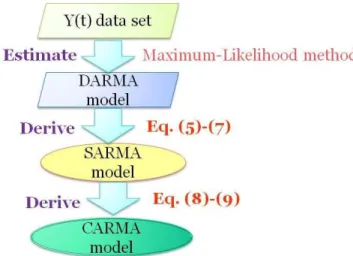
The scheme of the CSARMA algorithm based on Eq.(5)-(9) is presented in Fig.1. We firstly estimate a DARMA model by applying some traditionally used methods such as the Maximum Likelihood method [Shea 1987]. Then, we obtain a SARMA model, Eq.(3), by deriving its pa-rameter matrices from the matrices of the DARMA model through Eq.(8)-(9). Finally, by using the relations between the SARMA and the CARMA models presented in Eq.(5)-(7), we estimate parameters of the CARMA model of the system [Demeshko 2014].
Figure 1: The scheme of the CSARMA algorithm.
4.
IBR-2 analysis results
In this section, we analyzed the reactor data measured on IBR-2 [Pepyolyshev 1998] at Joint Institute of Nuclear Research in Dubna, Russia. As shown in Fig.2, IBR-2 has a special structure consisting of rotating main and additional neutron reflectors that initiate power pulses. When the re-flectors approach to the reactor core, they reflect the gener-ated neutrons back to the core. This increases the number of neutrons and more effectively activate the fission chain process in the reactor core. Because these reflectors rotate very fast, the activation of the chain reaction occurs in a very short period and produces power pulses. The data set
Figure 2: The scheme of the IBR-2 nuclear reactor.
we used for our analysis contains the peak energy of power pulses (Q) measured in thermal Wattage, axial deviations of the main neutron reflector (XQ) and of the additional neutron reflector (XA) measured in radian. The axial de-viations of the reflectors are their angular dede-viations from the vertical central line of the reactor core. The time series ofQ, XQ and XA has 8192 time steps and was measured during the stationary operation period. Every variable of the time series has been normalized to give a zero mean and a unit standard deviation. Sampling frequency of the time series data is equal to the frequency of the pulse operation of IBR-2, which is 5 Hz [Pepyolyshev 1998].
As mentioned in a previous section, the CSARMA ap-proach is applicable to an objective system, if the system is continuous, Markov, linear, stationary, controllable and observable. Since the generation process is well described by the point-kinematics, the process generating the power pulse by the neutron reflectors’ motions in IBR-2 is obvi-ously continuous and Markov. The point-kinematics relat-ingQ,XQandXAis well approximated by a linear relation, because the reactivity and the powerQinduced by the two reflectors are almost same over all power peaks and the de-viations from their average levels at the peaks are small. The process is stationary, since the time series are observed under the stationary operation of the IBR-2. It is also con-trollable and observable, since the observed output signal Q is fully controlled by the observed motionsXQ andXA
of the two neutron reflectors. Accordingly, all conditions required for the application of our CSARMA modeling are met in our analysis of the IBR-2 data set.
The process of the heat removal from the core and the negative feedback of the core temperature to the power gen-eration is approximately represented by a second order de-lay process. Also, the sinusoidal periodic rotations of the reflectors are approximated by a second order delay pro-cess. Therefore, in our study we applied DARMA (p=2, q=2) modeling and its Maximum Likelihood estimation to the time series data set and further derived its SARMA model using our CSARMA approach. The obtained results are presented in Eq. (10)-(13).
Matrix Ψ0 of the SARMA model contains the most
im-portant structural information, which shows the fast effects
The 28th Annual Conference of the Japanese Society for Artificial Intelligence, 2014
among variables,i.e., the effects that happen within a sam-pling period. We see significant values of (1,2) and (1,3) elements of Ψ0 in Eq.(10), which represent the influences
of the main and the additional neutron reflectors’ axial de-viations, XQ and XA, to the peak power, Q. This result corresponds to the system dynamics of IBR-2, since both re-flectors initiate the power pulse. In addition, the less effect of the additional reflector is reflected to the smaller value of its element. Further, we observe some influence of the main reflector’s motion to the additional reflector’s at (3,2) element. Though the cause of this influence is not clear, the voltage deriving the motor of the additional reflector could be influenced by the motor operation of the main reflector sharing an electricity power supply. We see that the other elements of Ψ0 are relatively small, which means that there
is no impact from the power output to the deviations of both neutron reflectors. The last also corresponds to the reactor’s dynamics.
Ψ0 =
Q XQ XA
49.7402 150.2176 65.0670 1.2771 15.7391 16.4848 11.1788 204.5666 80.6094
Q XQ XA
.(10)
Equations (11) and (12) show Ψ1 of the SARMA model
and Φ1of the DARMA model, respectively, which represent
the delayed effects among the variables. In the matrix Ψ1,
we see that the major effects between the variables are al-most localized at (1,2), (1,3) and (3,2) which is similar to the structure of Ψ0matrix. In addition, (1,2) and (1,3)
el-ements in Ψ1are negative because of the negative feedback
of the peak power. This effect occurs as follows. Once the neutron population is increased in the core by the reactor, the core temperature is increased through the activation of the nuclear fission chain reaction. The increase of the temperature reduces the efficiency of the individual nuclear fission reaction, and this suppresses the power generation. These processes form the negative feedback. Element (3,2) has also a negative sign because of the oscillatory nature of the power supply. These values correspond to the domain knowledge on the reactor. However, Φ1 of the DARMA
model, where the fast and the delayed effects are not de-composed, does not show any clear structure reflecting the dynamics of IBR-2.
Ψ1 =
Q XQ XA
4.8445 −55.6610 −8.4650
−0.2408 −17.2771 −2.9954
−0.1421 −70.5501 −9.1673
Q XQ XA
,(11)
Φ1 =
Q XQ XA
−0.1265 −0.0905 0.0074
−0.0029 −0.0932 −0.0400
−0.0270 1.1384 0.2169
Q XQ XA
. (12)
Equation (13) shows Ω1 of the SARMA model which
rep-resents the delayed effects from the noise components to their original variables. Here, we observe large values at (1,2) and (3,2) elements. However, they are not very sig-nificant, since amplitudes, i.e., standard deviations, of the
noise components ofXQandXAare less than 30% of those of the original variables.
Ω1 =
Q XQ XA
−0.4183 3.5814 −0.1413 0.0106 0.3921 −0.0041 0.0677 4.5130 −0.5953
Q XQ XA
. (13)
5.
Conclusion
We conclude that the application of CSARMA method gives us the informative relations among variables which reflect the physical structure of a nuclear reactor system. Particularly, it provides information on the fast effects that happen during a sampling period in the system. The last became possible through mathematical reconstruction of the SARMA model out of the DARMA model. Moreover, CSARMA is a highly generic modeling approach, and it is not limited to the fast neutron reactors, but can be applied for other types of reactors.
References
[Brockwell 1991] P.J. Brockwell and R.A. Davis: Time Se-ries: Theory and Methods, Springer (1991),
[Demeshko 2014] M. Demeshko and T. Washio and Y. Kawahara and S. Shimizu: A novel structural ARMA modeling across continuous and discrete time domains, Submitted to Computational Statistics & Data Anal-ysis Journal (2013),
[Gottschalk 2001] J. Gottschalk: An Introduction into the SVAR Methodology: Identification, Interpretation and Limitations of SVAR models, Kiel Working Paper (2001),
[Kawahara 2011] Y. Kawahara and S. Shimizu and T. Washio: Analyzing relationships between ARMA Pro-cesses Based on Non-Gaussianity of External Influ-ences, Neurocomputing (2011),
[Mainassara 2010] Y. B. Mainassara and C. Francq: Esti-mating structural VARMA models with uncorrelated but non-independent error terms, Journal of Multivari-ate Analysis (2010),
[Moneta 2010] A. Moneta and D. Entner and P. Hoyer and A. Coad: Causal Inference by Independent Component Analysis with Applications to Micro- and Macroeco-nomic Data, Jena EcoMacroeco-nomic Research Papers (2010),
[Pepyolyshev 1998] Yu. N. Pepyolyshev: Spectral charac-teristics of power noise parameters and fluctuations of neutron reflectors of nuclear reactor IBR-2, SPreprint, JINR, Dubna (1988) (in Russian),
[Shea 1987] B. L. Shea: Estimation of multivariate time series, Journal of Time Series Analysis (1987),
[Stamer 1996] O. Stamer and R.L. Tweedie and P.J. Brock-well: Existence and stability of continuous time thresh-old ARMA process, Statistica Sinica (1996).