Exchange rate pass-through and in
fl
ation: A nonlinear time
series analysis
Mototsugu Shintani
a,*, Akiko Terada-Hagiwara
b, Tomoyoshi Yabu
caDepartment of Economics, Vanderbilt University, Nashville, TN 37235, USA b
Economics and Research Department, Asian Development Bank, Mandaluyong City 1550, Manila, Philippines cFaculty of Business and Commerce, Keio University, Minato-ku, Tokyo 108-8345, Japan
JEL Classification: C22
E31 F31
Keywords: Import prices Inflation indexation Pricing-to-market
Smooth transition autoregressive models Sticky prices
a b s t r a c t
This paper investigates the relationship between the exchange rate pass-through (ERPT) and inflation by estimating a nonlinear time series model. Based on a simple theoretical model of ERPT deter-mination, we show that the dynamics of ERPT can be well approximated by a class of smooth transition autoregressive (STAR) models using the past inflation rate as a transition variable. We employ several U-shaped transition functions in the estimation of the time-varying ERPT to US domestic prices. The estimation result suggests that declines in the ERPT during the 1980s and 1990s are associated with lowered inflation.
2012 Elsevier Ltd. All rights reserved.
1. Introduction
Within the framework of new open economy macroeconomic models, the degree of exchange rate pass-through (ERPT) into domestic prices is one of the key elements in evaluating international spill-over effects of monetary policy. Over the past decade, a number of empirical studies have investigated whether ERPT, defined as the response of domestic inflation rates to the changes in exchange rates (or
*Corresponding author. Tel.:þ1 615 322 2196; fax:þ1 615 343 8495.
E-mail addresses:[email protected](M. Shintani),[email protected](A. Terada-Hagiwara),tomoyoshi. [email protected](T. Yabu).
Contents lists available atSciVerse ScienceDirect
Journal of International Money
and Finance
j o u r n a l h o m e p a g e : w w w . e l s e v i e r . c o m / l o c a t e / j i m f
in marginal costs), decreased during the 1980s and 1990s.1If there was a reduction in ERPT, it is natural to conjecture some interaction between the ERPT and the inflation rate because the timing corre-sponds, in many countries, to a period of low and stable inflation. This view is emphasized byTaylor (2000), who states that “the lower pass-through should not be taken as exogenous to the infl a-tionary environment (p.1390).”
The purpose of this paper is to investigate Taylor’s hypothesis on the positive relationship between the ERPT and inflation by estimating a nonlinear time series model. In particular, we employ the class of smooth transition autoregressive (STAR) models so that the degree of ERPT to domestic prices can be determined by the lagged domestic inflation rate. Most previous empirical studies on the positive association between ERPT and inflation focus on the cross-country evidence, including the analyses by
Calvo and Reinhart (2002), Choudhri and Hakura (2006), andDevereux and Yetman (2010). This paper differs from the existing studies in that we examine the role of inflation in the time-varying ERPT under the time series modeling framework.
In the empirical literature on the nonlinear adjustment of real exchange rates, STAR models have been popularly employed in many studies, includingMichael et al. (1997), Taylor and Peel (2000), Taylor et al. (2001), andKilian and Taylor (2003), among others. However, STAR models have rarely been used in analyses of the ERPT.2While nonlinear mean reversion of real exchange rates implies the full ERPT in the long-run, it does not imply the time-varying ERPT. We employ several U-shaped transition functions in STAR models to consider alternative forms of time-varying ERPT. Our method is applied to monthly US import and domestic price data and evaluatesfluctuations of ERPT during the period from 1975 to 2007.
To motivate our nonlinear regression approach, wefirst present a simple theoretical model of importingfirms where the ERPT becomes a nonlinear function of the past inflation rate. Our model is closely related to a model of ERPT developed byDevereux and Yetman (2010)so that the optimal price level depends directly on the nominal exchange rate, which corresponds to the marginal cost, and that importing firms endogenously select the probability of adjusting their price to an optimal level. However, our model differs from their model in several aspects. First, for every period, a fraction of
firms make afinite-periodTaylor (1980)type staggered contract of an inflation indexation rule. Second, eachfirm faces the problem of opting out of a contract. Whenfirms opt out, they can set an optimal price by paying afixed cost. Because the ERPT increases if morefirms set an optimal price, and the probability of opting out depends on the past inflation rate, our model predicts that ERPT depends on the lagged inflation. This prediction is in contrast to the case ofDevereux and Yetman (2010)where the ERPT depends on the steady-state inflation level of the economy. We show that the dynamics of ERPT predicted by the theoretical model can be well approximated by the STAR structure, and that the past decline during the 1980s and 1990s and the recent increase in the ERPT to US prices are well explained by the STAR model.
The remainder of the paper is organized as follows. Section “Theoretical motivation” briefly describes the prediction from the theoretical model. Section“Econometric procedures”introduces the empirical model. Estimation results are provided in the section “Empirical results”, followed by “Conclusions”in the next section.
2. Theoretical motivation
In this section, we briefly describe our theoretical model of importingfirms, which predicts that the ERPT depends on the lagged inflation.3The basic setup is similar toDevereux and Yetman (2010)in that importingfirms are monopolistic competitors who import differentiated intermediate goods from abroad. A representative domesticfinal good producer purchases all the imported intermediate goods
1 See, for example,Goldberg and Knetter (1997), Otani et al. (2003), Campa and Goldberg (2005), Sekine (2006) and McCarthy (2007).
2 One of the few exceptions is a study of UK import prices byHerzberg et al. (2003). However, their study did not find supporting evidence on nonlinearity.
3 The details of the model are provided in theAppendix.
and combines them to produce afinal output. Pricing contracts between the importers and thefinal good producer are valid forN(2) periods long, and a constant fraction 1/Nof all importingfirms write their contracts in any given time period. However,firms are allowed to opt out during the contract period and to deviate from the contract pricing rule by paying afixed costF(>0). During thefirstN*(1) periods of the contract,firms follow the contract pricing rule and fully index their prices to aggregate inflation
p
tof the initial contract period. Iffirms opt out of the contract afterN* periods, for theremaining periods of the contractN N*, they can charge the desired price^pt ¼stþptþ
m
wherestisthe nominal exchange rate,p
t is the foreign currency price and
m
is a mark-up. Since the marginal cost stþptis assumed to follow a random walk process (with the variance of its increments
2), all thefirmsentering into new contracts at timetset their price atp^t. Therefore, forfirms that write their contracts
at time t and opt out at time tþN*, the entire price path is given by
f^pt;^ptþ
p
t;.;^ptþ ðN 1Þp
t;^ptþN;.;p^tþðN 1Þg.
We follow Ball et al. (1988), Romer (1990), and Devereux and Yetman (2002, 2010), among others, and re-formulate thefirm’s optimization behavior so that the probability of (not) changing its price to the desired price level is endogenously determined. Let
k
ðtÞbe the (conditional) prob-ability that afirm under contract in the current period will maintain the contract price in the next period. Here, a superscriptt in parenthesis signifies that this probability applies to all the firms entering into new contracts at timet, but not to firms in other cohorts. After setting the new contract price att, the firms observe the aggregate inflationp
t and choosek
ðtÞ to minimize theexpected loss function given by
Lt ¼Et 2
4 X N 1
j¼1
bk
ðtÞj^ptþj
p
t ^ptþj 23
5 þ
1
k
ðtÞk
ðtÞX N 1
j¼1
bk
ðtÞj XN j[¼1
b
[ 1!
F (1)
where
b
is a discount factor. The above function implies that the loss is an increasing function of the inflation rate in absolute value. As the inflation rate rises (relative to the size of thefixed cost), thefirm can minimize loss by avoiding the inflation indexation. This strategy leads to a lowerk
ðtÞ(or a shorter average length ofN*). In an extreme case of a high inflation,k
ðtÞ ¼0 (orN*¼1) is selected with a pricing path given byfp^t;^ptþ1;.;p^tþðN 1Þg. In the other extreme case of a low inflation,
k
ðtÞ¼1(orN*¼N) can be selected with a pricing path given byf^pt;p^tþ
p
t;p^tþ2p
t;.;p^tþ ðN 1Þp
tg. In general, between the two extreme cases, the solution becomes a function of the inflation rate and can be expressed ask
ðtÞ ¼k
ðp
tÞ.The (short-run) ERPT is defined as thefirst derivative of
p
twith respect to a change in marginal cost,D
ðstþptÞ. Using the dynamic Phillips curve derived from the model, the ERPT can be expressed interms of
k
ðt jÞ ¼k
ðp
t jÞforj ¼1;.;N 1, so that the ERPT depends directly on the lagged inflation.
WhenN¼2, the model reduces to the two-periodTaylor (1980)model with a possibility of opting out in the second period as considered byBall and Mankiw (1994)andDevereux and Siu (2007). In this simple case, the inflation dynamics follow a nonlinear AR(2) model with the ERPT given by 1
k
ðp
t 1Þ=2 wherek
ðp
t 1Þ ¼ 1fjp
t 1jffiffiffiffiffiffiffiffiffiffiffiffiffiffi
F
s
2p
g.Fig. 1shows the predicted relationship between the lagged inflation rate and the ERPT. Abrupt transitions at the threshold values ffiffiffiffiffiffiffiffiffiffiffiffiffiffi
F
s
2p
and ffiffiffiffiffiffiffiffiffiffiffiffiffiffi
F
s
2p
suggest the possibility of approximating the ERPT by a variant of a threshold autoregressive (TAR) model, which is sometimes referred to as the three-regime TAR model or the band TAR model. WhenN becomes greater than 2, transitions become smoother. For example, whenN¼3, inflation follows a nonlinear AR(3) model with the ERPT given by 1 f
k
ðp
t 1Þ þk
ðp
t 2Þ2g=3 wherek
ðpt
Þ ¼F
s
2p
2t
2
b
F 2
s
2 4p
2 t ;provided F
s
2p
2t >0 and ðF
s
2p
2tÞ þ2b
ðF 2s
2 4p
2tÞ<0. As shown in Fig. 2 (whichimposes
b
= 0.98 andp
t 1 ¼p
t 2), the smooth nonlinear relationship between the inflation and theERPT resembles the adjustment dynamics described by a class of STAR models with a U-shaped transition function using the lagged inflation rate as a transition variable.
3. Econometric procedures
This section introduces the nonlinear time series model that we will use in the empirical analysis. There are three main predictions of the theoretical model on the ERPT we wish to incorporate in the empirical model. First, higher inflation (in absolute value) results in a higher degree of the ERPT. Second, the ERPT may be expressed as a symmetric function of the past inflation rates around zero. Finally, in general, the dynamics of the ERPT can be described as a smooth rather than an abrupt transition using the past inflation rate as the transition variable possibly with multiple lags. The only exception is a special case of two-period contract that predicts a discrete transition typically assumed in the TAR model.
To incorporate these features in a parsimonious parametric model, we primarily employ the exponential STAR (ESTAR) model, where a symmetric U-shaped transition function is represented by an exponential function
Gðzt;
g
Þ ¼ 1 exp ng
z2to;0.0 0.2 0.4 0.6 0.8 1.0
-10.0 -5.0 0.0 5.0 10.0
t-1)
ERPT
Fig. 2.ERPT and inflation: three-period contract case (N¼3). Solid line:F¼260 ands2¼170. Dotted line:F¼20 ands2¼12.
0 .0 0 .2 0 .4 0 .6 0 .8 1 .0
-10.0 -5.0 0.0 5.0 10.0
Inflation ( t-1)
ERPT
Fig. 1.ERPT and inflation: two-period contract case (N¼2). Solid line:F¼155 ands2¼100. Dotted line:F¼120 ands2¼100.
whereztis a transition variable and
g
(>0) is a parameter defining the smoothness of the transition. It isa popularly used STAR model originally proposed byHaggan and Ozaki (1981)and later generalized by
Granger and Teräsvirta (1993)andTeräsvirta (1994)among others. Since our objective is to determine the relationship between
p
t andD
ðstþptÞ, we estimate a bivariate variant of the ESTAR modelsspecified as
p
t¼f
0þ XNj¼1
f
1;jp
t jþXN 1 j¼0f
2;jD
st jþp t jþ
0
@ XN
j¼1
f
3;jp
t jþNX1 j¼0f
4;jD
st jþp t j1
AGðzt;
g
Þþ 3t;(2) where 3 twi.i.d.ð0;
s
23Þ. Note that the lag length of
p
tandD
ðstþptÞon the right-hand side of (2) comesfrom the prediction of the theoretical model provided in theAppendix. While our theoretical model also suggests multiple transition variables, here we consider a parsimonious specification and use a moving average of the past inflation rates as a single transition variable,zt¼d 1Pdj¼1
p
t j.4In thisESTAR framework, our interest is to obtain the time-varying ERPT defined as
ERPT ¼
f
2;0þf
4;0Gðzt;g
Þ:We impose a restriction 0
f
2;01 andf
2;0þf
4;0 ¼1 so that the ERPT falls in the range of [0, 1].In addition to the ESTAR model, our primary model in the analysis, we also consider another class of STAR models based on a different U-shaped transition function constructed from a combination of two logistic functions. This variant of logistic STAR (LSTAR) models has been considered inGranger and Teräsvirta (1993)and Bec et al. (2004) and is sometimes referred to as the three-regime LSTAR model. Here, we simply call the model a dual (or double) LSTAR (DLSTAR) model to emphasize the presence of two logistic functions.5The transition function in the DLSTAR model is given by
Gðzt;
g
1;g
2;c1;c2Þ ¼ ð1þexpfg
1ðzt c1ÞgÞ 1þð1þexpfg
2ðztþc2ÞgÞ 1where
g
1,g
2(>0) are parameters defining the smoothness of the transition in the positive and negativeregions, respectively, andc1,c2(>0) are location parameters. The definitions of all other variables and
parameters remain the same as in the ESTAR model. The function of our interest, the ERPT, is similarly computed as
ERPT ¼
f
2;0þf
4;0Gðzt;g
1;g
2;c1;c2Þ:The reason for considering this alternative specification of the transition function is two-fold. First, as pointed out byvan Dijk et al. (2002), the transition function in the ESTAR model collapses to a constant when
g
approaches infinity. Thus the model does not nest the TAR model with an abrupt transition as predicted by the theory when there are only two cohorts offirms in the economy. In contrast, the DLSTAR model includes the TAR model by lettingg
1andg
2tend to infinity. Second, andmore importantly, the model can incorporate both symmetric (
g
1¼g
2¼g
and c1¼c2¼c) andasymmetric (
g
1sg
2andc1sc2) adjustments between the positive and negative regions. Therefore, we can investigate the case beyond our simple model that predicts a symmetric relationship between the ERPT and the lagged inflation rate. In the estimation of DLSTAR models, we employ both specifi -cations of symmetric and asymmetric adjustments.4 As inKilian and Taylor (2003), we can also employ the transition variable,z
t¼
ffiffiffiffiffiffiffiffiffiffiffiffiffiffiffiffiffiffiffiffiffiffiffiffiffiffiffiffiffiffiffi
d 1Pd
j¼1p2t j
q
, which yields a similar parsimonious specification. The main result turns out to be unaffected even if our transition variable is replaced by this alternative.
Note that all specifications in our analysis can be represented as
pt
¼x0t
f
1þGðzt;q
Þx0tf
2þ 3t;where xt ¼ ð1;
p
t 1;.;p
t N;D
ðstþptÞ;.;D
ðst Nþ1þpt Nþ1ÞÞ0, zt ¼d 1Pdj¼1p
t j andq
¼g
forESTAR models,
q
¼ ðg
;cÞ0for symmetric DLSTAR models,q
¼ ðg
1;
g
2;c1;c2Þ0for asymmetric DLSTARmodels, respectively. In our analysis, we follow van Dijk et al. (2002) and employ the Lagrange multiplier (LM)-type test for linearity against the class of STAR models, based on the artificial model of the form:
p
t ¼x0tb
0þx0tztb
1þxt0z2tb
2þx0tz3tb
3þet: (3)Let~et ¼
p
t x0tb
~0be the regression residual from(3)with restrictionsb
1 ¼b
2 ¼b
3 ¼ 0 and^etbethe residual from the full regression (3). Then, the LM test statistic can be computed as LM¼TðSSR0 SSR1Þ=SSR0 where SSR0 ¼P~e2t and SSR1 ¼P^e2t. The LM statistic asymptotically
follows
c
2 distribution with 3ð2Nþ1Þdegree of freedom under the null hypothesis of linearity. To improve thefinite sample size property,Teräsvirta (1994)also recommends the F version of the LM test statistics given by
FL ¼ð
SSR0 SSR1Þ=3ð2Nþ1Þ
SSR1=ðT 4ð2Nþ1ÞÞ :
The F statistic approximately followsFdistribution with 3ð2Nþ1ÞandT 4ð2Nþ1Þdegrees of freedom under the null hypothesis. In addition, we also employ a heteroskedasticity-robust variant of the LM test suggested byGranger and Teräsvirta (1993)and denote the test statistic by LM*.
As discussed inTeräsvirta (1994), the auxiliary regression(3)can be further used to choose the specification among alternative STAR models. In our context, theFtest for H0:
b
3¼0 againstH1:b
3s0 can be used as a test for an ESTAR model against an asymmetric DLSTAR model (F3). Similarly, theFtest forH0:b
1 ¼0jb
3 ¼0 againstH1:b
1s0jb
3 ¼0 can be used as a test for a symmetricDLSTAR model against an ESTAR model ðF1j3Þ. Finally, the F test for H0:
b
1 ¼b
3 ¼0 againstH1:
b
1s0 andb
3s0 can be used as a test for a symmetric DLSTAR model against an asymmetricDLSTAR model (F13).6
4. Empirical results
4.1. Data and the linearity test
All the data we use in the STAR estimation are taken from International Financial Statistics (IFS) of the International Monetary Fund. First, the main regressor in the ERPT regression is the monthly log changes in nominal exchange rate and import price in foreign currency. Since the Bureau of Labor Statistics constructs the US import price index using US dollar prices paid by the US importer,
D
ðstþptÞis simply computed as 100 ðln IMPt ln IMPt 1Þ where IMPt is the import price after making
a seasonal adjustment using X-12-ARIMA procedure. The import prices are based either on“free on board (f.o.b.)”foreign port or“cost, insurance, and freight (c.i.f.)”US port transaction prices, depending on the practices of the individual industry. In either case, under our assumption of a constant iceberg transaction cost (proportional to import price in domestic currency), the same formula can be used to compute the monthly log changes in the prices of imported goods, excluding the cost of transaction.
6 The set of restrictions follows from the fact that a third-order Taylor approximation of the transition function of
a symmetric DLSTAR model is given byGðzt;g;cÞzðg3c=24 gc=2Þ þ ðg3c=8Þz2
t, while bothztandz3tappear for an asymmetric DLSTAR model similar to a single LSTAR model. The details of the derivation are available from the authors upon request.
Second, for the inflation used for the dependent and transition variables, we employ the producer price index rather than the consumer price index since the domestic price in our model is the price at which thefinal good producer sells its product.7The monthly log inflation
p
tis computed as 100 ðln PPItln PPIt 1Þwhere PPItis the seasonally adjusted US producer price index. As shown inFig. 3, our sample
period from January 1975 to December 2007 covers the high inflation episodes in the late 1970s and the relatively stable inflation environment beginning in the 1980s, as well as the recent resurgence of a hike in the oil prices.
As a preliminary test, wefirst conduct the LM tests of linearity against the STAR alternatives. The results usingN¼6 anddbetween 1 and 6 are reported inTable 1. All three tests,LM,FLandLM*, strongly suggest the presence of nonlinearity in inflation dynamics for all values ofd.
4.2. ESTAR model
For the estimation of the ESTAR model, our primary model in the analysis, wefirst search for the length of moving averagedin the transition variableztthat bestfits the specification. Wefix the lag
-4.0 -3.0 -2.0 -1.0 0.0 1.0 2.0 3.0 4.0
1975 1980 1985 1990 1995 2000 2005
Infl
ation rate
Fig. 3.Producer price index inflation. Seasonally adjusted series.
Table 1
Tests for linearity against STAR models.
Test statistics Transition Variableðzt¼d 1Pdj¼1ptejÞ
H0 d¼1 d¼2 d¼3 d¼4 d¼5 d¼6
LM Linear AR 137.09 (0.00) 116.63 (0.00) 106.81 (0.00) 92.74 (0.00) 86.06 (0.00) 67.62 (0.00) FL Linear AR 3.33 (0.00) 2.83 (0.00) 2.59 (0.00) 2.25 (0.00) 2.09 (0.00) 1.64 (0.00) LM* Linear AR 351.8 (0.00) 355.3 (0.00) 354.1 (0.00) 357.7 (0.00) 358.2 (0.00) 358.4 (0.00)
Lag length isN¼6. The LM test statistics, F version of the LM test statistics and the heteroskedasticity-robust variants of the LM test statistics are denoted as LM,FLand LM*, respectively. The numbers in parentheses below statistics arep-values.
7 There are other studies that also report ERPT to producer price index. See, for example,Choudhri et al. (2005)andMcCarthy (2007).
lengthN¼6 and search for the value ofdbetween 1 and 6 that minimizes the sum of squared residuals from the nonlinear least squares regression of (2). This search procedure leads to the choice ofd¼3. We then adopt a general-to-specific approach, as suggested byvan Dijk et al. (2002), in arriving at the
final specification. Starting with a model withN¼6, we sequentially remove the lagged variables for which thetstatistic of the corresponding parameter is less than1.0in absolute value. The resultingfinal specification and the estimates for the ESTAR model are as follows:
p
t ¼0:099ð3:118Þþ0:123ð2:322Þ
p
t 1þ0:200ð4:706Þp
t 3 0:081ð1:689Þp
t 4þ0:336ð9:746ÞD
stþpt
þ0:093 ð2:803Þ
D
st 1þpt 1
þ0:074 ð1:859Þ
D
st 4þpt 4
þ0:039 ð1:349Þ
D
st 5þpt 5
þh0:752
ð2:103Þ 1:352ð3:400Þ
p
t 5þ0:664 ð19:246Þ
D
s tþpt
0:569 ð2:849Þ
D
s
t 2þpt 2
0:300 ð1:393Þ
D
s
t 4þpt 4 iG
ðzt; ^
g
Þ þ^3t;Gðzt; ^
g
Þ ¼ 1 exp 8 > > > > > > > > > < > > > > > > > > > : 0:076 ð4:777Þ0
@ 1 3
X3
j¼1
p
t j1 A 2 0:4772 9 > > > > > > > > > = > > > > > > > > > ; ;
R2 ¼0:606;se ¼ 0:476;obs¼396;LMð1Þ ¼ 0:146;LMð1 12Þ ¼ 0:189
where t-statistics in absolute values are given in parentheses below the parameter estimates, R2 denotes the coefficient of determination, se is the standard error of the regression, obs is the number of observations, LM (1) and LM (1e12) arep-values for Lagrange multiplier test statistics forfirst-order, and up to 12th-order serial correlations in the residuals, respectively.
Note that the estimate of the scaling parameter
g
is expressed in terms of the transition variable zt ¼ 3 1P3j¼1p
t jdivided by its sample standard deviation 0.477. The model performs well in terms0.0 0.2 0.4 0.6 0.8 1.0
-5.0 -4.0 -3.0 -2.0 -1.0 0.0 1.0 2.0 3.0 4.0 5.0
Transition variable (zt)
ERPT
Fig. 4.ERPT against the transition variable: ESTAR model.
of the goodness of fit and statistically significant coefficient estimates. Furthermore, there is no evidence of remaining autocorrelations in residuals.
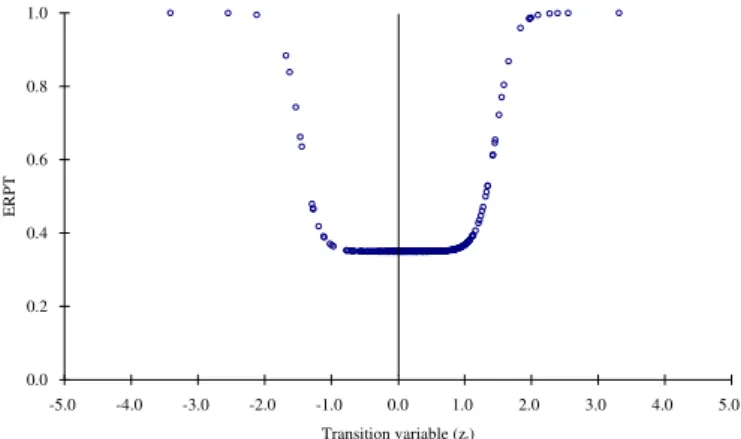
Based on the parameter estimates, we show the implied ERPT
f
^2;0þ^f
4;0Gðzt; ^g
ÞinFig. 4againstthe transition variablezt ¼3 1P3j¼1
p
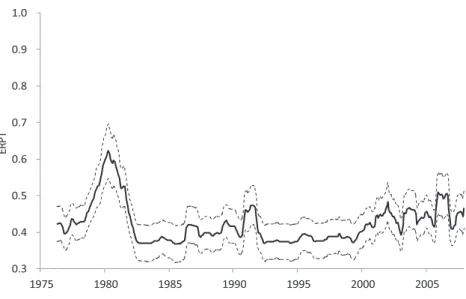
t j (the circles denoting the actual data points). The plotsuggests that the degree of ERPT becomes largest when the transition variable, namely the average lagged inflation rate, exceeds 2 percent in absolute value. Fig. 5 shows the smoothed estimates of the time-varying ERPT, based on the 12-month moving averages, along with their two-standard error bands. The smoothed plot illustrates three distinct high ERPT episodes. The
first high ERPT period corresponds to the second oil shock in the late 1970s. During the 1980s and 1990s, the ERPT is relatively stable except for the early 1990s when the producer price index is relatively volatile. During the decade beginning in 2000, the ERPT becomes high again due to the increased inflation.
4.3. Symmetric DLSTAR model
To select the delay parameter for the transition variable and lags for the regressors in a symmetric version of the DLSTAR model, we use a procedure similar to the one employed for the ESTAR model estimation. We selectd¼1 and the estimation results are given as follows:
pt
¼0:098ð3:466Þþ0:208ð3:866Þ
p
t 1þ0:159ð4:278Þp
t 3 0:101ð2:195Þp
t 5þð0:34912:519ÞD
stþpt
þ0:075 ð2:341Þ
D
st 1þpt 1
0:070 ð2:441Þ
D
st 2þpt 2
þ0:066 ð2:081Þ
D
st 5þpt 5
þh0:242
ð1:150Þ
p
t 4 0:739ð2:749Þp
t 5þ1:230ð5:269Þp
t 6þð0:65123:333ÞD
stþpt
0:438 ð5:568Þ
D
st 1þpt 1
þ0:350 ð3:109Þ
D
st 2þpt 2
0:534 ð2:695Þ
D
st 4þpt 4
0:356 ð1:957Þ
D
st 5þpt 5 i
Gðzt; ^
g
;^cÞ þ^3t;Fig. 5.ERPT over time: ESTAR model.
Gðzt;^
g
;^cÞ¼ 0B B B @
1þexp
8 > > <
> > :
5:130 ð2:924Þ
p
t 1 1:474ð21:283Þ
0:686 9 > > =
> > ; 1
C C C A 1
þ 0
B B B @
1þexp
8 > > <
> > :
5:130 ð2:924Þ 0
B B @
p
t 1þ1:474ð21:283Þ 0:686
1
C C A 9 > > =
> > ; 1
C C C A 1
;
R2 ¼0:654;se ¼ 0:448;obs¼396;LMð1Þ ¼ 0:040;LMð1 12Þ ¼ 0:242:
Again, the estimate of the scaling parameter
g
(¼g
1¼g
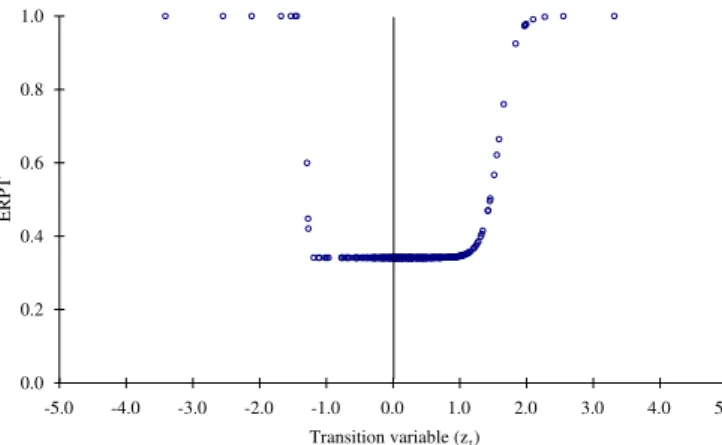
2) is expressed in terms of a normalizedtransition variable. As shown inFig. 6, the shape of the implied ERPT
f
^2;0þ^f
4;0Gðzt; ^g
;^cÞas a functionof the transition variablezt ¼
p
t 1 somewhat resembles the shape of the transition function of TARmodel predicted by the two-period contract case (Fig. 1). A threshold-model-like shape of the tran-sition function results in many data points near the lowest ERPT. Because of this feature, the time series plot of ERPT based on the DLSTAR model shown inFig. 7shows more observations of low and stable ERPT around 0.35 compared to the case of the ESTAR model.
0.0 0.2 0.4 0.6 0.8 1.0
-5.0 -4.0 -3.0 -2.0 -1.0 0.0 1.0 2.0 3.0 4.0 5.0
Transition variable (z )
ERPT
Fig. 6.ERPT against the transition variable: symmetric DLSTAR model.
ER
P
T
Fig. 7. ERPT over time: symmetric DLSTAR model.
4.4. Asymmetric DLSTAR model
We now turn to the estimation of the asymmetric version of the DLSTAR model to incorporate the possibility of asymmetric adjustment. Minimizing the sum of the squared residuals yields the choice of d¼1. Thefinal specification of the model with parameter estimates is as follows:
pt
¼0:095ð3:349Þþ0:270ð4:183Þ
p
t 1þ0:153ð4:094Þp
t 3 0:105ð2:326Þp
t 5þð0:34112:352ÞD
stþpt
þ0:062 ð1:879Þ
D
st 1þpt 1
0:078 ð2:747Þ
D
st 2þpt 2
þ0:064 ð2:071Þ
D
st 5þpt 5
þh 0:198
ð1:722Þ
p
t 1 0:510ð1:979Þp
t 5þ1:001ð4:666Þp
t 6þð0:65923:868ÞD
stþpt
0:338 ð3:324Þ
D
st 1þpt 1
þ0:417 ð3:352Þ
D
st 2þpt 2
0:298 ð2:685Þ
D
st 4þpt 4
0:482 ð2:699Þ
D
st 5þpt 5 i
Gðzt; ^
g
1;g
^2;^c1;^c2Þ þ^3t;Gðzt; ^
g
1;^g
2;^c1;^c2Þ ¼ 0B B B @
1þexp
8 > > < > > : 5:762 ð1:129Þ
p
t 1 1:591ð14:924Þ 0:686 9 > > = > > ; 1 C C C A 1 þ 0 B B B @
1þexp
8 > > < > > : 55:253 ð1:124Þ
p
t 1þ 1:293ð156:218Þ 0:686 9 > > = > > ; 1 C C C A 1 ;
R2 ¼0:663;se ¼0:443;obs ¼396;LMð1Þ ¼ 0:073;LMð1 12Þ ¼0:247:
Again, the estimates of the scaling parameters
g
1andg
2are expressed in terms of the normalizedtransition variable.
Fig. 8plots the implied ERPT
f
^2;0þf
^4;0Gðzt; ^g
1;^g
2;^c1;^c2Þagainst the transition variablezt ¼p
t 1allowing for the asymmetric adjustment. In terms of the shape of the transition function, the
0.0 0.2 0.4 0.6 0.8 1.0
-5.0 -4.0 -3.0 -2.0 -1.0 0.0 1.0 2.0 3.0 4.0 5.0
Transition variable (zt)
ERPT
Fig. 8.ERPT against the transition variable: asymmetric DLSTAR model.
asymmetric DLSTAR specification result is similar to that of the symmetric DLSTAR specification. However, because the estimate of
g
2is much larger than that ofg
1, the transition is much faster in thenegative region.Fig. 9shows the smoothed plots of the ERPT implied by the asymmetric DLSTAR model estimates over the sample period. The behavior of estimated ERPT is very similar to the one implied by the symmetric DLSTAR model.
4.5. Specification test
Table 2reports the results of the specification test to select an appropriate transition function among the ESTAR, the symmetric DLSTAR and the asymmetric DLSTAR models. In some cases, the null hypothesis of the ESTAR model against the asymmetric DLSTAR model cannot be rejected (seeF3with
dgreater than 3). On the other hand, the evidence suggests rejecting the symmetric DLSTAR model in favor of the asymmetric DLSTAR (F13) and the ESTAR specifications ðF1j3Þ. While the evidence is
somewhat mixed, the ESTAR and asymmetric DLSTAR specifications may be slightly better than the symmetric DLSTAR specification.
ER
P
T
Fig. 9.ERPT over time: asymmetric DLSTAR model.
Table 2
Specification tests for STAR models.
Test statistics Transition variableðzt¼d 1Pdj¼1ptejÞ
H0(H1) d¼1 d¼2 d¼3 d¼4 d¼5 d¼6
F3 ESTAR
(Asymmetric DLSTAR)
3.82 (0.00) 2.91 (0.00) 2.31 (0.01) 1.49 (0.13) 1.70 (0.06) 1.14 (0.32)
F1j3 Symmetric DLSTAR
(ESTAR)
2.70 (0.00) 3.00 (0.00) 2.74 (0.00) 2.97 (0.00) 2.28 (0.01) 1.27 (0.23)
F13 Symmetric DLSTAR
(Asymmetric DLSTAR)
3.04 (0.00) 2.76 (0.00) 2.37 (0.00) 2.10 (0.07) 1.89 (0.02) 1.16 (0.29)
Lag length isN¼6.F3is the F test statistic forH0:b3¼0 againstH1:b3s0.F1
j3is the F test statistic forH0:b1 ¼0jb3¼0 againstH1:b1s0jb3 ¼0.F13is the F test statistic forH0:b1 ¼b3 ¼0 againstH1:b1s0 andb3s0. Under the null hypothesis, three sets of F test statistics follow F distributions withð2N;T 8N 1Þ,ð2N;T 6N 1Þandð4N;T 8N 1Þdegrees of freedom, respectively. The numbers in parentheses below F statistics arep-values.
5. Conclusion
In this paper, we show that the STAR models, the parsimonious parametric nonlinear time series models, offer a very convenient framework in examining the relationship between the ERPT and inflation. First, a simple theoretical model of ERPT determination suggests that the dynamics of ERPT can be well approximated by a class of STAR models with lagged inflation as a transition variable. Second, we can employ various U-shaped transition functions in the estimation of the time-varying ERPT. When this procedure is applied to US import and domestic price data, wefind the supporting evidence of nonlinearity in ERPT dynamics. Our empirical results imply that the period of low ERPT is likely to be associated with the low inflation.
According to our model, the degree of ERPT varies over time because the fraction of importingfirms opting out from the contract is endogenously determined by importingfirms’optimization behavior. In the model, however, all imports are treated as if they are invoiced in the producer’s (exporter’s) currency. An alternative approach in introducing a time-varying ERPT is to use a model in which exportingfirms endogenously choose between producer currency pricing (PCP) and local currency pricing (LCP). For example, a recent study byGopinath et al. (2010)extends the model ofEngel (2006)
and investigates the role of the invoice currency in determining the observed ERPT. Our analysis does not consider this channel partly because we do not have data on individual exporters’invoice currency. Incorporating the effect of currency choice in our estimation procedure seems to be a promising direction for further analysis.
Acknowledgment
The authors gratefully acknowledge an anonymous referee, the Editor, Mick Devereux, Ippei Fuji-wara, Naohisa Hirakata, Kevin Huang, Nobu Kiyotaki, Takushi Kurozumi, Keisuke Otsu, Shigenori Shiratsuka and seminar and conference participants at the Georgia Institute of Technology, Osaka University, the University of Texas at Arlington and the 2009 Far East and South Asia Meeting of the Econometric Society for their helpful comments and discussions. Shintani gratefully acknowledges
financial support by the National Science Foundation Grant SES-1030164. The views expressed in the paper are those of the authors and are not reflective of those of the Asian Development Bank.
Appendix: Model of importers
In this appendix we provide a full description of the theoretical model and derive its implications discussed in Section2. There is a continuum of monopolistically competitive importingfirms, each of which imports a differentiated intermediate good from abroad and sells it to a representative domestic
final good producer. In each time period, a constant fraction 1 /Nof all importingfirms and thefinal good producer write their pricing contracts ofNperiods long. An importingfirm that writes the pricing contract at timetej(forj ¼0;1;.;N 1) and imports a goodi˛½0;1, at timetis facing a demand
given by
Ctði;t jÞ ¼ P
tði;t jÞ
Ptðt jÞ
q
Ctðt jÞ
where
q
>1 is a constant elasticity of substitution. Here, Ptði;t jÞ is the price of a good iimported by afirm with a contract beginning in periodt j.Ptðt jÞ ¼ ðR01Ptði;t jÞ1 qdiÞ1=ð1 qÞis
the price index for the composite intermediate good sold by importing firms whose contracts begin in periodt j.Ctðt jÞis the demand for the corresponding composite good. The elasticity
of substitution among composite intermediate goods sold by each fraction 1/Nof all importing
firms is assumed to be one, and thus aggregate price index at time t (in log) is pt ¼ N 1PNj¼01ptðt jÞ whereptðt jÞ ¼lnPtðt jÞ.
All the differentiated intermediate goods are imported at the same foreign currency price,P t, which
is beyond the control of importers. The importer’s profit, in terms of the domestic currency, at timetis given by
P
tði;t jÞ ¼Ptði;t jÞCtði;t jÞ ð1þs
ÞStPtCtði;t jÞ
whereStis the nominal exchange rate, and
s
is the iceberg transportation cost the importer must bear. The importer’s desired price, which maximizes the profit underflexible price economy, is^
Ptði;t jÞ ¼
q
q
1ð1þs
ÞStPtwhere
q
=ðq
1Þ, andð1þs
ÞStPt represent the mark-up and marginal cost, respectively. By taking a log
of the desired price, which is same across all the importingfirmsð^Pt ¼^Ptði;t jÞÞ, we havep^t ¼stþ p
tþ
m
where st ¼lnSt andm
¼lnðq
=ðq
1ÞÞ þlnð1þs
Þ. Both st and pt are assumed to follow
(possibly mutually correlated) random walk processes with a variance of the sum of each increment,
D
ðstþptÞ, given bys
2.In the initial period of the contract, importers set the price at^pt. For the rest of the contract
period, they fully index their initial price^ptto the aggregate inflation rate given by
p
t ¼ pt pt 1.Note that prices are indexed to inflation of the initial period only, instead of following the period-by-period lagged inflation indexation rule as in Christiano et al. (2005). While the latter pricing scheme can be also introduced in our model, the former assumption greatly simplifies the analysis.
In reality, contracts written forfixed periods can, in special circumstances, be re-negotiated. By paying afixed cost,firms can opt out of the contract and reset their price at the desired level. For example, inDevereux and Siu (2007), eachfirm observes its fix cost, which is assumed to be i.i.d. acrossfirms, after setting its (two-period) contract price. Consequently, the pricing in the second period becomes state-dependent with all firms facing the same probability of opting out in the second period. We also letfirms make their decision in a sequential manner by assuming that the aggregate inflation is not observed by individualfirms at the time of the contract. However, instead of formally deriving the state-dependent pricing solution, we followBall et al. (1988), Romer (1990), and
Devereux and Yetman (2002, 2010), among others, and re-formulate thefirm’s optimization behavior so that the probability of (not) changing its price to the desired price level is endogenously deter-mined. Let
k
ðtÞbe the conditional probability that afirm will not opt out of the contract, provided that thefirm is in the contract in the current period. After setting the new contract price^ptatt, thefirmsobserve the aggregate inflation
p
tand choosek
ðtÞto maximize their profit. As inWalsh (2003), we canrewrite the intertemporal profit maximization condition using the expected squared deviation of the actual price from the desired price in each period.
(A) Two-period contract case
WhenN¼2, an optimal value of
k
ðtÞis selected by minimizing the expected loss function given byLt ¼Et h
bk
ðtÞð^ptþp
t p^tþ1Þ2 iþ
b
1k
ðtÞF
¼
b
Fb
F
s
2p
2t
k
ðtÞwhere
b
is a discount factor andFis afixed cost. Here we exclude the possibility ofF<s
2, sincethe loss is always minimized by setting
k
ðtÞ ¼0 in such a case. WhenFs
2, thefirm selectsk
ðtÞ ¼1 ifp
2t F
s
2andk
ðtÞ ¼0 ifp
2t >Fs
2. Thus, for the given values ofFands
2,k
ðtÞis simply a function ofp
t. When we use the same argument, for anyfirms entering into contracts at timet ej,k
ðt jÞ isa function of
p
t jgiven byk
ðp
t jÞ ¼1fjp
t jj ffiffiffiffiffiffiffiffiffiffiffiffiffiffiF
s
2p
g. Using the definition of the aggregate price index, we have
pt ¼ 1
2ðptðtÞ þptðt 1ÞÞ ¼
stþpt þ
m
k
ðp
t 1Þ2
D
stþpt
since thefirms with new contracts set their priceptðtÞat the desired price,p^t ¼stþptþ
m
, and thefirms with contracts made in the previous period set their price ptðt 1Þ at ð1
k
ðp
t 1ÞÞ^ptþk
ðp
t 1Þð^pt 1þp
t 1Þ. The inflation dynamics are written asp
t ¼1
k
ðp
t 1Þ 2
D
stþpt
þ
k
ðp
2t 2ÞD
st 1þpt 1
þ
k
ðp
2t 1Þp
t 1k
ðp
t 2Þ 2p
t 2:We followDevereux and Yetman (2010), among others, and consider the (short-run) ERPT in terms of thefirst derivative of
p
twith respect toD
ðstþptÞ, orERPT ¼1
k
ðp
t 1Þ 2 ;which depends on the lagged inflation,
p
t 1. Whenffiffiffiffiffiffiffiffiffiffiffiffiffiffi
F
s
2p
p
t 1ffiffiffiffiffiffiffiffiffiffiffiffiffiffi
F
s
2p
,
k
ðp
t 1Þtakes a value ofone and the ERPT becomes 0.5. On the other hand, whenj
p
t 1j> ffiffiffiffiffiffiffiffiffiffiffiffiffiffiF
s
2p
, the model predicts a full ERPT.
(B) Three-period contract case
WhenN¼3, the loss function becomes a quadratic function of
k
ðtÞgiven byLt¼Et h
bk
ðtÞð^ptþp
t p^tþ1Þ2þbk
ðtÞ2ð^ptþ2p
t ^ptþ2Þ2 iþ
b
1k
ðtÞð1þb
ÞFþb
2k
ðtÞ1k
ðtÞF¼
b
ð1þb
ÞFb
Fs
2p
2 tk
ðtÞb
2F 2
s
2 4p
2 t
k
ðtÞ2:
Thefirst-order condition yields the optimal
k
ðtÞgiven byk
ðpt
Þ ¼F
s
2p
2t
2
b
F 2
s
2 4p
2 tprovided F
s
2p
2t >0 and ðF
s
2p
2tÞ þ2b
ðF 2s
2 4p
2tÞ<0. In this case,k
ðtÞ is a smoothfunction of the inflation rate
p
t. Otherwise,k
ðtÞbecomes a corner solution taking a value of either0or1.In particular, if F
s
2p
2t >0 and ðF
s
2p
2tÞ þ2b
ðF 2s
2 4p
2tÞ 0, thenk
ðp
tÞ ¼1. IfF
s
2p
2t 0, then
k
ðp
tÞ ¼0. The aggregate price is given bypt¼13ðptðtÞþptðt 1Þþptðt 2ÞÞ
¼
stþpt
k
ðp
t 1Þþk
ðp
t 2Þ23
D
stþpt
k
ðp
t 2Þ23
D
st 1þpt 1
þ
k
ðp
3t 1Þp
t 1þ2k
ðp
t 2Þ 23
p
t 2where the second equality follows from ptðt 1Þ ¼ ð1
k
ðp
t 1ÞÞ^ptþk
ðp
t 1Þðp^t 1þp
t 1Þ andptðt 2Þ ¼ ð1
k
ðp
t 2Þ2Þ^ptþk
ðp
t 2Þ2ð^pt 2þ2p
t 2Þ. The inflation dynamics are given byp
t ¼ 1k
ðp
t 1Þ þk
ðp
t 2Þ 23
!
D
s tþpt1 3
k
ðp
t 2Þ2k
ðp
t 2Þk
ðp
t 3Þ2D
st 1þpt 1
þ
k
ðp
t 3Þ 23
D
st 2þpt 2
þ
k
ðp
3t 1Þp
t 1þ1 3
2
k
ðp
t 2Þ2k
ðp
t 2Þp
t 22
k
ðp
t 3Þ23
p
t 3:The ERPT is given by
ERPT ¼1
k
ðp
t 1Þ þk
ðp
t 2Þ2
3
which now depends on
p
t 1andp
t 2.(C) N-period contract case
Using a similar argument, for general N, the current inflation becomes a function of
p
t j for j ¼1;.;NandD
ðst jþpt jÞforj ¼0;.;N 1. The ERPT for anyNis given by
ERPT ¼1
PN 1
j¼1
k
p
t jjN
where
k
ðp
t jÞis a nonlinear function ofp
t j. The second termN 1PNj¼11k
ðp
t jÞjrepresents the fractionoffirms adapting the indexation rule and the ERPT can now vary from 1/Nto1. In general, the ERPT is a smooth nonlinear function of lagged inflation rates, with its dynamics possibly approximated by STAR models with a U-shaped transition function.
References
Ball, L., Mankiw, N.G., 1994. Asymmetric price adjustment and economicfluctuations. Economic Journal 104, 247e261. Ball, L., Mankiw, N.G., Romer, D., 1988. The new Keynesian economics and the output-inflation trade-off. Brookings Papers on
Economic Activity 1, 1e65.
Bec, F., Ben Salem, M., Carrasco, M., 2004. Detecting mean reversion in real exchange rates from a multiple regime STAR model. Mimeo. Calvo, G.A., Reinhart, C.M., 2002. Fear offloating. Quarterly Journal of Economics 117 (2), 379e408.
Campa, J.M., Goldberg, L.S., 2005. Exchange rate pass-through to domestic prices. Review of Economics and Statistics 87 (4), 679e690. Choudhri, E.U., Hakura, D.S., 2006. Exchange rate pass-through to domestic prices: does the inflationary environment matter?
Journal of International Money and Finance 25 (4), 614e639.
Choudhri, E.U., Faruqee, H., Hakura, D.S., 2005. Explaining the exchange rate pass-through in different prices. Journal of International Economics 65 (2), 349e374.
Christiano, L.J., Eichenbaum, M., Evans, C.L., 2005. Nominal rigidities and the dynamic effects of a shock to monetary policy. Journal of Political Economy 113, 1e45.
Devereux, M.B., Siu, H.E., 2007. State dependent pricing and business cycle asymmetries. International Economic Review 48 (1), 281e310.
Devereux, M.B., Yetman, J., 2002. Menu costs and the long-run output-inflation trade-off. Economics Letters 76, 95e100. Devereux, M.B., Yetman, J., 2010. Price adjustment and exchange pass-through. Journal of International Money and Finance 29,
181e200.
Engel, C., 2006. Equivalence results for optimal pass-through, optimal indexing to exchange rates, and optimal choice of currency for export pricing. Journal of the European Economic Association 4 (6), 1249e1260.
Goldberg, P.K., Knetter, M.M., 1997. Goods prices and exchange rates: what have we learned? Journal of Economic Literature 35, 1243e1272.
Gopinath, G., Itskhoki, O., Rigobon, R., 2010. Currency choice and exchange rate pass-through. American Economic Review 100 (1), 304e336.
Granger, C.W.J., Teräsvirta, T., 1993. Modelling Nonlinear Economic Relationships. Oxford University Press, Oxford.
Haggan, V., Ozaki, T., 1981. Modelling nonlinear random vibrations using an amplitude-dependent autoregressive time series model. Biometrika 68 (2), 189e196.
Herzberg, V., Kapetanios, G., Price, S., 2003. Import prices and exchange rate pass-through: Theory and evidence from the United Kingdom. Bank of England Working Paper, No. 182.
Kilian, L., Taylor, M.P., 2003. Why is it so difficult to beat the random walk forecast of exchange rates? Journal of International Economics 60, 85e107.
McCarthy, J., 2007. Pass-through of exchange rates and import prices to domestic inflation in some industrialized economies. Eastern Economic Journal 33 (4), 511e537.
Michael, P., Nobay, A.R., Peel, D.A., 1997. Transaction costs and nonlinear adjustments in real exchange rates: an empirical investigation. Journal of Political Economy 105, 862e879.
Otani, A., Shiratsuka, S., Shirota, T., 2003. The decline in the exchange rate pass-through: evidence from Japanese import prices. Bank of Japan Monetary and Economic Studies 21 (3), 53e81.
Romer, D., 1990. Staggered price setting with endogenous frequency of adjustment. Economics Letters 32, 205e210. Sekine, T., 2006. Time-varying exchange rate pass-through: Experiences of some industrial countries. BIS Working Paper, No. 202. Taylor, J.B., 1980. Aggregate dynamics and staggered contracts. Journal of Political Economy 88, 1e23.
Taylor, J.B., 2000. Low inflation, pass-through, and the pricing power offirms. European Economic Review 44, 1389e1408. Taylor, M.P., Peel, D.A., 2000. Nonlinear adjustment, long-run equilibrium and exchange rate fundamentals. Journal of
Inter-national Money and Finance 19, 33e53.
Taylor, M.P., Peel, D.A., Sarno, L., 2001. Nonlinear mean-reversion in real exchange rates: toward a solution to the purchasing power parity puzzles. International Economic Review 42, 1015e1042.
Teräsvirta, T., 1994. Specification, estimation, and evaluation of smooth transition autoregressive models. Journal of the American Statistical Association 89, 208e218.
van Dijk, D., Teräsvirta, T., Franses, P., 2002. Smooth transition autoregressive models: a survey of recent developments. Econometrics Reviews 21, 1e47.
Walsh, C.E., 2003. Monetary Theory and Policy, second ed. MIT Press, Cambridge.