Measurement of stem form of Japanese cedar
(Cryptomeria japonica D. Don) trees in the
Takakuma Experimental Forests, Kagoshima
University (1)
著者
INOUE Akio, KOSHIKAWA Kazuki, HARADA Rikito,
KIRIMURA Satoko
journal or
publication title
Research bulletin of the Kagoshima University
forests
volume
43
page range
67-71
year
2018-03-01
別言語のタイトル
鹿児島大学高隈演習林におけるスギの幹形の計測(
1)
URL
http://hdl.handle.net/10232/00031124
研究資料
Measurement of stem form of Japanese cedar (Cryptomeria japonica D. Don)
trees in the Takakuma Experimental Forests, Kagoshima University (1)
INOUE Akio1), KOSHIKAWA Kazuki1), HARADA Rikito1) and KIRIMURA Satoko1)
1) Laboratory of Forest Ecology, Department of Environmental Resources, Faculty of Environmental and Symbiotic Sciences, Prefectural University of Kumamoto
Summary
We measured stem form of Japanese cedar (Cryptomeria japonica D. Don) trees in the Takakuma Experimental Forests, Kagoshima University, southern Japan. In three stands of Japanese cedar (stand age: 19, 42 and 53 year-old), five straight, healthy trees were felled, and then tree height (H), branch height (Hb), diameters at breast height (D) and base, and stem di-ameters along a stem with intervals of 0.5 m from tree tip to base (d ) were measured. In this paper, original data of the 15 sample trees was published.
Keyword: Japanese cedar, stem form, Takakuma Experimental Forests
1. Introduction
Stem form data is essential to develop growth model as well as volume equation and taper curve (e.g., Corral-Rivas et al., 2017). In November 2017, we measured stem form of Japanese cedar (Cryptomeria japonica D. Don) trees in the Takakuma Experimental Forests, Kagoshima University. Japanese cedar is one of the most popular and important coniferous tree species in Japan. In this paper, we published original data obtained by the measurement, which will be useful in various subsequent researches relevant to forest science.
2. Materials and methods
Measurement was performed in the Takakuma Experimental Forests, Kagoshima University located in the northern part of Tarumizu City, Kagoshima Prefecture, southern Japan. For general description of the Experimental Forests, see Takakuma Experimental Forests (2015). Sample trees were gathered in three even-aged pure stands of Japanese cedar, of which age was 19, 42 and 53 year-old (hereafter referred to as stand A, B and C, respectively). Our data covers the standard rotation period for Japanese cedar stands in Kagoshima Prefecture, i.e., 35 year-old (Kagoshima Prefecture, 2017).
Five straight, healthy sample trees with various sizes were selected in each stand, and felled at ground level for direct measurement of height and stem diameter. Therefore, the total number of sample trees was 15 in this paper. Tree height (H ) and
branch height (Hb) were measured directly on the stem using a
tape measure to the nearest tenth of a meter. Diameters outside bark at breast height (1.2 m above ground level; D) and base were also measured using a diameter tape to the nearest tenth of a centimeter. Furthermore, the stem diameters outside bark (d ) were measured with equal intervals of 0.5 m from tree tip to base using a caliper or a diameter tape to the nearest tenth of a centimeter. When using a caliper, the diameters of two orthogonal directions were measured, and then averaged. Stem volume (V ) of each sample was calculated by the sectional measurement method (West, 2004).
3. Results
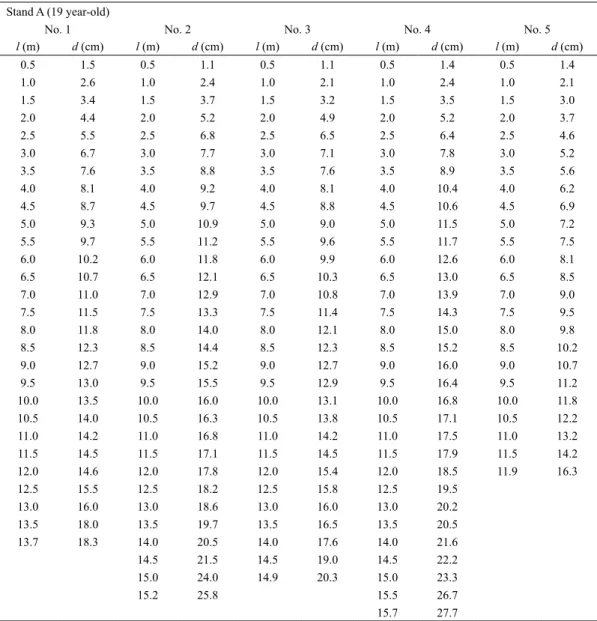
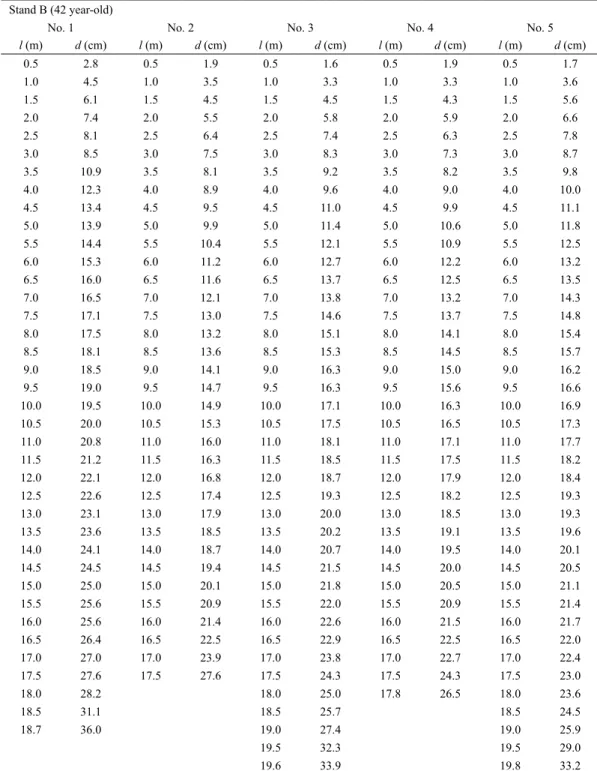
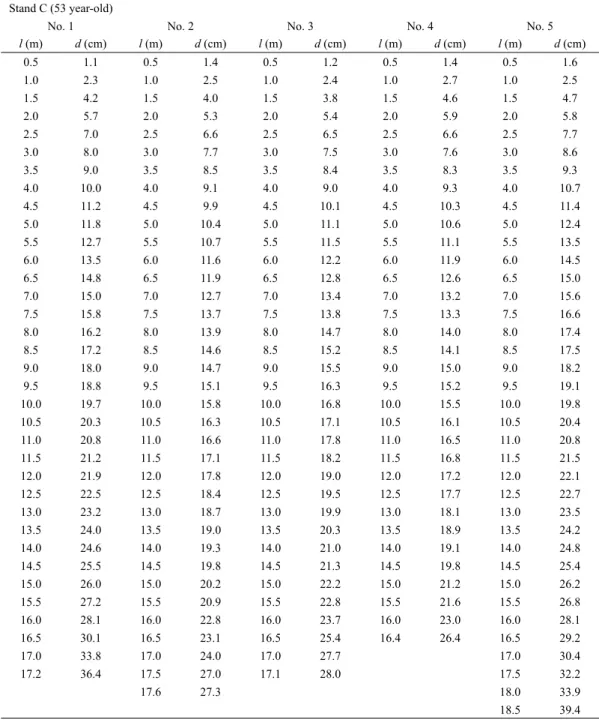
A summary of the sample trees is shown in Table 1. The H, D and V of the 15 sample trees ranged from 11.9 m to 19.8 m, 12.9 cm to 31.4 cm and 0.071 m3 to 0.595 m3, respectively. Stem form
data obtained in this study is summarized in Table 2. Note that l indicates the distance from tree tip. All measurements were conducted after felling trees, resulting in a reliable stem form data. The data can be used to develop and verify the growth model, volume equation and taper curve for Japanese cedar stands in Kagoshima Prefecture.
Acknowledgements
Field assistance was provided by the staff of the Takakuma Experimental Forests, Kagoshima University, whose help is
68 INOUE Akio, KOSHIKAWA Kazuki, HARADA Rikito and KIRIMURA Satoko
Table 1 Summary of Japanese cedar sample trees
Stand Compartment * No. H (m) Hb (m) D (cm) V (m3) **
A 107 (76) 1 13.7 9.2 15.4 0.133 (19 year-old) 2 15.2 9.2 20.5 0.238 3 14.9 9.5 16.6 0.164 4 15.7 10.8 22.2 0.288 5 11.9 8.9 12.9 0.071 B 106 (21) 1 18.7 11.8 27.6 0.561 (42 year-old) 2 17.5 10.0 22.1 0.301 3 19.6 10.2 25.5 0.476 4 17.8 13.3 22.5 0.333 5 19.8 13.1 24.7 0.466 C 108 (23) 1 17.2 8.5 28.1 0.475 (53 year-old) 2 17.6 11.7 22.8 0.326 3 17.1 9.7 23.4 0.342 4 16.4 11.0 21.3 0.272 5 18.5 10.5 31.4 0.595
* Values in the parenthesis represent the sub-compartment number. ** Stem volume was computed using the sectional measurement method.
Table 2 Stem form of Japanese cedar trees
Stand A (19 year-old)
No. 1 No. 2 No. 3 No. 4 No. 5
l (m) d (cm) l (m) d (cm) l (m) d (cm) l (m) d (cm) l (m) d (cm) 0.5 1.5 0.5 1.1 0.5 1.1 0.5 1.4 0.5 1.4 1.0 2.6 1.0 2.4 1.0 2.1 1.0 2.4 1.0 2.1 1.5 3.4 1.5 3.7 1.5 3.2 1.5 3.5 1.5 3.0 2.0 4.4 2.0 5.2 2.0 4.9 2.0 5.2 2.0 3.7 2.5 5.5 2.5 6.8 2.5 6.5 2.5 6.4 2.5 4.6 3.0 6.7 3.0 7.7 3.0 7.1 3.0 7.8 3.0 5.2 3.5 7.6 3.5 8.8 3.5 7.6 3.5 8.9 3.5 5.6 4.0 8.1 4.0 9.2 4.0 8.1 4.0 10.4 4.0 6.2 4.5 8.7 4.5 9.7 4.5 8.8 4.5 10.6 4.5 6.9 5.0 9.3 5.0 10.9 5.0 9.0 5.0 11.5 5.0 7.2 5.5 9.7 5.5 11.2 5.5 9.6 5.5 11.7 5.5 7.5 6.0 10.2 6.0 11.8 6.0 9.9 6.0 12.6 6.0 8.1 6.5 10.7 6.5 12.1 6.5 10.3 6.5 13.0 6.5 8.5 7.0 11.0 7.0 12.9 7.0 10.8 7.0 13.9 7.0 9.0 7.5 11.5 7.5 13.3 7.5 11.4 7.5 14.3 7.5 9.5 8.0 11.8 8.0 14.0 8.0 12.1 8.0 15.0 8.0 9.8 8.5 12.3 8.5 14.4 8.5 12.3 8.5 15.2 8.5 10.2 9.0 12.7 9.0 15.2 9.0 12.7 9.0 16.0 9.0 10.7 9.5 13.0 9.5 15.5 9.5 12.9 9.5 16.4 9.5 11.2 10.0 13.5 10.0 16.0 10.0 13.1 10.0 16.8 10.0 11.8 10.5 14.0 10.5 16.3 10.5 13.8 10.5 17.1 10.5 12.2 11.0 14.2 11.0 16.8 11.0 14.2 11.0 17.5 11.0 13.2 11.5 14.5 11.5 17.1 11.5 14.5 11.5 17.9 11.5 14.2 12.0 14.6 12.0 17.8 12.0 15.4 12.0 18.5 11.9 16.3 12.5 15.5 12.5 18.2 12.5 15.8 12.5 19.5 13.0 16.0 13.0 18.6 13.0 16.0 13.0 20.2 13.5 18.0 13.5 19.7 13.5 16.5 13.5 20.5 13.7 18.3 14.0 20.5 14.0 17.6 14.0 21.6 14.5 21.5 14.5 19.0 14.5 22.2 15.0 24.0 14.9 20.3 15.0 23.3 15.2 25.8 15.5 26.7 15.7 27.7
Table 2 Stem form of Japanese cedar trees (continued )
Stand B (42 year-old)
No. 1 No. 2 No. 3 No. 4 No. 5
l (m) d (cm) l (m) d (cm) l (m) d (cm) l (m) d (cm) l (m) d (cm) 0.5 2.8 0.5 1.9 0.5 1.6 0.5 1.9 0.5 1.7 1.0 4.5 1.0 3.5 1.0 3.3 1.0 3.3 1.0 3.6 1.5 6.1 1.5 4.5 1.5 4.5 1.5 4.3 1.5 5.6 2.0 7.4 2.0 5.5 2.0 5.8 2.0 5.9 2.0 6.6 2.5 8.1 2.5 6.4 2.5 7.4 2.5 6.3 2.5 7.8 3.0 8.5 3.0 7.5 3.0 8.3 3.0 7.3 3.0 8.7 3.5 10.9 3.5 8.1 3.5 9.2 3.5 8.2 3.5 9.8 4.0 12.3 4.0 8.9 4.0 9.6 4.0 9.0 4.0 10.0 4.5 13.4 4.5 9.5 4.5 11.0 4.5 9.9 4.5 11.1 5.0 13.9 5.0 9.9 5.0 11.4 5.0 10.6 5.0 11.8 5.5 14.4 5.5 10.4 5.5 12.1 5.5 10.9 5.5 12.5 6.0 15.3 6.0 11.2 6.0 12.7 6.0 12.2 6.0 13.2 6.5 16.0 6.5 11.6 6.5 13.7 6.5 12.5 6.5 13.5 7.0 16.5 7.0 12.1 7.0 13.8 7.0 13.2 7.0 14.3 7.5 17.1 7.5 13.0 7.5 14.6 7.5 13.7 7.5 14.8 8.0 17.5 8.0 13.2 8.0 15.1 8.0 14.1 8.0 15.4 8.5 18.1 8.5 13.6 8.5 15.3 8.5 14.5 8.5 15.7 9.0 18.5 9.0 14.1 9.0 16.3 9.0 15.0 9.0 16.2 9.5 19.0 9.5 14.7 9.5 16.3 9.5 15.6 9.5 16.6 10.0 19.5 10.0 14.9 10.0 17.1 10.0 16.3 10.0 16.9 10.5 20.0 10.5 15.3 10.5 17.5 10.5 16.5 10.5 17.3 11.0 20.8 11.0 16.0 11.0 18.1 11.0 17.1 11.0 17.7 11.5 21.2 11.5 16.3 11.5 18.5 11.5 17.5 11.5 18.2 12.0 22.1 12.0 16.8 12.0 18.7 12.0 17.9 12.0 18.4 12.5 22.6 12.5 17.4 12.5 19.3 12.5 18.2 12.5 19.3 13.0 23.1 13.0 17.9 13.0 20.0 13.0 18.5 13.0 19.3 13.5 23.6 13.5 18.5 13.5 20.2 13.5 19.1 13.5 19.6 14.0 24.1 14.0 18.7 14.0 20.7 14.0 19.5 14.0 20.1 14.5 24.5 14.5 19.4 14.5 21.5 14.5 20.0 14.5 20.5 15.0 25.0 15.0 20.1 15.0 21.8 15.0 20.5 15.0 21.1 15.5 25.6 15.5 20.9 15.5 22.0 15.5 20.9 15.5 21.4 16.0 25.6 16.0 21.4 16.0 22.6 16.0 21.5 16.0 21.7 16.5 26.4 16.5 22.5 16.5 22.9 16.5 22.5 16.5 22.0 17.0 27.0 17.0 23.9 17.0 23.8 17.0 22.7 17.0 22.4 17.5 27.6 17.5 27.6 17.5 24.3 17.5 24.3 17.5 23.0 18.0 28.2 18.0 25.0 17.8 26.5 18.0 23.6 18.5 31.1 18.5 25.7 18.5 24.5 18.7 36.0 19.0 27.4 19.0 25.9 19.5 32.3 19.5 29.0 19.6 33.9 19.8 33.2
70 INOUE Akio, KOSHIKAWA Kazuki, HARADA Rikito and KIRIMURA Satoko
Table 2 Stem form of Japanese cedar trees (continued )
Stand C (53 year-old)
No. 1 No. 2 No. 3 No. 4 No. 5
l (m) d (cm) l (m) d (cm) l (m) d (cm) l (m) d (cm) l (m) d (cm) 0.5 1.1 0.5 1.4 0.5 1.2 0.5 1.4 0.5 1.6 1.0 2.3 1.0 2.5 1.0 2.4 1.0 2.7 1.0 2.5 1.5 4.2 1.5 4.0 1.5 3.8 1.5 4.6 1.5 4.7 2.0 5.7 2.0 5.3 2.0 5.4 2.0 5.9 2.0 5.8 2.5 7.0 2.5 6.6 2.5 6.5 2.5 6.6 2.5 7.7 3.0 8.0 3.0 7.7 3.0 7.5 3.0 7.6 3.0 8.6 3.5 9.0 3.5 8.5 3.5 8.4 3.5 8.3 3.5 9.3 4.0 10.0 4.0 9.1 4.0 9.0 4.0 9.3 4.0 10.7 4.5 11.2 4.5 9.9 4.5 10.1 4.5 10.3 4.5 11.4 5.0 11.8 5.0 10.4 5.0 11.1 5.0 10.6 5.0 12.4 5.5 12.7 5.5 10.7 5.5 11.5 5.5 11.1 5.5 13.5 6.0 13.5 6.0 11.6 6.0 12.2 6.0 11.9 6.0 14.5 6.5 14.8 6.5 11.9 6.5 12.8 6.5 12.6 6.5 15.0 7.0 15.0 7.0 12.7 7.0 13.4 7.0 13.2 7.0 15.6 7.5 15.8 7.5 13.7 7.5 13.8 7.5 13.3 7.5 16.6 8.0 16.2 8.0 13.9 8.0 14.7 8.0 14.0 8.0 17.4 8.5 17.2 8.5 14.6 8.5 15.2 8.5 14.1 8.5 17.5 9.0 18.0 9.0 14.7 9.0 15.5 9.0 15.0 9.0 18.2 9.5 18.8 9.5 15.1 9.5 16.3 9.5 15.2 9.5 19.1 10.0 19.7 10.0 15.8 10.0 16.8 10.0 15.5 10.0 19.8 10.5 20.3 10.5 16.3 10.5 17.1 10.5 16.1 10.5 20.4 11.0 20.8 11.0 16.6 11.0 17.8 11.0 16.5 11.0 20.8 11.5 21.2 11.5 17.1 11.5 18.2 11.5 16.8 11.5 21.5 12.0 21.9 12.0 17.8 12.0 19.0 12.0 17.2 12.0 22.1 12.5 22.5 12.5 18.4 12.5 19.5 12.5 17.7 12.5 22.7 13.0 23.2 13.0 18.7 13.0 19.9 13.0 18.1 13.0 23.5 13.5 24.0 13.5 19.0 13.5 20.3 13.5 18.9 13.5 24.2 14.0 24.6 14.0 19.3 14.0 21.0 14.0 19.1 14.0 24.8 14.5 25.5 14.5 19.8 14.5 21.3 14.5 19.8 14.5 25.4 15.0 26.0 15.0 20.2 15.0 22.2 15.0 21.2 15.0 26.2 15.5 27.2 15.5 20.9 15.5 22.8 15.5 21.6 15.5 26.8 16.0 28.1 16.0 22.8 16.0 23.7 16.0 23.0 16.0 28.1 16.5 30.1 16.5 23.1 16.5 25.4 16.4 26.4 16.5 29.2 17.0 33.8 17.0 24.0 17.0 27.7 17.0 30.4 17.2 36.4 17.5 27.0 17.1 28.0 17.5 32.2 17.6 27.3 18.0 33.9 18.5 39.4
greatly appreciated. This study was supported in part by KAKENHI (grant numbers: 16K14948 and 15K07478).
Literature cited
Corral-Rivas JJ, Vega-Nieva DJ, Rodríguez-Soalleiro R, López-Sánchez CA, Wehenkel C, Vargas-Larreta B, Álvarez-González JG, Ruiz-Álvarez-González AD (2017) Compatible system for predicting total and merchantable stem volume over and under bark, branch volume and whole-tree volume of pine species. Forests 8, 417
Kagoshima Prefecture (2017) Guideline on the standard rotation period in Kagoshima Prefecture. https://www.pref.kagoshima. jp/ad06/sangyo-rodo/rinsui/ringyo/keikaku/3.html (in Japanese; accessed on 2018.1.13)
Takakuma Experimental Forests (2015) Educational and research forests: Kagoshima University Forests. http://ace1.agri. kagoshima-u.ac.jp/~takakuma/images/takakumapanhuaka-eigo1.pdf (accessed on 2018.1.13)
West PW (2004) Tree and forest measurement. Springer, Berlin