Day 1: Dispute Resolution Process in Asia
Session I: Dispute Resolution Process in Asia:
Theory and Reality "A Perspective on
Comparative Study of Dispute Settlement
Institutions and Socioeconomic Development"
journal or
publication title
Proceedings of the Roundtable Meeting Law,
Development and Socio-Economic Changes in Asia
II
volume
11
page range
79-92
year
2002
A P
ERSPECTIVE ONC
OMPARATIVES
TUDY OFD
ISPUTES
ETTLEMENTI
NSTITUTIONS ANDS
OCIOECONOMICD
EVELOPMENTWith reference to “The Role of Law and Legal Institutions in Asian Economic Development 1960-1995”
by
Miwa Yamada
*The purpose of this paper is to raise questions regarding the methods and findings of a study of dispute settlement institutions in Asia in the book titled “The Role of Law and Legal Institutions in Asian Economic Development 1965-1995.”1 Initiated by and published for Asian Development Bank, the book examines the correlation between legal development and economic development during 1960-1995 in six Asian economies: China, India, Japan, Korea, Malaysia, and Taiwan. The research in the book consists of three studies: the relationship between corporate law and capital formation, the relationship between security interest law and lending, and the relationship between dispute settlement institutions and economic development. I will, inter alia, focus on the study of the relationship between dispute settlement institutions (DSIs) and economic development (hereinafter referred to as ‘the Study’), for the Study contains interesting implications for our joint research project.
First, I will overview the framework of the Study, introducing methods used and findings therein. Second, I will raise questions regarding findings of the Study about Japan, and third, discuss the method used in the Study to analyze the correlation between
*
Researcher, Institute of Developing Economies (IDE), Japan. 1
Katharina Pistor and Philip A. Wellons, The Role of Law and Legal Institutions in Asian Economic
Development 1965-1995, Oxford University Press, 1999.
dispute settlement institutions and socioeconomic development. Finally, I will present remarks about our joint research project on dispute settlement institutions.
I.
Overview of the Study
1. Purpose of the Study
Western historical experience suggests that the availability of effective and low-cost dispute settlement is an important condition for expanding markets, for meeting the increasing complexity of economic development, and thus ultimately for economic development itself. In order to prove that this experience also applies to Asia, the Study analyzes the role of legal institutions, in particular the role of courts in Asian economic development, focusing on the role of dispute settlement institutions in resolving commercial disputes between non-state parties.
2. Samples used in the Study
To analyze the importance of formal DSIs, the Study collected data on litigation, the total number of civil cases. [See Table 1 for Japan.] Litigation rates indicate the demand for DSIs. The demand for dispute settlements in the courts, however, may be determined not only by the willingness but also by the availability of DSIs. Therefore, the Study also presents data on the number of courts at different levels and the number of judges.
3. Methods used in the Study
The Study tests the proposition that formal dispute settlement will become more important with increasing division of labor. The Study ranks the six economies on a common scale. [See Table 2.] To measure the division of labor, the Study selected three indicators that are summarized in a cumulative index on a scale from zero to ten, called the Division of Labor Index. The three indicators are (i) the share of the population in urban areas; (ii) the share of the population engaged in agriculture (negative indicator); (iii) the share of the population above the age of 25 that has completed primary and secondary education. These indicators measure the diversification of economic activities, which is typically higher in urban than in rural areas as well as in sectors outside
agriculture. Education levels reflect the level of human capital available for more diverse economic activities. The Study seeks a correlation between the Division of Labor Index and the litigation rates in six economies.
4. Findings in comparison across economies
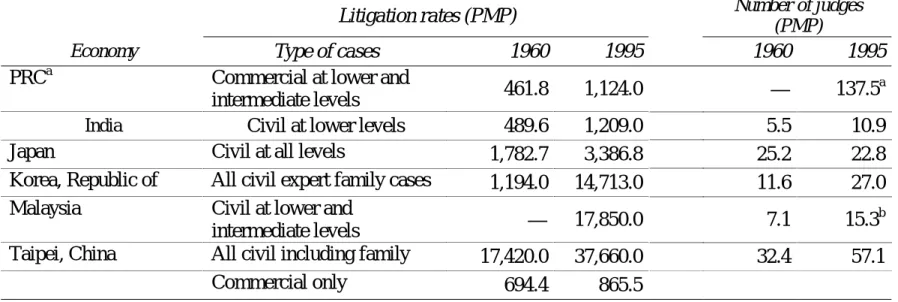
The Study’s findings are summarized as follows: (1) Over the long term, rates for litigation concerning civil and commercial disputes increased in all economies. The Study found a positive and statistically significant correlation between per capita litigation rates and indicators for the division of labor. [See Table 3.] It suggests that with economic development, legal institutions will perform increasingly similar functions throughout the world. (2) Still, litigation rates vary considerable across economies. The variations cannot be explained by economic development, or the extent to which division of labor has been achieved in these economies. For example, litigation rates in Japan in particular have remained much lower than in the other high performing economies. (3) Nor do institutional constraints explain differences in litigation rates. Comparing litigation rates in Japan with those of the Republic of Korea and Taiwan, it is demonstrated that even when these countries share civil law tradition and a legacy of state imposed ceilings for the legal profession, litigation rates can vary considerably. This puzzle of persistent divergence is not solved.
II.
Questions on Findings about Japan
1. Statistical question on Japan’s low litigation rate
The data in the Study are limited to the number of civil litigations in first instance courts, and the Study explains that the reasons for the low number of civil litigations are culture and institutional barriers, including control mechanisms the state exercises over the judiciary. The Study did not refer to the court-connected mediation, which is significant in terms of the number of cases and the outcome available.
One distinctive feature of the Japanese court system is that it provides court-connected mediation. 2 According to the data in 1999, the number of civil litigation cases filed in courts (district courts and summary courts) was 523,000 in total, whereas 264,000 civil mediation cases3 were filed in courts (summary courts and district courts). The number of civil cases filed in court-connected mediation is equivalent to more than half of all civil cases.
An agreement between the parties in court-connected mediation has the same legal effect as settlement in litigation. When the parties do not reach an agreement, the court may render a decision if it is deemed necessary for resolving the dispute. If no party objects to the decision within 2 weeks from its notification, the decision will also have the same effect as settlement in litigation. In litigation, almost half of all litigation cases end in settlement without rulings. 4 Though the litigation procedure differs from court-connected mediation procedure, in many cases both produce outcomes with the same legal effects, i.e. settlement in litigation, that is to be enforced as final judgment.
The number of court-connected mediation cases is significant and cannot be ignored in researching litigation in Japan. Limiting the statistics to the number of litigation cases filed does not necessarily reflect litigation propensity or institutional barriers of courts. People might bring a suit with the aim of settling in litigation, and also might use courts for mediation to obtain the same results that they would obtain by bringing a suit. Therefore, the figure in the Study may not necessarily reflect accurately the litigation preference of Japanese people. Looking at the similar outcomes resulting from litigation and court-connected mediation cases, suggests the need to adjust the number of litigation cases by taking court-connected mediation into consideration.
2
In a court-connected mediation, a judge sits with two mediators appointed from among non-judges. The qualifications of mediators are (1) to be an attorney, (2) to be able to provide useful and well-versed knowledge and experience in resolving civil disputes, or (3) to possess valuable life experience, and be aged more than 40 and less than 70. Minji Chotei Hou (Code of Civil Mediation Law), Minji-Chotei-Iin Kisoku (Rules of Civil Mediation Members)
3
This number excludes family cases.
4
Naohisa Hirota, “ADR as Dispute Settlement Means in Comparison with Litigation” (in Japanese), No.1207 Jurist, 2001.
2. Questions on analysis of Japan’s low litigation rate
The comparison of litigation rates in the Study is based on the premise that in the societies with similar social structures and in similar economic development stages, the number of disputes per unit of population would be approximately the same. On this premise the litigation rate is calculated by dividing the number of litigation cases by the population, and the rate is deemed to be litigation propensity in the society. The Study found that the record of civil, including commercial litigation, in Japan between 1960 and 1995 casts some doubt on theories suggesting that commercial litigation increases with the expansion and increase of complexity of economies. The fact remains that in comparison with other highly industrialized economies in the West, but also, in comparison with other Asian economies, the propensity to litigate in Japan has been low. The Study attributes the comparatively low litigation rate in Japan to its culture and institutional barriers.
It is said that in contrast to Western culture, Japanese culture, with its emphasis on harmony, influences the preference for mediation and conciliation rather than litigation, which is deemed to be hostile. However, examples proving the contrary are also found: e.g. Christian ethics to deter litigation and social conventions to avoid impetuous litigation in the US business community.5 Further, in the US, where the litigation rate is comparatively high, most of the litigation cases filed end up in settlement, with less than 10% proceeding to trial. 6 Thus, it is not easy to make a sharp contrast between Japanese culture and Western culture, harmony on one hand and confrontation on the other hand.
The Study presented institutional barriers as another reason for the low litigation rate in Japan. Institutional barriers are often shaped by culture, but they may also reflect the political interests of the governing elite, as opposed to the economic or cultural preference of disputing non-state parties. The strong evidence for the existence of institutional barriers is the control over the size of the legal profession, including judges
5
Yasuo Watanabe et al., Textbook Modern Judiciary (in Japanese) Nihonhyoronsha, 2000.
6
Takeshi Kojima, Out-of-court Dispute Settlement and the Rule of Law (in Japanese) Yuhikaku, 2000.
and attorneys. 7 However, as admitted by the Study itself, as similar constraints have not led to the same outcome in other economies (Korea, Taiwan), institutional barriers alone are not a sufficient explanation for the low litigation rate in Japan.
Predictability in dispute settlements would be another factor to cause the low litigation rate. 8 Parties would settle their disputes by means that would rationally maximize their wealth. When both parties can foresee the outcome of litigation and the plaintiff can recover damages outside litigation, litigation would be avoided as the result of rational judgment made by the parties. Ramseyer proved this assumption in traffic accident cases in Japan, where a developed insurance system is available. 9 It is concluded that a low litigation rate does not necessarily mean that people do not pursue their legal rights. If apart from litigation there are more effective and lower cost mechanisms that would enable the parties to fulfill their rights, culture and institutional barriers are insufficient to explain the low litigation rate in Japan.
III. Questions on Analysis Methods
1. Definition of dispute settlement institutions
The Study is based on the premise that the availability of effective and low-cost dispute settlement is an important condition for expanding markets with complex business transactions. In other words, as markets expand, formal institutions that have the power to enforce their rulings against parties unwilling to comply voluntarily become more important. In the West, that is the court system. Partly due to the lack of data, therefore, the Study dealt with only formal DSIs, i.e. litigation in court systems established by states. However, if the Study intends to examine the relationship between effective and low-cost dispute settlement and the expansion of markets, the Study does not necessarily have to limit its subject to the court system. There are DSIs other than
7
Frank K. Upham, Law and Social Change in Postwar Japan, Harvard University Press, 1987.
8
Supra note 5.
9
Mark Ramseyer, Law and Economics (in Japanese) Kobundo, 1990.
courts that could certainly serve as mechanisms to solve disputes effectively at low cost. In fact, the court system, which is believed to be effective and less costly, is often found not to be the case even in Western countries.
When we study a particular DSI, we need to define the institution as it is distinguished from other institutions. Otherwise, we will not be able to analyze the reasons why the particular institution is used or not used. The Study contrasted litigation as a Western system against conciliation/mediation as an Asian system. However, the dichotomy between litigation and other dispute settlement institutions is not easy to establish. We can find conciliation/mediation elements in the litigation process in the Western countries such as the US10 and England11. In Japan, the court-connected mediation also provides the parties with a forum where, with professional advice on issues, they estimate the time and cost in case of litigation and foresee the outcome, considering several determining factors such as enforceability. Whereas the pretrial conference is a part of litigation, the court-connected mediation is not within litigation. As DSIs, however, they may share similar functions in seeking a possibility of settlement.12 When a case is filed in a court and then referred to other dispute settlement means, whether inside or outside the court, we cannot conclude that the dispute in the case filed is resolved by the court. We cannot, therefore, draw the conclusion that the
10
Federal Civil Procedure Rules 16 (amended 1983, 1987, 1993) explicitly recognizes that it has become commonplace to discuss settlement at pretrial conferences. Since it obviously eases crowded court dockets and results in savings to the litigants and the judicial system, settlement should be facilitated at as early stage of the litigation as possible. Although the Rule does not impose settlement negotiations on unwilling litigants, it is believed that providing a neutral forum for discussing the subject might foster it. For instance, a judge may arrange, on his own motion or at a party’s request, to have settlement conferences handled by another member of the court or by a magistrate. In addition to settlement, the Rule refers to exploring the use of procedures other than litigation to resolve the disputes. Notes of Advisory Committee on 1983 amendments to Rules.
11
The Civil procedure (Amendment) Rules 1999 provides that when appropriate, a judge may recommend that the parties use alternative means other than litigation. The purpose of the pretrial conference is by discovery at an earlier stage to enable the parties to foresee the outcome of the disputes so that they may be able to avoid litigation in cases where they might incur wasteful time and costs.
12
The significance of the pretrial conference is facilitated by the discovery system, which Japanese court-connected mediation lacks. Settlement in pretrial conference is deemed a contract between the parties, unlike settlement in litigation in Japan, which is equivalent to final judgment. In terms of technical accuracy, comparison of the systems in this paper is insufficient and needs further study.
increasing number of cases filed reflects the increasing significance of the court’s role in dispute settlement.
For a study of effective and low-cost institutions for settling disputes, both litigation and non-litigation institutions need to be covered. If we narrow our study to litigation only, it is necessary to define the significance of the court system, which other DSIs do not have. Is it the state’s power to enforce the ruling against parties unwilling to comply voluntarily? Would social sanction serve as a third-party power to enforce in cases other than litigation? Defining the significance of each DSI, we will be able to articulate their relationships to socioeconomic development.
2. Function of DSI
When we look at the statistics of cases in DSIs, it is necessary to distinguish the functions of each institution, such as function to receive cases, function to settle cases, and function to enforce rulings. The statistics to be selected would differ depending on functions. In order to examine how DSIs function in settling disputes by statistics, it is suggested to classify the following: a) the number of cases filed, b) the number of cases settled by ruling, c) the number of cases transferred to other institutions, and d) the number of cases withdrawn.
When a plaintiff brings a suit and succeeds in collecting his claims by enforcement of judgment, we can conclude that the number of cases filed actually shows the number of cases where the court functions to settle disputes. This, however, is not always the case. When a case is filed but transferred to institutions outside the court and settled there, the number of cases filed does not reflect the court’s function as dispute settlement institutions. Data on the number of cases filed is, therefore, not sufficient to prove that the court functions as a dispute settling institution. If the Study focuses on the court system because the court system entails the power to enforce rulings, the number of cases settled by ruling and the number of cases enforced should be surveyed, not just the number of cases filed.
3. Factors determining litigation rate
The Study is based on the premise that as markets expand and the complexity of impersonal transactions increase, disputes between parties who do not belong to the same ethnicity or trade will increase, and thus, the number of litigations will increase as well. This assumes that in the societies with similar social structures and in similar economic development stages, the number of disputes per unit of population would be approximately the same.
In reality, however, the number of disputes would be determined by numerous variables. For example, the rate of defective products would differ in different countries, and a lack of a particular system such as land registration would contribute to an increase in disputed cases. In order to calculate litigation rates precisely, we need to distinguish the factors determining the number of litigations from the factors causing disputes. In calculating the litigation rate, the denominator should be the total number of disputes occurring and the numerator should be the number of disputes that are brought before courts. Thus, in order to obtain an accurate litigation rate, not only dividing the number of litigations by population, but further, we need to consider various factors to adjust the statistics.
4. Division of labor index
In the Study, to test the proposition that formal dispute settlement will become more important with increasing division of labor, the six economies are ranked according to a cumulative index on a scale from zero to ten, consisting of three indicators: i) the share of the population in urban areas, ii) the share of the population engaged in agriculture (negative indicator), and iii) the share of the population above the age of 25 that has completed primary and secondary education. These three indicators are believed to represent the diversification of economic activities. The Study concluded that there existed a positive correlation that was statistically significant between litigation rates and the three measurements for the division of labor.
It should be noted that the finding does not provide a direct causal link between the litigation rate and the division of labor index. The division of labor index alone cannot explain the increase of litigation rate unless it also considers what factors contribute to choosing litigation other than non-litigation methods and what factors deter such choices as well. The Study itself, however, admits that civil and commercial litigation is a more complex matter than a simple function of labor in society and the supply of court institutions.
In order to find a correlation between market expansion and increase in litigation rates, I suggest a research with a limited scope targeting business entities and commercial disputes, instead of viewing the society as a whole. Samples of business entities can be classified by the number of their clients, the geographical expansion of their markets and the volume of trading. Then we would survey commercial disputes they are involved in and how they resolve them, whether by litigation or other means, and the reason for such means. The result would be more accurate and credible for proving the correlation between market expansion and increase in litigation rates in a particular context of commercial transactions.
A fundamental question about the Study is whether increasing division of labor equates with socio-economic development. The Division of Labor Index adopted in the Study is based on the premise that the increase of urban population, decrease of agricultural population, and increase of population with education represent the increase of markets and more complex economic transactions. Expanding markets and increasing complexity of economic transactions are only limited aspects of economic development. In order to measure socio-economic development, we need more indicators.
IV.
For Further Research
The Study tested the proposition that a court system modeled after and transplanted from the West would play an important role in economic development as it did in the West. It assumed the same economic development path would be followed by Asian countries and overlooked their variety. In fact, Asian countries track different respective paths in their socio-economic development and possess a variety of DSIs.
For further research on how DSIs evolve in response to changes in the socioeconomic environment, it will be necessary to analyze the interaction between the propensity to litigate or to use other institutions within a specific environment of a given country and outcomes available in each institution. After the Asian economic crisis, many Asian countries have undergone judicial reforms, and a variety of dispute resolution systems are drawing attention. With the increasing complexity of economic development, dispute settlement institutions are needed to handle not only commercial transactions but also disputes arising from diversified interests in societies. Labor disputes, consumer protection disputes and environmental disputes reflect drastically changing modern societies. Our joint research on these cases will find how DSIs play important roles in present Asian societies.
Table 1 Civil Litigation Cases filed Year Number PMP 1962 132,191 14.0 1966 169,979 17.3 1970 175,164 17.0 1974 149,688 13.5 1978 156,505 13.6 1982 244,069 20.5 1986 335,679 27.6 1990 210,178 17.0
PMP = per million people
Table 2 Division of Labor Index, 1960 and 1995 Indicators Share of population in urban areas (percent) Share of labor force in agricultural sectors (percent) Mean years of secondary education Cumulative index Economy 1960 1995 1960 1995 1960 1995 1960 1995 PRC 18.2 30.3 80.8 73.5 0.96a 1.56 Index 2 4 2 3 8 9 4.0 5.3 India 18.8 26.8 72.9 64.1 0.12 0.84 Index 2 3 3 4 2 8 2.3 5.0 Japan 67.3 77.6 26.4 7.2 1.87 3.06 Index 9 10 8 10 10 10 9.0 10.0 Korea, Republic of 32.4 81.3 55.1 18.1 0.97 3.47 Index 4 10 5 9 8 10 5.7 9.7 Malaysia 29.9 53.7 58.6 64.0 0.49 1.63 Index 4 8 4 8 6 9 4.7 8.3 Taiwan 51.0b 63.0 46.5 12.8 0.92 2.49 Index 8 9 6 9 8 10 7.3 9.3
a. Education estimate for PRC is based on 1975 data.
b. Population estimate for Taipei, China is based on 1974 data.
Table 3 Demand and Supply of DSIs in Lower and Intermediate Level Courts in Asia, 1960 and 1995
Litigation rates (PMP) Number of judges
(PMP)
Economy Type of cases 1960 1995 1960 1995
PRCa Commercial at lower and
intermediate levels 461.8 1,124.0 ― 137.5
a
India Civil at lower levels 489.6 1,209.0 5.5 10.9
Japan Civil at all levels 1,782.7 3,386.8 25.2 22.8
Korea, Republic of All civil expert family cases 1,194.0 14,713.0 11.6 27.0
Malaysia Civil at lower and
intermediate levels ― 17,850.0 7.1 15.3
b
Taipei, China All civil including family 17,420.0 37,660.0 32.4 57.1
Commercial only 694.4 865.5
PMP= per million people
a. Numbers for PRC are based on estimates. Note that many who serve as judges do not have full legal training. b. Data for Malaysia are for 1990.