Meta-level institutionalization of
negotiations : explaining irreconcilable
Sino-Japanese rivalry in TPP, RCEP, AIIB, and
AMF
著者
Hamanaka Shintaro
権利
Copyrights 日本貿易振興機構(ジェトロ)アジア
経済研究所 / Institute of Developing
Economies, Japan External Trade Organization
(IDE-JETRO) http://www.ide.go.jp
journal or
publication title
IDE Discussion Paper
volume
725
year
2018-09
INSTITUTE OF DEVELOPING ECONOMIES
IDE Discussion Papers are preliminary materials circulated to stimulate discussions and critical comments
Keywords: Meta-level rivalry, Irreconcilable Rivalry, Negotiation, Asia Infrastructure Investment Bank (AIIB), Trans-Pacific Partnership, Regional Comprehensive Economic Partnership (RCEP)
* Overseas Research Fellow (Washington DC), Institute of Developing Economies (IDE-JETRO); Visiting Fellow, Reischauer Center, School of Advanced International Studies (SAIS), Johns Hopkins University. Corresponding author ([email protected])
IDE DISCUSSION PAPER No. 725
Meta-level Institutionalization of
Negotiations:
Explaining Irreconcilable Sino-Japanese Rivalry in TPP, RCEP, AIIB, and AMF
Shintaro Hamanaka*
September 2018
Abstract
Countries that have totally different policy preferences tend to insist upon negotiation modalities convenient to themselves, without entering into substantial negotiations. This is what I refer to as the elevation of rivalry to the “meta-” level. Negotiations often become irreconcilable not because of fierce disagreement on substance but because of the elevation of disagreement to the meta-level. The purpose of this study is to depict the meta-level rivalry between countries that aspire to international leadership, using case studies of Sino-Japanese rivalry in regional cooperation, such as Trans-Pacific Partnership (TPP), Regional Comprehensive Economic Partnership (RCEP), Asia Infrastructure Investment Bank (AIIB), and Asian Monetary Fund (AMF).
The Institute of Developing Economies (IDE) is a semigovernmental, nonpartisan, nonprofit research institute, founded in 1958. The Institute merged with the Japan External Trade Organization (JETRO) on July 1, 1998.
The Institute conducts basic and comprehensive studies on economic and related affairs in all developing countries and regions, including Asia, the Middle East, Africa, Latin America, Oceania, and Eastern Europe.
The views expressed in this publication are those of the author(s). Publication does not imply endorsement by the Institute of Developing Economies of any of the views expressed within.
INSTITUTE OF DEVELOPING ECONOMIES (IDE), JETRO 3-2-2, WAKABA,MIHAMA-KU,CHIBA-SHI
CHIBA 261-8545, JAPAN
©2018 by Institute of Developing Economies, JETRO
No part of this publication may be reproduced without the prior permission of the IDE-JETRO.
1
1. Introduction
Suppose that there are two countries that have entirely different policy preferences. The two countries may sit down and have constructive negotiations and agree to assume co-leadership, complementing each other’s strengths. There is, however, the possibility that each country ends up insisting upon negotiation modalities convenient to itself, without initiating substantial negotiations. This is what I refer to the elevation of rivalry to the “meta-” level. Negotiations often become irreconcilable not because of fierce disagreement on substance but because of the elevation of disagreement to the meta-level. The purpose of this study is to depict the meta-level rivalry between countries that aspire to international leadership.1 The analysis below will show how
difficult it is to set negotiation modalities acceptable to concerned parties in competition.
It is during the negotiation preparation stage when such an elevation of rivalry may happen. Once the negotiations on substance are launched, the game is nearly over; the negotiations over the negotiation modalities before the launch of negotiations on substance are the main battlefield for countries that aspire to leadership. The negotiation preparation stage starts with the formation of a group of countries that share the idea of establishing institutions and ends with the launch of substantial negotiations on institution building, to be followed by the actual negotiation stage. The “negotiation” during the negotiation preparation stage is intense and complex because negotiation modalities set during this period affect the entire course of negotiations. During the negotiation preparation stage, the modalities of the forthcoming negotiations on substance should be agreed upon or at least shared among the concerned parties. There are three meta-level factors that are important in shaping negotiations: membership (which countries can and cannot participate in negotiations), agenda (what can and cannot be discussed in the negotiations), and sponsorship (which country can claim credit as the “founder” and can hold the chairmanship at negotiation meetings).
We will use the case study of Sino-Japanese relations in regional cooperation building to examine irreconcilable meta-level rivalry. The two countries certainly compete at the non-meta level, having entirely different ideas about regional cooperation, including free trade agreements (FTAs) and international financial institutions (IFIs). China emphasizes trade facilitation and, at most, trade liberalization. It does not like “deep” integration that requires regulatory reform of services and investment sectors. Hence, China prefers goods-centric FTAs and supports IFIs that finance infrastructure development beneficial to trade facilitation, such as transport infrastructure. China is not of the view that IFIs should assist in the development of the regulatory framework of the recipient country. Even if IFIs make a “profit” under the given regulatory standards, just like in the private sector, such is acceptable to China (note that regulatory standards, such as environmental standards, are sometimes absent). By contrast, Japan emphasizes the significance of regulatory reform in services trade and investment, rather than tariff reduction. It prefers comprehensive approaches to
1 Having a fundamental difference in policy preference (disagreement at the non-meta level) is a necessary but not
sufficient condition for meta-level rivalry. To identify the determinants that enhance the rivalry at the meta level is beyond the scope of this paper.
2
development (not just infrastructure development), including the establishment of regulatory standards (e.g., environmental standards) for partner countries. Hence, Japan supports service/investment-centric FTAs. It holds to the idea that IFIs should help develop environmental standards of recipient countries, not just lending money—it prefers a development bank. However, interestingly, the two countries seldom have substantial discussions about these substantial issues of regional cooperation in a quiet room; the real problem is that disagreement on substance is elevated to the meta level, resulting in a situation in which no constructive negotiation takes place.
Note, however, that I do not argue that the meta-level rivalry of institutionalizing negotiation modalities is unique to China and Japan. It is undoubtedly a world-wide phenomenon. In fact, as we will see later, such a meta-level rivalry also exists between China/Japan and the United States. However, the negotiation process maneuver of achieving convenient negotiation modalities seems be to be more important to China and Japan, and perhaps other Asian countries, than it is to the West because Asians value the process of negotiations or institutionalization in addition to substance (Acharya 1997). In particular, the sponsorship of negotiations, such as which country originally proposed the new institution, is highly critical to Asian countries in making a decision over whether or not to support a proposal. This is because many countries accept the norm that the founder’s voice should be respected.
This paper is structured as follows. The next section provides an overview of the analytical framework of empirical examinations, namely, the meta-level institutionalization of negotiation modalities. More specifically, I will explain the way in which the meta-level rivalry takes place with regard to the membership, agenda, and sponsorship of negotiations. Then, the irreconcilable rivalry between China and Japan in regional cooperation in the field of finance and trade will be discussed in turn. We will review the irreconcilable rivalry between China and Japan using specific cases of regional cooperation, such as the Regional Comprehensive Economic Partnership (RCEP) and the Trans-Pacific Partnership (TPP) in trade, or the Asian Infrastructure Investment Bank (AIIB) and Asian Development Bank (ADB) in finance. The final section concludes with some observations regarding the future prospects of rivalry between the two countries on regional cooperation.
2. Irreconcilable Rivalry: Meta-level Institutionalization
The negotiations for institution building have two stages. The first one is the negotiation preparation stage, which starts with the formation of a group of countries that share the value of establishing an institution and ends with the launch of negotiations on the substance of the institutions to be established. During the preparation stage, a loosely formed group of states starts to institutionalize its modality of decision-making rules and norms. The second stage is the actual negotiation stage, which starts with the launch of negotiations and ends with the conclusion of negotiations, to be followed by the establishment of the institution. This is the stage when negotiations are actually conducted to agree upon the details of the institution to be established.
3
Existing studies do not make a clear distinction between the negotiation preparation stage and the actual negotiation stage. At best, they regard the preparation stage as a tiny or insubstantial part of the whole negotiation process. As a result, they tend to oversimplify negotiations and overlook critical negotiation dynamics that can be observed at the outset of the entire negotiation process. First, it is often assumed that negotiations are conducted in an anarchical setting, and the fact that even negotiations for new institution building have some institutional context is overlooked. Liberal leadership literature argues that leadership is necessary to overcome so-called prisoners’ dilemma situations or collective action problems in an anarchical world that impedes the supply of international public goods, namely institutions.2 Second, it is assumed
that negotiation takes place suddenly and that everything is negotiated at once through issue linkages. It is considered that nothing is agreed until everything is agreed. These assumptions are not particularly problematic in analyzing hegemonic institutions because the hegemon in any case dominates the negotiations at both the meta- and non-meta-levels. However, an attempt to establish regional institutions by non-hegemons involves a more nuanced politics.
Real negotiations, especially during the negotiation preparation stage, are a highly dynamic process, caused mainly by two factors associated with the problems discussed above. First, negotiations usually start at the meta-level and do not concern substance. The main task to be accomplished during the negotiation preparation stage is to conduct “negotiations to launch negotiations.” The modality of negotiations should be negotiated and agreed upon or at least shared among the concerned parties before the launch of actual negotiations on substance. Second, negotiations usually have some institutional context, even when it looks like negotiations for a newly proposed institution started from scratch.3 Countries spend a huge amount of resources so that
favorable rules during the actual negotiation stage can be institutionalized during the preparation stage. Because countries attempt to institutionalize convenient negotiation modalities, no negotiation can take place in a vacuum.
The rivalry among countries that aspire to leadership culminates during the negotiation preparation stage, not the actual negotiation stage, because the rules are institutionalized during the preparation stage. It is often the case that the launch of actual negotiations is delayed because countries are unable to agree upon the negotiation modalities to be institutionalized. Once negotiations are launched, the game is nearly over. Hence, the meta-level rivalry in institutionalizing negotiation modalities during the preparation stage tends to be irreconcilable.
There are at least three meta-level modalities of negotiations to be institutionalized during the negotiation preparation stage. The first concerns membership. The issue of which countries can and cannot participate in the negotiations is critical; it has to be decided who is inside and who is outside the group of “like-minded” countries. There is a strong incentive for exclusion, rather than inclusion, because the exclusion of rivals is
2 In this vein, Young (1991) argues that there are three types of source for leadership: material resources (structural
leadership), intellectual capacity (intellectual leadership), and entrepreneurship (entrepreneur leadership).
4
necessary to assume leadership during negotiations in the group. Second, agenda setting is important, particularly the suppression of collective decisions (so-called non-decisions). Concerned parties should share some ideas regarding both what can and cannot be negotiated. Agenda items to be prioritized are often referred to as built-in agenda, while items to be dropped from negotiations are treated as fait accompli. A framework agreement and memorandum of understanding (MOU) are often used to confirm what has become no longer negotiable. Third, the sponsorship of a group or negotiations significantly affect the influence in the group’s decision making at an early stage of negotiations. Issues relating with sponsorship, including which country proposes a new institution, which country is the founder, which country chairs the meeting, and which country (location) hosts the organization or secretariat, affects the decision-making norms of the group.
3. Regional FTAs
3.1. Chinese Approach to Regional FTAs: EAFTA
China seems already to have had the capacity to conduct proactive regional trade diplomacy by the late 1990s, but the situation was complicated because of the interaction between its regional trade diplomacy and its World Trade Organization (WTO) membership application. China applied for WTO membership in July 1986, but the process was a very long and difficult one. China’s regional trade diplomacy was nearly absent until it secured the WTO membership. This is because the pursuit of FTAs at a critical juncture of the WTO accession process would only make the prospect of its WTO membership slim. China and the United States bilaterally agreed upon the terms of WTO accession in November 1999, but it was only in September 2000 that the US Congress agreed to render Permanent Normal Trade Relations (PNTR), namely, most-favored-nation (MFN) status, to China. Then-president Bill Clinton signed the bill for the Chinese PNTR in the following month. This meant that Chinese membership of the WTO was secured by then as far as US-China relations were concerned.
The idea of a China-ASEAN FTA was informally floated by China around 1998, partly to cope with the “China threat” sentiment in ASEAN (Aslam 2012). China became very serious about realizing this ambitious project soon after it secured WTO membership in 2000, despite the fact that the East Asia Vision Group (EAVG) formed in December 1998 was discussing East Asia–wide cooperation, including an East Asia Free Trade Area (EAFTA).4 China aggressively lobbied its ASEAN counterparts during
ASEAN-related meetings held in late November 2000. The ASEAN side, however, regarded it as necessary to keep the same distance from China and Japan. In fact, at the ASEAN+3 Summit on 24 November, Thai Prime Minister Chuan Leekpai expressed the view that an FTA that involved not only China but also Japan and Korea was desirable. Partly because Goh Chok Tong, the Singaporean Prime Minister, successfully guided the discussions among the ASEAN+3, the leaders agreed to establish an East Asia Study Group (EASG), consisting of government officials, and to include EAFTA as one of the
4 EAVG produced a report in which it recommended the establishment of an EAFTA. The report was submitted to
5
group’s study items (Hamanaka 2008). China, however, strongly demanded the initiation of a feasibility study on an ASEAN-China FTA at the ASEAN-China Summit held the next day. As a result, the Statement of the ASEAN Informal Summit, released on 25 November 2000, emphasized the significance of East Asian cooperation while also spelling out the initiation of a study on an ASEAN-China FTA.5 At the
ASEAN-China Summit in November 2001 in Brunei Darussalam, China and ASEAN agreed to establish an FTA in ten years’ time. In November 2002, the ASEAN-China Summit delivered a Framework Agreement on an ASEAN-China FTA while the ASEAN+3 Summit, held back-to-back with it, simply requested that their economic ministers study options for an EAFTA.6 By November 2004, China and ASEAN had
already signed the Agreement on Trade in Goods of an ASEAN-China FTA. To summarize, ASEAN was unable to refuse the strong request from China, and the project of an ASEAN-China FTA moved very quickly, while the progress of EAFTA discussions was slow.7
At the ASEAN+3 Summit in November 2004, leaders exchanged views on the establishment of EAFTA, and they welcomed the decision by the ASEAN+3 economic ministers to set up an expert group to conduct the feasibility study for EAFTA. The first meeting of the Joint Expert Group for a Feasibility Study on EAFTA (JEG) was held in April 2005 in Beijing, meaning that China was leading the project. China’s idea was to establish a goods-centric FTA among ASEAN+3 members alone (Teh 2011). The Chinese emphasis on trade in goods was natural given the fact that the service and investment components of the ASEAN-China FTA were still under negotiations as of 2005.8
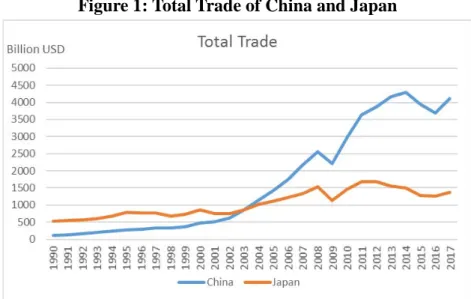
One may wonder why China’s position with regard to an EAFTA that included Japan suddenly changed. As we saw, in 2000, China made every effort to facilitate the establishment of an ASEAN-China FTA excluding Japan, yet by 2005, China was already insisting upon the creation of an EAFTA that included Japan. One critical reason is that China’s trade expanded rapidly during this period and overtook that of Japan. In fact, as Figure 1 shows, Chinese trade grew much faster than Japan’s, and the total trade of China and Japan were almost the same in 2003. Whereas Chinese trade was 55% of that of Japan in 2000, it had become 30% more than that of Japan in 2005. By the mid-2000s, China was confident of assuming the leadership in negotiations for an FTA that covered the whole of Asia, provided that it was a goods-centric agreement.
5 http://asean.org/?static_post=the-fourth-asean-informal-summit-22-25-november-2000-singapore 6
http://asean.org/?static_post=press-statement-by-the-chairman-of-the-8th-asean-summit-the-6th-asean-3-summit-and-the-asean-china-summit-phnom-penh-cambodia-4-november-2002-3
7 In 2003, the statement for the ASEAN+3 Summit was merged with that of the ASEAN Summit. The statement for
the ASEAN and ASEAN+3 Summit does not specifically mention the EAFTA.
8 The Trade in Services Agreement and Agreement on Investment for ASEAN-China FTA were signed in 2007 and
6
Figure 1: Total Trade of China and Japan
Source: Author’s compilation based on UNCTAD STAT
China was not all that keen to support the idea of a Comprehensive Economic Partnership for East Asia (CEPEA) proposed by Japan in 2006 (see next section for the Japanese motivations for proposing CEPEA). Unlike EAFTA, CEPEA emphasized the significance of trade in services and investment. These were the areas where Japan was competitive via-a-vis China and had large commercial interests. Moreover, China had a very clear policy about the membership of a regional FTA—CEPEA was problematic because it included members beyond the ASEAN+3 (Teh 2011).9 The Chinese proposal
on EAFTA and the Japanese proposal on CEPEA competed; feasibility studies for the two proposals were conducted separately, one led by China and the other led by Japan. While ASEAN made a desperate effort to bridge the two proposals in 2010, such an attempt was unsuccessful because the two countries stuck to their own initiatives (Hamanaka 2014).10
However, in August 2011, both China and Japan suddenly announced a joint statement on East Asia cooperation and proposed the establishment of working groups in which both EAFTA and CEPEA could be discussed among the 16 members. This basically meant that China had become receptive to the Japanese idea of “wider” trade cooperation in terms of both issue areas and membership. The working groups were established to discuss three issues: (trade in goods, trade in services, and investment); China accepted the inclusion of trade in services and investment in the prospective region-wide FTA. Moreover, participation in the working groups included not only ASEAN+3 countries but also Australia, New Zealand, and India, which made the inclusion of those countries in the final agreement very likely. In November 2011, ASEAN agreed to support the joint proposal made by China and Japan and to establish working groups to conduct preparatory work for the negotiations for the prospective region-wide agreement, which was given a new name, the RCEP. Hence, we can say
9 CEPEA included Australia, New Zealand, and India in addition to the ASEAN+3 countries.
10 In 2010, ASEAN established working groups on the rules of origin, tariffs, customs procedures, and economic
cooperation. The participants in these working groups were the ASEAN+6 countries. From the Japanese perspective, the ASEAN proposal was too goods-centric. For China, its membership was too wide.
7
that by 2010, China had agreed to negotiate a region-wide FTA covering not only goods but also services and investment that was very similar to the CEPEA originally proposed by Japan.11
How to explain such a rapid shift in Chinese regional economic diplomacy, especially its positive attitude toward the investment negotiations? There are two main reasons. First, there was the possibility that regional trade diplomacy in Asia might be dominated by the US-led TPP. In fact, Japanese Prime Minister Kan expressed interest for the first time in Japanese membership of TPP at the Diet Session in October 2010. China did not want to see regional trade diplomacy dominated by a TPP that was jointly led by the United States and Japan. It was necessary for China to attract Japan so that its region-wide FTA project became successful. The second main reason was the rise of China. As Figure 2 shows, the rise of China in the investment field was highly significant after 2005. In particular, having a large amount of outward investment was critical to having a large voice in investment agreement negotiations because many countries were trying to attract investment. While investment flows fluctuate across years, Chinese outward investment grew very quickly, especially after 2005. It is highly symbolic that Chinese outward investment surpassed that of Japan for the first time in 2010. In short, while China was not confident of negotiating investment with Japan in 2005, such a situation had totally changed by 2010.
Figure 2: Outward Investment of China and Japan
Source: Author’s compilation based on UNCTAD STAT.
From around 2010, from the Chinese perspective, the only condition that any region-wide agreement had to satisfy was that the United States be excluded from it. Given US absence, China could dominate regional trade negotiations even if they included Japan. In November 2012, ASEAN and its FTA partners formally agreed to launch RCEP negotiations, and the Guiding Principle and Objectives for Negotiating the RCEP was announced. Principle 6 of the Guiding Principles states that only ASEAN
8
FTA partners can join the RCEP negotiations. Note that the United States does not have an FTA with ASEAN as a group; hence, it cannot be a part of the RCEP negotiations.
3.2. Japanese Approach to Regional FTAs: From CEPEA to TPP
For a long time, Japan had not been interested in trade regionalism, for two main reasons. First, protection of the agricultural sector was critically important for politicians to secure their seat in the Diet (Pempel and Urata 2013). Because tariffs would have to be eliminated for practically all trade, including agricultural products, the signing of FTAs was difficult for Japan. Second, economic multilateralism, rather than regionalism or bilateralism, was in Japan’s interest (Manger 2005). Japan always considered the WTO system to be critically important and the signing of FTAs would ruin the WTO system. Moreover, investment multilateralism, that is, the establishment of multilateral regimes for investment, which is not fully covered by the WTO, had been one of Japan’s critical agendas. In fact, Japan was a strong proponent of the Multilateral Agreement on Investment (MAI), which was negotiated at the Organisation for Economic Cooperation and Development (OECD) in the 1990s.
Japan’s pursuit of regionalism and bilateralism started in the field of investment, rather than trade. As Japan started to have huge amounts of investment assets abroad, both investment protection and liberalization had become immediate problems by the late 1990s, especially after the MAI became unlikely. Japan launched negotiations for a bilateral investment treaty (BIT) with Korea12 in November 1998, immediately after
the collapse of MAI negotiations. Japan also agreed to start BIT negotiations with Vietnam in March 1999. These pre-dated the launch of Japan’s first FTA negotiation with Singapore; the two countries agreed to start negotiations only in January 2001. Hence, we can say that Japan’s investment bilateralism started even before its trade bilateralism (Hamanaka 2017).
Japan’s regional trade diplomacy responded quickly to the Chinese proposal for an FTA with ASEAN made in November 2000. In January 2001, Japan and Singapore agreed to launch bilateral negotiations for an Economic Partnership Agreement (EPA). After the agreement was made to launch ASEAN-China FTA negotiations in November 2001, Japan’s regional trade diplomacy became even more proactive (Hamanaka 2008). In January 2002, Japanese Prime Minister Koizumi visited Singapore and proposed the establishment of an EPA between Japan and ASEAN. Unlike the Chinese proposal, which was an FTA (goods-centric), the Japanese proposal was intended to be comprehensive, covering trade in services, investment, and intellectual property and applying to both Japan-Singapore and Japan-ASEAN agreements.
Japan was concerned that the negotiations for EAFTA would be dominated by China. It therefore made a counter-proposal on CEPEA in 2006 (Teh 2011). Emphasis was placed on CEPEA’s comprehensiveness, going beyond traditional goods trade, the
12 Until 2001, Japan signed only nine BITs. The first one was with Egypt signed in 1977. For almost all Japanese
BITs signed in early days, the partner side approached Japan expecting BITs are helpful in attracting Japanese investment. Those BITs are classified as the first generation of Japanese BITs – they cover only investment protection, not liberalization. In contrast, Japan-Korea BIT cover both investment protection ne liberalization. See Hamanaka (2017).
9
focus of EAFTA. Trade in services, investment, and intertextual property were the core components of the Japanese proposal. Japan’s idea was that it could dominate the discussions even in regional negotiations that included China if the core issue areas were services and investment. With regard to membership, CEPEA included not only ASEAN+3 but also Australia, New Zealand, and India. Japan considered that the involvement of Australia, New Zealand, and India would contribute to its bargaining power vis-à-vis China. Moreover, it seems that the CEPEA did not rule out the possibility of US participation in future, provided that it joined the East Asia Summit. The first experts’ meeting for CEPEA was held in Tokyo in June 2007. Japan sped up the study so that it would not fall behind the EAFTA study led by China. The CEPEA study was finalized in July 2009, only one month after the completion of the study on EAFTA. While the results of EAFTA study were reported to the ASEAN+3 Economic Ministers Meeting (EMM) in August 2009, those of CEPEA were reported to the EMM of the ASEAN+6, meetings that were held back-to-back with each other.
In August 2011, Japan and China agreed to establish working groups in which both EAFTA and CEPEA could be discussed. This movement implies that China accepted CEPEA, as already discussed, although the prospective agreement received a new name: RCEP. However, this did not lead to a situation in which the Japanese could achieve their original goal of realizing CEPEA using the platform of RCEP. Rather, by 2011, Japan had become very cautious about CEPEA/RCEP, wary that it could lead to the creation of a regional FTA dominated by China. This is ironic because Japan was keen to establish CEPEA when China was reluctant, and became disinterested in its own proposal when China became receptive to it. It is perhaps more accurate to argue that Japan became cautious about CEPEA because China became receptive to it. This clearly shows that who leads and dominates is critical to understanding Asian trade diplomacy (Teh 2011, 353; Hamanaka 2014).
Why, then, did Japan agree to make an announcement on East Asian cooperation with China that resulted in the creation of the three working groups, despite the fact that it had started to fear any regional trade agreements that were likely to be dominated by China? The essential reason for Japan agreeing to launch RCEP was that Japan wanted to obtain a “China card” in order to make its TPP negotiations easier (Hamanaka 2014). Japan and China agreed to establish working groups in August 2011, but three months later, in November 2011, at Honolulu, where the meeting of the Asia-Pacific Economic Cooperation (APEC) leaders was being held, Japan formally expressed interest in participating in the TPP negotiations. While Mexico and Canada expressed interest at the same time as Japan, and their applications were approved in June 2012, approval for Japan’s participation was delayed, which frustrated Japan. On 20 November 2012, Japanese Prime Minister Noda met US President Obama and requested that the US support Japan’s participation in TPP; on exactly the same day, the RCEP negotiations were formally launched. The Japanese message was very clear: “If you (the United States) do not treat us (Japan) in a friendly manner, there is a possibility that we will go to the Chinese camp.” Partly because of the China card, Japan’s participation in TPP negotiations was finally approved in March 2013.
10
negotiating resources on TPP negotiations. Once TPP was concluded, Japan started to think that China should join TPP and accept the rules crafted by TPP members and did not seem to be keen to facilitate RCEP negotiations any longer.
4. Regional Financial Institutions
4.1. Japanese Approach to Regional Financial Cooperation: ADB and AMF
Since the end of World War II, Japan has been a strong proponent of Asia-only financial cooperation. While it is true that Japan supported US international financial hegemony, namely, the Bretton Woods system, it had a strong desire to lead Asian financial cooperation, excluding the United States. It is entirely wrong to argue that Japan was an obedient follower of the United States as far as regional finance is concerned (Hamanaka 2011a, b).
The ADB, established in 1966, included the United States, but we should not overlook the fact that it was treated as a non-regional member. One cannot simply argue that the United States’ non-regional membership was natural because it was not an Asian country. The regional development bank responsible for regional development in Latin America is called the Inter-American Development Bank (not the Latin American Development Bank), which included the United States as a regional member; its head office is in Washington, DC. Hence, it is not surprising that an Asia-Pacific Development Bank that included the United States as a regional member was established in the 1960s. The point here is that Japan successfully excluded the United States from the ADB’s regional membership while securing its financial contributions. In short, the ADB was a Japanese arrangement with a large US financial contribution and little US involvement in management, according to Huang (1975). The United States was not keen to support the Japan-led ADB project but reluctantly decided not to object because it feared that opposition to the proposal would simply fuel anti-US sentiment in Asia caused by its bombing in the Vietnam War (White 1970). At the same time, we should remember that the United States made every effort to have the ADB headquarters located in Manila, not Tokyo. Indeed, Manila was chosen, but as a result of voting (Yasutomo 1983).
In February 1991, the first Executives Meeting of the East Asian and Pacific Central Banks (EMEAP) was held in Tokyo. EMEAP is a regional central bank forum, established by Bank of Japan (BOJ), which can be regarded as the Asian version of the Bank for International Settlements (BIS). It should be noted that the EMEAP project began even before Mahathir floated the idea of an East Asia Economic Group (EAEG), which later came to be known as the East Asia Economic Caucus (EAEC). While some argue that the EAEG/EAEC triggered regionalism in East Asia, which eventually led to ASEAN+3 (Terada 2003), such an argument tells us only a part of the story. In the finance field, Asianism existed even before the EAEG/EAEC. EMEAP is not an exception in this regard. The United States was excluded from EMEAP, and despite the US Central Bank (Federal Research Board) strongly requesting membership, the BOJ has refused to accept its request (Yokoi-Arai 2002). What is also very interesting is that
11
China is also excluded from the original membership, although it joined in 1992, unlike the United States. BOJ officials may be able to provide several plausible excuses why China was not ready to be a part of EMEAP in 1991, but none of them seems to be sufficiently convincing because China obtained EMEAP membership only one year later, and all the more so given that APEC accepted Chinese membership in 1991. A more convincing argument is that the BOJ excluded China from the original membership of EMEAP, whereas there was a growing trend of “engaging China” in the early 1990s. The absence of China for one year was critical to realizing an EMEAP dominated by Japan (Hamanaka 2010, 101).
The Japanese Ministry of Finance (MOF) attempted to establish the Asian Monetary Fund (AMF) soon after the Asian financial crisis in 1997. The United States was not included in the prospective membership of the AMF. The Japanese proposal for AMF membership included only the contributors to the Thai rescue package agreed at the Thai rescue meeting organized in Tokyo in August 1997. It can be said that Japan took advantage of the fact that the United States did not contribute to the Thai package to justify the US exclusion from the AMF.13 The United States did not support the AMF
on the grounds that it undermined the function of the International Monetary Fund (IMF) (Blustein 2001). However, the real reason why the United States blocked the proposal was that AMF excluded the United States from membership. In fact, Fred Bergstein, who was the president of the Peterson Institute for International Economics (PIIE) and a close aide to the Clinton Administration, argued that the establishment of an Asia-Pacific Monetary Fund that included the United States was desirable (Bergsten 1998).
While the AMF was not established, Asian countries agreed to create the Chiang Mai Initiative (CMI) in May 2000, and the United States was unable to make an objection to it. The CMI is a network of swap arrangements among financial authorities in East Asia. This was a virtual AMF, because countries hit by crises could borrow money from regional partners, although there was no formal organizational structure attached to the CMI, unlike AMF. While the United States was not a part of the CMI, there was one important rider: only 10% of CMI money could be disbursed without the approval of IMF. In other words, when members disbursed more than 10% of CMI money, the approval of IMF, where the United States has the dominant voice, was necessary. Hence, the CMI features Asian money that virtually requires US approval for disbursement. Japan, of course, was unhappy with such an arrangement, and its strategy was to reduce US influence by increasing the total amount of the fund and the delinked portion of CMI money from the IMF.14
After 2005, Japan was no longer the single dominant player in Asia in the field of international finance. As Figure 3 shows, the foreign reserves of China and Japan were already comparable in 2005. At the same time, China was not confident enough to assume leadership in international or regional finance, partly because of the global financial crisis that culminated in the Lehman shock in 2008. What is very interesting is that China and Japan agreed to accept “equal footing” in Asian financial arrangements
13 The United States participated in the Thai rescue meeting but refused to contribute financially to the package. 14 The delinked share was increased to 20% in 2009 and to 30% in 2014.
12
when their financial power was comparable. The CMI was multilateralized and started to introduce a voting mechanism in March 2010. The two parties agreed to hold the same voting power in the multilateralized CMI. In May 2010, China and Japan agreed to the basic modality of the ASEAN+3 Macroeconomic Research Office (AMRO), a kind of secretariat for surveillance under the multilateralized CMI.15 The AMRO Office
is located neither in Tokyo nor Beijing but in a third country, Singapore. The head position of AMRO rotates between China and Japan.16
Figure 3: Foreign Reserves of China and Japan
Source: Author’s compilation based on IMF data.
Japan became very cautious about an Asia-only financial arrangement after 2011. From the beginning, Japan was not supportive of the AIIB proposed by China in 2013. While some may argue that Japan is following the United States with regard to its position on the AIIB, in my view, the reality is that it is Japan, not the United States, that fundamentally dislikes the AIIB. Any debate on the AIIB always relates to the ADB. The Japanese executives, officials, and media always see the AIIB in comparison with the ADB. The implied question expressed by any opinion leader is “Why do we need the AIIB given the fact that there is the ADB, established by Japan half a century ago?” It is true that there are some co-financing projects between the ADB and the AIIB, but we should not overlook the fact that all of them are ADB projects co-financed by the AIIB. There is no AIIB project co-financed by the ADB.
4.2. Chinese Approach to Regional Financial Cooperation: AIIB
Beijing was not part of the ADB when it was established. Taipei represented China. Beijing joined the ADB as a latecomer in 1986, and Taipei continued to stay in the ADB. The ADB is one of the few international organizations of which both Beijing and Taipei
15 AMRO was established in April 2011.
16 The three-year term of the inaugural president was split into the first year and the subsequent two years because
13
have membership. It was inevitable that China (Beijing) should join the ADB in 1986 because it was by then an institution in existence for two decades. The options that China had were limited to whether or not to join it. The situation of the Chinese membership of EMEAP is similar to that of its ADB membership. Because EMEAP was established in secret in 1991 (EMEAP 2003), perhaps without Beijing even noticing, Beijing was inevitably a latecomer. Beijing decided to join as a latecomer because it did not like to see the Hong Kong Monetary Authority (HKMA) join EMEAP before it. In short, because the ADB and EMEAP already existed, all China could do was join them before problematic competitors (such as Taiwan and Hong Kong) joined.
When Japan proposed the AMF in 1997, all Asian countries supported the Japanese idea, with the notable exception of China. It is noteworthy that the Chinese position on the AMF proposal was very similar to that of the United States: Japanese-led regional financial cooperation in Asia was undesirable. China did not speak at all at the meeting to discuss the establishment of the AMF held in Hong Kong in September 1997, despite Korea and ASEAN members supporting the Japanese idea. Japanese MOF officials involved in AMF negotiations recall that China did not support the AMF proposal because silence means objection in international meetings (Blustein 2001, 167).
As has been discussed, the critical question regarding the institutional design of the CMI established in May 2000 was its IMF linkage. Japan wanted an independent CMI in which money could be disbursed without IMF approval. The United States insisted upon a high IMF linkage. A compromise was made to set the portion of IMF linkage at 90% (only 10% can be disbursed without IMF approval). What, then, was the Chinese position on this critical question? China’s position was that the CMI should be fully linked to the IMF, meaning a 100% linkage of CMI money to IMF conditionality (Amyx 2004). In other words, China was of the view that the IMF and the United States should be fully involved in CMI decision making via the IMF linkage. Because China did not want a CMI dominated by Japan to be established, it chose a CMI dominated by the United States/IMF, which was “the second-worst scenario.”
China announced its proposal on the AIIB in October 2013. During the ADB annual meeting in May 2014, China arranged a dinner meeting and invited 16 countries to discuss the AIIB; the United States and Japan were not invited. In October 2014, an MOU for the AIIB was signed by 21 countries in which a headquarters in Beijing was mentioned. We can say that China learned from the mistake committed by Japan during the ADB establishment process. Because the location of ADB headquarters had been decided by voting, Japan failed to secure it. China’s strategy was that the MOU, which stipulates the location of the headquarters as Beijing, should be signed quickly by the invited guests to avoid any complicated negotiations.
China set the deadline of expressing an interest in AIIB membership as March 2015. While more than 50 countries, including the United Kingdom, France, Germany, Korea, and Australia, expressed an interest, Japan and the United States did not. Any country that wanted to participate in negotiations, including Japan and the United States, had to submit an application to Beijing. Japan and the United States were of the view that the lack of transparency in AIIB governance made it difficult for them to join. It is
14
possible to argue that China took advantage of such statements made by Japan and the United States—as long as transparency was not guaranteed, the United States and Japan would not ask to join. In the AIIB, there are two types of distinction in terms of membership: (i) between regional and non-regional members and (ii) between original members and latecomers. Because neither Japan nor the United States qualified as regional and original members, China was the legitimate leader of the AIIB as far as its membership rules were concerned, because it is from Asia and one of its original member.17
5. Conclusion: Is China-Japan Cooperation Possible?
In general, we have confirmed that Sino-Japanese rivalry over the meta-level institutionalization of negotiation modalities have been intense. The launch of negotiations that comfortably involve both China and Japan is extremely difficult to produce. The meta-level power struggle concentrates on three negotiation modalities: membership (who should participate in the negotiations); prior agenda setting (what should be discussed in the negotiations); and sponsorship (who can claim the credit; who chairs the negotiations). Each country expends a huge amount of resources in order to launch negotiations favorable to itself. The launch of negotiations sometimes becomes very difficult because of the intense struggle preceding it.
The behavior patterns of the two countries are very similar. First, on membership, both try to assume leadership by excluding the other, as well as the United States. Holding the predominant leadership position in regional projects that exclude the United States is the best scenario for both China and Japan. The worst scenario for each is the leadership assumed by the other under conditions of regionalism that excludes the United States. Each country often objects to the other’s regionalism projects. As a result, these projects tend to exclude not only the United States, but also the other country. Regionalism that includes the United States, in which it naturally assumes leadership, is an option that lies between the two extreme scenarios—it can be the second-best or the second-worst scenario, depending on the context. For China, the Japan-led AMF and Japan-led CEPEA were the worst scenarios. Hence, it sometimes opted for the second-worst potion, namely, US-led regionalism. Indeed, China attempted to include the United States in the CMI via its IMF linkage. Likewise, for Japan, China-led projects such as RCEP are the worst scenario. Japan is supporting TPP, led by the United States. Similarly, in the field of finance, the AIIB is the worst scenario for Japan.
Second, agenda setting is also important for the two countries. While the two countries proposed the FTA, the Chinese one was a goods agreement, whereas what Japan attempted to establish was, in essence, an investment agreement. The rivalry between the trade-centric EAFTA of 13 countries proposed by China and the investment-centric CEPEA of 16 countries proposed by Japan are one illustrative example.
17 If the United States and Japan had made a joint counter-proposal of an Asia-Pacific Infrastructure Investment Bank,
located in Beijing but with a non-Chinese president in its early stage, the course of negotiations would have been totally different.
15
Third, sponsorship is critical. Perhaps the most intense rivalry can be observed in the claims over sponsorship of negotiations. The two countries try to chair meetings and host the secretariats or head offices. Moreover, it matters which country initially proposed a new institution; each country sticks to the projects it initiated and seldom supports a project sponsored by its rival, even if the contents are agreeable. China wanted to launch new negotiations for RCEP, even though the contents of RCEP were almost the same as those of CEPEA, because the latter was originally a Japanese proposal in which Japan naturally had a large voice. The fact that RCEP was regarded as a Chinese initiative simply reduced the Japanese appetite for it, even though the contents of RCEP and CEPEA were similar. While Japan thinks that the AIIB is redundant, simply duplicating the Japan-sponsored ADB, China wanted an institution sponsored by itself. The fact that China proposed the AIIB and hosted the negotiation meeting and the head office is important to China. These are exactly the reasons why Japan is indifferent to AIIB, though what China is doing is almost the same as what Japan did a half century ago.
We can now have a relatively clear idea about what is likely to happen in the near future regarding Sino-Japanese rivalry in economic cooperation in Asia. In the field of finance, the worst scenario for Japan is for Japan to join the AIIB and the United States not to join, because this would result in Asia-only cooperation being dominated by China. The only scenario for Japanese participation in the AIIB is for it to join together with the United States. Here, the question is whether the United States can be a dominant player in AIIB. It may try to compete with China in the AIIB by requesting significant voting power and executive positions, such as vice president, but the important point here is that China has already won vis-à-vis the United States at the meta level. First, the United States and Japan are treated as non-original members. The agenda of the AIIB is already decided. Moreover, the AIIB is under Chinese sponsorship. If Chinese dominance is clear even after the participation of the United States and Japan, they are unlikely to join. In the field of trade, because Japan did not have the desire to lead the region by establishing an Asia-only FTA, it decided to join the TPP led by the United States, which is much better than participating in an RCEP dominated by China. While some argue that TPP and RCEP are the two wheels of trade liberalization in the Asia-Pacific, it is more likely that Japan will try to involve China in the TPP without concluding RCEP negotiations. At least, until the United States returns to the TPP, Japan will try to delay the conclusion of RCEP negotiations. For Japan, having a TPP that involves the United States is a necessary condition of finalizing RCEP negotiations.
16
References
Acharya, Amitav (1997) "Ideas, identity, and institution‐building: From the ‘ASEAN way’ to the ‘Asia‐Pacific way'?." The Pacific Review 10(3): 319-346.
Amyx, Jennifer (2004), “Japan and the Evolution of Regional Financial Arrangements in East Asia” in Krauss, E. and Pempel, T. J. (eds.) Beyond Bilateralism: U.S.-Japan Relations in the New Asia-Pacific. Stanford, Stanford University Press
Aslam, Mohamed (2012). The impact of ASEAN-china free trade area agreement on ASEAN's manufacturing industry. International Journal of China Studies, 3(1): 43-78
Bergsten, C. Fred (1998), “Reviving the “Asian Monetary Fund””, The International Economy, November/December.
Blustein, Paul (2001), The Chastening: Inside the Crisis that Rocked the Global Financial System and Humbled the IMF, New York, Public Affairs.
EMEAP (2003) What is EMEAP?: Its Past, Present, and Future.
Manger, Mark (2005). "Competition and bilateralism in trade policy: the case of Japan's free trade agreements." Review of International Political Economy 12(5): 804-828.
Hamanaka, Shintaro (2008) "Comparing summitry, financial and trade regionalism in East Asia: From the Japanese perspective", in Christopher Dent (eds) China, Japan and Regional Leadership in East Asia, Edward Elgar
Hamanaka, Shintaro (2010) Asian Regionalism and Japan: The Politics of Membership in Regional Diplomatic, Financial and Trade Groups, Routledge, London.
Hamanaka, Shintaro (2011a) “Asian Financial Cooperation in the 1990s: The Politics of Membership”, Journal of East Asian Studies, 11 (1), 2011
Hamanaka, Shintaro (2011b), “Asia-only versus Asia-Pacific Regionalism: Regionalism Cycle in Summits and Financial Cooperation”, Pacific Focus 26 (2)
Hamanaka, Shintaro (2014), “TPP versus RCEP: Control of Membership and Agenda Setting”, Journal of East Asian Economic Integration 18 (2)
Hamanaka, Shintaro (2016) “Insights to Great Powers’ Desire to Establish Institutions: Comparison of ADB, AMF, AMRO and AIIB”, Global Policy, 7(2), 288-292
Hamanaka, Shintaro (2017) “China-Japan-Korea Trilateral Investment Treaty: Implications for Future Investment Negotiations in Asia” in Julien Chaisse, Tomoko Ishikawa, and Sufian Jusoh (eds), Asia's Changing International Investment Regime Sustainability, Regionalization, and Arbitration, Springer
17
Huang, Po-Wen (1975), The Asian Development Bank: Diplomacy and Development in Asia, N.Y, Vantage Press.
Steven, Lukes (1974). "Power: A radical view." London and New York: Macmillan.
Nabers, Dirk (2010). "Power, leadership, and hegemony in international politics: the case of East Asia." Review of International Studies 36(4 ): 931-949.
Payne, Anthony and Gamble, Andrew (1996), “Introduction: The Political Economy of Regionalism and World Order” in Gamble, A. and Payne, A. (eds.) Regionalism and world order. Basingstoke, Macmillan.
Pempel, T. J., and Urata, Shujiro (2013). "Japan: a new move toward bilateral trade agreements." In Aggarwal, Vinod and Urata, Shujiro (eds) Bilateral Trade Agreements in the Asia-Pacific: Origins, Evolutions, and Implications, Routledge
Russett, Bruce (1985). "The mysterious case of vanishing hegemony; or, Is Mark Twain really dead?." International organization 39(2): 207-231.
Teh, Benny Cheng Guan (2001) "Japan–China rivalry: What role does the East Asia Summit play?." Asia Pacific Viewpoint 52.3 (2011): 347-360.
Terada, Takashi (2003). "Constructing an ‘East Asian’ concept and growing regional identity: from EAEC to ASEAN+ 3." The Pacific Review 16.2 (2003): 251-277.
White, John (1970), Regional Development Banks: The Asian, African and Inter-American Development Banks, London, Overseas Development Institute.
Yasutomo, Dennis T. (1983), Japan and the Asian Development Bank, New York, Praeger.
Yokoi-Arai, Mamiko (2002), Financial Stability Issues – The Case of East Asia, Springer.
Young, Oran R. (1991) "Political leadership and regime formation: on the development of institutions in international society." International organization 45(3): 281-308.