Spectral
properties of
weighted line digraphs
Etsuo Segawa,1 $*$
1 Graduate School of Information Sciences, Tohoku University
Aoba, Sendai 980-8579, Japan
Abstract. In this paper, wetreat someweighted line digraphs which are induced by a connected
and undirected graph. For agiven graph$G$, the adjacencymatrixofthe weightedline digraph$W$ is
determined byaboundary operator from an arc-based spaceto a vertex-based space. Wesee that
dependingonthe boundary operator and the Hilbert spaces, $W$has differentkindofanunderlying
stochastic transition operator. As an application, we obtain the spectrum of the positive support
of cube ofthe Grover matrix ina large girthofthe graph.
1
Introduction
Quantum walk
was
proposedas
iterations of aunitary operatoron
some
discrete space [10, 11]. Quantum walks (QWs) have been intensively studied since its efficiency of spatialquantum search were shown i.g., [1] and see its reference for more detail. Now QWs are
investigated from various fields, for example, implementation in experiments, condensed
matter physics, probability theories, and graph theories and so on.
For agiven graph$G$, the spectralmappingtheorem ofquantumwalks have beenfounded
by Szegedy [2]. In this paper, we consider this spectral map to three kinds of quantum walks. First we consider a special classofquantum walks, which
can
be constructedon
any (undirected) graphs and its spectrum has a relation to a random walk. This class of QW is called the Szegedy walk including the Grover walk. We refine the original one tosee
arelation to a graph laplacian and the Grover walks which work well in the spacial quantum search for hypercube, Johnson graph and finite $d$-dimensional lattice and soon, see [1] and
its reference. The original Szegedy walk introduced by [2] is equivalent to square of the Szegedy walk treated here.
Secondly wetreat a quantum graph walk introduced by [8]. Recently, arelationship
be-tweenthisquantumwalkand thequantumgraph [4], which is asystemofalinearSchr\"odinger
equations with boundary conditions. has been found [8, 12]. In this paper, we develop this
study by connecting the spectrum of the original quantum graph and this quantum walk.
To this end, we apply the spectral map.
Finallywe also consider the cube ofpositive supportof the Groverwalk. There are some
trials to apply QW to graph isomorphism problems. For a matrix $M$, the positive support
*email address [email protected]
Key words and phrases. Spectral mappingtheorem, Szegedywalk, Quantum graph, Positivesupportof
of$M,$ $M^{+}$, is denoted by
$(M^{+})_{i,j}=\{\begin{array}{l}1 :(M)_{i,j}\neq 00 : otherwise\end{array}$
It is suggested that the spectra of $(U^{3})^{+}$, which is the positive support of the cube of the Grover matrix $U^{3}$, outperforms distinguishing strongly regular graphs in [3].
Thispaper isorganized
as
follows. InSection2,weconstruct quantum walkson
$\ell^{2}(m_{A}, A)$,where$A$ is the set of thesymmetric arcsand
$m_{A}$ is apositive realvalued
measure.
In Section3, first, we present the spectral mapping theorem from $C^{0}(G)$ to $C^{1}(G)$, which is the key in
ourpaper. secondly, we take three examples Szegedy walk [5, 2], quantum graphwalk [4, 8]
and the positive supports of the Grover walks [3, 6, 7] as applications.
2
Szegedy
walk:
reconsideration
Let $G=(V(G), E(G))$ be a connected and locally finite graph, where $V(G)$ is the set of
vertices and $E(G)$ is the set of all edges. We set $A(G)=\{(u, v) : \{u, v\}\in E(G)\}$ asthe set
ofall arcs of$G$, and the origin vertex and terminal one of$e=(u, v)\in A(G)$ are denoted by
$o(e)=u$ and $t(e)=v$. The inverse arc $e=(u, v)$ are denoted by $\overline{e}=(v, u)$. We take
$C^{0}(G)=\{f:Varrow \mathbb{C}\}, C^{1}(G)=\{\psi : Aarrow \mathbb{C}\}$
as the space of allfunctionson$V(G)$ and$A(G)$, respectively. We preparepositivereal valued functions $m_{A}$ : $C^{1}(G)arrow C^{1}(G)$ and $m_{V}$ : $C^{0}(G)arrow C^{0}(G)$. For given such $m_{V}$ and $m_{A},$
we also set $\ell^{2}(m_{V};V)$ and $\ell^{2}(m_{A};A)$ as the square-summable functions with respect to the
inner product
$\langle f_{1}, f_{2}\rangle_{m_{V},V}=\sum_{u\in V(G)}\overline{f_{1}(u)}f_{2}(u)m_{V}(u)$, (2.1)
$\langle\psi_{1}, \psi_{2}\rangle_{m_{A},A}=\sum_{e\in A(G)}\overline{\psi_{1}(u)}\psi_{2}(e)m_{A}(e)$, (2.2)
respectively. Fromnowon, weconstruct the time evolution of aquantumwalkon $\ell^{2}(m_{A};A)$.
We set a complex valued function $w$ : $C^{1}(G)arrow C^{1}(G)$ to define boundary operator $d$ :
$C^{1}(G)arrow C^{0}(G)$:
$(d \psi)(u)=\sum_{e:t(e)=u}\overline{w(\overline{e})}\psi(e)$. (2.3)
This operator takes just terminus one to get a unitary operator on $\ell^{2}(m_{A}, A)$, which is
dif-ferent from a “usual boundary operator. We introduce coboundary operator $d^{*}$ : $C^{0}(G)arrow$
$C^{1}(G)$ satisfying $\langle d^{*}f,$$\psi\rangle_{mA}A,=\langle f,$$d\psi\rangle_{m_{V},V}$:
$\langle f, d\psi\rangle_{m_{V},V}=\sum_{u\in V}\overline{f(u)}\sum_{e:t(e)=u}\psi(e)\overline{w(\overline{e})}m_{V}(u)$
$= \sum_{e\in A}\psi(e)\overline{f(t(e))}\frac{m_{V}(t(e))\overline{w(\overline{e})}}{m_{A}(e)}m_{A}(e)$
So we have
$(d^{*}f)(e)=f(t(e)) \frac{m_{V}(t(e))w(\overline{e})}{m_{A}(e)}$. (2.4)
Put $S:C^{1}(G)arrow C^{1}(G)$ by $(S\psi)(e)=\psi(\overline{e})$. We define $U:C^{1}(G)arrow C^{1}(G)$ as follows.
$U=S(2d^{*}d-1_{A})$. (2.5)
Definition 1. $($Szegedy $walk on G(V, E)$)
When $U$
defined
in Eq. (2.5) isnorm
conservative in$\ell^{2}(A;m_{A})$ i. e., $||U\psi||_{m_{A},A}=||\psi||_{mA}A,$for
any$\psi\in\ell^{2}(m_{A};A)$,we
define
the quantum walkas
follows:
The quantum walk witha unitinitial state $\psi_{0}\in\ell^{2}(m_{A};A)$ is
defined
by the following sequenceof
probability distributions$\{\mu_{n}^{(\psi 0)}\}_{n\in N}$, where $\mu_{n}^{(\psi_{0})}$
: $Aarrow[O$,1$]$ is $deter\gamma nined$ by
$\mu_{n}^{(\psi 0)}(e)=|\psi_{n}(e)|^{2}m_{A}(e)$. (2.6)
Here $\psi_{n}$ is the n-th iteration
of
$U$ i.e., $\psi_{n}=U\psi_{n-1}(n\geq 1)$. In particular,we
define
the finding probabilityof
a quantum walker at time $n$ in locationof
$u\in V,$ $\nu_{n}:Varrow[O$, 1$]$, by$\nu_{n}^{(\psi_{0})}(u)=\sum_{e:t(e)=u}\mu_{n}^{(\psi_{0})}(e)$.
We provide two ways which give the operator $U$ definedin Eq. (2.5) preserving the
norm
withrespect to $\rangle_{mA}A,\cdot$ Both of them have some underlying dynamics on $C^{0}(G)$; thefirst
one is a random walk while the second one is a laplacian. (1) Setting 1
(a) $\sum_{e:o(e)=u}|w(e)|^{2}=1$ for all $u\in V$;
(b) $m_{V}(u)=1,$ $m_{A}(e)=1$ for all $u\in V$ and $e\in A.$
(2) Setting 2
(a) $\sum_{e:o(e)=u}w(e)=1$ for all $u\in V$;
(b) $m_{A}(e)=m_{V}(o(e))w(e)=m_{V}(t(e))w(\overline{e})$ for all $e\in A.$
We call thecondition (2) in Setting 2 “extended detailedbalanced condition”’ Wecaneasily check that both of the coboundary operators $d^{*}$ in the setting of(1) and (2) are isometric.
Proposition 1. Both settings (1) and (2) imply that $U$ preserves the norm.
Proof.
It is easy to check that both settings (1) and (2) provide$\langle S\psi_{1}, S\psi_{2}\rangle_{mA}A,=\langle\psi_{1}, \psi_{2}\rangle_{m_{A},A}$. (2.7)
$dd^{*}=1_{V}$ (2.8)
By Eq. (2.7), it holdsthat
$\langle U\psi,$$U\psi\rangle_{m_{A},A}=\langle S(2d^{*}d-1_{A})\psi,$$S(2d^{*}d-1_{A})\psi\rangle_{mA}A,=\langle(2d^{*}d-1_{A})\psi,$ $(2d^{*}d-1_{A})\psi\rangle_{m_{A},A}$
bom Eq. (2.8), the inner product of the first term of RHS is rewritten by
$\langle d^{*}d\psi, d^{*}d\psi\rangle_{m_{A},A}=\langle d\psi, d\psi\rangle_{m_{V},V}$
$=\langle\psi, d^{*}d\psi\rangle_{m_{V},V}=\langle d^{*}d\psi, \psi\rangle_{m_{V},V}$. (2.10)
Inserting Eqs. (2.10) into (2.9), wehave $||U\psi||_{m_{A},A}^{2}=||\psi||_{m_{A},A}^{2}.$ $\square$
We take $U_{1}$ and $U_{2}$ as the time evolution of quantum walks with respect to the inner
products under the settings of 1 and 2, respectively. Equivalently, $U_{1}$ and $U_{2}$ are expressed
by
$(U_{1} \psi)(e)=\sum_{f:o(e)=t(f)}(2w_{1}(e)\overline{w_{1}(\overline{f})}-\delta_{e,\overline{f}})\psi(f)$, (2.11)
$(U_{2} \psi)(e)=\sum_{f:o(e)=t(f)}(2w_{2}(\overline{f})-\delta_{e,\overline{f}})\psi(f)$, (2.12)
where
$(d_{j} \psi)(u)=\sum_{e:t(e)=u}\psi(e)\overline{w_{j}(\overline{e})}(j=1,2)$ (2.13)
$(d_{j}^{*}f)(e)=\{\begin{array}{ll}f(t(e))w_{1}(\overline{e}) :j=1,f(t(e)) :j=2.\end{array}$ (2.14)
Here $w_{j}$ : $Aarrow \mathbb{C}(j=1,2)$ satisfy settings 1 (a) and 2, respectively. These two quantum
walks are essentially the same in the following meaning:
Proposition 2. Assume that $w_{1}^{2}(e)=w_{2}(e)>0(e\in A)$. For$\psi\in C^{1}(G)$, let $\psi_{n}^{(\psi)}=U_{1}^{n}\psi,$
$\tilde{\psi}_{n}^{(\psi)}=U_{2}^{n}\psi$ and $\mu_{n}^{(\psi)}$
and $\tilde{\mu}_{n}^{(\psi)}$
be the distributions
of
$QWs$ at time $n$defined
in Eq. (2.6)under the settings 1 and 2, respectively. Then we have (1) $\tilde{\psi}_{n}(\psi_{0})_{=\mathfrak{D}^{-1/\psi 0)}}2\psi_{n}^{(\mathfrak{D}^{1/2}}$
(2) $\tilde{\mu}_{n}^{(\psi_{0})}=\mu_{n}^{(\psi_{0})}\mathfrak{D}^{1/2}$
Proof.
For the proofofpart 1, comparing Eq. (2.11) with Eq. (2.12) immediately provides that if$w_{1}^{2}(e)=w_{2}(e)\in \mathbb{R}$, then we have$U_{2}=\mathfrak{D}^{-1/2}U_{1}\mathfrak{D}^{1/2}$, (2.15)
where $(\mathfrak{D}\psi)(e)=m_{A}(e)\psi(e)$. Equation (2.15) implies part 1. For the proofofpart 2, using
Eq. (2.15),
$\tilde{\mu}_{n}^{(\psi 0)}(e)=|\tilde{\psi}_{n}(e)|^{2}m_{D}(e)=|\mathfrak{D}^{1/2}(\mathfrak{D}^{-1/2}U_{1}^{n}\mathfrak{D}^{1/2}\psi_{0})(e)|^{2}=|(U_{1}^{n}\mathfrak{D}^{1/2}\psi_{0})(e)|$
$=\mu_{n}^{(\mathfrak{D}^{1/2}}\psi_{0)}(e)$
3
Spectral
map
3.1
Spectral map
For a given boundary operator $d$, let us define an operator on $C^{1}(G)$ by
$W=S(cd^{*}d-1_{A})$, (3.16)
We assume that the following value $c’$ is constant with respect to the vertices ofthe given
graph:
$c’= \sum_{e:t(e)=u}\frac{m_{V}(t(e))|w(\overline{e})|^{2}}{m_{A}(e)}$ for anyu $\in V.$
This assumption implies $dd^{*}=1_{V}$. We also
assume
$cc’\neq 1$ forsome
technicalreason.
Remark that in the present stage, $W$ has no restriction of the norm conservation. Weprovide examples by taking appropriate functions $m_{A},$ $m_{V},$ $w$ and parameter $c\in \mathbb{C}$ in the
later subsection. We set
$\mathcal{H}_{\pm}=\{\psi\in\ell^{2}(A):\psi(\overline{e})=\pm\psi(e)(e\in A$
The following lemmais the key in this paper, which is an extended version of Proposition 1
in [5].
Lemma 1. Let$G$ be a
finite
graph. Put $\varphi(x)=(x+(cc’-1)x^{-1})/c$ and$\mathcal{L}=d^{*}(C^{1}(G))+$$Sd^{*}(C^{1}(G))\subseteq C^{1}(G)$. Then we have $W(\mathcal{L})=\mathcal{L}$ and
$\sigma(W|_{\mathcal{L}})=\{\begin{array}{ll}\varphi^{-1}(\sigma(d^{*}Sd)\backslash \{\pm c’\})U\{\pm(cc’-1)\} :\pm c’\in\sigma(dSd^{*})\varphi^{-1}(\sigma(d^{*}Sd)\backslash \{c’\})\cup\{cc’-1\} :c’\in\sigma(dSd^{*})\varphi^{-1}(\sigma(d^{*}Sd)\backslash \{-c’\})\cup\{-(cc’-1)\} :-c’\in\sigma(dSd^{*})\varphi^{-1}(\sigma(d^{*}Sd)) :otherwise\end{array}$ (3.17)
$\sigma(W|_{\mathcal{L}^{\perp}})=\{\begin{array}{ll}\{1, -1\} :\mathcal{H}_{-}\cap ker(d)\neq\{0\}, \mathcal{H}_{+}\cap ker(d)\neq\{0\}\{1\} :\mathcal{H}_{-}\cap ker(d)\neq\{0\}, \mathcal{H}_{+}\cap ker(d)=\{0\}\{-1\} :\mathcal{H}_{-}\cap ker(d)=\{0\}, \mathcal{H}_{+}\cap ker(d)\neq\{0\}\emptyset :otherwise.\end{array}$ (3.18)
The eigenfunction
for
$\lambda\in\sigma(W|_{\mathcal{L}})$, $\psi_{\lambda}\in C^{1}(G)$, can be expressedby using the eigenfunctionof
$dSd^{*}for$ $\varphi(\lambda)\in\sigma(dSd^{*})$, $f_{\varphi(\lambda)}\in C^{0}(G)$, asfollows:
$\psi_{\lambda}=\{\begin{array}{ll}(d^{*}-\lambda Sd^{*})f_{\varphi(\lambda)} :\lambda\neq\{\pm(cc’-1)\}\pm d^{*}f_{\varphi(\lambda)} :\pm c’\in\sigma(dSd^{*}) , \lambda\in\{\pm(cc’-1)\}\end{array}$ (3.19)
Proof.
From the properties of$d$ and $S$, it holds that for any $n\in \mathbb{N},$$[Wd^{*} WSd^{*}]=[d^{*} Sd^{*}]\tilde{T}$. (3.20) Herewe put
By multiplying arbitrary $T[f_{1}, f_{2}]$ to both sides of Eq. (3.20), we have $W(\mathcal{L})\subset \mathcal{L}$. For any $h\in \mathcal{L}$, there exist $f,$$9\in C^{0}(G)$ such that $h=d^{*}f+Sd^{*}g$. By Eq. (3.20)
$W(d^{*}(c(dSd^{*})f+g)-Sd^{*}f)=(cc’-1)h,$
whichimplies $W(\mathcal{L})\supset \mathcal{L}$ since $cc’\neq 1$. Thus $W(\mathcal{L})=\mathcal{L}$. Fhrom now on, we choose a pair of
nonzero functions $(f, g)\in C^{0}(G)\cross C^{0}(G)$ sothat
$\tilde{T}\{\begin{array}{l}fg\end{array}\}=\lambda\{\begin{array}{l}fg\end{array}\}$
.
(3.21)Eq. (3.21) is equivalent to
$g=-\lambda f$ (3.22)
$(\varphi(\lambda)-dSd^{*})f=0$ (3.23)
From Eqs. (3.21) and (3.22), wehave
$W(1_{A}-\lambda S)d^{*}f=\lambda(1_{A}-\lambda S)d^{*}f$ (3.24)
By the way, let $v\in \mathbb{R}$ and $f\in C^{0}$ be an eigenvalue and its eigenfunction $dSd^{*}$, which is a
self adjoint operator. Set $\Pi=(1/c’)d^{*}d.$ $\Pi$is aprojection onto $d^{*}(C^{0}(G))$. Taking $d^{*}f=\psi,$
we have
$|v|^{2}||f||^{2}=||dSd^{*}f||^{2}=||d\Pi S\Pi\psi||^{2}=c’||\Pi S\Pi\psi||^{2}\leq c’||\Pi\psi||^{2}=(c’)^{2}||f||^{2}.$
Thus $\nu\leq c’$. The fourth equality holds if and only if$Sd^{*}f=d^{*}f$ or $Sd^{*}f=-d^{*}f$, which
implies that
$\nu=\pm c’$if andonly if$d^{*}f\in \mathcal{H}_{\pm}$
Now from Eq. (3.24), we consider the following two cases.
(1) $(1_{A}-\lambda S)d^{*}f=0$ case. From the above observation, this situation is equivalent to
(
$\lambda=1$ and $c’\in\sigma(T)$” or $\lambda=-1$ and $-c’\in\sigma(T)$”, and $f\in ker(dSd^{*}\pm c$
Remark that $Wd^{*}f=\pm(cc’-1)d^{*}f$ and $\varphi^{-1}(\pm c’)=\{\pm 1,$$\pm(cc’-1$ So we have if
$\pm c’\in\sigma(dSd^{*})$, then $\pm(cc’-1)\in\varphi^{-1}(\pm c’)\backslash \{\pm 1\}\subset\sigma(W|_{\mathcal{L}})$.
(2) $(1_{A}-\lambda S)d^{*}f\neq 0$ case. This situation implies $\lambda\in\sigma(U)$. Equation (3.23) implies that $\lambda\in\varphi^{-1}(\sigma(d^{*}Sd)\backslash \{\pm c’\})$. (3.25)
In this case, the eigenfunction $(1_{A}-\lambda S)d^{*}f\not\in \mathcal{H}_{\pm}$ but $(1_{A}-\lambda S)d^{*}f\in \mathcal{H}_{+}+\mathcal{H}_{-}.$
$\dim(\mathcal{H}_{+}\cap L)=|V|$ Combining
cases
(1) and (2), we have Eq. (3.17) and Eq. (3.19).In the following, we show Eq. (3.18). Since $\mathcal{L}^{\perp}=ker(d)\cap ker(dS)$, we have
$W(\psi+S\psi)=-(\psi+S\psi)\in \mathcal{H}$-and $W(\psi-S\psi)=\psi+S\psi\in \mathcal{H}_{+}$. (3.26)
We set $c_{\pm}=\mathcal{L}^{\perp}\cap \mathcal{H}_{\mp}$. We have
$W\psi\pm=\pm\psi\pm$, for any $\psi_{\pm}\in c_{\pm}$. (3.27)
For $\psi\in \mathcal{H}_{\mp}\cap ker(d)$, $dS\psi=\pm d\psi=0$holds which implies $\mathcal{H}_{\mp}\cap ker(d)=c_{\pm}$. It is completed
3.2
Example 1: Szegedy
walk
We consider the spectral map of the Szegedy walk treated in Sect. 2. The parameter $c$ and
functions $m_{A},$ $m_{V}$ and $w$ are in the following table:
Let a selfadjoint operator on $C_{0}(G)$ be
$(Tf)(u)= \sum_{e:o(e)=u}w_{1}(e)\overline{w_{1}(\overline{e})}f(t(e))$
and a Laplacian operator be
$(Lf)(u)= \sum_{e:o(e)=u}w_{2}(e)f(t(e))-f(u)$.
Proposition 3. Put$\varphi_{1}(x)=(x+x^{-1})/2,$ $\varphi_{2}(x)=(x+x^{-1})/2-1.$
$\sigma(U_{1})=\{\begin{array}{ll}\varphi_{1}^{-1}(\sigma(T))\cup\{\pm 1\} :|E|-|V|+1_{\{1\in\sigma(T)\}}>0, |E|-|V|+1_{\{-1\in\sigma(T)\}}>0\varphi_{1}^{-1}(\sigma(T))\cup\{1\} :|E|-|V|+1_{\{1\in\sigma(T)\}}>0, |E|-|V|+1_{\{-1\in\sigma(T)\}}\leq 0\varphi_{1}^{-1}(\sigma(T))\cup\{-1\} :|E|-|V|+1_{\{1\in\sigma(T)\}}\leq 0, |E|-|V|+1_{\{-1\in\sigma(T)\}}>0\varphi_{1}^{-1}(\sigma(T)) : |E|-|V|+1_{\{1\in\sigma(T)\}}\leq 0, |E|-|V|+1_{\{-1\in\sigma(T)\}}\leq 0\end{array}$
(3.28)
$\sigma(U_{2})=\{\begin{array}{ll}\varphi_{2}^{-1}(\sigma(L)) : G is a tree\varphi_{2}^{-1}(\sigma(L))\cup\{1\} :G has just one cycle and not bipartite\varphi_{2}^{-1}(\sigma(L))\cup\{1\}\cup\{-1\} :otherwise\end{array}$ (3.29)
Proof.
By a simple observation, we can see that$d_{1}^{*}Sd_{1}=T, d_{2}^{*}Sd_{2}=L+1_{V}$. (3.30)
We should remark that $L+1_{V}=\tau P$, where $P$ is a transition matrix of random walk:
$(Pf)(u)= \sum_{e:t(e)=u}w_{2}(e)f(e)$. In the setting of $U_{2}$, since $w_{2}$ is reversible, then $\sigma(^{T}P$) $=$
$\sigma(P)$ holds, which implies $\sigma(^{T}P$) $=\sigma(T)$ when $w_{2}=w_{1}^{2}.$ $Rom$ the reversibility of the
stochastic process described by transition matrix $P$, it holds that $m_{1}=1$ and $m_{-1}=$
$1_{\{Gisbipartite\}}$. From now on, we consider the dimensions of$c_{\pm}$
.
By Eq. (3.19) and $\varphi^{-1}(v)\in$$\{\lambda, \overline{\lambda}\}$ with $v={\rm Re}(\lambda)$, we observe
$\psi_{\lambda}+\lambda\psi_{\overline{\lambda}}\in\{\begin{array}{ll}\mathcal{H}_{-}\backslash \{0\} :\nu\neq-1\{0\} :\nu=-1\end{array}$
Therefore
$\dim(\mathcal{L}\cap \mathcal{H}_{+})=|V|-m_{-1}$ and$\dim(\mathcal{L}\cap \mathcal{H}_{-})=|V|-m_{1}$. (3.31)
Remarking$\dim(\mathcal{H}_{\pm})=|E|$, by Eq. (3.31),
$\dim(C_{+})=\dim(\mathcal{H}_{-})-\dim(\mathcal{L}\cap \mathcal{H}_{-})=|E|-|V|+m_{1}$ (3.32)
$\dim(C_{-})=\dim(\mathcal{H}_{+})-\dim(\mathcal{L}\cap \mathcal{H}_{+})=|E|-|V|+m_{-1}$ (3.33)
We should remark that
$|E|-|V|\{\begin{array}{ll}=-1 :G is a tree=0 :G has one cycle\geq 1 : G has at least 2 cycles\end{array}$ (3.34)
Combining Eqs. (3.32), (3.33) and Eq. (3.27) with Eq. (3.34) leads to Eq. (3.18).
Then Lemma 1 completesthe proof. $\square$
3.3
Example
2: Quantum graph walk
Quantum graph is asystem of linearSchr\"odiner equations on ametric graph with boundary conditions at each vertex. In the metric graph, each edge has a euclidean length, and there exists a one-dimensional plain wave on each edge. On $e\in A(G)$ whose euclidean length is
$L_{e}=L_{\overline{e}}$, we determine $x\in[0, L_{e}]$ as the distance from$o(e)$. Theplainwave on
$e\in A(G)$ at
$x$ is described by using some complex numbers $a_{e},$$b_{e}$ as follows.
$\phi_{e}(x)=a_{e}e^{ikx}+b_{e}e^{-ikx}, (x\in[O, L_{e}])$ (3.35)
Sincethe plain
wave
on each edge is independent of the arc direction, we should impose the following condition to $\phi_{e}.$$\phi_{\overline{e}}(x)=\phi_{e}(L_{e}-x)e\in A(G)$ (3.36)
Combining Eqs. (3.35) and (3.36), $\phi_{e}(x)$ is rewritten by
$\phi_{e}(x)=a_{e}e^{ikx}+a_{\overline{e}}e^{ik(L-x)}$. (3.37)
The boundary conditions at each vertex are as follows:
(1) For every $u\in V$ and for all $e_{1}$, .
.
. ,$e_{\kappa}\in A(G)$ with $u=o(e_{1})=o(e_{2})$, there exists $\theta_{u}\in \mathbb{C}$ such that$\phi_{e_{1}}(0)=\cdots=\phi_{e_{\kappa}}(0)=\theta_{u}.$
(2) For every$u\in V$, there exists $\alpha_{u}\in[0, \infty]$ such that
Definition 2. Let $\psi_{n}\in C^{1}(G)(n\in \mathbb{N})$ be determined by the iterations
of
$\tilde{U}$ i.e., $\psi_{n}=$ $\tilde{U}\psi_{n-1}$, where $( \tilde{U}\psi)(e)=e^{ikL_{e}}\sum_{f:t(f)=o(e)}).$ Here $\tau_{u}=\frac{2}{\deg(u)+i\alpha_{u}/k}.$The quantum graph walk is sequence
of
distributions $\{\mu_{n}\}_{n\in N}$ obtained by $\mu_{n}(e)=|\psi_{n}(e)|^{2}.$Note that $\tilde{U}$
is a unitary operator i.e., $\tilde{U}\tilde{U}^{*}=\tilde{U}^{*}\tilde{U}=1_{A}$.
Set $\psi\in C^{1}(G)$ with $\psi(e)=a_{e}.$
If $(a_{e})_{e\in A}$ satisfies the boundary conditions (1) and (2) with $\psi\neq 0$, then we say that the
quantum graph has non-trivial solution.
Proposition 4. [8] The quantum graph walk has a non-trivial solution
if
and onlyif
$1\in$$\sigma(\tilde{U})$.
Rom now on we restrict ourselves to consider the following simple case to make $\tilde{U}$ be able to apply the spectral map of Lemma 1.
Lemma 2.
If
$L_{e}=L$for
any $e\in A,$ $\deg(u)=\kappa$ and$\alpha_{u}=a$for
any $u\in V$, then we have$\tilde{U}=e^{ikL}S(cd^{*}d-1_{A})$, (3.38)
where
$c= \frac{2\kappa}{\kappa+iq(k)}, w(e)=\frac{1}{\sqrt{\kappa}}, m_{V}(u)=1, m_{A}(e)=1.$
Here we put$q(k)=\alpha/k.$
Remark that in this setting the boundary operator $d$ is given by
$(d \psi)(u)=\frac{1}{\sqrt{\kappa}}\sum_{e:t(e)=u}\psi(e)$.
We can easilycheck that $dd^{*}=1_{V}$ which implies$c’=1.$
Proposition 5. Let $P$ be a stochastic transition operator
of
the simple random walk on$G(V, E)$. Then the spectrum
of
the quantum graph walk under the settingof
$L_{e}=L$for
any$e\in A,$ $\deg(u)=\kappa$ and $\alpha_{u}=\alpha$
for
any$u\in V$, we have$e^{-ikL} \sigma(\tilde{U})=e^{i\arg(\tau)}\varphi_{1}^{-1}(\frac{\kappa}{\sqrt{\kappa^{2}+q^{2}(k)}}\sigma(P))$
$\{\emptyset\}$ : $G$ is a tree”’ or $q(k)\neq 0$ and $G$ has at most one cycle
$\cup$ $\{$
{1}
: $tq(k)=0$ and$G$ hasjust one cycle whose length is odd (3.39)Proof.
Eq. (3.23)implies$\det(\lambda^{2}-cJ\lambda+c-1)=0$, (3.40) where $J=dSd^{*}$ is expressed by
$(Jf)(u)= \sum_{e:t(e)=u}\frac{1}{\sqrt{\deg(u)\deg(o(e))}}.$
Since $P$ is reversible, $\sigma(P)=\sigma(J)$ holds. Taking$\gamma=\arg(\tau)\in[\pi/2, \pi/2]$, we have
$c-1=e^{2i\gamma}$ and $c=2e^{i\gamma}\cos\gamma$. (3.41)
Inserting Eq. (3.41) into Eq. (3.40) provides
$\det(\frac{(e^{-i\gamma}\lambda)-(e^{-i\gamma}\lambda)^{-1}}{2}-\frac{\kappa}{\sqrt{\kappa^{2}+q^{2}(k)}}P)=0.$
Weshould remark that since $1\in\sigma(P)$with simple multiplicity, then$1\in\kappa/\sqrt{\kappa^{2}+q^{2}(k)}\sigma(P)$
if and only if $q(k)=0$. and also remark that since $-1\in\sigma(P)$ if and only if$G$ is bipartite
and $q(k)=0$, then $-1\in\kappa/\sqrt{\kappa^{2}+q^{2}(k)}\sigma(P)$ if and only if$q(k)=0$ and $G$is bipartite. Put
$M_{+}=|E|-|V|+1_{\{q(k)=0\}}$ and $M_{-}=|E|-|V|+1_{\{q(k)=0andGisbipartite\}}$. Let $b(G)$ be the
number of the essential cycles of$G$
.
So the following statement holds:Thus we cancomplete the proofby applying the last half of the proof of Proposition 2. $\square$ Corollary 1. Set $A=\{k^{2}\in[0, \infty$) $:1 \in e^{i(kL+\arg(\tau))}\varphi_{1}^{-1}(\frac{\kappa}{\kappa+q^{2}(k)}\sigma(P))\}$
.
The spectrumof
the quantum graph walk is expressed as
follows:
$\{\begin{array}{ll}A : G is a treeA\cup\{(\frac{2n\pi}{L})^{2}:n\in \mathbb{N}\}\cup\{(\frac{(2n+1)\pi}{L})^{2}:n\in \mathbb{N}\} : G has at least one cycle\end{array}$
3.4
Example 3:
Positive
support of the
Grover
walk
Recently there are some trials to apply QW to graph isomorphism problems. For a matrix
$M$, thepositive support of$M,$ $M^{+}$, is denoted by
$(M^{+})_{i,j}=\{\begin{array}{l}1 :(M)_{i,j}\neq 00 :otherwise\end{array}$
It is suggested that the spectra of $(U^{3})^{+}$, which is the positive support of the cube of the
Grover matrix $U^{3}$, outperforms distinguishing strongly regular graphs in [3]. It
seems to be that not only the Grover matrix $U$ itself but the positive support $(U^{n})^{+}$ of its n-th power
is an important operator of a graph. For a first step, in this section, we consider $\sigma(U^{3})^{+}$
Proposition 6. [6] Let$G$ be a connected and$\kappa$-regular graph with$g(G)\geq 5$
.
Thenwe
have$(U^{3})^{+}=(U^{+})^{3}+^{T}U^{+}$. (3.42)
We can rewrite $U^{+}$ as follows:
Lemma 3. When we take $m_{A}(e)=1,$ $m_{V}(u)=1$ and $w(e)=1$, then we have
$U^{+}=S(d^{*}d-1_{A})$
The results on $(U)^{+}$ and $(U^{2})^{+}$ have already appeared in [6, 7]. In this paper, we newly
obtain $(U^{3})^{+}$
case
as follows.Proposition 7. Assume that $G$ is a connected and $\kappa$-regular graph with $g(G)\geq 5$. Let $M$ be the adjacency matrix
of
G. We set$s_{\pm}^{(1)}(x)= \frac{x}{2}\pm\frac{\sqrt{x^{2}-4\kappa+4}}{2}$ , (3.43) $s_{\pm}^{(2)}(x)= \frac{x^{2}-2\kappa+4}{2}\pm\frac{x\sqrt{x^{2}-4\kappa+4}}{2}$ (3.44) and $s_{\pm}^{(3)}(x)= \frac{x(x^{2}+4-3\kappa)}{2}$ $\pm\frac{1}{2}\sqrt{x^{6}+2(2-3\kappa)x^{4}+(13\kappa^{2}-24\kappa+16)x^{2}-8(\kappa-1)(\kappa^{2}-2\kappa+2)}$
.
(3.45) Then we have $\sigma((U)^{+})=\{s_{\pm}^{(1)}(\lambda) : \lambda\in\sigma(M)\}\cup\{1\}^{|E|-|V|}\cup\{-1\}^{|E|-|V|}$ (3.46) $\sigma((U^{2})^{+})=\{s_{\pm}^{(2)}(\lambda):\lambda\in\sigma(M)\}\cup\{2\}^{2(|E|-|V|)}$ (3.47) $\sigma((U^{3})^{+})=\{s_{\pm}^{(3)}(\lambda) : \lambda\in\sigma(M)\}\cup\{2\}^{|E|-|V|}\cup\{-2\}^{|E|-|V|}$ (3.48)Proof.
The proofs ofcases of $(U)^{+}$ and $(U^{2})^{+}$ can be seen in [6, 7] So we provide only theprooffor the $(U^{3})^{+}$ case. Since $\tau U^{+}=SU^{+}S$ holds, by Eq. (3.20), we have
$[^{T}U^{+}d^{*} \tau U^{+}Sd^{*}]=S[U^{+}Sd^{*} U^{+}d^{*}]$
$=S[Sd^{*} d^{*}]\tilde{T}’$
$=[d^{*} Sd^{*}]\tilde{T}’$, (3.49)
where
$\tilde{T}=\{\begin{array}{lll} 0 -1_{V}(k -1)1_{V} M\end{array}\}$ and $\tilde{T}’=\{\begin{array}{ll}0 1_{V}1_{V} 0\end{array}\}\tilde{T}\{\begin{array}{ll}0 1_{V}1_{V} 0\end{array}\}.$
Using Eq. (3.20) again,
Inserting Eqs. (3.49), (3.50) into Proposition (6) provides
$[(U^{3})^{+}d^{*} (U^{3})^{+}Sd^{*}]=[d^{*} Sd^{*}](\tilde{T}^{3}+\tilde{T}’)$ (3.51)
Now we consider the spectra of $\tilde{T}^{3}+\tilde{T}’$.
Since $M=M^{*},$ $M$ is decomposed by $M=$ $\sum_{\lambda\in\sigma(M)}\lambda\Pi_{\lambda}$, where $\Pi_{\lambda}$ is the orthogonalprojectiononto the eigenspaceofeigenvalue$\lambda$. By
Eq. (3.51),
$\tilde{T}^{3}+\tilde{T}’=\sum_{\lambda\in\sigma(M)}\Lambda(\lambda)\otimes\Pi_{\lambda}$. (3.52)
Here
$\Lambda(\lambda)=\{\begin{array}{lllll} -\lambda(\kappa-2) -\lambda^{2}+2\kappa -2(\kappa -\kappa -1)(\lambda^{2}+1)-1 \lambda(\lambda^{2} -2\kappa+2)\end{array}\}$
A simple computation gives
$\sigma(\Lambda(\lambda))=\{s_{\pm}^{(3)}(\lambda)\}.$
From the above, we obtain $2|V|$ eigenvalues of $(U^{3})^{+}$. All the $2|V|$ eigenvectors in $\mathcal{L}\equiv$ $d^{*}(C^{0}(G))+Sd^{*}(C^{0}(G))$ are
$\{(\lambda^{2}-2\kappa+2)d^{*}f_{\lambda}-(\lambda(\kappa-2)-s_{\pm}^{(3)}(\lambda))Sd^{*}f_{\lambda}$ : $\lambda\in\sigma(M)\}.$
Here $f_{\lambda}\in ker(\lambda-M)$. Note that since $(U^{3})^{+}$ is no longer ensured its regularity, there may
exist $\lambda\in\sigma(M)$ such that $s_{+}(\lambda)=s_{-}(\lambda)\equiv s(\lambda)$. In such a case, the geometric multiplicity
of$s(\lambda)$ is dimker$(T-\lambda)$ while the algebraic multiplicity is 2dimker(T–A).
Next weconsider the other invariantsubspace $\mathcal{L}^{\perp}$
. It holds that$\mathcal{L}^{\perp}=ker(d)\cap ker(dS)=$
$(ker(d)\cap \mathcal{H}_{+})\oplus(ker(dS)\cap \mathcal{H}_{+})$. For $\psi\in ker(d)\cap \mathcal{H}\pm$, we can check that $(U^{+})^{3}\psi=\mp 2\psi.$
Therefore the algebraic multiplicities ofeigenvalues $\pm 2$ are $|E|-|V|.$ $\square$
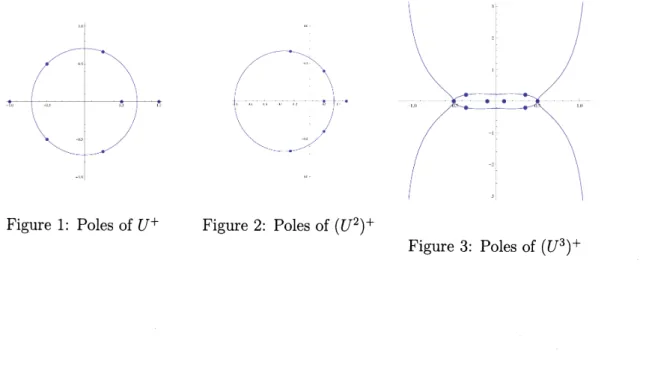
Let $Z_{G}^{(j)}(u)= \prod_{\lambda\in\sigma((U))}j+(1-u\lambda)^{-1},$ $(j\in\{1,2,3$ The following figure depict the poles
of$Z_{G}^{(j)}(u)$ for the Petersen graph.
Figure 1: Poles of$U^{+}$ Figure 2: Poles of $(U^{2})^{+}$
Acknowledgment ES thanks to the financial supports of the Grant-in-Aid for Young
Sci-entists (B) and ofScientific Research (B) Japan Societyfor the Promotion ofScience (Grants No.25800088, No.23340027).
References
[1] A. Ambainis, Quantum walks and their algorithmic applications, Int. J. Quantum Inf. 1 (2003),
pp.507-518.
[2] M. Szegedy, Quantum speed-up of Markov chain based algorithms, Proc. 45th IEEE
Sympo-siumon Foundations of Computer Science (2004), pp.32-41.
[3] D. Emms, E. R. Hancock, S. Severini, R. C. Wilson, A matrix representationofgraphs and
its spectrumas agraph invariant, Electr. J. Combin. 13, R34 (2006).
[4] P. Exner, P. Seba, Freequantum motion on a branching graph, Rep. Math. Phys. 28 (1989),
pp.7-26.
[5] Yu. Higuchi, N. Konno, I. Satoand E. Segawa, Spectral and asymptotic propertiesof Grover
walks on crystal lattices, Journalof Functional Analysis 267 (2014), pp.4197-4235.
[6] Yu. Higuchi, N. Konno, I. Sato,E. Segawa, A noteonthediscrete-time evolutions ofquantum
walkon a graph, Journal of Math-for-Industry 5 (2013), pp.103-109.
[7] Yu. Higuchi, N. Konno, I. Sato and E. Segawa, A remark on zeta functions of finite graphs
via quantum walks, Pacific Journal ofMath-for-Industry 6 (2014), pp.73-81.
[8] Yu. Higuchi, N. Konno, I. Satoand E. Segawa, Quantum graphwalksI: mapping to quantum
walks, Yokohama Mathematical Journa159 (2013), pp.33-55.
[9] C. GodsilandK.Guo, Quantumwalksonregular graphsandeigenvalues,Electron. J. Combin.
18 (2011) P165.
[10] S. Gudder, Quantum Probability, Academic Press Inc., CA, 1988.
[11] S. Severini, On the digraph ofa unitary matrix, SIAM Journal on MatrixAnalysis and
Ap-plications 25 (2003), pp.295-300.
[12] G. Tanner, From quantum graphs to quantum random walks, In: Non-linear Dynamics and
Fundamental Interactions NATO Science SeriesII: Mathematics, Physics and Chemistry213