非弾性衝突の数値シミュレーション
The
Simulation
of the
Inelastic
Impact
京大人環 國仲寛人 (Hiroto Kuninaka), 早川尚男 (Hisao Hayakawa)
Graduate School
of Human andEnvironmental
Studies,Kyoto University
1Introduction
Collisions
are common
phenomena in nature. For example, in the microscopic scale, atoms andmolecules in gas
are
colliding each other. In the macroscopicscale, we oftensee
collisionofballs insportssuch
as
the baseball and the billiard. In such collisions, the initial kineticenergy
of materialdissipates into internal degrees of freedom like elastic vibration, sound emission, and heat. As
a
result, macroscopic collisions
are
always inelastic.Inelastic collisions
playan
important role in granular materials[l].Characteristic
behaviorsof granular material
come
from inelastic collisions among particles. By tiltingor
shaking thecontainer which contains granular material,
one can
see
the characteristic behavior of granuleswhich is different from that of ordinaryfluid. The Distinct Element Method(DEM) is awell-known
simulation method for the granular materials[2]. DEM contains
some
phenomenological parameterssuch
as
the Coulomb’s coefficient of friction, dashpots, andso on.
Nobodycan
determine such theviscoelastic parameter from the first principle. However,
even
the determination of the simplestparameter, the coefficient of normal restitution (COR) is not reliable.
Thecoefficient of normal restitution(COR) $e$ is afamiliarparameter which is introduced in text
books ofthe elementary physics.
COR
is defined by the ratio of the normal components of theinitial collision velocity $v_{i}$ and the
rebound
velocity $v_{\mathrm{r}}$as
$e=-v_{\mathrm{r}}/v_{i}$, $0\leq e\leq 1$. (1)
Historically,
COR
was
first introduced by Newton[3]. Though many text books of elementaryphysics state that
COR
is amaterial constant, many experiments and simulations showCOR
decreases
as
the impact velocity increases[4, 5, 6, 7, 8, 9, 10, 11].On
the other hand, Louge andAdams reported in their recent paper that
COR
$e$can
exceeds unity in the situation of the obliqueimpact which is contrary to the assumption $e\leq 1[12]$. This topic is interesting and worthyof
more
detailedstudy.
In addition, the coefficient of tangential restitution $\beta$ is also well-known parameter to describe
the rotational motion of material. $\beta$ is defined
as
$\beta=-\frac{v_{\acute{t}}}{v_{t}}$, (2)
where $v_{t}$ and $v_{\acute{t}}$
are
the tangential components of the velocityof thecontact
point before andafter
collision. $\beta$ is known to be dependent
on
the incident angle ofimpact. However, the mechanism ofthis dependency is not unclear
数理解析研究所講究録 1305 巻 2003 年 81-88
Orn lesealcll is to understand the lnechanisrn of the coefficient of tangential restitution. We
study tlic relation between the coefficient of tangential restitution and the angle of incidence in
oblique collision in this paper. The organization of this $1$)$\mathrm{a}1$)$\mathrm{e}1$ is as follows. In tlle next section, we
will rcvie$\backslash \mathrm{v}$ the definition ofthe coefficientofrestitution andthe coefficient oftangential restitution.
In section 3we introduce
our
numerical model and setup of the simulation. Section 4is the mainpart of this paper where
we
summarize tlle results ofour
simulation and, explain the numericalresults bv the theory. Section 5is the conclusion of this paper.
2Introduction of
e
and
$\beta$To characterize inelastic collision, Walton introduced three parameters[13]. The three parameters
are
the coefficient ofnormal restitution $\mathrm{e}$, the coefficient ofCoulomb’sfriction
$\mu$, and thernaximum
value of the coefficient of tangential restitution $\beta_{0}$. Experiments have supported that his
charac-terization adequately capture the
essence
of binary collision of spheresor
collision of asphereon
aflat plate[14, 15, 16, 17]. Now, let
us
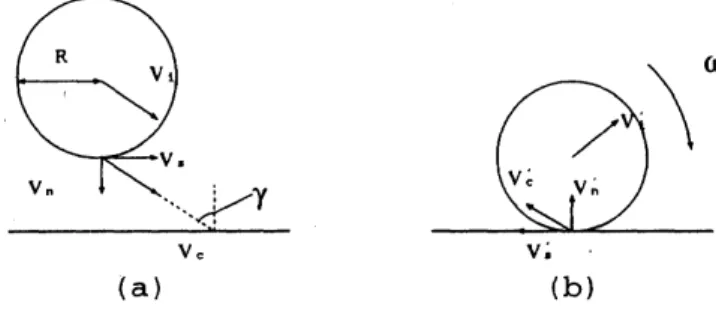
define the coefficient of restitution $\mathrm{e}$ and the coefficient oftangentialrestitution $\beta$ in the 2-dimensional situation. Figure 1is the schematic figure that adisk
$\mathrm{v}_{\mathrm{c}}$
$\mathrm{t}$a I $\mathrm{t}\mathrm{b}$I
Figure 1: The schematic figure of acollision of sphere with awall.
is colliding with astationary wall with initialvelocity ofitscenter of mass, Vi. The relative velocity
at the contact point after collision, thus, becomes
$\mathrm{v}_{\mathrm{c}}’=\mathrm{v}_{\mathrm{i}}-R\mathrm{n}\mathrm{x}$ $\omega’$, (3)
where $R$ is the radius of the disk, $\mathrm{n}$ is the unit vector in the normal direction to the wall, and
$\omega$
’is
the angular velocity. The prime denotes post-colliding quantities. The coefficient of normalrestitution $\mathrm{e}$ is defined as
$\mathrm{v}_{\acute{\mathrm{c}}}\cdot \mathrm{n}=-e\mathrm{v}_{\mathrm{c}}\cdot \mathrm{n}$. (4)
Conventionally, this parameter is assumed to be $0\leq \mathrm{e}\leq 1$.
The coefficient of tangential restitution $\beta$ is defined
as
$\mathrm{v}_{\acute{\mathrm{c}}}\cdot \mathrm{t}=-\beta \mathrm{v}_{\mathrm{c}}\cdot \mathrm{t}$, (5)
where $\mathrm{v}_{\acute{\mathrm{c}}}$ and $\mathrm{t}$
are
the post-collisional velocity at the contact point after collision and the unittangential vector, respectively. It is believed that $\beta$ is afunction of the angle of incidence
$\gamma$, with
possible values lying in the
range
between -1 and 1 $[13, 14]$. The incident angle $\gamma$ isdefined
as
$\gamma=\arctan(\mathrm{v}_{t}/\mathrm{v}_{n})$, where $\mathrm{v}_{n}$ and $\mathrm{v}_{t}$
are
$\mathrm{v}_{n}=\mathrm{v}_{\mathrm{c}}\cdot$ $\mathrm{n}$ and $\mathrm{v}_{t}=\mathrm{v}_{\mathrm{c}}\cdot$$\mathrm{t}$, respectively.
For the oblique collision, the coefficient of tangential restitution $\beta$ is more important than $e$.
From the conservation laws of momentum and angular momentum and Coulomb’s friction on tlte
surfaces of two identical $\mathrm{r}$igid
$\mathrm{s}\mathrm{l}$)
$1\mathrm{l}\mathrm{e}\mathrm{l}\mathrm{e}\mathrm{s}$, Walton[13] derives
$\beta\simeq\{$
$-1- \mu(1+e)\cot\gamma(1+\frac{mR^{\underline{)}}}{I})$ $(\gamma\geq\gamma_{0})$
$\beta_{0}$ $(\gamma\leq\gamma_{0})$,
(6)
where $\gamma_{0}$ is the critical angle, and $m$, $R$, and I
are
mass, radius and moment of inertia of spheresrespectively. Labous, Rosato, and Dave performed the experiment of binary collision of nylon
spheres and showed the consistency of their results to the Walton’s relation[14]. Furthermore, it
has become clear that Many experimental results
are
consistent with the relationso
that Walton’smodel is accepted
as
reasonable[15, 16, 17]. Meanwhile, Maw, Barber, and Fawcett extended theHertz theory of impact and established the theory of the oblique impact to be consistent with
their experimental results[18]. In contrast to Walton’s assumption, they demonstrated the need to
consider normal and tangential compliance
over
the contactarea.
3Our
Models
Here, let
us
introduce three lattice models. Each model consists ofan
elastic disk andan
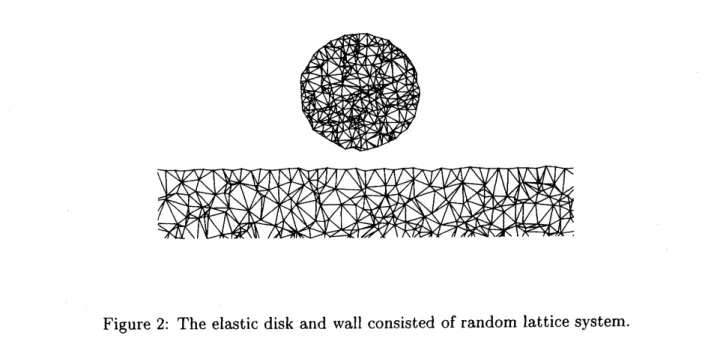
elasticwall. The main results of this paper
are
those of random lattice model(Fig. 2). Both the disk andFigure 2: The elastic disk and wall consisted ofrandom lattice system.
the wall
are
composed of randomly distributed 800mass
points. Allmass
pointsare
bound withnonlinear springs using the Delaunay triangulation algorithm[19]. The spring interaction between
connected
mass
points is describedas
$V(x)= \frac{1}{2}k_{a}x^{2}+\frac{1}{4}k_{b}x^{4}$, (7)
$\mathrm{F}_{-}$,
Figure
3:
Interaction between surface particles of the disk and the wall.where $x$ is astretch from the natural length of spring, and $k_{a}$ and $k_{b}$
are
the spring constants. Weuse
atypical ratio of $k_{b}$ to $k_{a}$as
$k_{b}/k_{a}=10^{-3}$.
The width of the wall is 4timesas
longas
thediameter ofthe disk. The height of the wall is
same
as
the diameter of the disk. Two sides of thewall
are
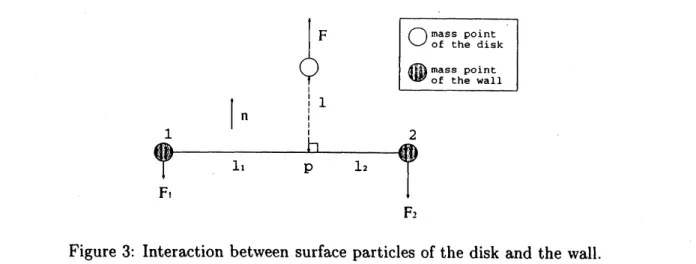
fixed.The interaction between the disk and the wallduring acollisionis introduced
as
follows. Figure3isthe schematic figure of the interaction of surface
mass
pointsof the disk and the wall. When thedistance $l$ between the edge of the disk and the surface ofthe wall is less than the cutoff
length(we
set it equal to the length of the linear spring), the surface particles of the disk feel the repulsive
force, $\mathrm{F}(l)=aV_{0}\exp(-al)\mathrm{n}$, where $a$ is $300/R$, $V_{0}$ is $amc^{2}R/2$, $m$ is the
mass
of the particle, $R$is the radius of the disk, $c=\sqrt{E}/\rho$, $E$ is Young’s modulus, and $\rho$ is the density, $\mathrm{n}$ is the normal
unit vector to the surface. The reaction forces applied to the two points of the surface of the
wall (point 1and 2)
are
decided by the balance of the torquesas
Fi$(/)=-F(l)\mathrm{n}/(1+/1//2)$ and$\mathrm{F}_{2}(l)=-F(l)\mathrm{n}/(1+l_{2}/l_{1})$, where $l_{i}(i=1,2)$ is the distance between the point $p$ and the point $i$
(see Fig. 3).
In this model, roughness of the surfaces is important mechanism to make the disk rotate after
collision. How to make roughness is
as
follows. Atfirst,we
generate normal random numbers whoseaverage
value is 0and then make the initial position of particleson
surface of both the disk andthe wall deviate with them. We choose the value ofdispersion $\delta$
as
$\delta=3\cross 10^{-2}R$, where$R$ is the
radius of the disk.
As for
random lattice model,we
cannotdetermine
Poisson’s ratio theoretically. Whenwe
determine Poisson’s
ratio of thismodel,we
introduce the viscous damping term in (7). By stretchingthe strip of random lattice and measuring its width and height,
we
can
obtain Poisson’s ratio.Forcomparison,
we
make othertwo latticemodels: triangularlattice and square latticedisk(Fig.4).The triangular lattice disk is made by replacing the internal structure of the random lattice disk
with the triangularlattice. The surface of the triangularlattice disk is
same as
that of the randomlattice disk. Poisson’s ratio ofthe triangular lattice
can
be calculated theoreticallyas
1/3[20]. Thesquare lattice disk is made by replacing the internal structure of the random lattice disk with the
square lattice. We introduce two spring constants: $k_{a}=k_{1}$ for nearest neighbor interaction and
$k_{a}=k_{2}$ for next-nearest neighbor interaction. Poisson’s ratio of the
square
lattice is expressedas
$\nu=\frac{k_{2}^{2}+(k_{1}^{2}-4k_{2}^{2})n_{x}^{2}n_{y}^{2}}{k_{2}(k_{1}+k_{2})+(k_{1}^{2}-4k_{2}^{2})n_{x}^{2}n_{y}^{2}}$
.
(8)We scale the equation of motion for each particle using the radius of the
disk
$R$as
the scale of(a)
(b)
Figure 4: The schematic figures of (a) triangular lattice disk and (b) square lattice disk.
length and the velocity of elastic
wave
$c=\sqrt{E}/\rho$as
the scaling unit ofvelocity.As
thenumerical
scheme of the integration,
we use
the fourth order symplectic numerical method with the timestep$\Delta t\simeq 10^{-3}R/c$.
4Results
and Discussions
In this section,
we
carry out the simulation ofthe oblique impact. The angle of incidence is rangedfrom 5.7’ to80.5’ while the normal component ofvelocity is fixed
as
0.$1c$. Thedisk hasno
internalvibration and rotation before collision. In order to eliminate the effect ofthe initial configuration
of
mass
points,we
prepare100
samples of diskas
the initial condition by using100
setsof
randomnumbers and average dataof all samples.
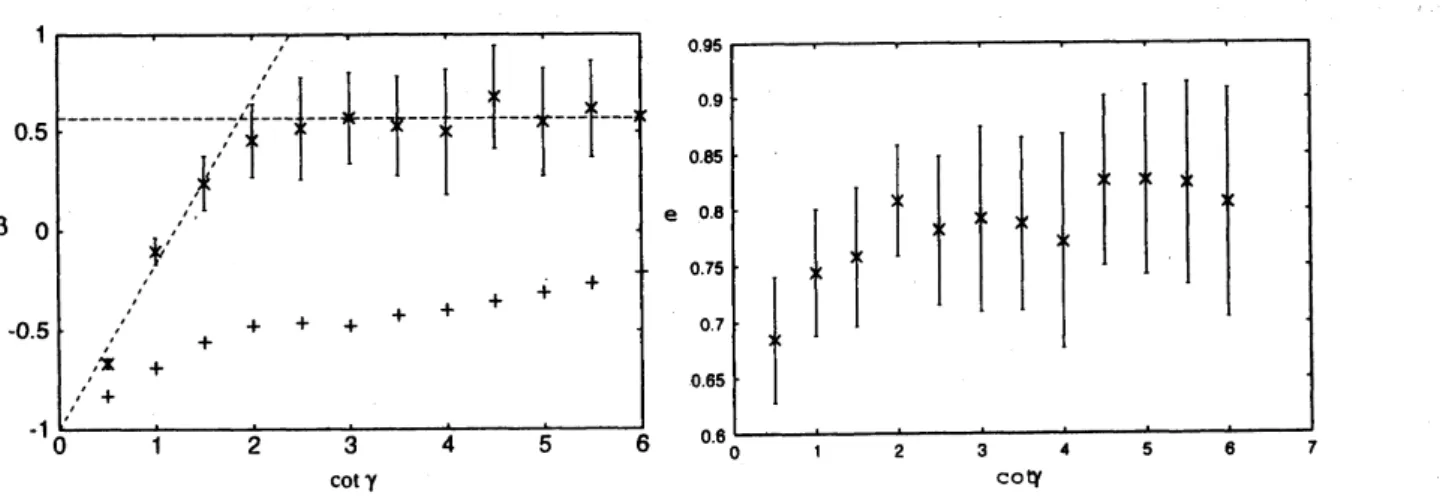
Figure 5: The relation between $\cot\gamma$ and $\beta$. Figure
6:
The relation between $\cot\gamma$ and $e$.Figure 5shows the relation between the cotangent of the angle of incidence
7and
the coefficien$\mathrm{t}$(9)
of tangential restitution $\beta$. In this figure,
cross
pointsare
the result of the 1$\mathrm{a}\mathrm{n}\mathrm{d}\mathrm{o}\ln$ lattice diskand $\backslash \backslash \prime \mathrm{a}11$, and broken lines
are
eq.(6), where$e=0.8$, $\mu$ and $\beta_{0}$
are
fitting parameters. This resultshows that $\beta_{0}$ takes the value nearly 0.56 and $\mu_{0}$
takes
tlle value nearly0.18. From this estimation,we can see that this model can reproduce the tendency of the experimental results of the oblique
collision qualitatively$[14, 15]$. In contrast, plus points
are
the results ofthe triangular lattice disk.In this lnodel, $\beta$ takes negative values in all range of the angle of incidence. This
means
that thetriangular lattice model is easy to slip on the surface.
Figure 6shows the relation between the cotangent of the angle of incidence and
COR
$e$.Al-though it is expected that
COR
takes the constant value because the normal velocity ofthe disk isset to the fixed value, 0.$1\mathrm{c}$,
COR
dependson
the angle of incidence. In particular, in the region ofsmall value
of
$\cot\gamma$,COR
decreasesas
$\cot\gamma$decreases. At
present,we
cannot explain this tendencyofnormal
COR.
Here,
we
compareour
result with the theory of Maw, et a1.[18]. According to their theory, allthe region of the angle of incidence
can
be divided into three regimes. For each regime, $\beta$can
beexpressed
as
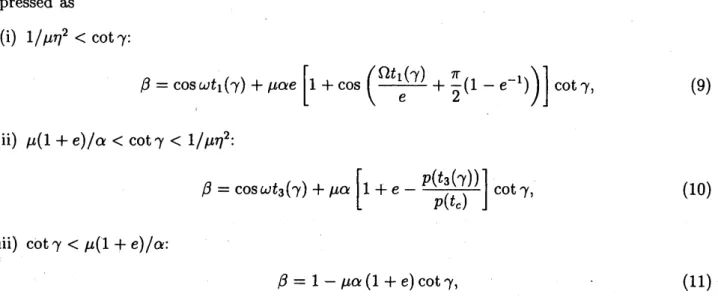
(i) $1/\mu\eta^{2}<\cot\gamma$:
$\beta=\cos\omega t_{1}(\gamma)+\mu\alpha e[1+\cos(\frac{\Omega t_{1}(\gamma)}{e}+\frac{\pi}{2}(1-e^{-1}))]\cot\gamma$,
(ii) $\mu(1+e)/\alpha<\cot\gamma<1/\mu\eta^{2}$:
$\beta=\cos\omega t_{3}(\gamma)+\mu\alpha[1+e-\frac{p(t_{3}(\gamma))}{p(t_{\mathrm{c}})}]\cot\gamma$, (10)
(iii) $\cot\gamma<\mu(1+e)/\alpha$:
$\beta=1-\mu\alpha(1+e)\cot\gamma$, (11)
where $\mu$ is the coefficient of friction, $\eta$ is the constant dependent
on
Poisson’s ratio, $\alpha=3.02$which is aconstant dependent
on
the shape ofmaterial, $\Omega=\pi/2t_{c}$, $t_{/c}$ is aduration ofacollision,$\omega$ $=(\pi/2\eta t_{c})\sqrt{\alpha}$, $t_{1}(\gamma)$ is thetransitiontime fromstickmotionto slip motion, $t_{3}(\gamma)$ is the transition
time from slip motion to stick motion, and $p(t)$ is impulse. This theory
was
confirmed to beconsistent with experimental data[15, 16, 17, 18].
We compare the result
of
simulation of theoblique impact using the random lattice model withthe theoretical curve(Fig. 7). Here
we
used $\eta=1.015$, which corresponds to Poisson’s ratio 0.058,$e=0.8$
as
afixed value, and $\mu=0.3$as
afitting parameter. It is found that the result of randomlattice model is consistent with the theory.
On the other hand,
as
for the result of figure 5,we
focusour
attention to the difference ofPoisson’s ratio between the random disk and the triangular disk. By changing the value of spring
constants of square lattice disk and controlling Poisson’s ratio,
we
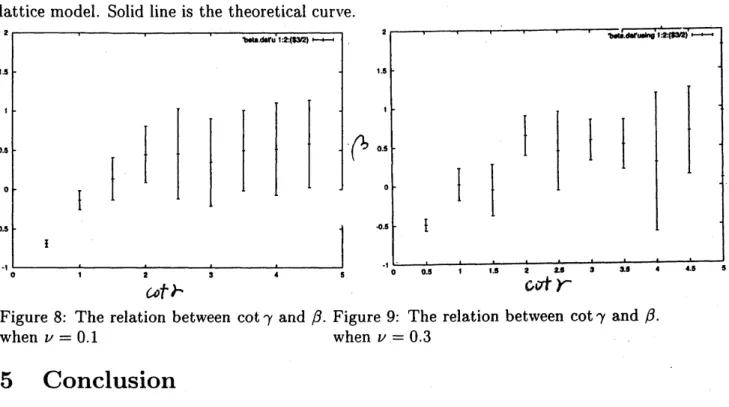
investigate the dependency of$\beta_{0}$ on Poisson’s ratio. Figure 8is the result when $\nu=0.1$ while figure 9is the result when $\nu=0.3$.
We cannot
see
the difference of the values of$\beta_{0}$. From these results, Poisson’s ratioseems
not toaffect the value of$\beta_{0}$
.
$\beta$
$\mathrm{c}\mathrm{o}q$
Figure 7: The relation between $\cot\gamma$ and $\beta$.
Cross
pointsare
the numerical results of the randomlattice model. Solid line is the theoretical
curve.
A
Figure 8: The relation between $\cot\gamma$ and $\beta$. Figure 9: The relation between $\cot\gamma$ and $\beta$
.
when $\nu=0.1$ when $\nu=0.3$
5Conclusion
Inthis paper,
we
demonstrate the2-dimensional simulation of the oblique impactand obtain resultsas
follows.(i)
Our
random lattice model exhibits thesame
tendencyas
experimental data qualitatively. Inaddition, the model is consistent with Maw’s theory of the oblique impact.
(ii) There
seems
to beno
relation between Poisson’s ratio of material and the value of $\beta_{0}$.References
[1] See, forexample, L. P. Kadanoff: Rev. Mod. Phys. 71 (1999) 435; P. G. de
Gennes:
Rev. Mod.Phys. 71 (1999) S374 and references therein
[2] P. A. Cundall,
0.
D. L.Strack:
Geotechnique 29 (1979) 47.[3] I. Newton: Philoshophiae naturalis Principia mathematica (W. Dawason and Sons, London,
1962). The original
one
has been published in1687.
[4] W. Goldsmith: Impa
ct:
The Theory
and Physical Behaviorof
CollidingSolids
(Edward ArnoldPubl., London, 1960).
[5] K. L. Johnson: Contact Mechanics (Cambridge University Press, Cambridge, 1985).
[6] W. J. Stronge: Impact Mechanics (Cambridge Univ. Press, 2000)
[7] R. Sondergaard, K. Chaney, and
C.
E. Brennen: Transaction of theASME, Journal ofAppliedMechanics
57
(1990)694.
[8] F.
G.
Bridges,A.
Hatzes, andD.N.C.
Lin: Nature 309 (1984)333.
[9] K. D. Supulver, F. G. Bridges, and D. N. C. Lin: ICARUS 113 (1995) 188
[10 G. Kuwabara and K. Kono: Jpn. J. Appl. Phys. 26 (1987) 1230.
[11 H. Hayakawa and H. Kuninaka: Chem. Eng.
Sci.
57 (2002)239.
[12 M. Y. Louge and M. E. Adams: Phys. Rev. E65 (2002) 021303.
[13 O. R. Walton and R. L. Braun: J. Rheol. 30 (1986) 949.
[14 L. Labous, A. D. Rosato, and R. N. Dave: Phys. Rev. E56 (1997) 5717.
[15
S.
F. Foerster, M. Y. Louge, H. Chang, and K. Allia: Phys. Fluids 6(1994) 1108.[16 A. Lorentz,
C.
Tuozzolo, and M. Y. Louge: Exp. Mech. 37 (1997) 292.[17 D. A. Gorham, A. H. Kharaz: Powder Technology 112 (2000) 193.
[18 N. Maw, J. R. Barber, and J. N. Fawcett: Wear 38 (1976) 101.; N. Maw, J. R. Barber, and J.
N. Fawcett: ASME J. Lub. Tech 103 (1981) 74.
[19] K. Sugihara: Data Structure and Algorithms (Kyoritsu, Japan, 2001).
[20] W.
G.
Hoover: Computational Statistical Mechanics (ElsevierScience
Publishers B. V.,Ams-terdam, 1991