• 検索結果がありません。

近畿大学学術情報リポジトリ

N/A
N/A
Protected

Academic year: 2021

シェア "近畿大学学術情報リポジトリ"

Copied!
103
0
0

読み込み中.... (全文を見る)

全文

(1)

Doctoral Thesis

Study on the regulation of host apoptosis and

apoptotic factors by Chlamydia infection

January 24, 2018

Graduate school of Biology-Oriented Science and Technology,

Kindai University

Md. Abdul Aziz

(2)

1

Contents

Contents

1

Abstract

5

1.

Introduction

7

1.1

Diseases caused by Chlamydia

7

1.2

Developmental cycle of Chlamydia

7

1.3

Pathogenicity of Chlamydia

8

1.3.1

Attachment

8

1.3.2

Type III secretion

9

1.3.3

Modification of host immune response

9

1.4

Apoptosis regulation by Chlamydia

10

1.5

Interaction with Chlamydia and host factors

13

1.6

Aim of this study

14

2.

Materials and methods

15

2.1

Host cell lines, chlamydial strains, other bacteria and yeast

15

2.2

Media and culturing

15

2.3

Reagents and antibodies

16

2.4

Chlamydial infection

16

2.5

Apoptosis induction and assays

17

2.6

Immunofluorescence staining

17

2.7

pCMV vector construction and transfection

18

2.8

Construction of whole chlamydial genome library

18

2.9

Construction of pGADT7+caspase-9 vector

19

2.10

Caspase-9 cloning into pGEX(2T-P) vector

20

2.11

Chlamydial gene clone into pET-15b vector

21

2.12

Selection of chlamydial factors interacting with caspase-9

21

2.13

Selection of human factors interacting with Chlamydial OMPs

22

2.14

Protein expression and purification

23

2.15

GST pull-down assay

24

2.16

SDS-PAGE and western blotting

24

3.

Results

26

3.1

Apoptosis regulation by Chlamydia pneumoniae

26

(3)

2

3.1.2 Anti-apoptotic environments for chlamydial infection

26

3.1.3 Chlamydial infection in Apaf-1- and Caspase-9-deficient cells

26

3.1.4 Apaf-1-independent caspase-9 activation by chlamydial infection 27

3.2

Screening chlamydial genes interacting with caspase-9

28

3.2.1 Chlamydial genomic library construction

28

3.2.2 Caspase-9 interact with five C. pneumoniae (J138) protein

30

3.2.3 Protein preparation of caspase-9 and C. pneumoniae

30

3.2.4 Pull-down assay

30

3.3

Selection of human factors interacting with Chlamydial OMPs

31

3.3.1 Chlamydial 22 OMPs interact with 74 human proteins

31

4.

Discussion

33

5.

Acknowledgment

38

6.

Abbreviations

39

7.

References

40

8.

List of tables

49

Table: 1 Chlamydiaceae family (species that cause disease in human)

49

Table: 2 List of cells and strains

50

Table: 3 List of primer for chlamydial genomic library construction

51

Table: 4 List of primers used for cloning and sequencing

68

Table: 5 Pseudo positives containing pGBKT7+ C. pneumoniae genes 69

Table: 6 C. pneumoniae five proteins interact with human caspase-9

70

Table: 7 C. pneumoniae 47 OMPs selected for human

71

Table: 8 Chlamydial 22 OMPs found to interact with 74 human proteins 72

9.

Figures

74

Fig. 1 Developmental cycle of C. pneumonioae

74

Fig. 2 Host apoptosis (Intrinsic Pathway)

75

Fig. 3 Chlamydophila pneumoniae regulates host apoptosis

under apoptotic stimulation using STS

76

Fig. 4 Apaf-1 and caspase-9 inhibitors show opposing contributions

to C. pneumoniae infection

77

Fig. 5 Apaf-1 and caspase-9 show epistatic effects

on chlamydial infection

78

Fig. 6 Independent contributions of caspase-9 and Apaf-1

in C. pneumoniae infection are confirmed

(4)

3

using apoptosis inhibitors and apaf- 1 gene complementation 79

Fig. 7 Caspase-9, but not caspase-3, is activated by C. pneumoniae

infection in a manner independent from Apaf-1

80

Fig. 8 Caspase-9, but not caspase-3, is proteolytically activated by

C. pneumoniae infection in a manner independent from Apaf-1 81

Fig. 9 Caspase-9, but not Apaf- 1, is co-localized with inclusions of

C. pneumoniae

82

Fig. 10 Scheme of establishment of chlamydial genome library

for Yeast two-hybrid (Y2H) and screening of chlamydial

genes interacting with human caspase-9

83

Fig. 11 Linearization of pGBKT7 by BamHI for genomic library

construction.

84

Fig. 12 PCR product of some randomely selected chlamydial genes

85

Fig. 13 Chlamydial whole genomic library

86

Fig. 14 Preparation of the chlamydial genome library for Y2H

87

Fig. 15 Chlamydial protein accumulation in yeast transformat

88

Fig. 16 Cloning of Caspase-9 into pGADT7

89

Fig. 17 Schematic flow sheet for screening interaction of caspase-9

with chlamydial genomic library.

90

Fig. 18 Positive results from chlamydial genomic library screening

with human caspase-9

91

Fig. 19 Caspase-9 cloning into pGEX(2T-P) vector

92

Fig. 20 Expression and partial purification of GST-Caspase-9 protein

93

Fig. 21 Direct interaction between human apoptotic factor caspase-9

and C. pneumoniae EB

94

Fig. 22 Cloning of chlamydial five gene into pET-15b

95

Fig. 23 Expression and purification of Chlamydia protein Cpj0838

96

Fig. 24. Direct interaction between human apoptotic factor caspase-9

and C. pneumoniae Cpj0838 protein

97

Fig. 25 Summary of interactions between human caspase-9

and C. pneumoniae proteins.

98

Fig. 26 Screening interaction of human aorta cDNA library

and chlamydial outer membrane genes

99

(5)

4

with human aorta cDNA library

100

Fig. 28 Confirmation of the interaction between chlamydial 22 outer

membrane proteins and 94 human proteins

101

Fig. 29 Sub-cellular location of proteins interacting with chlamydial

(6)

5

Abstract

Chlamydia pneumoniae is an obligate intracellular pathogen and can replicate

solely within a membrane-bound vacuole termed an inclusion. C. pneumoniae can

cause acute and chronic respiratory diseases, including pneumonia and bronchitis, and

its chronic infection is widely considered to be a cause of atherosclerosis, asthma,

Alzheimer's disease and other inflammatory processes. Chlamydia perturbs multiple

cellular processes of the host to facilitate their survival and evade the host immune

surveillance, such as host cell apoptosis. Apoptosis is an active process of cellular

suicide triggered by a variety of stressors and physiological stimuli for tissue

development and homeostasis of organisms. C. pneumoniae was reported to inhibit

apoptosis induced by staurosporine (STS) and tumor necrosis factor alpha (TNF-α) in

infected epithelial cells, macrophages and monocytes. But the precise mechanisms by

which C. pneumoniae regulates host cell apoptosis remain unknown.

In our first attempt to clarify host and chlamydial factors involved in apoptosis

regulation, it has been found that Apaf-1 and caspase-9 inhibitors were shown to

increase and decrease C. pneumoniae infection, respectively. But no effects were

observed by caspase-8 and -3 inhibitors or Bcl-2 over expression. These opposite

effects by Apaf-1 and caspase-9 inhibitors were confirmed using apaf-1

-/-

and

caspase-9

-/-

mouse embryonic fibroblasts (MEFs) as host cells. Moreover caspase-9 was

activated without activation by Apaf-1, and accumulated within chlamydial

inclusions. The sequestration of caspase-9, which means physical disconnection from

the caspase cascade, by Chlamydia seems to result in apoptosis repression. As an

interesting observation, caspase-9 inhibitor could diminish chlamydial infection. Thus

there are crucial queries remained, such as which chlamydial proteins are involved in

the sequestration of caspase-9 on the chlamydial inclusions and are affected by

caspase-9 inhibitor in the inclusions.

As our next attempt to clone chlamydial genes, which products can interact

with human caspase-9, a screening using a yeast two-hybrid system was performed.

We have constructed the genomic library including 1065 genes of Chlamydia

pneumoniae by homologous recombination method and analyzed interaction with

caspase-9. We found chlamydial proteins Cpj0056, Cpj0444, Cpj0512, Cpj0838 and

Cpj0948 to positively interact with capase-9. Pull-down experiments showed that

caspase-9 physically bound to the Cpj0838 product and chlamydial cells (EB). These

interactions may provide a valuable clue regarding the mechanism for

(7)

Apaf-1-

6

independent activation of caspase-9 supporting chlamydial multiplication in parallel

with apoptosis repression by the caspase-9 sequestration. Using gene annotation

chlamydial 47 outer membrane protein coding genes were selected for screening

interaction with human aorta cDNA library. Human aorta cDNA library were

individually transformed into the yeast strains AH109 carrying pGBKT7 vector

cloned with chlamydial 47 outer membrane genes. Chlamydial 22 outer membrane

proteins found to interact with 74 human proteins.

(8)

7

1.

Introduction

1.1

Disease caused by Chlamydia

Chlamydia is an obligate intracellular parasitic bacterium firstly described as a

pathogen for acute respiratory diseases (Grayston et al. 1986). Currently, 9 species of

Chlamydia have been confirmed including Chlamydia psittaci (Balsamo et al. 2017).

The host range is wide, and there are reports of separation from amphibians such as

frogs, reptiles such as turtles, snakes, iguanas, chameleons, koalas, and horses other

than humans (Bodetti et al. 2002). Chlamydia pneumoniae have been found by its

specific antibody titers with chronic bronchitis patients and were confirmed by culture

or PCR (Blasi et al. 1998). It has also considered as a cause of several chronic

inflammatory diseases including atherosclerosis (Campbell & Kuo 2004), asthma

( Hahn, Dodge & Golubjatnikov 1991), and Alzheimer’s disease (Balin et al. 1998)

(Kinoshita 2004). More than 50% tissue samples of atherosclerotic patients have been

reported positive for Chlamydia pneumoniae (Grayston 2000), which was supported

by in vitro experiments demonstrating that cells involved in atherogenesis are also

susceptible to Chlamydia pneumoniae infection (Godzik et al. 1995). Chlamydia

trachomatis is a causative microorganism of ocular conjunctivitis and if it is not

treated with antibiotic, chronic infection led to the blindness of millions of people

annually in developing countries (Taylor et al. 1987) through scratching of the cornea

(Gambhir et al. 2007). It is also a serious cause of sexually transmitted infection

(Brunham & Rey-Ladino 2005). Its chronic infection is responsible for pelvic

inflammatory diseases and infertility (Sherman et al. 1990). Chlamydophila psittaci is

a zoonotic infectious pathogen causes human psittacosis. The infection is transmitted

by close contact with infected birds, especially poultry industry, and from contact

with Psittaciformes (cockatoos, parrots, parakeets and lories) (Beeckman &

Vanrompay 2009) (Table: 1).

1.2

Developmental cycle of Chlamydia

Chlamydia shows different morphology and function in infected host cell

environment and external environment (Hackstadt et al. 1997). Chlamydia has a

unique biphasic life cycle initiated by the infectious but metabolically inactive

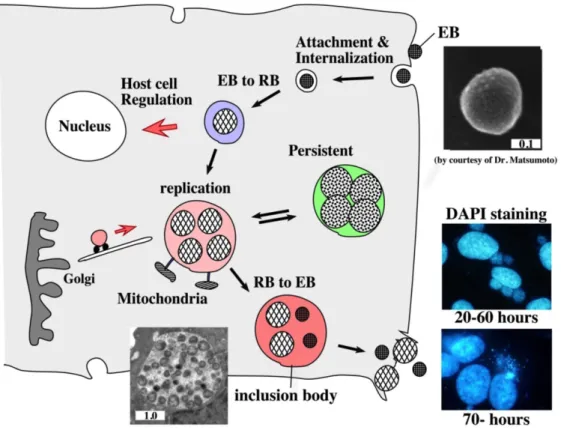
elementary bodies (EBs), with diameter approximately 0.3 µm (AbdelRahman &

Belland 2005). Firstly, infectious elementary body (EB) of Chlamydia pneumoniae

enters into the host cell by phagocytosis. Phgocytosed EBs reside within a membrane

(9)

8

bound vacuole named the inclusion. The inclusion membrane is actively modified to

avoid fusion with late endosomes or lysosomes to ensure their survival against

lysosomal degradation (

Ojcius, Hellio, & Dautry-Varsat

1997;

Scidmore, Fischer &

Hackstadt

2003). About 2 to 3 hours after the infection, the form changes from

infected type to proliferative reticulate body (RB), and the phagocytic membrane

constructs inclusion body membrane by Chlamydia membrane protein. Growth starts

in the inclusion body. RBs perform binary fissions proliferations (AbdelRahman &

Belland 2005) and grows to about 1000 cells per inclusion body. In the absence of

stress such as growth inhibition, RB retransforms to EB and EB is released to start the

next infection (Hybiske & Stephens 2007) (Fig. 1). Antibiotics are effective for

pneumonia with acute infection of Chlamydia pneumoniae but are considered to be

ineffective for persistent infection (Yamaguchi et al. 2003). Under stressed condition

(e.g. treatment with antibiotic or interferon gamma (IFNγ) induced activation host

cell), Chlamydia can alternate some morphological changes ultimately formation of

persistent body (PB) (Luis et al. 1987). Formation of persistent body (PB) allows for a

chronic infection of the host cell. In the case of Chlamydia pneumoniae, one cycle of

infection takes about 3 days, whereas, Chlamydia trachomatis takes about 2 days.

1.3

Pathogenicity of Chlamydia

1.3.1 Attachment

The very early step in the host-pathogen interaction is attachment of the

pathogen to host surfaces. Chlamydia spp. is obligate intracellular bacterial pathogen

that causes a number of diseases in human. A number of both bacterial and host

factors are involved with the attachment and invasion of Chlamydia spp. The

attachment and internalization processes vary depending on different types of hosts

and tissues. The attachment starts by the low-affinity interaction of C. pneumoniae, C.

trachomatis and C. muridarum with heparan sulphate proteoglaycans (HSPGs)

followed by binding to host cell receptors.

Microbial factors made from polypeptides (proteins) or polysaccharides

(carbohydrates or sugars) mediate the adhesion to host cell are called adhesins.

Chlamydial adhesins proteins such as OmcB (also known as CT443), GroEL-1,

chlamydial major outer membrane protein (MOMP), EB proteins-like

glycosaminoglycans (GAGs) and polymorphic membrane protein (pmp) family from

(10)

9

lipopolysaccharides (LPS) are also involved in attachment of Chlamydia to host cell

(Hegemann &

Moelleken

2012). Surface proteins of host cell such as

mannose/mannose-6-phosphate (M6P) receptor, apolipoprotein E4 receptor,

epidermal growth factor receptor (EGFR), ephrin receptor A2 (EPHA2) and

estrogen/protein di-sulphide isomerase (PDI) receptor have been proposed to

associated with binding and adhesion of Chlamydia spp. (Hegemann &

Moelleken

2012;

Elwell, Mirrashidi & Engel

2016).

1.3.2 Type III secretion

On contact with host cells, Chlamydia spp. inject the pre-synthesized effectors

through the type III secretion system (T3SS) to induce cytoskeletal remodeling that

promote invasion and activate host signaling to establish an anti-apoptotic

environment (Dai & Li 2014). The most well characterized chlamydial effector,

translocated actin-recruiting phosphoprotein (TarP; also known as CT456) nucleates

and bundles actin through its own globular actin (G-actin) and filamentous actin

(F-actin) domains (Hackstadt 2012). T3SS effector CT694 a multidomain protein

interacts with the AHNAK protein. Both CT694 and CT166 promote the

depolymerization of actin and TepP (also known as CT875) phosphorylated by host

tyrosine kinases, involve in the intiation of innate immune signaling

(Elwell,

Mirrashidi & Engel

2016). The elementary body (EB) is then endocytosed into a

membrane bound vesicle termed as the inclusion.

1.3.3 Modification of host immune response

Recognition of the microbe by the innate immune system is a critical first step

to remove a pathogenic microbe. The innate immune cells have certain receptors

called pathogen recognition receptors (PRRs) used for recognizing the microbial

conserved structures called microbe associated molecular patterns (MAMPs)

(Nagarajan 2012). Chlamydia is an obligate intracellular bacterium and has biphasic

life cycle. Chlamydial MAMPs are initially recognized by PRRs at the host cell

surface but the majority of the recognition occurs intracellularly. Moreover, different

effectors secreted by EBs and RBs are also recognized by different host receptors

(Nagarajan 2012). Chlamydial lipopolysaccharides (LPS) and/or 60kDa heat shock

protein (HSP60) are recognized by TLR4, whereas TLR2 recognizes peptidoglycan,

macrophage inhibitory protein (MIP) and/or chlamydial plasmid regulated ligand. The

(11)

10

downstream signaling of both TLR2 and TLR4 requires the adaptor myeloid

differentiation primary response protein 88 (MYD88) and tumor necrosis factor

(TNF) receptor-associated factor 6 (TRAF6) for the activation of NF-κB and MAPK.

In response to infection with C. pneumoniae, C. trachomatis and C. muridarum , an

intracellular cytosolic receptor nucleotide-binding oligomerization domain-containing

1 (NOD1) is also activated that can causes NF-κB activation (Nagarajan 2012). To

ensure their survival in the host Chlamydia modifies several host immune responses

and in some cases, prevents clearance. TRAF3 is a signaling molecule which has a

pivotal role in the production of type I interferon (IFN). Type I IFNs are induced by

microbial infections and has antiviral activities. During infection with C. pneumoniae,

an unknown protease specific to C. pneumoniae degrades the signaling molecule

tumor necrosis factor (TNF) receptor-associated factor 3 (TRAF3) and ultimately

interferon beta (IFNβ) production are suppressed (Wolf & Fields 2013).

In different manner Chlamydia reduce or block nuclear factor-κB (NF-κB)

transcription (Bastidas et al. 2013; Hackstadt 2012) to escape cell autonomous

immunity. The C. pneumoniae specific inclusion (Inc) protein CP0236 contains

domains exposed to the host cytoplasm. The Inc protein CP0236 are shown to

interact to and sequesters NF-κB activator 1 (ACT1; also known as CIKS) to the

inclusion membrane, leading to the blockage of NF-κB signaling, whereas The T3SS

effector ChlaDub1 (also known as CT868) binds to NF-κB inhibitor-α (IκBα) and

stabilizes by impairing its ubiquitination in the cytosol (

Wolf, Plano & Fields

2009).

In an ex vivo tissue infection with C. trachomatis

the level of olfactomedin 4 (a

glycoprotein) OLFM4 mRNA was increased about 100-fold compare to non-infected

control. The increased level of olfactomedin 4 (OLFM4), may suppress the

NOD1-mediated activation of NF-κB (Kessler et al. 2012).

1.4 Apoptosis regulation by Chlamydia

Apoptosis is one of the programmed cell death of the host and is induced

against various stimuli from inside and outside the cell to maintain homeostasis of

multi-cellular organisms. Apoptosis is characterized by apparent morphological

changes thus formation of apoptotic bodies, and finally cleared from the system

through phagocytosis and degradation by other cells (

Kerr, Wyllie & Currie

1972).

There are two types of apoptosis pathway; the death receptor mediated extrinsic

pathway and the mitochondrial intrinsic pathway (Fig. 2). In mitochondrial intrinsic

(12)

11

pathway, when the apoptotic signal is transmitted by the ultraviolet irradiation, DNA

damage, internal stress, etc., the apoptosis-promoting Bcl-2 family such as Bax and

Bak is activated, and cytochrome c released into the cytoplasm from the mitochondria.

The cytochrome c, Apaf-1 and procaspase-9 form an apoptosome leading to caspase-9

activation with the hydrolysis of dATP or ATP. Apoptotic pathway is initiated by the

active caspase-9 mediated cleavage of caspase-3 (Salvesen & Dixit 1997). This

apoptotic response is tightly regulated by Bcl-2 to prevent the release of cytochrome c

from mitochondria (Shimizu, Narita & Tsujimoto 1999).

In order to avoid the host's immune system, many pathogenic bacteria are

important to reorganize the apoptotic function (Friedrich et al. 2017) and metabolic

process (Gehre et al. 2016) of host cells. The ultimate goal of all pathogen is to

establish a favorable niche in the host for their own multiplication. Several pathogenic

microbes both bacteria and viruses to ensure intracellular survival modulate apoptosis

to escape host immune response. Bacteria like Shigella, Salmonella, and Yersinia are

thought to have developed a variety of strategies to control the inflammatory and

apoptotic process to establish infection, multiplication and dissemination to other

hosts (Giogha et al. 2014; Gao & Kwaik 2000).

Obligate intracellular parasitic bacteria Chlamydia and Rickettsia avoid the

immune system by inhibiting host cell apoptosis (Clifton et al. 1998). It is believed

that by proliferating intracellularly Chlamydia inhibit host apoptosis; it also avoids

removal of infected cells by immune cells. In case of Chlamydia, depending on the

host and Chlamydia type and infection conditions, many factors that promote

apoptosis have been reported, and cases in which caspase-independent apoptosis is

promoted are also shown (Perfettini et al. 2002). C. pneumoniae was reported to

inhibit apoptosis induced by staurosporine (STS) and tumor necrosis factor alpha

(TNF-α) in infected epithelial cells, macrophages and monocytes (Rajalingam et al.

2001; Airenne et al. 2002; Geng et al. 2000; Fischer et al. 2001). It was reported that

C. pneumoniae induced apoptosis in coronary artery endothelial cells (Schöier et al.

2006), whereas in many cases C. pneumoniae tends to suppress host apoptosis.

Elucidation of host cell apoptosis controlled by Chlamydia is a prerequisite to

understanding chlamydial strategies for persistent infection and how to overcome the

diseases caused by Chlamydia.

The first installment reported that host cell apoptosis promoted by a variety of

stimuli, such as STS and TNF-α, was inhibited by chlamydial infection. This

(13)

12

inhibition was accompanied with and explained by prevention of the cytochrome c

release from mitochondria (Fischer et al. 2001; Fan et al. 1998). This prevention was

later explained by specific degradation of the pro-apoptotic BH3-only proteins, such

as Bik, Puma, Bim, Bad, Bmf, Noxa, and tBid (Fischer et al. 2004; Dong et al. 2005;

Ying et al. 2005). Chlamydial protease– or proteasome–like activity factor (CPAF),

which is a potent and promiscuous cysteine protease capable of cleaving many host

proteins, was initially implicated in this degradation (Pirbhai et al. 2006). However,

subsequent studies showed that the proteolysis of the reported CPAF substrates was

due to enzymatic activity in cell lysates rather than in intact cells (Chen et al. 2012),

(Snavely et al. 2014). Moreover, conflicting observations concerning the degradation

of the pro-apoptotic BH3-only proteins were also reported (Verbeke et al. 2006),

(Rajalingam et al. 2008). Thus, the involvement of BH3-only proteins and CPAF is

still an important topic to be clarified. Instead of the degradation of pro-apoptotic

factors, stabilization of the anti-apoptotic factor Bcl-2 has been described (Rajalingam

et al. 2008; Kun et al. 2013). Along with protection from host cell apoptosis during C.

trachomatis infection, the activation of both Raf/MEK /ERK (or MAPK/E RK) and

PI3K/AKT pathways has been observed, leading to up regulation of mcl-1 gene

expression and stabilization of Bcl-2 family protein myeloid leukemia cell

differentiation protein (Mcl-1). Mcl-1 protein binds to the BH3-only protein Bim and

inhibits apoptosis initiation (Rajalingam et al. 2008). Recently, Bag-1

(Bcl-2-associated athanogene), which interacts with a diverse array of molecular targets

including anti-apoptotic regulator Bcl-2 and heat shock proteins, was identified as

another element that is potentially regulated via the MAPK/ERK pathway (Kun et al.

2013).

Two interesting sequestration models have been proposed, based on evidence

suggesting that pro-apoptotic factors are mislocalized away from their conventional

target sites in infected cells. In the first study, activation of the PI3K pathway by C.

trachomatis infection, but not C. pneumoniae, led to phosphorylation of Bad, and the

phosphorylated Bad was sequestered via 14-3-3 beta in the chlamydial inclusion

membrane that expresses IncG proteins (Verbeke et al. 2006). The other observation

was that protein kinase C delta (PKC-δ), which functions as a pro-apoptotic effector

in the mitochondria and nucleus, was mislocalized in the immediate vicinity of

chlamydial inclusions where diacylglycerol was accumulated (Tse et al. 2005). In

both cases, it was not mentioned whether those factors work only to trigger apoptotic

(14)

13

regulation or serve any other special functions at the sequestration sites.

The engagement of downstream molecules has also been suggested. C.

pneumoniae infection of human monocytic cells induced the expression of the cellular

inhibitor of apoptosis 2 (cIAP2) by misuse of the NF-κB pathway during infection

(Wahl et al. 2003). Infection with C. trachomatis also led to the upregulation of cIAP2

and stabilized functional heterodimers of the IAPs, thereby the ability to inhibit

apoptosis may be more secure (Rajalingam et al. 2006).

1.5

Interaction with Chlamydia and host factors

In the early stage of infection, endocytosed inclusions of some Chlamydia spp.

are trafficked to and aggregate at the microtubule-organizing center (MOTC). During

infection with C. trachomatis inclusions are colocalized with host factor src-family

kinases (SFKs). Four inclusion membrane proteins (Incs) in C. trachomatis (IncB,

CT101, CT222 and CT850) are shown to contact and colocalize with active SFKs and

is enriched in cholesterol (Mital et al. 2010; Kokes & Valdivia 2012). C. psittaci

inclusion protein IncB found to interact and colocalize with host cytosolic fator

Snapin, a protein that associates with host SNARE proteins (soluble

N-ethylmaleimide-sensitive factor attachment protein receptor proteins) (Böcker et al.

2014). These inclusion and host factor interaction with SFKs and Snapin are involved

in inclusion transport to MOTC possibly through dynein motor complex. Moreover

CT850 from C. trachomatis also directly bind to dynein light chain 1 (DYNLT1)

(Mital et al. 2015). Chlamydia spp. can arrest apoptotic cell death and modify

immune response by activating pro-survival pathway (Bastidas et al. 2013). Human

epidermal growth factor receptor (EGFR) is recruited for binding both C. pneumoniae

adhesin protein Pmp21 and EB. This binding of Pmp21 to EGFR activates the

signaling cascade and enhances the internalization of EB into host cell (Mölleken,

Becker & Hegemann

2013). In C. trachomatis infection, fibroblast growth factor 2

(FGF2) mediated binding of EB with fibroblast growth factor receptor (FGFR)

activate MEK–ERK signaling survival pathway (Kim et al. 2011)

C. pneumoniae inclusion protein Cpn1027 can binds with cytoplasmic

activation/proliferation-associated protein 2 (CAPRIN2) and glycogen synthase

kinase 3β (GSK3β) members of the Wnt signaling pathway associated β-catenin

destruction complex (Flores & Zhong 2015), which may allows β-catenin to activate

(15)

14

the transcription of anti-apoptotic genes hence promote the survival of C.

pneumoniae.

1.6

Aim of this study

Apoptosis or programmed cell death is an active process of cellular suicide

triggered by a variety of stresses and physiological stimuli for tissue development and

homeostasis (Steller 1995). Chlamydia seems to perturb multiple cellular processes of

the host, such as, rearrangement of the membrane trafficking system for its

intracellular multiplication, and inhibition of host cell apoptosis for persistent

infection. In this study our first attempt was to clarify host factor involvement in

apoptosis regulation by Chlamydia. We found that inhibition of Caspase-9 restricted,

while Apaf-1 promoted, Chlamydia pneumoniae infectionin HEp-2, HeLa, and mouse

epithelial fibroblast (MEF) cells. These opposite contributions to the chlamydial

infection were confirmed using caspase-9

-/-

and apaf-1

-/-

MEFs. Similar phenomena

also appeared in the case of infection with Chlamydia trachomatis. Interestingly,

caspase-9 in apaf-1

-/-

MEFs was activated by chlamydial infection but during the

infection caspase-3 was not activated. That is, caspase-9 was activated without

support for multiplication and activation by Apaf-1, and the activated caspase-9 may

be physically disconnected from the caspase cascade. This may be partially explained

by the observation of caspase-9 accumulation within chlamydial inclusions. The

sequestration of caspase-9 by Chlamydia seems to result in apoptosis repression,

which is crucial for the chlamydial development cycle. Our next attempt was to

identify chlamydial genes interact with caspase-9 using chlamydial gene library of

1033 genes and 47 chlamydial outer membrane gene interactions with human aorta

cDNA library by yeast two-hybrid (Y2H) system and to explain the repression of

apoptosis and pathogenicity caused by Chlamydia pneumoniae.

(16)

15

2.

Materials and methods

2.1

Host cell lines, chlamydial strains, other bacteria and yeast

Apaf-1 knockout (apaf-1

-/-

) and caspase-9 knockout (caspase-9

-/-

) mouse

epithelial fibroblasts (MEF), and Bcl-2-overexpressing HeLa cells were kind gifts

from Xiaodong Wang (Univ of Texas) (Honarpour et al. 2000), Shin Yonehara (Kyoto

Univ) (Ohgushi et al. 2005) and Yoshihide Tsujimoto (Osaka Univ) (Tsujimoto 1998),

respectively. These cell lines and their corresponding control cells, i.e. MEFs,

HeLa229 (ATCC CCL-2), and HEp2 (ATCC CCL23) were cultured in Dulbecco’s

modified Eagle’s medium supplemented with 2 mM L-glutamine (Sigma-Aldrich),

10% heat-inactivated fetal calf serum and 50 µg/mL gentamicin at 37ºC under 5%

CO

2

. Chlamydia pneumoniae J138 and AR39, and Chlamydia trachomatis serovar D

were used for chlamydial infection. For vector construction and protein expression

E.coli DH5α, E.coli BL21(DE3) bacterial strains were used respectively.

Saccharomyces cerevisiae (AH109) (Clontech) strain were used for C. pneumoniae

genomic library construction and Y2H assay.

2.2

Media and culturing

E. coli strains were cultured in Luria-Bertani (LB, Nacalai tescue) broth or

plated on solid media containing 1.5% bacteriological agar. Transformed E. coli with

plasmid vector were selected on solid LB + ampicilin (Amp) (100 µg/ml) or LB +

kanamycin (Kan) (25 µg/ml) supplemented medium. Saccharomyces cerevisiae

(AH109) (Clontech) strain was cultured on YPD broth medium or plated on solid

media containing 2.0% bacteriological agar. Yeast transformed with vector(s) was

selected on yeast synthetic dropout (SD) medium supplemented with yeast nitrogen

base (YNB w/o amino acids, Difco) and glucose (2%). SD medium without

tryptophan (SD-W), SD medium without leucine (SD-L), SD medium without

leucine, tryptophan (SD-LW), SD medium without tryptophan, adenine and histidine

WAH) and SD medium without leucine, tryptophan, adenine and histidine

(SD-LWAH) were prepared by adding required Adenine (0.4 mg/mL), Leucine (3.6

mg/mL), Histidine (10.0 mg/mL) purchased from Wako (Tokyo, Japan) and

L-Tryptophane (4.0 mg/mL) from Sigma (Saint Louis, MO).

(17)

16

2.3

Reagents and antibodies

Apoptosis inhibitors, Hoechst 33258,4´6-diamidino-2-phenylindole (DAPI),

and cell-permeant inhibitors of Apaf-1 (NS3694), 8 (Z-IETD-FMK),

caspase-9 (Z-LEHD-FMK), and caspase-3 (Z-EDVD-FMK) were obtained from

Sigma-Aldrich (Saint Louis, MO). Fetal calf serum was from Cansera International Inc.

(Etobicoke, Canada). Staurosporine (STS), gentamicin, penicillin, streptomycin, and

cycloheximide were from Wako (Tokyo, Japan). Anti-Apaf-1, caspase-9 and

anti-caspase-3 antibodies were from Cell Signaling Technology (Danvers, MA).

Anti-caspase-9 antibodies were also purchased from Calbiochem (La Jolla, CA) and

Abcam (Cambridge, UK). Caspase-9, -8 and -3 Colorimetric Activity Assay kits, and

ApopTag Fluorescein kit for TUNEL assays were from Chemicon (Temecula, CA).

Chlamydiaceae-specific fluorescein isothiocyanate (FITC)-conjugated monoclonal

antibody (Chlamydia-FA) was from Denka Seiken (Tokyo, Japan). For pull-down

assay experiment caspase-9 was stained by anti pro-caspase-9 mouse monoclonal

antibody Santa Cruze (Santa Cruze, CA) followed by alkaline phosphatase conjugated

anti-mouse goat polyclonal antibody Santa Cruze (Santa Cruze, CA) and His-tagged

chlamydial protein was detected by alkaline phosphatase conjugated anti-6X His-tag

monoclonal antibody (Abcam, Cambridge, UK). Chlamydia pneumoniae J138 EB

were detected by anti-Chlamydia Pmp mouse monoclonal antibody.

2.4

Chlamydial infection

Host cells, 2 × 10

4

cells per well of flat-bottomed 96-well tissue culture plates,

were allowed to adhere for 24 hours prior to infection. Measurements of infection

rates for C. pneumoniae J138 were calculated by the same method described

previously (Rahman et al. 2005), or as described in the figure legend for each

experiment. Briefly, the multiplicity of infection (MOI) of each chlamydial stock

solution was first calculated and determined by its inclusion formation units (IFUs)

against HEp-2 cells. Infection rates achieved at MOI = 0.2 in HEp-2, HeLa, and

MEFs were approximately from 15% to 25% in our experiments. Infection was

generally carried out at MOI = 0.2 to given host cells. After cells were fixed at 48

hours post-infection (hpi) and stained with Chlamydia-FA and DAPI, cells with

inclusions only larger than 4 µm in diameter were counted as infected ones, to adjust

the infectious stage and diminish staining noises. Infection rates were calculated

based on cell numbers determined by DAPI staining of nuclei. Generally more than

(18)

17

100 infected cells were counted as a population for one sample. All data are expressed

as means ± SD calculated from at least three independent experiments. An asterisk

denotes p < 0.05 with Student’s t test.

Amounts of infectious progenies of C. pneumoniae were calculated as

previously described (Rahman et al. 2005). Briefly, culture supernatants of Chlamydia

infection at 80 hpi were harvested and used for re-infection in control MEFs. The

infection rates were measured at 48 hpi.

2.5

Apoptosis induction and assays

HEp-2 cells were infected with C. pneumoniae J138 (MOI= 0.2). At certain

times during infection, apoptosis of host cells was induced with 0.5 µM STS for 4 h.

After fixation with 30% and then 70% ethanol for 10 min at room temperature, cells

were stained with Chlamydia-FA and 2 µM Hoechst 33258 in phosphate-buffered

saline (PBS) for 45 min at 4ºC.

For the categorization of apoptotic or non-apoptotic cells in the infection

cases, only cells containing inclusions larger than 4 µm in diameter were counted as

infected cells. Out of more than 50 infected cells, which were selected randomly

under 200 times magnification, cells showing apoptotic nuclear morphology were

counted. All data are expressed as means ± SD calculated from at least three

independent experiments. An asterisk denotes p < 0.05 with Student’s t test. To

confirm apoptotic cell death, we carried out TUNEL staining as described previously

(Tse et al. 2005).

For caspase-8, -3 and -9 activity assays, cytosolic extracts were prepared and

analyzed by caspase-8, -3 and -9 Colorimetric Activity Assay Kits from Chemicon

(Temecula, CA), according to the manufacturer’s protocol. For western blot detection

of Apaf-1, caspase-3 and -9 protein, total cell extracts were prepared from apaf-1

-/-and control MEFs in the lysis buffer of the caspase activity assay kit, -/-and western

blotting assays to detect caspase cleavage were performed as described previously

(Murata et al. 2007).

2.6

Immunofluorescence staining

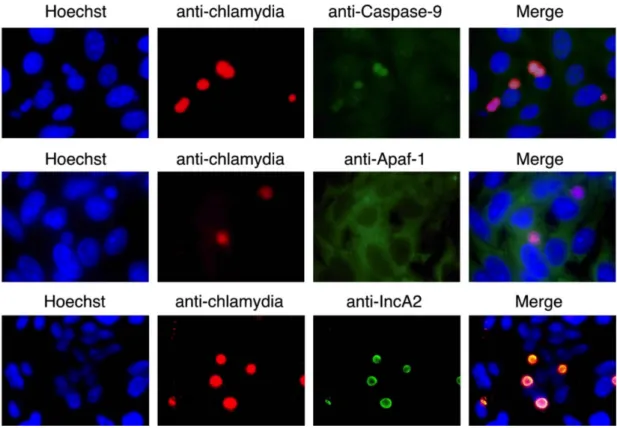
For analysis of the localization of caspase-9, host cells grown on coverglasses

(with or without chlamydial infection) were fixed with 100% methanol and

independently stained with anti-caspase-9 antibodies purchased from Cell Signaling,

(19)

18

Calbiochem and Abcam. To detect chlamydial inclusions, mouse anti-Chlamydia spp.

monoclonal antibody RR402 (Washington Research, Seattle, WA) and

rhodamine-conjugated goat anti-mouse antibody (DAKO) were used. Polyclonal antibody against

IncA2 (inclusion membrane protein A2) of C. pneumoniae J138 was produced using

recombinant IncA2 protein by the same method as described previously (Murata et al.

2007).

2.7

pCMV Vector construction and transfection

pCMV-SPORT6.1 containing the mouse apaf-1 gene was obtained from

Invitrogen (Carlsbad, CA). The pCMV control vector was prepared by removing the

0.9-kb HindIII-HindIII region containing the mouse apaf-1 gene from the

pCMV-SPORT6.1. Transfection was carried out with a Nucleofector (Lonza, Cologne,

Germany) based on the manufacturer’s recommended methods. The infection assays

were carried out when the rates of the transient transfection were above 70%.

2.8

Construction of whole chlamydial genome library

To construct a chlamydial genomic library for Y2H screening, the pGBKT7

vector was linearized by restriction digestion with BamHI Clontech Takara (Mountain

View, CA). Reaction condition for linearization was total volume 25.0 µL with

composition (DNA 5.0 µL, 10 x K buffer 2.5 µL, BamHI 0.5 µL (12 U/µL), H

2

O 17.0

µL) and incubated at 37

℃ over night. All protein coding DNA fragments of

Chlamydia were individually amplified by PCR using modified method (Miura et al.

2008). C. pneumoniae J138 genomic DNA was used as a template. The 1072 sets of

primer sequences designed for construction of whole chlamydial genome library are

shown in Table: 3. The PCR cycles comprised an initial denaturation step at 95°C for

5 minutes, followed by 25 cycles of, 95°C for 30 seconds, 54°C-65°C (according to

primers annealing temperature) for 30 seconds, and 72°C for 30 seconds, and 72°C

for 5 minutes, finally hold on temperature 4°C. Size of some PCR products were

confirmed by electrophoresis.

Yeast cells were transformed using a Lithium acetate method (Fukunaga et al.

2013). Briefly, cells of AH109 were initially grown in YPD liquid medium overnight,

from which 1 mL of the cultures was added with 9 mL of fresh YPD, and incubation

was carried out at 30°C for 5 hours with shaking at 250 rpm. The yeast cells were

then collected by centrifugation at 2000 rpm (1000 xg) for 5 minutes at room

(20)

19

temperature, washed once with 1 mL of sterile Milli Q water, and suspended in

approximately 100 µL of Milli Q water. The cells were next mixed with

transformation solution as follows; 120 µL of 60% Polyethyleneglycol 4000 (Wako

Pure Chemical Industries Ltd. Japan), 10 µL 5 mg/mL carrier DNA (Calf thymus

DNA) , 20 µL 1 M Lithium acetate, 1 µL linearized pGBKT7 vector (50-100 ng) and

5 µL (50-100 ng) of the PCR product. The resulting mixture was incubated at 42°C

for 1 hour. 5 µL from each transformant was spotted on SD medium without Trp

(SD-W) plate and incubated at 30°C for 2 to 3 days. Cloning was confirmed by colony

PCR of nine genes as examples using respective primers shown in (Table: 3) designed

for chlamydial gene cloning. Colony PCR was carried out using yeast colony as

template and same condition for DNA fragments amplification.

2.9

Construction of pGADT7+caspase-9 vector

To construct a bait vector, pGADT7+caspase-9, a human caspase-9 DNA

fragment was amplified by PCR using human aorta cDNA library as a template and

two primers, Caspase-9 for pGADT7_F (BamHI site) and Caspase-9 for pGADT7_B

(BamHI site) (Table: 4). PCR reaction was carried in total volume 40.0 µL with

composition H

2

O 21.8 µL, template DNA 2.0 µL (human PACT2 aorta cDNA library

1/10 dilution), 10X Ex Taq buffer 4.0 µL, dNTP (2.5 mM) mixture 3.2 µL, Ex Taq (5

U/µL) 1.0 µL Clontech Takara (Mountain View, CA), forward primer (Caspase -9 for

pGADT7 primer 10 pmol / µL) 4.0 µL, backward primer (Caspase-9 for pGADT7

primer 10 pmol / µL) 4.0 µL. The PCR cylcles comprised an initial denaturation step

at 95°C for 5 minutes, followed by 25 cycles of, 95°C for 30 seconds, 62°C for 30

seconds, and 72°C for 30 seconds, and 72°C for 5 minutes, finally hold on

temperature 4°C. Amplified PCR product was confirmed by electrophoresis.

pGADT7 vector was linearized by BamHI (Clontech TAKARA) restriction enzyme.

Reaction condition using total volume 25.0 µL with composition (DNA 5.0 µL, 10 x

K buffer 2.5 µL, BamHI (12 U/µL) 0.5 µL, H

2

O 17.0 µL) and incubate at 37°C over

night. Full-length PCR product of Caspase-9 was cloned with linearized pGADT7

vector by infusion cloning method. Infusion cloning was performed using Infusion kit

(TAKARA). Total reaction volume 10 µL (In-fuison HD Enzyme premix 2.0 µL,

vector 2.0 µL, insert 2.0 µL, sterile Milli Q H

2

O 4.0 Μl) incubated at 50 ° C for 15

(21)

20

(competent cell 50.0 µL, DNA 4.0 µL,) was run on 1700 V, incubated at 37°C for 30

minutes, then spread on LB + Amp plate and incubated at 37°C for 12 h.

2.10

Caspase-9 cloning into pGEX(2T-P) vector

The plasmid vector pGEX(2T-P)+caspase-9 was constructed by cloning the

full-length DNA fragment of human caspase-9 into the BamHI and SalI sites of

pGEX(2T-P)SRP1, an improved version of pGEX-2T vector (GE Healthcare Japan)

which was mutated at PstI site of AmpR and introduced SRP1 gene at multiple

cloning site between BamHI and Eco RI (Azuma et al. 1995). The BamHI/SalI

digested PCR product was then cloned into BamHI/SalI digested pGEX(2T-P)SRP1

to generate pGEX(2T-P)Caspase-9. Full length Caspase-9 DNA fragment was

amplified from human aorta cDNA library by PCR. PCR reaction solution was carried

in total volume 40.0 µL with composition H

2

O 21.8 µL, template DNA 2.0 µL (human

PACT 2 aorta cDNA library 1/10 dilution), 10X Ex Taq buffer 4.0 µL, dNTP (2.5

mM) mixture 3.2 µL, Ex Taq (5 U/µL) 1.0 µL Clontech Takara (Mountain View, CA).

Forward primer (hCaspase-9_3 primer 10 pmol / µL 4.0 µL, reverse primer

(hCaspase-9_4 primer 10 pmol / µL) 4.0 µL (Table: 4). The PCR cylcles comprised an

initial denaturation step at 95°C for 5 minutes, followed by 25 cycles of, 95°C for 30

seconds, 60°C for 30 seconds, and 72°C for 30 seconds, and 72°C for 5 minutes,

finally hold on temperature 4°C.

Restriction enzyme treatment was carried out for insert and vector

preparation as described bellow. Insert (Caspase-9) and vector (pGEX(2T-P)SRP1)

were treated with restriction enzymes BamHI. Restriction enzyme reaction: (For

insert) total 25.0 µL (DNA (~30 ng/ µL) 19.0 µL, 10 × K buffer 2.5 µL, BamHI (12

U/ µL) 0.5 µL, H

2

O 3.0 µL), (For vector) total 25.0 µL (DNA (~120 ng/ µL) 5.0 µL,

10 x K buffer 2.5 µL, BamHI (12 U/ µL) 0.5 µL, H

2

O 17.0 µL), was incubated at

37°C over night. Insert (Caspase-9) and vector (pGEX(2T-P)SRP1) after BamHI

treatment were treated with restriction enzymes SalI (Clontech TAKARA).

Restriction enzyme reaction: (For insert) total 25.0 µL (DNA (~30 ng/ µL) 19.0 µL,

10 × H buffer 2.5 µL, SalI (15 U/ µL) 0.5 µL, H

2

O 3.0 µL), (For vector) total 25.0 µL

(DNA (~30 ng/ µL) 19.0 µL, 10 × H buffer 2.5 µL, SalI (15 U/ µL) 0.5 µL, H

2

O 3.0

µL), was incubated at 37°C over night.

Restriction enzyme-treated inserts and vectors were applied to 1% agarose gel

and electrophoresed (total amount 25.0 µL) at 100 V for 30 minutes. After

(22)

21

electrophoresis, the gel was stained with ethidium bromide (EtBr) solution for 15

minutes, and was washed with ultrapure water. Ultraviolet irradiation / photographing

apparatus set TCP 20 LM (Amuzu System Science) was used to cut out the gel out of

the wavelength of 312 nm and collected in a micro tube. DNA purification QIAquick

Gel extraction kit (Qiagen) was used to purify insert caspase-9 and linearized vector.

Ligation was performed using DNA ligation kit (TAKARA). For ligation, vector 2

µL, insert 2 µL and ligation buffer 4 µL were mixed and incubated at 16°C for 1 h.

PGEX(2T-P)+caspase-9 was transformed into E. coli DH5α compatible cell

(TAKARA) and cells were spread on LB + Amp plate and incubated at 37°C for 12 h.

2.11 Chlamydial gene clone into pET-15b vector

For tagging the production of caspase-9 interacting five Chlamydia

pneumoniae proteins with Histidine (6X), the coding DNA fragments were cloned

into pET-15b vector. DNA fragments coding for five chlamydial genes were

amplified form C. pneumoniae J138 genomic DNA by PCR using the corresponding

primers (Cpj0056 for pET-15b_F, Cpj0056 for pET-15b_B; Cpj0444 for pET-15b_F,

Cpj0444 for pET-15b_B; Cpj0512 for pET-15b_F, Cpj0512 for pET-15b_B; Cpj0838

for pET-15b_F, Cpj0838 for pET-15b_B; Cpj0948 for pET-15b_F, and Cpj0948 for

pET-15b_B) (Table: 4) designed for infusion cloning into pET-15b vector. pET-15b

was digested with NdeI (Clontech TAKARA). Reactions in total volume 25.0 µL with

DNA 22.0 µL, 10 x K buffer 2.5 µL and NdeI(10 U/ µL) 0.5 µL were incubated at

37°C over night. Full-length chlamydial five genes and linearized pET-15b vectors

were cloned using infusion cloning method (Clontech Mountain View, CA). Reaction

in total volume 10 µL (In-fuison HD Enzyme premix 2.0 µL, vector (~30 ng/ µL) 2.0

µL, insert (~30 ng/ µL) 2.0 µL, sterile Milli Q H

2

O 4.0 µL) was incubated at 50°C for

15 minutes. After cloning vectors were transformed into E. coli DH5α competent cell

(TAKARA) and cells were spread on LB + Amp plate and incubated at 37°C for 12 h.

Primarily Cpj0444 was not cloned into pET-15b vector. After isolation all four cloned

plasmid vectors were re-transformed into E. coli BL21 (DE3) and confirmed by

colony PCR using same the primers used for infusion cloning.

2.12 Selection of chlamydial factors interacting with caspase-9

Cloned pGADT7+caspase-9 vector was isolated from E. coli DH5α and the

insert was checked by vector and caspase-9 specific restriction enzyme digestion.

(23)

22

After confirmation the DNA sequence, pGADT7+caspase-9 were individually

transformed into the 1033 yeast strains (Fukunaga et al. 2013). Briefly, colonies

grown on SD-W plate were inoculated into 100 µL of SD-W liquid medium and

incubated at 30°C for 16 to 18 hours. A single culture mixture was prepared by

mixing 30 µL over night culture from each 6-8 types of yeast colony containing

pGBKT7+chlamydia genes. Fresh SD-W liquid medium were added to the culture

mixtures (culture 100 µL: SD-W medium 900 µL) and incubated at 30°C for 5 hours.

After incubation, centrifugation was carried out at 1000 xg for 5 minutes at room

temperature. After the supernatant was removed, the pellet was suspended in 100 µL

of sterilized Milli Q water and centrifuged at 2000 rpm for 5 minutes at room

temperature. The supernatant was removed and the pellet was suspended with 11.5 µL

of sterilized Milli Q water and transferred to a 200 µL PCR tube. The transformation

mixture 38.5 µL composed with 30.0 µL of 60% Polyethyleneglycol 4000 (Wako

Pure Chemical Industries Ltd. Japan), 2.5 µL 5mg/mL carrier DNA (Calf thymus

DNA, 5.0 µL 1M Lithium acetate and 1 µL pGADT7+Caspase-9 vector (50-100 ng)

was added per reaction and incubated at 42°C for 1 hour. The culture (5 µL) was

spotted on SD-LW, as control, and on SD-LWAH. The colony show positive

interaction was selected on SD-LWAH.

2.13 Selection of human factors interacting with Chlamydial OMPs

Using gene annotation chlamydial 47 outer membrane protein coding genes

were selected (Table: 7) for screening interaction with human aorta cDNA library.

Human aorta cDNA library were individually transformed into the yeast strains

AH109 containing pGBKT7 vector cloned with chlamydial 47 outer membrane

protein coding genes (Fukunaga et al. 2013). Briefly, 47 chlamydial colonies

containing omp/pmp protein grown on W plate were inoculated into 2 mL of

SD-W liquid medium and incubated at 30°C with shaking at 250 rpm for 16 to 18 hours.

The 200 µL of culture was mixed with 1.8 mL SD-W liquid medium to make 2 mL

and the cell was cultured at 30°C for 5 hours with shaking at 250 rpm. After

incubation, centrifugation was carried out at 1000 xg for 5 minutes at room

temperature. After the supernatant was removed, the pellet was suspended with 200

µL of sterilized Milli Q water and centrifuged at 2000 rpm for 5 minutes at room

temperature. The supernatant was removed and the pellet was suspended with 10.5 µL

of sterilized Milli Q water and transferred to a 200 µL PCR tube. The transformation

(24)

23

mixture composed with 30.0 µL of 60% polyethylene glycol 4000 (Wako Pure

Chemical Industries Ltd. Japan), 2.5 µL 5mg/mL carrier DNA (Calf thymus DNA, 5.0

µL 1M Lithium acetate and 2 µL human pACT2 aorta cDNA library was added per

reaction and incubated at 42°C for 1 hour. All transformed cells were spread on

SD-LWAH or SD-SD-LWAH+x-α-Gal. Blue colonies from SD-SD-LWAH+x-α-Gal and all

colonies from SD-LWAH were selected as positive clones.

2.14 Protein expression and purification

For GST pull-down assay, Escherichia coli BL21(DE3) harboring

pGEX(2T-P) caspase-9, pET-15b Cpj0056, pET-15b Cpj0512, pET-15b Cpj0838 and pET-15b

Cpj0948 were initially grown overnight at 37°C with shaking in LB+Amp medium.

Culture solution was 1/100

th

diluted with fesh liquid LB+Amp medium and cultured

at 37°C at 200 rpm for 3:30 hours. Then IPTG (at final concentration 0.5mM) was

added to the culture and culturing was continued at 37°C at 200 rpm for 3:30 hours

and finally the cell was harvested by centrifugation at 9000 rpm, 4°C for 5 min.

Proteins were purified from the harvested cell. Briefly, for GST-Caspase-9 cells were

lysed using the lysis buffer (1% Triton X-100 and 1× phosphate buffered saline

(PBS), pH7.4 (Sigma/Merch, Darmstadt, Germany)) by ultrasonication on ice and the

supernatant was collected by centrifugation at 7,740 ×g at 4˚C for 15 minutes.

GST-Casp9 was purified using Glutathione Sepharose 4B beads (Amersham/GE Healthcare,

Marlborough, MA). Glutathione sepharose beads bound to GST-caspase-9 were used

to interaction assay with His-tagged chlamydial MnmE protein. GST-caspase-9

proteins were purified from glutathione sepharose beads through competitive elution

with 50 mM reduced glutathione in 1% lysis buffer (1% Triton X-100 and 1×

phosphate buffered saline (PBS), pH7.4 (Sigma/Merch, Darmstadt, Germany)). 10 µL

of 0.2 M GSH was added to the 20 µL glutathione sepharose beads bound to

GST-caspase-9 suspension with 1% Triton X-100 and 1× PBS. To adjust the GSH

concentration 10 µL of 1% lysis buffer (1% Triton X-100 and 1× PBS) was added to

the reaction mixture. The total 40 µL reaction mixture into a 1.5 mL micro centrifuge

tube was rotated at 5-10 rpm at 4°C for 20 minutes with a rotator. The supernatant

(GST-caspase-9) was recovered by centrifugation at 4000 rpm for 5 minutes at 4°C.

Cells with chlamydial proteins were lyses with lysis buffer (50mM NaH

2

PO

4

, 300mM

(25)

24

(Qiagen, Venlo, Netherlands). Purified proteins were boiled at 95°C for 5 min with

3xSDS sample buffer and analyzed by 10% SDS-PAGE and western blotting.

2.15 GST pull-down assay

To clarify whether caspase-9 can bind to the chlamydial outer membrane, a pull-down

experiment was carried out using recombinant caspase-9 and the EBs of C.

pneumoniae J138. GST-Casp9 and purified EBs of C. pneumoniae J138 (Rahman et

al. 2015) were mixed in 1% lysis buffer (1% Triton X-100, 1x PBS, 1mM MgSO

4

,

0.01% BSA) and incubated at 37˚C for 15 min. After incubation centrifugation was

carried out at 15000 rpm at 4°C for 5 min and supernatant was removed. EBs were

washed with wash buffer (1% Triton X-100, 1x PBS, 1mM MgSO

4

, 0.01% BSA)

three times and collected by centrifugation at 4˚C for 5 min at 21,500 ×g. EB

interacted GST-Casp9 was then analyzed by western blotting using anti-pro-caspase-9

mouse monoclonal antibody (Santa Cruz, Dallas, TX), followed by a second detection

using anti-chlamydia Pmp mouse monoclonal antibody (Cp-11, HITACHI, Tokyo,

Japan). In both detections, alkaline phosphatase conjugated anti-mouse IgG goat

polyclonal antibody (Santa Cruz) was used as a secondary antibody and target

proteins were visualized using CDP-star (Roche, Basel, Switzerland).

To confirm the interaction between Cpj0838 and caspase-9, a pull-down

experiment was performed. To conduct GST pull-down experiments, GST-Casp9 and

His-Cpj0838 were mixed in the pull-down buffer (1×PBS, 1 mM DTT, 0.5% triton,

and 10 mM MgSO

4

, pH 7.4) at 25˚C for 10 min, and GST-Casp9 was retrieved with

glutathione beads. The beads were washed three times with the pull-down buffer. The

proteins on the beads were boiled at 95°C for 5 min with 3xSDS sample buffer and

analyzed by 10% SDS-PAGE and western blotting using anti pro-caspase-9 mouse

monoclonal antibody (Santa Cruz) and alkaline phosphatase conjugated anti-6X His

tag antibody monoclonal antibody (Abcam, Cambridge, UK).

2.16 SDS-PAGE and western blotting

Proteins were resolve by SDS-10% PAGE and then transferred onto a 0.45 µm

PVDF blotting membrane (GE Healthcare life science.). Nonspecific binding sites

were blocked with 1xDIG blocking buffer and membrane was then probed with the

alkaline phosphatase conjugated anti-6X His tag antibody monoclonal antibody

(mAb) (Abcam, Cambridge, UK) to detect the chlamydial gene product. The same

(26)

25

blot was used to detect caspase-9 by anti pro-caspase-9 mouse monoclonal antibody

(Santa cruze) and second antibody alkaline phosphatase conjugated anti-mouse goat

polyclonal antibody (Santa cruze). Immunopositive proteins were visualized by

alkaline phosphatase activity using CDP star (Roche) as a substrate.

(27)

26

3.

Results

3.1 Apoptosis regulation by Chlamydia pneumoniae

3.1.1 Apoptosis repression by Chlamydia pneumoniae

We verified the involvement of C. pneumoniae J138 in HEp-2 cell apoptosis.

C. pneumoniae mediated blockage of STS-induced apoptosis was found at 48 hpi and

this blockage ceased by 72 hpi (Fig. 3). Similar responses were observed using HeLa

cells and MEFs (data not shown). In the absence of apoptotic stimuli, apoptotic

induction by C. pneumoniae infection was not observed between 48 and 72 hpi,

which are the middle and late stages of C. pneumoniae infection, respectively (Miura

et al. 2008); chlamydial infection partially stimulated STS-induced apoptosis at 72

hpi. These data, combined with previous results (Rajalingam et al. 2001; Airenne et

al. 2002; Geng et al. 2000; Fischer et al. 2001), indicate that C. pneumoniae infection

at relatively low MOI represses STS-induced apoptosis of various host cell lines in

the early-to-middle stages of infection, but not in the late stage.

3.1.2 Anti-apoptotic environments for chlamydial infection

The anti-apoptotic activity of chlamydial infection seems to be an advantage

for escaping from the host immunosurveillance. It is also possible that this

anti-apoptotic environment is also favorable for chlamydial multiplication. To verify this

possibility, the susceptibility of host cells to chlamydial infection was assessed by

adding anti-apoptotic agents prior to chlamydial infection (Fig.4a). The cell-permeant

irreversible caspase-9 inhibitor (C9-i) decreased the infection rate to nearly half of

control, and cell-permeant Apaf-1 inhibitor (Ap-i) conduced a 1.5 times higher

infection rate, while caspase-8 and -3 inhibitors (C8-i, C3-i, respectively) showed no

modification of infection rates. It has been reported that C. trachomatis and C.

psittaci induce host apoptosis and that chlamydial infection is inhibited by Bcl-2 over

expression (Perfettini et al. 2002). In contrast, no significant difference was observed

in the current study in infection rates or inclusion sizes of C. pneumoniae J138

between the HeLa cells over expressing Bcl-2 and control cells (Fig. 4b).

3.1.3 Chlamydial infection in Apaf-1- and Caspase-9-deficient cells.

To confirm the different contributions of Apaf-1 and caspase-9 in chlamydial

infection, Apaf-1 and caspase-9 knockout (apaf-1

-/-

and caspase-9

-/-

, respectively)

Fig. 1 Developmental cycle of C. pneumonioae   74
Fig. 1 Developmental cycle of C. pneumonioae
Fig.  3  Chlamydophila  pneumoniae  regulates  host  apoptosis  under  apoptotic  stimulation using STS
Fig.  4  Apaf-1  and  caspase-9  inhibitors  show  opposing  contributions  to  C.
+7

参照

関連したドキュメント

To investigate whether defects in the SPATA17 gene are associated with azoospermia due to meiotic arrest, a mutational analysis was conducted, in which the SPATA17 coding regions

Relative expression levels of RaSTM (open) and RaYAB2 (shaded) in phylloclade primordia (PP), shoot apices and bud scales subtending them (S), floral buds (F), scale leaves (L)

Treatment with ONO-1301 increased hepatic HGF mRNA expression, but decreased the expressions of TGF-β1, connective tissue growth factor, α-smooth muscle actin, and type-I and

Transporter adaptor protein PDZK1 regulates several influx transporters (PEPT1 and OCTN2) in small intestine, and their expression on the apical membrane is diminished in pdzk1

東京大学 大学院情報理工学系研究科 数理情報学専攻. [email protected]

情報理工学研究科 情報・通信工学専攻. 2012/7/12

In [1, 2, 17], following the same strategy of [12], the authors showed a direct Carleman estimate for the backward adjoint system of the population model (1.1) and deduced its

理工学部・情報理工学部・生命科学部・薬学部 AO 英語基準入学試験【4 月入学】 国際関係学部・グローバル教養学部・情報理工学部 AO