JAIST Repository
https://dspace.jaist.ac.jp/
Title
Cooperative Strategies for Innovation : Exploring
Untapped Opportunities in Context of India and
Japan in ICT Industry
Author(s)
Momaya, K.; Kuroda, M.
Citation
年次学術大会講演要旨集, 23: 140-145
Issue Date
2008-10-12
Type
Conference Paper
Text version
publisher
URL
http://hdl.handle.net/10119/7522
Rights
本著作物は研究・技術計画学会の許可のもとに掲載す
るものです。This material is posted here with
permission of the Japan Society for Science
Policy and Research Management.
Paper for 研究技術計画学会
第23回年次学術大会、10月12日-13日
Cooperative Strategies for Innovation: Exploring Untapped Opportunities in
Context of India and Japan in ICT Industry
K. Momaya1 and M. Kuroda2
Abstract
Large emerging countries face huge challenges of complex problems related to environment and energy while they explore opportunities of technology, innovation and competitiveness. Recognizing opportunities of learning and innovation through cooperative strategies, an attempt has been made to share findings from our efforts on identifying arena of synergistic inter-country cooperation. The case focusing on identified several segments of potentially high synergy: network services, terminal equipment software and back office. Realizing the opportunities such as innovation network will demand successful execution of bold cooperative strategies.
Keywords: Cooperative strategies, イノベーション, competitiveness, India, Japan, ICT industry,
課題:ホットイシュー:C.イノベーションの国際展開
1. Introduction
Achieving and sustaining competitiveness is a huge challenge for large countries. Japan’s rapid scale-up on competitiveness stages in 1950s and 1960s laid foundations on which leading firms from Japan achieved international attention in the 1980s. Back in the late 1940s, Toyota and other Japanese auto majors realized the potential of innovation: to match the productivity of American auto makers on smaller volume, with less capital, and with fever (but more permanent) workers (Doz and Hamel, 1998). The results are sustained for decades with stream of cooperative innovations under names such as TQC, JIT, TPS, lean. Human capital, technology, innovation and knowledge, with several overlapping elements, are recognized as key ingredients of competitiveness (Sushil and Momaya, 2001; Takeuchi and Nonaka, 2004; Herstatt et al., 2006). India, starting journey at the same time, always had human capital, but seems to have been very slow at leveraging technology and innovation for competitiveness (Momaya, 2001). Despite some remarkable achievements across industries, it still struggles on many basic issues such as education, economic growth with equity, environment (just 3 Es for example).
Cooperation, a fundamental ingredient of development, seems to be relegated to backseat as competitive spirit (e.g. Porter, 1985) swept the world and reached India with liberalization of 1991. Situation is becoming hypercompetitive in many markets as players from across the world jostle for expanding their pie of rapidly growing markets. Interestingly, a counter-current of cooperation also seems to be flowing in many countries. While cooperative arrangements have been there all along, the rapid increase in the number of collaborative agreements at the beginning of the 1980s can be summer up by a single statistic: from the late 1970s to the early 1990s, the number of major alliances formed each year by American, European and Japanese companies was multiplied by a factor of 30 (Dussage and Garrette, 1999). No company can go it alone (Doz and Hamel, 1998). For industry giants and ambitious start-ups alike, strategic partnerships have become central to competitive success in fast-changing global markets. In this connected world, coalitions and alliances are not an option but a necessity—be it Toyota’s network of suppliers or Microsoft’s extended family of independent software developers. Naturally, India seems to have been
1
Associate Professor, Department of Management Studies, IIT Delhi, New Delhi-110016; currently Visiting Associate Professor, Institute of Innovation Research, Hitotsubashi University, Tokyo. Email: [email protected]
2
Medical ICT Institute, New Generation Wireless Communications Research Center, National Institute of Information and Communications Technology, Tokyo. Email: [email protected]
lagging on this systemic innovation. Strategic partnership being initiated by political leadership of India and Japan, may provide impetus to cooperative strategies across levels.
This paper explores a key, less explored issue of cooperative strategies in context of innovation and emerging industries in India and Japan with ideas for leadership. Adapting relevant elements of case study research design (Yin, 2003), questions were evolved. The unit of analysis is industry/segment in the case of ICT. Small contribution of the paper comes in an attempt to apply theory of cooperative strategies to a practical problem of identifying industry/segment of potentially higher synergy. It starts with basic macro questions: How has been competitiveness and innovation performance of India and Japan? Are trends in competitiveness satisfactory? Can the journey to the vision of strategic partnership be travelled without massive scale-up in interactions? Does not that demand breakthrough innovation? What role innovative companies can play? Are there any useful learning from quick review of “World’s 25 Most Innovative Companies”? What are learning from the case of ICT industry?
2. Reality of Competitiveness, Innovation and Cooperation
It seems that large countries face unparallel challenges in achieving and sustaining competitiveness. Irrespective of criticism of competitiveness reports (Cho and Moon, 2005; Shibata, 2006; Momaya, 2008), analysis of data from best available reports do provide some hints. Trends in competitiveness ranks for select countries are given in Table 1. The rank for Japan has been in the range 20 to 30, far below the number 1 rank it achieved from 1989 (the year the IMD ranking started) to 1993. India also seems to be grossly underperforming in competitiveness, far below its potential. Any liberalization should aim at development. Fifteen years past the massive liberalization of 1991, India still seems to be stuck in middle rung (rank in the range 32-42 out of 66 countries). Thus, neither the positions, nor the trends can be considered very satisfactory for both—India as well as Japan. The strategic partnership envisaged by two countries can not be of much relevance, unless both the countries make rapid competitiveness strides. If one considers critical issues such as education, human development or equity (Shibata, 2006), per capita income etc. the pace of enhancing competitiveness for India opens up huge opportunities.
Table 1. Trends in competitiveness of India, Japan and select countries
Sources: National Competitiveness Report (IPS) & World Competitiveness Yearbook (IMD), many years Having got a glimpse of competitiveness reality, let us get feel for situation on innovation front and think about role of companies—the torch-bearers in liberalizing and privatizing world economy-- in addressing the opportunities mentioned above through innovation. Notwithstanding, limitations of surveys in popular media, quick review of the “World’s 25 Most Innovative Companies” survey (Businessweek, 2006) provides some interesting inferences. Design emerged to be a key differentiator; design-focused companies such as BMW, IDEO and P&G improved their ranking. Innovation is becoming ever more broadly defined. Apart from product innovation,
Country
NCR
WCY
2007
2003-04
2002
2001
2000
USA
2
1
1
1
1
Singapore
11
5
5
2
2
Canada
3
3
8
9
8
Australia
13
16
14
11
10
Japan
20
19
30
26
24
Korea
23
25
27
28
28
Malaysia
37
28
26
29
27
China
21
32
31
33
30
India
32
42
40
41
39
66
68
56
56
52
Countries
business model innovators who create new way of doing business, seems to be getting lot of attention. In terms of countries, the firms from USA totally dominate the list (17 as compared to 3 from Japan and EU each). No new firms from Japan entered the list. Japanese firms seems to excel at product innovation (all 3 have it), but seems to be lagging behind in business model innovation (as defined by the designers of the survey). As usual, not a single firm from India made it within top 25. While much deeper analysis is needed to understand real innovation, these weaknesses in innovation, for both India as well as Japan, can be a seed for cooperative strategies between the two countries for innovation.
Quick review of interactions between India and Japan indicates huge untapped potential. Interaction was reviewed on several fronts—people, trade, technology and investments. Focus of discussion here is on trade front. In line with the trends of emerging regional integration in Asia (particularly rapidly evolving East Asia), India’s trade with East Asia (US $ 32 billion) surpassed the same with EU (US $ 28 b) and twice the same with the USA (US $ 16 b) in 2003 (METI, 2005). While the trend is quite encouraging with East Asia, details of India-Japan trade indicate that majority of that has been driven by China and not Japan.
Let us look at the trends more carefully and over longer horizons. Facts indicate that, India’s trade with Japan was paltry US $ 6.5 billion; may be less that 5 % of the same of China in 2005-06. Trend over 2001-02 to 2005-06 indicates that India’s total trade with world is growing at faster pace (at 164.9 %) as compared to the same with Japan (at 78.9 %). If not scaled-up rapidly, India may slip from already low rank in Japan’s trading partners to a totally insignificant. Contents of the trade indicates that most of it is driven by comparative advantage; not a healthy sign when both the countries have huge potential to explore innovation opportunities in emerging knowledge economy. Let us have now a look at one such emerging industry—ICT.
3. Glimpse of Learning from Case of ICT Industry
Considering the remarkable growth of the software industry from India, ICT has been identified as an industry with potential high synergy for India-Japan cooperation. Formation of India-Japan ICT forum is just a small example of efforts. While large number of firms from Japan in India may be in manufacturing (e.g. auto / components), majority of firms from India having presence in Japan are from software industry. Considering that, it was expected that ICT / related products / services will lead the rapid scale-up in business. Surprisingly, the ICT industry does not even figure in Japan’s exports to India. In India’s exports to Japan, software seems to be far behind gems and jewellery, marine products, iron-ore, petroleum products, tea and cut flowers. Hence, ICT was selected as the focus in the project3. After review of several frameworks of competitiveness such as diamond
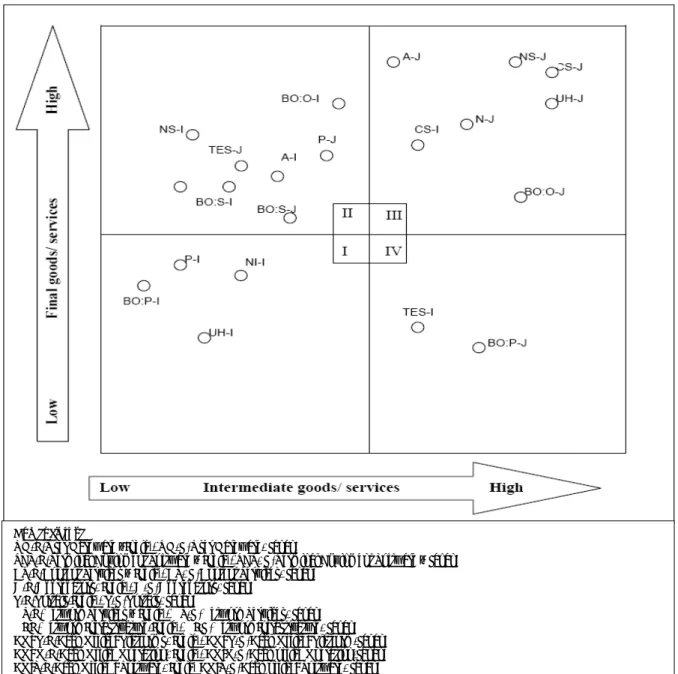
(Porter, 1990) and Assets-Processes-Performance (APP, Momaya, 1998), consensus emerged to adapt a simple portfolio approach that leverages concepts such as trade specialization index that is quite popular in Japan (e.g. in METI, Shibata, 2006) and understood easily by many. The eight-layer framework of ICT was adapted from digital media industry (Nagumo, 2000) as segments of ICT industry. Each segment (e.g. Terminal Equipment Software such as browser, Java) for India and Japan was positioned separately depending on competitiveness (on relative spectrum of low to high) in the portfolio that has intermediate goods/services on X-axis and Final goods/services on Y-axis (Figure 1). Initial positions were obtained through review of factual data about leading players (including global, Indian and Japanese) on each layer. Subsequently, consensus position was obtained after two rounds of Delphi type interactions with four professionals with knowledge about the ICT industry. As per theory and expert inputs, positions in diametrically opposing quadrants for two countries indicates less competitive situation and hence higher possibility of cooperation. Overall, in most segments the positions are complementing with higher potential (due to bigger gap, Figure 1) in segments such as network services (NS), terminal equipment software (TES), user hardware (UH) and back office (BO).
3 The Project “Role of India-Japan Cooperation in Information and Communications Technology for Competitiveness”
from the Ministry of Internal Affairs, Japan was undertaken by team at the Strategy and Competitiveness Lab, Department of Management Studies, IIT Delhi.
Source: Developed based on concept evolved in discussions with Japanese experts
Figure 1 Relative Competitiveness Positions of India and Japan on Segments of ICT
While the positions on the model hint at high potential synergy, concrete cooperative strategies need to be evolved and speedily implemented to leverage the synergy. While the governments (when in strong positions and right mood) can facilitate the cooperation, but real cooperation has to be driven by companies and industrial houses for win-win business benefits to both sides. From alternative type of cooperation such as vertical partnerships, cross-industry agreements, complementary alliances (Dussage and Garrette, 1999), the most relevant need to be evolved with passion for success. Root causes of slow scale-up in India-Japan cooperation were also identified across key stakeholder groups for action agenda. Weaknesses in leadership and teamwork emerged to be a root cause across levels in case of India.
Looking forward to future areas of strategies in industry and research, the industry faces several big challenges. What we have learned from ICT industry, especially from communication world, is that the industry does not create very limited new services for people. Their basic idea is how to increase network transaction.
Nomenclature
UH-I (User Hardware –India), UH-J (User Hardware- Japan)
TES-I (Terminal Equipment Software – India), TES- J (Terminal Equipment Software – Japan) CS-I (Content Services – India), CS- J (Content Services- Japan)
A-I (Aggregators- India), A-J (Aggregators- Japan) P-I (Portals-India), P-J (Portals- Japan)
NS-I (Network Services – India), NS-J (Network Services- Japan) NI-I (Network Infrastructure-India), NI-J (Network Infrastructure- Japan) BO: P-I (Back Office: Platforms- India), BO: P-J (Back Office: Platform-Japan) BO: O-I (Back Office Operation- India), BO:O-J (Back office Operation-Japan) BO:S-I (Back Office : Software- India) BO:S-J (Back office: Software- Japan)
Sometimes, they provide attractive visual contents for users to increase network access. Information industry is little better. By having new service systems, users can feel efficiency not to spend extra time, such as automatic washing and drying machines. But still these industries do not look at the prosperity of ordinary citizens. ICT itself is not a service, but an infrastructure and provides baseline for various services, such as healthcare and medical services. So, it may be better to find collaboration between two countries to look as services, such as healthcare ICT, medical ICT, environmental ICT, where there is high synergy between the two countries.
4. Concluding Remarks
While this exploratory paper has given only a glimpse taking a case, there seems to be lot of potential to research cooperative strategies across levels to innovatively address complex problems such as slow economic development, environmental degradation, energy & food shortages and divides (from economic to digital). In ICT, excessive focus on the West may be a key reason for most cooperative strategies in both the countries concentrated towards partners in the West. Recent developments indicate that West alone may be able to sustain innovation engine and large countries such as Japan and India should contribute more in innovative way to enhance ICTs role in sustainable world as discussed in future opportunities above. There is high potential strategy in many segments identified in the project. If leadership can evolve aspiring vision, platform innovations can also be experimented by orchestrating innovation networks (e.g. Dhanaraj and Parkhe, 2006) for not only convergent ICT, but also for benefit of ubiquitous society in the world. Moving toward a more advanced knowledge economy (Shibata, 2006), Japan has climbed stages of competitiveness with many achievements (e.g. speed, growth with equity, flexibility). Improving knowledge-creation mechanism are likely to address problems such as “ two Japans”, slow innovation, weaknesses in science-based industries. Innovation challenges for development of India are much bigger and cooperative strategies focusing on learning can help. In emerging trend of open innovation, innovation from India that spread fast at the base of the pyramid can complement the high-tech/end/cost innovations that Japan excels at.
Acknowledgments
First author would like to acknowledge the cooperation from many colleagues at the Department of Management Studies (DMS) and IIT Delhi for facilitating creation of environment for research. Financial support from the Ministry of Internal Affairs, Japan for the cooperative project is acknowledged. First author thanks Institute of Innovation Research, Hitotsubashi University for its support of innovation / related project. We are grateful to Ms. Anuprita Singh and late Pravat Nayak for research assistance and experts in industry and academia for feedback.
References
Businessweek, The World’s 25 Most Innovative Companies, (2006).
D. Cho and H. Moon, National Competitiveness: Implications for Different Groups and Strategies, International Journal of Global Business and Competitiveness, 1 (1): 1-11 (2005).
C. Dhanaraj and A. Parkhe, Orchestrating Innovation Networks, Academy of Management Review,31 (3), 659-669 (2006).
Y. Doz and G. Hamel, Alliance advantage: the art of creating value through partnering, Harvard Business School Press, Boston (1998). P. Dussauge and B. Garrette, Cooperative strategy: competing successfully through strategic alliances, Wiley, Chichester (1999). IMD, World Competitiveness Yearbook, International Institute for Management Development, Lausanne, various years.
IPS, IPS National Competitiveness Research 2005 Report. The Institute for Industrial Policy Studies (IPS) and The Institute for Policy & Strategy on National Competitiveness (IPS-NaC), Seoul, various years.
K. Momaya, Evaluating International Competitiveness at the Industry Level, Vikalpa-The Journal for Decision Makers, IIM Ahmedabad, April-June, Vol. 23, No. 2, 39-46 (1998).
K. Momaya, Evaluating Country Competitiveness in Emerging Industries: Learning From a Case of Nanotechnology, Journal of International Business and Economy, 9 (1), 37-58 (2008).
T. Nagumo, The Future of the Interactive Digital Media Industry, NRI Papers, No. 12, 2000. M. Porter, Competitive Advantage of Nations, Simon & Schuster (1990).
T. Shibata (ed.), Japan: Moving Towards a More Advanced Knowledge Economy-Assessment and Lessons, Volume 1, The World Bank, 2006. H. Takeuchi and I. Nonaka (eds.), Hitotsubashi on Knowledge Management, John Wiley & Sons, Singapore.