FROM CONVEX POLYTOPES TO MULTI-POLYTOPES
Osaka
City University Mikiya Masuda (枡田幹也)1. INTRODUCTION
We introduce the notion of multi-polytopes generalizing that of
convex
polytopes, andreport that Ehrhart polynomials and Khovanskii-Pukhlikov
on
latticeconvex
polytopes(i.e.,
convex
polytopes with vertices in the lattice) can be extended to latticemulti-polytopes. This is ajoint work with A. Hattori and the detailed argument and
a
connec-tion with geometry
can
be found in [7].Let
us
briefly explain the idea ofmulti-polytopes. Itcomes
from geometry. Accordingto the theory of toric varieties,
a
latticeconvex
polytope $P$ corresponds toan
ample linebundle $L$ over a compact non-singular toric variety $M$. In fact, $P$ is the image of $M$ by
the moment map associated with $L$. This suggests
us
to view theconvex
polytope $P$as
being formed from two combinatorial data corresponding to $M$ and $L$. We shall explain
them for
a convex
polygon (i.e., two-dimensionalconvex
polytope) $P$ shown in Figure1(1). We take an (outward) normal vector to each side and form four two-dimensional
cones, each of which isspanned by two normal vectors whose corresponding sides intersect
at a vertex of $P$. Then we obtain a complete fan shown in Figure 1(2). This complete
fan is the combinatorial datum corresponding to the base space $M$ in the theory oftoric
varieties. The other datum is
an
arrangement oflines obtained by extending the sides of$P$,
see
Figure 1(3). This arrangement is the information brought by the line bundle $L$.Note that the arrangement is related to the fan. Namely the lines in the arrangement
are
perpendicular to the edge vectors in the fan.
$(|)$
’ $(s_{b})$
$\mathrm{E}^{1}\mathrm{I}\mathrm{G}\mathrm{U}\mathrm{R}\mathrm{E}1$
The observation above
can
be applied to $n$-dimensionalconvex
polytopes. In thiscase,the associated fan is
an
$n$-dimensional
completefan andthearrangement consists ofaffinehyperplanes in an $n$-dimensional vector space which
are
perpendicular to edge vectors inthe fan.
Now, let
us
take the followingstar shaped figure $Q$ and make thesame
observationas
FROM CONVEX POLYTOPES TO MULTI-POLYTOPES
FIGURE 2
Then
we
obtain five two-dimensional cones, each of which is spanned by two normalvectors whose corresponding sides intersect at
a
vertex. A notable fact is that thecones
have overlap and the degree of overlap is uniformly two. This is
an
example of almostwhat
we
calla
complete multi-fan. The multi-polytope associated with $Q$ isa
pair of thecomplete multi-fan and the arrangement oflines obtained by extending the five sides of
$Q$. In general,
a
multi-polytope is defined to bea
pair ofa
complete multi-fan andan
arrangement ofaffine hyperplanes perpendicular to edge vectors in the multi-fan.
This article is organized
as
follows. In section 2we
givea
precise definitionof multi-fanand multi-polytope. We also define the notion of completeness, simpliciality and
non-singularity of
a
multi-fan. The definition of simpliciality and non-singularity isstraight-forward but the definition ofcompleteness is somewhat complicated and essential in
our
argument. In section 3
we
associate witha
simple multi-polytopean
interger valuedlo-cally constant function (called the Dusitermaat-Heckman function) on the complenent of
the hyperplane arrangement. When the multi-polytope arises from
a
convex
polytope $P$,the function takes 1
on
the interior of$P$ and $0$ on the otherregions divided by thehyper-plane arrangement. The generalization of Ehrhartpolynomials andKhovanskii-Pukhlikov
formula is discussed in sections 4 and 5 respectively.
2. MULTI-FANS AND MULTI-POLYTOPES
In this section,
we
definea
multi-fan which isa
complete generalization ofa
fanand introduce the notion ofmulti-polytopes. We also define the completeness and
non-singularity of
a
multi-fan generalizing the corresponding notion ofa
fan. We shall beginwith reviewing the definition of
a
fan.Let $N$ be
a
lattice of rank $n$, which is isomorphic to $\mathbb{Z}^{n}$. We denote the real vector space $N\otimes \mathbb{R}$ by $N_{\mathbb{R}}$. A subset $\sigma$ of$N_{\mathbb{R}}$ is calleda
stronglyconvex
rational polyhedralcone
(with apex at the origin) if there exits
a
finite number of vectors $v_{1},$$\ldots,$$v_{m}$ in $N$ suchthat
$\sigma=$
{
$r_{1}v_{1}+\cdots+r_{m}v_{m}|r_{i}\in \mathbb{R}$and $r_{i}\geq 0$ for all $i$}
and $\sigma\cap(-\sigma)=\{0\}$. Here “rational”
means
that it is generated by vectors in the lattice$N$, and “strong” convexity that it contains
no
line through the origin. We will often calla
stronglyconvex
rational polyhedralcone
in $N_{\mathbb{R}}$ simplya cone
in $N$. The dimension$\dim\sigma$ of
a
cone
a is the dimension of the linear space spanned by vectors in$\sigma$. A subset $\tau$ of a is called
a
face
of $\sigma$ if there isa
linear function $\ell:N_{\mathbb{R}}arrow \mathbb{R}$ such that $p$ takesFROM CONVEX POLYTOPES TO MULTI-POLYTOPES
nonnegative values
on
a and $\tau--\ell^{-1}(0)\cap\sigma$. Acone
is regardedas a
face of itself, whileothers
are
calledproper faces. Definition. A fan $\triangle$ in $N$ is a setof
a
finite number of stronglyconvex
rationalpolyhe-dral
cones
in $N_{\mathbb{R}}$ such that(1) Each face of
a
cone
in $\triangle$ is alsoa
cone
in $\triangle$;
(2) The intersection oftwo
cones
in $\Delta$ isa
face ofeach, (sothat different
cones
do notoverlap).
Definition. A fan $\triangle$
is said to be complete if the union of
cones
in $\triangle \mathrm{c}\mathrm{o}$,
vers
$\mathrm{t}\mathrm{h}\mathrm{e}arrow$ entirespace $N_{\mathbb{R}}$.
A
cone
is called simplicial,or a
simplex, if it is generated by linearly independentvectors. Ifthe generating vectors
can
be takenas a
$.\mathrm{p}$art ofa
$\mathrm{b}.$asi.s
o..f
$N,$th.en
thecon..e
is called non-singular.Definition. A fan $\triangle$ is said to be simplicial
(resp. non-singular) ifevery
cone
in $\Delta$ issimplicial (resp. non-singular).
The
fundamental
fact in the theory of toric varieties says that there isa
$\mathrm{o}\mathrm{n}\mathrm{e}- \mathrm{t}_{0}$-one
correspondence between $n$-dimensional toric varieties and $n$-dimensional fans, and
a
fanis complete (resp. simplicial
or
non-singular) if and only if the correspondingtoric.
varietyis compact (resp.
an
orbifoldor
non-singular).Foreach$\tau\in\triangle$,
we
define $N^{\tau}$ to be the quotientlattice of$N$ bythe sublattice generated
(as
a
group) by$\tau\cap N$;so
the rankof$N^{\tau}$ is$n-\dim\tau$. Weconsidercones
in $\triangle$ thatcontain
$\tau$as a
face, and project themon
$(N^{\mathcal{T}})_{\mathbb{R}}$. These projectedcones
forma
fan in $N^{\tau}$, whichwe
denote by $\triangle_{\tau}$ and call the projectedfan
with respect to $\tau$. The dimensions of theprojected
cones
decrease by $\dim\tau$. The completeness, $\mathrm{s}\mathrm{i}\mathrm{m}_{\mathrm{P}^{1}}\mathrm{i}\mathrm{c}\mathrm{i}\mathrm{a}\mathrm{l}\mathrm{i}\mathrm{t}\mathrm{y}$. $\mathrm{a}.\mathrm{n}$ . $\mathrm{d}.\mathrm{n}$on-sing $\mathrm{t}$
ular..ity
of$\triangle$ willbe inherited to $\triangle_{\tau}$ for any
$\tau$.
We
now
generalize these notions ofa
fan. Let $N$ beas
before. Denote by $C(N)$ theset of all
cones
in $N$. An ordinary fan isa
subset of $C(N)$. The set $C(N)$ hasa
(strict)partial $\mathrm{o}\mathrm{r}\mathrm{d}\mathrm{e}\mathrm{r}\mathrm{i}\mathrm{n}\mathrm{g}\prec \mathrm{d}\mathrm{e}\mathrm{f}\mathrm{i}\mathrm{n}\mathrm{e}\mathrm{d}$ by: $\tau\prec\sigma$ if and only if$\tau$ is
a
proper face of$\sigma$. Thecone
$\{0\}$consisting of the origin is the unique minimum element in $C(N)$. On the other hand, let
$\Sigma$ be
a
partially ordered finite set witha
unique minimum element. We denote by the
(strict) partial ordering by $<$ and the minimum element by $*$. An example of $\Sigma$ used
later is
an
abstract simplicial set withan
empty set addedas a
member, whichwe
callan
augmented simplicial set. In thiscase
the partial ordering is defined by the inclusionrelation and the empty set is the unique minimum element which may be considered
as
a
$(-1)$-simplex. Suppose that there is a map$\Lambda:\Sigmaarrow C(N)$ such that
(1) $\Lambda(*)=\{0\}$;
(2) If $I<J$ for $I,$ $J\in\Sigma$, then $\Lambda(I)\prec\Lambda(J)$;
(3) For any $I,$ $J\in\Sigma$ and $\kappa\in C(N)$ such that $I<J$ and $\Lambda(I)\prec\kappa\prec\Lambda(J)$, there is
a
unique element $K\in\Sigma$ such that
$I<K<J$
and $\Lambda(K)=\kappa$.For
an
integer $m$ such that $0\leq m\leq n$,we
setFROM CONVEX POLYTOPES TO MULTI-POLYTOPES
One
can
easilycheck that $\Sigma^{(m)}$ does not dependon
A. When $\Sigma$ isan
augmented simplicialset, $I\in\Sigma$ belongs to $\Sigma^{(m)}$ if and only if the cardinality $|I|$ of $I$ is $m$, namely $I$ is
an
$(m-1)$-simplex. Therefore,
even
if $\Sigma$ is notan
augmented simplicial set,we
use
thenotation $|I|$ for $m$ when $I\in\Sigma^{(m)}$.
The image $\Lambda(\Sigma)$ is
a
finite set ofcones
in $N$. We may think ofa
pair $(\Sigma, \Lambda)$as a
set ofcones
in $N$ labeled by the ordered set $\Sigma$. Cones inan
ordinary fan intersect only at theirfaces, but
cones
in $\Lambda(\Sigma)$ may overlap,even
thesame cone
may appear repeatedly withdifferent labels. The pair $(\Sigma, \Lambda)$ is almost what
we
calla
multi-fan, butwe
incorporatea pair of weight functions on
cones
in $\Lambda(\Sigma)$ of the highest dimension $n=\mathrm{r}\mathrm{a}\mathrm{n}\mathrm{k}N$. Moreprecisely, we consider two functions
$w^{\pm}:$ $\Sigma^{(n)}arrow \mathbb{Z}_{\geq 0}$.
These two functions naturallyarise from geometry, and their
sum
corresponds to $\mathrm{E}\mathrm{u}\mathrm{l}\mathrm{e}\mathrm{r}\backslash$number while their difference is related to Todd genus (see [10]).
Definition. We call a triple $\triangle:=(\Sigma, \Lambda, w^{\pm})$
a
multi-fan
in $N$. We define the dimensionof$\triangle$ to be the rank of $N$ (or the dimension of$N_{\mathbb{R}}$).
Since
an
ordinary fan $\triangle$ in $N$ isa
subset of $C(N)$,one
can view itas
a multi-fan bytaking $\Sigma=\triangle,$ $\Lambda=\mathrm{t}\mathrm{h}\mathrm{e}$ inclusion map, $w^{+}=1$, and $w^{-}=0$. In
a
similar wayas
in thecase
of ordinary fans,we
say thata
multi-fan $\triangle=(\Sigma, \Lambda, w^{\pm})$ is simplicial (resp.non-singular) ifevery
cone
in $\Lambda(\Sigma)$ is simplicial (resp. non-singular). The following lemma iseasy.
Lemma 2.1. A
multi-fan
$\triangle=(\Sigma, \Lambda, w^{\pm})$ is simplicialif
and onlyif
$\Sigma$ is isomorphic toan $au.,gm_{\mathrm{I}}e$nted
si.m
p..l.ic.
$ial$
: set as
$p.artia\iota l\backslash \backslash \cdot y$
o.rdered
sets.$\mathrm{r}$ Thedefinition ofcompletenessof
a
multi-fan$\triangle$israther complicated. Anaivedefinition
of the completeness would be that the union of
cones
in $\Lambda(\Sigma)$covers
the entire space$N_{\mathbb{R}}$. But this is not
a
right definition. Although the two weighted functions$w^{\pm}$ are
incorporated in the definition of
a
multi-fan, only the difference$w:=w^{+}-w^{-}$
matters in this article. We shall introduce the following intermediate notion of
pre-completeness at first.
Definition. We call a multi-fan $\triangle=(\Sigma, \Lambda, w^{\pm})$ pre-complete if the integer
$v \in\Lambda\sum_{(I)}w\{I)$
is independent ofthe coice of
a
generic element$v$ in $N$. Here the sum above is understoodto be
zero
if there isno
such$I$, and “generic”means
that$v$doesnot lieon
alinear subspacespanned by
a cone
in $\Lambda(\Sigma)$ ofdimension less than $n$. We callthe integer above the degreeof$\triangle$ and denote it by $\deg(\triangle)$.
Remark. For
an
ordinary fan, pre-completeness issame as
completeness.To define the completeness for a multi-fan $\triangle$,
we
need to definea
projected multi-fanwith respect to
an
element in $\Sigma$. We do itas
follows. For each $K\in\Sigma$, we setFROM CONVEX POLYTOPES TO MULTI-POLYTOPES
It inherits the partial ordering from $\Sigma$, and $K$ is the unique minimum element in $\Sigma_{K}$. A
map
$\Lambda_{K}$: $\Sigma_{K}arrow C(N^{\Lambda(K)})$
sending $J\in\Sigma_{K}$ to the
cone
$\Lambda(J)$ projectedon
$(N^{\Lambda(K)})_{\mathbb{R}}$ satisfies the three propertiesabove required for A. We define two functions
$w_{K^{\pm}}:$ $\Sigma_{K^{-|K|)}}^{(n}\subset\Sigma^{(n)}arrow \mathbb{Z}_{\geq 0}$
to be the restrictions of $w^{\pm}$ to $\Sigma^{(n}K-|K|$). A triple $\triangle_{K}:=(\Sigma_{K}, \Lambda_{K}, W_{K^{\pm}})$ is
a
multi-fan in$N^{\Lambda(K)}$, and this is the desired projected
multi-fan
with respect to $K\in\Sigma$. When $\triangle$ isan
ordinary fan, this definition agrees with the previous
one.
Definition. A pre-complete multi-fan $\triangle=(\Sigma, \Lambda, w^{\pm})$ is said to be complete if the
pro-jected multi-fan $\triangle_{K}$ is pre-complete for any $K\in\Sigma$.
Example 2.2. Here is an example of
a
complete non-singular multi-fan of degree two.Let $v_{1},$$\ldots,$$v_{5}$ be integral vectors shown in the following figure, where the dots denote
la..ttice
points.$q\}_{\Omega}$ $?)_{A}$
$\mathrm{u}_{5}$ $\mathrm{u}_{\mathrm{d}}$
FIGURE 3
The vectors
are
rotating around the origin twice in counterclockwise. We take$\Sigma=\{\phi, \{1\}, \ldots, \{5\}, \{1,2\}, \{2,3\}, \{3,4\}, \{4,5\}, \{5,1\}\}$, define $\Lambda:\Sigmaarrow C(N)$ by
$\Lambda(\{i\})=$ the
cone
spanned by $v_{i}$,$\Lambda(\{i, i+1\})=$ the
cone
spanned by $v_{i}$ and $v_{i+1}$,where $i=1,$$\ldots$ ,5 and 6 is understood to be 1, and take
$w^{\pm}$ such that $w=1$ on every
two dimensional
cone.
$\mathrm{T}\mathrm{h}\mathrm{e}\mathrm{n}_{1},\triangle=(\Sigma, \Lambda, w^{\pm})$ isa
comp.l.ete
non-singul.ar
two-dimensionalmulti-fan with $\deg(\triangle)=2$.
Examp.le
2.3. Here is an example of a complete multi-fan “with folds”. Let $v_{1},$ $\ldots,$$v_{5}$be vectors shown in $\mathrm{t}\dot{\mathrm{h}}\mathrm{e}\mathrm{f}\mathrm{o}\mathrm{l}\dot{\mathrm{l}}\mathrm{o}\mathrm{W}\mathrm{i}\mathrm{n}\mathrm{g}$ figure.
We define $\Sigma$ and A
as
in Example 2.2 and take $w^{\pm}$ such that$w(\{3,4\})=-1$ and $w(\{i, i+1\})=1$ for $i\neq 3$.
FROM CONVEX POLYTOPES TO MULTI-POLYTOPES
$\nwarrow \mathrm{r}$
.
$\bigvee_{3}$
FIGURE 4
A similar example
can
be constructed fora
number of vectors $v_{1},$ $\ldots,$$v_{d}(d\geq 2)$ bydefining
$w(\{i, i+1\})=1$ if$v_{i}$ and $v_{i+1}$
are
rotating in counterclockwise,$w(\{i, i+1\})=-1$ if$v_{i}$ and $v_{i+1}$
are
rotating in clockwise,where $d+1$ is understood to be 1. The degree $\deg(\triangle)$ is the rotation number of the
vectors $v_{1},$$\ldots$ ,$v_{d}$ around the origin in counterclockwise and may not be
one.
Example 2.4. Here is
an
exampleofa
multi-fanwhich is pre-complete but not complete.Let $v_{1},$
$\ldots,$$v_{5}$ be vectors shown in the followingfigure.
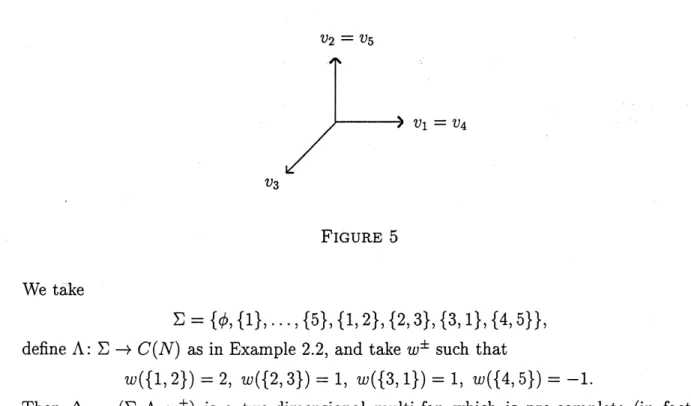
$v_{2}=v_{5}$
FIGURE 5
We take
$\Sigma=\{\phi, \{1\}, \ldots, \{5\}, \{1,2\}, \{2,3\}, \{3,1\}, \{4,5\}\}$, define $\Lambda:\Sigmaarrow C(N)$
as
in Example 2.2, and take $w^{\pm}$ such that$w(\{1,2\})=2,$ $w(\{2,3\})=1,$ $w(\{3,1\})=1,$ $w(\{4,5\})=-1$.
Then $\triangle=(\Sigma, \Lambda, w^{\pm})$ is a two-dimensional multi-fan which is pre-complete (in fact,
$\deg(\triangle)=1)$ but not complete because the projected multi-fan $\triangle\{i\}$ for $i\neq 3$ is not
pre-complete.
So far,
we
treated rationalcones
thatare
generated by $\backslash ’\cdot \mathrm{e}\mathrm{c}\mathrm{t}\mathrm{o}\mathrm{r}\mathrm{S}$ in the lattice $N$. But,most of the notions introduced above make
sense even
ifwe
allowcones
generated byFROM CONVEX POLYTOPES TO MULTI-POLYTOPES
lattice $N$, but others do not. Therefore,
one can
definea
multi-fan and its completenessand simpliciality in this extended category
as
well. Int.he
followingwe
will denote $N_{\mathbb{R}}$by $V$.
As explained in the introduction,
a convex
polytopeor
the star shaped figure producesa
complete multi-fan andan
arrangement of hyperplanes perpendicular to edge vectorsin the multi-fan. Taking this observation into account,
we reverse a
gear. We start witha
complete multi-fan $\triangle=(\Sigma, \Lambda, w^{\pm})$. It is convenient to think of the hyperplanesas
sitting in the dual space $V^{*}$ of$V$. Let HP$(V^{*})$ be the set of all affine hyperplanes in $V^{*}$.
Definition. Let $\triangle=(\Sigma, \Lambda, w^{\pm})$ be
a
complete multi-fan and let $F:\Sigma^{(1)}arrow \mathrm{H}\mathrm{P}(V^{*})$ bea
map such that the affine hyperplane $F(J)$ is ‘perpendicular’ to the half line $\Lambda(J)$ foreach $J\in\Sigma^{(1)}$, i.e.,
an
element in $\Lambda(J)$ takesa
constanton
$F(J)$. We calla
pair $(\triangle, \mathcal{F})$a
multi-polytope and denote it by $P$. The dimension ofa
multi-polytope $P$ is defined tobe the dimension of the multi-fan $\triangle$. We say that
a
multi-polytope$P$ is simple if $\triangle$ is
simplicial. When $P$ is simple, $\bigcap_{i\in I}\mathcal{F}(\{i\})$ for $I\in\Sigma^{(n)}$ is called
a
vertex of$P$, and if allvertices of$P$
are
lattice points, thenwe
say that $P$ isa
simple lattice multi-polytope.Remark. There are two notions similar to that of multi-polytopes, which
were
introducedbyKarshon-Tolman [8] andKhovanskii-Pukhlikov [9] when $\triangle$ is
an
ordinaryfan. They
use
the terminology twisted polytope and virtual polytope respectively. The notion of
multi-polytopes is
a
direct generalization of that oftwisted polytopes, and also generalizesthatof virtual polytopes,
see
[11].3.
$\mathrm{D}\mathrm{u}\mathrm{I}\mathrm{s}\mathrm{T}\mathrm{E}\mathrm{R}\mathrm{M}\mathrm{A}\mathrm{A}\mathrm{T}$-HECKMANFUNCTIONS
A multi-polytope $P=(\triangle, F)$ defines
an
arrangement of affine hyperplanes in $V^{*}$. Inthis section,
we
associate with $P$ a functionon
$V^{*}$ minus the affine hyperplanes when $P$is simple. This function is locally constant and Guillemin-Lerman-Sternbergformula ([5]
[6]$)$ tells
us
that it agrees with the density function ofa
Duistermaat-Heckmanmeasure
when $P$ arises from
a
moment map.Hereafter our multi-polytope $P$ is assumed to be simple,
so
that the multi-fan $\triangle=$$(\Sigma, \Lambda, w^{\pm})$ is complete and simplicial unless otherwise stated. We may
assume
that $\Sigma$consists of subsetsof$\{1, \ldots, d\}$ and $\Sigma^{(1)}=\{\{1\}, \ldots, \{d\}\}$. Denote by$v_{i}$
a
nonzero
vectorin the one-dimensional cone $\Lambda(\{i\})$. To simplify notation,
we
denote $F(\{i\})$ by $F_{i}$ andset
$F_{I}:= \bigcap_{i\in I}F_{i}$ for $I\in\Sigma$.
$F_{I}$ is
an
affine space of dimension $n-|I|$. In particular, if $|I|--n$ (i.e., $I\in\Sigma^{(n)}$), then $F_{I}$ is a point, denoted by $u_{I}$.Suppose $I\in\Sigma^{(n)}$. Then the set $\{v_{i}|i\in I\}$ forms a basis of $V$. Denote its dual basis
of $V^{*}$ by $\{u_{i}^{I}|i\in I\}$, i.e., $\langle u_{i}^{I}, v_{j}\rangle=\delta_{ij}$ where $\delta_{ij}$ denotes the Kronecker delta. Take a
generic vector $v\in V$ such that $\langle u_{i}^{I}, v\rangle\neq 0$ for all $I\in\Sigma^{(n)}$ and $i\in I$, and set
$(-1)^{I}:=(-1)\#\{i\in I|\langle u^{I},vi\rangle>0\}$ and $(u_{i}^{I})^{+}:=\{$
$u_{i}^{I}$ if $\langle u_{i}^{I}, v\rangle>0$ $-u_{i}^{I}$ if $\langle u_{i}^{I}, v\rangle<0$.
We denote by $\Lambda(I)^{+}$ the
cone
in $V^{*}$ spanned by $(u_{i}^{I})^{+}’ \mathrm{S}(i\in I)$ with apex at $u_{I}$, and byFROM CONVEX POLYTOPES TO MULTI-POLYTOPES
Definition. We define
a
function $\mathrm{D}\mathrm{H}_{P}$on
$V^{*} \backslash \bigcup_{i=1i}^{d}F$ by $\mathrm{D}\mathrm{H}_{\mathrm{p}}:=\sum_{I\in\Sigma^{(}n)}(-1)^{I}w(I).\phi I$a‘n
$\mathrm{d}$ call it th\’eDuistermaat-Heckman
$\dot{f}uncti\mathit{0}\acute{n}\mathrm{a}\mathrm{s}\mathrm{S}\mathrm{O}\mathrm{C}\mathrm{i}\mathrm{a}\mathrm{t}\dot{\mathrm{e}}\mathrm{d}\mathrm{w}\mathrm{i}:\mathrm{t}\mathrm{h}P$.
Apparently, the function $\sum_{I\in\Sigma^{(n)}}(-1)^{I}W(I)\phi I$ is defined
on
the whole space $V^{*}$ anddepends
on
the choice of the generic vector $v\in V$, but it turns out that it restrictedto $V\backslash \cup F_{i}$ is independent of $v$. This is the
reason
whywe
restricted the domain of thefunction to $V\backslash \cup F_{i}$.
On
can
also prove that the support of the function $\mathrm{D}\mathrm{H}_{P}$ is bounded.Remark. There is
a
$\mathrm{c}.$om.pl.etJely.
different way todefin.e
the$\mathrm{D}\mathrm{u}\mathrm{i}_{\mathrm{S}\mathrm{t}\mathrm{a}\mathrm{a}\mathrm{t}}\mathrm{e}\mathrm{r}\mathrm{m}-\mathrm{H}\mathrm{e}\mathrm{c}\mathrm{k}\mathrm{m}\mathrm{a}\mathrm{n}$
.
func-tion,
see
[7].Example 3.1. When $P$ is
a
multi-polytope associated with the following rectangle $P$and the vector $v$ is taken
as
is shown,$\nearrow \mathrm{t}I$
$\mathrm{P}$
FIGURE
6
the
Duistermaat-Heckman
function $\mathrm{D}\mathrm{H}_{P}$ is thesum
(or difference) of the following char-acteristic functions of the four shaded domains:.$\cdot$
..
$\wedge\backslash$
FIGURE 7
Therefore, $\mathrm{D}\mathrm{H}_{P}$ takes 1
on
the interior of $P$ and $0$on
the other regions divided by thearrangement of$P$. This is the
case
for any (simple)convex
polytope $P$.4. $\mathrm{p}_{\mathrm{I}\mathrm{C}\mathrm{K}}$’
FORMULA AND EHRHART POLYNOMIALS
In this section
we
explain how to define the number of lattice points in a latticemulti-polytope and state
a
generaliztion ofa
Ehrhart’s theoremon
latticeconvex
polytopes tolattice simple multi-polytopes.
Let $P$ be
a
convex
lattice polytope of dimension$n$ in $V^{*}$, where “lattice polytope”
means
that each vertex of$P$ lies in the lattice $N^{*}=\mathrm{H}\mathrm{o}\mathrm{m}(N, \mathbb{Z})$ of$V^{*}--\mathrm{H}_{0}\mathrm{m}(V, \mathbb{R})$. WeFROM CONVEX POLYTOPES TO MULTI-POLYTOPES
$P)$. The following formula called Pick’s formula asserts that when $\dim P--2$, the
area
Area$(P)$ of$P$ can be found by counting lattice points in $P$ and in the boundary $\partial P$ of
$P$.
Theorem 4.1 (Pick’s formula). (see [4]
or
[12] for example.)If
$P$ is a lattice (convex)polygon, then
Area$(P)= \beta(P^{\mathrm{o}})+\frac{1}{2}\#(\partial P)-1$.
Example 4.2. In the following lattice polygon Area$(P)=17/2,$$\#(P)=13$ and $\#(\partial P)=$
$7$.
FIGURE
8
Remark. (1) The convexity of $P$ is unnecessary in Pick’s formula
as
isseen
in thefollowing
non-convex
polygon:FIGURE
9
(2) There
are
many generalizations of Pick’s formula. For instance, it is generalizedin [10] to any piecewise linear closed
curve
with vertices in the lattice which mayhave self-intersections such
as
the star shaped figure in the introduction. In thiscase,
we
have to define the terms Area$(P),$$\#(P^{\mathrm{O}})$ and $\#(\partial P)$ inan
appropriate way.An interesting fact is that the constant term, that $\mathrm{i},\mathrm{s}1$ in Pick’s formula, is not
necessarily 1 any more.
Pick’s formula
can
be rewrittenas
FROM CONVEX POLYTOPES TO MULTI-POLYTOPES
because $\#(P^{\mathrm{o}})=\#(P)-\#(\partial P)$.
For
a
positive integer l ノ, let $\nu P:=\{\iota \text{ノ}u|u\in P\}$. It is againa
convex
lattice polytopein $V^{*}$. Since Area$(\nu P)=\mathrm{A}\mathrm{r}\mathrm{e}\mathrm{a}(P)_{\mathcal{U}^{2}}$ and $\#(\partial(\mathcal{U}P))=\#(\partial P)\iota \text{ノ}$, the above two identities
imply
(1) $\#(\nu P^{\mathrm{o}})$ and $\#(\nu P)$
are
both polynomials in $\nu$ of degree 2,(2) $\#(\nu P^{\mathrm{o}})=(-1)^{n}\#(-l\text{ノ}P)$, where $\#(-\mathcal{U}P)$ denotes the polynomial $\#(\nu P)$ with $\nu$
re-placed $\mathrm{b}\mathrm{y}-\mathcal{U}$.
(3) The coefficient of $\nu^{2}$ in
$\#(\nu P)$ is Area$(P)$ and the constant term in $\#(\nu P)$ is 1.
Ehrhart shows that these statements holdforhigherdimensional
convex
lattice polytopes.The lattice $N^{*}$ determines
a
volume elementon
$V^{*}$ by requiring that the volume of theunit cube determined by
a
basis of$N^{*}$ is 1. Thus the volume of$P$, denoted by $\mathrm{v}\mathrm{o}\mathrm{l}(P)$, isdefined.
Theorem 4.3 (Ehrhart). (See [4], [12] for example.) Let $P$ be an $n$-dimensional
convex
lattice polytope.
(1) $\#(\nu P)$ and $\#(I^{\text{ノ}}P\mathrm{O})$ are polynomials in $\nu$
of
degree $n$.(2) $\#(\nu P^{\mathrm{o}})=(-1)^{n}\#(-I\text{ノ}P)$, where $\#(-l\text{ノ}P)$ denotes the polynomial $\#(\nu P)$ with $\nu$
re-placed by-v.
(3) The
coefficient
of
$\nu^{n}$ in $\#(\nu P)$ is $\mathrm{v}\mathrm{o}\mathrm{l}(P)$ and the constant term in $\#(\nu P)$ is 1.The polynomial$\#(\nu P)$ in$\nu$ is called the Ehrhart polynomial of$P$. The fan
$\triangle$ associated
with $P$maynot be simplicial, but if
we
subdivide $\triangle$, then wecan
always takea
simplicialfanthat is compatible with $P$. We claim that the theorem above
can
beextendedto simplelattice multi-polytopes$P=(\triangle, \mathcal{F})$. For that, we need to define $\#(P)$ and $\#(P^{\circ})$. This is
done
as
follows. Let $v_{i}(i=1, \ldots, d)$ bea
primitive integral vector in the half line$\Lambda(\{i\})$.In
our
convention, $v_{i}$ is chosen “outwardnormal” to the face$\mathcal{F}(\{i\})$ when$P$ arises froma
convex
polytope. We slightlymove
$\mathcal{F}(\{i\})$ in the direction of$v_{i}$ (resp. $-v_{i}$) for each $i$,so
that
we
obtain a map $\mathcal{F}_{+}$ (resp. $F_{-}$) : $\Sigma^{(1)}arrow \mathrm{H}\mathrm{P}(V^{*})$. We denote the multi-polytopes$(\triangle, F_{+})$ and $(\triangle, F_{-})$ by $P_{+}$ and $P$-respectively. Since the affine hyperplanes $\mathcal{F}_{\pm}(\{i\})’ \mathrm{s}$
miss the lattice $N^{*}$, the functions $\mathrm{D}\mathrm{H}_{p_{\pm}}$
are
defined on $N^{*}$.Definition. We define
$\#(P):=\sum_{u\in N^{*}}\mathrm{D}\mathrm{H}P+(u)$, $\#(^{\mathrm{p}^{\circ}}):=\sum_{u\in N}\mathrm{D}*\mathrm{H}P-(u)$.
When $P$ arises from
a
convex
polytope $P,$ $\mathrm{D}\mathrm{H}_{p_{+}}$ (resp. $\mathrm{D}\mathrm{H}_{P-}$) takes 1on
$u\in N^{*}$ in$P$ (resp. in the interior of$P$) and $0$ otherwise. Therefore, $\#(P)$ (resp. $\#(\mathrm{p}^{0})$) agrees with
the number of latice points in $P$ (resp. in the interior of$P$) in this
case.
Denote the volume element
on
$V^{*}$ by $dV^{*}$, and define the volume vol(P) of$P$ by$\mathrm{v}\mathrm{o}\mathrm{l}(P):=\int_{V^{*}}\mathrm{D}\mathrm{H}_{P}dV^{*}$.
Needless to say, when $P$ arises from a
convex
polytope $P,$ $\mathrm{v}\mathrm{o}\mathrm{l}(P)$ agrees with the actualvolume of$P$, but otherwise it
can
bezero or
negative.For
a
(not necessarily positive) integer $\nu$,we
denote $(\triangle, \nu F)$ by $\nu P$, where$(l^{\text{ノ}}\mathcal{F})(\{i\}):=\{u\in V^{*}|\langle u, v_{i}\rangle=\nu ci\}$
FROM CONVEX POLYTOPES TO MULTI-POLYTOPES
Theorem 4.4. Let $P=(\triangle, \mathcal{F})$ be a simple lattice multi-polytope
of
dimension $n$.(1) $\#(\nu P)$ and $\#(\nu \mathrm{p}\circ)$
are
polynomials in $\nu$of
degree (at most) $n$.(2) $\#(\nu P^{\mathrm{O}})=(-1)^{n}\#(-UP)$
for
any integer$\nu$.(3) The
coefficient of
$v^{n}$ in $\#(\nu P)$ is $\mathrm{v}\mathrm{o}\mathrm{l}(\mathrm{p})$ and the constant term in$\#(\nu P)$ is$\deg(\triangle)$.(See Section 2
for
$\deg(\triangle).$)Let
us
statea
key identity used to prove the theorem above. For $I\in\Sigma^{(n)}$,we
define$G_{I}$ to be the projection image of
{(
$.a_{1}.’$ .$.$ ‘ ,$a_{d}) \in \mathbb{R}^{d}|\sum_{i=1}^{d}a_{i}vi\in N$ and $a_{j}=0$ for$j\not\in I$
}
on
$\mathbb{R}^{d}/\mathbb{Z}^{d}$. Since vectors $v_{i}’ \mathrm{s}$ for $i\in I$are
linearly independent and belong to $N,$ $G_{I}$ is afinite subgroup of$\mathbb{R}^{d}/\mathbb{Z}^{d}$. It is trivial if the set ofthe vectors $v_{i}$ for $i\in I$ is
a
basis of thelattice $N$, in particular, all $G_{I}$ for $I\in\Sigma^{(n)}$
are
trivial if$\triangle$ is non-singular.On the other hand, for $i=1,$$\ldots$,$d$,
we
define$\rho_{i}$:
$\mathbb{R}^{d}/\mathbb{Z}^{d}arrow \mathbb{C}^{*}$
tobe the homomorphisminducedfrom
a
homomorphism: $\mathbb{R}^{d}arrow \mathbb{C}^{*}$ mapping$(a_{1}, \ldots, a_{d})arrow$$\exp(2\pi\sqrt{-1}a_{i})$.
Let $N_{\Delta}^{*}$ be the lattice of$N_{\mathbb{R}}^{*}$ generated by all $u_{i}^{I}’ \mathrm{s}$ for $I\in\Sigma^{(n)}$ and $i\in I$ (see Section
3
for $u_{i}^{I}’ \mathrm{s}$). If $\triangle$ is non-singular, then$N_{\Delta}^{*}=N^{*}$. The group ring $\mathbb{C}[N_{\Delta}^{*}]$ is
a
commutative$\mathbb{C}$-algebra, and it has
a
basis $t^{u}(u\in N_{\triangle}^{*})$as a
complex vector space with multiplicationdetermined by the addition in $N_{\Delta}^{*}:$
$t^{u}\cdot t^{u’}:=t^{u+u’}$
The followingis the key identity used in the proofofTheorem 4.4.
Lemma 4.5. Let the notation be as above. Then
$\sum_{I\in\Sigma^{()}n}\frac{w(I)t^{u_{I}}}{|G_{I}|}\mathit{9}\in\sum G_{t}\frac{1}{\prod_{i\in I}(1-\rho i(g)t-u^{I})i}=u\in\sum N^{*}\mathrm{D}\mathrm{H}\mathrm{p}+(u)t^{u}$
as elements in the quotient ring
of
$\mathbb{C}[N_{\triangle}^{*}]$. In particular,if
themulti-fan
$\triangle$ is
non-singular, then $N_{\Delta}^{*}=N^{*}$ and
$\sum_{I\in\Sigma^{(n)}}\frac{w(I)t^{u_{I}}}{\prod_{i\in I}(1-t^{-}u_{t}^{I})}=\sum_{u\in N^{*}}\mathrm{D}\mathrm{H}P+(u)t^{u}$.
5. COHOMOLOGICAL FORMULA FOR $\#(P)$
In the theory oftoric varieties,
a
fan corresponds toa
toric variety anda
latticeconvex
polytope corresponds to
an
ample line bundleover
a toric variety. Therefore,one can
view the cohomology of a toric variety as that of the corresponding fan and the first
Chern class ofan ample line bundle
as
that of the corresponding latticeconvex
polytope.This viewpoint leads
us
todefine the “(equivariant) cohomology” ofa complete simplicialmulti-fan and the “(equivariant) first Chern class” of a multi-polytope. We then define
an
index map “in cohomology” and establisha
“cohomological formula” describing $\#(P)$FROM CONVEX POLYTOPES TO MULTI-POLYTOPES
that the Khovanskii-Pukhlikov formula for a simple lattice
convex
polytope ([2] [3])can
be generalized to
a
simple lattice multi-polytope.Let$T$ be
a
compacttoralgroup of dimension$n=\mathrm{r}\mathrm{a}\mathrm{n}\mathrm{k}_{\mathbb{Z}}N$and let $BT$be the classifyingspace of$T$. Then $H_{2}(BT)$ is canonically isomorphicto$\mathrm{H}\mathrm{o}\mathrm{m}(S^{1}, \tau)$ the
group
consistingofhomomorphismsfrom $S^{1}$ to$T$. In fact,
a
homomorphism$f:S^{1}arrow T$inducesa
continuousmap $Bf:BS^{1}arrow BT$and
once
we
fixa
generator $\alpha$ of$H_{2}(BS^{1})\cong \mathbb{Z},$ $(Bf)_{*}\alpha$ definesan
element of $H_{2}(BT)$. The correspondence : $farrow(Bf)_{*}\alpha$ is known to be
an
isomorphismfrom $\mathrm{H}\mathrm{o}\mathrm{m}(S^{1}, \tau)$ to $H_{2}(BT)$. In the following
we
assume
$N=H_{2}(BT)$ and identify itwith $\mathrm{H}\mathrm{o}\mathrm{m}(S^{1}, \tau)$. Then $N^{*}=H^{2}(BT)$ is identified with $\mathrm{H}\mathrm{o}\mathrm{m}(T, S^{1})$ and the group ring
$\mathbb{C}[N^{*}]$
can
be identified with the representation ring of$T$.Let $\triangle=(\Sigma, \Lambda, w^{\pm})$ be
a
complete simplicial multi-fan in $N$. Let $v_{i}\in H_{2}(BT)$ bea
unique primitive vector in $\Lambda(\{i\})$ for each $i=1,$$.*\cdot,$
$d$
as
before. Motivated by thedescription of the equivariant cohomology of
a
compact non-singular toric variety (see[10]$)$,
we
define $H_{T}^{*}(\triangle)$ to be the face ring ofthe augmented simplicial set $\Sigma$, i.e.,$H_{T}^{*}(\triangle):=\mathbb{Z}[X_{1}, \ldots, x_{d}]/(x_{I}|I\not\in\Sigma)$,
where$x_{I}= \prod_{i\in I}x_{i}$ and the degree of$x_{i}$is two, and call$H_{T}^{*}(\triangle)$the equivariant cohomology
of$\triangle$
.
We also definea
homomorphism $\pi^{*}:$ $H^{2}(BT)arrow H_{T}^{2}(\triangle)$ by$\pi^{*}(u)=\sum_{i=1}^{d}\langle u, vi\rangle x_{i}$,
where $\langle, \rangle$ denotes the natural pairing between cohomology and homology. It extends
to
an
algebra homomorphism $H^{*}(BT)arrow H_{T}^{*}(\triangle)$, which we also denote by $\pi^{*}$. Onecan
think of$H_{T}^{*}(\triangle)$
as a
module (ormore
generallyan
algebra)over
$H^{*}(BT)$ through $\pi^{*}$.For $I\in\Sigma^{(n)}$, let $\{u_{i}^{I}|i\in I\}$ be the dual basis of $\{v_{i}|i\in I\}$
as
before. We definea
ring homomorphism$\iota_{I}^{*}:$ $H_{T}^{*}(\Delta)\otimes \mathbb{Q}arrow H^{*}(BT;\mathbb{Q})$ by
$\iota_{I}^{*}(x_{i}):=\{$
$u_{i}^{I}$ if $i\in I$,
$0$ otherwise.
This mapis well-defined because $x_{J}$ for $J\not\in\Sigma$, which is
zero
in $H_{T}^{*}(\triangle)\otimes \mathbb{Q}$, maps tozero
through $\iota_{I}^{*}$. One checks that $\iota_{I}^{*}$ is
an
$H^{*}(BT;\mathbb{Q})$-module map.A multi-polytope $P=(\triangle, \mathcal{F})$ is associated with real numbers $c_{i}’ \mathrm{s}$ by
$\mathcal{F}(\{i\})=\{u\in H^{2}(B\tau_{;}\mathbb{R})|\langle u, v_{i}\rangle=C_{i}\}$,
and these numbers determine
an
element $c_{1}^{T}( \mathcal{P}):=\sum_{i=1}^{d}CiX_{i}$ of $H_{T}^{2}(\triangle)\otimes \mathbb{R}$, which wecall the equivariant
first
Chern class ofP.
Thisgivesa
bijective correspondence betweenthe set ofmulti-polytopesdefined
on
$\triangle$ and $H_{T}^{2}(\triangle)\otimes \mathbb{R}$. Note that $\iota_{I}^{*}(c_{1}^{T}(P))$ agreeswiththe vertex $\bigcap_{i\in I}\mathcal{F}(\{i\})$. If $P$ is
a
lattice multi-polytope, then $c_{i}’ \mathrm{s}$are
integers and the $u_{I}$in Corollary 4.5
agrees
with $\iota_{I}^{*}(c_{1}^{T}(P))$.Let $S$be the multiplicative set consisting of
nonzero
homogeneous elements of positivedegree in $H^{*}(BT;\mathbb{Q})$. Since $H^{*}(BT;\mathbb{Q})$ is
a
polynomial ring (hencean
integral domain),$H^{*}(BT;\mathbb{Q})$ can be thought of$\mathrm{a}.\mathrm{s}$ a subring of the localized ring
$S^{-1}H^{*}(BT;\mathbb{Q})$. We define
the index map
FROM CONVEX POLYTOPES TO MULTI-POLYTOPES
“in cohomology” by
$\pi_{!}(x):=\sum_{I\in\Sigma(n)}\frac{w(I)\iota_{I}^{*}(_{X)}}{|G_{I}|\prod_{iI}\in u_{i}^{I}}$
(cf. [1, (3.8)]). This map decreases degrees by $2n$ and is
an
$H^{*}(BT;\mathbb{Q})$-module map. Itturns out that the image of$\pi_{!}$ lies in $H^{*}(BT;\mathbb{Q})$.
Now, motivated by the description of the cohomology ring of
a
compact non-singulartoric variety (see p.106 in [4]),
we
define $H^{*}(\triangle)$ to be the quotient ring of$H_{T}^{*}(\triangle)$ by theideal generated by $\pi^{*}(H^{2}(B\tau))$, in other words,
$H^{*}(\triangle):--\mathbb{Z}[X_{1}, \ldots, x_{d}]/\mathfrak{U}$,
where $\mathfrak{U}$ is the ideal generated by all
(1) $x_{I}$ for $I\not\in\Sigma$,
(2) $\sum_{i=1}^{d}\langle u, vi\rangle X_{i}$ for $u\in N$.
Since $\pi_{!}$ is
an
$H^{*}(BT;\mathbb{Q})$-module map and $H^{*}(BT;\mathbb{Q})/(H^{2}(BT;\mathbb{Q}))$ is isomorphic to$H^{0}(BT;\mathbb{Q})=\mathbb{Q},$ $\pi_{!}$ induces
a
homomorphism$\int_{\triangle}$: $H^{*}(\triangle)\otimes \mathbb{Q}arrow \mathbb{Q}$,
where only elements of degree $2n$ in $H^{*}(\triangle)\otimes \mathbb{Q}$ survive through the map $\int_{\triangle}$.
Remember that $G_{I}$ is
a
finite subgroup of$\mathbb{R}^{d}/\mathbb{Z}^{d}$. We denote by $G_{\triangle}$ the union of $G_{I}$over all $I\in\Sigma^{(n)}$. Since
$\rho_{i}$ is defined
on
$\mathbb{R}^{d}/\mathbb{Z}^{d},$ $\rho_{i}(g)$ makes sense for $g\in G_{\triangle}$. It followsfrom the definition of$G_{I}$ and
$\rho_{i}$ that if$g\in G_{I}$, then $\rho_{i}(g)=1$ for $i\not\in I$.
We define the Todd class $\mathcal{T}(\triangle)$ of the complete simplicial multi-fan $\triangle$ by
$\mathcal{T}(\triangle):=\sum_{g\in G_{\Delta}}\prod_{i=1}\frac{\overline{x}_{i}}{1-\rho_{i}(g)e^{-\overline{x}}i}d\in H^{**}(\triangle)\otimes \mathbb{Q}$,
where $\overline{x}_{i}$ denotes the image of $x_{i}\in H_{T}^{*}(\triangle)$ in $H^{*}(\triangle)$. We also
define.
thefirst
Chernclass $c_{1}(\mathcal{P})$ ofa multi-polytope $P$ defined on $\triangle$ to be the image of $c_{1}^{T}(\mathrm{p})\in H_{T}^{2}(\triangle)\otimes \mathbb{R}$
in $H^{2}(\triangle)\otimes \mathbb{R}$.
Theorem 5.1.
If
$P$ is a simple lattice multi-polytope, then $\int_{\triangle}e^{c_{1}(\mathrm{p})}\mathcal{T}(\triangle)=\#(P)$.As an application of the theorem above,
we
shall show that Khovanskii-Pukhlikovformula, whichrelates
a
certain variationofthe volumeofasimpleconvex
lattice polytopeto the number of lattice points in it,
can
be generalized to simple multi-polytopes. Webegin with
Lemma 5.2. $\mathrm{v}\mathrm{o}\mathrm{l}(\mathrm{p})=\frac{1}{n!}\int_{\triangle}c_{1}(P)^{n}=\int_{\triangle}e^{c_{1}()}P$
for
a simple multi-polytope $P$.Multi-polytopes defined on $\triangle$ form
a
vector space isomorphic to $H_{T}^{2}(\triangle)\otimes \mathbb{R}$ andLemma5.2 implies that the volume function isa homogeneous polynomialfunction of
de-gree$n$. In fact, if
one
writes $c_{1}^{T}( \mathrm{p})=\sum_{i=1}^{d}c_{i}x_{i}$, then$\mathrm{v}\mathrm{o}\mathrm{l}(\mathrm{p})$. is
a
homogeneous polynomialin $c_{1},$
FROM CONVEX POLYTOPES TO MULTI-POLYTOPES
For $h=(h_{1}, \ldots, h_{d})\in \mathbb{R}^{d}$, we denote by $P_{h}$ a multi-polytope with $c_{1}^{T}(P_{h})= \sum_{i=1}^{d}(c_{i}+$ $h_{i})x_{i}$.
Since
$c_{1}(P_{h})= \sum_{i=1}^{d}(c_{i}+h_{i})\overline{x}_{i}$, Lemma5.2
applied to $P_{h}$ implies that $\mathrm{v}\mathrm{o}\mathrm{l}(P_{h})$ isa
polynomial in $h_{1},$$\ldots,$$h_{d}$ (oftotal degree $n$). We define the Todd operator
as
follows:$\mathcal{T}(\partial/\partial h):=\sum_{g\in c\Delta}\prod_{i=1}\frac{\partial/\partial h_{i}}{1-\rho_{i}(g)e^{-}\partial/\partial h_{i}}d$.
Although the Todd operatorisof infiniteorder, its operation
on
$\mathrm{v}\mathrm{o}\mathrm{l}(P_{h})$converges because $\mathrm{v}\mathrm{o}\mathrm{l}(P_{h})$ isa
polynomial in $h_{1},$$\ldots,$$h_{d}$. The following theorem extends the
Khovanskii-Pukhlikov formula ([9] [2] [3]) to simple lattice multi-polytopes.
Theorem 5.3.
If
$P$ is a simple lattice multi-polytope, then$\mathcal{T}(\partial/\partial h)_{\mathrm{V}}\mathrm{o}1(P_{h})|h=^{0}\#=(\mathrm{p})$.
Proof.
An elementary computation shows that$\frac{\partial/\partial h_{i}}{1-p_{i}(g)e^{-}\partial/\partial h_{i}}e^{(C_{i+}}|_{h=0}hi)\overline{x}iei=ci\overline{x}i_{\frac{\overline{x}_{i}}{1-\rho_{i}(g)e^{-\overline{x}}i}}$.
Therefore, it follows from Lemma
5.2
and Theorem 5.1 that$\tau(\partial/\partial h)_{\mathrm{V}}\mathrm{o}1(\mathcal{P}h)|h=^{0\mathcal{T}(\partial/}=\partial h)\int_{\Delta}e^{c1(\mathrm{p}_{h})}|h=0$
$= \sum_{\mathit{9}\in c_{\Delta}}\prod^{d}i=1\frac{\partial/\partial h_{i}}{1-\rho_{i}(g)e^{-}\partial/\partial h_{i}}\int\Delta)e(c_{i}+h_{i}\overline{x}_{i}|_{h=}i0$
$= \int_{\Delta}\sum_{g\in G\Delta}\prod_{=i1}de^{c_{i}\overline{x}_{i}}\frac{\overline{x}_{i}}{1-\rho_{i}(g)e^{-\overline{x}}i}$
$= \int_{\Delta}e^{c_{1}}\mathcal{T}(\mathrm{p})(\Delta)=\#(P)$,
proving the theorem. $\square$
Remark.
One can
reformulate the Khovanskii-Pukhlikov formulaas
follows. As remarkedabove, the volume function $\mathrm{v}\mathrm{o}\mathrm{l}$ is
a
polynomial in$c_{1},$
$\ldots,$$c_{d}$,
so one can
apply the Toddoperator $\mathcal{T}(\partial/\partial c)$ (with the variables $c=(c_{1},$
$\ldots,$$c_{d})$ instead of $h=(h_{1},$ $\ldots,$$h_{d})$) to
the volume function $\mathrm{v}\mathrm{o}\mathrm{l}$ and evaluate at
a
simple lattice multi-polytope P. Thesame
argument
as
in the proofofTheorem 5.3shows that the evaluatedvalue agreeswith$\#(P)$.REFERENCES
[1] M. Atiyah and R. Bott, The moment map and equivariant cohomology, Topology 23 (1984), 1-28.
[2] M. Brion and M. Vergne, Lattice points in simple polytopes, J. Amer.Math.Soc. 10(1997),371-392.
[3] M. Brion and M. Vergne, An equivariant Riemann-Roch theorem
for
complete, simplicial toric varieties, J. reine angew. Math. 482 (1997), 67-92.[4] W. Fhlton, Introduction to Toric Varieties, Ann.of Math. Studies, vol. 131, Princeton Univ., 1993.
[5] V. Guillemin, E. Lerman and S. Sternberg, On the Konstant multiplicity formula, J. Geom. Phys.
5 (1988), 721-750.
[6] V. Guillemin, E. Lerman and S. Sternberg, Symplectic
fibrations
and multiplicity diagrams,Cam-bridge Univ. Press, Cambridge, 1966.
FROM CONVEX POLYTOPES TO MULTI-POLYTOPES
[8] Y. Karshon andS. Tolman, The momentmap and line bundles overpresymplectic toric manifolds,
J. Diff. Geom. 38 (1993), 465-484.
[9] A.G. KhovanskiiandA.V. Pukhlikov,A Riemann-Roch theorem
for
integrals andsumsof
quasipoly-nomials over virtual polytopes, St. Petersburg Math. J. 4 (1993), 789-812.
[10] M. Masuda, Unitary toric manifolds,
multi-fans
and equivariant index, Tohoku Math. J. 51 (1999),237-265.
[11] Y. Nishimura, Multi-polytopes and convex chains, in preparation. [12] T. Oda, Convex Bodies and Algebraic Geometry, Springer-Verlag, 1988.
[13] R. Stanley, Combinatorics and Commutative Algebra (second edition), Progress in Math. 41,
Birkh\"auser, 1996.