国 際 論 集
第 19 号
社会科学系論文 「人文学の危機」の時代と日常からの文化研究: インターアジアな文脈での教育事例からの考察 ……… 濱 野 健 ……… 15北九州市立大学 国際教育交流センター
A Pedagogical Challenge in Inter-Asia Context
Abstract
Through a reflection on the teaching of Cultural Studies in Asia, this paper discusses how the teaching of cultures, particularly everyday cultures, is a unique opportunity to improve students’ skills in unlearning our social world. Similar to Western institutions, Asian universities, including those in Japan, face a crisis in the humanities as they deal with the rapid (and even unpredictable) transformation of society in the age of globalization. Meanwhile, while tertiary education has played an increasingly prominent role in the career prospects of younger generations, educational institutions are still far from reinventing themselves and offering programs that address the growing complexity of our world from alternative perspectives by facing the increasing anxiety not only among young people, but also among university students and policy makers. Although instructors must understand and respond to the immediate demand of students to acquire practical skills to deal with the complexities of the world, they are also responsible for teaching them how to deal with wordily issues inclusively rather than use their knowledge exclusively and then reduce their alternatives and possibilities for a better future. Given that liberal arts education in the humanities can be essentially regarded as an art of experience and recognition of the reality of our world with its diversity and differences, the teaching of the humanities can be considered the most precious opportunity for students to realize their own contingent status quo, which would result in the development of their resilience and inclusion in life. Cultural Studies is indeed the latest discipline in the long history of the humanities. Its peculiar methods and theories on critical matters have been surprisingly elaborated over the past decades in response to voices that have been calling for the deconstruction and reconstruction of our social world since the last century. In seeking to understand this immediate progress of Cultural Studies and its growth through disciplinary differentiation as a response of the humanities to our society, this paper debates how teaching Cultural Studies can enable students to obtain specific knowledge and resilience skills to recreate their future by increasing their sense of inclusion and openness beyond borders and territories.
Hamano, Takeshi
(School of Human Relations, Department of Humanities)
Keyword
1. INTRODUCTION
1-a. Crisis of Humanities in Tertiary Education
In April 2019, Amanda Ruggeri, a journalist at BBC.com posted an article about global trends in tertiary education.3 Until recently, tertiary education was seen as a gateway to a
better career relatively open to everyone, regardless of his/her social circumstances. Tertiary education involved a large part of liberal arts education, which aimed at broadening one’s life course through social upward mobility with knowledge derived from humanities and social sciences playing a substantial role. Today, the situation has seemingly changed. Flexibility and unpredictability of job market in “liquid modernity”4 make university students anxious
about their careers, pushing them to seek more practical and useful tertiary education courses. Skyrocketing university tuition fee is a common burden for students in many countries, which also makes them avoid taking a risk with their tertiary education and instead go for a college degree guaranteeing a job. Not only does this so-called “plug-and-play”5 approach to higher
education has affected reconstruction of organization and curriculum of universities as Ruggeri argues, but it also has altered expectations of students (and their parents, perhaps) from university education. In view of the social changes brought by advanced technologies (and their amalgamation), some specific majors, such as IT, engineering, law, commerce or finance, and language studies have become more appealing to the students. Universities today must deal with increasing demand of tertiary education. The issue is more extreme in Asia, where people are experiencing the fastest and most dynamic process of social shift and innovation, involving a drastic transformation of self-recognition as well.6 7Yet, if globalization has brought us to the
deepest and most complex structure of the world as never seen before, how can we face and have a dialogue with it, irrespective of an engineering reduction of the nature of contemporary society we live?
Indeed, it is considerable to say that there are arguments about the significance of liberal arts education in order for students to realize civil society, democracy, and other “practical skills” to deal with diversity, flexibility, and fluidity of contemporary society.8 The question,
here, is what is the role of humanities (or liberal arts) in tertiary education in our global world, and what knowledge and methods can be articulated to understand this complicated and extended social world in the light of critical manners. Alternatively, how can we account and respond to the students through humanity education?
university. In the last decades, cultural studies has been widely and controversially viewed as one of the most critical approaches in humanities, along with an elaboration of its research agenda, theoretical premises, and pedagogical explorations. As Stuart Hall remarked, it should be remembered that cultural studies was genealogically explored and elaborated as an alternative program within the crisis of humanities in tertiary education in the UK.9 Today, as
Graeme Turner suggests, cultural studies has been renowned as an “interdisciplinary lingua franca” by its own inclusive research agenda and theoretical premises.10 Among numerous
associations and societies in cultural studies, there are inter-regional societies such as Inter-Asia cultural studies Society (since 2004), which has made a great contribution in promoting and developing critical dialogues beyond different backgrounds and stories. Institutionalized at the department or faculty level or managed by individual scholars by their own efforts, cultural studies have now become an integral part of critical studies in humanities and beyond. 11
Gilbert B. Rodman identifies cultural studies with the following four accounts: 1) theories to explain the complexities of culture and society with an emphasis on its political economy, 2) multi-angle research methods in the production of new bodies of knowledge to trace the complexity, 3) pedagogic challenge to carry out public articulation to the accumulated knowledge in an effort to educate and inform a wider society, and 4) making changes to public policy, opinion, and alternative life to promote equality and social justice.12 Among those four
agendas, what I would like to emphasize here is the pedagogical challenge in cultural studies (and subsequent actions taken up by students). While, conventional debates on cultural studies frequently highlight its theoretical elaborations and socially engaged attitude, pedagogical side of this interdisciplinary study should not be dismissed. In fact, pedagogical aspect of cultural studies can play a pivotal role to mediate between theory/method and practice/action in a project.13 Yet, Rodman argues that pedagogical engagement in cultural studies has been often
neglected. Criticizing this trend, he says:
People writing about the history of cultural studies, for example, frequently overlook the project’s early beginnings in workers’ education programs in the United Kingdom, concentrating instead on the early publications of Richard Hoggart and Raymond Williams as the primary foundation on which cultural studies was built (…). However, pedagogy remains a marginal—rather than a central—part of the dominant conversations that cultural studies practitioners have with each other in public forums (…) And, in this sense of the term, pedagogy is an arena where nonacademic cultural
studies practitioners have generally been much more effective than professional scholars—if only because their cultural studies work already tends to be directed to a broader range of nonspecialist audiences.14
I believe that teaching and learning cultural studies, either in the classroom or outside the campus, should be an immanent part of tertiary education, especially the undergraduate program. Involving various topics of everyday life, pedagogical engagement in cultural studies can produce an inclusive dialogue and critical insights among the participants. In addition, a focus on practice of everyday life is one of the most remarkable characteristics of cultural studies. Our everyday life is a string of incommensurable network of economic, political, historical, and spatial derivatives of our global society. Starting from a story of daily familiar goods and customs would be a good springboard for students to stretch out their imaginations to the complex amalgamation of history, space, economics, and politics of global world. Encouraging students’ imaginations in that way, a pedagogical challenge in cultural studies may be introduced in the classroom and beyond.
1-b. Aim of This Paper
This paper aims to examine the ways in which learning about cultures in humanities can play a prominent role in higher education amid the turbulence of educational reform in the era of globalization, in response to the recent popular discourse on the crisis of humanities. Looking at recent trends and controversies surrounding tertiary education reforms in Japan, this study analyzes how contemporary social changes have influenced tertiary education. In reply to such a crisis of humanities in tertiary education, this paper insists that the methods and ideas of critical thinking elaborated in cultural studies is still combatable against the voice of crisis foreshadowing higher education today. By reviewing my own experimental workshop in cultural studies with undergraduate students, I explore the ways in which students are collaboratively able to generate and develop their alternative view of everyday culture and its consumption in the globalized world, which would be expected to improve their critical attitudes toward daily life and its surroundings. Finally, this paper proposes a possible discovery of another “practical” skill of students drawn from their achievements of humanities education that can positively impact society.
2. TERTIARY EDUCATION IN JAPAN : A SNAPSHOT
2-a. Changing Society, Changing University
In response to the social shift in the course of globalization, higher education reforms are one of most popular topics in public today. Historically, the development of higher education in Japan was thought to be one of the most integral parts of the establishment of modern nation state since 19th century. Through the Meiji Restoration, early organizational structure of tertiary education was constituted in reference to western universities of that time. In particular, the establishment of Imperial Universities across the nation played a significant role in the development of an elite class, followed by other private institutions. While pre-war higher education aimed to develop an elite class for the sake of the state, the post-war educational reforms focused on public education with universities playing a major role. Leading research institutions were tasked with the recovery of post-war Japan. Until mid-70s, Japan enjoyed highest life expectancy with the developed state-welfare system, and the decline of the population was already predicted. Yet, the number of universities steadily kept on increasing until recently. In 1950, there were 201 universities, but in 1994, they reached to 552.15 Due to
the post-war democratic educational reforms, the popularization of tertiary education in Japan contributed to the growth of post-war society. According to a national survey by the Ministry of Education, the college-going rate steadily rose over years: while it was only 7.9 per cent in 1954, the going rate skyrocketed to 52.0 per cent in 2018.16 Today, one out of two high school
graduates go to university in Japan. In that sense, post-war university reform was a success with regard to the popularization of tertiary education.
In the 2000s, Japanese universities faced a new social change, calling for radical educational and organizational reforms. In the last two decades, two major social changes were witnessed in the Japanese society. First, while Japanese universities mushroomed during the post-war period, population in Japan reached its peak in the early 1990s. Later on, aging and low fertility rate caused rapid depopulation of Japanese society. After several decades, Japanese universities today suffer from the decline of prospected students caused by low birth rate in contemporary Japan.17
In view of such rapid population decline in domestic society, educational reforms, irrespective of universities, are at stake. This crisis has also affected population distribution across regions. For example, more than half of the entire population of Japan is now concentrated in three major cities (Tokyo, Osaka, and Nagoya). It is estimated that approximately 20% of the
present residential area, mostly small regional towns and cities, would have no population by 2050.18 In addition to that, a long-term economic recession in the last two decades increased
young generations’ anticipation of university providing practical skills and recognized qualifications in order to survive in domestic job market.19 Consequently, universities have
engaged with frequent restoration of the existed departments and faculties and establishment of new ones. In order to survive this predicament caused by a sharp decline of youth population in Japan, several small private universities in regional towns have desperately carried out admission policy reforms to enroll more international students to meet their student quotas. Amid declining numbers of domestic students, some universities began to admit a large number of intentional students from neighboring countries in Asia, who aim to have prospective future career in Japan through higher education. Despite that, according to a national survey conducted by the Promotion and Mutual Aid Cooperation for Private School of Japan in 2019, 33 per cent of the private universities (194 out of 587 privates in Japan) answered that they were unable to meet their student quotas due to shortage of applicants.20
2-b. Globalization and Educational Reform
However, one should realize that such scenario is not specific to Japan. Regardless of the region and country, tertiary education today is under the pressure of being involved in the global competition with regard to both education and research. In particular, for non-English speaking countries such as Japan, globalization of tertiary education not only calls for an organizational or institutional reform, but it also involves internationalization of students. Keeping this in mind, Japan’s Ministry of Education introduced a national policy “The 300,000 International Students” in March 2014. The policy aimed at encouraging mutual cultural exchange between Japanese and international students through tertiary education, as well as development of human resources for the domestic job market. One of the major pillars of the national strategy is to adapt Japanese universities to the global conditions with regard to both curriculum and admission of students.21 However, it is noted that one of the key reasons behind
the implementation of this policy in Japanese tertiary education is depopulation of the domestic society and an anxiety about social degradation in future. In fact, the Ministry of Education remarks:
The acceptance of international students not only contributes to nurturing a country’s human resources, but advances Japanese students’ understanding towards foreign
cultures and stimulates mutual exchange between students and teachers. Moreover, it enriches the learning environment of Japanese students and greatly contributes to the globalization of Japanese universities. As it also promotes the understanding of Japanese culture and improves international relations which will eventually lead to Japan’s sustainable development, it is interlinked to various national interests and is an important matter which requires national commitment.
As Japan’s birth rate continues to decline, there is an ever-increasing need to secure highly skilled foreign professionals in addition to advancing the active participation of young people and women in society in order to sustain Japan’s future development. (…) As such, with the nation being called for actively developing polices to accept international students in order to realize the “300,000 International Student Plan.”22
Such a discourse of globalizing national education is now an international cliché that is assumed to be familiar to tertiary education throughout the world.23 Including many Asian countries,
globalizing tertiary education by increasing number of international students and developing curriculum available in English are common trends in higher education.24 In addition to globally
substantial achievement in research, university today is required to produce global knowledge workers by radical provision of the global education. In this regard, internationalization of university students is expected to be prospected global human resources in the country. Certainly, globalization of tertiary education is prominent in that it can provide students with practical knowledge and skills to maximize their achievements in the globalized society. Everyday interaction and discussion with those who are from different cultures and exchanging ideas with them is considerable to enrich students’ mutual understanding and growing tolerance which is crucial for a global citizen. Yet, Yasumasa Igarashi and Jyun’ichi Akashi et al. criticize the Japanese discourse of “global human resource” attuned to globalization in tertiary education in contemporary Japan,25 as it often neglects the fact of immanent contradiction of globalization,
as Saskia Sassen stated in her study of the hierarchical structure of global city in the world today.26 Under such circumstances, how can those who engage with tertiary education in
humanities respond to students, and how would they elaborate alternative “scopes”27 to see the
depth and expansion of the global world? Including a deep consideration of selection of subjects and topics that encourage students to reach certain critical skills, what program or course can we construct for the better future of students, community and society over time, passing beyond the “plug-and-play” knowledge to accommodate oneself to the status-quo of the world?
2-c. Controversy Surrounding Reconstruction of University Organizations
Certainly, social change led to the reconstruction of tertiary education on the premise that the role of higher education is, primarily, to provide professional skills and techniques for the development of society. Educational reform in this context can also be seen as a generic trend. In Japan, such a policy reform in tertiary education will have an inevitable impact on depopulation. Given that national and public universities are still under strong government influence in Japan, how would they reply to the recent policy revision in higher education?
Recent policy reform apparently looks like hastening the implementation of “plug-and-play” approach in higher education. Followed by the release of the National University Reform Plan in 2013 in Japan, the Ministry of Education, under the name of the then Minister Hakubun Shimomura, issued a notice about reviewing the organization and operation of the national university corporations and other higher educational institutions on June 8, 2015. In the review, several agendas were proposed in order for the national university to accommodate the role of higher education into changing society and globalizing world. In addition to the reconstruction of university organization, including centralization of the structure, it also argued that university today must consider: active learning in education, exam reform to admit students with diverse talents, more contribution to regional community, and globalization of the organization.28
While the proposed agenda pointed to Japanese university’s need for reform in the era of globalization, a proposal to reconstruct the university organization drew much public attention, and, eventually, gave birth to a wider public controversy, since the proposal seemed to suggest a scrap-down of humanities and social sciences departments in national universities. In account of the revision of the organization, the notice says:
Considering the role of national universities regarding both: downsizing the organization to deal with the decline of under eighteen years old population; and guaranteeing enough numbers of skilled human resources and providing educational quality, those of normal school and its graduate school, and undergraduate and graduate school of humanities and social sciences are, in particular, encouraged to promote the abolition of those organizations (e.g., faculties) and conduct the reconstruction of them in order to meet increasing demands by society.29
Several media outlets attacked the government for its proposed plan to scrap-down humanities and social sciences departments in national universities. Many intellectuals and even public
voices represented their objection to the reform policy, considering the risk of loss of humanities in higher education in Japan. Papers and op-eds were also issued on this account. 30
To justify their statement, the Ministry of Education emphasized that their proposal suggested the fact that humanities and social sciences must consider organizational reforms to provide necessary skills to meet the needs of changed nature of work, while universities today are required to educate or train youngsters to suit the needs of local economy and industry. Several business societies questioned this proposal. For example, Keidanren (Japan Business Federation), the largest economic organization and political lobby in Japan, released a message insisting that skills exclusively attained by liberal arts education, such as language ability, communication and partnership skills, and logical thinking, are rather the most crucial for employees, and even Japanese companies today must consider those of various backgrounds and skills in order to organize business in this global world of flexibility and complexity.31
Nevertheless, in a text analysis of media campaigns against the review, Shunya Yoshimi argues that misleading media representation led to criticizing of the Ministry of Education and the government.32 According to him, the Ministry of Education by no means intended to
close-down faculties of humanities and social sciences in national universities. In fact, Minister Shimomura made excuses about that notice saying it neither meant to look down upon humanities nor prioritize other practical subjects in tertiary education. Yet, questioning the present organizational structure of humanities faculties in which interdisciplinary program is hardly attainable at this rate, he explained that the notice was intended to encourage national universities to consider a radical organizational and institutional reform to meet social demand.33
Few years later, a large number of national universities eventually conducted an organizational reform of humanities and social sciences faculties and many universities are planning faculty reforms in coming years.
3. UNLEARNING EVERYDAY CULTURE IN THE GLOBAL WORLD
3-a. Students’ Anxiety: An Anecdote from a University in Japan
As a member of Faculty of Humanities, it is not unusual for me to meet undergraduate students honestly expressing their ambivalent feelings about what comes after studying humanities (in my case, I teach sociology and cultural studies in a university located in a regional city in Japan).34 Those who are generally hard-working and seriously thinking about their careers
after graduation, also suffer from such ambivalence. In a casual conversation, they speak how exciting and insightful they have felt in lecture or tutorial every time. Yet, once they begin to speak of their future careers, or share stories of job hunting, they feel awkward interpreting their intellectual excitement as something to do with their practical ability. To friends who belong to different faculties and are studying other subjects, they feel difficulty in explaining what they actually learnt during their four-year study. In job interview, the interviewer often asks the candidate (i.e., student) why and what they learn from studying humanities. Of course, some students are good at answering what they found and achieved through their study, and it is more often the case after they successfully complete a graduate dissertation.35 Those students
are looking for words to explain how they got interested in humanities and how they make use of it. Some would say that attainable abilities in humanities (and social sciences) can be represented as a skill of socialization, communication, and tolerance, which would be worthy of learning for future career.36 Others would say humanities give a student more abstract ability
of critical thinking, generalization or abstraction of the incident. However, in reference to the force of “plug-and-play” approach in tertiary education, or so-called “global utilitarianism” with which many universities have been struggling along with the conduct of organizational and institutional reform, those few supportive terms for learning humanities are less convincing for students.
In reply to these expectations of students, recent trend in education frequently refers to the introduction of active learning to develop students’ ability of knowledge creation in a collaborative manner. In literature, this teaching method can be identified by the following points:
• Students are involved in activities other than listening.
• Less emphasis is placed on transmitting information and more on developing students’ skills.
• Students are involved in higher-order thinking (analysis, synthesis, and evaluation). • Students are engaged in activities (e.g., reading, discussing, and writing).
• Greater emphasis is placed on students’ exploration of their own attitudes and values.37
Active earning is, in fact, a collection of methods and educational approaches to encourage students to engage in the learning process. Students are encouraged to take part in the lecture
actively and voluntary, supported by the facilitator (or coordinator), instead of studying at the desk in the classroom. Even though this concept is too diverse to address something specific regarding its pedagogical maneuver, no wonder it is still considered to be a suitable method in global education or even in the field of humanities education (remember social and communication skills are thought to be fruitful achievements of learning humanities).38
Conducting a small group workshop is one of the major approaches that best exemplifies active learning. Guided by the instructor or facilitator, participants are encouraged to actively engage with the process of knowledge creation by employing several ways, such as: brainstorming for an idea, identifying a problem related to the topic, finding a solution to the problem, or constructing a theory or concept. This method is not only popular in various degrees of education but is also widely employed by businesses for elevating teamwork or marketing for development of new products. Nevertheless, this active learning-workshop style is by no means a panacea for knowledge production in education. It is considerable to examine and evaluate the limit of the method itself in its application.39 Also, we should be aware of the risk
as the instructor or facilitator secretly directs the participant to a desirable direction, while the participants are still encouraged to actively engage with the event as if they demonstrate their own efforts and take decisions by their own.40 Taking those things into account, it would be
interesting to consider the ways in which cultural studies make a critical articulation with this pedagogical approach. If so, how can we do it in humanities?
3-b. Neither Global nor Local: A Workshop in Cultural Studies
In order to look into pedagogical exploration in teaching cultural studies in the light of above-mentioned question, let me reflect upon a workshop which I conducted as an experimental practice in teaching cultural studies through liberal arts education for undergraduate students. In November 2019, I got an opportunity to give a guest lecture at a university in Hong Kong. The purpose of this guest lecture was to give students, taking a core course in the department of English, an opportunity to think about the importance of learning culture beyond its practical training of language and communication skills. I specified the object of the upcoming workshop as following:
Unlearning Everyday Life in Our Global World: A Cross-National Workshop in Humanities
to develop the ways of how to unlearn their daily experiences from alternative perspective, by accumulating their knowledge and methodological skills in humanities. In reference to critical approaches in cultural studies, the students will realize the ways in which our daily communications with everyday cultures are, in fact, connected with broader system of reproduction and possible reconstruction of our social world. (…) This workshop will be a site of acknowledging the contingent (but not vulnerable) nature of our social world, which may involve chances of transformation and reconstruction toward a better future, than accommodating him/herself to the status quo awkwardly. Above all, the students will know the art of unlearning their everyday life, by improving their critical skills to (re)connect their material world in everyday life and immaterial life sphere stretched out across national borders in the world today. As Paul Willis states in reference to Raymond Williams’ notable thesis “culture is ordinary,” one of the highlights of cultural studies is to discover and examine “the extraordinary in the ordinary.”41 In recognizing Willis’s emphasis on symbolic work in the practice of everyday
culture, like many cultural studies scholars trying to analyze the ways in which people, both individually and collectively, take part in the meaning-making practice by interpreting and reproducing values and ideas immanent to the culture, it may contain an opportunity of alternative symbolic creativity by challenging or contesting the conventional meanings or values.42 Taking this identity politics in everyday life into account, my approach in the
workshop was aimed at reconsidering the ways in which those commodities and events have eventually reached us, as a consequence of complicated mixture of both economic and political situations, stretching our daily life to outer environments and hidden networks and relationships in a wider social context. By observing a tangible familiar material, I plotted the ways in which the students carry out unlearning in everyday life. By referring to the term “unlearning”, which generally signifies a critical attitude of questioning our privilege or normative assumptions or “de-hegemonize the holders of hegemonic discourse,”43 I expected the students to discover the
extraordinary of our globalized world in the ordinary (of our daily lives).
This workshop was carried out for ninety minutes in English. Approximately sixteen students joined and most of them were second-year undergraduate students of different majors from English to Business and Commerce, including international students of East Asian background, as well as one visiting graduate student majoring in English education. The workshop was planned and instructed by myself, although the local coordinator of this
special lecture supported as co-instructor in the actual workshop. Initially, students were given background information to grasp some ideas to recognize the purpose of this workshop. To the students currently learning several subjects in this liberal arts university, the instructor provided a growing narrative of “crisis of humanities” in liberal arts education in many universities of the world including Japan by speaking about the incident I described above. The students were encouraged to understand that there is a global trend with regard to humanities at tertiary education as a consequence of globalization. Yet, as argued in this paper, they were also informed that there are certain privileges of learning humanities, with an emphasis on the achievement of critical skills and other abilities to develop resilience in this transient world. The instructor shared several concepts and ideas, including “unlearning,” which are derived from cultural studies, as analytical tools in the subsequent workshop. He concluded with a reference to the three aims of the workshop:
• To share common concerns about the future of humanities in tertiary education in both local and global context.
• To re-examine the significance of learning everyday culture in our daily lives. • To discover the art of “unlearning” in the study of cultures in humanities.
This information session was carried out for approximately half an hour in order to share the direction of this active learning in cultural studies with the students.
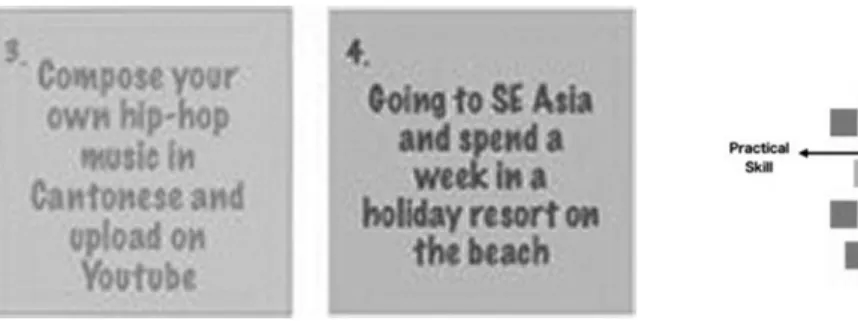
Following this information session, the students were asked to form a small group of four or five persons and were given stationary for use. The instructor then introduced the title of the workshop, “Writing a Syllabus on Everyday Culture in Humanities.” Using the popular method of flip teaching, the instructor announced that each group, as an instructor of an undergraduate course in cultural studies, was encouraged to make a plan of fifteen weeks of lecture series in order to examine how every day cultures (and its daily use) can be appealing to students in order to learn cultural studies in the classroom. The students were given some time to make a list of preferable topics of everyday culture for the course, and each topic of the week was written on a sticky note provided to the students. During the process, the students kept on making a list of topics on the sticky note, in reference to their own daily experience and practice (see Figure 1). This process gave students the opportunity to reflect upon what they normally consume and play from a different perspective to recognize an object of learning about culture
and society. In the classroom, I saw there were exchanges of possible topics between local and international students. One student also described a snack he/she had on the desk. In this way, they listed several unique topics from their daily experience and consumption.
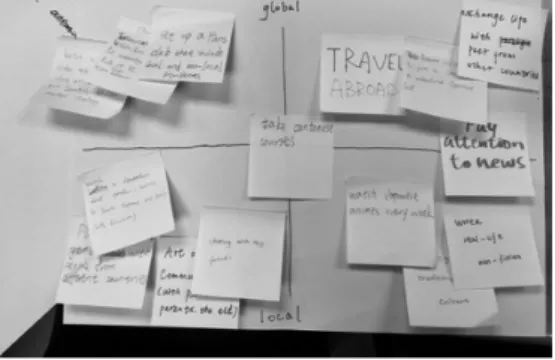
Next, the instructor asked the students to prepare a 2x2 axis in order to sort out and categorize possible topics of the week to several key arguments according to the aim of the proposed course. 2x2 axis is a graphic tool to set up ideas and conversation about participants and problem space. Using this method in a synthesis process of some task or question, the participants get to think about relationships between things or ideas.44 A 2x2 axis is also an
effective way to visually communicate a relationship the participant needs to convey in the workshop. Allocate two spectra (one on each axis), draw a 2x2 axis on a large white paper, and plot the sticky notes on the axis. In this workshop, two spectra were set up according to the purpose of this workshop: 1) global-local spectrum for the vertical axis; and 2) critical knowledge and practical skills for the horizontal axis (see Figure 2).
The students were then asked to see which quadrants were full or empty and consider where did the proposed correlation broke down. To do so, the instructor advised the students that as course instructors, they had to draw attention to a balanced selection of topics to meet the purpose of the course they had chosen. Eventually, to meet the object of the course represented by two spectra, students had to remove each topic or even develop new topics in a discussion with other group members. Through this, the students were expected to realize the fact that learning humanities like cultural studies will not only enable them to develop both practical skills and critical knowledge by the distributed notes in the horizontal axis, but it also consider the ways in which their everyday culture and cultural practice would involve both the global and local characteristics by the notes placed according to the vertical axis. During the process, the students expressed difficulty in plotting some notes (topics) on the 2x2 axis. In that case, the instructor guided that there are complex characteristics and social relations in the familiar or
popular culture and its practice in our everyday life. Such a feel could lead us to unlearn some parts of everyday culture by questioning its entanglement with social relations. This 2x2 axis workshop was a perceptive practice to visualize such an experience.
Finally, by the more deeper investigation of differentiated distribution of notes between both axis in the group in the final classroom presentation for evaluation, all of the students could develop some insights of the ways in which they articulate their daily experiences to cultural studies, drawing a (dis)juncture between several skills and knowledge and its global-local attributes (see Figure 3). Their intellectual engagement with the workshop was also strengthened by the point that, in the final presentation, the students were responsible for reasoning of the distribution of the notes on the axis. In reply to the students, the instructor sorted out the differences among the axis of each group and answered questions about how they could “unlearn” their daily experiences as students’ achievement of theoretical application. Here, the workshop was concluded with the instructor’s final remark as to how thinking about everyday culture in cultural studies could give us other “practical skills” to explore the world from alternative perspective and it might lead us to imagine something different or act for it. Thus, the instructor could examine to what extent this workshop was evaluated as a pedagogical challenge in cultural studies.
4. CONCLUSION
Taking contemporary social context of tertiary education in our global world into account, this paper has explored the ways in which cultural studies, as a prominent subject in humanities, is interdisciplinary in nature. Additionally, it has explored to what extent cultural studies could be employed as a pedagogical scheme in the classroom, in conjunction with recent mode of active learning, from my Inter-Asian teaching experience. Influenced by social shift in
both international and domestic contexts, “plug-and-play” approach to higher education has been stressed, rather than providing a wider range of ideas and thoughts to make a prolong contribution to sustain and develop civil society in a patient dialogue with others. To explore such a social circumstance in depth, this paper has focused on recent situation of higher education in Japan, although that would be the case more in some other Asian states, where impact of globalization is greater. As a pedagogical effort in cultural studies to develop students’ critical skills, I conducted an experimental workshop in Hong Kong, in order to observe the immanent complexity of our social relations and develop resilience against the unpredictable and fluid world. From the beginning, it was crucial for students to realize how their everyday life is stretched out across global cultural, economic, and political environment; they also recognized that it has something to do with other societies in their everyday-ness. By employing a trendy method of active learning as a workshop style work, I have attempted to illustrate the ways in which teaching cultural studies could appropriate contemporary pedagogical tools and methods to popularize global education, although there are limitations to it. Concerning different contexts regarding university curriculum and student culture which should not be dismissed, it would be more prolific to share and exchange ideas and organize inter-cultural or cross-national collaboration to teach cultural studies across Asia. Of course, as having remarked somewhere before, practice of cultural studies in the classroom should be articulated to the development of an art of intervention for a better future. My approach of teaching cultural studies in the mode of active learning should be examined from that point. This classroom approach to cultural studies will lead students to rethink about society through everyday fandom and daily consumption and will hopefully present them with an opportunity to develop the art of unlearning their everyday life.
References
1 This paper was initially published in Chinese. See, 滨野健(梁成林译・许诺校). (2020). “人文学科危机 ” 中的文化研究 :
一个亚际语境下的教学挑战. 热风学术 .6: 16-33. The author deeply expresses his gratitude to Associate Professor Luo Xiaoming (Shanghai University) for her editorial work and two other translator for their enduring work for my original English paper. He also thanks Dr. Chen Keng Liang (Ted) for his invitation to this great opportunity.
2 Associate Professor of Sociology, Faculty of Humanities. Contact: [email protected]
3 Ruggeri, A. (2019). “Why ‘worthless’ humanities degrees may set you up for life”, Retrieved November 27, 2019 from
https://www.bbc.com/worklife/article/20190401-why-worthless-humanities-degrees-may-set-you-up-for-life
5 Ruggeri, (2019).
6 Palmer, J. D. (2011). The internationalization of East Asian higher education: Globalization's impact. New York Palgrave
Macmillan.
7 Gordon, P. (2012). “The changing face of higher education”. Retrieved Nvember 30, 2019 from https://www.scmp.com/
comment/insight-opinion/article/1064138/changing-face-higher-education
8 Gordon, H., Feisal, G. M., Roger, L. G., & Sheldon, R. (2015). A new deal for the humanities. New Brunswick, NJ: Ruggers
University Press.
Qiao, G. The significance of the humanities and liberal arts in higher education. European Review, 26(2), 299-310.
9 Stuart, H. The emergence of cultural studies and the crisis of the humanities. October, 53, 11-23. 10 Turner, G. (2012). What's become of cultural studies? London: SAGE, pp. 168-171.
11 Ryan M. (2010). Cultural studies: A practical introduction. Oxford: Wisely-Blackwell. 12 Rodman, G. B. (2015). Why cultural studies? Oxford: Wisely-Blackwell. pp. 75-76.
13 For example, the Inter-Asia Cultural Studies Society notably organizes biannual teaching camps for early career researchers
in teaching cultural studies. It also conducts summer camps for graduate students in addition to regular biannual conferences for intellectual exchange.
14 Rodman, 2015, pp.82-83.
15 Yoshimoto, K. (2010). Sengokōtōkyōiku no taishū katei [The process of popularization of post-war higher education].
Murasawa, M. (ed.). Daigaku to kokka: seido to seisaku [The university and state: institutions and policies]. Tokyo: Tamagawa University Press, p. 22.
16 Ministry of Education, Culture, Sports, Science and Technology. (2017). Gakkōkihonchōsa Nenjitōkei [Annual statistics on
basic school survey] Retrieved November 20, 2019, from https://www.e-stat.go.jp/dbview?sid=0003147040
17 Unlike national and public universities, small private universities, and colleges were established in response to an increase
in the number of youth in post-war Japan. These institutions are vulnerable to a decline due to recent depopulation even though private universities in Japan are eligible for financial support from the Ministry of Education. Many local governments established numerous private universities and sought an increase of student population to develop the local economy based on the young population. Yet, many of the institutions face serious financial crisis, contrary to the belief during their inception. In May 2019, a local newspaper reported that between 2010 and 2016, at least 21 universities were officially approved to be closed down by the Ministry of Education. Nishinippon Shinbun.(2019). Chihōshidai tōta no jidai ni. Susumu shōshika gakuseikakuho muzukashiku [Local private universities to be selected: Facing a difficulty in meeting the student quota due to depopulation] Retrieved November 20, 2019, from https://www.nishinippon.co.jp/item/n/510181/
18 See the following reports by the Ministry of International Affairs of Japan,
Ministry of Internal Affairs. (2012). Heisei24nennban jyōhōtsushinhakusho [The 2012 White Paper Infromation and Communication in Japan] Tokyo:MIA.
19 Due to the large number retiring post-war baby boomers in recent years, the domestic job market has now recovered in
Japan. The selection ratio was 1.63 in 2018 as compared to 0.43 in 2009, when it was influenced by domestic recession and bankruptcy of Lehman Brothers in the United States of America.
Ministry of Health, Labor, and Welafare of Japan. (2019). Ippansyokugyōshōkaijyōkyō (Heisei30nenn12gatsubun oyobi heisei30nenbun [About the status of general job placements (December 2019 and a whole year of 2019)] Retreieved November 20, 2019, from https://www.mhlw.go.jp/stf/houdou/0000192005_00001.html
20 It was reported that the number was slightly recovered because the Ministry of Education recently imposed private
universities to restrict an extra acceptance of applicants beyond the initial student quota. The Ministry concerned that applicants would be concentrated on limited numbers of notable private universities. Nihonkeizai Shinbun. (2019). Konshyunnoshidai teiinware 33% 3 pointogen, kaizenkeikōtsuzuku [33% of private universities failed to meet the student quota: a sustainable improvement of 3 point since last year] Retrieved November 20, 2019, from https://www.nikkei.com/ article/DGXMZO48425750Z00C19A8CR8000/
21 From another angle, such a national educational policy of internationalization of tertiary education can be considered as an
example of ‘soft power’ diplomacy by the state.
For furthier details, see Lowe, D. (2015). Australia’s Colombo Plans, old and new: international students as foreign relations.
International Journal of Cultural Policy, 21(4), 448-462; also
Klein, N. (2008). The shock doctrine :The rise of disaster capitalism: New York: Picador.
22 Ministry of Education, Culture, Sports, Science, and Technology of Japan. (2014). Working group report on advancing the
establishment of sufficient housing for international students in Japan towards realizing the “300,000 International Students Plan” Retrieved November 25, 2019 from http://www.mext.go.jp/en/news/topics/detail/sdetail/1372647.htm
23 Shields, R. (2013). Globalization and international student mobility: A network analysis. Comparative Education Review,
57(4), 609-636.
24 See, Gordon, P. (2012).
25 Igarashi, Y. & Akashi, J. (eds.). (2015). Gurōbarujinzai wo meguru seisaku to genjitsu [The policy and reality of “global
human resource”]. Tokyo: Akashi Shoten.
26 Sassen S. (2001). The global city: New York, London, Tokyo. Princeton, NJ: Princeton University Press.
27 Appadurai A. (1996). Modernity at large: Cultural dimensions of globalization. Minneapolis, MN: University of Minnesota
Press.
28 Ministry of Education, Culture, Sports, Science, and Technology of Japan. (2015). Kokuritsudaigakuhōjin no soshiki oyobi
gyōmuzenpanno minaoshi ni tsuite (tsūchi) [About the restructuring of organizations and general institutions of national
university corporations (notice)] Tokyo: MEXT.
29 Ibid. p.3.
Kyoto: Nakanishiya Shuppan.
Yamaguchi, H. (2017). Jinbunkeigakubu wa haishi? Nipponno daigakukaikaku no genjyōto kadai [Demolition of humanities facultites? Current status and issues]. Ningenshakaibunkakenkyu (25), 148-158.
Muroi, H. (2015). Bungakubukaigai [The demolition of humanities faculties] Tokyo: Kadokawa Shoten.
31 Keidanren. (2018). Kongonosaiyō to daigakukyōiku ni kansuru teian [Prposal for the future recruitment and univeristy
educaiton]. Retrieved November 25, 2019 from https://www.keidanren.or.jp/policy/2018/113_honbun.html#p2
32 Yoshimi, S. (2016). “Bungakubuhaishi” no shōgeki [The impact of “the abolition of humanities faculties”] Tokyo: Shueisha.. 33 Ministry of Education, Culture, Sports, Science, and Technology of Japan. (2015). Shimomura Hakubun monbukagakudaijin
kishakaikenroku (Heisei27nen7gatsu24nichi) [Record of press conference by Shimomura Hakubun, Minister for Education, Junly 24, 2015]. Retrieved November 28, 2019 from http://www.mext.go.jp/b_menu/daijin/detail/1360172.htm.
34 In Japanese universities, double major or double degree programs are not common. This is the case in my university, too. 35 The submission of a graduate dissertation is still compulsory in most Japanese universities for humanities.
36 Ruggeri. (2019).
37 Bonwell C. C., & Eison J. A. (1991). Active learning: creating excitement in the classroom. ASHE-ERIC higher education
reports. p. 19.
38 This argument would call for an enquiry about digital humanities in the classroom, although I do not proceed to this different
topic in this paper. See, Battershill C., & Shawna, R. (2017). Using digital humanities in the classroom: A practical
introduction for teachers, lecturers, and students. London: Broomsbury Academic.
39 Kobari, Makoato. (2018). Akuthiburaningu: gakkokyōiku no risō to genjitsu [Active learning: the dream and reality in school
education]. Tokyo: Kodansha Gendaishinsyo.
40 Hasegawa, Hajime. (2014). Dizunirandokasurusekai de kibō wa ikanikatariuruka: tekunoroji to shintai no yūgi [How can
we talk about hopes in the Disneyfication of society? The attraction between the technology and body] Tokyo: Keiōgijyuku University Press.
41 Willis, P. (1990). Common culture: Symbolic work at play in the everyday cultures of the young. Milton Keynes: Open
University Press. p.2
42 For example, Hebdige, D. (1979). Subculture:Tthe meaning of style. London: Methuen. Certeau, M. d. (1988). The practice of everyday life. Barkley, CA: University of California Press.
43 Spivak, G. C., F. Bartkowski, F., & Threadgold, T. (1988). The intervention interview, Southern Humanities Review Vol. 22(4). pp. 323-343
THE UNIVERSITY OF KITAKYUSHU
No. 19
Center for International Education and Exchanges
The University of Kitakyushu
March 2021
Social Sciences
Cultural Studies in the “Crisis of Humanities”: A Pedagogical Challenge in Inter-Asia Context