Corresponding author Toshihiro Takao
Department of Health Care Medicine, Kawasaki Medical School, 577 Matsushima, Kurashiki 701-0192, Japan
Phone : 81 86 462 1111 Fax : 81 86 464 1040
E-mail: [email protected]
Is “less calories and more exercise” enough to prevent hypertension,
diabetes, or dyslipidemia in individuals undergoing health checkups?
A 5-year retrospective cohort study
Toshihiro TAKAO
1), Fumiaki MIKAMI
2), Yoshiyuki YAMANAKA
1),
Sohachi FUJIMOTO
1), Tomoari KAMADA
1), Hiromi KATAOKA
2),
Mihoko OKADA
2)1) Department of Health Care Medicine, Kawasaki Medical School, 2) Department of Health Informatics, Kawasaki University of Medical Welfare
ABSTRACT Medical professionals generally use “less calories and more exercise” as advice to patients with lifestyle-related diseases. This retrospective cohort study aimed to determine suitable lifestyle modification strategies to prevent hypertension, diabetes, or dyslipidemia in individuals who participated in a medical health check. Health check data of 24, 244 individuals who underwent a specific health check at a health service organization in Fukuyama, Japan from 2011 to 2015 were compared and the association between current lifestyle and onset of hypertension, diabetes, or dyslipidemia in the next 5 years was assessed via Cox proportional hazard model. Current daily alcohol consumption was associated with the onset of hypertension in the next 5 years. Onset of diabetes was related to current smoking. In addition, “eating quickly” was related to diabetes onset in the next 5 years. Given that these lifestyle habits were associated with the onset of the diseases after adjustment with BMI, more appropriate recommendations for lifestyle modification should be considered at health
guidance. doi:10.11482/KMJ-E201945087 (Accepted on Sep 27, 2019)
Key words: alcohol, eating speed, health check participants, lifestyle-related disease, smoking 〈Regular Article〉
INTRODUCTION
In 2008, a new system of mandatory health check, called the “specific health check,” was launched in Japan1,2). The primary purpose of the “specific
health check” is for the early diagnosis of lifestyle-related diseases such as hypertension, diabetes, or dyslipidemia, also known as metabolic syndrome, with the aim of improving treatment efficacy3). In
this system, participants answer a self-administered questionnaire that covers medical history, smoking habits, alcohol intake, exercise habits, and eating patterns4).
Various lifestyle modification strategies have been suggested to prevent lifestyle-related diseases. The hypertension clinical guideline from the National Institute for Health and Clinical Excellence
investigate suitable lifestyle modification strategies to prevent developing hypertension, diabetes, or dyslipidemia for those undergoing health check using 5-year health check data.
SUBJECTS AND METHODS Subjects
Health check data of 24, 244 individuals who underwent a specific health check at Chugoku Occupational Health Service Organization in Fukuyama, Japan from 2011 to 2015 were used. As of 2011, those who had past history of cerebrovascular/cardiovascular/renal failure dialysis and anemia were excluded. Inappropriate answer value(s) for the questionnaire were also excluded. Finally, a total of 5, 475 individuals who received a health check every year from 2011 to 2015 were enrolled in the study (Fig. 1).
Methods
Age, sex, BMI, waist circumference, systolic blood pressure, diastolic blood pressure, triglyceride recommends regular aerobic exercise and reduction
of salt, alcohol, and smoking and advocates “healthy, low-calorie diets” for “overweight individuals with raised blood pressure”5). Sodium restriction and
physical activity are both important for primary prevention of hypertension6).
Unhealthy lifestyle choices, characterized by physical inactivity and overeating, are an established risk factor for obesity and type 2 diabetes. Lifestyle modification targeting dietary change and increased physical activity is recommended for successful prevention of obesity and type 2 diabetes, irrespective of genetic susceptibility7). Moreover,
lifestyle interventions, such as weight reduction, dietary modification, and increased physical activity in people at high risk of type 2 diabetes, induce sustained changes and result in long-term prevention of progression to type 2 diabetes8). Reducing
5%-10% of excess body weight and increasing moderate physical activity by 150 min/week have been shown to reduce the development of diabetes in different at-risk populations9).
Hypertriglyceridemia is among the factors contributing to metabolic syndrome, in which an atherogenic diet, sedentary lifestyle, overweight/ obesity, and genetic factors interact, thus requiring a multi-factorial intervention, including weight reduction, dietary modification, and increased physical activity10). In general, total body and
abdominal adiposity influence all dyslipidemia markers, and consumption of fruits and vegetables protects against hypertriglyceridemia11).
Thus, strategies for weight reduction, including reduced food consumption and increased physical activity, are emphasized as lifestyle modifications for preventing hypertension, diabetes, or dyslipidemia in outpatient clinics. However, the situation may be different for health check participants and outpatients as the body mass index (BMI) in health check participants is often
levels, fasting blood glucose levels, hemoglobin A1c levels, and lifestyle of the participants were assessed using specific health check data. Measurement methods, cutoff values, and protocols have been described in the “Operational Guide to Specific Health Checkups and Specific Health Guidance” by the Japanese Ministry of Health, Labor and Welfare12).
The “specific health check” questionnaires (Table 1) were developed based on the conventional National Health and Nutrition Examination Survey and questions specified by the Industrial Safety and Health Act13). It included selection/stratification
questions (1-3 [medication use], 4-6 [medical history, present illness], and 8 [smoking history]),
which are essential for the specific medical checkup. It also included 22 other items such as frequency of exercise, weight gain, dietary habits, alcohol consumption, and sleeping habits. The questionnaire items are standard and have been widely used, and previous studies have showed that these lifestyle behaviors are related to the prevalence of metabolic syndrome12,14).
Questions numbered 8, 10-12, and 14-20 were used for assessment of eating and exercise habits. As for daily alcohol consumption (question number 19), 1 “Go” of Japanese Sake contains approximately 23 grams of alcohol. Because the number of “3 Go or more” responses was small for question number 19, we analyzed “Below 3 Go” and “3 Go or more”
Table 1. Specific health check questionnaire
1. Are you currently taking medications to lower your blood pressure? 1: Yes 2: No 2. Are you currently taking insulin shots or oral hypoglycemic medications? 1: Yes 2: No 3. Are you currently taking medications to lower your cholesterol? 1: Yes 2: No 4. Have you ever been diagnosed with having cerebral stroke (cerebral hemorrhage,
cerebral infarction, etc.) or received medical treatment for it? 1: Yes 2: No 5. Have you ever been diagnosed with having cardiac diseases (angina pectoris,
myocardial infarction, etc.) or received medical treatment for it? 1: Yes 2: No 6. Have you ever been diagnosed with having chronic renal failure or received medical
treatment (artificial kidney dialysis treatment)? 1: Yes 2: No 7. Have you ever been diagnosed with anemia? 1: Yes 2: No 8. Do you currently smoke habitually? 1: Yes 2: No 9. Have you gained more than 10 kg compared to your 20 year-old weight? 1: Yes 2: No 10. Do you exercise for over 30 min. at a time enough to slightly sweat for more than
twice a week and continuing it for over 1 year? 1: Yes 2: No 11. Do you walk or an exercise an equivalent physical activity for over 1 hour a day in
your daily life? 1: Yes 2: No
12. Do you walk faster compared to the people of your sex at your age? 1: Yes 2: No 13. Have you lost/gained for less/more than 3 kg in the last one year? 1: Yes 2: No
14. Do you eat faster compared to others? 1: Faster 2: Normal 3: Slower 15. Do you have dinner within 2 hours before bedtime for more than 3 times a week? 1: Yes 2: No
16. Do you have snacks (late-evening snacks other than regular 3 meals) after dinner for
more than 3 times a week? 1: Yes 2: No 17. Do you skip breakfast for more than 3 times a week? 1: Yes 2: No
18. Do you drink (sake, distilled spirit, beer, whiskey, brandy, wine, etc.)? 1: Daily 2: Sometimes 3: Hardly 19. How much do you drink on your drinking day?
“1 Go” equals to: [sake: 180 mL] [beer: about 500 mL (1 medium bottle)] [distilled spirit (35 proof) 80 mL] [whiskey: 60 mL double (1 shot)] [wine: 240 mL (2 glasses)]
1: Below 1 Go 2: 1 Go to 2 Go 3: 2Go to 3 Go 4: 3 Go or more
20. Can you get enough rest from sleep? 1: Yes 2: No
21. Would you like to improve your lifestyle such as exercise habit or diet? 1: No intention to improve 2: Yes (within about 6 months)
3: Yes, shortly (within about 1 months)/ Slowly improving
4: Already in progress (less than 6 months) 5: Already in progress (more than 6 months) 22. Are you interested in receiving health guidance on lifestyle diseases if you have a
together.
Statistical Analysis
Baseline characteristics for all participants were presented as mean ± standard deviation. First, the difference in laboratory data between 2011 and 2015 was analyzed via Wilcoxon’s sign rank test. Next, we examined whether current lifestyle had an effect on onset of hypertension, diabetes, or dyslipidemia in the following 5 years. Participants who did not take drugs for hypertension, diabetes, or dyslipidemia, as determined according to inquiry item numbers 1 to 3 of the questionnaires at the examination in 2011, were included. The relative risk compared with “No” for question number 8, 10-12, 15-17, 20, “Normal” for question number 14, “Hardly” for question number18 or “Below 1 Go” for question number19 was calculated using the Cox proportional hazard model. If the participants took medication(s) at some point during the 5 years
of follow-up period, it was recognized as the onset of diseases. Those who did not take any medicines for 5 years were treated as censored observations. All data were analyzed using statistical Package for JMP11 (SAS Institute Japan, Tokyo Japan). P-value <0.05 was considered statistically significant. Ethical consideration
As no identifying patient data were obtained in the study, the need for informed consent was waived. The study protocol followed the Japanese Government’s Ethical Guidelines Regarding Epidemiological Studies in accordance with the Declaration of Helsinki, and this research was approved by Kawasaki Medical School Ethics Committee (Approval No.: 2324-4).
RESULTS
First, we compared the laboratory data from 2011 and 2015 (Table 2). Waist circumference,
Table 2. Comparison between the examination values in 2011 and 2015
Year 2011 2015 Significance
n 5,475 5,475
mean ± SD mean ± SD Age (years) 50.3±7.2 54.3±7.2
Body mass index (kg/m2) 23.3±3.5 23.3±3.6 ns
Waist circumference (cm) 82.7±9.6 83.2±9.7 p<0.01 Systolic blood pressure (mmHg) 122.5±16.3 123.8±16.2 p<0.01 Diastolic blood pressure (mmHg) 76.6±11.5 77.1±11.2 p<0.01 Red blood cell count (×104/μL) 479.8±41.3 476.8±42.3 p<0.01
White blood cell count (/μL) 5.99±1.7 6.14±1.8 p<0.01 Hb (g/dL) 14.76±1.5 14.8±1.5 p<0.01 Hematocrit (%) 44.47±3.9 45.0±3.9 p<0.01 ALP (IU/L) 222.2±67.7 219.5±68.8 p<0.01 γ-GT (IU/L) 46.9±57.0 46.6 ±62.8 ns AST (IU/L) 24.3±12.1 24.1±12.9 ns ALT (IU/L) 25.8±17.7 25.0±15.7 p<0.01 TG (mg/dL) 113.4±86.9 113.4±93.9 ns Total cholesterol (mg/dL) 206.8±33.4 205.3±33.6 p<0.01 HDL cholesterol (mg/dL) 60±15.2 58.9±15.1 p<0.01 LDL cholesterol (mg/dL) 122.5±30.7 122.8±31.1 ns Creatinine (mg/dL) 0.75±0.2 0.77±0.2 p<0.01 HbA1c (%) 5.19±0.7 5.65±0.7 p<0.01 Plasma glucose (mg/dL) 98.9±23.0 100.9±22.0 p<0.01 Uric acid (mg/dL) 5.56±1.4 5.61±1.3 p<0.01 SD: standard deviation; ns: not significant; Hb: hemoglobin; ALP: alkaline phosphatase; γ-GT: γ -glutamyltranspeptidase; AST: aspartate aminotrasnferase; ALT: alanine aminotransferase; TG, triglyceride; HDL: high density lipoprotein; LDL: low density lipoprotein
systolic blood pressure, and diastolic blood pressure significantly increased over 5 years. In addition, white blood cell count, hemoglobin, hematocrit, creatinine, hemoglobin A1c, fasting plasma glucose, and uric acid were also higher in 2015 than in 2011. Meanwhile, red blood cell count, alkaline phosphatase, alanine aminotransferase, total cholesterol, and high-density lipoprotein cholesterol were lower in 2015 than that in 2011. BMI, γ -glutamyl transpeptidase, aspartate transaminase, triglyceride, and low-density lipoprotein cholesterol did not change in 2011 and 2015.
The association between lifestyle in 2011 and the onset of hypertension, diabetes, or dyslipidemia in the next 5 years was as follows. Of the 4,883 participants not taking antihypertensive drugs in 2011, 364 (7.5%) developed hypertension
within 5 years. The amount of alcohol consumed daily was significantly associated with the onset of hypertension. The risk ratio of daily alcohol consumption more than 23 g and less than 46 g of ethanol, and more than 46 g of ethanol compared with less than 23 g of ethanol was 1.44 and 1.82, respectively, after adjusting for age, sex, and BMI in 2011 (Table 3). Meanwhile, other dietary habits, exercise habits, sleep, and smoking did not show significant association with the onset of hypertension.
Regarding diabetes, of the 5,270 participants not taking antidiabetic drugs in 2011, 111 (2.1%) developed diabetes within 5 years. The risk ratio of smoking to non-smoking was 1.64 after adjusting for age, sex, and BMI in 2011 (Table 4a).
For eating speed, the risk ratio between “eating
Table 3. Risk ratio of drinking amount (question number 19) in 2011 on onset of hypertension
Factor RR 95% CI p Sex (female) 0.7620 0.560-1.0205 0.0687 Age 1.0665 1.0513-1.0819 <0.0001 BMI in 2011 1.1453 1.1164-1.1739 <0.0001 Ethanol<23g 1.0000 23g ≤ Ethanol<46g 46g ≤ Ethanol 1.44101.8209 1.1276-1.83521.3274-2.4620 0.00370.0003 RR: Risk ratio; CI: confidence interval; BMI: body mass index
As for drinking amount, RR compared with “Ethanol<23g” is indicated.
Table 4a. Risk ratio of current smoking (question number 8) in 2011 on onset of diabetes
Factor RR 95% CI p Sex (female) 0.3869 0.1800-0.7331 0.0025 Age 1.0797 1.0525-1.1077 <0.0001 BMI in 2011 1.1861 1.1371-1.2336 <0.0001 No smoking 1.0000 Smoking 1.6378 1.1144-2.3986 0.0123 RR: Risk ratio; CI: confidence interval; BMI: body mass index
As for smoking, RR compared with "No smoking" is indicated.
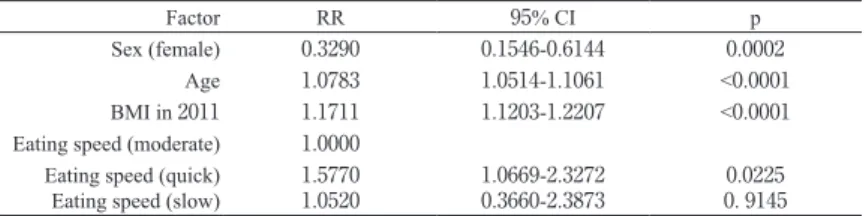
Table 4b. Risk ratio of eating speed (question number 14) in 2011 on onset of diabetes
Factor RR 95% CI p
Sex (female) 0.3290 0.1546-0.6144 0.0002 Age 1.0783 1.0514-1.1061 <0.0001 BMI in 2011 1.1711 1.1203-1.2207 <0.0001 Eating speed (moderate) 1.0000
Eating speed (quick)
Eating speed (slow) 1.57701.0520 1.0669-2.32720.3660-2.3873 0. 91450.0225 RR: Risk ratio; CI: confidence interval; BMI: body mass index
quickly” and “moderately” was 1.58, while it was not significantly different between “moderately” and “slowly” after adjusting for age, sex, and BMI in 2011 (Table 4b). Other dietary habits, exercise habits, and sleep did not show significant association with the onset of diabetes.
With respect to dyslipidemia, 199 participants (3.9%) developed dyslipidemia in the 5 years; during the same time, 5,130 participants did not take drugs for dyslipidemia in 2011. “Eating quickly” to “moderately” tended to show an increasing risk ratio (P=0.1033). Other dietary habits, exercise habits, sleep, and smoking did not show significant association with the onset of dyslipidemia.
DISCUSSION
Hypertension, diabetes, and dyslipidemia are controllable by having a healthy lifestyle, such as maintaining normal weight, dietary changes, exercise, low-sodium diet, alcohol restriction, smoking cessation, and sleeping. However, the appropriate strategies for participants undergoing health check have not been fully investigated. In the present study, the most common disease that developed in the 5 years from the health checkup was hypertension (7.5%) among those with no BMI change. In the Framingham study, the risk of progression to high blood pressure during 4 years from optimal blood pressure, normal blood pressure, and normal-high blood pressure was 5.3, 17.6, and 37.3 persons per 100 young individuals and 16, 25.5, and 49.5 persons per 100 elderly, respectively15). These results are consistent with our
study showing that blood pressure increases with age.
As for the association between alcohol drinking and developing hypertension, those drinking relatively large amounts of alcohol tended to have higher blood pressures, and this alcohol-blood pressure association was not attributable to demographic characteristics, adiposity, reported
salt use, smoking, or coffee consumption in the Kaiser-Permanente study of approximately 87,000 individuals16). Among Japanese men, alcohol
drinking remained positively associated with blood pressure even after adjusting for the effects of age, BMI, and other macronutrient and electrolyte intakes17). Despite these findings, restriction of
alcohol intake has not been emphasized as the most important factor for preventing hypertension. The Japanese Society of Hypertension Guidelines for the Management of Hypertension (JSH2014) recommend salt reduction (<6 g/day), increased intake of vegetables/fruit and fish (fish oil), reduced intake of cholesterol and saturated fatty acids, weight loss (BMI<25 kg/m2), exercise ( ≥ 30 min/day),
reduction of alcohol intake (ethanol consumption ≤ 20-30 mL/day in men, ≤ 10-20 mL/day in women), and quitting smoking18). In this guideline, the
reduction of alcohol intake is the fifth of 6 items. In the present study, only the amount of alcohol consumed per day was significantly associated with developing hypertension, while other dietary habits, exercise habits, sleep, and smoking did not show any significant association with the onset of hypertension, although salt reduction was not included in the questionnaire. Therefore, restriction of alcohol intake should be emphasized more greatly to health check participants. Although it is ideal to stop drinking completely to prevent hypertension, it is more realistic and achievable if a reduction in the amount of alcohol to an equivalent of 20 to 30 mL/ day and 10 to 20 mL/day of ethanol is recommended for men and women, respectively, based on the JSH 201418).
Although smoking is known as a risk factor for coronary artery disease and cerebrovascular accident19), it is also a risk factor for the onset of
diabetes20). According to a recent meta-analysis in
Japan, smokers and former smokers have 1.38 and 1.19 of relative risk of developing type 2 diabetes compared with non-smokers, respectively21).
Moreover, a linear dose response was observed between the number of cigarettes smoked and the risk of developing diabetes21). In our study, those
who reported smoking showed a risk ratio of 1.64 for developing type 2 diabetes compared with those who did not smoke. It is somewhat surprising that only smoking was associated with developing diabetes. This could be because of differences between health check participants and outpatients. These findings indicate the importance of smoking cessation. Furthermore, the importance of avoiding smoking to prevent diabetes should be emphasized. One study showed that compared with “eating slowly,” “eating quickly” is a high risk for developing type 2 diabetes22). In Japan, Totsuka
et al. reported that “eating quickly” is a high risk for diabetes using the occurrence of impaired glucose tolerance (IGT) or diabetes as the objective variable. Meanwhile, other eating habits such as “skipping meals,” “eating snacks,” “eating after dinner,” and “eating out” did not show any significant association with the occurrence of IGT or diabetes23). Moreover, a study of 2,050 metallic
industry workers showed a significant association between eating speed and onset of diabetes24). These
results are consistent with that in our study. As a mechanism related to the onset of diabetes, Totsuka et al. inferred that “eating quickly” induces obesity and that obesity causes insulin resistance which in turn causes diabetes23). The exact mechanism by
which “eating quickly” is associated with the onset of diabetes is unknown. However, collectively, our results indicate that the risk ratio of “eating quickly” for developing dyslipidemia tended to be higher compared with that of “eating moderately,” and thus management of “eating quickly” may suppress not only the onset of diabetes but also the onset of dyslipidemia. As control of eating speed seems to be easier than calorie restriction or everyday exercise, it is important to instruct participants regarding eating speed during health checks.
There are several limitations in this study. First, lifestyle habits were determined via self-reports, which has a possibility of reporting bias although this uniform questionnaire is nationwide and mandatory. Next, the onset of diseases was determined according to the year of starting medication, while it should essentially be judged according to the diagnostic criteria of hypertension, diabetes, or dyslipidemia. However, the present method was used because only one measurement of blood pressure, plasma glucose, or triglyceride taken at the time of health check is inadequate for diagnosis. Moreover, this study did not judge the subjects who were receiving dietary treatment or exercise therapy only but not taking any medicines. Therefore, there is a possibility that the onset of diseases was not accurately determined. Third, it is unknown whether each individual received health guidance; thus, each group may include both participants with and without lifestyle modifications. However, because the degree of lifestyle modification varies between individuals, our results can be considered comprehensive as it included a high number of both participants.
CONCLUSION
The current amount of alcohol consumed was related to the onset of hypertension, and smoking was related to the onset of diabetes in the next 5 years. “Eating quickly” was associated with the onset of diabetes for participants undergoing health check. Given that these lifestyle habits were associated with the onset of the diseases after adjustment with BMI, more appropriate recommendations for lifestyle modification should be considered at health guidance.
ACKNOWLEDGMENTS
We thank President Akira Miyata and the members of the Chugoku Occupational Health Service Organization for providing data.
D E C L A R AT I O N O F C O N F L I C T I N G INTEREST
The authors declare that there is no conflict of interest.
FUNDING
This research received no specific grant from any funding agency in the public, commercial, or not-for-profit sectors.
REFERENCES
1)Sato Y, Fujimoto S, Konta T, et al.: Significance of estimated glomerular filtration rate in predicting brain or heart attacks in obese and non-obese populations. Clin Exp Nephrol 19: 790-796, 2015
2)Tsushita K, Muramoto A. [The current situation of newly started lifestyle intervention system to reduce metabolic syndrome in Japan--specific health checkup and health guidance]. Nihon Rinsho 69 Suppl 1: 723-728, 2011 3)Tominaga T, Matsushima M, Nagata T, Moriya A,
Watanabe T, Nakano Y, Hirayama Y, Fujinuma Y. Psychological impact of lifestyle-related disease disclosure at general checkup: a prospective cohort study. BMC Fam Pract 16: 60, 2015
4)Wakasugi M, Kazama JJ, Narita I, et al.: Association between combined lifestyle factors and non-restorative sleep in Japan: a cross-sectional study based on a Japanese health database. PLoS One 9: e108718, 2014 5)Nicoll R, Henein MY. Hypertension and lifestyle
modification: how useful are the guidelines? Br J Gen Pract 60: 879-880, 2010
6)Diaz KM, Shimbo D. Physical activity and the prevention of hypertension. Curr Hypertens Rep 15: 659-668, 2013
7)Temelkova-Kurktschiev T, Stefanov T. Lifestyle and genetics in obesity and type 2 diabetes. Exp Clin Endocrinol Diabetes 120: 1-6, 2012
8)Lindström J, Peltonen M, Eriksson JG, Ilanne-Parikka P, Aunola S, Keinänen-Kiukaanniemi S, Uusitupa M, Tuomilehto J, Finnish Diabetes Prevention Study (DPS). Improved lifestyle and decreased diabetes risk over 13 years: long-term follow-up of the randomised Finnish Diabetes Prevention Study (DPS). Diabetologia 56: 284-293, 2013
9)Allende-Vigo MZ. Diabetes mellitus prevention. Am J Ther 22: 68-72, 2015
10)Manfredini F, D'Addato S, Laghi L, Malagoni AM, Mandini S, Boari B, Borghi C, Manfredini R. Influence of lifestyle measures on hypertriglyceridaemia. Curr Drug Targets 10: 344-355, 2009
11)Takahashi MM, de Oliveira EP, Moreto F, Portero-McLellan KC, Burini RC. Association of dyslipidemia with intakes of fruit and vegetables and the body fat content of adults clinically selected for a lifestyle modification program. Arch Latinoam Nutr 60: 148-154, 2010
12)Tsushita K, S Hosler A, Miura K, Ito Y, Fukuda T, Kitamura A, Tatara K. Rationale and Descriptive Analysis of Specific Health Guidance: the Nationwide Lifestyle Intervention Program Targeting Metabolic Syndrome in Japan. J Atheroscler Thromb 25: 308-322, 2018
13)Tada H, Kawashiri MA, Yasuda K, Yamagishi M. Associations between questionnaires on lifestyle and atherosclerotic cardiovascular disease in a Japanese general population: A cross-sectional study. PLoS One 13: e0208135, 2018
14)Yoshida J, Eguchi E, Nagaoka K, Ito T, Ogino K. Association of night eating habits with metabolic syndrome and its components: a longitudinal study. BMC Public Health 18: 1366, 2018
15)Vasan RS, Larson MG, Leip EP, Kannel WB, Levy D. Assessment of frequency of progression to hypertension in non-hypertensive participants in the Framingham Heart Study: a cohort study. Lancet 358: 1682-1686, 2001
16)Friedman GD, Klatsky AL, Siegelaub AB. Alcohol, tobacco, and hypertension. Hypertension 4: III143-150, 1982
17)Choudhury SR, Okayama A, Kita Y, Ueshima H, Yamakawa M, Niki I, Sasaki S. The associations between alcohol drinking and dietary habits and blood pressure in Japanese men. J Hyperten 13: 587-593, 1995 18)Shimamoto K, Ando K, Fujita T, et al.: The Japanese
Society of Hypertension Guidelines for the Management of Hypertension (JSH 2014). Hypertens Res 37: 253-390, 2014
19)Ueshima H, Choudhury SR, Okayama A, Hayakawa T, Kita Y, Kadowaki T, Okamura T, Minowa M, Iimura O. Cigarette smoking as a risk factor for stroke death in
Japan: NIPPON DATA80. Stroke 35: 1836-1841, 2004 20)Willi C, Bodenmann P, Ghali WA, Faris PD, Cornuz
J. Active smoking and the risk of type 2 diabetes: a systematic review and meta-analysis. JAMA 298: 2654-2664, 2007
21)Akter S, Goto A, Mizoue T. Smoking and the risk of type 2 diabetes in Japan: A systematic review and meta-analysis. J Epidemiol 27: 553-561, 2017
22)Radzevi ien L, Ostrauskas R. Fast eating and the risk of type 2 diabetes mellitus: a case-control study. Clin Nutr
32: 232-235, 2013
23)Totsuka K, Maeno T, Saito K, et al.: Self-reported fast eating is a potent predictor of development of impaired glucose tolerance in Japanese men and women: Tsukuba Medical Center Study. Diabetes Res Clin Pract 94: e72-4, 2011
24)Sakurai M, Nakamura K, Miura K, et al.: Self-reported speed of eating and 7-year risk of type 2 diabetes mellitus in middle-aged Japanese men. Metabolism 61: 1566-1571, 2012