Vol.47, pp.276 to 285. 1991
Some Characteristic
Features
of Large Amorphous
Particles
(NUTA)
in the Seto Inland Sea, Japan*
Shigeru Montanit, Yasufumi Mishimat and Tomotoshi Okaichll
Abstract: Large amorphous aggregates (NUTA) observed in coastal areas after
spring and autumn phytoplankton blooms and red tide outbreaks were collected
using NUTA traps which we devised. These particles become thickly attached to mooring ropes and/or fishing nets.
The variation of the collection of materials by NUTA traps was about 23% in
organic carbon and 25% in organic nitrogen (n=29). The chemical nature and
vertical distribution pattern of NUTA were significantly different from those of
suspended particles collected by water samplers. Since C/ATP and C/Chl a ratios
in NUTA were very high compared with those of suspended particles, NUTA
seems to consist of a small amount of phytoplankton but much detritus. These
values suggest that NUTA has characteristics intermediate between suspended
particles and sinking particles. The standing stock of NUTA was also estimated to
be no more than 10% suspended particles from a calculation of the trapping
efficiency of the NUTA trap.
1. Introduction
It is well known that large amorphous
ag-gregates occur in the marine environment.
These particles were named "marine snow",
from observations using the submersible
"KUROSHIO"(Suzuki and Kato
, 1953).
Marine snow, being fragile and amorphous, is
very difficult to collect using a water sampler; in reality little is known about it. Recent stud-ies by SCUBA divers in the coastal area reveal
that marine snow occurs in abundances up to
several tens of aggregates per liter. Longest
dimensions are generally from 30 to 40mm
(Trent at al., 1978; Alldrege, 1979; Shanks and Trent, 1980).
These particles also contain rich detritus
communities of bacteria, phyto-flagellates, and
protozoans, generally at concentrations several orders of magnitude greater than found in the
surrounding seawater (Silver et al., 1978).
Some organic matter and nutrient
concentra-tions are 2 or 3 times higher than those in the
surrounding seawater (Beers et al., 1986;
Shanks and Trent, 1979; Alldrege and Cox,
1982). These particles are probably not only
an important site for biological processes of
production, decomposition, and nutrient
recy-cling in the water column, but are also a food source for large particle feeders including fish and zooplankton (Trent at al., 1978; Alldrege, 1979; Knauer at al., 1982; Alldrege and You ngbluth, 1985; Alldrege at al., 1986).
Japanese fishermen report that large
amor-phous particles have commonly occurred after phytoplankton blooms in the Seto Inland Sea, a
euphotic coastal sea. These particles, up to
several centimeters in diameter, are found att-ached to mooring nets and on ropes. We also observed many particles attached to the
moor-ing ropes of sediment trap systems. As we
mentioned in our previous papers (Mishima at al., 1990a, b), the behavior and general
char-acter of NUTA were different from those of
*Received 18 June 1991; in revised from 18 Sep -tember 1991; accepted 19 September 1991.
†Faculty of Agriculture
, Kagawa University,
Miki, Kagawa 761-07, Japan
‡Present address:Govemment Industiral Re
-search Institute, Chugoku. Hirosuehiro 2-2-2, Kure 737-01, Japan.
¶Present address:President
, Kagawa University,
suspended particles and sinking particles, whereas the chemical nature of NUTA may be intermediate between those of suspended par-ticles and sinking particles.
In this study, we collected and examined these particles, and determined their sinking rates and their behaviors in the marine envi-ronment.
2. Materials and methods
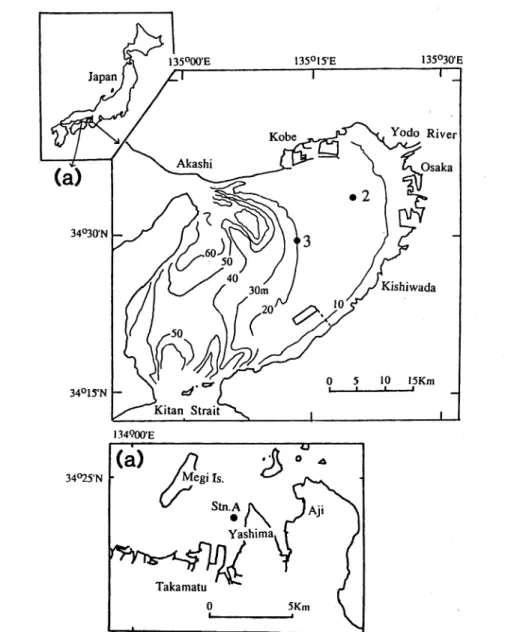
Samples for this study were collected at Stn. 2 in Osaka Bay in June and December (1986),
and at Stn. 3 in May (1987) by the T/S
Toy-oshio-Maru, Hiroshima University (Fig. 1).
Suspended particles were collected with Van
Dorn type water samplers from the surface to
the bottom. Sinking particles were collected
with a M-type sediment trap system (Montani
et al., 1988) at 5m and 10m depths. Large
amorphous aggregates, which we call"NUTA",
were collected with the NUTA trap system
(Mishima et al., 1990a, b) (Fig.2). Since NUTA
tended to be attached to ropes, we collected
NUTA on approximately 1g glass wood (fiber
(a)
Fig. 1. Location of sampling stations in Osaka Bay and the Bisan Strait, the Seto Inland Sea, Japan.
Fig. 2. Illustration of the NUTA trap system. One set of this system has six plastic cages.
diameter: 9ƒÊm) in a nylon net cage over a period of 24 hr. The top and bottom plates of the NUTA trap system were made of acrylic resin and were fixed in place by a center rod of
stainless steel. One set of the NUTA trap system has six nylon net cages.
Suspened particles and sinking particles were filtered onto pre-combusted (450•Ž, 3 hr) Whatman GF/C glass fiber filters. After col-lection on the glass wool, NUTA was then rinsed with redistilled water onto a pre-combusted Whatman GF/C glass fiber filter. All samples were frozen at-20•Ž immediately after sampling, freeze-dried, and then analyzed. We determined an organic carbon content and a nitrogen content for these samples by a CN automatic analyzer. We also measured the chlorophyll a (Parsons et al., 1984), ATP (Holm-Hansen and Booth, 1966), total phosphorus
(Parsons et al., 1984), and amino acid (Montani and Okaichi, 1985) content of these samples.
Five NUTA traps were set at Stn. A (Bisan Strait off Takamatsu City, Fig. 1) in December, 1986, and each glass wool sample of the NUTA trap was examined for an organic carbon
con-tent and a nitrogen content.
In May 1987, continuous observation for 24 hours was carried out at Stn. 3 in Osaka Bay (Fig. 1). Four NUTA traps were set at 5 and 10 m depths (8 traps in total) at the beginning of the observation time. One of them was recov-ered successively from two depths at 6, 12, 18,
and 24 hours after deployment. We also col-lected sea water samples vertically using a Van Dorn bottle at 0, 5, 10m, and from the depth of 2m above the sea bottom, every 3 hr through-out the period.
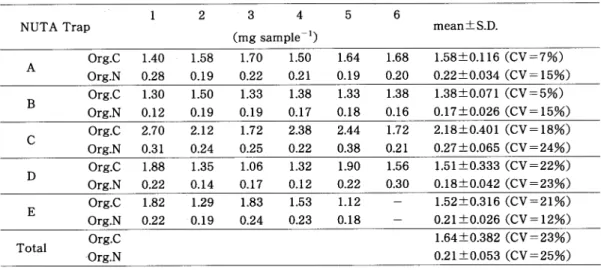
Table 1. Variation of a trapping organic matter content in five NUTA traps at Stn. A, the Bisan Strait off Takamatu City, December 5, 1986.
3. Results and discussion
3.1. Variation in trapped organic matter
compositions of NUTA
Table 1 shows the variation of organic carbon and nitrogen abundances in individual glass wool samples from five NUTA traps at
Susp-P Relative abundance
(A)
NUTA Relative abundance(B)
Ratio(C)
Fig. 3. Vertical distribution of organic carbon, organic nitrogen, chlorophyll a , and
adenosine triphosphate in suspended particles (A) and NUTA (B). Vertical
distribution of C/ATP, C/Chl a, and Chl a/ATP ratios in suspended particlels and
Stn. A, the Bisan Strait off Takamatsu Port in
December 1986. The variabilities of averaged
organic carbon and nitrogen were 23% and 25
%, respectively. But some series from the
NUTA trap were not as high (e.g. 5% and 15 %, respectively).
3.2. Vertical distribution of suspended
par-ticles and NUTA parpar-ticles Temp(•Ž)
(A)
S(%•B)
(B)
POC(ƒÊg/l)
Chla(ƒÊg/l)
Fig.5. Diurnal changes of POC (A) and Chl a (B) in suspended particles and NUTA. The circle size shows relative abundance of POC and Chl a contents in NUTA. Data are expressed by relative area, with the sample which stands for 6 hours at 5m water depth as the standard (organic carbon: 3.06mg sample-1, Chl a: 15ƒÊg sample-1), at Stn. 3, 17-18 May, 1987.
Figure 3 shows the vertical distributions of the organic carbon, organic nitrogen, Chl a, and
ATP content and the ratios in suspended
par-ticles and NUTA parpar-ticles in Osaka Bay at Stn. 2 on 28-29 June 1986. In Fig. 3(A) and (B) the
content of each organic matter at depth is
given as a percentage abundance of the
com-ponent at the surface.
At that time, a red tide of Heterosigma
aka-shiwo occurred in this area. The amount of
suspended particles at the surface was 9.6
mgl-1, which was higher than the amount at 5
m (4.1mg1-1). The organic matter content in
the suspended particles significantly decreased
from the surface to the 5m depth. However,
the decrease in NUTA was less pronounced.
This indicates that the abundance of NUTA
reflects not only the abundance of suspended
particles which were collected by the Van Dorn bottles, but also that the NUTA trap can collect
particulate matter different from the
sus-pended partciles (Mishima et al., 1990a). The vertical distribution of C/ATP, C/Chl a,
and Chl a/ATP ratios in suspended particles
and in NUTA are shown in Fig.3(C). The
C/ATP and C/Chl a ratios are a diagnostic
indication of the biomass (phytoplankton and/
or microheterotrophs) in particles(e.g. Antia et al., 1963; Holm-Hansen and Booth, 1966). The C/ATP and C/Chl a ratios in NUTA were much higher than those of the suspended particles. However, the C/ATP ratio of NUTA at 15m depth was very low. This relatively high ATP content may be reflected by the bacterial
bio-mass of the resuspension from the surface
sediment (Fig. 3(B)).
The Chl a/ATP ratio is also an indication of
the relative abundance of phytoplankton or
microheterotrophic organisms. The values of
Chl a/ATP of the suspended particles were
much higher than those of NUTA at all depths. The C/N ratio in the three different types of particles did not vary significantly.
These high C/ATP and C/Chl a ratios and
low Chl a/ATP ratio indicate that NUTA
con-tains very few living phytoplankton but many
detrital particles with microheterotrophs. This
speculation is supported by microscopic
ex-aminations. This tendency is apparently
ob-served at the other stations as well.
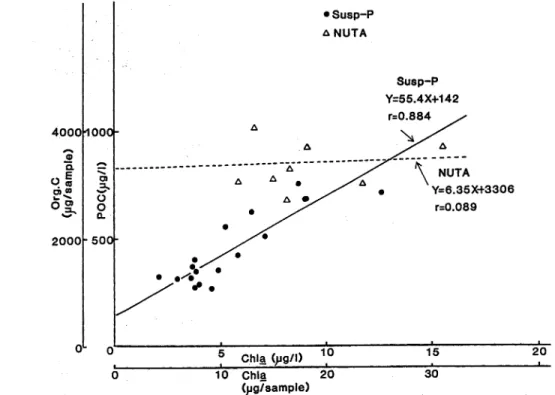
Fig.6. Correlation between Chl a and organic carbon in suspended particles and NUTA at Stn. 3,17-18 May, 1987.
3.3. 24 hour continuous observation
Figure 4 shows the diurnal change of water temperature and salinity of sea water (Osaka Bay, Stn. 3, 17-18 May 1987). During this observation, the water mass changed twice. The high temperature and low salinity water
(greater than 16 t, less than 31psu), which is near shore, flowed into the surface layer.
Figure 5 shows the diurnal changes of POC (particulate organic carbon) and Chl a of sus-pended particles and NUTA. In Fig.5, the circle size shows relative abundance of organic carbon and Chl a contents in NUTA-standing for 6 hours at 5 m depth is the standard (or-ganic carbon: 3.06 mg sample-1, Chl a: 15.1ƒÊg sample-1)-when the NUTA trap was recovered at 6, 12, 18, and 24hr.
The diurnal change of the Chl a concentra-tion in the suspended particles is similar to that of POC and that of water mass, because the organic matter content of the suspended par-ticles was significantly influenced by the
phy-toplankton biomass. However, the variability patterns in organic carbon and Chl a in NUTA were not similar.
In order to compare the composition of sus-pended particles and NUTA particles, the cor-relation regression lines between the organic
carbon content and the Chl a content in the suspended particles and NUTA particles are shown in Fig. 6. The correlation coefficient of these variables for suspended particles was very high (r=0.884) and the slope of 55.4 is similar to that of phytoplankton C/Chl a ratios which varied from 30 to 60 (Antia et al., 1963). The coefficient of these two values in NUTA particles, however, is very low (r=0.082).The intercept of the regression line of NUTA that is very high, about 3, 300ƒÊgC in each sample and the slope which is quite low, indicating that the abundance of organic carbon in NUTA parti-cles is not influenced by phytoplankton, but detrital particles.
3.4. Trapping efficiency of the NUTA trap We tried to estimate the adsorption or trap-ping efficiency of the NUTA traps by mea-suring the increase in adsorption with time up to 6 hr(Table 2). Current speeds were reported from 2 to 15cm sec-1 around this area (Joh,
1986), so we used the minimum current speed (2cm sec-1) for the later calculation. The sea water was filtered through the glass at the speed of 7.21cm-2 hr-1. Multiplication of the mean concentration of each organic matter in the suspended particles by 7.21cm-2 hr-1
Table2. The trapping efficiency of NUTA Trap at Stn. 3. in Osaka Bay.
*Transportation rate of suspended particle was calculated by mean concentration of suspended particles
gives the transportation rate of each organic
matter. The trapping rate of the NUTA trap
divided by the transportation rate of the
sus-pended particles indicates the efficiency. The
efficiencies of organic carbon and organic
ni-trogen are 1-2%, Chl a: 0.4-0.8%, ATP: 0.4-0.5
%, total phosphorus: 0.9-1.6%, and amino
acids: 0.9-2.1%. Since the efficiency is a
di-agnostic indication of phytoplankton (for
ex-ample Chl a and ATP are very low), this NUTA trap may hold very little phytoplankton.
These calculations were made under two
assumptions. If the mean current speed is 2cm
sec-1 and NUTA particles are saturated for one hour, the efficiency should be 6 times greater
than the efficiency we obtained. If the mean
current speed is 15cm sec-1 and particles
sat-urated for 6 hr, these values are 1/8 times
greater than we obtained. The efficiencies of
organic carbon and nitrogen are from 0.13 to
12% in these cases. In view of these efficien-cies, the standing stock of NUTA has probably
not more than 10% of the total suspended
particle standing stock. 4.Conclusions
The high C/ATP and C/Chl a ratios and low
Chl a/ATP ratio in the NUTA indicate that
NUTA contains very few living phytoplankton
but many detrital particles. The comparison
between suspended particles and NUTA also
show that the latter contain a large amount of detrital particles as well. The standing stock of
NUTA has probably not more than 10% of
suspended particles according to the
estima-tion of the trapping efficiency of the NUTA
trap.
The source substance of NUTA may be
phytoplankton debris. In our microscopic
ob-servations, the major components of NUTA
were unidentified materials with diatom
frast-ules, decomposed fecal pellets, and phytoplank-ton. Sinking particles mainly contain densely
packed and/or fresh fecal pellets. Suspended
particles consist of very small particles. It is
considered that NUTA is formed by the
floc-culation of phytoplankton and detritus.
Fur-ther work is required to fully understand the
mechanism for the occurrence of NUTA
parti-cles, and to estimate the standing stock of
NUTA in the marine ecosystem in situ.
References
Alldredge, A. L.(1979): The chemical composition of
macroscopic aggregates in two neritic seas.
Limnol. Oceanogr., 24, 855-866.
Alldredge, A. L., J. J. Cole and D. A. Caron (1986):
Production of heterotrophic bacteria inhabiting
macroscopic organic aggregate (marine snow)
from surface water. Limnol. Oceanogr., 31, 68-78.
Alldredge, A. L. and J. L. Cox (1982): Primary
pro-ductivity and chemical compositon of marine
snow in surface waters of the Southern Califor-nia Bight. J. Mar. Res., 40, 517-527.
Alldredge, A. L. and M. J. Youngbluth (1985): The
significance of macroscopic aggregates (marine
snow) as sites for heterotrophic bacterial
pro-duction in the mesopelagic zone of the subtrop-ical Atlantic. Deep-Sea. Res., 32, 1445-1456. Antia, N. J., C. D. McAlliister, T. R. Parsons, K.
Ste-phens and J. D. H. Strickland ( 1963): Further
measurements of primary production using
lar-ge-volume plastic sphere. Limnol. Oceanogr., 8, 166-183.
Beers, J. R., J. D. Trent, F. M. H. Reid and A. L. Shanks
(1986): Macroaggregates and their
phytoplank-tonic components in the Southern California
Bight. J. Plankton Res., 8, 475-487.
Holm-Hansen, O. and C. A. Booth (1966): The
mea-surement of adenosine triphosphate in the ocean
and its ecological significance. Limnol.
Ocean-ogr., 11, 510-519.
Joh, H.(1986): Studies on the mechanism of
eutro-phication and its effect on fisheries production in Osaka Bay. Bull. Osaka Pref. Fish. Exper. Stn., No.7, 174pp.
Knauer, C. A., D. Hebei and F. Cipriano (1982):
Marine snow: major site of primary production in coastal waters. Nature, 300, 630-631.
Mishima, Y., S. Montani and T. Okaichi (1990a): The
nature and distribution of large amorphous
particles (NUTA) in Osaka Bay, Japan.
Geo-chem. J., 24, 197-206.
Mishima, Y., S. Montani and T. Okaichi (1990b):
Large amorphous particles (NUTA): The
devel-opment of the sampling system and comparision
with suspended and sinking particles. La mer,
28, 123-130.
Montani. S. and T. Okaichi (1985): Amino acid
var-iations in marine particles during sinking and
sedimentation in Harima-Nada, the Seto Inland
Geochemistry. Ed. by A. C. Sigleo and A. Hattori, Lewis Publisher Inc.
Montani, S., K. Tada and T. Okaichi (1988): Purine and pyrimidine bases in marine particles in the Seto Inland Sea, Japan. Mar. Chem., 25, 359-371. Parsons, T. R., Y. Maita and C. M. Lalli (1984): A
Manual of Chemical and Biological Methods for Seawater Analysis. Pergamon Press, pp.173. Shanks, A. L. and J. D. Trent (1979): Marine snow:
microscale nutrient patches. Limnol. Oceanogr.,
24, 850-854.
Shanks, A. L. and J. D. Trent (1980): Marine snow: Sinking rates and potential role in vertical flux.
Deep-Sea Res., 27, 137-144.
Silver, M. W., A. L. Shanks and J. D. Trent (1978):
Marine snow: microplankton habitat and source
of small-scale patchiness in pelagic populations. Science, 201, 371-373.
Suzuki, S. and K. Kato (1953): Studies on suspended materials, marine snow in the sea: Part 1 Source of marine snow. Bull. Fac. Fish. Hokkaido Univ., 4, 131-137.
Trent, J. D., A. L. Shanks and M. W. Silver (1978): In
situ and laboratory measurements on
macro-scopic aggregates in Monterey Bay, California.
Limnol. Oceanogr., 23, 626-635.
瀬戸 内海 にお け る巨視 的浮遊 性大 型粒子(NUTA)の
諸特性 につ いて
門 谷 茂*,三 島 康 史**,岡 市 友 利*** 要 旨:巨 視 的 サ イ ズ の浮 遊 性 大 型 粒 子(NUTA)は, 春,秋 の植 物 プ ラ ン ク トンの ブル ー ミン グや赤 潮 が発 生 し た後 な ど に 多 く見 ら れ る こ とが 知 られ て い る.こ の NUTAは ロ ー プ や 漁 網 な ど に 絡 ま る こ とが よ く観 察 さ れ て い る の で,こ の 現 象 を 利 用 し て 採 取 す る 装 置 NUTA Trapを 開 発 した.NUTA Trapに よ るNUTAの 捕 集 量 は変 動 幅 は有 機 態 炭 素 で23%,有 機 態 窒 素 で 25%程 度 で あ る こ とが わ か った.こ のNUTAの 化 学 的 性 質 お よ び鉛 直 分 布 は採 水 器 に よ り採 取 さ れ る懸 濁 粒 子 と は大 き く異 な って い た.C/ATPお よ びC/Ch1α の 比 較 な ど か ら,NUTAは 植 物 プ ラ ン ク トン を ほ とん ど 含 ま な い 粒 子 群 で あ る こ とが わか った.化 学 的 キ ャ ラ ク タ リゼ ー シ ョ ンを 行 っ た結 果 か らNUTAは 懸 濁 粒 子 と沈 降粒 子 の 中 間 的 な 性 質 の 粒 子 で あ る こ とが推 察 され た. ま たNUTA Trapの 捕 集 効 率 な ど の計 算 か らNUTAの 現 存 量 は 懸 濁 粒 子 全 体 の数10%程 度 を 占 め て い る と考 え られ た. *香 川 大 学 農 学 部 〒761-07香 川 県 木 田 郡 三 木 町 池 戸 **中 国 工 業 技 術 試 験 所 〒737-01呉 市 広 末 広2-2-2 ***香 川 大 学 学 長 〒760高 松 市 幸 町1-1