Measurement of Comparative Social Attitudes :
From a German Perspective
Carmen SCHMIDT
*Definitions: second modernity: term coined by Ulrich Beck; name for the period after modernity, i.e. after industrial society; post-materialistic values: a value orientation that emphasises non-materialistic goods, such as self-expression, gender equality or environ-ment protection; risk society: Ulrich Beck’s notion, that advanced societies are increas-ingly characterised by the production of risks, such as atomic disasters, climate change etc., that endanger humans. Therefore there is a need for a critical, or reflexive, self-examination of society itself; reflexive modernity: according to Ulrich Beck and others, the emergence of risksociety leads to a critical scrutiny of the cornerstones of modernity, such as unlimited growth.
1. Introduction
The Allied Occupation of Germany and Japan introduced a democratic order in the two countries after World War II in reaction to their previously authoritarian rule – fascism in Germany and ultranationalism1) in Japan. Both countries were subject to Western inte-gration and experienced remarkable economic growth. The major political parties that emerged mainly represented the cleavage between capital and labour as well as between a traditional religious and a progressive value orientation. In Germany, an alternating two-party system was established from the late 1960s onwards, of which the Christian Demo-cratic Union (CDU) and the Social DemoDemo-cratic Party (SDP) were the main players. In Japan, a one-and-a-half party system was established with the Liberal Democratic Party (LDP) as the party in power and the Socialist Party (SPJ) as the main opposition party. With the emergence of globalization at the beginning of the 1970s and, with this, the transition from modernity to the “second modernity” (Beck et al. 2001: 13-14), we witnessed an “unfreezing” of the party systems and voter alignments in both countries.2)In
* Professor of Political Sociology of Osnabrueck University, Speaker Japan Research Center. 1) I hereby refer to the writings of Maruyama Masao (2007).
2) The cleavage theory by Lipset and Rokkan (1967) is understood as a dynamic model of crises in the historical development of a given nation, i.e. as a sequence of “freezing” and “unfreezing” of party systems and voter alignments. For this interpretation, see Schmidt 2015.
Germany, new social movements occurred in the 1970s. In the 1980s, the Green Party was established, advocating new political issues such as environment protection and represent-ing a new political elite, who challenged the established political parties and conventional political culture.3) Japan also saw the emergence of new political parties, especially from the 1990s onwards; however, these parties were mere re-groupings of the established polit-ical elite, having no long-lasting effect on Japan’s party system (e.g. Schmidt 2009).
In Germany, the Green Party absorbed those voters turning away from “old” politics, which the “old” modernity parties, the CDU and SDP, embodied. Nevertheless, dealign-ment trends continued in both countries, finding expression in shrinking voter turnout, the rise of political non-supporters and in growing political apathy.
In recent years, new parties emerged in Germany, for example, the Leftist Party, the Pirate Party and the right-wing populist Alternative for Germany (AfD), which forced the “old” rivals CDU and SDP to form grand coalitions. This has led to a blurring of the differences between the two parties and also to an accelerated dealignment from these parties. In Japan, new right-wing populists also came to the fore and new parties mush-roomed. However, the LDP is still the only dominant party.
The attitudes and behaviour of citizens as well as institutions of government deeply influence the politics in democratic countries. In addition, the citizens determine the structure of the political process (Dalton 2000: 912). This article thus focuses on political culture and cultural change to explain the differences in political systems and democracy in Germany and Japan. The theoretical starting point is modernisation theory and the asso-ciated value change in order to identify the social attitudes and values that influence politi-cal systems. We assume that that the social-structural changes that the modernisation proc-ess causes, initiate value change in a given society. Further, we presuppose that structural factors and individual agency have a complementary effect,4) whereby the different genera-tions function as the main agents of change.5)Even though Japan and Germany can both be classified as advanced societies, value change might not be equally pronounced.
We start off by analysing the main social attitudes and variables associated with value change from modernity to the “second modernity”. The following section documents the main empirical findings and data. The last section summarises the major findings and points to key differences in Germany and Japan that influence attitudes towards politics and democracy.
3) In 1985, for example, Joschka Fischer caused a stir when wearing sneakers during his oath-taking as Minister for the Environment in the Landtag of Hessen in the first red-green coalition between the SDP and the Greens. Fischer was later appointed Green Foreign Minister and Vice Chancellor of Germany in the 1998 to 2005 cabinet of Gerhard Schröder.
4) For the debate on structure and agency as complementary forces, see e.g. Bourdieu (1977). 5) According to Inglehart (1990: 4-5, 11), value change in a given society only takes place through
intergenerational change and, therefore, gradually and over a longer period of time. The generational replacement of older generations therefore causes intergenerational value change.
2. Social attitudes and value change in advanced societies
2.1 Value change in advanced societies: Theoretical considerations2.1.1 Value change from tradition to modernity
Explaining value change in the “second modernity” requires a brief investigation of the value change that occurred in the “first” modernity. Modernity hereby refers to the transition from traditional to modern societies, which occurred from the 19thuntil the
mid-dle of the 20thcentury. Within the economical sphere, we saw a transition from the primary
to the secondary sector, causing rapid urbanization and “. . . an opposition between two value orientations: the recognition of status through ascription and kin connections versus the claims for status through achievement and enterprise” (Lipset/ Rokkan 1967: 134). In other words, it caused a shift from a traditional towards a modern value orientation.
The industrial revolution did not only characterize modernisation, but also the national revolution, which triggered a shift from religious to secular values. The newly emerging nation states tried to foster secular values among their citizens by curtailing the churches’ influence on education and replacing religion with national “civil religions”, thus fostering national rather than religious identity (Rousseau 1762). Besides a shift from traditional to modern values, the process of modernisation also provoked trends towards rationalization and secularization.
Value change in advanced modern societies, specifically after World War II, also led to a growing demand for democracy and equality, instead of the authority and hierarchy of fascism and ultranationalism. The student protests in the 1960s were a major driving force behind value change from traditional to modern values in Germany. Besides demands for an honest dealing with Germany’s past, the protests also generated protest against rigorous values, lifestyles and taboos. They advocated human rights, equal opportunities, social equality, and, specifically, gender equality, sexual freedom, solidarity with oppressed marginalised groups and nations as well as non-violence. The protests not only brought libertarian values, but also individual and psychological needs, such as the need for self-realisation, emotional expression and individualism, to public consciousness. Ultimately, the protests triggered regime change from the conservative CDU to the more progressive SDP in the late 1960s (Schmidt 2016: 6-8).
2.1.2 Value change from modernity to “second modernity”
The process of globalisation and “de-nationalisation” (Zürn 1998: 9) characterizes post-modernity, which started in the early 1970s and is viewed as a transitional stage between modernity and the “second modernity”.6)Even though globalization is used in a
variety of different meanings, it includes at least three kinds of processes from a sociolog-ical point of view, namely economsociolog-ical, politsociolog-ical and cultural globalization.
In the economic sphere, globalization refers to the growing interdependence of world economies, with transnational corporations (TNCs), the main carriers of economical global-ization, operating against state frontiers (“transnationally”) and, therefore, increasingly against state ideologies (Gill 1995: 405). New technologies are the transformative factor that promoted this globalization process (Rosenau 1990). In this context, neo-liberalism became the prior political principle in many parts of the world. The core of neo-liberal reforms included three major reforms, namely the privatization of public companies, the enhancement of labour market flexibility and the opening of the financial market (Harvey 2005). Within the labour force, globalization caused a shift from the secondary sector, which was outsourced to low-wage countries, to the tertiary sector, which, in contrast to the unionized industrial sector, is very heterogeneous with regard to qualification, net-income and working conditions.
In the cultural or value dimension, several kinds of changes can be observed. At first we witnessed a shift from materialist to post-materialist values, as Inglehart (1977) and others had predicted. The economic development, which led to economic security for the mass of the population, social protection of the individual through the expansion of the welfare state and the rising levels of education caused this value change. Accordingly, the saturation of material basic needs encouraged increased demands for non-material goods, such as environmental protection, equal rights, the guarantee of human rights, etc. How-ever, it is argued that the shock effect of the oil crisis and the concomitant deterioration of economic prospects triggered a critical questioning of the modernisation process in Western societies and a move away from boundless growth, especially among the younger genera-tions. It was only in the context of the oil crisis that the "limits of growth", which the Club of Rome identified in 1972, gained political importance (Brand et al., 1984: 80).
On the political side, this value change led to increased voter preferences for “new politics”, such as unconventional forms of political participation, participation in new social movements (including ecology, women, peace and Third World movements) and citizens' initiatives as well as changes in policies, such as the increased importance of environ-mental policy issues (Hildebrand/ Dalton 1977). In Germany, the unprecedented rise in civic engagement from the 1970s onwards can mainly be attributed to this value change. The participation in social movements corresponded – and still corresponds – to the new value orientation, because it allows flexible engagement and variable action forms, is less hierarchical and not based on any firm member roles.
In the 1980s, the new social movements found their institutionalised expression in the founding of the Green Party. Before this event, the trend at first benefited the SDP. In their article on the formation of a "new politics", Hildebrand and Dalton (1977: 249) pointed out that the new conflict line mainly had an impact on the SDP and led to an internal
division between the traditional supporter groups (workers, trade unions) and the "New Liberals", who supported the “new” politics. In contrast to the traditional SDP supporters, these new supporters were mainly from the new middle class, had a significantly higher education and were younger. However, the SDP did not manage to balance the gap between the “new” and “old” politics. Many follow-up studies showed that these electoral groups were the basis of the Greens, even if studies have shown that Green voters have grown older and “grey” (Bürklin/ Dalton 1994).
The “reflexive modernity” concept builds on value change in a post-material direction. The catastrophe at the Chernobyl nuclear power plant in 1986, which affected many coun-tries in Europe in the form of radioactive rainfall, again undermined the people’s faith in modernity’s progress 14 years after the first oil-crisis. According to Beck, in the year of the disaster (1986: 17), the production of risks (such as climate change, the danger of atomic disasters, etc.), which increasingly endangered humans, also increasingly character-ized advanced societies. Beck therefore predicted an increasing process of awareness and a critically re-examination and re-evaluation of the most important cornerstones of modern-ity, such as unlimited growth and mass production (see also Beck/ Giddens/ Lash 1994). The Green Party, at least in its earliest days, was in favour of a critical reviewing of unlimited economic growth (Müller-Rommel 1994: 4, 15). Today, however, it is claimed that the solution to ecological problems is possible within the framework of the social market economy (Bündnis 90/ Die Grünen 2002: 43-50, Klein/ Falter 2003: 92). Conse-quently, the Greens currently represent only a fraction of the post-materialist/ reflexive value cleavage, leaving scope for new parties mobilizing along this conflict line.
The rise in new technologies and the opening of borders as well as international migration have fostered cross-cultural contacts and the transformation of cultures. Some influential schools link cultural globalization and universal trends, such as Westernization and the McDonaldization of values and culture, due to the far-reaching rationalization ten-dencies in the working environment and the harmonization of habits, such as the con-sumption of fast food (Ritzer 1983).7)The spread of the new media, such as the internet, reinforces the increase in intercultural contacts. This process, however, also provokes strong defensive reactions, leading to the emergence of a nationalist vs. cosmopolitan value cleavage between those who want to protect their national culture and citizenship versus those with a universalistic, multicultural or cosmopolitan value orientation (Kriesi et al., 2012). Within the EU, this cleavage manifests itself in issues such as “immigration” and “European integration”. In particular, EU-sceptic parties mobilize along this cleavage, iden-tifying the EU as a threat to national identity (Kriesi 2005: 10, Schmidt 2015).
According to Ulrich Beck, Anthony Giddens and others (e.g. 1994), globalization
trig-7) The more sophisticated “glocalisation” concept (Robertson 1995) predicts the adaptation of interna-tional products to local cultures, meaning the co-presence of universalizing and particularizing tenden-cies.
gers pluralism and growing individualism. The decline in social welfare due to neo-liberal politics; the loss of traditional collective prescriptions and life-style guarantees due to the dissolution of traditional socio-cultural milieus (states, labour unions, neighbourhoods, fam-ilies), conventional moral concepts and belief systems (religions); and growing cross-cultural contacts all foster the individualization and pluralism process. These processes make it even harder for parties to mobilize along social-structural cleavages due to the growing heterogenisation of the voter milieus and the increasing status inconsistencies.
2.2 Operationalisation and data basis
The following investigation is based on the World Value Surveys. The first survey wave started in 1981 with the aim of studying changing values and their impact on social and political life. The World Values Surveys were designed to test the hypothesis that economic and technological changes were transforming the basic values and motivations of industrialized societies’ publics. Thus, the 1981 study was largely limited to developed countries; however, today it comprises nationally representative surveys conducted in almost 100 countries. The samples are drawn from the entire national population of 18 years and older, with a minimum sample of 1000 respondents. Professional organizations, using face-to-face interviews or phone interviews in remote areas, carry out the surveys. Scholars of value change, such as Ronald Inglehart, Jan Kerkhof and Ruud de Moor, largely influenced the studies’ design. The inclusion of nearly all countries in the world and six survey waves since 1981,8)make it a perfect tool for studying social attitudes in a cross-cultural comparison. The last wave available, the sixth wave, was conducted between 2010 and 2014, with Germany being surveyed in 2013 and Japan in 2010.
2.2.1 Dimensions of change and corresponding variables: From tradition to modernity
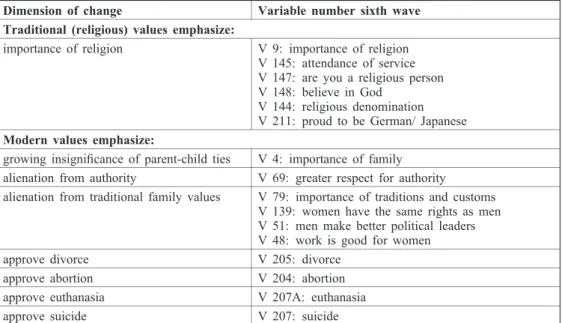
Our first hypothesis is that the process of modernisation has led to a shift from reli-gious to secular and from traditional to modern values. According to Ronald Inglehart and Christian Welzel, traditional values emphasize the importance of religion, parent-child ties, deference to authority and traditional family values. People who embrace these values also reject divorce, abortion, euthanasia and suicide. These societies have high levels of national pride and a nationalistic outlook. Modern values have the opposite preferences to tradi-tional values. Modern societies place less emphasis on religion, traditradi-tional family values and authority. Divorce, abortion, euthanasia and suicide are seen as relatively acceptable.9) Table 1 summarizes the variables of the sixth wave, which correspond to the shift from religious to secular and from traditional to modern values. The religious to secular values are: the importance of religion (V 9), the frequency of service attendance (V 145),
8) These were: first wave: 1981-84; second wave: 1990-94; third wave: 1995-98; fourth wave: 1999-04; fifth wave 2005-09; sixth wave: 2010-14.
a person’s religiousness (V 147), belief in God (V 148) and, finally, a religious denomina-tion (V 144). Since tradidenomina-tional societies have a rather nadenomina-tionalistic outlook, the degree of national pride (V 211) sheds light on this attitude.
In the shift from traditional to modern values, we expect parent-child ties to become increasingly insignificant as measured by the importance of the family (V 4); decreasing levels of deference to authority (V 69); alienation from traditional family values as meas-ured by the importance of traditions and customs (V 79); alienation from traditional gender roles, such as the approval of equal rights for women (V 139); alienation from the view that men make better political leaders (V 51); and approval of job opportunities for females (V 48). Further, we expect greater approval of divorce (V 205), abortion (V 204), euthanasia (V 207A) and suicide (V 207).
As Ingelhart (e.g. 1990) and others pointed out, value change takes place through generational replacement. We therefore hypothesise that the trend in value change can be most clearly observed within the younger cohorts, which is why we analyse the age group up to 29 years separately as a control group.
Table 1: Value change from religious, traditional to secular, modern values and corresponding variables
Dimension of change Variable number sixth wave Traditional (religious) values emphasize:
importance of religion V 9: importance of religion V 145: attendance of service V 147: are you a religious person V 148: believe in God
V 144: religious denomination V 211: proud to be German/ Japanese
Modern values emphasize:
growing insignificance of parent-child ties V 4: importance of family alienation from authority V 69: greater respect for authority alienation from traditional family values V 79: importance of traditions and customs
V 139: women have the same rights as men V 51: men make better political leaders V 48: work is good for women approve divorce V 205: divorce
approve abortion V 204: abortion approve euthanasia V 207A: euthanasia approve suicide V 207: suicide
Source: Own compilation on basis of the WWS. Note: Variables WWS sixth wave.
2.2.2 Dimensions of change and corresponding variables: From modernity to “second modernity”
As can be seen from the above, the “second modernity” should lead to more individu-alism, to increased preference for post-material and cosmopolitan values as well as to a decline in faith in progress and a critical view of progress. The three main attitudes/
dimensions, (1) independence/ autonomy, (2) growing cosmopolitan values and (3) growing post-material values/ approval of reflexive modernity measure these shifts.
With regard to individual autonomy, we distinguish between three important dimensions, namely individual self-determination, independence within the family and indi-vidual responsibility (Pollack/ Pickel 1999: 469). Two educational goals, namely approval of expression (V 22) and rejection of obedience (V 21) measure individual self-determination. Independence within the family includes rejection of the assumption that men have more rights to a job when jobs are scarce (V 45), rejection of the view that being a housewife is just as fulfilling as working for pay (V 54) and rejection of the view that when a mother works, the children suffer (V 50). Individual responsibility can be judged by the degree to which people accept the view that people should be more responsi-ble for themselves instead of expecting the government to be (V 98) and by the degree to which they oppose the idea that the state should ensure equal income for all (V 137). Growing cosmopolitan values favour out-group trust (Welzel 2010), which is meas-ured by individuals’ level of trust in people they met the first time (V 105), their trust in people of another religion (V 106) and their trust in people of another nationality (V 107). We further expect decreasing levels of national belonging, i.e. more people see themselves as world citizens (V 212) rather than as primarily German or Japanese (V 214).
The shift from material to post-material values is measured by the four-item Inglehart index (Y 002). This index measures whether people tend to be more materialistic or post-materialistic by asking them about the priorities they believe their government should have in the future, building an index from their answers. The respondents were asked to select their first priority from the list, followed by a second. A respondent selecting two material-ist items (out of a lmaterial-ist of two materialmaterial-ist and two post-materialmaterial-ist items) is classified as a materialist; if the first item is materialist and the second post-materialist (or the other way round), the person is classified as “mixed”, etc. (see Inglehart 1977).10) The associated change to a more reflexive view of modernity can be measured by the degree to which the respondents think that protecting the environment should be given priority, even if this causes slower economic growth and some loss of jobs, or whether they think economic growth and creating jobs should be given top priority, even if the environment suffers to some extent (V 81).
Table 2: Value change in the “second modernity” and corresponding variables
Dimension of change Variable number sixth wave (1) Independence/ Autonomy
(a) self-determination/ autonomy
(private dimension independence) Educational goals:V 22: Approval of self-expression
V 21: Rejection of authority and discipline (=obedience) 10) It should be noted that the index has received considerable attention and critical discussion in the
(b) Independence within the family (private dimension of
independence)
(c) individual responsibility (public dimension of independence)
V 45: men have more rights to a job (reject) V 54: being a housewife (reject)
V 50: when females work, children suffer (reject) V 98: People should take more responsibility vs. the
government should
V 137: state should ensure equal income vs. should not
(2) Growing cosmopolitan values Growing out-group trust:
V 105: trust in people met for first time V 106: trust in people of another religion V 107: trust in people of another nationality Rejection of national belonging:
V 212: see myself as world citizen vs. V 214: see myself as German/ Japanese
(3) Growing post-material values/
approval of reflexive modernity Y 002: Inglehart indexV 81: importance of environment vs. economy
Since the different dimensions of value change are not parallel one to the other (Pollack/ Pickel 1999: 469f.), we will analyse the dimensions separately rather than build-ing an overall index on value change.
2.2.3 Attitudes towards the political system and corresponding variables
An overview of the state of affairs regarding democracy is a requirement in order to compare the political attitudes in Germany and Japan. The population’s recognition of the political system and the leadership (belief in the legitimacy of the democratic order) is one of the basic prerequisites for the functioning and the existence of a democratic order, since this is normatively and institutionally linked to the voluntary consent of the ruled. In this respect, there is a direct connection between the acceptance of and the stability of demo-cratic rule (Lipset 1962: 64). Surveys of the degree of political support for the existing political community, the political order and its regime as well as for the bearers of political authority can empirically measure belief in the political order’s legitimacy. In this respect, we distinguish between (1) specific, output-related support for current political actors, such as Chancellor Merkel or Prime Minister Abe, which can vary in the short term, and (2) diffuse support, which expresses itself independently of output and allows statements on long-term support for the regime principles and basic institutions (Easton, 1965, see also Schmidt 2005b, Westle 1989). Following such an interpretation, we limit our investigation to basic institutions and the ideals and principles of democracy, namely trust in the govern-ment (V 115), political parties (V 116) and parliagovern-ment (V 117), as the most important political institutions of a given democracy.
Concerning the main ideals and principles of democracy, we want to determine how important a democratic system (V 130) and choosing leaders via fair elections are (V 133), to assess the importance of being governed democratically (V 140) and to investigate sat-isfaction with the own democratic system (V 141).
Value change in advanced industrial societies is associated with a shift from “old politics”, i.e. conventional political participation, such as voting in national elections (V 227) or in local elections (V 226), to “new politics”. Here it is also interesting to see whether or not the respondents mention a party for which they would vote (V 228). Among the “new” forms of political actions, the WWS asked whether the respondents had ever signed a petition (V 85), joined a boycott (V 86), attended a peaceful demonstration (V 87), joined a strike (V 88) or joined any other form of protest (V 89).
Table 3: Overview of attitudes towards the political system and corresponding variables
Dimension of change Variable number sixth wave
Trust in basic institutions V115: government V116: political parties V117: parliament Trust in regime principles and
democracy V130: having a democratic system is importantV133: people should choose a leader in fair elections V140: the importance of being governed democratically V141: satisfaction with a democratic system
“Old politics” V226: voting in local election V227: voting in national elections V228: which party would you vote for? “New” politics V 85: signing petition
V 86: joining boycotts
V 87: attending peaceful demonstrations V 88: joining strikes
V 89: any other act of protest
3. Empirical data and findings
3.1 Attitudes towards the political systemAs can be seen from the previous, it is useful to investigate the state of democracy, as this helps us to assess the quality and health of the two democracies. Thereafter we can start investigating the value change in Germany and Japan and the associated social atti-tudes. We start off by analysing trust in the basic democratic institutions.
3.1.1 Trust in basic institutions
The overall trust in the basic institutions is low in both countries and the percentage of those who do not trust is higher than those who do trust in nearly all the cases. Specifically, trust in the political parties is very low in both countries. Nevertheless, trust in the parliament, parties and government in Germany is higher than in Japan, although we do not observe a clear tendency towards more or less trust over the course of time. In Japan, trust in all the institutions is not only lower, but is also lowest among the younger genera-tion.
Table 4: Trust in basic institutions
Government (Political parties) 1994-98 1999-04 2005-09 2010-14 Age up to 29*
Germany Yes n.d. n.d. 25% (13) 44% (24) 51% (26) No n.d. n.d. 71% (83) 54% (74) 47% (71) Japan Yes 30% (17) 26% (16) 29% (17) 24% (15) 16% (10) No 63% (75) 69% (75) 65% (75) 64% (71) 74% (77) Parliament 81-84 89-93 1994-98 1999-04 2005-09 2010-14 Age up to 29 Germany Yes 53% 49% n.d. 34% 28% 44% 47% No 46% 52% n.d. 62% 68% 54% 50% Japan Yes 28% 29% 24% 20% 21% 19% 13% No 68% 81% 68% 72% 71% 67% 74%
Note: n.d.: No data. *Here, and in the following tables, the age group up to 20 years is calculated on the basis of the sixth wave. Figures in parentheses ( )=Trust in political parties.
3.1.2 Attitudes towards democracy
The Germans have a more positive attitude towards democracy than the Japanese. A full 94% indicate that democracy is a good way of governing the country compared to only 72% of the Japanese respondents. More Germans state that it is important to live in a country that is governed democratically (mean 8.9 vs. 8.3 in Japan) and that their country is governed democratically. The same is true regarding whether or not it is an essential characteristic of democracy that leaders should be chosen in fair elections. It is noteworthy that democracy has even less support among young Japanese, since the figures show that they support democracy less than the overall population does.
Table 5: Trust in regime principles and democracy
Having a democratic system
Germany 1994-98 1999-04 2005-09 2010-14 Age up to 29 Is good n.d. 90% 88% 94% 90% Is bad n.d. 5% 6% 5% 7% Japan Is good 79% 80% 78% 72% 64% Is bad 8% 7% 10% 10% 16% Trust in democracy 2005-09 2010-14 Age up to 29 Mean (1) (2) (3) (1) (2) (3) (1) (2) (3) Germany 9.1 6.5 9.2 8.9 7.2 9.1 8.5 7.1 9.1 Japan 8.5 6.9 8.1 8.3 6.7 7.9 7.3 5.8 7.7
Note: n.d.: No data. The mean shows the distribution of the average value for this question, excluding missing values. (1): Importance of being governed democratically; 1=Not at all important; 10=absolutely
important. (2) How democratically is this country governed today?; 1=not at all democratic; 10=com-pletely democratic. (3) People should choose leaders in fair elections; 1=Not an essential of democracy; 10=an essential of democracy.
3.1.3 Participation in “old” politics
Concerning the question “which party would you vote for?”, the percentage of those in Germany who mention a party is far higher than in Japan. More than 70% of Germans choose a party; in Japan, this percentage amounts to only to 48% and among the younger generation in Japan to only 32%. Regarding voting in national elections, more people in Germany indicate that they always vote in national elections; however, in reality, the per-centage of non-voters is much higher than shown in this table. It has been argued that many people — at least of the older generations — say they intend to vote because this is their civic duty. Among the younger generations in Germany and in Japan, the percentage of those who say that they never vote is much higher than among the overall population. Further, in Japan, approximately one-third of the young respondents say that they vote in neither national, nor in local elections.
Table 6: Participation in “old” politics
Which party would you vote for?
Germany 1989-93 1994-98 1999-04 2005-09 2010-14 Age up to 29 No party named n.d. n.d. n.d. 30% 27% 29% Party named n.d. n.d. n.d. 68% 72% 70% Japan No party named 33% 57% 37% 32% 50% 68% Party named 67% 43% 54% 67% 48% 32%
Voting in national and local elections
Vote in elections: national level Vote in elections: local level Germany 2010-14 Age up to 29 2010-14 Age up to 29
Always 69% 59% 61% 44% Never 12% 21% 17% 27% Japan Always 58% 31% 58% 31% Never 10% 31% 9% 29% Note: n.d.: No data.
3.1.4 Participation in “new” politics
With regard to participation in “new” politics, only a minority in both countries says that they would never do so in nearly all cases. There is no clear tendency over time, with the exception of joining a strike. The percentage of those who would never join a strike has declined significantly in both countries and is lowest among the young generation. With regard to other “new” forms of politics, the young generation in Germany is more inclined to do so, while the Japanese youngsters are, surprisingly, not.
Table 7: Participation in “new” politics
% Would never do 1981-84 1989-93 1994-98 1999-04 2005-09 2010-14 Age up to 29 Signing a petition Germany 17% 11% n.d. 13% 17% 24% 20% Japan 13% 11% 11% 6% 11% 19% 30% Joining in boycotts Germany 57% 49% n.d. 44% 47% 52% 48% Japan 32% 31% 23% 22% 33% 42% 55%
Attending lawful/peaceful demonstrations
Germany 50% 31% n.d. 29% 32% 30% 25%
Japan 48% 44% 40% 38% 46% 41% 49%
Joining strikes
Germany 81% 75% n.d. 76% 74% 45% 33%
Japan 64% 60% 60% 58% n.d. 52% 53%
Any other act of protest
Germany n.d. n.d. n.d. n.d. 30% 42% 39%
Japan n.d. n.d. n.d. n.d. 9% 41% 49%
Note: Percentage “would never do”. N.d.: No data.
3.1.5 Summary: Attitudes towards the political system
In conclusion it can be said that trust in the political institutions is somewhat higher in Germany than it is in Japan, but, specifically, trust in the (existing) political parties is very low in both countries. Nevertheless, many more Germans mention a party, while the Japa-nese do not. With regard to democracy, the JapaJapa-nese show far less support and, specifically, the younger generation seems to be rather sceptic about democracy, at least about the current state of democracy. As we might have expected, the younger generation in both countries is more alienated from “old” politics, but only the German youngsters are more inclined to engage in “new” forms of politics, while the Japanese young ones are not.
3.2 Statistical analysis: Value change from tradition to modernity
3.2.1 Religion and secularism
Regarding religion, the respondents were asked how important religion is for their life. In both countries, a clear majority mention that religion is “not very important” or “not important at all” for their life. Overall, in the sixth wave, 61% of Germans and 67% of Japanese mention that religion is not of specific importance, while only 38% of Germans and 19% of the Japanese consider religion to be “very important” or “rather important” for their life. Interestingly, over the course of time, religion has become more important in both countries, even though it is not yet a significant trend.
In both countries, the importance of religion is much lower for the younger respond-ents. In the age group up to 29 years, only 24% of Germans and 11% of Japanese mention that religion is somehow important for their life, while approx. 75% in both countries
consider religion not very important for their life.
Table 8: Religious values
Importance of religion
Germany 1989-93 1999-04 2005-09 2010-14 Age up to 29
Very important/ rather important 34% 35% 34% 38% 24% Not very important/ not at all 58% 60% 53% 61% 76%
Japan
Very important/ rather important 17% 19% 18% 19% 11% Not very important/ not at all 68% 68% 72% 67% 74%
Are you a religious person?
Germany 1981-84 1989-93 1999-04 2005-09 2010-14 up to 29
A religious person 58% 50% 52% 43% 49% 29% Not a religious person 22% 29% 34% 38% 38% 53%
A convinced atheist 3% 5% 7% 13% 10% 14%
Japan
A religious person 24% 21% 23% 21% 21% 13% Not a religious person 52% 51% 52% 54% 50% 45% A convinced atheist 11% 9% 12% 12% 11% 13%
Believe in God (% Believe)
Germany 72% 57% 62% 58% 63% 52%
Japan 39% 37% 44% 35% 41% 44%
Attendance of service
Germany 1981-84 1989-93 1999-04 2005-09 2010-14 up to 29
More than once a month 37% 30% 29% 19% 19% 10%
Once a year* 24% 25% 28% 26% 28% 37%
Less often** 38% 45% 43% 34% 51% 54%
Japan
More than once a month 13% 15% 11% 12% 10% 6%
Once a year* 29% 57% 63% 65% 64% 51%
Less often** 45% 29% 26% 22% 26% 43%
Note: *incl. special holidays; **incl. practically never/ never.
Concerning the question whether the respondents consider themselves a “religious per-son”, a “non-religious person” or an “atheist”, comparatively more Germans mention that they are religious. However, this percentage has shrunk over the course of time from nearly 60% to 50%, while the percentage of non-religious persons has almost doubled from 22% to 38%. With the German reunification, the percentage of atheists in the population grew, as many East Germans were non-religious. The percentage of non-religious people has also grown significantly over the 2000s. Numerous scandals within the Roman Catholic Church might have contributed to this. In Japan, only around one quarter of the respond-ents regards themselves as religious, while half of them do not. In the age group up to 29 years, a much lower percentage in both countries describes themselves as religious, namely
29% in Germany, and 13% in Japan.
Overall, many more Germans mention that they believe in God (63% compared to 41% in Japan); over the course of time, however, this percentage has decreased by 10% in Germany, while in Japan the percentage has remained more or less stable. The youngsters in both counties are comparably less religious.
Even though we witness tendencies towards secularization in Germany, it seems the Germans are more religious than the Japanese. However, the interpretation of the data is not easy, since 18% of the Japanese (28% of the younger generation) in the sixth wave mention that they do not know whether or not they believe in God. Similar observances can be made with regard to the question whether one considers oneself a religious person or not. The problem may be one’s interpretation of the word religion. It we look at the question “Do you belong to a religion or religious denomination? If yes, which one?”, Shintôism was not included in the list, which may have fostered the interpretation that Shintô is not a religion. This might explain why 53% of the Japanese indicate that they do not belong to a religion.
A good indicator of the importance of religion in Western countries is the level of service attendance.11) In Germany, the percentage of those attending a service often, i.e. more than once a month, decreased considerably from 37% in the first wave to 19% in the sixth wave, while the percentage of those attending less than once a month has increased markedly in the same period from 38% to 51%. Among the younger respondents, this share amounts to 54%.
In Japan, the results are somewhat different. Even though the percentage of those “attending often” has dropped from 13% to 10%, the biggest change can be seen among those who attend less often. This share dropped from 45% in the first wave to 26% in the sixth wave; while the percentage of those who attend only on special holidays increased markedly from 29% to 64% during the same period. Over all, the young ones seem to attend less often (43%).
Since there is a correlation between religiousness and national pride, it is not surpris-ing that the Germans, who seem to be more religious (with shrinksurpris-ing tendencies) than the Japanese, are more proud to be German than the Japanese are to be Japanese. However, this percentage has – in contrast to the religiousness – even grown from 59% in the first wave to 70% of all the respondents in the sixth wave and amounts to 73% of the younger respondents in the sixth wave. In Japan, there is no clear tendency, but the percentage of younger Japanese who are proud to be Japanese is lower (54%) than among all the respondents (65%).
Table 9: Proud to be German/ Japanese
Germany 1981-84 1989-93 1999-04 2005-09 2010-14 Age up to 29
Proud/ quite proud 59% 61% 61% 66% 70% 73% Not very/ not at all 29% 26% 29% 23% 19% 15%
Japan
Proud/ quite proud 61% 62% 54% 57% 65% 54% Not very/ not at all 33% 32% 39% 37% 26% 33%
3.2.2 Traditional and modern values
In both countries, the family is very important for the respondents. The percentage of those who considered the family “important” or “very important” for their life varies between 94% (second wave) and 96% in Germany (sixth wave) and between 97% and 98% in Japan. Among the younger generation, this percentage is even higher in both tries (Germany: 97%; Japan: 98%). However, it should be noted that other Western coun-tries show a similar pattern concerning the importance of family. Overall, the importance of the family in Germany is somewhat lower than it is in Japan.
Concerning desirable future changes, the respondents were asked, whether “greater respect for authority” would be “a good thing”, “a bad thing”, or whether they “don't mind”. In Germany, the percentage of respondents who answer “a good thing” is surpris-ingly high and has increased considerably over the course of time, namely from 44% in the third wave to 59% in the sixth wave. This (together with rising levels of national pride) might explain the growing preferences for right-wing populist parties like the AfD in Germany. Even half of the respondents of the younger generation find that more authority would be “a good thing”. In Japan, on the contrary, only 5% of all the respondents and ⚗ % of the younger generation answer “a good thing”, while the vast majority consider more authority to be a “bad thing”.
Table 10: Greater respect for authority
Germany 1981-84 1989-93 1999-04 2005-09 2010-14 Age up to 29 Good thing 44% 36% 44% 47% 59% 50% Bad thing 34% 41% 33% 24% 17% 19% Japan Good thing 6% 5% 4% 3% 5% 7% Bad thing 76% 75% 74% 80% 76% 74%
Attitudes towards tradition were only queried in the fifth and sixth wave. In Germany, the approval of tradition is higher than it is in Japan. On a scale between 1 and 6, the respondents were asked to classify whether a person for whom tradition and customs, which are handed down by one’s religion or family, is important is much like themselves, or not at all like themselves. In this case, the mean in the sixth wave amounted to 3.1 in Germany and 4.1 in Japan, which was slightly lower than in the fifth wave (Germany: 3.3;
Japan: 4.3). The younger generations in Germany and Japan have slightly less preferences for tradition than the overall society (Germany: 3.5; Japan: 4.5).12)
Attitudes towards “Having a job is the best way for a woman to be an independent person” were only queried in the sixth wave. In Germany, 71% agree with this question; in Japan, however, only 49% of the respondents agree. Approval is lower among the males in both countries (Germany: 59%; Japan: 42%). There is a significant difference between the younger generations: Only 30% of those aged up to 29 agree with this question in Japan, which is approx. 20% lower than among the overall population. In contrast, in Germany, this percentage is a bit higher among the young ones than among the overall respondents and amounts to 73%.
Asked whether or not it is a characteristic of democracy that women have the same rights as men, nearly all Germans (mean 9.2 fifth wave; 9.1 sixth wave)13)mention that it is. In Japan, support for this view is much lower and has even decreased over time, namely from 8.3 in the fifth wave to 7.2 in the sixth wave. Among the young ones, this percentage is somewhat higher (7.7), which contradicts their previous attitude.
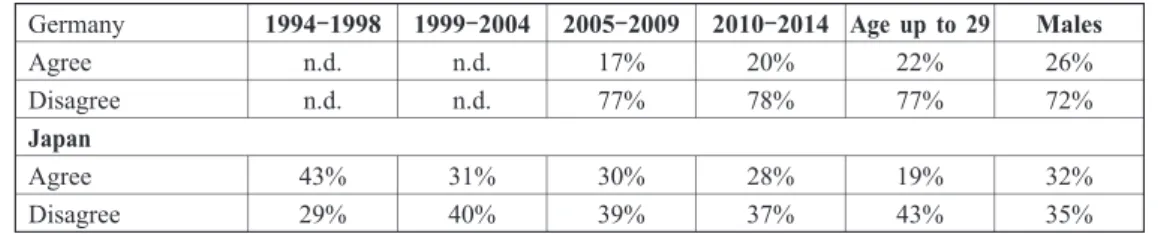
The statement “on the whole, men make better political leaders than women do” was queried in different waves. In Germany, a clear majority rejected this view in all the waves, with even 72% of males rejecting it. Conversely, in Japan, this view finds more support, but with a shrinking tendency. Over the past 20 years, the percentage of those who support this view has fallen by 15%. Among the younger cohorts, only a minority of 19% support this view. However it should be noted that Japan’s party in power, the LDP, is male dominated and frustration with politics is primarily frustration with male politics. Shrinking support for this view is therefore not necessarily an expression of more support for gender equality.
Table 11: Men make better political leaders
Germany 1994-1998 1999-2004 2005-2009 2010-2014 Age up to 29 Males
Agree n.d. n.d. 17% 20% 22% 26% Disagree n.d. n.d. 77% 78% 77% 72% Japan Agree 43% 31% 30% 28% 19% 32% Disagree 29% 40% 39% 37% 43% 35% Note: N.d.: No data.
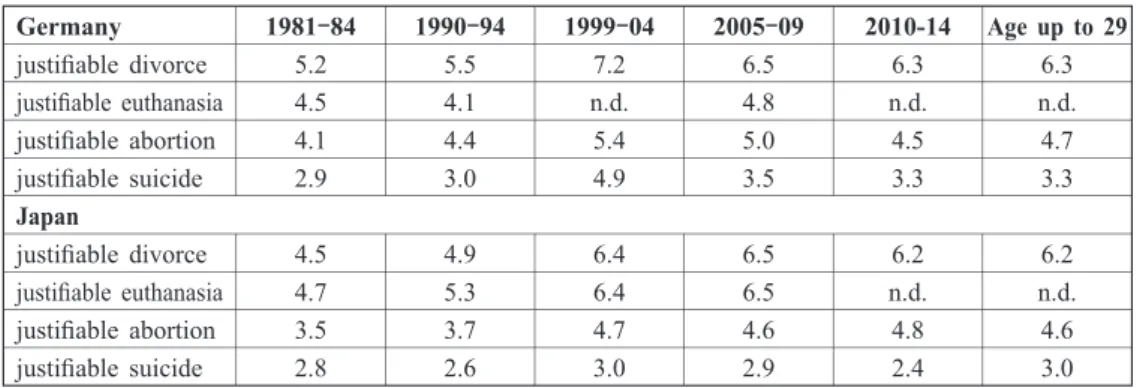
There is not much variation between the German and the Japanese respondents regard-ing their approval of divorce, euthanasia, abortion and suicide. Divorce receives the highest rate of approval, while suicide receives the lowest. There is not much variation between
12) 1=very much like me; 6=Not at all like me.
13) 1 means “not at all an essential characteristic of democracy” and 10 means it definitely is “an essential characteristic of democracy”.
the younger generations in both countries either.
Table 12: Support for divorce, euthanasia, abortion and suicide
Germany 1981-84 1990-94 1999-04 2005-09 2010-14 Age up to 29 justifiable divorce 5.2 5.5 7.2 6.5 6.3 6.3 justifiable euthanasia 4.5 4.1 n.d. 4.8 n.d. n.d. justifiable abortion 4.1 4.4 5.4 5.0 4.5 4.7 justifiable suicide 2.9 3.0 4.9 3.5 3.3 3.3 Japan justifiable divorce 4.5 4.9 6.4 6.5 6.2 6.2 justifiable euthanasia 4.7 5.3 6.4 6.5 n.d. n.d. justifiable abortion 3.5 3.7 4.7 4.6 4.8 4.6 justifiable suicide 2.8 2.6 3.0 2.9 2.4 3.0
Note: ⚑ = “never justifiable”; 10 = “always justifiable”. N.d.: no data.
3.2.3 Summary: Value change from tradition to modernity
To summarise the findings concerning the value change from tradition to modernity, it can be concluded that in both countries, the number of those who indicate that religion is not important is much greater than the number who indicate that it is. Many Germans and Japanese never attend religious services, or only on special occasions. A majority of Ger-mans indicate that they believe in God, but with shrinking tendencies. Among the younger generation, the tendency towards secularism is even stronger. However, in Germany, national pride is greater than it is in Japan and has not only grown over the course of time, but is even more pronounced in the younger generation.
The greatest differences between the two countries are in terms of authority and gen-der equality: Many more Germans state that respect for authority is important compared to the Japanese and this is a growing tendency. Conversely, Germans show a far higher level of acceptance of gender equality. With regard to tradition, Germans regard themselves more as traditionalist compared to the Japanese. This, too, seems to be a growing trend. Overall alienation from authority and tradition is higher in Japan, while alienation from traditional family values is higher in Germany.
3.3 Statistical analysis: Value change from modernity to “second modernity”
3.3.1 Independence/ autonomy
With regard to “self-determination and autonomy”, the respondents were asked to indicate which of the qualities (on a list) that children should be encouraged to learn at home, they consider especially important. Only 13% of the German respondents in the sixth wave mention “obedience”, and only 5% of the Japanese. Even though only a minor-ity of Germans choose obedience, 17% of the younger Germans mention “obedience” compared to only 5% of the younger Japanese. 39% of Germans choose “self-expression” and 34% of Japanese. Specifically, 50% of the younger Japanese find that self-expression is
an important educational goal. On the whole, we find a rejection of authority and discipline in both countries as well as a preference for autonomy.
Table 13: Self determination and autonomy
1981-84 1989-93 1999-04 2005-09 2010-14 Age up to 29
Germany 15% 23% 12% 14% 13% (39%) 17% (43%)
Japan 6% 10% 4% 5% 5% (34%) 5% (50%)
Note: % obedience mentioned; figures in parenthesis ()= % self-expression mentioned
“Independence within the family” is significantly lower in Japan than in Germany, which resembles the findings concerning gender equality. Only 14% of Japanese reject the view that when jobs are scarce, men have more right to a job than women, compared to 60% of Germans. The combination of motherhood and a job is more accepted, since 60% of Japanese and 82% of Germans do not think that children suffer when a mother works. However, the view that “Being a housewife is just as fulfilling as working for pay” is very widespread in Japan, since only ⚘% reject this view. In Germany, 43% of the respondents do not agree with this view.
Table 14: Independence within the family
When jobs are scarce, men should have more right to a job than women
% Reject 1989-93 1999-04 2005-09 2010-14 Age up to 29
Germany 54% 54% 62% 60% 65%
Japan 23% 20% 17% 14% 24%
When a mother works for pay, the children suffer
Germany 16% 32% 40% 65% 82%
Japan 23% n.d. n.d. 55% 60%
Being a housewife is just as fulfilling as working for pay
Germany 41% 53% 52% 43% 54%
Japan 13% 9% 6% 8% 8%
Note: n.d.: no
data-With regard to “individual responsibility” we receive a mixed picture: In Japan, more people share the view that the government should take more responsibility (mean 7.3) compared to Germany (mean 6.3); however, more Germans indicate that the state should ensure people have an equal income (mean 5.6 compared to 4.0 in Japan).
Table 15: Individual responsibility
Mean 1989-93 1994-98 1999-04 2005-09 2010-14 Age up to 29
Germany n.d. 6.2 n.d. 6.5 6.3 (5.6) 6.5 (6.2) Japan 6.8 n.d. 6.7 7.0 7.3 (4.0) 7.3 (4.5)
Note: People should take more responsibility vs. government should take more responsibility; People should take more responsibility to provide for themselves (=⚑) vs. the government should take more responsi-bility to ensure that everyone is provided for (=10). n.d.: no data. Figures in parentheses (): The state should ensure people’s incomes are equal. ⚑ = Not an essential characteristic of democracy; 10 = an essential characteristic of democracy.
3.3.2 Cosmopolitan values
As can be seen from the previous, emancipative values establish a civic form of mod-ern individualism that favours out-group trust and cosmopolitan orientations towards others. Out-group trust is more pronounced in Germany than it is in Japan. Even though a majority of Germans indicate that they do not trust others when meeting them for the first time, a majority do trust people of another religion or nationality. In Japan, more respond-ents indicate that they do not trust people they meet for the first time, or people of another religion or nationality. Age does not make a big difference in terms of out-group trust.
Table 16: Cosmopolitan values
Germany 2005-09 2010-14 Age up to 29 (1) (2) (3) (1) (2) (3) (1) (2) (3) Yes 25% 36% 36% 31% 50% 52% 24% 50% 51% No 71% 49% 49% 67% 41% 41% 74% 41% 43% Japan Yes n.d. n.d. n.d. 9% 10% 13% 8% 10% 14% No n.d. n.d. n.d. 73% 51% 47% 80% 54% 49%
Note: n.d.: no data. (1) Trust in people met for the first time; (2) Trust in people of another religion; (3) Trust in people of another nationality.
If values are changing in a cosmopolitan direction, we expect further declining feel-ings of national belonging and, instead, the adoption of a cosmopolitan worldview. The findings in this dimension are mixed: In Germany, the percentage of those who see themselves as world citizens is lower than it is in Japan, but the percentage has grown significantly from 48% in the fifth wave to 60% in the sixth wave. Among the younger generation a full 68% see themselves as world citizens. In Japan, this percentage is higher, but has not grown over time. Interestingly, among the younger generation, the percentage is 10% lower than among all the respondents. Nearly all Japanese (91%) see themselves as Japanese compared to Germans (86%). However, in Germany this percentage has some-what increased over the past two waves.
Table 17: Rejection of national belonging
2005-09 2010-14 Age up to 29 Germany (1) (2) (1) (2) (1) (2) Yes 48% 82% 60% 86% 68% 84% No 43% 14% 36% 12% 26% 14% Japan Yes 72% 93% 71% 91% 61% 83% No 5% 1% 5% 1% 9% 4%
Note: (1) See myself as a world citizen; (2) See myself as a citizen of Germany/ Japan.
3.3.3 Post-materialist values and reflexive modernity
between the countries. In Germany, this percentage rose from 16% in the first wave to 26% in the second, but fell to 17% thereafter, picking up again to 22% in the sixth wave. In Japan, however, only 7% consider themselves post-materialists, which has shown a shrinking tendency since the third wave, even though this percentage among the younger generation in Japan was a little higher than among all the respondents.
Table 18: Inglehart four-item index
Germany 1981-84 1989-93 1999-04 2005-09 2010-14 Age up to 29 Materialist 25% 14% 27% 18% 20% 17% Post-materialist 16% 26% 17% 19% 22% 21% Japan Materialist 29% 21% 17% 21% 19% 13% Post-materialist 4% 1% 9% 8% 7% 10%
With regard to a reflexive view of modernity, the findings are very clear too: A majority of Germans indicate that protecting the environment is more important than eco-nomic growth, and this percentage grew markedly from the fifth to the sixth wave. This view is even more pronounced among young Germans. Conversely, the percentage of those in Japan who think that jobs and economic growth are more important is higher, even among the younger generation. Interestingly, in Japan, the percentage of those who indicate that protecting the environment is more important fell by 13% between the fifth and sixth waves. Since the survey was carried out in 2010, well before the Fukushima nuclear disas-ter of March 2011, it would be indisas-teresting to see whether this has led to changes in the trend.
Table 19: Protecting the environment vs. economic growth
Germany 1991-98 2005-09 2010-14 Age up to 29
Protecting the environment n.d. 34% 48% 50% Economic growth and creating jobs n.d. 46% 39% 38%
Japan
Protecting the environment 31% 36% 23% 25% Economic growth and creating jobs 27% 23% 30% 27%
Note: n.d.: no data.
3.3.4 Summary: Value change from modernity to “second modernity”
With regard to autonomy or self-determination, we find a rejection of authority and discipline in both countries. However, “independence within the family” was far more pronounced in Germany than in Japan. We received a mixed picture with regard to “indi-vidual responsibility”: In Japan, more people share the opinion that the government should take more responsibility. On the other hand, more Germans indicate that the state should equalise people’s income. When it comes to cosmopolitan values, the picture is also a mixed one. Out-group trust is much more pronounced in Germany and we witness a
ten-dency towards a self-image as a world citizen. In Japan, the percentage of those who consider themselves world citizens is higher, but shows a shrinking tendency. Feelings of national belonging are high with great stability in both countries; however, among the young ones in both countries feelings of national belonging are somewhat lower than among the overall population.
We find the most significant differences between the countries within the post-materialist dimension and that of a reflexive society. In Germany, there is a clear tendency towards post-materialism and a reflexive society, while we witness no such trend in Japan.
4. Conclusion: Major findings and key differences between
Germany and Japan
Value change and social modernisation are inextricably linked. Starting with modern-isation theory and the associated value change, we thus tried to obtain insights into funda-mental values that shape the political attitudes in Germany. We compared the findings with those of Japan to identify the major peculiarities shaping the German view of life and politics. We first investigated attitudes towards democracy, since belief in a democratic order and its major institutions is a major precondition for a given democracy’s stability. Germans still show a high level of acceptance of the democratic order, especially when compared to Japan. It is noteworthy that the younger generation in Japan is espe-cially very sceptic about democracy. The political parties score worst in both countries and participation in “old” politics has declined, especially among the young, but support for “new” forms of political actions has somewhat increased – at least in Germany. We might therefore conclude that the stability of the political order in Germany is not yet “endangered”, even though there is a demand for new political actors and new forms of political action. In Japan, on the other hand, the prospects for democracy are rather gloomy.
Regarding the value change associated with modernity, we found strong tendencies towards secularization in both countries, even though the overall importance of religion is somewhat higher in Germany. However, in Japan, the interpretation of religion remains rather unclear, since Shintôism does not appear on the list of religious faiths. In Germany, the greater importance of religion is paralleled by the greater importance of national pride, which has grown recently and is more pronounced among the younger generation.
With regard to modern values, we also find a growing demand for more authority and tradition in Germany over the last surveys. This u-turn towards more traditional values and the rising levels of nationalism might be the result of the migrant waves and Islamist threats. The u-turn may also explain the increasing support for new right-wing populist parties. It seems that these findings should be interpreted as part of the cleavage, which occurs in the “second modernity”, between those who want to protect their national culture
and citizenship and those with a more cosmopolitan world view rather than between tradi-tional and modern values in the common understanding.
However, in Germany, we find greater alienation from traditional family values and a much higher level of acceptance of gender equality than in Japan. The student movements of the 1960s played a major role in advocating modern values, like gender equality and women’s participation in politics. In Japan, the student movements did not have the same societal impact, which might explain why civic movements such as the citizen networks,14) which women often led in Japan, did not lead to political changes. Since the roles of females are still seen within the family rather than within the public sphere, the political engagement of women ekes out a niche existence. In Germany, conversely, specifically within the Green Party, females have gained increased political representation.
Within the three dimensions of value change occurring in the “second modernity”, we find a growing rejection of obedience and approval of self-expression, in both countries. However, independence within the family is more distinctive in Germany. With regard to individual responsibility, the nation state still seems to play a role in the determining of social equality in both countries.
Cosmopolitan values, too, play a more important role in Germany, since out-group trust is more pronounced here. Even though more Japanese see themselves as world citi-zens, this percentage is not growing and is lower among the young generation. In Germany, we obtain a different picture, since the share of “world-citizens” is growing and is especially high among the young generation. However, feelings of national belongings are not shrinking in response.
When it comes to post-materialistic values and reflexive society, the differences between Japan and Germany are quite obvious. In Germany, we find many more people supporting post-materialist values and a majority seems to be in favour of a reflexive view of modernity. Since value change within this dimension is seen as crucial for the rise of new social movements, new parties and civic engagement, Japan lacks a major precondi-tion for changes in such a direcprecondi-tion. As menprecondi-tioned earlier, it was the shock effect of the oil crisis and the Chernobyl atomic disaster that triggered this value change in many Western societies. In Japan, however, the oil crisis had no effect on economic growth, which lasted until the burst of the “bubble-economy” in the 1990s and Chernobyl was too far away to have the same effects as it did in Europe. Since the sixth wave of the WWS was conducted in Japan in 2010, it would be interesting to see whether the Fukushima nuclear disaster of 2011 initiated value change in the direction of a more post-materialist, reflexive view of modernity and a corresponding rise in citizen engagement.
The student movement of the 1960s, which continued in the 1970s, promoted value change in Germany, Not only did this value change lead to a regime change, but also to
the formation of new social movements and the foundation of new parties, like the Green Party. This has to date largely contributed to Germany scoring better in terms of democ-racy when compared to Japan. However, the analysis of the value change in Germany has also shown rising levels of nationalism and tradition as well as demands for more authori-tarianism among the German population, which has recently led to the formation of new right-wing populist parties, fuelling fears about the future of representative democracy and party politics in Germany.
References
Beck, Ulrich 1986. Risikogesellschaft. Auf dem Weg in eine andere Moderne. Frankfurt a. M.: Suhrkamp. Beck, Ulrich / Wolfgang Bonß/ Christoph Lau (2001): „Theorie reflexiver Modernisierung – Fragestellun-gen, Hypothesen, Forschungsprogrammen“. In: Die Modernisierung der Moderne. Eds.: Ulrich Beck and Wolfgang Bonß. Frankfurt/ Main: Suhrkamp: 11-59.
Beck, Ulrich/ Anthony Giddens/ Scott Lash (1994): Reflexive Modernization: Politics, Tradition and Aes-thetics in the Modern Social Order. Redwood City: Stanford University Press.
Bourdieu, Pierre (1977): Outline of a Theory of Practice. Cambridge University Press: London. Brand, Karl-Werner/ Detlef Büsser/ Dieter Rucht (1984): Aufbruch in eine andere Gesellschaft: Neue
soziale Bewegungen in der Bundesrepublik. Frankfurt/ New York: Campus.
Bündnis 90/ Die Grünen (2002): Die Zukunft ist grün. Grundsatzprogramm 2002. http://www.gruene.de/ fileadmin/user_upload/Dokumente/Grundsatzprogramm-2002.pdf (approached 25.11.2016).
Bürklin, Wilhelm/ Russel J. Dalton (1994): „Das Ergrauen der Grünen“. In: Wahlen und Wähler: Analysen aus Anlaß der Bundestagswahl 1990. Eds.: Hans-Dieter Klingemann and Max Kaase. Opladen: West-deutscher Verlag: 264-302.
Dalton, Russel J. (2000): “Citizen attitudes and political behaviour”. In: Comparative Political Studies 33/ 6-7: 912-940.
Easton, David (1965). A System Analysis of Political Life. New York: John Wiley.
Gill, Stephen (1995): „Globalization, Market Civilization, and Disciplinary Neoliberalism“. In: Millennium: Journal of International Studies 24/ 3: 399-423.
Harvey, David (2005): A Brief History of Neoliberalism. New York: Oxford University Press.
Hildebrandt, Kai/ Russell S. Dalton (1977): „Die neue Politik: Politischer Wandel oder Schönwetterpolitik“. In: Politische Vierteljahresschrift (Nov.): S. 230-256.
Inglehart, Ronald (1977): The Silent Revolution: Changing Values and Political Styles Among Western Pub-lics. Princeton: Princeton University Press.
Inglehart, Ronald (1990): Cultural Shift in Advanced Industrial Society. Princeton: Princeton University Press.
Klein, Markus/ Jürgen W. Falter (2003): Der lange Weg der Grünen, München: Beck.
Kriesi, Hanspeter (2005): “The Mobilization of the Political Potentials Linked to European Integration by National Political Parties”. Paper presented at the conference on „Euroscepticism“, Amsterdam, 1.-2. July 2005.
Kriesi, Hanspeter/ Grande, Edgar/ Dolezal, Martin/ Helbling, Marc/ Hoglinger, Dominic/Hutter, Swen/Wuest, Bruno, eds. (2012): Political Conflict in Western Europe. Cambridge: Cambridge University Press. Lipset, Seymour M. (1962): Soziologie der Demokratie, translated into German by Otto Kimminich,
Neuwied and Berlin: Luchterhand.
Lipset, Seymour M./ Stein Rokkan (1967): “Cleavage Structures, Party Systems and Voter Alignments: An Introduction“. In: Party Systems and Voter Alignments: Cross National Perspectives. Eds.: Semour M. Lispset and Stein Rokkan. New York: The Free Press: 1-64.
Maruyama Masao (2007): Freiheit und Nation in Japan. Ausgewählte Aufsätze 1936-1949. Bd. 1. Ed.: Wolfgang Seifert. München: Iudicium.
Pollack, Detlef/ Gert Pickel (1999): “Individualisierung und religiöser Wandel in der Bundesrepublik Deutschland.“. In: Zeitschrift für Soziologie 28/6: 465-483.
Ritzer, George (1983): „The McDonaldization of Society“. In: Journal of American Culture 6 (1): 100-107. Robertson, Roland (1995): “Glocalization: Time-Space and Homogeniety-Heterogeneity“. In: Global
Mod-ernities. Eds.: Mike Featherstone and Roland Robertson. London: Sage: 25-44. Rosenau, James (1990): Turbulence in World Politics. Brighton: Harvester Wheatsheaf.
Rousseau; Jean Jacques (1762): The Social Contract or Principles of Political Right, trans. G. D. H. Cole. http://www.constitution.org/jjr/socon.htm
Schmidt, Carmen (2001): Sozialstruktur und politisches System in Japan: Gesellschaftliche Konfliktlinien, politische Repräsentation und die Formierung der Wählerschaft. Marburg: Tectum. 2nd. ed. 2012. Schmidt, Carmen (2005a): „Lokale Bürgernetzwerke in Japan: Möglichkeiten und Perspektiven einer
bürgernahen „neuen“ Politik“. In: Veröffentlichungen der Forschungsstelle Japan 17: 5-41. Schmidt, Carmen (2005b): „Die Verdrossenheit wächst: Japans politisches System in der
Legitimitätsk-rise?“. In: Japan aktuell 1: 26-35.
Schmidt, Carmen (2009): “Japan’ s New Party System: Characteristics and Future Perspectives”. In: Germany and Japan after 1989: Reform Pressures and Political System Dynamics. Eds.: Roland Czada and Kenji Hirashima. Tôkyô: University of Tôkyô Press: 1-17.
Schmidt, Carmen (2015): „Die Transformation der Moderne: Konfliktstruktur und politisches System im Umbruch“. In: Wirtschaft, Krise und Wahlverhalten. Eds. Heiko Giebler and Aiko Wagner. Baden Baden: Nomos: 361-395.
Schmidt, Carmen (2016): “A comparison of civil religion and remembrance culture in Germany and Japan”. In: Asian Journal of German and European Studies 1/1: 1-21.
Welzel, Christian (2010), "How Selfish Are Self-Expression Values: A Civicness Test". In: Journal of Cross Cultural Psychology 41: 1-23.
Westle, Bettina (1989). Politische Legitimitä – Theorien, Konzepte, empirische Befunde. Baden-Baden: Nomos.