Abstract
This paper introduces the present situation of lesson study in Japan, and examines the state of lesson study in Social Studies. Using the case of a politics unit from 6th grade Social Studies in elementary school, this is followed by implementation of a Social Studies lesson study, showing the present situation and ultimate goal of Social Studies lesson study in Japan, and clarification of issues related to Social Studies lesson study.
The state of lesson study
Lesson study in schools and school subject specific lesson study
Lesson study is carried out on a regular basis in schools in Japan. It can be implemented in various forms (Hirayama 1997, National Association for the Study of Educational Methods 2007). Lesson study is done for purposes such as improvement of the teacher’s teaching, improvement of the school’s competence in education, and improvement of children’s academic proficiency, and is used for pre-service and in-service professional development and for reform of school management, class management, educational evaluation, student guidance and educational guidance, in line with subject education reform.
It is possible to classify lesson study in Japan into two types, namely, general lesson study and school subject specialized lesson study. In general lesson study, some attention is paid to subject content, but the main focus tends to be on points such as how learning is organized, learning groups, and educational guidance. In contrast, school subject specific lesson study deals with materials and learning content, closely examining elements related to the school subject and study of these elements, together with inquiry focused on Norio Ikeno
Hiroshima University
Elementary Social Studies Lesson Study in Japan:
Case Study of a 6th Grade Politics Unit
the appropriateness of teaching and learning. The key characteristic of school subject specific lesson study is that it is based on materials, and focuses on the teaching and learning of the particular subject.
School subject specific lesson study
When conducting lesson study as general educational research, it is not only teaching materials that are studied, but also aspects related to human relations. For example, research is conducted on how children behave vis-à-vis the teacher and other children in the lesson, or how the teacher structures the class, or what criteria she/he uses to organize and manage the class, in terms of learning groups and their regulation, or educational aspects such as educational guidance.
However, school subject specific lesson study is research that mainly analyzes points related to materials rather than human relations aspects. In other words, the school subject in question focuses attention on studying materials that form part of that subject. In the case of Japanese, the focus of interest would be language, in the case of Mathematics, it would be numbers, and in the case of Social Studies, it would be society. Like lesson study in other school subjects, the aim in Social Studies lesson study is to clarify the educational effectiveness of teaching materials. Social Studies lesson study examines teaching using materials related to society and the subsequent results. The state of Social Studies lesson study
Social Studies lesson study
When it comes to school subject specific lesson study, Social Studies lesson study differs from Japanese and Mathematics in one important respect. This is that teaching materials for Social Studies are less defined than for other school subjects. Teaching materials for Japanese are language, and for Mathematics are numbers. Few people would argue with this point. For Social Studies, though, the number of people who would agree that teaching materials should be society, even among people involved in education, is not that great. The majority of people would subscribe to the view that teaching materials should cover subdivided fields such as geography, history, politics, economics and culture, rather than the bigger field of society as a whole. In the present situation, it is difficult to claim that there is consensus among those in the field of education that the society should be the teaching materials of Social Studies. Having said that, there are many points shared in common among those involved, and so it is possible to discuss Social Studies across these subdivisions. There is a need to discuss Social Studies education across these lines based on understanding of each other’s premises. If this is not
done, people may end up talking about units, classes and evaluation based on differing premises in their views of Social Studies.
All teachers have something to say about Social Studies classes. For example, take the teaching plan and a lesson based on this plan. Any lesson study would include discussion about the teaching plan and the lesson. In most cases, the order of discussion in a lesson study is decided and followed. However, a structured lesson study can be divided into the stages of planning, implementation and achievement. Below, an overview of these three stages will be provided for Social Studies lesson study, from study of the planning stage dealing with the structure of the lesson plan itself, through study of the lesson stage in line with implementation of the lesson plan, to study of the stage of results of the lesson plan, in terms of what children have acquired.
At the planning stage of Social Studies lesson study, the fundamental point for examination is consideration of the Social Studies teaching plan. The suitability of the Social Studies teaching plan is thoroughly examined. This is done by looking at how well the plan fits with the three points of aims, teaching materials, and children’s understanding. Discussion considers whether the set teaching plan is congruent with the aims, materials and children’s understanding, whether the structure of the plan is logically consistent, why it is this way and whether it should be this way.
Lesson study at the implementation stage involves recording the lesson, examining how it was conducted and how the children learned. This leads to evaluations about whether teaching was conducted properly and whether learning was appropriate. Grasping the lesson itself is impossible to do even with (multiple) video cameras. Based on a particular aim, what can be recorded is recorded. Choices are made. In many cases, the main points of the teacher’s talk and children’s talk are collected, and recorded in chronological fashion. For individual elements as well, the appropriateness of the teacher’s teaching and children’s learning is examined from the three perspectives of aims, teaching materials and children’s understanding.
Social Studies lesson study at the achievement stage involves using records of the lesson and children’s acquisition and achievement outcomes to evaluate the lesson. This stage involves identification of the good points and problematic points of the designed and prepared teaching plan and implemented lesson, examining whether children actually achieved the goals of the class, to what extent, what proportion of the class achieved the level, and reasons and grounds for these outcomes.
Different aspects are thoroughly examined in each of these three stages, but appropriateness is usually employed as the evaluation criterion,
with logical consistency and justifiability employed for evaluation of individual parts.
Social Studies lesson study: Individual lesson study and comprehensive lesson study
Social Studies lesson study comprises the three stages described above. These three stages examine different aspects in detail, but evaluation criteria are logical consistency and justified appropriateness. Social Studies classes themselves are a single mass. General Social Studies lesson study takes these classes as a whole as the issue, and questions their rationality and justifiability. Two types of Social Studies lesson study
The terms “individual lesson study” and “comprehensive lesson study” used above may not be familiar terms.
Comprehensive Social Studies lesson study examines factors such as unit aims, content and methods from the macro-level perspective of the subject, the unit or Social Studies overall, evaluating the justifiability of the existence and model of the lesson or the unit (Ikeno 2012). Individual Social Studies lesson study examines individual elements (questioning, teaching materials, learning content) in depth from the micro-level perspective of goal achievement, closely investigating the structure of lesson elements and their consistency (see Ikeno 2013).
Through conducting these two types of Social Studies lesson study, it is possible to research lessons, and also to study the state of units and materials as objects in themselves. School subject specific lesson study is not simply a matter of deciding whether a particular lesson is good or bad. It is important to question the lesson, units related to it and the state of the subject as a whole as well as elements and activities within the lesson. Examining why teaching is being done in this way, or why this kind of learning is important, and explaining this in a justified way from the perspectives of the unit and the subject in the pursuit of better teaching and learning is the role and the mission of school subject specific lesson study.
Against this background, the next question is how to actually implement individual Social Studies lesson study and comprehensive Social Studies lesson study. One actual lesson study case is described below to clarify this question.
Case study of elementary school Social Studies lesson study: Politics and our daily life: What’s the Constitution?
6th grade politics lesson case
taught by Ms. Okinishi in the 6th grade Social Studies politics unit, “Politics and
our daily life: What’s the Constitution?” at Hiroshima University Elementary School. The Lesson is the sixth of seven lessons in this unit (Okinishi 2016).
Ikeno (2016) has already conducted lesson study of this class. The discussion below is based on the study conducted. While discussing Ms. Okinishi’s Social Studies lesson study, the processes and issues of Social Studies lesson study will be explained.
Research methods for Social Studies lesson study
Social Studies lesson study always begins with a proposed issue. Individual Social Studies lesson study (Ikeno 2013) and comprehensive Social Studies lesson study (Ikeno 2012) are then conducted in line with this proposed issue.
Within this context, focusing on Ms. Okinishi’s class, this paper explicates the significance and issues in the issue proposed by Ms. Okinishi, based on the two types of Social Studies lesson study, making clear the theme of “what is required of Social Studies in global society” that was being pursued by Ms. Okinishi (2016).
Proposed issue and its structure
Based on the unit subtitle “What’s the Constitution?”, Ms. Okinishi’s proposed issue was: “Were activities to make students think about the relationship between the Constitution of Japan and us as national citizens effective in raising interest in politics in our country and deepening understanding of the Constitution of Japan?”(Okonishi 2016, p.33) This proposed issue includes the following three elements:
1. Were activities to make students think about the relationship between the Constitution of Japan and us as national citizens effective?
2. Did these activities stimulate children’s interest in our country’s politics? 3. Did these activities deepen understanding of the Constitution of Japan,
based on sovereignty of the people? 1 is evaluated through 2 and 3. Method of Social Studies lesson study
Social Studies lesson study for Ms. Okinishi’s lesson was thus based around individual school subject specific lesson study related to (2) and (3), and comprehensive school subject specific lesson study on (1). In terms of order, Social Studies lesson study started from individual Social Studies lesson study and progressed to comprehensive Social Studies lesson study, combining two into one.
Individual Social Studies lesson study
introduced by Ms. Okinishi in this lesson was “activities to make students think about the relationship between the Constitution of Japan and us as national citizens”(Okinishi 2016, p.33). Following Tsujimura (2014), Ms. Okinishi did this by questioning the three-way relationship between a lion, a cage, and a teddy bear (us)(Okinishi 2016, p.34).
This activity responds to the questions of what the Constitution is and how it functions. What Tsujimura shows through the three-way relationship is two types of views of the Constitution. One view is seeing the Constitution as setting aims for the state, with rules that national citizens have to follow (that bind national citizens), while the other view sees it as protecting the freedom and rights of national citizens (Tsujimura 2014, p.23).
B) Ikeno’s response to the proposed issue as an observer. Ikeno’s response was to say “Yes, it was so” to (2) and (3). Explanation of the grounds and reasons for this response are an issue for individual school subject specific lesson study.
All observers could recognize sustained and heightened interest in relation to (2). For example, children exhibited a much more enthusiastic response than would be evident in textbook and source book activities responding to the questions, “What is the Constitution? What is the relationship between the Constitution and us?” from the diagram of the three major principles of the Constitution in the textbook(Okonishi 2016, p.32).
C) Children’s reactions and consideration of reactions. The problem is depth of understanding of (3). Resulting from (2), what did children understand and to what extent, and can that be said to be deep?
A summary of children’s replies is shown in Table 1.
Table 1 Responses from children and lawyer
Respondent Us Cage Lion
C1 Prison Police
C2 Constitution
C3 National citizens Constitution Anti-public
C4 Restrictions Government
C5 Constitution Dictator
Lawyer Outsiders Constitution Political power (Note: Blank spaces indicate that no clear response was given)
Children imagine and examine the issue with the teddy bear as us, the cage as the Constitution, and the lion as power. In this process of examination, there are five aspects of learning. (1) relationship between us and the cage, (2) relationship between the cage and the lion, (3) seeing the cage as the Constitution, (4) the role of the cage, (5) awareness of the three-way relationship between us, the cage and the lion. Among these aspects, the most important points are seeing the cage as the Constitution, and the viewpoint of the cage and the lion from our perspective. If these two are achieved, children could understand that the role of the cage is to inhibit power, and that the Constitution functions as a device to protect us and our rights as national citizens. This is shown in the presentations of C1 to C6.
D) Depth of understanding. So how deep is this? To answer this question, it is necessary to examine possible responses to the question of what the Constitution is, and to confirm the kind of quality required in Ms. Okinishi’s proposed issue. Based on this, the level of attainment of children’s actual replies can be considered in depth.
How can the question of what the Constitution is be decided as levels? This is not a clearly defined issue. It is an issue that is connected to so-called ways of seeing and thinking about society, or decision-making about social ways of seeing and thinking (see Matoba et al. 2013).
In other words, it is not possible to determine unequivocal answer to questions such as “what is xxx?”, or “what is the relationship between xxx and yyy?”, or “why does that exist?” Such questions can be answered at various levels or stages, and it is necessary in Social Studies learning to design and implement plans that raise children’s levels, and to make judgments about children’s actual levels.
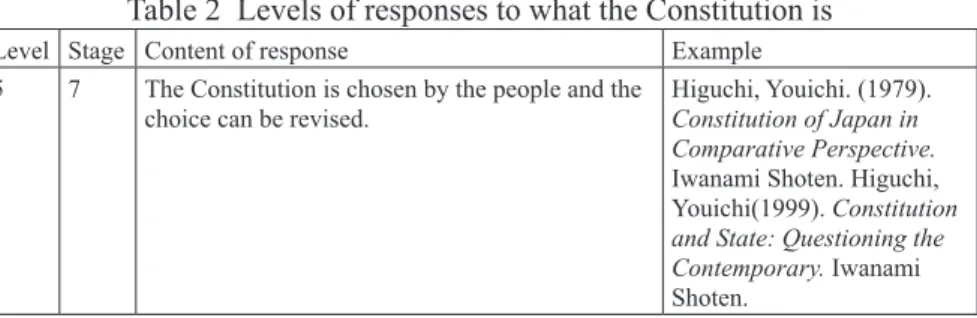
Here, levels of responses to the question of what the Constitution is will be examined and summarized, making the assumption that teaching materials have been researched though a perusal of easily accessible recent literature.
Table 2 Levels of responses to what the Constitution is
Level Stage Content of response Example 5 7 The Constitution is chosen by the people and the
choice can be revised. Higuchi, Youichi. (1979). Constitution of Japan in Comparative Perspective.
Iwanami Shoten. Higuchi, Youichi(1999). Constitution
and State: Questioning the Contemporary. Iwanami
4 6 The Constitution can be seen as setting aims for the state, with rules that national citizens have to follow (that bind national citizens), or as protecting the freedom and rights of national citizens (p.23).
Tsujimura, Miyoko. (2014).
Constitutional Reform Debates in Comparative Perspective: Situating the Constitution of Japan.
Iwanami Shoten. 3 5 Based on constitutionalism, the Constitution
“recognizes that people in the world have many differences in fundamental values in ways of living and the meaning of the world, but builds a basic framework to facilitate convenience of daily life and fair distribution of costs in spite of this, aiming to realize individuals’ freedoms in how they live while ensuring rational discussion and decision-making processes for the benefit of society as a whole (p.iii).
Hasebe, Yasuo. (2006). What
is the Constitution? Iwanami
Shoten.
4 The Constitution is “the structure of principles of state governance currently in existence” (p.6) and “the basis of government” (p.209).
Hasegawa, Masayasu. (1994). Constitution of
Japan (3rd edition).
Iwanami Shoten. 2 3 The Constitution of Japan has three principles
(sovereignty of the people, pacifism and respect for fundamental human rights).
The Story of the New Constitution.
2 The Constitution of Japan is formed from the three aspects of principles, human rights and government bodies (p.235).
Shibutani, Hideki. (2014). Invitation to the
Constitution: Revised Version. Iwanami Shoten.
1 1 The Constitution is the preamble and articles of
the Constitution of Japan. Constitution of Japan
Results are shown above in Table 2. This Table 2 is divided into 5 levels and 7 stages. These range from Level 1, Stage 1, stating that the Constitution is the preamble and articles of the Constitution of Japan, as designated and explained in textbooks and source books, to Level 5, Stage 7, which is Higuchi’s (1979, 1999) statement that the Constitution is chosen by the people and the choice can be revised. Levels and stages are configured for gradual stage-by-stage improvement, from the matter-of-fact reply of the Constitution being what it is, to more complex replies referring to ways of seeing, and from there to possibilities for alternative change in relation to its content, role and significance.
According to Table 2, Tsujimura’s (2014) approach, which was used by Ms. Okinishi(2016, p.34, 37), is shown as Level 4, Stage 6. Compared to usual implementation of elementary school Social Studies, it is immediately possible to understand the height of the level of the proposed issue set by Ms. Okinishi.
Study of the Constitution in elementary school Social Studies is most often done at Levels 1 or 2, Stages 1, 2 or 3. Compared to this, the response to the question about Constitution used by Ms. Okinishi after researching teaching materials was Level 4, Stage 6, which is extremely high level.
Children understand this level of content very well. There were two reasons why this learning was successful. The first is that the content was disguised. Logical, conceptual explanations of the Constitution itself were not required, as the focus was on enabling children to think about the role of the Constitution through the disguised relationships between the teddy bear, the cage and the lion. The second is viewpoint. As a matter of course, the supposition of teddy bear = us helps children to naturally create a way of seeing the other, and finding ways of interacting. Once children identify the teddy bear with us, it becomes easy for them to see the cage and lion from that perspective. Then, if the cage is seen as a prison, they see the question of who is imprisoning whom, and this makes it easy to think about the relationship between the cage and national citizens (us). They can also infer that the lion is power.
Due to these two reasons, children were able to acquire what Ms. Okinishi had intended. The response from Child A illustrates this well: “I could understand about the system of politics very well because politics was shown using dolls in a play”(Okonishi 2016, p.32).
By researching Tsujimura (2014) for teaching materials and introducing this into this unit, it was possible to enable children to easily understand the Constitution at Level 4, Stage 6. This was done by dramatizing the content to be understood, and making the most of the effectiveness of this approach, so that children easily achieved understanding at a high level.
Comprehensive Social Studies lesson study
Summarizing the discussion of individual Social Studies lesson study, it can be said that (1) the activities aroused children’s interest in politics in our country and (2) the activities, based on the principle of sovereignty of the people, enabled children to attain deep understanding of the Constitution of Japan at Level 4, Stage 6.
Making an evaluation on “(1) were activities to make students think about the relationship between the Constitution of Japan and us as national citizens effective?” for comprehensive Social Studies lesson study based on these results, it can be said that they were effective. However, this judgment need to be confirmed in two respects. One is examination of what children actually attained through this unit. The other is the resulting nature of what is required in global society, as reflected in Ms. Okinishi’s aim.
A. Attainment of children. Ms. Okinishi showed the notebooks of two children after the unit had been completed(Okonishi 2016, p.36). Child C had written, “[From doing this unit], I thought that young people also have to express their own opinions to government”. Child D wrote, “I thought that more people have to have their own opinions for the country to be moved by the power of national citizens and to protect them, and that it is important for these to be reflected in politics”. Both statements emphasize the need for people to create politics by forming their own ideas, and reflect the fact that the children themselves were developing the ability to be able to form their own ideas in this way. These two children had attained the goal, but it is unclear whether this was true of the whole class.
B. What is required in global society. Ms. Okinishi’s view of Social Studies is that it should promote “seeing things from multiple perspectives” and “comparing Japan with other countries’ Constitutions and thinking about how we should engage with the Constitution of Japan, because developing children’s ability to make independent decisions themselves in global society is linked to the Social Studies aim of ability to form the nation state and society, or capacity to create society”(Okinishi 2016, p.32). If this is what is required of Social Studies in this kind of global society, then it can be claimed that what children achieved was the forming of opinions as an element of capacity to form society.
Conclusion on Social Studies lesson study
The two dimensions of individual and comprehensive school subject specific lesson study were conducted on the class proposed by Ms. Okinishi and the unit it belonged to. The results can be summarized as follows.
From the viewpoint of individual Social Studies lesson study, the lesson proposed by Ms. Okinishi was composed of elements to develop capacity to form society, and two children attained the level of forming opinions.
In terms of results of comprehensive Social Studies lesson study, a structure of human development was evident in the lesson, but it is unclear whether all children achieved. This attainment level was partial attainment of capacity to form society.
It is necessary to investigate the substance of capacity to form society as required in global society, and to correlate this with levels and stages of ways of seeing and thinking about society.
Conclusion: current state and issues in school subject specific lesson study This paper pointed out the two types of school subject specific lesson study, linking
these two types of lesson study through a case study of Social Studies lesson study of Ms. Okinishi’s class at Hiroshima University Elementary School, and explained the important aspects to be considered in terms of carrying out Social Studies lesson study. This can be summarized in the following way.
1. Two types of school subject specific lesson study
There are two types of school subject specific lesson study. These are comprehensive school subject specific lesson study and individual school subject specific lesson study. Comprehensive school subject specific lesson study examines unit aims, content and methods from the macro-level perspective such as the unit or the subject. In contrast, individual Social Studies lesson study examines individual elements of the lesson (questioning, teaching materials, activities, learning content) in depth from the micro-level perspective of goal achievement.
2. Interrelation of two types of school subject specific lesson study The two types of school subject specific lesson study can be carried out independently of each other, or they can be linked with each other. The lesson study above was conducted individually, and so this paper adopted the method of interrelating the two types. The interrelationship can work along two routes, from comprehensive to individual, or from individual to comprehensive. Here, the method of progressing from individual school subject specific lesson study to comprehensive school subject specific lesson study was demonstrated, pointing out the “subject viewpoint”, which plays an important role in judgments about school subject specific lesson study. The “subject perspective”, which is essential to school subject specific lesson study, was clarified in the frame of Social Studies.
3. Subject viewpoint
If it is taken that school subject specific lesson study of Social Studies is Social Studies, the characteristics of Social Studies appear most clearly in the subject viewpoint. The subject viewpoint functions in lesson planning and implementation including unit design, goal setting and selection of teaching materials and cases, and in evaluation design and implementation, including evaluation objectives, standards (criteria) and learning attainment of students, as well as in improvement of lessons and evaluation.
References [Japanese]
Hasebe, Yasuo. (2006). What is the Constitution? Tokyo:Iwanami Shoten.
Hasegawa, Masayasu. (1994). Constitution of Japan (3rd edition). Tokyo:Iwanami Shoten.
Higuchi, Youichi. (1979). Constitution of Japan in Comparative Perspective. Tokyo:Iwanami Shoten.
Higuchi, Youichi. (1999). Constitution and State: Questioning the Contemporary. Tokyo:Iwanami Shoten.
Hirayama, Mitsuyoshi (ed.) (1997). Lesson Study through Qualitative Research Methods. Kyoto: Kitaoji Shobo.
Ikeno, Norio. (2012). Developing Capacity to Form Society through Elementary School Social Studies: Lesson Study and its Methods. School Education. Issue 1140, July 2012, pp.32-37.
Ikeno, Norio. (2013). Individual Lesson Study for Developing Capacity to Form Society in Elementary Social Studies. School Education. Issue 1154, October 2013, pp.32-37. Ikeno, Norio. (2016). Elementary School Politics Unit Lesson Study: The Requirements of
Global Society. School Education. Issue 1187, July 2016, pp.38-43.
Matoba, Masami, Ikeno, Norio & Yasuno, Isao (2013). The New Mission of Social Studies. Osaka: Nihon Bunkyou Shuppan.
National Association for the Study of Educational Methods. (2009). Lesson Study in Japan
(Part 1, Part 2). Tokyo:Gakubunsha.
Okinishi, Keiko.(2016). Development on Social Studies Lesson Plan in the Global Society: on the 6th unit of the Constitution, School Education. Issue 1187, July 2016, pp.30-37.
Shibutani, Hideki. (2014). Invitation to the Constitution: Revised Version. Tokyo:Iwanami Shoten.
Tsujimura, Miyoko. (2014). Constitutional Reform Debates in Comparative Perspective: