Dynamic Sustainability Assessment towards the Integrated
Coastal Zone Management
※Ken’ichi N
akagami※※, Taisuke Y
oshioka※※※,
Ryoya T
omeNo※※※※, Norio o
baTa※※※※※Abstract
The Japanese term Satoumi inspires us to pursue sound coastal zone governance by taking sustainable development into consideration with the establishment of Satoumi in the coastal sea. The popular ICZM (Integrated Coastal Zone Management) shows us the potential approach toward a coastal area with harmonious interaction between humans and the natural environment. To realize sustainable fisheries, comprehensive sustainable values are also estimated due to their powerful role in representing the relationship between humans and coastal zones, and supporting
※This paper is written by following papers.
[1] NAKAGAMI Ken’ichi, OBATA Norio, TAKAO Katsuki, UEHARA Takuro, SAKURAI Ryo, OTA Takahiro, YOSHIOKA Taisuke, NIU Jia, Dr.CHEN Xiaochen, MINEO Keito, The Integrated Coastal Zone Management Based on Ecosystem Services, EMECS11-Sea Coasts XXVI Joint Conference, ICM and Satoumi Special Session, 23, Aug. 2016, AZIMUT Hotel St.Petersburg [ 2 ] NAKAGAMI Ken’ichi, YOSHIOKA Taisuke, TOMENO Ryoya, Dynamic Sustainability
Assessment to Realize the Sustainable Coastal Sea (In Japanese), Policy Science, Vol.25, No.3, March, 2018
※※ Specially Appointed Professor, College of Policy Science, Ritsumeikan University
※※※Senior Researcher, Research Organization of Open Innovation and Collaboration, Ritsumeikan
University
※※※※ Graduate Student, Graduate School of Policy Science, Ritsumeikan University ※※※※※ Specially Appointed Professor, College of Policy Science, Ritsumeikan University
© The Policy Science Association of Ritsumeikan University:
sustainability of a Satoumi system. To evaluate the comprehensive sustainable values of Satoumi, the framework of dynamic sustainability assessment was designed. The first step means the state of sustainability of the environment, economy and society. The second step means the management ability of sustainability composed of diversity, vulnerability and resilience. And the third step means the will of sustainability composed of management, capability and social consensus. This paper examines sustainability towards regional revitalization through the case studies of Hinase Bay, Shizugawa Bay and Nanao Bay, using dynamic sustainability assessment. The assessment results were Hinase Bay (A), Shizugawa Bay (B), and Nanao Bay (A). Shizugawa Bay which is known as one of the famous Satoumi sites, saw the destruction of its fishermen and their ships from the Great East Japan Earthquake in March, 2011, when the brutal loss caused by the tsunami was witnessed. Finally, how the dynamic sustainability assessment related to Satoumi, and its effectiveness in regional revitalization, was emphasized.
Introduction
In fishing villages in Japan, a maritime nation, depopulation and the super aging phenomenon are proceeding rapidly, which is an unprecedentedly serious situation. To consider conservation and maintenance of coastal zones as not only an issue for fishermen, who account for 0.2% of the Japanese population, but an issue for all Japanese people, it may be effective to socially realize the concept of “Satoumi,” by aiming to cooperate with local residents. The Japanese term Satoumi refers to coastal zones that have sound bio-productivity and biodiversity through human activities, which are composed of five elements. Three factors support the conservation and revitalization of coastal zones, i.e. material circulation, ecosystems and communication. Another two facilitate the realization of Satoumi, i.e. the field of activities and the executors of this activity.
Twenty years have passed since the concept of Satoumi was defined by Dr. Tetsuo Yanagi in 1988 as, “coastal zones where biodiversity and productivity improve through human activities,”
and the concept is now recognized in and out of Japan and is accompanying many practices 1).
The concept is being taken further with the ideal future of the earth with limited resources should be realized by aiming for both naturally and socially a sustainable world, by decreasing the transportation costs of products and carbon emissions through “Chisan-chisho,” which means the
wise utilization of natural and human resources of Satoyama and Satoumi 2).
So far, there have been many discussions about how to utilize coastal zones, however how to realize the sustainable management of coastal zones is also necessary. From this perspective, evaluation of the ecosystem services of coastal zones, as well as the pursuit of approaches for sound ICZM (integrated Coastal Zone Management), is urgently required.
When implementing Satoumi, we aim for sustainability of people’s lives through revitalizing the local community, but the goal is not guaranteed. To assess regional sustainability, it is required
to establish that the assessment method is based on three elements of Satoumi, that it is, clean, productive and prosperous. In this document, we offer a dynamic sustainability assessment method of Satoumi, as well as the ideal picture of sustainable coastal zones, through the assessment of the target areas, Hinase Bay, Shizugawa Bay and Nanao Bay.
1. Review of projects concerning coastal zone exploitation
1.1. Industrial development and consequent pollution in coastal zonesAs the processing trade is the core of Japanese industry, convenient and fast shipping of raw materials and end products is of vital importance. Coastal areas fully meet this requirement. According to the National Comprehensive Development Plan formulated in 1962, the Seto Inland area was proposed to be the base for heavy and chemical industries. With the promulgation of the New Law for Construction of Industrial Cities in 1962, 15 areas were appointed as Intensive Industrial Development Areas, including southern parts of Okayama Prefecture, Touyo (Enime Prefecture), Oita, and Tokushima. Then with the implementation of the Act of Industrial Development in 1964, six more areas were further appointed, including Harima, Bingo, and the Shunan area. One third of all the appointed areas are within the territory of the Seto Inland. With large-scale industrialization, land reclamation boomed, which to a great extent changed the landscape of the Seto Inland Sea area. At the same time, undesirable phenomena started to occur, such as red tides (eutrophication) due to pollutants, the pileup of sludge, scarcity of dissolved oxygen in water, and the discovery of teratogenic fish. All these put the Seto Inland Sea on the verge of dying. As a countermeasure, the Law Concerning Special Measures for Conservation of the Environment of the Seto Inland Sea was enacted, aiming at cutting down pollution. As the first step, strict regulation on industrial pollution was introduced, including the control of the total amount of pollution discharged from 1979, reduction of phosphorus pollution from 1980, and the reduction of nitrogen pollution from 1994. Simultaneously, improvement of the sewer system was carried out. As a result, the coverage rate greatly increased from 24% in 1973 to 63% in 2000.
In terms of the decrease of tidal flats and seaweed beds, this directly led to the loss of habitats and breeding sites for various biota, and consequently degraded regional biodiversity. As a matter of fact, the area of eelgrass beds shrank by 70% from 1960 to 1990, and the area of tidal flats dropped
by 50% from 1898 to 2006 3).
1.2. Pursuit of richness of the sea
The Law Concerning Special Measures for Conservation of the Environment of the Seto Inland Sea enacted in 1973 , was recently amended in 2015. Regarding the basic principles for conservation
of the Seto Inland Sea, the importance and rational utilization of the Seto Inland Sea were once again emphasized. As an area with unparalleled scenic beauty and invaluable fishery resources, the Seto Inland Sea should not only be enjoyed by the current generation, but also be passed down to future generations for their welfare. In order to achieve this goal, we as human beings must exploit the Seto Inland Sea in a sustainable way, which maximizes the value of the Seto Inland Sea without sacrificing its richness in its landscape function, bio-productivity and biodiversity. It is recommended to promote various stakeholders’ activities for the conservation, revitalization, and creation, of that richness in the coastal zones of the Seto Inland Sea. The strategy for the conservation of the Seto Inland Sea is apparently different from what it was, as in this amendment we could see the basic viewpoint of keeping the richness of the Seto Inland Sea from the perspective of Satoumi. This fundamental change points to a new direction that could turn the Seto Inland Sea from its current eutrophic state back to a sea-like oligotrophic state.
1.3. Establishing sustainable fishing villages
In 2012, fishery production was about 380,000 tons, of which 170,000 tons came from fishing and the rest from aquaculture. Fishing and aquaculture production peaked in 1985, and gradually declined thereafter. One of the reasons was the decrease of seagrass beds and tidal flats, as well the subsequent degradation of living environments for fish. A dramatic decline was particularly seen for sardines, anchovy, sand eels and clams. Fishery production even seemed to get better for a while when the sea turned eutrophic, but eventually it dropped. Then fishermen started to realize the vital importance of seagrass beds for fishing. Based on a survey of the Hinase Bay area of Okayama Prefecture in 1940, the eelgrass beds had an area of 590 ha. However it’s area rapidly had decreased to 82 ha and then 12 ha respectively, in 1971 and 1985. With the endeavor to recover this by the relevant stakeholders in recent decades, it has improved to 80 ha in 2007, 200 ha in 2011, and 250
ha in 2014. This effort shows a promising future for a coastal zone with richness 4). However, it was
reported by the Japan Policy Council that the human population in that area is going to experience a dramatic decrease. For example, from 2010 to 2040, the population of young women (20 – 39 years old) is estimated to decrease by 60.1%. How then to continue this effort and maintain the
sustainability of the coastal zone has become a new concern5).
2. Framework of sustainability assessment of Satoumi
2.1. Meanings and limits of sustainability assessmentsThe concept of Satoumi is that the value of the sea is not a simple correlation between coastal zones and people, and that it is important for many people, not only stakeholders such as fishermen,
to expand the area of activities, and to argue how to establish activity entities. By doing so, the diversity (material circulation, ecosystems and communication) and sustainability (activity areas and activity entities) of Satoumi are assured. The increase in diversity leads to the development of the fishing industry which is on the wane. To aim for community development during the rapid acceleration of depopulation and aging, it is fundamental that diversity and sustainability strengthen regional characteristics, and to do that, it is necessary to establish an implementation process. If we define Satoumi as “clean, productive and prosperous,” it is necessary to organize the current elements in consideration of each area’s situation. “Clean” reflects “material circulation” and “ecosystems” in diversity, “productive” reflects “activity areas,” “activity entities” in sustainability, and “prosperous” reflects “communication” in diversity.
We organize the elements of sustainability assessments of Satoumi as follows based on the environment, society and economy.
“Clean” –
Water Quality standards: maintain healthy material circulation and show the environmental situation of high and low quality water
Landscape standards: show the landscape situation of coastal zones, and the natural and historic landscape of the coastal zones including seaweed beds and tidal flats
“Productive” –
Population standards: show the situation of the population, which is fundamental to urban activities
Fish catches standards: show fishermen’s activities in Satoumi
“Prosperous” - cultural standards: show symbiosis with nature, history and culture
Communication standards: show regional cooperation and communication between fishing villages and urban cities
2.2. Sustainability of Satoumi
The sustainability assessment is to assess various aspects of the environment, society and
economy 6). In the planning process to achieve sustainability, we assume potential sustainability by
measuring the environmental carrying capacity using general indices such as the ecological footprint in the pre-assessment of planned target areas. We conduct sustainability assessments using special indices for the environment, society and economy, based on a general understanding. Then we decide a sustainability plan based on the assessment of the situation and abilities. These three steps of sustainability assessment are to understand the “state” of the target areas in sustainability planning, to measure the “ability” to realize sustainability, and to assess the “will” as a decision to conduct a sustainability plan.
We show in figure 1 the sustainability elements of the “state,” the first step related to a sustainability assessment of Satoumi. Although the elements of the environment, society and culture vary, depending on each Satoumi, the issues are “environmental policy planning ” for the environment and society, the “development of environment friendly fisheries” for the environment and economy, and the “development of the community” for society and the economy, when we focus on Satoumi.
2.3. The process of dynamic sustainability assessments
Various aspects of the environment, society and economy of sustainability assessments of Satoumi can to be listed according to the region and period. However, to make these elements assure the diversity and sustainability of Satoumi, it is necessary to have the ability to realize sustainability, and a will to utilize such ability based on the recognition of the condition. The process of dynamic sustainability assessments is shown in figure 2.
First, we list “environment,” “society” and “economy” as the elements that show the state of sustainability. However, even if we understand the current state of sustainability, the “ability” to maintain that condition is required. Based on the condition of sustainability, the elements to maintain the condition are “diversity,” “vulnerability” and “resilience.” After achieving such abilities comprehensively, collaboration with urban cities as well as regional communities, and movement toward the future, is necessary to realize the sustainability of Satoumi. The “will” to realize sustainability is indispensable. The elements of the “will” to demonstrate the ability of sustainability are “management,” “capability” and “social consensus.”
Based on the state of sustainability, the dynamic sustainability assessment to realize the sustainability of Satoumi is as follows.
Econimic
Environment
Social
Adjustment of Climate Maintenance of Seagrass Bed Biodiversity Beautiful Landscape Tourism&Leisure Inshore Fishery Offshore Engineering Project Growing Fishery Resources Plotting of Environmental Policy Environmental Education Comfort of Mind and Body Environmental-conscious Fishery and Development Plotting of Environmental Policy Planning to boost the development of the area1 R&D Activity
First step: setting target areas (Satoumi) and problem structures
Second step: organizing past basic data of the target areas (1950, 2015, 2050) Third step: economic assessment of the ecosystem services of target areas
Fourth step: first phase of sustainability assessment of target areas (five-grade assessment) Fifth step: A (ideal state) – B (current state) = C (gap assessment)
Sixth step: second phase of sustainability assessment of target areas/deciding management level
Seventh step: third phase of sustainability assessment of target areas/deciding attainment level Eighth step: deciding the level for clean, productive and prosperous
Ninth step: offering guidelines for coastal zone management and reflecting the results to environmental policy
2.4. Elements and criteria of dynamic sustainability assessments
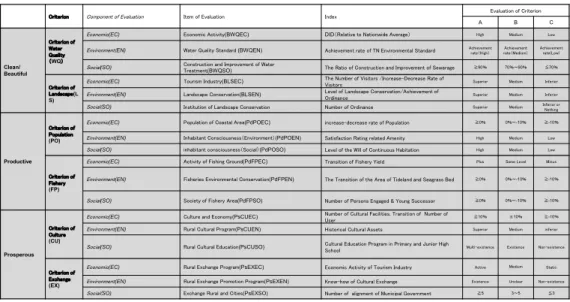
The elements and criteria of dynamic sustainability assessments are shown in tables 1, 2 and 3. Regarding the criteria, there are subjective elements because we created it based on the current condition of Satoumi. We will make improvements based on the condition of each target Satoumi.
2.5. Calculation procedure of sustainability assessments
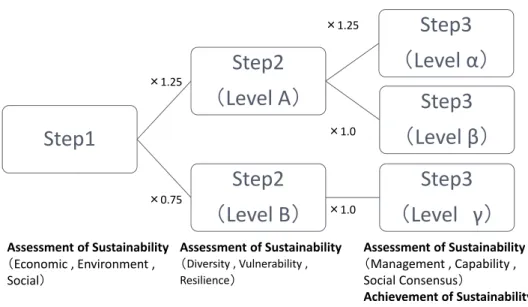
The calculation procedure of sustainability assessments is shown in figure 3. The calculation procedure is as follows.
Fig 2. Dynamic sustainability assessment process
【Sustainability Assessment STEP1】 ・Environment
・Social ・Economic
【Sustainability Assessment STEP2】 ・Diversity
・Vulnerability ・Resilience
【Sustainability Assessment STEP3】 ・Management
・Capability ・Social Consensus
8
Criterion Component of Evaluation Item of Evaluation Index Evaluation of Criterion
A B C
Clean/ Beautiful
Criterion of Water Quality(WQ)
Diversity(D) Balance of Industry(BWQD) Production Value by Industry , Ratio of Primary Sector of
Industry High Medium Low Vulnerability(V) Climate Change Strategy(BWQV) Variation of Fishery Species inferior Medium Superior Resilience(R) Effective Water Treatment(BWQR) Water Treatment based on Circulated Balance of Nutrient
Salts Existence Unclear Non-Existence Criterion of
Landscape (LS)
Diversity(D) Harmonization of Area(BLSD) Rate of Artificial Structural Object Low Medium High Vulnerability(V) Community Development &Disaster Prevention(BLSV) Environs Improvement(ex: Coastal Levee) Active Medium Static Resilience(R) Landscape conservation(BLSR) Arrangement of Landscape Existence Unclear Non-existence
Productive
Criterion of Population (PO)
Diversity(D) Intergenerational Balance(PdPOD) Transition of the Composition Ratio of Younger Generation ≧20% 10%~20% ≦10% Vulnerability(V) Tsunami &津波・Disaster Prevention(PdPOV) Flood Control , Stock, Emergency Evacuation area,
Cooperation with Citizen and Company Active Unclear Non-Existence Resilience(R) Community Revitalization(PdPOR) Achievement rate of Community Revitalization High Medium Low Criterion of
Fishery (FP)
Diversity(D) Multiproduct of Fish Species(PdFPD) Number of Pieces Superior Medium Inferior Vulnerability(V) Climate Change(PdFPV) Transition of Seawater Temperature inferior Medium Superior Resilience (R) Succession Planning of Fishery(PdFPR) Transition of New Persons Engaged ≧0% 0%~-10% ≧-10%
Prosperous
Criterion of Culture (CU)
Diversity(D) Community Traditional Culture(PsCUD) Participated person of Community Traditional Culture Superior Medium Inferior Vulnerability(V) Cultural Succession (PsCUV) Extinct Cultural Event Inferior Medium Superior Resilience(R) Movement to Boost Development(PsCUR) Number of Events, Number of Participates Superior Medium Inferior Criterion of
Exchange (EX)
Diversity(D) International Exchange(PsEXD) Inbound Tourists Superior Medium Inferior Vulnerability(V) Traffic Accessibility(PsEXV) Access time by Public Transportation and Automobile Short Medium Long Resilience (R) Community Cultural Exchange(PsEXR) Budget of Publicity Superior Medium Inferior
Table 2. Sustainability Assessment Indicators Step2-Ability
7
Criterion Component of Evaluation Item of Evaluation Index
Evaluation of Criterion A B C Clean/ Beautiful Criterion of Water Quality (WQ)
Economic(EC) Economic Activity(BWQEC) DID(Relative to Nationwide Average) High Medium Low
Environment(EN) Water Quality Standard(BWQEN) Achievement rate of TN Environmental Standard Achievement rate(High)
Achievement rate(Medium)
Achievement rate(Low)
Social(SO) Construction and Improvement of Water Treatment(BWQSO) The Ratio of Construction and Improvement of Sewerage ≧90% 70%~90% ≦70%
Criterion of Landscape(L S)
Economic(EC) Tourism Industry(BLSEC) The Number of Visitors /Increase-Decrease Rate of Visitors Superior Medium Inferior Environment(EN) Landscape Conservation(BLSEN) Level of Landscape Conservation/Achievement of Ordinance Superior Medium Inferior Social(SO) Institution of Landscape Conservation Number of Ordinance Superior Medium Inferior or Nothing
Productive
Criterion of Population
(PO)
Economic(EC) Population of Coastal Area(PdPOEC) increase-decrease rate of Population ≧0% 0%~-10% ≧-10%
Environment(EN) Inhabitant Consciousness(Environment)(PdPOEN) Satisfaction Rating related Amenity High Medium Low
Social(SO) inhabitant consciousness(Social)(PdPOSO) Level of the Will of Continuous Habitation High Medium Low
Criterion of Fishery
(FP)
Economic(EC) Activity of Fishing Ground(PdFPEC) Transition of Fishery Yield Plus Same Level Minus
Environment(EN) Fisheries Environmental Conservation(PdFPEN) The Transition of the Area of Tideland and Seagrass Bed ≧0% 0%~-10% ≧-10%
Social(SO) Society of Fishery Area(PdFPSO) Number of Persons Engaged & Young Successor ≧0% 0%~-10% ≧-10%
Prosperous
Criterion of Culture
(CU)
Economic(EC) Culture and Economy(PsCUEC) Number of Cultural Facilities, Transition of Number of
User ≧10% ±10% ≧-10% Environment(EN) Rural Cultural Program(PsCUEN) Historical Cultural Assets Superior Medium inferior
Social(SO) Rural Cultural Education(PsCUSO) Cultural Education Program in Primary and Junior High
School Multi-existence Existence Non-existence
Criterion of Exchange
(EX)
Economic(EC) Rural Exchange Program(PsEXEC) Economic Activity of Tourism Industry Active Medium Static
Environment(EN) Rural Exchange Promotion Program(PsEXEN) Know-how of Cultural Exchange Existence Unclear Non-existence
Social(SO) Exchange Rural and Cities(PsEXSO) Number of alignment of Municipal Government ≧5 3~5 ≦3
Fig 3. Computational process of Sustainability assessment
Step1
Step2
(
Level A)
Step3
(
Level α)
Step3
(
Level β)
Step2
(
Level B)
Step3
(
Level γ)
Assessment of Sustainability (Economic , Environment , Social) Assessment of Sustainability (Diversity , Vulnerability , Resilience) Assessment of Sustainability (Management , Capability , Social Consensus) Achievement of Sustainability (α:High , β:medium , γ :Low)Fig.3 Computational process of Sustainability assessment
×1.25 ×0.75 ×1.25 ×1.0 ×1.0 Criterion Component of Evaluation Item of Evaluation IndexEvaluation of Criterion A B C Clean/ Beautiful Criterion of Water Quality (WQ)
Management(M) Institution of Water Quality (CWQM) Achievement rate of Water Quality Standard High Medium Low Capability(C) Participation of community resident(CWQC) Number of Participants Superior Medium Inferior Social Consensus(SC) Acceptance of Water Quality Standard(CWQSC) Setting Standards based on the Area Condition Existence Unclear Non-Existence Criterion of
Landscape(LS)
Management(M) Institution of Landscape Conservation(CLSM) ordinance Superior Medium Inferior Capability(C) Activity of Community Resident(BLSC) Recognition Degree of Institution of Landscape
Conservation High Medium Low Social Consensus(SC) Common Basic Values of Landscape(BLSSC) landscape conservation High Medium Low
Productive
Criterion of Population (PO)
Management(M) Population Policy (PdPOM) Ways and Means of Social Increase in Population Existence Unclear Non-Existence Capability(C) Intraregional Move-in and out of (PdPOC) Ratio of Change on Move-out Move-in Excess ±5% Move-out
Excess Social Consensus(SC) Future Target of Population(PdPOSC) Transition of Future Population ≧-10% -10%~-25% ≧-25% Criterion of
Fishery (FP)
Management(M) Activity of Fishermen's Union(PdFPM) Management of Fishery’s Facilities, Obtain
Certification High Medium Low Capability(C) Encourage of Fishermen’s Union(PdFPC) Transition of New Number of Fishermen’s
Union ≧0% 0%~-10% ≧-10% Social Consensus(SC) Regional Alliances(PdFPSC) Set of Regular Consultative Meetings (More than 4)Existence (Less than 3)Existence Non-Existence
Prosperous
Criterion of Culture (CU)
Management(M) Public Administration &Tourist Association(PsCUM) Budget of Activity/Number of Staff High/(More than 3) /1~2personMedium Low/0 Capability(C) Cultural Creation (PsCUC) Train up of Corporate Actor High Medium Low or nothing Social Consensus(SC) Common Basic Values of Community Value(PsCUSC) Affection to Area High(≧70%) Medium
(35%~70%) (≦35%)High Criterion of
Exchange (EX)
Management(M) Activity of Common Basic Values of (PsEXM) Power of Transmission High Medium Low Capability(C) Encourage of Exchange & Human Resources
Development(PsEXC) Participation to Community Event High Medium Low Social Consensus(SC) Value of Exchange Program(PsEXSC) Social Cognition of Exchange Program High(≧70%) (35%~70%)Medium (≦35%)Low
Table 3 Sustainability assessment indicators Step3‐Will
[Comprehensive evaluation criteria]
A+ (161-189) --- Sustainability is realized and expected to be developed A (118-160) --- Large potential for sustainability
B (74-117) --- Efforts to maintain current conditions are required C (45-73) --- Difficulties realizing sustainability
3. The current situation and issues in the target areas
Japanese coastal zones have been greatly changing along with natural and social conditions. Especially the artificialization of coastal zones due to urbanization and industrialization has significantly decreased tidal flats and seaweed beds, which has degraded the fishing environment. In addition, the decrease of fishing catches is prominent recently. The trend of depopulation and aging in coastal zones is very serious, the Fisheries Agency has pointed out that fishing villages have a higher aging rate than the national average, and the higher the fishery rate is, the higher
the depopulation rate is.7) Japan, which is a maritime nation, formulated the Basic Act on Ocean
Policy in 2007, and the Basic Plan on Ocean Policy in 2013, which aims for integrated coastal zone management. Despite such planned activities to consider comprehensively coastal zones (not only from the perspective of fisheries), when the tsunami hit the Tohoku coast area due to the Great East Japan Earthquake in 2011, many of the fishermen were victims and there was a catastrophic demolition of fishery facilities. Under such harsh circumstances, seeking sustainability of fisheries is an extremely difficult issue, as well as a new challenge for revitalizing the community. It is not a simple case of resolving issues facing fishing villages. It aims to revitalize the local community toward the creation of coastal zones in a broad sense, and not only offering ecosystem services in coastal zones.
In the research project, three areas were chosen as targets: (1) the Seto Inland Sea as a representative of a closed sea area, (2) the Sanriku coast area including Shizugawa Bay as a representative of an open inner bay, and (3) the Japan Sea coast area as a representative of an international closed sea area. In this document, we set Hinase Bay in Bizen City, Okayama Prefecture, Shizugawa Bay in Minamisanriku Town, Miyagi Prefecture, and Nanao Bay in Nanao City, Ishikawa Prefecture as our target areas to clarify their characteristics.The characteristics of the target areas are shown in table 1 and its summary is described below. We organized statistical data of the three areas as follows. We labelled Hinase Bay in Bizen City, Okayama Prefecture as “Bizen City,” Shizugawa Bay in Minamisanriku Town, Miyagi Prefecture as “Minamisanriku Town,” and Nanao Bay in Nanao City, Ishikawa Prefecture as “Nanao City” to clarify their characteristics.
1) Population
In all three areas, the population has decreased significantly, almost 30% from 1985 to 2015: Bizen City (48,112 to 35,179), Minamisanriku Town (21,970 to 12,370), and Nanao City (69,915 to
55,325). In particular Minamisanriku Town was directly affected by the Great East Japan Earthquake. The population has been rapidly aging in these 30 years as shown in the shift of the elderly ratio from 1985 to 2015: Bizen City (14.2% to 36.3%), Minamisanriku Town (12.9% to 33.5%), and Nanao City (14.2% to 34.7%).
2) Economy
Product shipments in the target areas: Bizen City (25.546 billion yen), Minamisanriku Town (2.065 billion yen), and Nanao City (5.531 billion yen).
Fish catches and fishery management entities, respectively: Bizen City (353 t, 105 people), Minamisanriku Town (8,485 t, 472 people), and Nanao City (8,396 t, 283 people). The scale differs among the three areas.
Bizen City has a high ratio of ceramic industries and a low dependence on fishing, while in Minamisanriku Town and Nanao City, fishing is positioned as an important industry.
3) Finance
The revenue of the general accounts: Bizen City (20.9 billion yen), Minamisanriku Town (51.8 billion yen), and Nanao City (33.2 billion yen). Minamisanriku Town has experienced a large impact from construction investment because of the earthquake disaster reconstruction, which is a special situation for the region.
4) Characteristics of the bay (1)Hinase Bay
The Hinase Islands (consisted of 14 islands such as Kakuijima Island and Kashirajima Island) area, including Hinase Bay, is a part of the Seto Inland Sea. The depth of sea between the mainland and Kakui Island, the largest of the Hinase Islands, is largely less than 10 meters, so the sea is basically calm except for typhoons and storm surges.
(2)Shizugawa Bay
The bay is facing the Pacific Ocean and has an area of 47 square kilometers. The maximum depth is 54 meters, which is deeper than Hinase Bay. Eight rivers flow into the bay, all of which have their origin in Minamisanriku Town.
Table 4. General Situations of the Target Areas
Bizen City (※1) Minamisanriku Town( ※2) Nanao City (※3) Population Total Population(Person) 1985 48,112 14,086 21,970 5,195 69,915 19,063 Household 14.2 12.9 14.2 2015 35,179 12,370 55,325
Elderly Person(Over 65year)(%) 13,878 4,041 20,855
36.3 33.5 34.7
Economic
Industry Manufacutured Goods Shipment Value(2014FY/ten thousand-yen) 25,546,652 2,065,312 5,531,613
Fishery Fish Catches(2014/Ton) 353 8,485 8,396
Fishery Management(2013) 105 472 283
Finance
Revenue of General Account(thousand Yen) 20,930,323 51,805,832 33,231,978 Expenditure of General Account(thousand Yen) 19,750,140 45,671,462 32,893,229 Toatl Revenue of Municipal Tax(thousand Yen) 5,029,380 1,096,006 7,989,531
(3)Nanao Bay
The bay is facing the Japan Sea and is divided by Notojima Island (area: 47 square kilometers, population: about 3,000 people) into three parts, Nanao-kita Bay, Nanao-nishi Bay and Nanao-minami Bay. The maximum depth is 58 meters. There are tourism resources such as the Wakura hot spring area facing Nanao-nishi Bay.
4. Comparison analysis of Shizugawa Bay, Hinase Bay and Nanao Bay
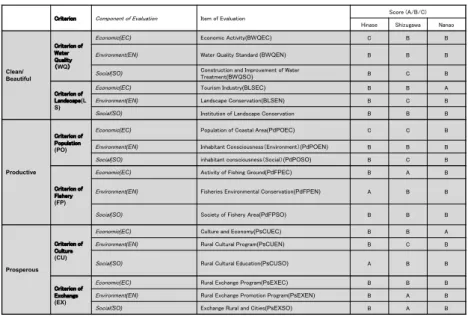
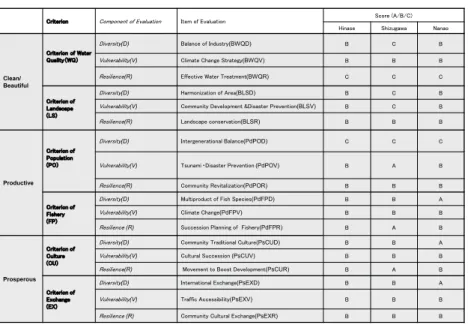
4.1. Sustainability assessments of the target areasThe results of sustainability assessments of Hinase Bay, Shizugawa Bay and Nanao Bay are shown in tables 5, 6 and 7.
Hinase Bay: High grades for fishing grounds conservation and regional culture education Shizugawa Bay: High grades for fishing activities, regional communication promotion and communication between regional communities and urban cities
Nanao Bay: High grades for tourism and the cultural economy
Hinase Bay: Holistically “B” grade for diversity, vulnerability and resilience
Shizugawa Bay: “A” grade for vulnerability and resilience but “C” grade for water quality and landscape
11
Criterion Component of Evaluation Item of Evaluation Score (A/B/C) Hinase Shizugawa Nanao
Clean/ Beautiful Criterion of Water Quality (WQ)
Economic(EC) Economic Activity(BWQEC) C B B
Environment(EN) Water Quality Standard(BWQEN) B B B
Social(SO) Construction and Improvement of Water
Treatment(BWQSO) B C B Criterion of
Landscape(L S)
Economic(EC) Tourism Industry(BLSEC) B B A
Environment(EN) Landscape Conservation(BLSEN) B C B
Social(SO) Institution of Landscape Conservation B B B
Productive
Criterion of Population
(PO)
Economic(EC) Population of Coastal Area(PdPOEC) C C B
Environment(EN) Inhabitant Consciousness(Environment)(PdPOEN) B B B
Social(SO) inhabitant consciousness(Social)(PdPOSO) B C B Criterion of
Fishery
(FP)
Economic(EC) Activity of Fishing Ground(PdFPEC) B A B
Environment(EN) Fisheries Environmental Conservation(PdFPEN) A B B
Social(SO) Society of Fishery Area(PdFPSO) B B B
Prosperous
Criterion of Culture
(CU)
Economic(EC) Culture and Economy(PsCUEC) B B A
Environment(EN) Rural Cultural Program(PsCUEN) B C B
Social(SO) Rural Cultural Education(PsCUSO) A B B
Criterion of Exchange
(EX)
Economic(EC) Rural Exchange Program(PsEXEC) B B B
Environment(EN) Rural Exchange Promotion Program(PsEXEN) B A B
Social(SO) Exchange Rural and Cities(PsEXSO) B A B
Nanao Bay: “A” grade for diversity in fish catches, culture and communication
Hinase Bay: “A” grade for capability for “clean,” management of fish catches for “productive”, and social consensus of culture for “prosperous”
Shizugawa Bay: “A” grade for management of fish catches and social consensus for “productive,” and management of communication for “prosperous”
Nanao Bay: “B” grade for all items of management, capability and social consensus
Criterion Component of Evaluation Item of Evaluation Score (A/B/C) Hinase Shizugawa Nanao
Clean/ Beautiful
Criterion of Water Quality (WQ)
Management(M) Institution of Water Quality (CWQM) B B B Capability(C) Participation of community resident(CWQC) A B B Social Consensus(SC) Acceptance of Water Quality Standard(CWQSC) B B B Criterion of
Landscape(LS)
Management(M) Institution of Landscape Conservation(CLSM) B C B Capability(C) Activity of Community Resident(BLSC) B C B Social Consensus(SC) Common Basic Values of Landscape(BLSSC) B B B
Productive
Criterion of Population (PO)
Management(M) Population Policy (PdPOM) B B B Capability(C) Intraregional Move-in and out of (PdPOC) B C B Social Consensus(SC) Future Target of Population(PdPOSC) B C B Criterion of
Fishery (FP)
Management(M) Activity of Fishermen's Union(PdFPM) A A B Capability(C) Encourage of Fishermen’s Union(PdFPC) B B B Social Consensus(SC) Regional Alliances(PdFPSC) A A B
Prosperous
Criterion of Culture (CU)
Management(M) Public Administration &Tourist Association(PsCUM) B B B Capability(C) Cultural Creation (PsCUC) B B B Social Consensus(SC) Common Basic Values of Community Value(PsCUSC) A B B Criterion of
Exchange (EX)
Management(M) Activity of Common Basic Values of (PsEXM) B A B Capability(C) Encourage of Exchange & Human Resources
Development(PsEXC) B B B Social Consensus(SC) Value of Exchange Program(PsEXSC) B B B Table 7. Sustainability Assessment of Three Area STEP3(Will) Table 6. Sustainability Assessment of Three Area STEP2(Ability)
12
Criterion Component of Evaluation Item of Evaluation Score (A/B/C) Hinase Shizugawa Nanao
Clean/ Beautiful
Criterion of Water Quality(WQ)
Diversity(D) Balance of Industry(BWQD) B C B
Vulnerability(V) Climate Change Strategy(BWQV) B B B
Resilience(R) Effective Water Treatment(BWQR) C C C
Criterion of Landscape (LS)
Diversity(D) Harmonization of Area(BLSD) B C B
Vulnerability(V) Community Development &Disaster Prevention(BLSV) B C B
Resilience(R) Landscape conservation(BLSR) B B B
Productive
Criterion of Population (PO)
Diversity(D) Intergenerational Balance(PdPOD) C C C
Vulnerability(V) Tsunami ・Disaster Prevention(PdPOV) B A B
Resilience(R) Community Revitalization(PdPOR) B B B
Criterion of Fishery (FP)
Diversity(D) Multiproduct of Fish Species(PdFPD) B B A
Vulnerability(V) Climate Change(PdFPV) B B B
Resilience (R) Succession Planning of Fishery(PdFPR) B A B
Prosperous
Criterion of Culture (CU)
Diversity(D) Community Traditional Culture(PsCUD) B B A
Vulnerability(V) Cultural Succession (PsCUV) B B B
Resilience(R) Movement to Boost Development(PsCUR) B A B Criterion of
Exchange (EX)
Diversity(D) International Exchange(PsEXD) B B A
Vulnerability(V) Traffic Accessibility(PsEXV) B B B
4.2. Comparison analysis of Shizugawa Bay, Hinase Bay and Nanao Bay
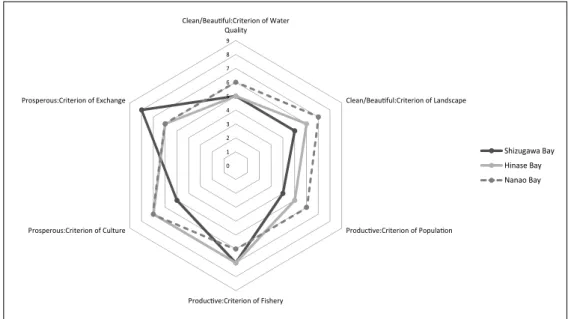
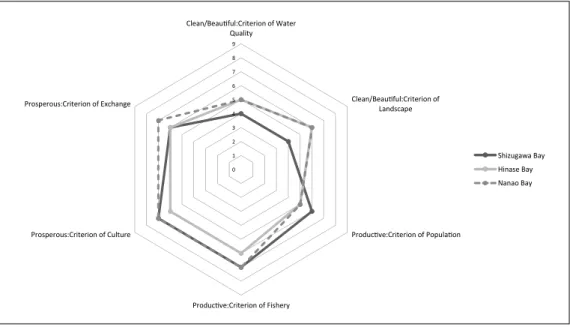
The comparison of the results of the sustainability assessment for the three areas is shown in figures 4,5 and 6.
STEP 1 shows sustainability states for the economy, environment and society. In the “clean” category, Nanao Bay has the highest grade and in the “productive” category, Hinase Bay and Shizugawa Bay have high grades for fish catches, whereas Nanao Bay has a high grade for population. In the “prosperous” category, Shizugawa Bay has a high grade for communication.
STEP 2 shows the abilities of diversity, vulnerability, resilience, etc. for sustainability. In the “clean” category, Nanao Bay has a high grade for landscapes, in the “productive” category, Shizugawa Bay has a high grade for population, and in the “prosperous” category, Nanao Bay has a slightly higher grade, but all three are almost the same.
Fig 4. Comprehensive Assessment of STEP1 (State)
0 1 2 3 4 5 6 7 8 9 Clean/Beautiful:Criterion of Water Quality Clean/Beautiful:Criterion of Landscape Productive:Criterion of Population Productive:Criterion of Fishery Prosperous:Criterion of Culture Prosperous:Criterion of Exchange Shizugawa Bay Hinase Bay Nanao Bay
STEP 3 shows the will of management, capability, etc. for sustainability. In the “clean” category, Nanao Bay has a high grade for landscapes, in the “productive” category, Shizugawa Bay has a high grade for population, and in the “prosperous” category, Nanao Bay has a high grade.
Fig 6. Comprehensive Assessment of STEP3 (Will)
0 1 2 3 4 5 6 7 8 9 Clean/Beautiful:Criterion of Water Quality Clean/Beautiful:Criterion of Landscape Productive:Criterion of Population Productive:Criterion of Fishery Prosperous:Criterion of Culture Prosperous:Criterion of Exchange Shizugawa Bay Hinase Bay Nanao Bay
Fig 5. Comprehensive Assessment of STEP2 (Ability)
0 1 2 3 4 5 6 7 8 9
Clean/Be :Criterion of Water Quality
Clean/Be :Criterion of Landscape
Produc ve:Criterion of Popula on
Produc ve:Criterion of Fishery Prosperous:Criterion of Culture
Prosperous:Criterion of Exchange
Shizugawa Bay Hinase Bay Nanao Bay
4.3. Comprehensive results
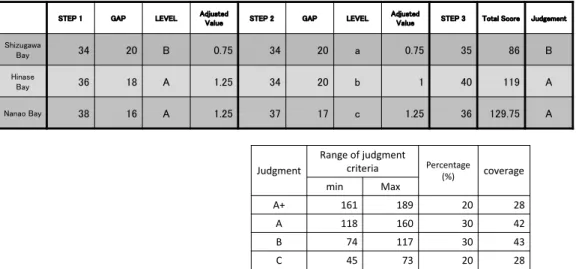
The comprehensive results of the three areas are shown in table 8. Nanao Bay and Hinase Bay got “A” grades and Shizugawa Bay got a “B” grade for the comprehensive results. We assume that Nanao Bay was rated highly for its political efforts regarding conservation of Satoumi, and its focus on tourism utilizing Wakura hot springs and the sea. For Hinase Bay, the results of the sustainability assessment were improved due to the strong relationship among regional residents and people in the Kansai area as a result of the eelgrass beds restoration. And for Shizugawa Bay, there are serious impacts from the Great East Japan Earthquake and tsunami regarding citizens and fishermen who were victims, and the annihilation of the natural coast due to the construction of coastal levees. From the perspective of sustainability assessments, we expect that sustainability will be improved because the stakeholders of the fisheries have a strong will to continue fishing.
5. Satoumi and ICZM
Studies related to pollution mitigation and prevention seem quite few in number and were probably included in the aforementioned studies about Satoumi enforced by the Ministry of Environment, which aims for a forest-river-coast connection based on ICZM. ICZM itself, due to the separation of current legal systems and various administrative agencies, such as the coastal
STEP 1 GAP LEVEL Adjusted
Value STEP 2 GAP LEVEL
Adjusted
Value STEP 3 Total Score Judgement
Shizugawa Bay 34 20 B 0.75 34 20 a 0.75 35 86 B Hinase Bay 36 18 A 1.25 34 20 b 1 40 119 A Nanao Bay 38 16 A 1.25 37 17 c 1.25 36 129.75 A Judgment Range of judgment criteria Percentage (%) coverage min Max A+ 161 189 20 28 A 118 160 30 42 B 74 117 30 43 C 45 73 20 28
administrative agency, mainly focuses on disaster prevention and coastal defenses, the harbor administrative agency mainly cares about the development and operation of ports, and the Ministry of Agriculture, Forestry and Fisheries always considers how to construct satisfactory places for aquaculture and fisheries as their main obligation. In this background of separation, key issues about the exploitation of the value of coastal zones were often overlooked, which was very undesirable.
The international definition of ICZM is as follows. ① United States
The Coastal Zone Management Act Performance Measurement System (CZMAPMS) was proposed in order to measure the national success of the Coastal Zone Management Program. A suite of contextual indicators, from the perspective of social, economic and environmental, were identified by the NOAA Office of Ocean and Coastal Resource Management (OCRM) to complement
and evaluate the performance of ICZM 8).
② European Union
The SUSTAIN Project was part-funded by the European Regional Development Fund. The aim of the project was to “create a fully implementable policy tool to help coastal authorities and communities throughout Europe to deliver sustainability on Europe’s coasts”. The tool will be applied to all 22 coastal states of the European Union and it is based on a set of easily measurable
sustainability indicators9) . The PEGASO Project was constructed for developing ICZM in the
Mediterranean and the Black Sea. Its main goal is “to construct a shared Integrated Coastal Zone Management (ICZM) Governance Platform with scientists, users and decision makers linked with
new models of governance”10) .
The definition of ICZM in different academic societies ① MEDCOAST
MEDCOAST was first held in an international conference in Turkey in 1993. Up till now it works as an important academic society, aiming to conserve the coast and marine life of the Mediterranean and the Black Sea through ICZM. (https://www.medcoast.net/)
② EMECS
The international organization EMECS aims at solving the environmental conversation of enclosed seas in the world, e.g., the Seto Inland Sea, Chesapeake Bay (U.S.A.), the Baltic Sea (Northern Europe), and the Mediterranean Sea (Southern Europe). It is an organization for “promoting international exchanges on not only coastal but also catchment areas in a wide range of fields such as research, policy, civic activities.” It defines ICZM as “sustainable use and development of coastal resources.” (http://www.emecs.or.jp/s-13/en/)
6. Conclusions
ICZM based on ecosystem services helps people to understand the importance and true value of a sustainable coastal environment. The Seto Inland Sea once faced a very severe environmental crisis, especially eutrophication. At that time, the Law Concerning Special Measures for Conservation of the Environment of the Seto Inland Sea came into being in 1973 as an effective countermeasure, which aimed for the reduction of discharged pollutants. Nevertheless, nowadays the enemy causing environmental degradation seems invisible, and we are not able to come up a solution overnight. It calls for the wisdom and experience that can lead to the harmonious development of the environment, economy and society, i.e. innovative ideas for achieving a state of sustainability. From now until 2030, a variety of activities related to SDGs (Sustainable Development Goals) will be set out. Fortunately, in Target 14 we have seen that sufficient attention
is paid to the conservation and sustainable exploitation of ocean and marine resources11). Based on
the investigation of ecosystem services, we therefore highly expect to see the birth of revolutionary ICZM approaches toward revitalized coastal zones.
Future issues
The dynamic sustainability assessment of Satoumi has just begun, so setting assessment criteria should be reviewed from here on. For its improvement, it is necessary to refine criteria for a more objective assessment reflecting the current conditions of coastal zones. In addition, the effectiveness and limits regarding policy development of the results of the sustainability assessment should be considered.
To address such issues, we aim to establish an international criteria for the sustainability assessment method.
Acknowledgements
Please note that this research is a part of the “Development of a coastal zone management method aiming to realize sustainable coastal zones,” by the Environment Research and Technology Development Fund of the Ministry of the Environment of Japan (S-13) and the Environmental Restoration and Conservation Agency (from 2014 to 2018).We would like to gratefully thank Dr. Tetsuo Yanagi, professor emeritus at Kyusyu University and S-13 project leader, who gave us his thoughts on the preparation of the sustainability assessment criteria.
References
1) Yanagi, T (2008), “Establishment of Sato-umi in the coastal sea”, Japan Society of Water Environment, 21,703p (in Japanese)
2) Matsuda, O (2013), “A Vital Role of Satoumi in the Implementation of ICM in Japan”Proceedings of the Global Congress on ICM: Lessons Learned to Address New Challenges”, pp241-250, 30 Oct.-03 Nov.2013, Marmaris, Turkey, E.Ozhan (Editor)
3) The Association for the Environmental Conservation of the Seto Inland Sea, 2015
4) Kitagawa Kenji edited, (2007), Setonaiakai Encyclopedia, 2007, Nannansha Ltd. (in Japanese)
5) Japan Policy Council (2015), “Strategies for Revitalization of rural regions and preventing Depopulation(Stop shoshika Chihou Genki Senryaku)”(In Japanese ), May 8th, 2014
6) Gernot Stoeglehner, and Georg Neugebauer. Integrating sustainability assessment into planning: benefits and challenges. “SUSTAINABILTY ASSESSMENT PLURALISM,PRACTICE AND PROGRESS”Edited by ALAN BOND,et’al, ROUTILEDGE, 2013
7) Fisheries Agency ,“The change in Fisheries condition”Ref.2-4, July, 2011
8) National Oceanic and Atmospheric Administration (NOAA) (2010). Coastal zone management act performance measurement system: contextual indicators manual. U.S. Department of Commerce & National Oceanic and Atmospheric Administration & National Ocean Service & Office of Ocean and Coastal Resource Management. 9) SUSTAIN, (2012) THE SUSTAIN INDICATOR SET, A set of easily measurable sustainability indicators.
INTERREG IVC & European Union
10) PEGASO, (2008) ,PEGASO Project,2008 http://www.pegasoproject.eu/. 11) UNDP, (2015), Sustainable Development Goals (SDGs),