Changes of Russia’s Migration Policies and
Human Rights of Labor Migrants
By KIM Timur
51114600 SEPTEMBER 2016
THESIS PRESENTED TO THE HIGHER DEGREE COMMITTEE
OF RITSUMEIKAN ASIA PACIFIC UNIVERSITY
IN PARTIAL FULFILLMENT OF THE REQUIREMENTS
FOR THE DEGREE OF MASTER OF SCIENCE IN ASIA PACIFIC
ii
ACKNOWLEDGEMENTS
First of all, I would like to thank my research supervisor Professor Rothman Steven. The door of Professor Rothman office was always open for me whenever I had a question about my research or writing. He allowed this paper to be my own work, but led me in the right direction whenever he thought I needed it.
I would also like to acknowledge Professor Yamagami Susumu as the second reader of this thesis, and I am gratefully indebted to his very valuable comments on this work.
I sincerely want to express my deepest appreciations to Ms. Emiliya Koleva, and Japan Student Services Organization (JASSO), for their scholarship support to my education. In fact, life would have been difficult for me without your financial support. Special gratitude to my family for moral and material support throughout my two year study in this highly prestigious institution.
The last but not least appreciation goes to all my friends, and classmates who have been giving me valuable comments throughout our interactions in seminar classes.
iii TABLE OF CONTENTS ACKNOWLEDGEMENTS………..ii TABLE OF CONTENTS……….iii LIST OF TABLES………...v LIST OF ABBREVIATIONS………..vi ABSTRACT………....vii INTRODUCTION………..viii
CHAPTER 1: IMMIGRATION INFLOW FROM THE FORMER SOVIET COUNTRIES TO RUSSIAN FEDERATION………..1
1.1 Historical background: changes of Social, Economic, and Political Backgrounds of Immigration in Former-Soviet Countries………..1
1.2 Literature review on migration theories, theoretical framework to migration from Central Asia to Russian Federation………...3
1.3 Background characteristics of three most sending countries of Central Asia to Russia: “push factors” that contribute to labor workers move………..6
1.3.1 Kyrgyzstan - a brief country profile………...6
1.3.2 Tajikistan - a brief country profile………8
1.3.3 Uzbekistan - a brief country profile………10
1.4 Russian demographic issues, labor shortage challenges and reality labor migrants from Central Asia………11
1.4.1 Distribution of foreign workers in Russia by industry………...13
CHAPTER 2: MIGRATION TRENDS AND IMMIGRATION POLICY TRANSFORMATION IN THE RUSSIAN FEDERATION IN THE LAST 25 YEARS………...……….16
iv
2.1 Liberal migration policy stage in the 1990s: welcoming “compatriots” to
Russia………...16
2.1.1 The legislative basis for the immigration policy in Russia……….17
2.2 Repressive migration policy: ethnic nationalism and security issues………19
2.2.1 National security, Russian nationalism and immigration interconnection.22 2.2.2 Russian authorities’ crackdown on civil society NGOs and human rights organizations………23
2.2.3 Violence towards labor migrants through religion, ethnicity and identity.24 2.2.4 Ethnic hostility: expansion of xenophobia and ethnic based criminality...25
2.2.5 Negative public perception of ethnic minorities in Russian Federation: public opinion surveys……….27
2.3 Liberal-restrictive migration policy in 2005: the reality of labor migrants from Central Asia……….28
CHAPTER 3: CASE STUDY OF MIGRANT WORKERS FROM KYRGYZ REPUBLIC TO RUSSIA………33
3.1 Introduction………33
3.2 Method of the case study………...33
3.3 Analysis………...37
3.3.1 Main factors of Kyrgyz labor migration to Russia……….37
3.3.2 Cultural and structural violence………..43
3.3.3 Different Perspectives……….46
CONCLUSION………50
BIBLIOGRAPHY………55
v
LIST OF TABLES
Table 1: Human Development Indicators in Central Asia and selected other countries, 1991……….……….8 Table 2: Distribution of foreign workers (by types of economic activity)...11 Table 3: Consolidated Statistics of Racist and Neo-Nazi Attacks in 2005-2006
(by the season)...22 Table 4: Consolidated Statistics of Racist and Neo-Nazi Attacks in 2005 and 2006 (by the object of attack)...23 Table 5: Public opinion overview………24
vi
LIST OF ABBREVIATIONS
IOM International Organization for Migration
CA Central Asia
CIS Commonwealth of Independent States
SU Soviet Union
FMS Federal Migration Service GDP Gross Domestic Product
WB World Bank
UNDP United Nations Development Programme
RF Russian Federation
USSR Union of Soviet Socialist Republics FMP Federal Migration Program
MPC Migration Policy Centre
NGO Non-governmental Organization LGBT Lesbian, Gay, Bisexual, Transgender WHO World Health Organization
vii ABSTRACT
The current thesis combines a bibliographical survey and a case study. The bibliographical survey argues that Russian repressive immigration policies of the 2000’s ended up with the flow of illegal labor migrants and created a hostile environment between native Russians and labor migrants, raising the issues of human rights of labor migrants. The case study picks up narratives of migrant workers from the Kyrgyzstan to Russia to partially embody the argument in the first part, and to offer a perspective for further study.
viii
INTRODUCTION
In the aftermath of the collapse of the Soviet Union, newly independent states were left face-to-face with their economic and social woes. Russia, unlike other
countries, benefited from the oil and gas reserves and experienced an economic growth (Gaddy & Ickes, 2001; World Bank (WB), 2016).
As a result, leading Russian economy attracted labor forces influx from less economically successful CIS countries, in particular, it became a destination point of labor migrants from Central Asian countries such as Uzbekistan, Kyrgyzstan and Tajikistan (Lazareva, 2007).
The steady decrease in the birth rate since 1991 (United Nations Development Programme (UNDP), 2009) and the, simultaneously, increasing mortality (Gerber, 2000) urged Russian government to welcome bigger number of nationals from the CIS countries to settle in the country by loosening migration rules in 1997 (Laurelle, 2007).
According to various academic works on migration to Russia, migration patterns can be divided into two waves; the first wave started in 1991 and reached the peak in 1997 (Laurelle, 2007, p. 102) and it was mostly comprised of the Russian ethnic migrants moving back to their historic motherland with the purpose of long-time settlement in there. However, the next wave started in the middle of 90s and is
comprised of migrants from Central Asian region’s titular nationalities who moved to Russia in the capacity of labor migrants for the economic reason (Suharnikova, 2013).
Russian immigration policy also has been taking different patterns within last two decades. Right after the dissolution of the Soviet Union, it is characterized as the most liberal policy welcoming all Russian compatriots to their historical homeland (Suharnikova, 2013). However, the immigration policies changed 90 degrees in
ix
response to the growing and unprecedented number of migrant’s inflow and changed into repressive one in the 2000s. This period coincided with the rise of numbers of illegal workers (Tyuryukanova, 2005).
Unlike the first wave of migrants that consisted of ethnic Russian nationals, the second wave of migrants comprised of people of other nationalities who went to Russia in the capacity of labor workers. They have been the most vulnerable to different abuses and risks due to their illegal status (LeGendre, 2006).
Given the problem mentioned above, this thesis explores the situation of labor migration from Kyrgyzstan, Tajikistan and Uzbekistan to Russian Federation from the viewpoint of their human rights protection. The first goal is to understand the main reasons for labor migration by tracing the trends over the past decades to the present. Next goal is to examine the social consequences of labor migration, in particular focusing the risks and challenges labor migrants have been facing in a hostile political and cultural environment. Main distinctive feature of this work is to see how the immigration policy of the Russian Federation has been changed in the course of last 25 years in regard to domestic and international terrorism and how those changes affect the labor migrant’s security and human rights.
Research Questions
The research questions of this study are as follows:
1) What are major factors of migration into Russia from Post-Soviet countries? 2) How have the immigration policies been changing in response to domestic terrorism?
x
4) How do migrants reconstruct their experiences in Russia in the capacity of labor migrants?
Bibliographic Survey
This thesis combines a bibliographical survey and a case study. The
bibliographical survey summarizes published statistical data on migration trends in the Russian Federation, and integrates two existing arguments for the better depiction of the current state. The first argument is the transformation of Russian immigration security into the repressive security policy, and the other is on the issues of the human rights of migrants, putting special focus on migrant workers from central Asia in the Russian Federation. It includes summarization of statistical data published by the United Nations, World Bank and International Organization for Migration. The study also involves such qualitative analysis of the primary and secondary sources as analysis of the Russian legislation concerning immigration policy. The Law on legal status of foreigners on the territory of the Russian Federation, State concept on migration policy of Russian Federation and other laws and legal acts directly or indirectly affecting well-being of labor migrants in Russia are analyzed in details. Theories of academicians, scholars’ publications, concerning immigration are taken into account, while evaluating current situation in the targeted countries. Besides academic papers, publications of the specialized NGOs, international organizations (IOM and UNHCR) from within the region were put under the scrutiny as well.
For the purpose of this work, narratives from seven Kyrgyz citizens who had been labor migrant workers in Russia were collected and analyzed in the case study. The experienced reality depicted in the narratives partially backs up the discussion of
xi
the bibliographical survey, and shows further insight. The methodology used in the case study is “narrative inquiry”. The details of narrative inquiry are discussed in the Chapter 3.
Organization and the structure of the thesis
In order to understand the main reasons that contributed to people’s movement to Russia, and to answer the question why Russia is chosen as a destination point for labor migrants, the first chapter analyses the migration patterns and trends to Russia after the dissolution of the Soviet Union by looking into the background changes in social, economic, and political situation after the break-up of the Soviet Union. It illustrates that unlike the first waves of immigrants to Russia, the second waves were comprised of people moving to Russian in the capacity of labor migrants. The next chapter looks at Russia’s transformation process of immigration policies and its connection to national security agenda over the past decades. It argues that the immigration security policies of Russia brought the reverse effect and resulted in the rise of illegal immigrants. The illegal status makes the labor migrants to be vulnerable to different risks and abuses. The theory of Galtung (1990) on cultural and structural violence is used in this chapter as a theoretical explanation of the argument of why labor workers fall the victims of various abuses in Russia. The last chapter includes the
narratives analysis of seven Kyrgyz labor migrants that partially backs up the argument of the first two chapters and depicts the personal experiences of those individuals in Russia as well as provides a different perspectives for the further study.
xii Terminology used in paper
For the purpose of this thesis the following definitions are used: The International Organization for Migration (further as IOM) defines
Migration as “the movement of people who cross the borders of a foreign country, or within the same country. It includes any kind of people move regardless of its length, content or reason; it also includes movement of refugees, displaced persons and economic migrants” (International Organization for Migration (IOM), 2016).
Labour migration - “movement of persons from one State to another, or within their own country of residence, for the purpose of employment” (IOM, 2016).
Illegal migration or illegal migrant is used to define the workers who stay in Russia without proper documentation and without registration with the proper Russian authorities (IOM, 2016; United Nations (UN), 2016).
Legal entrance of migrants to Russian Federation - means an act of crossing through the border checkpoints with the proper valid documentation such as passport and the aim why the worker is crossing the border is clarified and the migration card is issued. (General Administration For Migration Issues of the Interior Ministry of Russia (GAMI), 2016)
Illegal entrance - “An act of crossing borders without complying with the necessary requirements for legal entry into the receiving State” (IOM, 2016)
National security is defined as a system where the state plays the main role pursuing the goal of ensuring its territorial integrity, preservation of the existing political regime and safety of the society and individuals (Williams, 2012).
1
CHAPTER 1: IMMIGRATION INFLOW FROM THE FORMER SOVIET COUNTRIES TO RUSSIAN FEDERATION
1.1 Historical background: changes of Social, Economic, and Political Backgrounds of Immigration in Former-Soviet Countries
In order to understand the main reasons that contributed to people movement to Russia, and why Russia is chosen as a destination point for labor migrants, this part analyses the migration patterns and trends to Russia after the dissolution of the Soviet Union to the present. The demographic challenges, labor shortage issues of Russia as well as the distribution of the labor migrants in Russia by employment industry are also discussed in the chapter in order to give a whole picture of both social and economic conditions.
The disintegration of USSR became the time of most chaotic and turbulent times for many CIS countries and accompanied with severe economic decline and political and military tensions over the resources in those newly emerged countries (Abazov, 1999, p. 210-252), namely Armenia, Azerbaijan and Tajikistan experienced numerous armed conflicts that un-stabilized political and social situation and resulted in the movement of many refugees and ethnic Russians to Russian Federation. (Tishkov & Zaionchkovskaya, 2003, p. 9-16) Therefore, the immigration trends of this period is viewed from the political and economic context as a natural consequences of the collapse of the USSR.
While the exact estimates on migration inflow to Russia varies, according to International Organization for Migration (2008) report: “Russia is the second largest
country of immigrants after the USA, with the approximate number of immigrants of 12 million”. There are other estimations of academicians and scholars on migration inflows
2
to Russia in 1990-2000 indicate that Russia became a destination country to nearly 8 million labor workers from the post-soviet countries (Zaionchkovskaya, 2003). Among those migrants in Russia, almost 80% are non-registered, undocumented migrants (Ivakhnyuk, 2009, p.6). According to Russian Federal Migration Service (FMS, 2008) official statistics, the number of officially registered labor migrants in 2009 was 7.9 million.
Although the main characteristics of migrants moving into Russia are temporal and consists of labor migrants, the migration patterns from the post-soviet countries to Russia can be clearly classified into two main groups. First group is the ethnic native Russians or forced migrants going back to Russia, to their “homeland” (Lazareva, 2008). Ethnic Russian consisted of 80% of total immigration inflow to Russia in 1994.
Meanwhile, the next wave of migrant’s inflow to Russia has changed to labor migrants consisted of non-Slavic people that are other ethnicity labor migrants moved to Russia mainly for economic reasons, (IOM, 2008) with no intention of long-term
residency in Russia but in the capacity of temporary workers. According to approximate estimations, in 1991-2000 Russia has received from 4 to 8 million labor migrants from the post-soviet countries, especially from Central Asia (Zaionchkovskaya, 2005).
The factors of such unprecedented movements of migrants can be explained first of all by the economic factors of both sending and recipient countries (Andrienko & Guriev, 2005). Since the export and import between Central Asian countries and Russia has been dramatically decreased, which resulted in poverty and unemployment in most Central Asian countries. In contrast to that, Russia has experienced a different
development pace, from 1998 s; the Russian economy has shown sign of growth; the growing oil and gas prices contributed to an economic growth from 2000, which
3
reached its peak in 2004-2008. An industrial growth in Russia compared to other newly emerged countries created an ideal place of destination for the labor workers from Central Asia; thus, a high demand in the labor force in the field of construction, trade and transport industries created employment opportunities for hundreds and thousands of labor workers from Central Asia (Malyuchenko, 2013 p. 5-7).
1.2 Literature review on migration theories, theoretical framework to migration from Central Asia to Russian Federation
There are various theories of migration developed over the years that differ due to various reasons why people move, which in their turn affect the migration process in general in both receiving and sending countries. The most applicable theories to explain the character of migration trends to Russia from Central Asia are discussed below. The earliest migration theory is considered to be the “Laws of Migration”, developed in 1885 by Ernst Ravenstein. According to this theory, migration is based on the so-called push and pull process. Push in this process refers to the unfavorable conditions in the country of origin, namely heavy taxes, risky investment climate, suppressive legislation etc., which can “push” people to look for the better conditions in the neighboring countries or even further. At the same time more attractive conditions in the country of recipient have a pulling function in this process (Ravenstein, 1885, p.167-235.). This theory is clearly pertinent with Russia to explain the nature of general movement of people from post-soviet countries right after the dissolution of USSR in the 1990s.
Everett Lee (1966) revised Ravenstein’s theory by giving more importance to the “push” factors of sending countries. According to his theory, personal factors and internal conditions in the country of origin are the most important in defining the
4
migration pattern. This theory is most applicable to explain the phenomenon in the case of Central Asian countries’ economic and political situation that “pushed” labor
migrants move to Russia. The main reasons that contributed to the people’s decision to migrate were the unfavorable and deteriorating conditions in sending countries such as unemployment, political instability and social tensions in those countries which occurred right after the collapse of the USSR (Abazov, 1999; Zaionchkovskaia, 2003; Ilkhamov, 2006).
The network theory of De Haas (2010) points the role of social capital in migration processes. In his work “Migration System Formation and Decline: A theoretical inquiry into the self-perpetuating and self-undermining dynamics of
migration processes”, De Haas argues that network connections in the migrant recipient country is used as social capital people tend to use in order to gain the access to the foreign employment. Expansion of social networks helps reduce the costs and risks of people movement. Migrant communities or diaspora basically play an important role by creating safety nets and informal communities and therefore the probability of migration movements rises.
In the Central Asian case, this theory clearly works: millions of Central Asian labor migrants residing in Russia have already built informal connections and informal social networking that contributes more people to emigrate to Russia (Igushev, 2003; Ilkhamov, 2006). This theory is also partially backed up with the case study of Kyrgyz labor migrants who chose Russia, as a country of destination because of social
networking already existed there.
As opposed to Lee’s theory, Stouffer’s (1940) Law of intervening opportunities puts more emphasis and gives more importance to the opportunities in the country of
5
destination. According to this model, the number of migrants is directly proportional to the number of opportunities in a particular country-recipient. Russian demographic challenges and acute need for foreign labor workers in the Russian labor market support the argument that pull factors such as employment opportunities in Russia attract labor migrants and is proportional to the demand of market and supply, thus created
interdependent, complementary labor markets between Russia and Central Asian countries. (Lazareva, 2008; Zaionchkovskaya, 2007). This theory is suitable with Russian deteriorating demographic situation which cannot provide enough labor force and is dependent on foreign labor.
Based on the theoretical review presented above, this research will try to support the hypothesis that the less job opportunities Kyrgyz people find in their country, the more attractive migration to the neighboring countries will be; and the more expanding the social interconnections with Russia are, the clearer is their interest and more obvious is their choice.
The strength of this research is that the hypothesis will be evaluated against the primary sources, an interview of the labor migrants from Kyrgyz Republic.
Nevertheless, the most important limitation is presented by the lack of statistic data on number of labor migrants arriving to Russia from Central Asia as well as difficulty to assess influence of family or friendship relationships on migration destination choice accurately. Therefore, the following research and, most importantly, the empirical data collected will be analyzed and the conclusion on whether the theory is supported by the evidence or not.
6
1.3 Background characteristics of three most sending countries of Central Asia to Russia: “push factors” that contribute to labor workers move
Central Asia which consists of five former Soviet countries such as Kazakhstan, Kyrgyzstan, Uzbekistan, Tajikistan and Turkmenistan was particularly hit hard by the dissolution of centrally planned economy and witnessed the mass outflow of people moving for Russia for economic reason in search of a better life (Laurelle, 2007 p. 103). According to the official statistics from Federal Migration Service of the Russian
Federation, the number of Central Asian migrants in Russia is growing from year to year, reaching up to 42% in comparison to 33% five years ago (GAMI, 2016). The main factors that contributed to a mass migrant movement from Central Asia to Russia is an economic decline in those countries. Thus, the intensity of migration from Central Asia to Russia depended on the economic factors and people moved from poverty trapped, job-scarce regions to place with better employment situation like Russia (Abazov, 1999; Laurelle, 2007). The brief background information on three Central Asian countries clearly showcases the main reasons why local population opts for labor migration. In other words, the following country profiles restate the push factors of the sending countries.
1.3.1 Kyrgyzstan - a brief country profile.
By looking into basic statistic information on Kyrgyzstan, one can understand what gave an impetus to the Kyrgyz nationals to leave their homes and look for the better job opportunities elsewhere. The Kyrgyz Republic is the second poorest country in the Central Asia, after Tajikistan. Since its independence, the state is facing
7
p. 67). Some researchers suggest that due to the fact that the migration processes are prone to political sensitivity, the real numbers of migrants cannot be obtained (Abazov, 1999, p. 237). However, according to the Slovo Kyrgyzstana (January 5, 1995) the number of Kyrgyz citizens who left their home country during the period of 1989-1994 hit 13.1% of the population – somewhat more than half a million.
In order to understand nature of the migration processes in Kyrgyzstan, it is vital to understand the ethnic composition and history of population of the country. During the late 1930s through 1960s, Kyrgyzstan experienced 3 waves of industrialization that resulted in highly and rapidly increasing the number of Russians in the country
(Morkynin, 1999). In the course of 20 years their numbers doubled. Thus,
representatives of those “implanted” nationalities were the first group to migrate when the Soviet system collapsed and the opportunity to go back to Russia became feasible.
The common Soviet history, family or business network, good command of the Russian language and shared cultural values, as well as bilateral cross-border
agreements, can be counted as the key to the choice, people from Kyrgyzstan made in the aftermath of the disappearance of the Soviet Union. However the main reason that contributed to the flow of people from Kyrgyzstan to Russia is the economic decline, unemployment and poverty. In particular, most of the labor migrants from Kyrgyzstan to Russia are from less developed rural regions and south part of war torn regions where the living conditions are the hardest and the poverty is acute.
The political tensions between Uzbekistan and Kyrgyzstan in 1990 as well as the continuous popular appraisals and revolutions of 2000s followed by the change of the elite power also contributed to the deteriorating economic situation and political instability. Namely, the Osh conflict in summer of 1990 involved the large Kyrgyz and
8
Uzbek ethnic groups of Central Asia. Then, in the Uzgen, the conflict took place in 1990, with sporadic outbursts of criminality on other days as well (Asankanov, 1996; Cheterian, 2010).
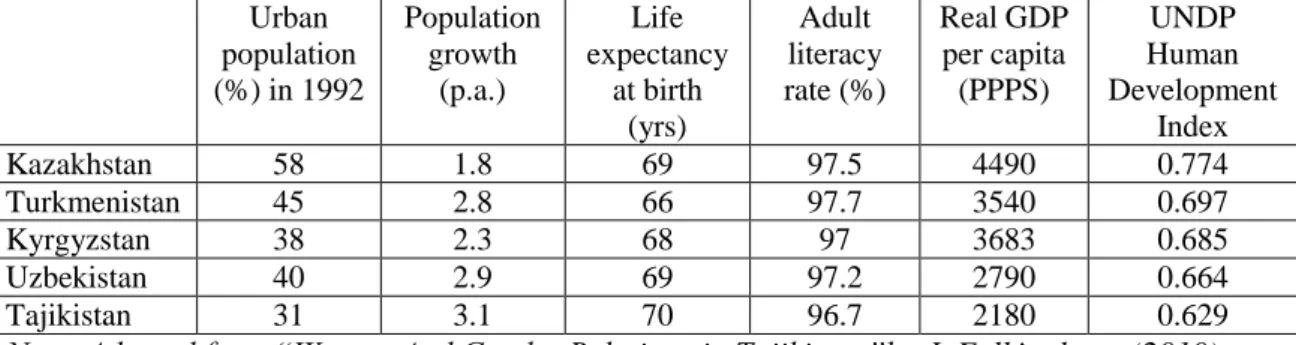
Thus, though the main push factors are considered to be poverty and the economic instability, it is also true for this Central Asian country that historically formed ethnical consistency influenced the ever-increasing number of migrants willing to move to Russia considerably. Unlike Tajikistan, Kyrgyz economy and internal labor market are not stagnating and the GDP per capita (table #1) is much higher.
Nevertheless, the continuing increase in the number of the Kyrgyz migrants arriving to Russia can be interpreted as a result of the close ties with the first wave of the migrants, which in its turn supports the Network theory of De Haas.
1.3.2 Tajikistan - a brief country profile.
Slightly different situation can be seen in Tajikistan, which was plunged into civil war almost right after it became independent of the Soviet Union in 1991. Though the civil war ended 6 years later, the economy of Tajikistan actually has never recovered, and poverty is widespread (Jones, Black, & Skeldon, 2007). As the result, Tajikistan is the poorest country in Central Asia with the lowest adult literacy rate and the most fast growing population (see table 1). The shrinking local labor market, economy stagnation and the tougher competition for scarce job opportunities pushed young males to look for more attractive wages in the foreign lands. As the migrants` endeavors paid off, the labor migration to Russia became a tendency, which led the country’s economy dependent on the migration remittances. The migration remittances from Russia alone consisted 42.7% of country’s GDP in 2014 (Putz, 2015).
9
Economic difficulties and deteriorating political situation are the main factors that push millions of Tajik people to move to Russia in the capacity of labor migrants. Although exact numbers of Tajik migrants in Russia are not available, the migration studies devoted to Central Asian migration indicate that the number of Tajik labor migrants in Russia consists of approximately 600,000, which is almost 10% of the whole population of Tajikistan. (Jones, Black, & Skeldon, 2007, p. 8). For one of the smallest Central Asian countries an outflow of their nationals of 10% might have long-lasting consequences and constant dependency on the recipient country, as almost half of the country`s budget comes from the incomes of the labor migrants.
Table 1: Human Development Indicators in Central Asia and selected other countries, 1991 Urban population (%) in 1992 Population growth (p.a.) Life expectancy at birth (yrs) Adult literacy rate (%) Real GDP per capita (PPPS) UNDP Human Development Index Kazakhstan 58 1.8 69 97.5 4490 0.774 Turkmenistan 45 2.8 66 97.7 3540 0.697 Kyrgyzstan 38 2.3 68 97 3683 0.685 Uzbekistan 40 2.9 69 97.2 2790 0.664 Tajikistan 31 3.1 70 96.7 2180 0.629
Note. Adapted from “Women And Gender Relations in Tajikistan”by J. Falkingham. (2010)
However, the growing number of the labor migrants from Tajikistan cannot be totally attributed to the higher birthrate or political instability after civil war in 1990s; the country`s scarce natural resources and the lack of internally developed industries were the prerequisites for the inability of the local economy to recover and support higher living standards of the population.
10 1.3.3 Uzbekistan - a brief country profile.
Unlike Kyrgyzstan and Tajikistan, Uzbekistan is a resource-rich country with the population of about 31 million (as recorded in the beginning of 2015),
approximately half of which lives in urban areas. However, since the early 90s,
Uzbekistan has also faced the economic decline and one of the most difficult challenges that country faced was lack of employment opportunities and a high disparity in living standards between rural and urban areas. Also high unemployment and low wages have resulted in a mass labor migration to Russia and Kazakhstan due to the demand for cheap labor forces particularly in construction sectors of Russia and Kazakhstan. Rough estimation of Uzbek labor migrants to Russia from 1990 to 2006 reached one million (Ilkhamov, 2006). With the Uzbek migrants being the second largest group of the foreign labor force in Russia, it is more obvious that the national natural resources are not always the guarantee for stability and do not always balance the other push factors. In this case, the push factors might have been political instability and the inability of the rural population, which is more than half, to adapt to the market economy, where
collective farming is no longer a pattern. In addition to this, one has to mention that Uzbekistan is a country where family ties value the most and therefore, it is obvious that once the first wave of migrants settled in Russia, their family members or the close friends followed. And as the Uzbek traditions are famous for close ties of the extended family, the waves of the migrants arriving to Russia might be decreasing only if the local Uzbek economy provide ample opportunities for its nationals or the Russian labor market would no longer be attractive.
As a conclusion, though Kyrgyzstan, Tajikistan and Uzbekistan have different economic prerequisites and natural resources, they all ended up with certain level of
11
political instability and high rates of unemployment, resulting in common
characteristics of the sending states with strong push factors. At the same time, shared history and some basic cultural values, as well as language, coupled with better economic condition and, therefore, more job opportunities in the neighboring Russia, played the role of the compelling pull factors that are to be examined in the later section of this Chapter.
1.4 Russian demographic challenges and labor migrants
There are a number of factors that make Russia an attractive place for labor migrants from the neighboring less developed states, including Central Asian countries. One of them is the aging society, which is the result of the decreasing birth rate in the country. Many academicians and policy experts suggest that the demographic
challenges of Russia are acute and the population of Russia has actively been shrinking since 1992. The demographic forecast for 2050 indicates that the number of working age population will be reduced to 50% (Andrienko & Guriev, 2005). According to Andrienko & Guriev (2005) the population change in Russia is predicted to reach minus 17 percent between the years 2004 and 2025 in contrast to the positive population growth in Central Asia which will be reached to 89 percent by 2025. The United
Nations also notes that Russia is unable to get by without foreign labor, particularly due to its demographic situation of an aging population and shrinking domestic
workforce (UNDP, 2009, p. 96). In order to compensate this drop annual inflow of one million working age migrants is necessary and therefore the migration from Central Asian countries would be used as a solution to current challenges (Meilus, 2013; Schenk, 2010; Zaionchkovskaya, 2003).
12
Russian authorities also acknowledged the problems of demography and aging population. The Russian Federal Statistics Agency Rosstat indicates that the Russian population will be shrinking by 11 million people from 2008 to 2025. The biggest decline in the population will be between 2011 and 2017.
However, there are two groups among Russian officials, pro and anti-migrant; one is those who do not consider migration as necessarily beneficial to resolve the country’s demographic challenges, but instead they considered migrants as a threat to internal security by linking them to criminality and domestic terrorism. This group of Russian authorities frequently described the foreign workers as economic threat by blaming them for $8 billion lost taxes (Marat, 2009, p. 22).
While the other group consisted of those who favored labor migrants and considered them as useful tools to address the demographic issues of the country (United Nations in the Russian Federation, 2008).
Russian President Vladimir Putin in his speech in 2006 at the council of
legislators (Putin, 2006), declared that temporary labor migration of non-Russians from Central Asia does not solve the country's demographic problems, instead he stressed on the realization of the immigration programs of invitation of ethnic Russian compatriots to immigrate to Russia as the key solutions to address the demographic challenges of the country. This was interpreted by some scholars and academicians as extremely
nationalistic and discriminatory and xenophobic (Meilus, 2013 p. 16; Schenk, 2010 p. 109; Marat, 2009).
Meanwhile, Dmitrii Medvedev made a speech in favor of labor migrants three years later in 2009, and pointed that the foreign labor migrants would be the best solution to address the labor shortages as well as the country’s demographic problems.
13
He stressed in his speech that the labor migrants from Central Asia are taking the positions that the Russian people are not willing to take in such industries as
construction, trade and transportation. Also, he urged to “respect” the labor migrants since they are contributing to the economy of Russia and filling the gaps of labor shortages of the country (Medvedev, 2009).
1.4.1 Distribution of foreign workers in Russia by industry
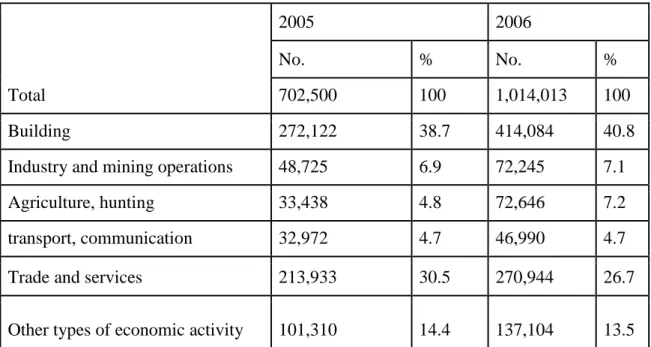
The table below gives an estimate of labor migrants’ employment in Russia by sector (see table 2):
Table 2: Distribution of foreign workers (by types of economic activity)
2005 2006
No. % No. %
Total 702,500 100 1,014,013 100
Building 272,122 38.7 414,084 40.8
Industry and mining operations 48,725 6.9 72,245 7.1
Agriculture, hunting 33,438 4.8 72,646 7.2
transport, communication 32,972 4.7 46,990 4.7
Trade and services 213,933 30.5 270,944 26.7
Other types of economic activity 101,310 14.4 137,104 13.5
Note. Adapted from “Migration in the Russian Federation: A Country Profile 2008” by Chindea A. and Majkowska-Tomkin M., 2008. International Organization for Migration.
While the estimates of labor migrants distribution by the economic sector according to their legal status vary, according to the recent sociological survey and
14
report on labor migration in Russia conducted by Denisenko & Varshavskaya, the number of migrants legally working in Russian exceeds 2 million as of 2012, and apart from construction and building industries that make up the most of the foreign labor workers, many labor migrants from Central Asia are involved in the low skilled work spheres such as taxi/mini bus drivers, at markets as whole selling, working in cafes, dishwashing, and street cleaning since these works do not require the professional training, educational background or special skills (Denisenko & Varshavskaya, 2013). Meanwhile, some of the works of academicians suggest that the highest concentration of illegal labor migrants is in shadow economies of the country and consists of 40% to 60% of the whole numbers of foreign labor workers in the Russian Federation
(Krassinets, 1998; Marat, 2009).
The Russian government showed no real political will to deal with the rise of xenophobia towards labor migrants, instead its self-contradicting and ambiguous approach to deal with the immigration hinders effective migration policy from being realized (Meilus, 2013).
It is clear that the Russian government is torn between the ever-decreasing population that leads to the acute labor shortage and all the consequences entailed and the challenges of the extensive labor migration from the Central Asian countries that might lead to popular discontent and illegal practices. Simultaneously, the deteriorating economic condition in the sending countries continue pushing more and more people to migrate and Russian labor market de facto is ready to accommodate low skilled workers for the sectors that cannot be filled with the Russian citizens. As the result, the dilemma exist rather de jure, while labor migration de facto is a non-stop process.
15
who are on the territory of the Russian Federation already should be taken care of. Therefore, it is vital to understand the Russian immigration policy evolution since the very collapse of the Soviet Union, to analyze how the practices were evolving and effecting the political decisions as well as how those adopted regulations were in their turn affected both the local population and the labor migrants. Such analysis is
16
CHAPTER 2: MIGRATION TRENDS AND IMMIGRATION POLICY TRANSFORMATION IN THE RUSSIAN FEDERATION IN THE LAST 25
YEARS
2.1 Liberal migration policy stage in the 1990s: welcoming “compatriots” to Russia The chapter looks at Russia’s transformation process of immigration policies and its connection to national security agenda over the past decades. It also lays down the theoretical framework on migration that are pertinent with migration patterns to Russia from the post-soviet countries. The main part of this section is devoted to look at how the immigration related changes affect the wellbeing of labor migrants in Russia.
In order to summarize the Russian migration policy evolution within the last 25 years, it is necessary to trace the implementations of legislation in immigration policies as well as to trace the immigration priorities and tendencies over a certain period in the past. According to different researchers and academicians, the development of the migration policy of the Russian Federation went through 3 basic stages (Meilus, 2013 p. 16; Tipaldou & Uba, 2014).
Stage one refers to a period of the 1990s right after the collapse of the USSR and it was mostly oriented on providing assistance to the forcibly displaced people, refugees and native Russians from the post-soviet countries. This period is considered to be the most liberal from the political viewpoint since it aimed to regulate the unexpected inflow of ethnic Russians back to their “homeland” (Meilus, 2013 p. 16; Alexseev, 2006) and Russian government engaged itself to settle the influx of migrants from post-soviet countries.
As the basis for the formation of the migration policy, the Russian government signed the international documents on refugees, namely The 1951 Convention on
17
refugees and the Additional Protocol on refugees of 1967 in 1991. In accordance with the procedures of implementation of international norms into the national legislation, Russian Government also issued a Decree #135 “On providing assistance to refugees and forcibly displaced people” (March 3, 1992), without the requirement of “propiska” to the above-mentioned groups of people.
Also, Russian Government adopted the State Program “Migration” (May 18, 1992), where the first principles of migration policy were stated. The new Program stipulated the most important right of the migrants to move freely and choose place of living and jobs. Moreover, intolerance to the discrimination based on race, sex, religion, citizenship, belonging to social groups or political beliefs was pronounced and the program also put down the guarantees of the equal treatment with the citizens of the hosting country. Besides, necessity of the interstate coordination to provide assistance to this group of population (refugees, displaced people, migrants) was recognized for the first time.
2.1.1 The legislative basis for the immigration policy in Russia.
The substantial part of the legislative basis for the immigration policy in Russia consists of the main law of the country – the Constitution of the Russian Federation (December 12, 1993), the law on refugees that was adopted in 1993 and Law on citizenship (1991, November Law N 1948-1). Besides the Laws, the legislative control of the migration processes is based on legal regulations of the Government
(podzakonnye akty) and the internal policies of the state bodies dealing with immigration.
18
of the Soviet Union collapse and still close ties between the former soviet republics resulted in quite liberal requirements to the acquisition of the Russian citizenship by those residing on the territories of the 15 countries. According to the Law on
Citizenship, the citizens of former Soviet Union countries could obtain the Russian citizenship via simplified procedure meaning that an application could be sent directly from the applicant`s home country without necessarily being on the territory of the Russian Federation. (Zhukawa, 2006).
However, in reality, the Law on Citizenship proved to be ineffective and overly bureaucratic since it required a lot of necessary documents to grant the citizenship to the immigrants from the post-soviet countries (Meilus, 2013, p. 17). The most part of those who fled to Russia in the capacity of refugees as well as internally displaced people had no proper documentation and thus failed to get the Russian citizenship.
Some scholars (Ivakhnyuk Irina 2009) argue that the bureaucratic stipulations in the Law were not intentional but rather circumstantial, and unpreparedness of the Russian government to control and regulate the migration influx can be explained by several factors: political and economic instability of Russia in 1991-1995 due to the collapse of the Soviet Union, lack of experience in the field of migration and no state capacity to implement long term migration policies at that time. Thus, due to lack of clear controlling mechanisms, inconsistency of migration regulating laws, especially the discrepancy of Law on Citizenship and no clearly distinguished differences between the returning Russians, refugees, and labor migrants from Central Asian countries, over three million people ended up staying in Russia without any status as of 2000 (Meilus, 2013).
19
including both legally staying and illegally staying in Russia raised serious concern among Russian society as well as officials over the possible economic, political and social impact of it on Russia. The aim, objectives, priorities of migration policies were reconsidered and reoriented into a war against illegal immigration (Latsis, 2002; Igushev, 2003).
As a conclusion, the seemingly liberal immigration legislation in the 1990s proved to be the result of the Russian government`s anxiety and lack of experience on the part of the immigration regulation and resulted in creating more constraints and in making assimilation of the labor migrants and refugees impossible. As the consequence, the number of the labor migrants staying in the country illegally increased and raised a lot of concerns and negative reaction of the local population. Therefore, the next stage in the development of the migration regulation was rather restrictive and reflected the realities of that period.
2.2 Repressive migration policy: ethnic nationalism and security issues
The next stage in the process of immigration policies evolution of Russia can be considered as repressive one. In the 2000s under the national security agenda of the fight with internal and international terrorism (Rukavishnikov, 2002) Russian government reconsidered the immigration policies as a serious policy matter and reoriented it into the war against illegal immigration as the main source of the internal instabilities and threat to the national security (Latsis, 2002; Igushev, 2003).
These immigration policies were driven by ethnic nationalism, which was expressed as institutional and social xenophobia (Schenk, 2010). Some academicians (Meilus, 2013) argue that the lack of coherent migration policy of that period
20
deliberately created plan of “ideological patriotism” by president Putin in order to gain the public support as an element for modernizing Russia as an election campaign. This “patriotism” however resulted in extreme xenophobia towards foreigners. (Laurelle, 2009, p. 8). But obvious need for migrant workers to fill the gap in Russian labor market shortages did not fit with the government's nationalistic sentiment. According to Schenk (2010), the immigration policies of Russia has linked to national security and nationalism that totally undermined the demographic reality of Russia and denied the fact that labor migrants can be used as a solution to fill in the shortage of labor markets in Russia.
The changes in migration policies also have a direct influence from the events such as internal terrorism and international terrorism (Meilus, 2013 p. 16; Schenk, 2010 p. 109). In 1999 numerous domestic terrorism attacks occurred in the territories of Russian Federation, namely there were series of apartment bombings in several cities of Russia that resulted in the death of 1000 civilians (The Fifth Estate, 1999).
The series of bombings, occurred in the Russian cities, exacerbated the Russian people, ethnic Russian population fear of threat of foreigners, Muslims and all ethnic minorities and led to the outbreak of anti-immigration hysteria in media segregating and condemning the “enemies” (Kjölstad, 2009).
In parallel with these events, the Federal Law (N 115-FZ) dated July, 25 2002 “On the Legal Status of Foreign Citizens in the Russian Federation” was given force in 2002 (Suharnikova, 2013). According to the law N 115-FZ the labor migrants who just entered Russian Federation were classified as “temporary staying foreigners”. The temporary staying foreigner’s allowed period of lengths of staying in the territory of Russia was 90 days upon arrival date. Within this 90 days, the foreigner has to find an
21
employment and has to get the proper work permit and his status changes from
“temporary staying foreigner” to “temporary staying resident”.
Additionally, according to the law, temporary staying foreigners, needed to register with the City Department of Interior of the Russian Federation within three
days upon arrival to the Russian Federation. The documents necessary for the
registration were either labor agreement issued by the prospective employers or written rental contract between the landlord and the foreigner. Moreover, all foreigners had to have a proof of employment, tax payment receipts and lease agreement copies in order to get an employment.
In reality, for labor migrants, it was very difficult to get both labor agreements and rental contract within 3 days. Employers are not willing to employ the foreign labor migrants and landlords did not provide any written agreement, especially to foreigners, in order to evade the taxes (Schaible, 2003). Since many landlords did not provide lease agreement easily in order to avoid the tax, many labor migrants had no choice but to get the work without proper documentation, which made them vulnerable to different abuses from the hands of employers, police and general public. For many labor workers, these restrictions left almost no chance to register legally and work in the country
legally (Meilus, 2013). Most of the labor workers got engaged in the shadow economy. Through 2000 to 2005 numerous labor migrants from Central Asian were simply employed in such areas as construction and trade without any registration with the Russian authorities.
Instead of expected decrease in the number of illegal immigrants the result was reverse; the number of illegal immigrants in Russia have been dramatically increasing year by year as a result of repressive and restrictive immigration policies. It also
22
provoked a growth of corruption in the immigration industry (Meilus, 2013, p. 23). Security concerns became almost inseparable from the immigration issues and became so interconnected in the minds of average citizens that one can find it necessary to look into those notions in more details in order to understand the nature and tendency of the Russian immigration policy development.
2.2.1 National security, Russian nationalism and immigration interconnection.
In 2004, another terrorist act hit Russia, the group of criminals took the Beslan school children as hostages and the siege has resulted in the death of 385 people including mostly children. In response to that, the Russian authorities took another number of decisions to fight the separatists and extremists and connected them to “international terrorism”. In the light of these events, the struggle against illegal immigration also took center stage as a source of internal crime and terrorism (Mukomel, 2006, p.4-5).
As another step to fight against “international terrorism” and extremists the Russian government adopted a Federal Law on countering extremist activities in 2002 (Federal Law On Countering Extremist Activities, 2008). This Law enabled the police enforcement to make random street document checkups, unexpected raids to
“suspicious” people’s homes to disclose, suppress and prevent all the forms of “extremist activities” (Human Rights Watch, 2007).
However, according to Sevortian (2009), the definition and interpretation of “extremist activities” were not clearly defined and were really broad, and therefore, the Russian government was criticized by many organizations concerned with human rights
23
for having a harsh manner in implementing the law and for justifying a legal platform for lawful acts against foreigners and human right organizations.
In addition to already existing stereotypes of illegal migrants as the potential threat and the source of terrorism, the numerous deadly attacks in the 2000s firmed popular phobia and justified stricter policies against basic rights and freedoms of the migrants. The legislative norms of that period reflected the willingness of the
Government to exercise tighter control over the immigration flow. The overwhelming control was exercised not only against individual migrants, but also over any
organization protecting their rights and the civil society in general.
2.2.2 Russian authorities’ crackdown on civil society NGOs and human rights organizations.
The role of international organizations and human rights organizations concerned with the human rights of labor migrants in Russia is very important to intervene the situation and help to ease the situation of labor migrants in Russia. In this section the relationship between the Russian government and the human rights
organizations is discussed in more details in order to understand how the tighter control policies affected such organizations.
Russia has been criticized by the human rights activists concerned with the human right issues for not affording the civil society to have the freedom of expression, freedom of movement, and especially for not letting the NGOs and human right
organizations concerned to operate freely on its territory. Different forms of restrictions and repression have been done by Russian government under the flag of “national security” agenda. The government's harsh attitude on civil society has been widely
24
discussed by media all over the world since those organizations existence is vital for vulnerable groups to different risks and discrimination, including labor migrants in a foreign country (Human Rights Watch, 2014).
The government’s crackdowns included the internet restrictions, random sudden police checkups and persecution of human activists, coupled with laws. In 2012 the law was adopted, which requires all the NGOs receiving funds from international
organizations to register as “foreign agents”. In addition to this, from June 2014 empowered the State to label organizations as “foreign agents” without the consent of those organizations. In May 2015 a new law was adopted and signed, which lets the police authorities to label those organizations as “undesirable,” if they are receiving the funds from the international organizations (Child Rights International Network (CRIN), 2015)
Inability of the government to differentiate between the “foreign funds” and “foreign interests” resulted in common perception of the NGOs with foreign donors as popular enemies. Crack down on the civil society entities striped the labor migrants of the last chance on social protection from the state abuse and made the human rights violation problem even more acute.
2.2.3 Violence towards labor migrants through religion, ethnicity and identity
As it is shown in the previous section, the violence towards labor migrants was an unavoidable consequence of the state policy in the 2000s. Direct and indirect acts of violence that occurred during that period in Russia can be analyzed through the prism of the Galtung`s theory of “Cultural Violence”, which he proposed in 1990. This is the
25
continuation of his first theory of “structural violence” that he introduced in 1969. Cultural violence means any violence which is direct or indirect based on someone’s ideology, religion, race or language. This violence is built into a culture and justifies any violence in a society by creating “Us” and “Them”. Structural violence is expressed in a way that it changes people’s mindset in the long run and justifies, condemns, represses and marginalizes certain group of people. Galtung describes cultural and structural violence as direct and indirect (Galtung, 1990). Indirect violence is expressed via the media, social phobia of certain groups of people, the expressions of Russian authorities etc., while the direct violence is expressed in case of Central Asian labors being the subject of ethnic based violence and crimes.
The hostile political and social environment created for years made the labor migrants to be the most unwanted group of people and exacerbated the human rights and human security of them in Russia. According to Schenk (2010):
“Both institutional and societal xenophobia work together to create an environment that demands restrictive immigration policies, despite the economic and demographic need for migrant labor”. In other words, restrictive immigration policies are created as
a result of institutional and societal xenophobia and undermines the role of labor migrants. The society is perceptive to governmental rhetoric and media. Institutional and societal xenophobia is a result of governmental nationalistic sentiment and rhetoric which is expressed through media and policies. In the meantime societal xenophobia includes the activity of nationalistic groups and attacks on foreigner (Schenk, 2010, p. 113-116)
26
2.2.4 Ethnic hostility: expansion of xenophobia and ethnic based criminality. The hostile environment towards foreigners that was discussed in the previous section has been constructed for years and led to the rise of xenophobia and racism in Russia. This kind of hostile environment particularly exacerbated the situation of labor migrants in terms of their human security. In this section the ethnic based criminality against foreigners in Russia and Russian public perception of foreign labor migrants as the result of the existing xenophobia, are discussed.
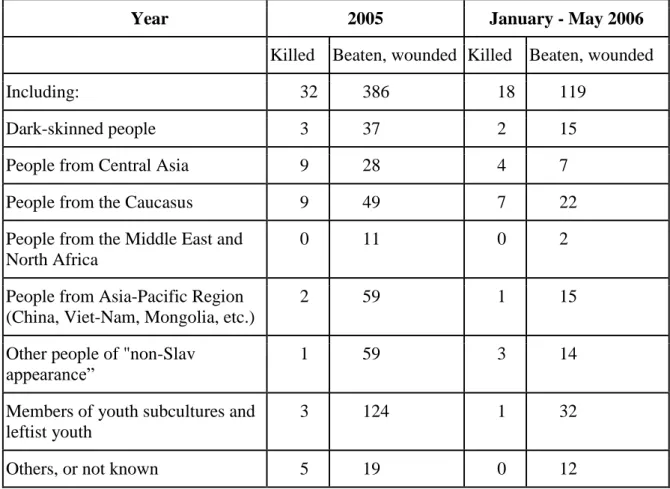
According to Sova Center in Moscow, the number of ethnic based criminality has been increasing from 2004 to 2008. People from Central Asia and Chechnya are found to be the most victims of hatred crimes (see tables 3, 4).
Table 3: Consolidated Statistics of Racist and Neo-Nazi Attacks in 2005-2006 (by the season)
2005 2006 Killed Beaten, wounded Total victims Killed Beaten, wounded Total victims Winter (December/January+ February/no date[1]) 6 (3/4/1) 70 (14/53/3 ) 76 (17/57/4) 7 (3/4/0) 98 (52/41/5) 105 (55/45/5) Spring 5 117 122 14 73 87 Summer 6 62 68 - - -Autumn 15 99 124 - - -Year total 32 386 418 - - -
27
Table 4: Consolidated Statistics of Racist and Neo-Nazi Attacks in 2005 and 2006 (by the object of attack)
Year 2005 January - May 2006
Killed Beaten, wounded Killed Beaten, wounded
Including: 32 386 18 119
Dark-skinned people 3 37 2 15
People from Central Asia 9 28 4 7
People from the Caucasus 9 49 7 22
People from the Middle East and North Africa
0 11 0 2
People from Asia-Pacific Region (China, Viet-Nam, Mongolia, etc.)
2 59 1 15
Other people of "non-Slav appearance”
1 59 3 14
Members of youth subcultures and leftist youth
3 124 1 32
Others, or not known 5 19 0 12
Note. Adapted from “Hate Crime in Russia: Statistics” 2006. SOVA Center
It is clear from the above mentioned statistics that the racist attacks are
escalating and people from Central Asia and Caucasus combined together constitute one of the most violence-targeted groups. The prerequisites for open violence resulting in deadly attacks lie in the public perception of otherness of the non-Slavic nations as posing threat. As it is pointed out in this section and is discussed in more details in the next, flourishing xenophobia has the roots in the public opinion on foreigners that was constructed through years.
28
2.2.5 Negative public perception of ethnic minorities in Russian Federation: public opinion surveys.
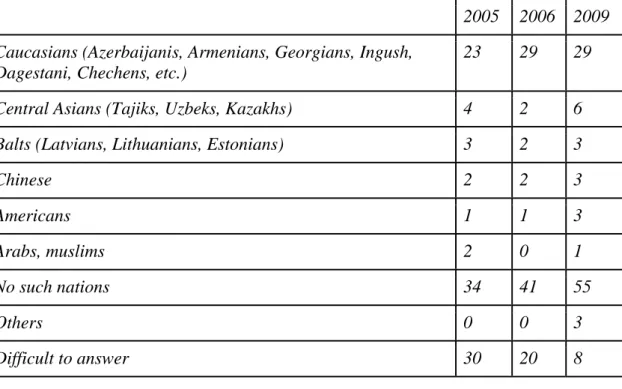
Human right organizations concerned with the human rights issues conducted several opinion poll surveys designed to find out the perception and attitude of Russian public towards the people of other nationalities, ethnicities and minorities in
Russia (see table 5). In 2005, the Russian Public Opinion Research Center, the
governmental institution under the Ministry of Labor and Social Affairs, conducted the opinion poll among native Russians on their attitude towards the other ethnicities residing in Russia. This project was the part of Immigration and Emigration of the Russian Federation Project.
According to this survey Caucasians are in the top list of minorities that Russian people “fear of”.
Table 5: Public opinion overview
Please name the nations, representatives of which makes you feel irritation, hostility (open questions, any number of responds)
2005 2006 2009 Caucasians (Azerbaijanis, Armenians, Georgians, Ingush,
Dagestani, Chechens, etc.)
23 29 29
Central Asians (Tajiks, Uzbeks, Kazakhs) 4 2 6 Balts (Latvians, Lithuanians, Estonians) 3 2 3
Chinese 2 2 3 Americans 1 1 3 Arabs, muslims 2 0 1 No such nations 34 41 55 Others 0 0 3 Difficult to answer 30 20 8
29
Note. Adapted from “Press release #1282”, 2009. VCIOM
2.3 Liberal-restrictive migration policy in 2005: the reality of labor migrants from Central Asia
In 2005, the chosen path of immigration repressive policy proved ineffective. As it was shown in the previous sections, it resulted in the growth of illegal immigrants, hostile public opinion and rising criminality against those arriving from Central Asian countries. At the same time, the demographic challenges of Russian Federation have still been an acute issue. The changes aiming to start liberalization of immigration policy, taking into consideration of unsystematic and ineffective policies of the 2000s, took place after 2007 with many new regulations adopted in different migration related areas (Schenk, 2010).
According to Meilus (2013), there are numerous reasons why the government of Russia has started the major immigration reforms. One is increasing construction boom that urged for the foreign labor force, the other reason is that the gaps in the current migration laws were obvious and needed to be reformed, and finally the demographic issues forced the Russian government to reconsider the immigration policies (Meilus, 2013, p. 24).
As a result, the Russian government made the amendments to the Law of 2002 in 2007. According to new amendments, the period for staying for foreign visitors in Russia was extended to 180 days, compared to 90 days in 2002.
Also several attempts to simplify the procedures for issuing the work permit and registration with the Russian authorities were taken place. For example, labor migrants could apply for work permits in the offices of FMS but not from particular employers,
30
which meant the protection from being dependent on one particular employer and being able to change the employers and work for different employers with the given work permit (General Administration for Migration Issues of the Interior Ministry of Russia (GAMI), 2016).
However, new procedures for work permits and liberalization of migration policies, while laudable on paper, prove complicated in terms of implementation and application. First of all, although the period for registration with FMS upon arrival to Russia was changed from 3 days to 7 days, this short period still created significant obstacle to get the proper document necessary for the registration. Especially the medical exam which is to be carried out within 30 day but costs around 500 USD is extremely expensive for migrants, and language test result documents, brought required, are not applicable to all labor migrants. For the majority of labor migrants these
requirement are challenging and impossible to meet, due to expensive and overly bureaucratic procedures.
The positive reforms in migration legislation in 2006 and 2007 allowed many workers coming to Russia to use simplified ways to obtain residency registration and work permits (GAMI, 2015). However, some academicians argue that those efforts to enforce the law to work properly have reminded only loud on papers, and in reality, FMS did not cooperate fully with other related state agencies to enforce the new reforms (Meilus, 2013).
This stage in the immigration policy of Russia is seen as “liberal-restrictive” due to the double standard approach to the immigration problems (Tipaldou, & Uba, 2014).
31
labors and as a result 6 million in 2007 were reduced to 3.38 million in 2008 (GAMI, 2007), while at the same time contradicting policies such as introducing various governmental programs for attraction of short and long-term foreign labor migration were introduced, which includes the simplified conditions of entry, residence and employment of foreign labor workers (Migration Policy Centre (MPC), 2013).
Meanwhile in 2010, the licensing of labor migrants was announced by the government and as a result around 516,000 migrant’s status were legalized in January-July 2011. Also, implementation of different programs attracting and granting the educated and skilled migrants to the territories of Russia from Central Asian countries has been implemented. Finally, in June 2012, the new Concept of the State Migration Policy of the Russian Federation for the Period to 2025 was adopted by the decree of the President of the Russian Federation (General Administration for Migration Issues of the Interior Ministry of Russia, 2015).
Despite all the attempts of liberalization for the migration policies, current Russian policies are described as ambiguous towards labor migrants, ineffective and self-contradictory. Moreover, human Rights Watch indicates that since the government does nothing to protect the rights of labor migrants, in contrast, there are many cases when the migrant workers have been humiliated and physically abused at the hand of police (HRW, 2009, p. 3).
Labor migrants are reluctant to appeal to the government about their rights due to various obstacles such as being afraid of disclosing of their own statutes. Simply they do not trust the governmental structures and instead they prefer to use the services of intermediaries, unofficial channels or direct employers (Meilus, 2013).
32
on the labor migrants’ lives, which are expressed in terms of societal and racial discrimination, refusal of housing, abuse at the hand of employers, and police enforcement discriminative checkups and risks of being the target of nationalistic groups or skinheads. Thus, the situation of labor migrants in terms of their human rights and security is still an acute issue in Russia (Laurelle, 2007).
Based on the analysis of the legislative regulation of the migration processes in Russia, one may conclude that its development has undergone several stages starting with permissive and seemingly liberal to restrictive and abusive. It was shown that legislation had opposite effect on the real practices and the laws otherwise favorable to migrants did not have desirable outcomes. Furthermore, as the Government decided to tighten the policies in the wake of worldwide fight against terrorism, and as the result of some deadly attacks on Russian territory, the situation for the labor migrants
deteriorated even further. As the result, formation of the popular stereotypes was affected by the events and government policies, which immediately took form of increased criminal behavior towards Central Asian migrants.
The analysis of the impact of such hostile environment on labor migrants is shown in the case study of seven Kyrgyz labor migrants in the next chapter, which partially backs up the discussions in the previous chapters in terms of human rights violations of migrants in Russia and provides a perspective for further study.
33
CHAPTER 3: CASE STUDY OF MIGRANT WORKERS FROM KYRGYZ REPUBLIC TO RUSSIA
3.1 Introduction
In this chapter, current situation and theoretical backgrounds of migration to Russia from post-soviet countries, discussed in previous chapters, are considered from the perspectives of actual experiences of individuals. The experienced reality depicted in the narratives of Kyrgyz nationals who have been in Russia in the capacity of labor migrants partially backs up the discussion of the bibliographical survey. At the same time, the narratives also give new qualitative insight to existing discussions.
3.2 Method of the case study
Although there is multitude of qualitative research tools, the case study in this chapter uses narrative inquiry to incorporate the perspectives of the labor workers in Russian Federation. A narrative is concisely defined as “the stories people tell”
(Patterson & Monroe, 1998). According to Webster & Mertova (2007), narrative inquiry is “set in human stories of experience” and it “provides researchers with a rich
framework through which they can investigate the ways humans experience in the world depicted through their stories”. Narrative inquiry recently has been used in the study of migration. Tyner (2002) suggests that mainly researchers used to observe the migration trends from outside factors, however, narratives in terms of life experience of
respondents explain the behavioral movements of migrants from inside. Data collection in this approach is conducted in the form of dialogues between the researcher and the respondents, as well as field notes, interview transcripts, storytelling, and audio and video recordings.