Deployment of American Management Education
in Germany after World War II
Toshio Yamazaki
※Abstract
Post World War II, European and Japanese enterprises and industries, as well as their overall economies, were developed by deploying and adapting US technology and management methods; this practice was also observed in Germany around the same time. American management methods were introduced and implemented under the US-led productivity movement. The major American management methods implemented in Germany were those for management education. In Germany, however, many factors influenced the introduction of American management education. This paper discusses the deployment of American management education in relation to universities’ role in management education, eligibility criteria for executive management, and the manager promotion system in German enterprises. We first consider American initiatives in management education reform, next examine German universities’ role in management education, and the deployment of Training Within Industry (TWI) and top management education methods. These discussions explain the various factors that restricted the deployment of American-style methods in management education.
Keywords: Management education, Productivity movement, Role of university, Training Within Industry (TWI), Business school, “Re-framing”
Ⅰ Research Problems
Ⅱ Management Education Reform and American Initiatives
Ⅲ Role of German Universities in Management Education and their Limitations Ⅳ Deployment of American Management Education
1 TWI Implementation
2 Deployment of Top Management Education Methods
Ⅴ Factors and Limitations in the Deployment of American-Style Management Education
※ Professor/Ritsumeikan University, Faculty of Business
Administration, 1-1-1 Noji-higashi, Kusatsu, Shiga, 525-8577 Japan Office: Tel +81-77-561-4865, Fax +81-77-561-3955
I Research Problems
In this paper, we will focus on management education in the deployment of American management methods and systems after World War II through the early 1970s and subsequent transformations in business management. The deployment of American management methods and systems varies widely between a specific management system and method as well as between industries and corporations. Thus, in addition to analyzing the overall situation, it is important to examine the differences and various factors influencing each industry and corporation.
In general, there is an extremely broad scope of transfer of American business culture in Germany, extending into all functional areas of management. In particular, elements of management philosophy and language, skills, technology, know-how, and specialized methods and processes are some of the aspects that have been adopted. However, unlike science and technology, for management, organizational know-how and techniques generally require extensive adaptations to the conditions of the importing country1). For example, even in a German subsidiary of a US company, despite the former’s subordinate relationship with the latter, the deployment of American-style innovations encountered many difficulties and did not go smoothly2). Thus, there are significant issues such as German corporate attitudes, responses, and the nature of the actual deployments in response to American management methods and systems; changes in business management itself with the deployment of management education; and the effect of German business management characteristics on specialized processes.
After World War II, the role of middle management in the function of manage-ment and top managemanage-ment functions increased. In such an environmanage-ment, reforms in management education became critical issues in Germany. The United States viewed reforms in management education in Europe as particularly important for the American-led productivity movement. Thus, the deployment of management education was important during the 1950s and 1960s. The reforms were influenced by pragmatic business schools and the type of education-oriented universities found in American-style education systems and practices. However, the deployment of American-style methods conflicted
1) G. P. Dyas, H. T. Thanheiser, The Emerging European Enterprise. Strategy and Structure in French
and German Industry, The Macmillan Press, 1976, pp.112-3.
with German universities’ form of management education. Several characteristics of Germany’s deployment of American-style management education stand out. It was evident that in Germany, which has an extensive history of management studies, universities did not train executives and managers. Corporations, executive management education, philosophies of and objectives for top management education, as well as the industry intentions they reflected, the internal promotion system and other factors had a great impact in Germany.
Along with commonalities with the US, what types of unique developments emerged? From a structural analysis perspective, this research elucidates the overall view of changes in business management that accompanied the deployment of American management methods. These changes included the adaptations of systems to local conditions based on an overall structure of and relationship with German capitalism in business management. This being said, it is important to consider the implications on various economic and social conditions by US intentions and postwar German corporations’ strategic intentions, business management traditions, management values, common labor practices, labor relations, and market structures.
American management methods often based on the principles of efficiency and productivity improvements and others that were related to business policy conditions or environmental factors (e.g., systems and practices, management values, and management culture). Therefore, it is important to consider the relationships between both aspects, analyze them, and understand them in regard to the deployment of American management education methods.
Many studies approach this theme from the perspective of economic and business histories3). However, these studies do not always identify which elements of American and German management methods were combined, how they were hybridized, and which factors determined the hybridization. This paper attempts to explain the details of hybridization and the process of modifying US management methods. It is very important to elucidate how German-style business management and its particular characteristics, conforming to German and European conditions while still bearing on the German management style, surfaced during the deployment of the American management method from the perspective of structural analysis. We will consider the problems stemming
from the German method of conforming to the American method, impacted by traditional and cultural factors in business management as well as institutional factors, and its relationship to the structural characteristics of German capitalism. In this paper, we will explain how were the German management style and characteristics created and what was the significance of these developments.
Regarding an analytical framework, the author establishes the idea of “re-framing,” using which we analyze the various problems in deploying American management methods that created conditions that facilitated business management changes in the postwar era. Re-framing, that is, the framework for analyzing various problems with the deployment of US management methods is explained below. Re-framing in this text refers to business management methods and systems that are defined by structural characteristics of a country’s capitalism and how these are adapted, modified, and made compatible with the structural characteristics of capitalism in a country to which it is transferred. Among these, structural characteristics of this capitalism are related to the state of existence of the following items: a structure of productive forces, industrial structures, and market structures—these three characteristics of Germany are deeply connected to re-framing. In addition, management values, business management traditions, and cultural factors and definability from an institutional perspective are also closely related to re-framing. Business management traditions and culture interrelated with business management standards and values. Decisions on where to place value, that is, production, technology, quality, or marketing policies, which are more directly tied to profit, specifically short-term profit, greatly affect corporate behavior. In addition, institutional factors include legal systems comprising all types of regulations; labor relations; educational systems; and system for specialized skills. A country’s educational system is closely related with the cultivation of executives and managers and that of skilled workers. Thus, the receiving nation’s capitalistic characteristics are amended or modified to an adaptable form when the originating country’s management methods, created for its own capitalistic structural characteristics, are introduced and spread throughout a foreign country using that country’s methods. Accordingly, re-framing is the process of structural adaptation in response to different environmental conditions and a method of structural analysis, whereby the overall structure of business management is foundational.
We discuss American initiatives in transforming management education and the role of German universities within the education, in Section II and III, respectively. Next, in
Section IV, we consider the deployment of American-style management education methods and in Section V the various factors that defined that state of affairs.
II Management Education Reform and American Initiatives
First, we examine American initiatives in management education reforms. The process of exporting American-style methods in this field to Western Europe followed three steps: 1) creation of the US Technical Assistance & Productivity Program (USTA&P); 2) combination of American universities and European management reforms; and 3) internationalization of American-style management education. The USTA&P was initiated to directly place American technology specialists and management consultants in corporations interested in implementing management and production reforms; they also provided factory observation opportunities and retraining seminars. Moreover, until business schools similar to those in America were established in Western Europe, programs run by productivity centers in each country, along with the USTA&P, played the important role of providing education. To combine American universities and European management innovations, the USTA&P constantly collaborated with American colleges and universities that were interested in providing management education courses for visiting teams, in response to the increasing numbers of managers in Europe. American universities played a decisive role in providing organization and support for TWI programs. The USTA&P’s programs for management education dramatically increased contact between American and European students and scholars. Since 1958, these programs opened paths to continually disseminate management knowledge through universities and corporations. The remarkable growth of foreign students in America further internationalized American-style management education. Beginning in the 1960s, Europe became the center of academic exchange between America and foreign countries4).
The American perception of conditions at the time was that European executives were resistant to constructive changes, unaware of their roles in providing long-term planning, and tended to participate in many day-to-day activities of the corporation;
4) J. McGlade, The Big Push: The Export of American Business Education to West Europe after the Second World War, L. Engwall, V. Zamagni (eds.), Management Education in Historical Perspective, Manchester University Press, 1998, pp.51-8, p.62, p.64.
thus, changing their attitudes was considered imperative5). In such as environment, USTA&P’s aim was to implement an American model of management research and executive and managerial training for European professors and universities6). USTA&P was initiated to promote effective communication between leading industrialists and executives in America and Europe, in alliance with business associations, employer associations, and employer organizations, such as the National Management Council (NMC) and the National Association of Manufacturers (NAM) in America, through workshops an seminars conducted in collaboration with several prominent universities in America7). For example, in the early 1950s, proper management education programs were conducted within the USTA&P framework in cooperation with the International Chamber of Commerce, OEEC, the European Productivity Agency (EPA), and each country’s productivity center. Executives representing leading corporations such as Eastman Kodak, P&G, Ford, DuPont, and GE, as well as those from NMC, various universities, and research organizations participated in the program8). The transfer of the American model into Germany was considered for executive education and retraining projects, with the assistance of the Mutual Security Agency (MSA) and Foreign Operations Administration (FOA). The MSA had already planned to create a management education center by 19539).
From Germany’s viewpoint, intensive research focusing on management education began between 1949 and 1950 in groups of delegations sent to America10). Several special delegations for technical assistance planning in the 1950s considered education in this field as one reason for the American economy’s superiority11). This perspective provides the
5) OEEC, Problems of Business Management. American Opinion, European Opinion (Technical Assistance Mission, No.129), Paris, 1954, p.5, pp.13-4.
6) J. McGlade, The US Technical Assistance and Productivity Program and the Education of Western European Managers, 1948-58, T. R. Gourvish, N. Tiratsoo (eds.), Missionaries and Managers: American
Influences on European Management Education, 1945-60, Manchester University Press, 1998, p.33.
7) Ibid., p.18, J. McGlade, From Business Reform Program to Production Drive. The Transformation of US Technical Assistance to West Europe, M. Kipping, O. Bjarnar (eds.), The Americanization of
European Business. The Marshall Plan and the Transfer of US Management Models, London, New York,
1998, p.27.
8) C. Kleinschmidt, Der produktive Blick. Wahrnehmung amerikanischer und japanischer Management-
und Produktionsmethoden durch deutsche Unternehmer 1950-1985, Berlin, 2002, S.296.
9) Ebenda, S.75-7.
10) W. Feldenkirchen, The Americanization of the German Electrical Industry after 1945. Siemens as a Case Study, A. Kudo, M. Kipping, H. G. Schröter (eds.), German and Japanese Business in the Boom
Years. Transforming American Management and Technology Models, London, New York, 2004, p.120.
11) M. Kipping, The Hidden Business School: Management Training in Germany since 1945, L. Engwall, V. Zamagni (eds.), op. cit., p.102.
background for Germany’s deployment of American-style methods.
Thus, although the initiative shown by America was important, American support for the EPA diminished after 1956; thereafter, the Ford Foundation increased its involvement12). This foundation had since the early 1950s been involved in the organizational and financial aspects of management education in Europe and, through the proliferation of focused education and research programs, had worked as a cultural intermediary in efforts to standardize management education and professional requirements. The primary goal of the Ford Foundation was to transfer the basics of America’s “organizational synthesis” into Europe, rather than export educational curricula and programs13).
III Role of German Universities in Management Education and their
Limitations
We have shown that America’s initiatives in transforming post-war management education were significant. In the 1950s and 1960s, the transfer of American-style management education into Europe varied greatly by country, and no country remained unaffected by it14). This level of influence owes a great deal to traditional management education within German universities.
Viewed historically, there are three different models for management education systems: German, Latin, and American. Management education in the German model was conducted outside universities in one of two higher education institutions, the engineering college and the commercial college. In the Latin model used in France, Italy, and Spain, while overall education focused on law, economics, and organization management, micro aspects such as schools providing opportunities to systematically learn business management were neglected. The American model of management education, however, was set up from the beginning as an element of the overall system of higher education. The emphasis was on actual decision making in market conditions, and business schools played
12) B. Boel, The European Productivity Agency and the Development of Management Education in Western Europe in the 1950s, T. Gourvish, N. Tiratsoo (eds.), op. cit., p.38, p.42.
13) G. Gemelli, American Influence on European Management Education. The Role of the Ford Foundation, R. P. Amdam (ed.), Management, Education and Competitiveness. Europe, Japan and the
United States, London, New York, 1996, p.42, p.47, p.55.
14) H. G. Schröter, Americanization of the European Economy. A Compact Survey of American Economic
an important role. The response to and absorption of American thinking into management education was primarily dependent on that country’s education system15).
In terms of education systems, German universities focused on academic research rather than specialized education. The differences between the Germans, who emphasized theory and science, and the Americans, with their tendency toward pragmatism, impeded the deployment of American-style methods in German universities. In the German system, a person’s compensation and promotion were determined by the type of school from which he/she graduated. Also, Germany had two qualification categories: “capable of work” (“Berufsfähig”), obtained from educational institutions, and “ready for work” (“Betriebsfertig”), obtained during on-the-job training (OJT). Although executives believed in the core pragmatic values provided during OJT, they could apply only limited pressure to modernize curricula16). Efforts to change this style of education faced stiff opposition from within schools, who rejected replacing theory with practicality17).
Further, German commercial colleges had not attained the status of providers of basic, broadly shared education for executives, as did American business schools. This more narrowly focused perception developed because the education obtained in German engineering colleges was recognized by manufacturing executives. However, although Germany’s commercial colleges concentrated primarily on business economics rather than management, unlike American MBA programs, it was not considered a tool for nurturing executives. In the American model education aimed at management development, which differentiated between education for operational functions and that for management functions. In general, it was highly unusual for engineers in America to fill important executive roles18). On this point, the American-style method regarding the function of management was not conducive to the German environment, where those with an engineering background were often leaders.
In addition, as observed in disputes concerning business administration methods, business economics needed to become a scholarly endeavor to be recognized as an academic field in universities. Furthermore, in choosing to either become pragmatically useful in management practice or maintain the traditional methods, standards of theoretical science
15) Ibid., pp.97-9. 16) Ibid., pp.103-4.
17) R. R. Locke, The Collapse of the American Management Mystique, Oxford University Press, 1996, p.76. 18) R. P. Amdam, Introduction, R. P. Amdam (ed), op. cit., pp.4-6.
or elements of a scientific nature inevitably received priority. In such an environment, the relationship between higher education and management practice was always tenuous. To complicate matters further, the difficult postdoctoral thesis, required to be promoted to a research professor in a university, along with the long research program it entailed, reduced any possibility of long-term work experience before becoming a professor. As a result, academicians with a high level of scholarly ability, but no actual experience in management were promoted to a professorship19).
Against this background, industry voiced its demands for reforms in the university system. However, the traditional German university system remained largely intact after 1945, and the academic persona was even reinforced. As a result, the business world sought alternative solutions, the most powerful of which was the American model20).
IV Deployment of American Management Education
1 TWI ImplementationHere, we examine the deployment of American-style management education methods in greater detail. First, TWI education courses based on American education materials were useful intermediaries for promoting stability in industrial and labor relations with management, improving relationships between superiors and subordinates, guidance for subordinates, and work methods and technological knowledge21).
Occupation authorities implemented TWI in Germany, organizing education courses for leaders of employee education in September 1948. Interest in the TWI program was heightened by many enthusiastic individuals, and the program spread further with the support of a few companies such as Bosch. It is important to note that these companies attempted to promote harmonious relationships in the workplace, and courses were conducted for both management and employee representatives. By mid-1953, 160 sessions of trainer education courses had been conducted, and about 80,000 individuals had participated in approximately 8,000 education courses22).
Because American corporate involvement in the USTA&P management education
19) R. R. Locke, op. cit., pp.74-5. 20) M. Kipping, op. cit., p.99, p.101. 21) Vgl. C. Kleinschmidt, a. a. O., S.74.
22) M. Kipping,‘Importing’American Ideas to West Germany, 1940s to 1970s, A.Kudo, M.Kipping, H. G. Schröter (eds.), op. cit., p.35.
project had ended, American universities began cooperating to pick up the slack23), and in 1951, American universities began organizing and conducting TWI programs. University participation played a decisive role in the USTA&P campaign to improve management education and support management retraining in postwar Europe24). Further, with the support of this program, thousands of European scholars and executives gained the unparalleled opportunities of observing and learning at American universities and corporations. Upon their return, they brought back these American management techniques with them25).
The RKW (National Board for Economy and Efficiency) also contributed to management education and retraining by visiting America in response to an invite by American professionals26) and conducting their own TWI education courses27). REFA also contributed to the implementation of TWI, and in 1954, incorporated TWI activities within its education programs28). Having REFA personnel engaged in the TWI program shows the extent of REFA’s public involvement in education29). The long-term cooperation between REFA and TWI also demonstrates how highly TWI education material was valued in the development of REFA employees30).
In this historical context, when we explore TWI implementation in detail, we find three TWI courses held by the chemical industrial firm, Henkel, during work hours: job instruction, labor relations, and job design (or job improvement). Among those, job design
23) J. McGlade, The US Technical Assistance and Productivity Program and the Education of Western European Managers, 1948-58, p.19.
24) Ibid., pp.24-5. 25) Ibid., p.28.
26) National Archives, RG469, Mission to Germany, Productivity and Technical Assistance Division, Subject Files of the Chief, 1953-1956, Council for International Progress in Management (USA), Inc (11.12.1953), National Archives, RG469, Mission to Germany, Productivity and Technical Assistance Division, Subject Files of the Chief, 1953-1956, TA09-217, Program for the TA-B-Project 09-217 Top Management, National Archives, RG469, Mission to Germany, Productivity and Technical Assistance Division, Subject Files of the Chief, 1953-1956, Berlin Top Management Team (7.10.1953).
27) National Archives, RG469, Mission to Germany, Productivity and Technical Assistance Division, Subject Files of the Chief, 1953-1956, Durchführung des TA-B-Projectes 09-216─Management Training,
National Archives, RG469, Mission to Germany, Productivity and Technical Assistance Division, Subject
Files of the Chief, 1953-1956, Management Programfor Berlin─Management Training Team (22.6.1953). 28) E. Pechhold, 50 Jahre REFA, Berlin, Köln, Frankfurt am Main, 1974, S.155, 30 Jahre REFA. Vortrag
von Herrn Min. -Dir. i. R. Dr. Kurt Magnus auf der Mitglieder-Versammlung in Bad Dürkheim,
REFA-Nachrichten, 7.Jg, Heft 4, Dezember 1954, S.75.
29) Zur Übenahme der deutschen TWI-Arbeit durch den REFA, REFA-Nachrichten, 8.Jg, Heft 1, März 1955, S.16.
was the most intensive, and these courses were used for the first time in 1964 within the framework of in-company retraining31). Bayer had also implemented TWI courses in 1950. The purpose of the TWI system was to simply and quickly train employees and make supervisors, particularly foremen and gang bosses, proficient in appropriately and humanely managing employees32). In addition to the educational purposes of the system, Bayer also emphasized the importance of methods for creating and maintaining good relationships with those in the factory33). Thereafter, TWI was developed to cover human relations problems in depth. TWI participants agreed that leadership and involvement by those in personnel management are crucial for good management, and that TWI is an effective way to develop this leadership34).
Similar programs on issues of human relationships and in-company retraining of middle management were undertaken at Glanzstoff, Volkswagen, Bahlsen, Continental, and other corporations. The American influence was clearly evident in TWI courses and foreman training courses, implemented during the 1950s. Beginning in the latter half of the 1950s, the foreman training and retraining courses used by these corporations were different in both form and content compared with their pre-war equivalents35).
The severe shortage of young managers in the 1950s led to the idea of adopting American methods for the systematic training of managers. R. Meine, head of human resources at Siemens, sought to strengthen the continuous education program and work training based on the American model, and concentrate all of Siemens’ education activities. In 1956, Siemens began preparatory management training for young employees and managers. In 1959, they began week-long master classes, with the objective of providing advanced instruction to lower and middle management36). The textile manufacturer Spinnerei und Weberei Offenburg AG had no formal training program until 1954, when they began exploring the use of the TWI program37).
31) Henkel Archiv, K160, Betriebliche Ausbildungs- und Bildungsarbeit (5.7.1960), S.2, Henkel Archiv, K160, Niederschrift über die Meisterbesprechung Nr.11 vom 17.11.64, S.2.
32) Bayer Archiv, 210-001, TWI (Training within Industry)-System, S.1, Bayer Archiv, 221/6, TWI (Training within Industry)-Kursus.
33) Bayer Archiv, 210-001, TWI (Training within Industry)-System, S.2. 34) Bayer Archiv, 221/6, TWI (Training within Industry)-Kursus. 35) C. Kleinschmidt, a. a. O., S.192-4.
36) W. Feldenkirchen, op. cit., p.128.
37) National Archives, RG469, Productivity & Technical Assit Division Labor Advisor Subject Files 1952-54, TA-Work, Labor and Human Relations Survey Report for Spinnerei und Webrei Offenburg A.G. (3.3.1954).
2 Deployment of Top Management Education Methods
As we consider education and retraining for executives, we find that German executives took a different path from that of America’s, given the value Germans placed on acquiring what they considered to be executive attributes. They focused their studies on law, business economics, and, in particular, engineering, as they had done prior to entering the workforce, and their executive development education was primarily short training courses, wherein they researched specialized topics instead of general management issues38). Most of the content of American-style executive development programs was missing in German universities, and only a few had begun offering short-term seminars for executives in 1966; most of these followed American examples of education for top management. These courses, which reflected the demands of the business world in their non-traditional content and education methods as well as their pragmatic orientation, were held outside the university system. Their adherence to an outline dictated by industry was an important characteristic. Executive development programs supplemented university training as well as the in-house selection process of top management both within and outside of corporations39). For example, among the brief three- to five-day training courses held by various associations for incumbent executives, certain German university professors individually conducted retraining and re-education lectures in specialized areas in their spare time. However, most lecturers were incumbent executives themselves, and this sort of retraining was different from the American model in that they conducted lectures outside of academia40). Documentation for a 1956 technical assistance project mentioned that, though top management education in America was predominant within universities, such type of education in Germany was conducted outside of universities41).
In this manner, private corporations and industrial associations took the initiative in advancing management education. Efforts by industrial associations included two management debates held in Baden-Baden in 1951 and 1952, and Baden-Baden seminars from 1955, and activities of the loosely aligned group known as the Wuppertal
38) R. R. Locke, op. cit., p.98, p.100. For information on business school issues in Germany see R.R. Locke,
Management and Higher Education since 1940. The Influences of America and Japan on West Germany, Great Britain, and France, Cambridge University Press, 1989, pp.164-76.
39) M. Kipping, The Hidden Business School, pp.104-8.
40) R. R. Locke, The Collapse of the American Management Mystique, p.78.
41) National Archives, RG469, Mission to Germany, Productivity and Technical Assistance Division, Subject Files of the Chief, 1953-1956, Projekt 329/1-329/4: Ausbildung von deutschen Lehrkräften auf dem Gebiet der Betriebsführung in USA (24.11.1956).
Circle42). The Baden-Baden seminars not only included debates to discuss American-style management methods and promote their introduction at an industry level but also provided as a forum for the exchange of ideas and theories on retraining and re-educating executives. They supplemented commercial colleges’ educational offerings by building at least a partial bridge between academic and practical experience43). A working group established by the Federation of German Industries in 1953 reviewed many case studies from Harvard Business School and other international sources. However, the working group eventually chose not to imitate those case studies, deciding instead to work toward transmitting knowledge and developing methods unique to Germany through the exchange of ideas between two generations of top management44). Germany tended to establish formal programs for executive development within each industry. One important reason for this approach was that the true role of this type of training was to instill entrepreneurial spirit, attitudes, and values45).
RKW was also involved in the deployment of methods for top management education. For example, in November 1953, 33 top executives from Berlin and their aides gathered in RKW’s Berlin branch office to listen to and debate on American management consultants regarding “management development.” Seeing this as an opportunity, a seven-week seminar was conducted. This event was in response to the need for better education for executives and managers in many organizations46). Consulting and intermediary institutions also participated; for example, Carl Duisberg-Gesellschaft, which was responsible for personnel development, developed a German-American exchange program in collaboration with Harvard Business School47).
Along with these additional corporate efforts, in the 1950s, many German corporations
42) M. Kipping, The Hidden Business School, pp.102-3.
43) C. Kleinschmidt, An Americanized Company in Germany. The Vereinigte Glanzstoff Fabriken AG in the 1950s, M. Kipping, O. Bjarnar (eds.), op. cit., p.184, C. Kleinschmidt, a. a. O., S.299.
44) M. Kipping,‘Importing’American Ideas to West Germany, 1940s to 1970s, pp.41-2.
45) D. Granick, The European Executive, London, 1962, pp.117-8, H. Hartmann, Authority and
Organization in German Management, Princeton, 1959, p.264.
46) National Archives, RG469, Mission to Germany, Labor Advisor, Subject Files, 1952-1954, Field Statistics, Management Development in Berlin, pp.1-2.
47) National Archives, RG469, Mission to Germany, Productivity and Technical Assistance Division, Subject Files of the Chief, 1953-1956, Carl Duisberg-Gesellschaft für Nachwuchsförderung e.V, Halbjahresbericht der Geschäftsleitung für die Zeit vom 1. April bis 30. November 1955, National
Archives, RG469, Mission to Germany, Productivity and Technical Assistance Division, Subject Files of
began to institutionalize their management education48). Internal corporate education rose to a new level and was largely based on the American model. In addition to internal management seminars, wherein the American case method was used in discussions and debates, Bayer conducted staff training, in which board members shared their experiences within their area of expertise. However, it became clear in the mid-1960s that the business community’s efforts and private initiatives, with their focus on the sharing of experiences and use of materials lacking in scientific methods, were insufficient. Thus, renewed interest arose in the establishment of business schools49).
Germany’s attempt to establish its first business school center, which followed the American model, failed due to the decentralized structure of its education system50). Nevertheless, the latter half of the 1960s finally saw a German business school established, and the Universitätsseminar der Wirtschaft’s founding in 1968 also played an important role. However, other than the College for Business Management at Koblenz, the era had no other institutions of this sort51).
The use of American education materials in courses designed for top management education in universities and specialized courses began in the 1960s and increased rapidly52), however, business schools failed to become a ubiquitous phenomenon at that time. In Germany, the topics studied by executives at universities were neither related to their being selected for promotion, nor was it important for their development. Executive selection remained traditionally grounded in actual experience and results, with most executives working at one company for long periods before being promoted to the top. These practices were an important factor in the strength of resistance to the American model and in delaying the introduction of business schools53).
48) M. Kipping, The Hidden Business School, p.103. 49) C. Kleinschmidt, a. a. O., S.300-1.
50) Ebenda, S.78.
51) Vgl. Ebenda, S.306, USW Netwerk: 30 Jahre Managerfortbildung in Schloss Gracht (http://www.esmt. org/deu/usw.-netwerk-30-jahre-Managerfortbildung-in-schloss-gracht/) (access: 3.6.2009).
52) G. P. Dyas, H. T. Thanheiser, op. cit., p.112.
53) L. Engwall, V. Zamagni, Introduction, L. Engwall, V. Zamagni (eds.), Management Education in
Historical Perspective, Manchester University Press, 1998, p.11, p.15, M. Kipping, The Hidden Business
V Factors and Limitations in the Deployment of American-Style
Management Education
On the basis of the aforementioned considerations, we next examine the various factors that restricted the deployment of American-style methods in management education.
The TWI program was first seen in supervisor and foreman education, and emphasized methods for better communication that could improve the labor climate by implementing more effective information policies. However, TWI was often met with a lukewarm reception54). It originated in America, and never took hold as firmly as it did in Germany. Although it was tailored to the German environment, the number of TWI programs implemented under the USTA&P in Germany was clearly lower than in other European countries. West Germany held only 134 TWI courses from the fall of 1948 (in the western region) to the summer of 1952, whereas the Netherlands for instance held more than 6,000 courses and the UK more than 30,000 in the same period. The TWI courses had relatively few participants from German corporations55), and institutions such as business schools, which supported executive development effectively in America, did not gain popularity and were not Americanized. At the time, individual organizations conducting retraining and re-education for German executives and managers remained separated, and saw limited change. The elements that did change were the types of retraining and the content within corporations. For example, week-long or several-week seminars were held for specialists and operational personnel in middle and upper management to learn about and discuss the latest American-style management methods56).
As we examine the relationship with America from the European perspective, we notice that, for example, the EPA’s improvements to management education were not an American product, but were an adaptation and fusion of European methods. B. Boel points out that “even in the 1950s, US-European relations in the field of management education were not a one-way affair”57). The overall influence of the American drive for management education in Europe was determined by a complex matrix of several factors. Amidst this, progress was particularly dependent on each program’s effectiveness and the amount of
54) C. Kleinschmidt, a. a. O., S.185. 55) Ebenda, S.75.
56) Ebenda, S.78. 57) B. Boel, op. cit., p.46.
resistance from executives and educators58).
The effects of attempting to transfer and implement the American model of management education into Europe during the period of the Marshall Plan and the productivity movement, apart from a few exceptions, were very modest. Converting traditional forms and replacing them with modern management education methods took another decade, and the impact of this process was smallest in German-speaking nations59). The direct transfer of programs from the American model, such as TWI and top management education, was also unsuccessful in German corporations because of their traditional views on managerial social policies. Within the field of management education, American development aid also had relatively little effect60). As C. Kleinschmidt noted, when compared with American and Western European expansion, education and retraining for German executives and managers adhered to a “special path.” This “German stubbornness” is the primary cause of the poor acceptance of the American-style business school model, its low probability of adoption, and the total emphasis on theory rather than practical work in the commercial colleges’ economics-focused education. It has been proposed that the German’s chosen path could even be seen as a German model, an alternative to American-style management61).
These observations elucidate that the American style was not always appropriate, given the nature of extant education systems and traditions, such as the role universities play within management education, the education and characteristics sought in executives, corporate promotion systems, and executives’ internal labor markets arising from them. Based on this point, management values and a management climate emphasizing technology and with a relatively long-term perspective was already well-rooted in Germany even after the war. They functioned counter to a personnel policy, thoroughly grounded in a doctrine of efficiency that reflected management values and a management climate based on American pragmatism. Even in the face of strong American influence, the German system could not be transformed overnight. The most important factor behind changes to management education and executive management education was the country’s overall education system and the strength of its management education
58) T. Gourvish, N. Tiratsoo, Missionaries and Managers: An Introduction, T. Gourvish, N.Tiratsoo (eds.),
op. cit., p.9.
59) H. G. Schröter, op. cit., p.121. 60) C. Kleinschmidt, a. a. O., S.79, S.83. 61) Ebenda, S.398-9.
system, along with cultural factors such as management styles and traditions for learning that could transcend national borders62).
Thus, in the 1990s, executive and manager development and education found in American-style business schools have attained unprecedented importance. The problem then arises that the global competition and market principles beginning in the 1990s, wrought dramatic changes to the conditions that supported German management values and management styles, causing a resurgence of Americanization.
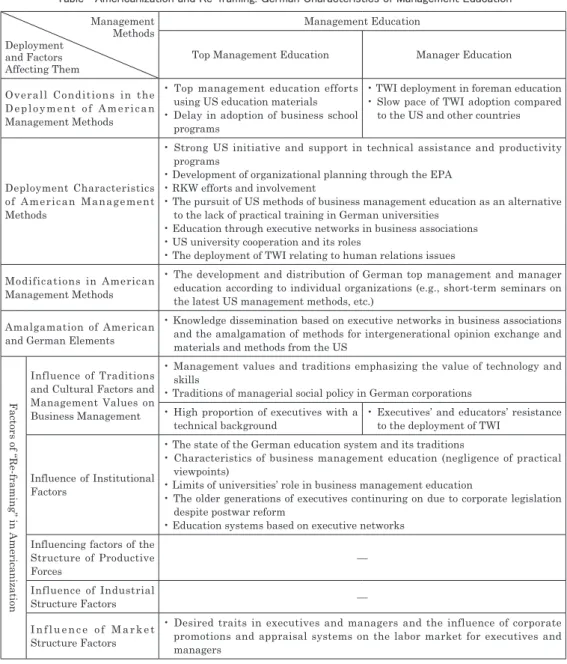
Following table (see next page) visualizes the conditions surrounding the introduction of Amer-ican management education methods as well as “re-framing” and the factors defining it, based on the discussion so far in this paper.
Table Americanization and Re-framing: German Characteristics of Management Education Source: Author Management Methods Deployment and Factors Affecting Them Management Education
Top Management Education Manager Education Overall Conditions in the
D e p l o y m e n t o f A m e r i c a n Management Methods
• Top management education efforts using US education materials • Delay in adoption of business school
programs
• TWI deployment in foreman education • Slow pace of TWI adoption compared
to the US and other countries
Deployment Characteristics of American Management Methods
• Strong US initiative and support in technical assistance and productivity programs
• Development of organizational planning through the EPA • RKW efforts and involvement
• The pursuit of US methods of business management education as an alternative to the lack of practical training in German universities
• Education through executive networks in business associations • US university cooperation and its roles
• The deployment of TWI relating to human relations issues Modifications in American
Management Methods
• The development and distribution of German top management and manager education according to individual organizations (e.g., short-term seminars on the latest US management methods, etc.)
Amalgamation of American and German Elements
• Knowledge dissemination based on executive networks in business associations and the amalgamation of methods for intergenerational opinion exchange and materials and methods from the US
Factors of “Re-framing” in Americanization
Influence of Traditions and Cultural Factors and Management Values on Business Management
• Management values and traditions emphasizing the value of technology and skills
• Traditions of managerial social policy in German corporations • High proportion of executives with a
technical background
• Executives’ and educators’ resistance to the deployment of TWI
Influence of Institutional Factors
• The state of the German education system and its traditions
• Characteristics of business management education (negligence of practical viewpoints)
• Limits of universities’ role in business management education
• The older generations of executives continuring on due to corporate legislation despite postwar reform
• Education systems based on executive networks Influencing factors of the
Structure of Productive Forces — Influence of Industrial Structure Factors — I n f l u e n c e o f M a r k e t Structure Factors
• Desired traits in executives and managers and the influence of corporate promotions and appraisal systems on the labor market for executives and managers
References
Amdam RP (1996) Introduction. In: Amdam RP (ed) Management, Education and Competitiveness. Europe, Japan and the United States. Routledge, London, New York, pp 1-16
Amdam RP (ed) (1996) Management, Education and Competitiveness. Europe, Japan and the United States. Routledge, London, New York
Boel B (1998) The European Productivity Agency and the Development of Management Education in Western Europe in the 1950s. In: Gourvish T, Tiratsoo N (eds) Missionaries and Managers: American Influences on European Management Education, 1945-60. Manchester University Press, Manchester, New York, pp 34-49
Dyas GR, Thanheiser HT (1976) The Emerging European Enterprise. Strategy and Structure in French and German Industry. The Macmillan Press, London
Engwall L, Zamagni V (1998) Introduction. In: Engwall L, Zamagni V (eds) Management Education in Historical Perspective, Manchester University Press, Manchester, pp 1-18
Engwall L, Zamagni V (eds) (1998) Management Education in Historical Perspective, Manchester University Press, Manchester
European School of Management and Technology (2009) USW Netwerk: 30 Jahre Managerfortbildung in Schloss Gracht (http://www.esmt.org/deu/usw.- netwerk-30-jahre-Managerfortbildung-in-schloss-gracht/) (Accessed 3 June 2009)
Feldenkirchen W (2004) The Americanization of the German Electrical Industry after 1945. Siemens as a Case Study. In: Kudo A, Kipping M, Schröteret HG (eds) German and Japanese Business in the Boom Years. Transforming American Management and Technology Models. Routledge, London, New York, pp 116-137
Gemelli G (1996) American Influence on European Management Education. The Role of the Ford Foundation. In: Amdam RP (ed) Management, Education and Competitiveness. Europe, Japan and the United States. Routledge, London, New York, pp 38-68
Gourvish T, Tiratsoo N (1998) Missionaries and Managers: An Introduction. In: Gourvish T, Tiratsoo N (eds) Missionaries and Managers: American Influences on European Management Education, 1945-60. Manchester University Press, Manchester, New York, pp 1-12 Gourvish TR, Tiratsoo N (eds) (1998) Missionaries and Managers: American Influences on European
Management Education, 1945-60. Manchester University Press, Manchester, New York Granick D (1962) The European Executive. Weidenfeld & Nicolson, London
Hartmann H (1959) Authority and Organization in German Management. Princeton University Press, Princeton, N. J.
Hartmann H (1963) Amerikanische Firmen in Deutschland. Westdeutche Verlag, Köln, Opladen Jaeckel B (1961) 10 Jahre REFA-Bundesverband. REFA-Nachrichten 14 (6) : 221-226
Kipping M (1998) The Hidden Business School: Management Training in Germany since 1945. In: Engwall L, Zamagni V (eds) Management Education in Historical Perspective, Manchester University Press, Manchester, pp 95-110
Kipping M (2004) ‘Importing’American Ideas to West Germany, 1940s to 1970s. In: Kudo A, Kipping M, Schröteret HG (eds), German and Japanese Business in the Boom Years. Transforming American Management and Technology Models. Routledge, London, New York, pp 30-53 Kipping M, Bjarnar O (eds) (1998) The Americanization of European Business. The Marshall Plan
and the Transfer of US Management Models. Routledge, London, New York
Kleinschmidt C (1998) An Americanized Company in Germany. The Vereinigte Glanzstoff Fabriken AG in the 1950s. In: Kipping M, Bjarnar (eds) The Americanization of European
Business. The Marshall Plan and the Transfer of US Management Models, Routledge, London, pp 171-189
Kleinschmidt C (2002) Der produktive Blick. Wahrnehmung amerikanischer und japanischer Management- und Produktionsmethoden durch deutsche Unternehmer 1950-1985. Akademie Verlag, Berlin
Kudo A, Kipping M, Schröteret HG (eds) (2004) German and Japanese Business in the Boom Years. Transforming American Management and Technology Models. Routledge, London, New York
Locke RR (1989) Management and Higher Education since 1940. The Influences of America and Japan on West Germany, Great Britain, and France. Cambridge University Press, Cambridge, New York
Locke RR (1996) The Collapse of the American Management Mystique. Oxford University Press, New York
McGlade J (1998a), From Business Reform Program to Production Drive. The Transformation of US Technical Assistance to West Europe. In: Kipping M, Bjarnar O (eds) The Americanization of European Business. The Marshall Plan and the Transfer of US Management Models. Routledge, London, New York, pp 18-34
McGlade J (1998b) The Big Push: The Export of American Business Education to West Europe after the Second World War. In: Engwall L, Zamagni V (eds) Management Education in Historical Perspective, Manchester University Press, Manchester, pp 50-65
McGlade J (1998c) The US Technical Assistance and Productivity Program and the Education of Western European Managers, 1948-58. In: Gourvish TR, Tiratsoo N (eds) Missionaries and Managers: American Influences on European Management Education, 1945-60. Manchester University Press, Manchester, New York, pp 13-33
OEEC (1954) Problems of Business Management. American Opinion, European Opinion (Technical Assistance Mission, No.129). OEEC, Paris
Pechhold E (1974) 50 Jahre REFA. Beuth, Berlin, Köln, Frankfurt am Main
REFA-Nachrichten (1954) 30 Jahre REFA. Vortrag von Herrn Min. -Dir. i. R. Dr. Kurt Magnus auf der Mitglieder-Versammlung in Bad Dürkheim. REFA-Nachrichten 7 (4) : 73-6
Nachrichten (1955) Zur Übenahme der deutschen TWI-Arbeit durch den REFA. REFA-Nachrichten 8 (1) : 16
Schröter HG (2005) Americanization of the European Economy. A Compact Survey of American Economic Influence in Europe since the 1880s. Springer, Dordrecht